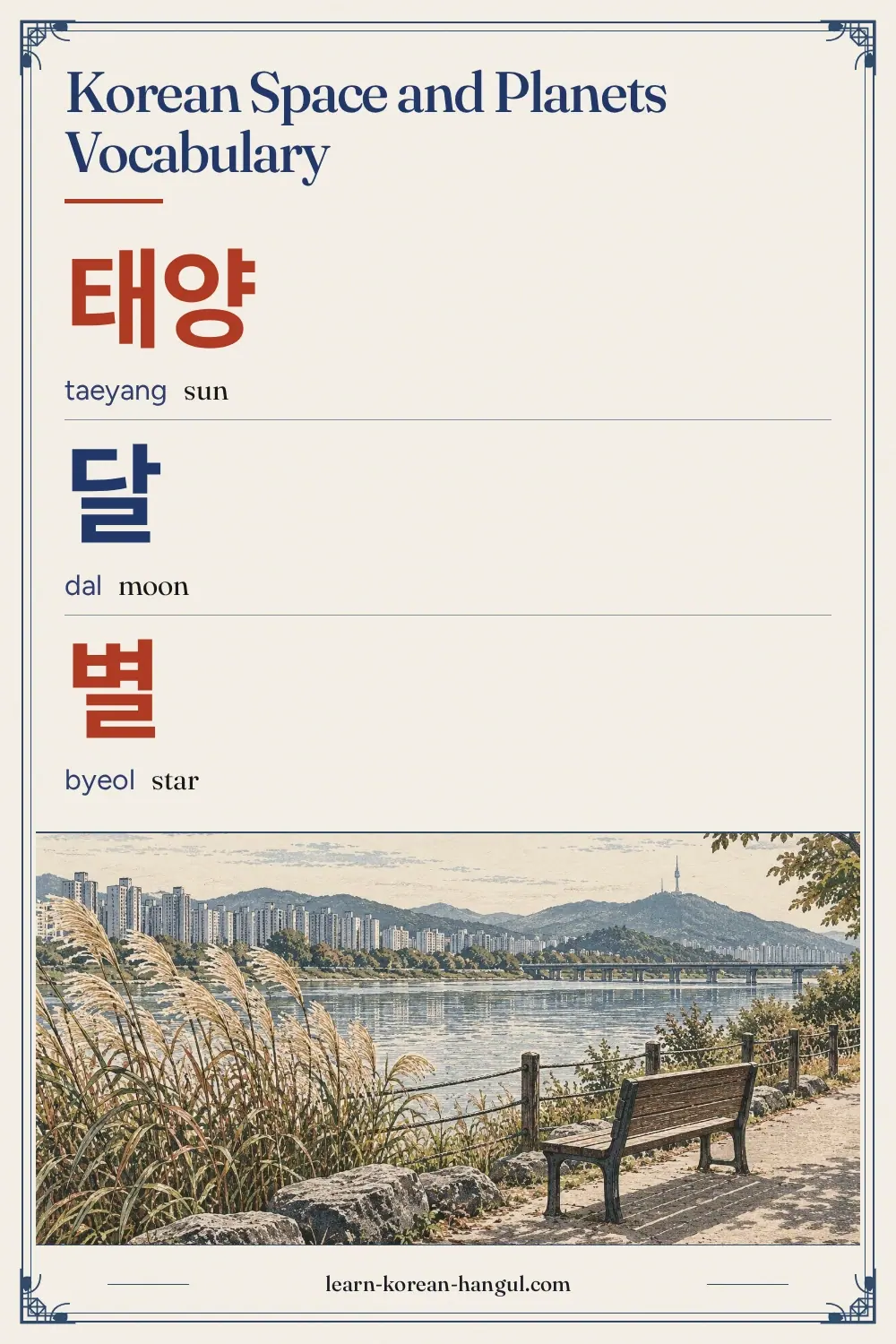
Korean Space and Planets Vocabulary at a Glance
Space words reach far beyond the science class. The moon is part of Korean holidays and folk tales, constellations appear in conversation about birthdays and personality, and the names of the planets turn out to be the same syllables as the days of the week. This list starts with what you see in the night sky, moves through the planets of our solar system, covers rockets and astronauts, names the tools and events of astronomy and ends with the moon in Korean tradition. It sits in Geography and Countries. For a single-word lookup of one star, see star in Korean.
| Group | Words | Use |
|---|---|---|
| Sun, moon and stars | 6 | What you see in the night sky |
| Planets | 7 | The planets and the weekday link |
| Space travel | 6 | Space, rockets, spaceships and satellites |
| Astronomy | 6 | Telescopes, galaxies, comets and eclipses |
| Space in culture | 5 | The moon in Korean customs and sayings |
Which Space Words Should You Learn First?
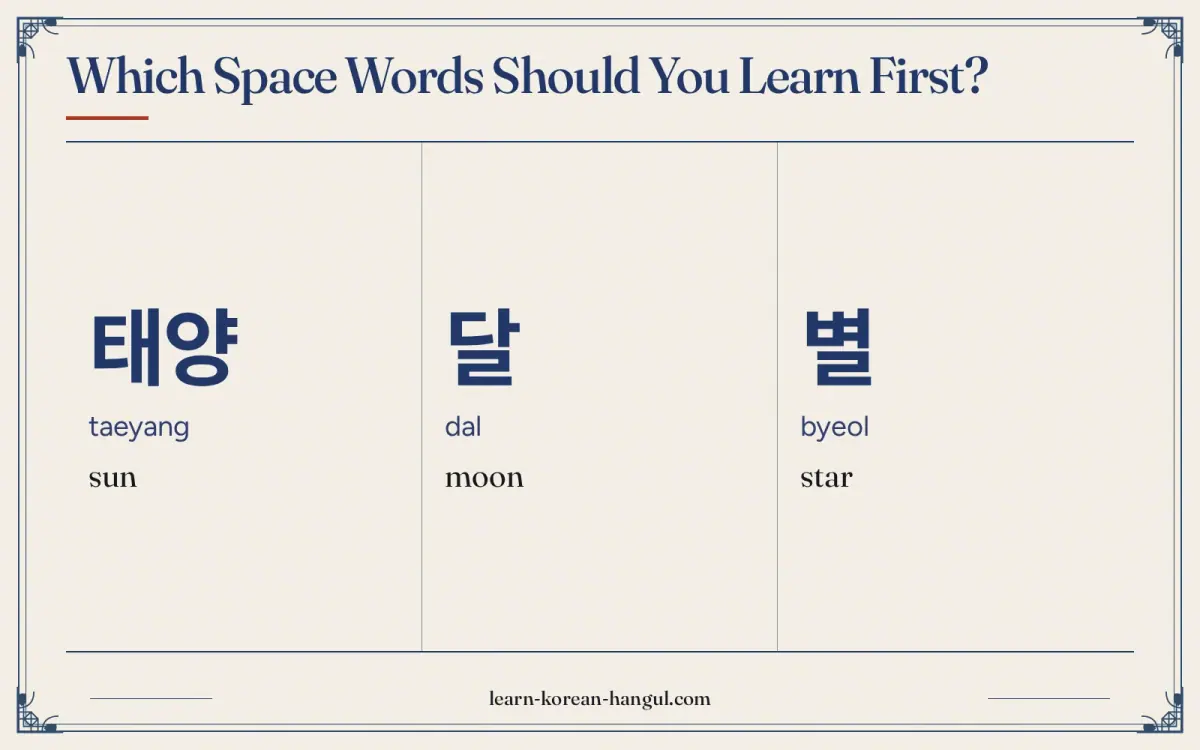
Learn 별, 달, 태양, 지구, 우주 and 행성 first. They are the words children learn first, and you will meet them in songs, stories and news. After that, add 보름달 and 별똥별, which are words people say out loud when they see something beautiful.
- Words to say. 별, 달, 태양, 지구, 우주, 행성.
- Words to recognise. 은하수, 별자리, 혜성, 일식. They appear in stories, poems and science news.
- Words to match. 수성, 금성, 화성, 목성, 토성. These five are the same syllables as five weekdays, so one memory trick learns both sets.
Note the double meaning of 달. It is the moon, and it is also a month, as in 한 달 (one month) and 다음 달 (next month). The sentence tells you which one. The scene below shows a night sky with numbered objects that match the list.
Word · 10
- 1
태양
taeyang
sun
- 2
달
dal
moon
- 3
별
byeol
star
- 4
은하수
eunhasu
Milky Way
- 5
행성
haengseong
planet
- 6
지구
jigu
Earth (the planet)
- 7
화성
hwaseong
Mars
- 8
우주선
ujuseon
spaceship
- 9
로켓
roket
rocket
- 10
망원경
mangwongyeong
telescope
Sun, Moon and Stars
Six words cover the sky you can see. 태양 is the sun, and the native word is 해, which is also the word for year in some uses. 달 is the moon and 별 is a star. 별똥별 is a shooting star, 별자리 is a constellation and 은하수 is the Milky Way. A constellation groups stars into a recognisable pattern in the night sky. Keep this word separate from 별, which refers to an individual star.
| No. | Hangul | Revised Romanization | Meaning and note | Example sentence | Audio assetId |
|---|---|---|---|---|---|
| 1 | 태양 | taeyang | sun. The formal and scientific word. In daily speech Koreans also say 해. | 태양은 별이에요. (The sun is a star.) | au-pg-vocabulary-nature-geography-space-1; example: au-pg-vocabulary-nature-geography-space-31 |
| 2 | 달 | dal | moon. The same word means month. 달이 밝아요 is about the moon, and 한 달 is one month. | 오늘 밤 달이 밝아요. (Tonight the moon is bright.) | au-pg-vocabulary-nature-geography-space-2; example: au-pg-vocabulary-nature-geography-space-32 |
| 3 | 별 | byeol | star. The star in the sky. It is also used for a star rating and a star-shaped mark. | 밤하늘에 별이 많아요. (There are many stars in the night sky.) | au-pg-vocabulary-nature-geography-space-3; example: au-pg-vocabulary-nature-geography-space-33 |
| 4 | 별똥별 | byeolttongbyeol | shooting star. Literally star dung star. Koreans, like many people, make a wish when they see one. | 별똥별을 봤어요. (I saw a shooting star.) | au-pg-vocabulary-nature-geography-space-4; example: au-pg-vocabulary-nature-geography-space-34 |
| 5 | 별자리 | byeoljari | constellation. Said [별짜리]. A pattern of stars in the night sky. | — | au-pg-vocabulary-nature-geography-space-5 |
| 6 | 은하수 | eunhasu | Milky Way. Literally silver river water. A road of stars across the sky. | 시골에서 은하수가 보여요. (In the countryside you can see the Milky Way.) | au-pg-vocabulary-nature-geography-space-6; example: au-pg-vocabulary-nature-geography-space-36 |
Example Sentences
Sky sentences use three simple frames. The first is noun + 이/가 + adjective, as in 달이 밝아요 (the moon is bright). The second is place + 에 + noun + 이/가 + 많아요, as in 밤하늘에 별이 많아요 (there are many stars in the night sky). The third is noun + 을/를 + 봤어요 (I saw), as in 별똥별을 봤어요. The past tense 봤어요 is the polite past of 보다 (to see). Read each sentence aloud after its audio.
Beyond the sky you can see with the eye are the planets, which have names with a surprising link to the calendar.
How Do You Say Planets in Korean?
Planet is 행성, and the planets use a set of Sino-Korean names built from the five elements. 수성 is Mercury (water star), 금성 is Venus (metal or gold star), 화성 is Mars (fire star), 목성 is Jupiter (wood star) and 토성 is Saturn (earth star). Earth is 지구, which means the earth ball. Outer planets 천왕성 (Uranus) and 해왕성 (Neptune) follow the same -성 pattern, where 성 means star. Because the weekdays use the same five elements, you can learn both lists at once.
| No. | Hangul | Revised Romanization | Meaning and note | Example sentence | Audio assetId |
|---|---|---|---|---|---|
| 7 | 행성 | haengseong | planet. 행 means to move and 성 means star: a star that moves. Used in all planet names. | 지구는 행성이에요. (The Earth is a planet.) | au-pg-vocabulary-nature-geography-space-7; example: au-pg-vocabulary-nature-geography-space-37 |
| 8 | 지구 | jigu | Earth (the planet). Not the soil: for ground, say 땅. 지구 is the whole planet. | 지구는 둥글어요. (The Earth is round.) | au-pg-vocabulary-nature-geography-space-8; example: au-pg-vocabulary-nature-geography-space-38 |
| 9 | 수성 | suseong | Mercury. 수 is water. Same 수 as 수요일, Wednesday. | 수성은 태양에 가까워요. (Mercury is close to the sun.) | au-pg-vocabulary-nature-geography-space-9; example: au-pg-vocabulary-nature-geography-space-39 |
| 10 | 금성 | geumseong | Venus. 금 is gold or metal. Same 금 as 금요일, Friday. | 금성은 아주 밝아요. (Venus is very bright.) | au-pg-vocabulary-nature-geography-space-10; example: au-pg-vocabulary-nature-geography-space-40 |
| 11 | 화성 | hwaseong | Mars. 화 is fire. Same 화 as 화요일, Tuesday. | 화성은 붉은 행성이에요. (Mars is a red planet.) | au-pg-vocabulary-nature-geography-space-11; example: au-pg-vocabulary-nature-geography-space-41 |
| 12 | 목성 | mokseong | Jupiter. Said [목썽]. 목 is wood. Same 목 as 목요일, Thursday. | 목성은 가장 큰 행성이에요. (Jupiter is the biggest planet.) | au-pg-vocabulary-nature-geography-space-12; example: au-pg-vocabulary-nature-geography-space-42 |
| 13 | 토성 | toseong | Saturn. 토 is earth or soil. Same 토 as 토요일, Saturday. | 토성에는 고리가 있어요. (Saturn has rings.) | au-pg-vocabulary-nature-geography-space-13; example: au-pg-vocabulary-nature-geography-space-43 |
Learn the five planet names 수성, 금성, 화성, 목성 and 토성, and you can already read five of the weekday names. The table below shows the link.
| Day | Element | Planet |
|---|---|---|
| 월요일 (Monday) | 월, moon | 달, the moon (not a planet) |
| 화요일 (Tuesday) | 화, fire | 화성, Mars |
| 수요일 (Wednesday) | 수, water | 수성, Mercury |
| 목요일 (Thursday) | 목, wood | 목성, Jupiter |
| 금요일 (Friday) | 금, metal or gold | 금성, Venus |
| 토요일 (Saturday) | 토, earth | 토성, Saturn |
| 일요일 (Sunday) | 일, sun | 태양, the sun |
For the full list of weekday names, see days of the week.
Space Travel
Space travel words are mostly Sino-Korean or loanwords. 우주 is space and also the universe. 우주선 is a spaceship, and 우주인 is an astronaut in everyday speech, with 우주비행사 as the formal term. 로켓 is a rocket, borrowed from English. 위성 is a satellite and 발사 is a launch. Korea has built its own launch rocket, called 누리호 (Nuriho), and a national space agency, 우주항공청. Check the agency site for current news, since facts about launches change over time.
| No. | Hangul | Revised Romanization | Meaning and note | Example sentence | Audio assetId |
|---|---|---|---|---|---|
| 14 | 우주 | uju | space; universe. The word for outer space and for the universe. 우주여행 (one word) is space travel. | 우주는 아주 넓어요. (Space is very wide.) | au-pg-vocabulary-nature-geography-space-14; example: au-pg-vocabulary-nature-geography-space-44 |
| 15 | 우주선 | ujuseon | spaceship. 우주 plus 선, ship. A craft that goes into space. | 우주선이 날아가요. (The spaceship flies away.) | au-pg-vocabulary-nature-geography-space-15; example: au-pg-vocabulary-nature-geography-space-45 |
| 16 | 우주인 | ujuin | astronaut. The everyday word. The formal word is 우주비행사. An alien is 외계인. | 우주인은 우주복을 입어요. (Astronauts wear space suits.) | au-pg-vocabulary-nature-geography-space-16; example: au-pg-vocabulary-nature-geography-space-46 |
| 17 | 로켓 | roket | rocket. A loanword from English. 로켓 is read as written. | 로켓이 하늘로 올라가요. (The rocket goes up into the sky.) | au-pg-vocabulary-nature-geography-space-17; example: au-pg-vocabulary-nature-geography-space-47 |
| 18 | 위성 | wiseong | satellite. The moon is a natural satellite, and man-made ones are 인공위성. | 위성이 지구를 돌아요. (A satellite goes around the Earth.) | au-pg-vocabulary-nature-geography-space-18; example: au-pg-vocabulary-nature-geography-space-48 |
| 19 | 발사 | balsa | launch; firing. Used for rockets, missiles and shots. 로켓 발사 is a rocket launch. | 로켓 발사를 봤어요. (I saw a rocket launch.) | au-pg-vocabulary-nature-geography-space-19; example: au-pg-vocabulary-nature-geography-space-49 |
Use 우주인 in conversation and 우주비행사 in writing and news. The word 인공위성 (man-made satellite) is the full form.
How Do You Say Astronomy in Korean?
Astronomy words cover the places and tools of stargazing. 천문대 is an observatory and 망원경 is a telescope. 은하 is a galaxy, and 혜성 is a comet with a tail. 블랙홀 is a black hole, written with the English loanword. 일식 is a solar eclipse, when the moon covers the sun. A lunar eclipse is 월식. Astronomy clubs and school science centres use these words, and news about eclipses and comets uses them all.
| No. | Hangul | Revised Romanization | Meaning and note | Example sentence | Audio assetId |
|---|---|---|---|---|---|
| 20 | 천문대 | cheonmundae | observatory. 천문 is astronomy and 대 is a platform or tower. | 천문대에서 별을 봐요. (I look at the stars at the observatory.) | au-pg-vocabulary-nature-geography-space-20; example: au-pg-vocabulary-nature-geography-space-50 |
| 21 | 망원경 | mangwongyeong | telescope. Literally distant-view mirror. Binoculars are 쌍안경. | 망원경으로 달을 봐요. (I look at the moon with a telescope.) | au-pg-vocabulary-nature-geography-space-21; example: au-pg-vocabulary-nature-geography-space-51 |
| 22 | 은하 | eunha | galaxy. Silver river. 은하수 is the Milky Way, and 은하 is any galaxy. | 우리 은하에는 별이 많아요. (Our galaxy has many stars.) | au-pg-vocabulary-nature-geography-space-22; example: au-pg-vocabulary-nature-geography-space-52 |
| 23 | 혜성 | hyeseong | comet. Comets have a long tail. The word 혜 means broom, as in a sweeping tail. | 혜성은 꼬리가 길어요. (A comet has a long tail.) | au-pg-vocabulary-nature-geography-space-23; example: au-pg-vocabulary-nature-geography-space-53 |
| 24 | 블랙홀 | beullaekhol | black hole. A loanword from English. Written with 홀 for hole. | 블랙홀 사진을 봤어요. (I saw a photo of a black hole.) | au-pg-vocabulary-nature-geography-space-24; example: au-pg-vocabulary-nature-geography-space-54 |
| 25 | 일식 | ilsik | solar eclipse. Said [일씩]. 일 is sun and 식 is eclipse. A lunar eclipse is 월식. | 오늘 일식이 있어요. (There is an eclipse today.) | au-pg-vocabulary-nature-geography-space-25; example: au-pg-vocabulary-nature-geography-space-55 |
Learn 은하 and 은하수 as a pair. The first is any galaxy and the second is our own Milky Way.
Space in Culture
The moon matters in Korean customs. On Chuseok and on the first full moon of the lunar year, many people go out to see the 보름달, the full moon. 초승달 is the thin crescent moon. In folk tradition the dark patches on the moon look like a rabbit pounding rice cake, called 달토끼. 달맞이 is the custom of welcoming the full moon, and 소원 is a wish, often made to the moon. These words come up in songs, children's stories and holiday greetings.
| No. | Hangul | Revised Romanization | Meaning and note | Example sentence | Audio assetId |
|---|---|---|---|---|---|
| 26 | 보름달 | boreumdal | full moon. Said [보름딸]. Linked to Chuseok and to the first full moon of the lunar year. | 추석에 보름달을 봐요. (On Chuseok I look at the full moon.) | au-pg-vocabulary-nature-geography-space-26; example: au-pg-vocabulary-nature-geography-space-56 |
| 27 | 초승달 | choseungdal | crescent moon. Said [초승딸]. A thin moon at the start of the lunar month. | 초승달이 가늘어요. (The crescent moon is thin.) | au-pg-vocabulary-nature-geography-space-27; example: au-pg-vocabulary-nature-geography-space-57 |
| 28 | 달토끼 | daltokki | moon rabbit. A rabbit that Koreans see in the moon, pounding rice cake. | 달 속에 토끼가 있어요. (There is a rabbit in the moon.) | au-pg-vocabulary-nature-geography-space-28; example: au-pg-vocabulary-nature-geography-space-58 |
| 29 | 소원 | sowon | wish. Said as written. People make a wish at a full moon, on a shooting star and at a temple. | 보름달에 소원을 빌어요. (I make a wish to the full moon.) | au-pg-vocabulary-nature-geography-space-29; example: au-pg-vocabulary-nature-geography-space-59 |
| 30 | 달맞이 | dalmaji | moon viewing; welcoming the moon. Said [달마지]. A custom on the night of a big full moon. | 달맞이를 가요. (We go moon viewing.) | au-pg-vocabulary-nature-geography-space-30; example: au-pg-vocabulary-nature-geography-space-60 |
The moon words are good for holidays and songs. Learn them with the stories behind them, and they stay in your head.
How Do You Pronounce These Words?
Space words are mostly said as written, but several have a tense consonant. Standard pronunciation follows the National Institute of Korean Language (국립국어원) rules, and the romanization follows the Revised Romanization of Korean, which does not show tensing caused by a neighbouring sound.
| Spelling | Sounds like | What changes |
|---|---|---|
| 목성 | [목썽] | After final ㄱ, ㅅ becomes tense [ㅆ]. |
| 별자리 | [별짜리] | The ㅈ becomes tense after ㄹ in this compound. |
| 일식 | [일씩] | In Sino-Korean words, ㅅ after a final ㄹ is said tense. |
| 보름달 | [보름딸] | The ㄷ becomes tense after ㅁ in this compound. |
| 초승달 | [초승딸] | The ㄷ becomes tense after ㅇ in this compound. |
| 달맞이 | [달마지] | The final ㅈ of 맞 moves over to the vowel of 이. |
The tense sounds in 목성 and 별자리 are the hardest. Close your throat slightly and say ㅆ or ㅉ without a puff of air. Compare the plain ㅅ in 수성 and the plain ㅈ in 지구.
Audio and Slow Playback
Each word and sentence has its own clip. The five clips below replay the hardest words slowly. Play one, repeat it aloud, then play it again and compare.
What Mistakes Do Learners Make with Space Words?
Five mistakes come up again and again.
- Mixing up 달 as moon and month. 달이 밝아요 is about the moon, and 한 달 is one month.
- Using 지구 for soil. 지구 is the planet Earth. For ground or soil, use 땅 or 흙.
- Mixing up 별 and 별자리. 별 is one star, and 별자리 is a constellation.
- Forgetting the tense sound in 목성. It is said [목썽], not [목성].
- Mixing up 일식 and 월식. 일식 is a solar eclipse and 월식 is a lunar eclipse.
The practice section turns the list into drills.
Practice: Flashcards and Worksheet
Use three steps. Run the flashcard deck in recognition mode until the 30 words come quickly. Switch to listening mode, then take the quiz. The deck holds every word on this page with audio, and your progress stays in your browser. The vocabulary flashcard decks page lists the other decks.
Practice · 64
- 01태양
Show answer
headword 1: sun
- 02달
Show answer
headword 2: moon
- 03별
Show answer
headword 3: star
- 04별똥별
Show answer
headword 4: shooting star
- 05별자리
Show answer
headword 5: constellation
- 06은하수
Show answer
headword 6: Milky Way
- 07행성
Show answer
headword 7: planet
- 08지구
Show answer
headword 8: Earth (the planet)
- 09수성
Show answer
headword 9: Mercury
- 10금성
Show answer
headword 10: Venus
- 11화성
Show answer
headword 11: Mars
- 12목성
Show answer
headword 12: Jupiter
- 13토성
Show answer
headword 13: Saturn
- 14우주
Show answer
headword 14: space; universe
- 15우주선
Show answer
headword 15: spaceship
- 16우주인
Show answer
headword 16: astronaut
- 17로켓
Show answer
headword 17: rocket
- 18위성
Show answer
headword 18: satellite
- 19발사
Show answer
headword 19: launch; firing
- 20천문대
Show answer
headword 20: observatory
- 21망원경
Show answer
headword 21: telescope
- 22은하
Show answer
headword 22: galaxy
- 23혜성
Show answer
headword 23: comet
- 24블랙홀
Show answer
headword 24: black hole
- 25일식
Show answer
headword 25: solar eclipse
- 26보름달
Show answer
headword 26: full moon
- 27초승달
Show answer
headword 27: crescent moon
- 28달토끼
Show answer
headword 28: moon rabbit
- 29소원
Show answer
headword 29: wish
- 30달맞이
Show answer
headword 30: moon viewing; welcoming the moon
- 31태양은 별이에요.
Show answer
example sentence for 태양
- 32오늘 밤 달이 밝아요.
Show answer
example sentence for 달
- 33밤하늘에 별이 많아요.
Show answer
example sentence for 별
- 34별똥별을 봤어요.
Show answer
example sentence for 별똥별
- 35시골에서 은하수가 보여요.
Show answer
example sentence for 은하수
- 36지구는 행성이에요.
Show answer
example sentence for 행성
- 37지구는 둥글어요.
Show answer
example sentence for 지구
- 38수성은 태양에 가까워요.
Show answer
example sentence for 수성
- 39금성은 아주 밝아요.
Show answer
example sentence for 금성
- 40화성은 붉은 행성이에요.
Show answer
example sentence for 화성
- 41목성은 가장 큰 행성이에요.
Show answer
example sentence for 목성
- 42토성에는 고리가 있어요.
Show answer
example sentence for 토성
- 43우주는 아주 넓어요.
Show answer
example sentence for 우주
- 44우주선이 날아가요.
Show answer
example sentence for 우주선
- 45우주인은 우주복을 입어요.
Show answer
example sentence for 우주인
- 46로켓이 하늘로 올라가요.
Show answer
example sentence for 로켓
- 47위성이 지구를 돌아요.
Show answer
example sentence for 위성
- 48로켓 발사를 봤어요.
Show answer
example sentence for 발사
- 49천문대에서 별을 봐요.
Show answer
example sentence for 천문대
- 50망원경으로 달을 봐요.
Show answer
example sentence for 망원경
- 51우리 은하에는 별이 많아요.
Show answer
example sentence for 은하
- 52혜성은 꼬리가 길어요.
Show answer
example sentence for 혜성
- 53블랙홀 사진을 봤어요.
Show answer
example sentence for 블랙홀
- 54오늘 일식이 있어요.
Show answer
example sentence for 일식
- 55추석에 보름달을 봐요.
Show answer
example sentence for 보름달
- 56초승달이 가늘어요.
Show answer
example sentence for 초승달
- 57달 속에 토끼가 있어요.
Show answer
example sentence for 달토끼
- 58보름달에 소원을 빌어요.
Show answer
example sentence for 소원
- 59달맞이를 가요.
Show answer
example sentence for 달맞이
- 60목성
Show answer
slow playback: 목성
- 61별자리
Show answer
slow playback: 별자리
- 62일식
Show answer
slow playback: 일식
- 63보름달
Show answer
slow playback: 보름달
- 64블랙홀
Show answer
slow playback: 블랙홀
Practice · 5
What does 별똥별 (byeolttongbyeol) mean?
Show answer
shooting star
별똥별 means shooting star. Example: 별똥별을 봤어요. (I saw a shooting star.)
What does 행성 (haengseong) mean?
Show answer
planet
행성 means planet. Example: 지구는 행성이에요. (The Earth is a planet.)
What does 화성 (hwaseong) mean?
Show answer
Mars
화성 means Mars. Example: 화성은 붉은 행성이에요. (Mars is a red planet.)
What does 망원경 (mangwongyeong) mean?
Show answer
telescope
망원경 means telescope. Example: 망원경으로 달을 봐요. (I look at the moon with a telescope.)
What does 보름달 (boreumdal) mean?
Show answer
full moon
보름달 means full moon. Example: 추석에 보름달을 봐요. (On Chuseok I look at the full moon.)
Korean Space and Planets Vocabulary Worksheet (PDF)
A printable worksheet for these words (word list, matching, writing practice, fill-in-the-blank exercises and answer key) is available in A4 and US Letter from the download card on this page. For practice, draw the night sky and label five things in Korean: 달, 별, 태양, 지구, 우주선.
Where to Go Next
After this page, return to the shore on Korean Ocean and Beach Vocabulary, or learn the weekdays alongside the planets on days of the week. To move up a level, return to Geography and Countries.
Frequently Asked Questions
How Do You Say Planet in Korean?
Planet is 행성 (haengseong). The planets are 수성 (Mercury), 금성 (Venus), 지구 (Earth), 화성 (Mars), 목성 (Jupiter) and 토성 (Saturn). Say 지구는 행성이에요 for the Earth is a planet.
Why Do Planet Names Match the Days of the Week?
Both sets use the same five elements. 화 (fire) is in 화성 and 화요일, 수 (water) is in 수성 and 수요일, 목 (wood) is in 목성 and 목요일, 금 (metal) is in 금성 and 금요일, and 토 (earth) is in 토성 and 토요일.
How Do You Say Space and Universe in Korean?
Both are 우주 (uju). Say 우주는 아주 넓어요 for space is very wide. A spaceship is 우주선 and an astronaut is 우주인 in everyday speech.
How Do You Say Star and Moon in Korean?
Star is 별 (byeol) and moon is 달 (dal). The word 달 also means month, so 한 달 is one month. Say 밤하늘에 별이 많아요 for there are many stars in the night sky.
How Many Space Words Should I Learn First?
Start with about six: 별, 달, 태양, 지구, 우주 and 행성. The whole list of 30 takes about six days at five new words a day, with review.
Is the Romanization on This Page Official?
It follows the Revised Romanization of Korean, which South Korea adopted on 7 July 2000 and whose rules the National Institute of Korean Language (국립국어원) publishes. It is a learning aid and does not mark every sound change, so rely on the Hangul and the audio.