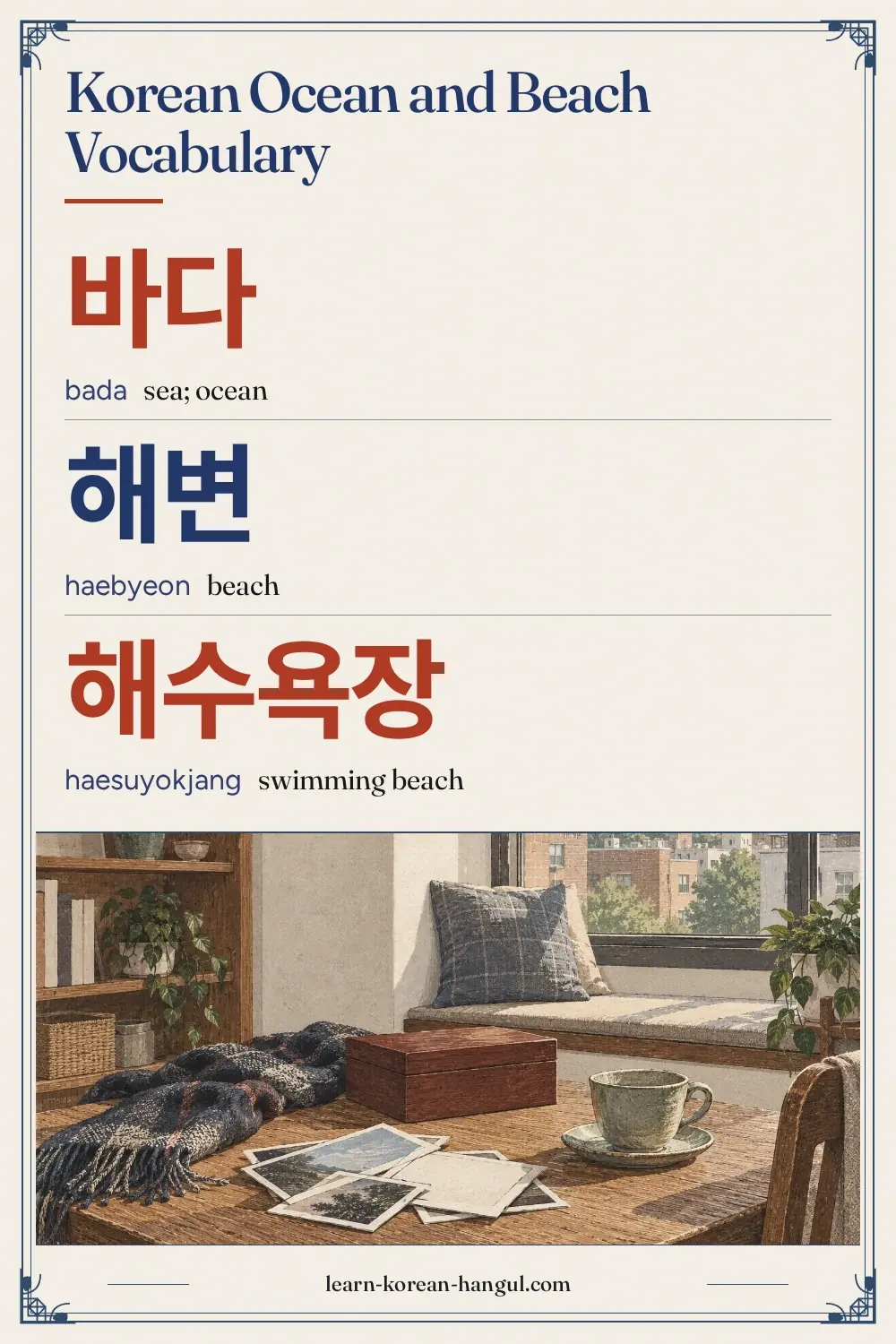
Korean Ocean and Beach Vocabulary at a Glance
Korea is a peninsula with three seas, so beach and seafood vocabulary is part of everyday life, especially in summer. This list starts on the sand, moves to the water, packs the beach bag, walks to the fish stalls and ends at the islands and ports. It sits in Geography and Countries. For a single-word lookup of the beach, see beach in Korean.
| Group | Words | Use |
|---|---|---|
| Beach scene | 6 | Naming the sea, the shore and the sand |
| Waves and tides | 6 | Waves, tides and the line of the horizon |
| Swimming and gear | 6 | What you wear and carry to the beach |
| Seafood stalls | 6 | Seaside fish markets and grilled shellfish |
| Islands and ports | 6 | Islands, harbours, lighthouses and the three seas |
Which Ocean and Beach Words Should You Learn First?
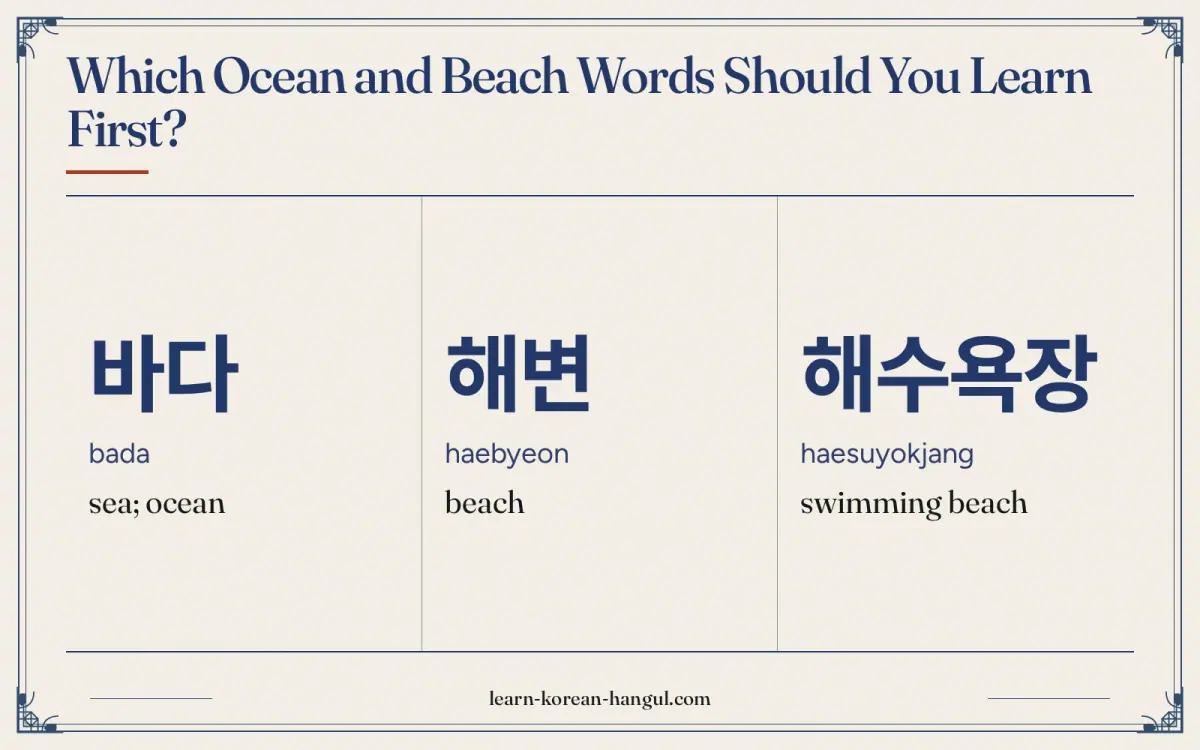
Learn 바다, 해변, 모래, 파도 and 수영복 first. They name the place and the things you see and wear. Then add 해수욕장 and 횟집, which you will read on signs, and 밀물 and 썰물 if you visit the west coast.
- Words to say. 바다, 해변, 모래, 파도, 섬, 배.
- Words to recognise. 해수욕장, 횟집, 수산시장, 구명조끼. They appear on signs and at ports.
- Words to match. 튜브, 파라솔, 선크림, 수영복. They are loanwords or short words you can see in a shop.
The word 배 is worth knowing early. It means boat, but it also means pear and stomach. The scene below shows a beach with numbered objects that match the list.
Word · 10
- 1
바다
bada
sea; ocean
- 2
해변
haebyeon
beach
- 3
해수욕장
haesuyokjang
swimming beach
- 4
모래
morae
sand
- 5
파도
pado
wave
- 6
수영복
suyeongbok
swimsuit
- 7
튜브
tyubeu
inflatable ring; float
- 8
파라솔
parasol
beach parasol
- 9
선크림
seonkeurim
sunscreen
- 10
섬
seom
island
Beach Scene
Four words name the shore and they are not the same. 바다 is the sea itself. 해변 is the beach, the strip of shore. 해수욕장 is a beach set up for swimming, with a name, hours and often lifeguards. 바닷가 is the native Korean word for the seaside and is used for any place beside the water. Sand has two words: 모래 is sand in general, and 백사장 is a wide stretch of white sand.
| No. | Hangul | Revised Romanization | Meaning and note | Example sentence | Audio assetId |
|---|---|---|---|---|---|
| 1 | 바다 | bada | sea; ocean. The basic word. Use 에 to say you go to it. | 바다에 가요. (I go to the sea.) | au-pg-vocabulary-nature-geography-ocean-beach-1; example: au-pg-vocabulary-nature-geography-ocean-beach-31 |
| 2 | 해변 | haebyeon | beach. Sino-Korean; 바닷가 is the native word. | 해변을 걸어요. (I walk along the beach.) | au-pg-vocabulary-nature-geography-ocean-beach-2; example: au-pg-vocabulary-nature-geography-ocean-beach-32 |
| 3 | 해수욕장 | haesuyokjang | swimming beach. Said [해수욕짱]. A beach set up for swimming. | 해수욕장에서 수영해요. (I swim at the swimming beach.) | au-pg-vocabulary-nature-geography-ocean-beach-3; example: au-pg-vocabulary-nature-geography-ocean-beach-33 |
| 4 | 바닷가 | badatga | seaside. Said [바다까] or [바닫까]. 가 is edge. | 바닷가에 살아요. (I live by the sea.) | au-pg-vocabulary-nature-geography-ocean-beach-4; example: au-pg-vocabulary-nature-geography-ocean-beach-34 |
| 5 | 모래 | morae | sand. Also used for sandboxes. | 모래가 뜨거워요. (The sand is hot.) | au-pg-vocabulary-nature-geography-ocean-beach-5; example: au-pg-vocabulary-nature-geography-ocean-beach-35 |
| 6 | 백사장 | baeksajang | stretch of white sand. Said [백싸장]. 백 means white. | 백사장이 넓어요. (The stretch of sand is wide.) | au-pg-vocabulary-nature-geography-ocean-beach-6; example: au-pg-vocabulary-nature-geography-ocean-beach-36 |
Example Sentences
Beach sentences use three frames. The first is place + 에 가요 (I go to the place), as in 바다에 가요. The second is place + 에서 + verb (do something at the place), as in 해수욕장에서 수영해요. The third is noun + 이/가 + adjective, as in 모래가 뜨거워요. Notice that 뜨겁다 changes to 뜨거워요, the same ㅂ-to-우 change as in 덥다. Read each sentence aloud after its audio.
The scene sets the place. The water brings its own words.
How Do You Say Waves and Tides in Korean?
파도 is a wave, and 물결 is a small ripple. Tides have two clear words: 밀물 is the rising tide, from 밀다 (to push), and 썰물 is the ebb tide, when water pulls out. At low tide the sea leaves a 갯벌, a muddy tidal flat. The west coast has the widest ones, and families walk out to dig for clams. 수평선 is the horizon, a word you will also hear in songs and poems.
| No. | Hangul | Revised Romanization | Meaning and note | Example sentence | Audio assetId |
|---|---|---|---|---|---|
| 7 | 파도 | pado | wave. Surf and swell; the verb is 치다 (to strike). | 파도가 높아요. (The waves are high.) | au-pg-vocabulary-nature-geography-ocean-beach-7; example: au-pg-vocabulary-nature-geography-ocean-beach-37 |
| 8 | 밀물 | milmul | rising tide. The incoming tide; 밀다 means to push. | 지금은 밀물이에요. (The tide is coming in now.) | au-pg-vocabulary-nature-geography-ocean-beach-8; example: au-pg-vocabulary-nature-geography-ocean-beach-38 |
| 9 | 썰물 | sseolmul | ebb tide. The outgoing tide. | 썰물 때 갯벌이 보여요. (The tidal flat shows at low tide.) | au-pg-vocabulary-nature-geography-ocean-beach-9; example: au-pg-vocabulary-nature-geography-ocean-beach-39 |
| 10 | 갯벌 | gaetbeol | tidal flat. Said [개뻘] or [갣뻘]. A key feature of the west coast. | 갯벌에서 조개를 잡아요. (I catch clams on the tidal flat.) | au-pg-vocabulary-nature-geography-ocean-beach-10; example: au-pg-vocabulary-nature-geography-ocean-beach-40 |
| 11 | 물결 | mulgyeol | ripple. Small waves on the surface. | 물결이 잔잔해요. (The ripples are calm.) | au-pg-vocabulary-nature-geography-ocean-beach-11; example: au-pg-vocabulary-nature-geography-ocean-beach-41 |
| 12 | 수평선 | supyeongseon | horizon. Where sea meets sky. | 수평선이 보여요. (I can see the horizon.) | au-pg-vocabulary-nature-geography-ocean-beach-12; example: au-pg-vocabulary-nature-geography-ocean-beach-42 |
Tide words matter in Korea because the tide changes what you can do on the same shore. A beach that is deep water at 밀물 can be a mud flat at 썰물.
Swimming and Gear
These six words fill a beach bag. 수영복 is the swimsuit, 튜브 is the float, 파라솔 is the parasol and 선크림 is the sunscreen. 물놀이 is a general word for playing in the water, used mostly for children and family outings. 구명조끼 is the life jacket, which you will be asked to wear on boat rides and on some water activities. Three of them, 튜브, 파라솔 and 선크림, are English loanwords, so you can read those labels at a beach shop.
| No. | Hangul | Revised Romanization | Meaning and note | Example sentence | Audio assetId |
|---|---|---|---|---|---|
| 13 | 수영복 | suyeongbok | swimsuit. 수영 is swimming and 복 means clothes. | 수영복을 입어요. (I put on a swimsuit.) | au-pg-vocabulary-nature-geography-ocean-beach-13; example: au-pg-vocabulary-nature-geography-ocean-beach-43 |
| 14 | 튜브 | tyubeu | inflatable ring; float. Loanword. | 튜브를 타고 놀아요. (I play on a float.) | au-pg-vocabulary-nature-geography-ocean-beach-14; example: au-pg-vocabulary-nature-geography-ocean-beach-44 |
| 15 | 파라솔 | parasol | beach parasol. Loanword. | 파라솔 아래에 앉아요. (I sit under the parasol.) | au-pg-vocabulary-nature-geography-ocean-beach-15; example: au-pg-vocabulary-nature-geography-ocean-beach-45 |
| 16 | 선크림 | seonkeurim | sunscreen. From English "sun cream"; the formal word is 자외선 차단제, and the verb is 바르다 (to apply). | 선크림을 발라요. (I put on sunscreen.) | au-pg-vocabulary-nature-geography-ocean-beach-16; example: au-pg-vocabulary-nature-geography-ocean-beach-46 |
| 17 | 물놀이 | mullori | playing in water. Said [물로리]: ㄴ turns into ㄹ after ㄹ. | 아이들이 물놀이를 해요. (The children play in the water.) | au-pg-vocabulary-nature-geography-ocean-beach-17; example: au-pg-vocabulary-nature-geography-ocean-beach-47 |
| 18 | 구명조끼 | gumyeongjokki | life jacket. Wear it on boat rides. | 구명조끼를 입으세요. (Please put on a life jacket.) | au-pg-vocabulary-nature-geography-ocean-beach-18; example: au-pg-vocabulary-nature-geography-ocean-beach-48 |
Safety words matter as much as the fun ones. On the sand, follow the signs and flags of the beach staff, and treat 구명조끼 as required whenever a boat or ride supplies it.
How Do You Say Seafood Stalls in Korean?
Many Korean beaches have a row of seafood stalls. A 횟집 is a restaurant that serves raw fish, called 회. At the tank outside you see 활어, live fish, and 조개 and 새우 in baskets. A 수산시장 is the fish market itself, where you can pick a fish and have it prepared on the spot. 조개구이 is a seaside meal where you grill shellfish at your table. The verb for grilling is 굽다, so 구워요 is I grill.
| No. | Hangul | Revised Romanization | Meaning and note | Example sentence | Audio assetId |
|---|---|---|---|---|---|
| 19 | 횟집 | hoetjip | raw fish restaurant. Said [회찝] or [휃찝]. 회 is raw fish. | 횟집에서 회를 먹어요. (I eat raw fish at a raw fish restaurant.) | au-pg-vocabulary-nature-geography-ocean-beach-19; example: au-pg-vocabulary-nature-geography-ocean-beach-49 |
| 20 | 활어 | hareo | live fish. Said [화러]. Fish kept alive in tanks. | 활어가 신선해요. (The live fish is fresh.) | au-pg-vocabulary-nature-geography-ocean-beach-20; example: au-pg-vocabulary-nature-geography-ocean-beach-50 |
| 21 | 조개 | jogae | clam; shellfish. Sold by weight in coastal markets. | 조개를 구워요. (I grill shellfish.) | au-pg-vocabulary-nature-geography-ocean-beach-21; example: au-pg-vocabulary-nature-geography-ocean-beach-51 |
| 22 | 새우 | saeu | shrimp. Also a common street-stall item. | 새우를 좋아해요. (I like shrimp.) | au-pg-vocabulary-nature-geography-ocean-beach-22; example: au-pg-vocabulary-nature-geography-ocean-beach-52 |
| 23 | 수산시장 | susansijang | fish market. 수산 means marine products. | 수산시장에서 생선을 사요. (I buy fish at the fish market.) | au-pg-vocabulary-nature-geography-ocean-beach-23; example: au-pg-vocabulary-nature-geography-ocean-beach-53 |
| 24 | 조개구이 | jogaegui | grilled shellfish. A grill-it-yourself seaside meal. | 바다에서 조개구이를 먹어요. (We eat grilled shellfish by the sea.) | au-pg-vocabulary-nature-geography-ocean-beach-24; example: au-pg-vocabulary-nature-geography-ocean-beach-54 |
If you eat 회, ask the staff how it is served. The words on a menu are often written in Hangul only, so practise reading the names above before you sit down.
Islands and Ports
A 섬 is an island, and many Korean islands are reached by ferry from a 항구, a port. A 등대 is the lighthouse at the harbour mouth. The three seas have simple names: 동해 is the East Sea, 서해 is the West Sea and 남해 is the South Sea. Each has a different coast: the east has deep water and sunrise viewing, the west has tidal flats and the south has many islands. The sea off the east coast is known by other names outside Korea, and this page teaches only the Korean word.
| No. | Hangul | Revised Romanization | Meaning and note | Example sentence | Audio assetId |
|---|---|---|---|---|---|
| 25 | 섬 | seom | island. Korea has thousands of them. | 섬에 배를 타고 가요. (I go to the island by boat.) | au-pg-vocabulary-nature-geography-ocean-beach-25; example: au-pg-vocabulary-nature-geography-ocean-beach-55 |
| 26 | 항구 | hanggu | port; harbour. Where boats dock. | 항구에 배가 많아요. (There are many boats in the harbour.) | au-pg-vocabulary-nature-geography-ocean-beach-26; example: au-pg-vocabulary-nature-geography-ocean-beach-56 |
| 27 | 등대 | deungdae | lighthouse. Stands at the harbour mouth. | 등대가 보여요. (I can see the lighthouse.) | au-pg-vocabulary-nature-geography-ocean-beach-27; example: au-pg-vocabulary-nature-geography-ocean-beach-57 |
| 28 | 동해 | donghae | East Sea. The Korean name for the sea east of Korea. | 동해에서 해돋이를 봐요. (We watch the sunrise at the East Sea.) | au-pg-vocabulary-nature-geography-ocean-beach-28; example: au-pg-vocabulary-nature-geography-ocean-beach-58 |
| 29 | 서해 | seohae | West Sea. Known for wide tidal flats. | 서해는 갯벌이 넓어요. (The West Sea has wide tidal flats.) | au-pg-vocabulary-nature-geography-ocean-beach-29; example: au-pg-vocabulary-nature-geography-ocean-beach-59 |
| 30 | 남해 | namhae | South Sea. Known for many islands. | 남해에는 섬이 많아요. (The South Sea has many islands.) | au-pg-vocabulary-nature-geography-ocean-beach-30; example: au-pg-vocabulary-nature-geography-ocean-beach-60 |
Use 에 to say you go to an island, as in 섬에 가요, and 로 or 를 타고 to say how: 배로 가요 or 배를 타고 가요, I go by boat.
How Do You Pronounce These Words?
Many beach words have tense sounds, because a final stop makes the next sound tight. Standard pronunciation follows the National Institute of Korean Language (국립국어원) rules, and the romanization follows the Revised Romanization of Korean, which does not mark every sound change.
| Spelling | Sounds like | What changes |
|---|---|---|
| 해수욕장 | [해수욕짱] | After final ㄱ, ㅈ becomes tense [ㅉ]. |
| 백사장 | [백싸장] | After final ㄱ, ㅅ becomes tense [ㅆ]. |
| 갯벌 | [개뻘] or [갣뻘] | The ㅅ between the two parts makes ㅂ tense [ㅃ]. |
| 물놀이 | [물로리] | ㄴ after ㄹ becomes [ㄹ]. |
| 횟집 | [회찝] or [휃찝] | The linking ㅅ makes ㅈ tense. |
| 활어 | [화러] | The final ㄹ moves to the vowel of 어. |
The tense sounds in 해수욕장 and 백사장 are the hardest. Close your throat slightly and say ㅉ or ㅆ without a puff of air. Compare with the plain ㅈ in 조개.
Audio and Slow Playback
Each word and sentence has its own clip. The five clips below replay the hardest words slowly. Play one, repeat it aloud, then play it again and compare.
What Mistakes Do Learners Make with Ocean and Beach Words?
Five mistakes come up again and again.
- Using 해수욕장 for any shore. It names a beach set up for swimming. For a rocky shore or a harbour, use 바닷가.
- Mixing up the three meanings of 배. 배를 타요 is I ride a boat, 배가 아파요 is my stomach hurts and 배를 먹어요 is I eat a pear.
- Swapping 밀물 and 썰물. 밀물 comes in, 썰물 goes out. The link between 밀물 and 밀다 (to push) can help you remember.
- Using 오다 with waves. Rain comes: 비가 와요. Waves strike: 파도가 쳐요.
- Pronouncing 해수욕장 without the tense ㅉ. The word is said [해수욕짱].
The practice section turns the list into drills.
Practice: Flashcards and Worksheet
Use three steps. Run the flashcard deck in recognition mode until the 30 words come quickly. Switch to listening mode, then take the quiz. The deck holds every word on this page with audio, and your progress stays in your browser. The vocabulary flashcard decks page lists the other decks.
Practice · 65
- 01바다
Show answer
headword 1: sea; ocean
- 02해변
Show answer
headword 2: beach
- 03해수욕장
Show answer
headword 3: swimming beach
- 04바닷가
Show answer
headword 4: seaside
- 05모래
Show answer
headword 5: sand
- 06백사장
Show answer
headword 6: stretch of white sand
- 07파도
Show answer
headword 7: wave
- 08밀물
Show answer
headword 8: rising tide
- 09썰물
Show answer
headword 9: ebb tide
- 10갯벌
Show answer
headword 10: tidal flat
- 11물결
Show answer
headword 11: ripple
- 12수평선
Show answer
headword 12: horizon
- 13수영복
Show answer
headword 13: swimsuit
- 14튜브
Show answer
headword 14: inflatable ring; float
- 15파라솔
Show answer
headword 15: beach parasol
- 16선크림
Show answer
headword 16: sunscreen
- 17물놀이
Show answer
headword 17: playing in water
- 18구명조끼
Show answer
headword 18: life jacket
- 19횟집
Show answer
headword 19: raw fish restaurant
- 20활어
Show answer
headword 20: live fish
- 21조개
Show answer
headword 21: clam; shellfish
- 22새우
Show answer
headword 22: shrimp
- 23수산시장
Show answer
headword 23: fish market
- 24조개구이
Show answer
headword 24: grilled shellfish
- 25섬
Show answer
headword 25: island
- 26항구
Show answer
headword 26: port; harbour
- 27등대
Show answer
headword 27: lighthouse
- 28동해
Show answer
headword 28: East Sea
- 29서해
Show answer
headword 29: West Sea
- 30남해
Show answer
headword 30: South Sea
- 31바다에 가요.
Show answer
example sentence for 바다
- 32해변을 걸어요.
Show answer
example sentence for 해변
- 33해수욕장에서 수영해요.
Show answer
example sentence for 해수욕장
- 34바닷가에 살아요.
Show answer
example sentence for 바닷가
- 35모래가 뜨거워요.
Show answer
example sentence for 모래
- 36백사장이 넓어요.
Show answer
example sentence for 백사장
- 37파도가 높아요.
Show answer
example sentence for 파도
- 38지금은 밀물이에요.
Show answer
example sentence for 밀물
- 39썰물 때 갯벌이 보여요.
Show answer
example sentence for 썰물
- 40갯벌에서 조개를 잡아요.
Show answer
example sentence for 갯벌
- 41물결이 잔잔해요.
Show answer
example sentence for 물결
- 42수평선이 보여요.
Show answer
example sentence for 수평선
- 43수영복을 입어요.
Show answer
example sentence for 수영복
- 44튜브를 타고 놀아요.
Show answer
example sentence for 튜브
- 45파라솔 아래에 앉아요.
Show answer
example sentence for 파라솔
- 46선크림을 발라요.
Show answer
example sentence for 선크림
- 47아이들이 물놀이를 해요.
Show answer
example sentence for 물놀이
- 48구명조끼를 입으세요.
Show answer
example sentence for 구명조끼
- 49횟집에서 회를 먹어요.
Show answer
example sentence for 횟집
- 50활어가 신선해요.
Show answer
example sentence for 활어
- 51조개를 구워요.
Show answer
example sentence for 조개
- 52새우를 좋아해요.
Show answer
example sentence for 새우
- 53수산시장에서 생선을 사요.
Show answer
example sentence for 수산시장
- 54바다에서 조개구이를 먹어요.
Show answer
example sentence for 조개구이
- 55섬에 배를 타고 가요.
Show answer
example sentence for 섬
- 56항구에 배가 많아요.
Show answer
example sentence for 항구
- 57등대가 보여요.
Show answer
example sentence for 등대
- 58동해에서 해돋이를 봐요.
Show answer
example sentence for 동해
- 59서해는 갯벌이 넓어요.
Show answer
example sentence for 서해
- 60남해에는 섬이 많아요.
Show answer
example sentence for 남해
- 61해수욕장
Show answer
slow playback: 해수욕장
- 62갯벌
Show answer
slow playback: 갯벌
- 63횟집
Show answer
slow playback: 횟집
- 64백사장
Show answer
slow playback: 백사장
- 65구명조끼
Show answer
slow playback: 구명조끼
Practice · 5
What does 바다 (bada) mean?
Show answer
sea; ocean
바다 means sea; ocean. Example: 바다에 가요. (I go to the sea.)
What does 해변 (haebyeon) mean?
Show answer
beach
해변 means beach. Example: 해변을 걸어요. (I walk along the beach.)
What does 해수욕장 (haesuyokjang) mean?
Show answer
swimming beach
해수욕장 means swimming beach. Example: 해수욕장에서 수영해요. (I swim at the swimming beach.)
What does 밀물 (milmul) mean?
Show answer
rising tide
밀물 means rising tide. Example: 지금은 밀물이에요. (The tide is coming in now.)
What does 횟집 (hoetjip) mean?
Show answer
raw fish restaurant
횟집 means raw fish restaurant. Example: 횟집에서 회를 먹어요. (I eat raw fish at a raw fish restaurant.)
Korean Ocean and Beach Vocabulary Worksheet (PDF)
A printable worksheet for these words (word list, matching, writing practice, fill-in-the-blank exercises and answer key) is available in A4 and US Letter from the download card on this page. For practice, draw a beach and label five things in Korean: 파라솔, 모래, 파도, 튜브, 바다.
Where to Go Next
After this page, continue with Korean Space and Planets Vocabulary, or learn the creatures of the sea on sea animals. For hiking instead, see Korean Mountains and Hiking Vocabulary. To move up a level, return to Geography and Countries.
Frequently Asked Questions
How Do You Say Sea in Korean?
Sea is 바다 (bada). Say 바다에 가요 for I am going to the sea. The same word is used for ocean. The word for beach is 해변, and the word for a swimming beach is 해수욕장.
How Do You Pronounce 해변 (haebyeon)?
Say hae-byeon with two syllables: 해 then 변. The 해 sounds like the English word hay with a short ending, and 변 starts with a plain b. Press the audio button on this page to hear the word and the slow clip.
How Many Ocean and Beach Words Should I Learn First?
Start with about six: 바다, 해변, 모래, 파도, 수영복 and 섬. The whole list of 30 takes about six days at five new words a day, with review.
Where Can I Practise Ocean and Beach Words with Flashcards?
Use the vocabulary flashcard decks. The deck for this page holds all 30 words with Hangul, romanization and audio, in recognition and listening modes. Your progress stays in your browser.
Is the Romanization on This Page Official?
It follows the Revised Romanization of Korean, which South Korea adopted on 7 July 2000 and whose rules the National Institute of Korean Language (국립국어원) publishes. It is a learning aid and does not mark every sound change, so rely on the Hangul and the audio.
Is There a Printable Worksheet for Ocean and Beach Words?
A printable worksheet for these words (word list, matching, writing practice, fill-in-the-blank exercises and answer key) is available in A4 and US Letter from the download card on this page. For practice, use the flashcard deck, which carries the same 30 words, or copy the tables by hand.