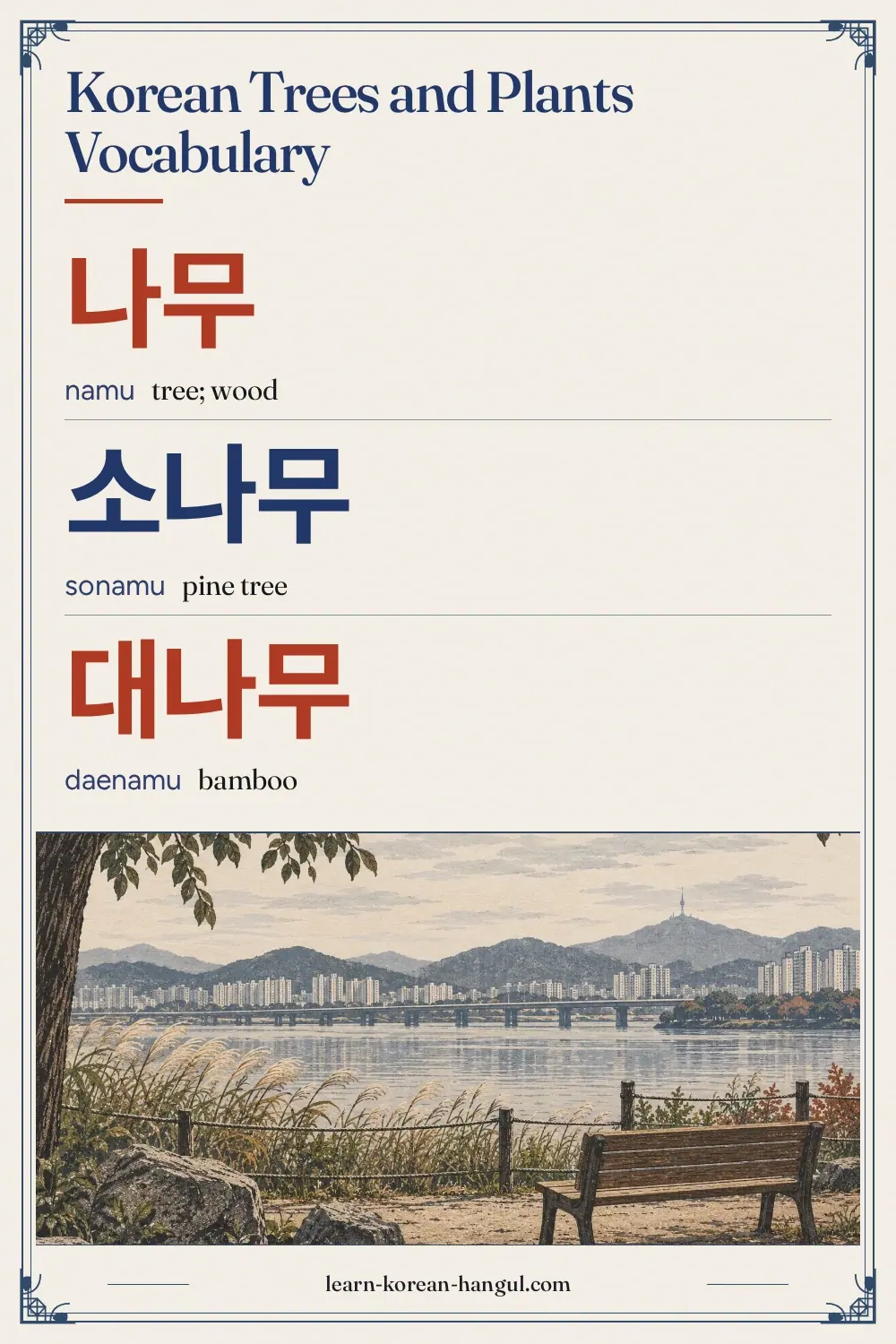
Korean Trees and Plants Vocabulary at a Glance
Trees and plants fill Korean life more than a word list may suggest. Pines stand on mountains and around old buildings, ginkgo trees turn city streets yellow in autumn, persimmons hang from branches in village yards, and ginseng and mugwort are part of the Korean kitchen and medicine cabinet. This list starts with the common trees, moves to the trees that carry a cultural meaning, names the parts of a plant, covers grasses and herbs, and ends with the nouns for a garden. It sits in Plants and Flowers. For blossoms, see Korean Flower Names.
| Group | Words | Use |
|---|---|---|
| Common trees | 6 | Trees you see in parks and streets |
| Trees in culture | 6 | Fruit trees, oaks, willows and the national flower |
| Plant parts | 6 | Roots, stems, leaves and seeds |
| Grasses and herbs | 6 | Grass, moss, ginseng, mugwort and weeds |
| Gardening | 6 | Gardens, pots, soil and how plants are counted |
Which Tree and Plant Names Should You Learn First?
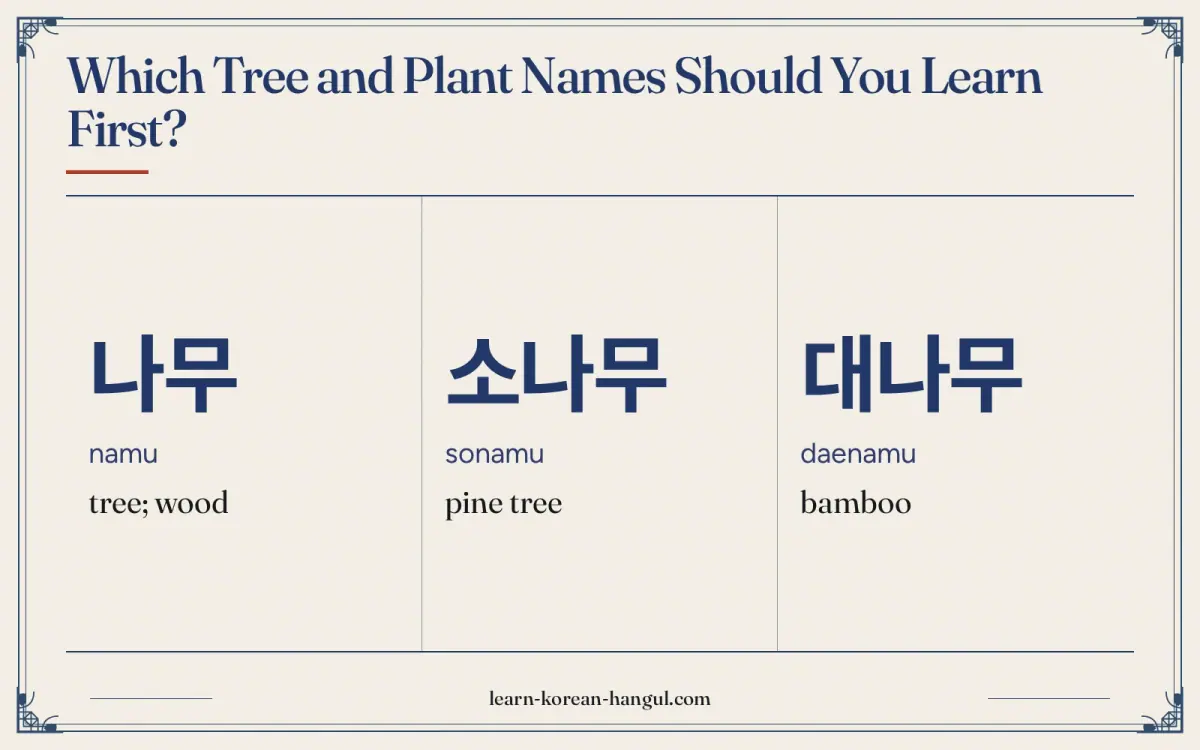
Learn 나무, 소나무, 대나무, 잎, 뿌리 and 정원 first. They are the words for what you see in a park and the parts you point to. Add 은행나무 and 단풍나무 in autumn, since they are the trees people talk about most when the leaves change.
- Words to say. 나무, 소나무, 대나무, 잎, 뿌리, 정원.
- Words to recognise. 은행나무, 단풍나무, 참나무, 무궁화. They appear in news, street names and holiday greetings.
- Words to match. 줄기, 가지, 열매, 씨. Match them to a drawing of a tree and they become easy to recall.
The key rule is word-building. Many tree names are a plant name plus 나무: 소나무 is pine, 대나무 is bamboo, 감나무 is the persimmon tree and 버드나무 is the willow. If you learn the fruit or the plant, you can often guess the tree. The scene below shows a garden with numbered trees and plant parts that match the list.
Word · 10
- 1
나무
namu
tree; wood
- 2
소나무
sonamu
pine tree
- 3
대나무
daenamu
bamboo
- 4
은행나무
eunhaengnamu
ginkgo tree
- 5
뿌리
ppuri
root
- 6
줄기
julgi
stem; trunk
- 7
잎
ip
leaf
- 8
열매
yeolmae
fruit; berry
- 9
정원
jeongwon
garden
- 10
화분
hwabun
flowerpot; potted plant
Common Trees
Six names cover the trees you see most. 나무 is the general word. 소나무 is the pine, a tree that appears in Korean art, poems and even the national anthem. 대나무 is bamboo, which grows in the south and is used for baskets and chopsticks. 은행나무 is the ginkgo that turns street corners gold in autumn, 단풍나무 is the maple with red leaves and 벚나무 is the cherry tree that fills streets with blossom in spring.
| No. | Hangul | Revised Romanization | Meaning and note | Example sentence | Audio assetId |
|---|---|---|---|---|---|
| 1 | 나무 | namu | tree; wood. The general word. The same word means wood as a material. Trees are counted with 그루. | 정원에 나무가 있어요. (There is a tree in the garden.) | au-pg-vocabulary-nature-plants-trees-1; example: au-pg-vocabulary-nature-plants-trees-31 |
| 2 | 소나무 | sonamu | pine tree. Seen as a sign of strength because it stays green in winter. Often painted on screens. | 산에 소나무가 많아요. (There are many pine trees on the mountain.) | au-pg-vocabulary-nature-plants-trees-2; example: au-pg-vocabulary-nature-plants-trees-32 |
| 3 | 대나무 | daenamu | bamboo. 대 is the bamboo, so 대 plus 나무 is the bamboo tree. A grass by botany, but called 나무. | 대나무는 빨리 자라요. (Bamboo grows fast.) | au-pg-vocabulary-nature-plants-trees-3; example: au-pg-vocabulary-nature-plants-trees-33 |
| 4 | 은행나무 | eunhaengnamu | ginkgo tree. 은행 also means bank and ginkgo nut. Here it means ginkgo. | 은행나무 잎이 노래요. (The ginkgo leaves are yellow.) | au-pg-vocabulary-nature-plants-trees-4; example: au-pg-vocabulary-nature-plants-trees-34 |
| 5 | 단풍나무 | danpungnamu | maple tree. 단풍 is autumn colour, so the name means the autumn-colour tree. | 단풍나무가 빨개요. (The maple tree is red.) | au-pg-vocabulary-nature-plants-trees-5; example: au-pg-vocabulary-nature-plants-trees-35 |
| 6 | 벚나무 | beonnamu | cherry tree. Said [번나무]. Its blossom is 벚꽃. Blossom festivals are held under these trees in spring. | 봄에 벚나무에 꽃이 피어요. (In spring the cherry tree blooms.) | au-pg-vocabulary-nature-plants-trees-6; example: au-pg-vocabulary-nature-plants-trees-36 |
Example Sentences
Tree sentences use three simple frames. The first is place + 에 + tree + 가 + 있어요 / 많아요, as in 산에 소나무가 많아요 (there are many pines on the mountain). The second is tree + 는 + verb, as in 대나무는 빨리 자라요 (bamboo grows fast). The third is tree + part + 가 + adjective, as in 은행나무 잎이 노래요 (the ginkgo leaves are yellow). The particles 이 and 가 mark the subject, and 에 marks the place. Read each sentence aloud after its audio.
The next group holds trees that carry a meaning beyond the plant.
How Do You Say Trees in Culture in Korean?
Some trees matter because of what they give or what they stand for. 감나무 is the persimmon tree, whose orange fruit hangs from bare branches in late autumn. 밤나무 gives chestnuts and 대추나무 gives jujubes, a small red fruit used in tea and soups. 참나무 is the oak that gives acorns, and 버드나무 is the willow by rivers. 무궁화 is the rose of Sharon, a flowering shrub that Korea treats as its national flower by long custom (no law designates it).
| No. | Hangul | Revised Romanization | Meaning and note | Example sentence | Audio assetId |
|---|---|---|---|---|---|
| 7 | 감나무 | gamnamu | persimmon tree. 감 is the persimmon fruit. A village yard often has one. | 감나무에 감이 열려요. (Persimmons grow on the persimmon tree.) | au-pg-vocabulary-nature-plants-trees-7; example: au-pg-vocabulary-nature-plants-trees-37 |
| 8 | 밤나무 | bamnamu | chestnut tree. 밤 is the chestnut and also means night. The tree is the one that gives chestnuts. | 가을에 밤나무에서 밤이 떨어져요. (In autumn chestnuts fall from the chestnut tree.) | au-pg-vocabulary-nature-plants-trees-8; example: au-pg-vocabulary-nature-plants-trees-38 |
| 9 | 대추나무 | daechunamu | jujube tree. The fruit 대추 is used in tea and soups. | 대추나무는 열매가 빨개요. (The jujube tree has red fruit.) | au-pg-vocabulary-nature-plants-trees-9; example: au-pg-vocabulary-nature-plants-trees-39 |
| 10 | 참나무 | chamnamu | oak tree. 참 means true. The acorn is 도토리. | 참나무에서 도토리가 열려요. (Acorns grow on the oak.) | au-pg-vocabulary-nature-plants-trees-10; example: au-pg-vocabulary-nature-plants-trees-40 |
| 11 | 버드나무 | beodeunamu | willow tree. A tree with long hanging branches, often seen by water. | 강가에 버드나무가 있어요. (There is a willow by the river.) | au-pg-vocabulary-nature-plants-trees-11; example: au-pg-vocabulary-nature-plants-trees-41 |
| 12 | 무궁화 | mugunghwa | rose of Sharon; national flower. A flowering shrub, so not a tree in the strict sense. The name means endless flower. Its national-flower status comes from custom, not from a law. | 무궁화는 한국의 나라꽃이에요. (The rose of Sharon is the national flower of Korea.) | au-pg-vocabulary-nature-plants-trees-12; example: au-pg-vocabulary-nature-plants-trees-42 |
Names like 감나무 and 밤나무 follow the rule from the first group: fruit name plus 나무. Learn the fruit and the tree comes free.
Plant Parts
Plant parts are short, native Korean words. 뿌리 is the root, 줄기 is the stem or trunk and 가지 is a branch. 잎 is a leaf, 열매 is the fruit or berry and 씨 is a seed. They are the words you use in school, in a garden and when you describe a tree to someone. Notice that 가지 is also the word for eggplant, and the word for a kind or sort, so the sentence matters.
| No. | Hangul | Revised Romanization | Meaning and note | Example sentence | Audio assetId |
|---|---|---|---|---|---|
| 13 | 뿌리 | ppuri | root. Used for plants and, in figures of speech, for origins and roots. | 나무는 뿌리가 깊어요. (A tree has deep roots.) | au-pg-vocabulary-nature-plants-trees-13; example: au-pg-vocabulary-nature-plants-trees-43 |
| 14 | 줄기 | julgi | stem; trunk. The main body of a plant, from the root up to the branches. | 줄기가 굵어요. (The trunk is thick.) | au-pg-vocabulary-nature-plants-trees-14; example: au-pg-vocabulary-nature-plants-trees-44 |
| 15 | 가지 | gaji | branch. Also the eggplant and the word for kind or sort. The sentence decides which. A tree branch is often the compound 나뭇가지 [나무까지]. | 나뭇가지가 길어요. (The branches of the tree are long.) | au-pg-vocabulary-nature-plants-trees-15; example: au-pg-vocabulary-nature-plants-trees-45 |
| 16 | 잎 | ip | leaf. Said [입]. With 이 it is 잎이 [이피]. | 가을에 잎이 떨어져요. (In autumn the leaves fall.) | au-pg-vocabulary-nature-plants-trees-16; example: au-pg-vocabulary-nature-plants-trees-46 |
| 17 | 열매 | yeolmae | fruit; berry. The fruit of a plant. The verb 열리다 means to bear fruit. | 열매가 열려요. (The fruit grows.) | au-pg-vocabulary-nature-plants-trees-17; example: au-pg-vocabulary-nature-plants-trees-47 |
| 18 | 씨 | ssi | seed. 씨 also follows names as Mr or Ms, as in 민수 씨. A seed for planting is 씨앗. | 열매 안에 씨가 있어요. (There is a seed inside the fruit.) | au-pg-vocabulary-nature-plants-trees-18; example: au-pg-vocabulary-nature-plants-trees-48 |
The verb 열리다 appears with 열매 and with 감 in the group before. It is the verb for a plant bearing fruit.
How Do You Say Grasses and Herbs in Korean?
Small plants have their own vocabulary. 풀 is grass and 이끼 is moss. 잡초 is a weed. Three plants matter in Korean food and medicine: 인삼 is ginseng, 쑥 is mugwort, which is picked in spring and used in rice cakes and soup, and 도라지 is the bellflower, whose root is eaten as a side dish. These words appear on shop signs, in markets and in recipes. For more on the food side, you can pair them with the ingredients on a restaurant menu.
| No. | Hangul | Revised Romanization | Meaning and note | Example sentence | Audio assetId |
|---|---|---|---|---|---|
| 19 | 풀 | pul | grass; herb. Also the word for glue, written the same way. Context decides. | 풀이 자라요. (The grass grows.) | au-pg-vocabulary-nature-plants-trees-19; example: au-pg-vocabulary-nature-plants-trees-49 |
| 20 | 이끼 | ikki | moss. Found on rocks and old trees in wet places. | 바위에 이끼가 있어요. (There is moss on the rock.) | au-pg-vocabulary-nature-plants-trees-20; example: au-pg-vocabulary-nature-plants-trees-50 |
| 21 | 인삼 | insam | ginseng. Grown as a crop and eaten as food or medicine. 홍삼 is red ginseng. | 인삼은 약으로 먹어요. (Ginseng is eaten as a tonic.) | au-pg-vocabulary-nature-plants-trees-21; example: au-pg-vocabulary-nature-plants-trees-51 |
| 22 | 쑥 | ssuk | mugwort. Picked in spring. Used in rice cakes and soup. | 봄에 쑥을 캐요. (In spring I pick mugwort.) | au-pg-vocabulary-nature-plants-trees-22; example: au-pg-vocabulary-nature-plants-trees-52 |
| 23 | 도라지 | doraji | bellflower root. A root vegetable. A well-known folk song has the same name. | 도라지는 뿌리를 먹어요. (We eat the root of the bellflower.) | au-pg-vocabulary-nature-plants-trees-23; example: au-pg-vocabulary-nature-plants-trees-53 |
| 24 | 잡초 | japcho | weed. 잡 means mixed or miscellaneous and 초 means grass. | 잡초를 뽑아요. (I pull the weeds.) | au-pg-vocabulary-nature-plants-trees-24; example: au-pg-vocabulary-nature-plants-trees-54 |
Pair 풀 and 잡초 carefully. 풀 is a neutral word for grass or herb, while 잡초 is a plant you do not want in your garden.
Gardening
Gardening nouns finish the list. 정원 is a garden, usually a decorated one with plants, while 텃밭 is a small plot for growing vegetables. 화분 is a flowerpot. 씨앗 is a seed for planting, 흙 is soil and 비료 is fertilizer. Korean also uses counters for plants. A tree is counted with 그루, a flower with 송이 and a clump of grass or a cabbage with 포기. Use the native numbers with them: 나무 한 그루, 나무 두 그루.
| No. | Hangul | Revised Romanization | Meaning and note | Example sentence | Audio assetId |
|---|---|---|---|---|---|
| 25 | 정원 | jeongwon | garden. A planted garden. For a flower bed, you can say 꽃밭. | 정원에 꽃과 나무가 있어요. (There are flowers and trees in the garden.) | au-pg-vocabulary-nature-plants-trees-25; example: au-pg-vocabulary-nature-plants-trees-55 |
| 26 | 화분 | hwabun | flowerpot; potted plant. Pots sit on balconies and windowsills. | 화분에 물을 줘요. (I water the plant in the pot.) | au-pg-vocabulary-nature-plants-trees-26; example: au-pg-vocabulary-nature-plants-trees-56 |
| 27 | 씨앗 | ssiat | seed (for planting). Said [씨앋]. With 을 it is 씨앗을 [씨아슬]. | 씨앗을 심어요. (I plant seeds.) | au-pg-vocabulary-nature-plants-trees-27; example: au-pg-vocabulary-nature-plants-trees-57 |
| 28 | 흙 | heuk | soil; earth. Said [흑]. With 이 it is 흙이 [흘기]. | 흙이 부드러워요. (The soil is soft.) | au-pg-vocabulary-nature-plants-trees-28; example: au-pg-vocabulary-nature-plants-trees-58 |
| 29 | 비료 | biryo | fertilizer. A Sino-Korean word used by farmers and gardeners. | 식물에 비료를 줘요. (I give fertilizer to the plant.) | au-pg-vocabulary-nature-plants-trees-29; example: au-pg-vocabulary-nature-plants-trees-59 |
| 30 | 텃밭 | teotbat | small vegetable plot. Said [턷빧]. Many families grow vegetables in a plot near the house. | 텃밭에서 채소를 키워요. (I grow vegetables in my plot.) | au-pg-vocabulary-nature-plants-trees-30; example: au-pg-vocabulary-nature-plants-trees-60 |
Learn 정원 and 텃밭 as a pair: one is for looks and the other for food.
| Item | Counter | Example |
|---|---|---|
| Tree | 그루 | 나무 한 그루 (one tree) |
| Flower | 송이 | 꽃 한 송이 (one flower) |
| Clump or head | 포기 | 풀 한 포기 (one clump of grass) |
| Pot | 개 | 화분 두 개 (two pots) |
How Do You Pronounce These Words?
Most plant words are said as written, but words that end in a consonant change when a vowel follows. Standard pronunciation follows the National Institute of Korean Language (국립국어원) rules, and the romanization follows the Revised Romanization of Korean, which does not show every sound change.
| Spelling | Sounds like | What changes |
|---|---|---|
| 벚나무 | [번나무] | The final ㅈ is said as ㄷ, then becomes ㄴ before ㄴ. |
| 잎이 | [이피] | The final ㅍ moves to the vowel of 이. |
| 흙이 | [흘기] | Of the two final consonants, ㄹ stays and ㄱ moves to the vowel of 이. |
| 씨앗을 | [씨아슬] | The final ㅅ moves to the vowel of 을. |
| 텃밭 | [턷빧] | The final ㅅ is said as ㄷ and makes the next ㅂ tense, and the final ㅌ is said as ㄷ. |
| 굵어요 | [굴거요] | Of the two final consonants, ㄹ stays and ㄱ moves to the vowel of 어. |
Words with two final consonants, such as 흙 and 굵다, are the hardest. Say the stand-alone form first: 흙 is [흑]. Then add a vowel and listen to the audio for the linked form.
Audio and Slow Playback
Each word and sentence has its own clip. The five clips below replay the hardest words slowly. Play one, repeat it aloud, then play it again and compare.
What Mistakes Do Learners Make with Tree and Plant Names?
Five mistakes come up again and again.
- Forgetting 나무 in tree names. 소나무 is the pine tree, and 소 alone does not name a tree.
- Saying 벚나무 as [벚나무]. The right sound is [번나무].
- Mixing up 가지. It means branch, eggplant and kind. A sentence about a tree means branch.
- Thinking 씨 and 씨앗 are different things. Both mean seed, and 씨를 뿌려요 (I sow seeds) is normal. 씨앗 is the usual word on seed packets, while only 씨 is used for the seed inside a fruit you eat.
- Counting trees with 개. Use 그루: 나무 두 그루, not 나무 두 개.
The practice section turns the list into drills.
Practice: Flashcards and Worksheet
Use three steps. Run the flashcard deck in recognition mode until the 30 words come quickly. Switch to listening mode, then take the quiz. The deck holds every word on this page with audio, and your progress stays in your browser. The vocabulary flashcard decks page lists the other decks.
Practice · 65
- 01나무
Show answer
headword 1: tree; wood
- 02소나무
Show answer
headword 2: pine tree
- 03대나무
Show answer
headword 3: bamboo
- 04은행나무
Show answer
headword 4: ginkgo tree
- 05단풍나무
Show answer
headword 5: maple tree
- 06벚나무
Show answer
headword 6: cherry tree
- 07감나무
Show answer
headword 7: persimmon tree
- 08밤나무
Show answer
headword 8: chestnut tree
- 09대추나무
Show answer
headword 9: jujube tree
- 10참나무
Show answer
headword 10: oak tree
- 11버드나무
Show answer
headword 11: willow tree
- 12무궁화
Show answer
headword 12: rose of Sharon; national flower
- 13뿌리
Show answer
headword 13: root
- 14줄기
Show answer
headword 14: stem; trunk
- 15가지
Show answer
headword 15: branch
- 16잎
Show answer
headword 16: leaf
- 17열매
Show answer
headword 17: fruit; berry
- 18씨
Show answer
headword 18: seed
- 19풀
Show answer
headword 19: grass; herb
- 20이끼
Show answer
headword 20: moss
- 21인삼
Show answer
headword 21: ginseng
- 22쑥
Show answer
headword 22: mugwort
- 23도라지
Show answer
headword 23: bellflower root
- 24잡초
Show answer
headword 24: weed
- 25정원
Show answer
headword 25: garden
- 26화분
Show answer
headword 26: flowerpot; potted plant
- 27씨앗
Show answer
headword 27: seed (for planting)
- 28흙
Show answer
headword 28: soil; earth
- 29비료
Show answer
headword 29: fertilizer
- 30텃밭
Show answer
headword 30: small vegetable plot
- 31정원에 나무가 있어요.
Show answer
example sentence for 나무
- 32산에 소나무가 많아요.
Show answer
example sentence for 소나무
- 33대나무는 빨리 자라요.
Show answer
example sentence for 대나무
- 34은행나무 잎이 노래요.
Show answer
example sentence for 은행나무
- 35단풍나무가 빨개요.
Show answer
example sentence for 단풍나무
- 36봄에 벚나무에 꽃이 피어요.
Show answer
example sentence for 벚나무
- 37감나무에 감이 열려요.
Show answer
example sentence for 감나무
- 38가을에 밤나무에서 밤이 떨어져요.
Show answer
example sentence for 밤나무
- 39대추나무는 열매가 빨개요.
Show answer
example sentence for 대추나무
- 40참나무에서 도토리가 열려요.
Show answer
example sentence for 참나무
- 41강가에 버드나무가 있어요.
Show answer
example sentence for 버드나무
- 42무궁화는 한국의 나라꽃이에요.
Show answer
example sentence for 무궁화
- 43나무는 뿌리가 깊어요.
Show answer
example sentence for 뿌리
- 44줄기가 굵어요.
Show answer
example sentence for 줄기
- 45나뭇가지가 길어요.
Show answer
example sentence for 가지
- 46가을에 잎이 떨어져요.
Show answer
example sentence for 잎
- 47열매가 열려요.
Show answer
example sentence for 열매
- 48열매 안에 씨가 있어요.
Show answer
example sentence for 씨
- 49풀이 자라요.
Show answer
example sentence for 풀
- 50바위에 이끼가 있어요.
Show answer
example sentence for 이끼
- 51인삼은 약으로 먹어요.
Show answer
example sentence for 인삼
- 52봄에 쑥을 캐요.
Show answer
example sentence for 쑥
- 53도라지는 뿌리를 먹어요.
Show answer
example sentence for 도라지
- 54잡초를 뽑아요.
Show answer
example sentence for 잡초
- 55정원에 꽃과 나무가 있어요.
Show answer
example sentence for 정원
- 56화분에 물을 줘요.
Show answer
example sentence for 화분
- 57씨앗을 심어요.
Show answer
example sentence for 씨앗
- 58흙이 부드러워요.
Show answer
example sentence for 흙
- 59식물에 비료를 줘요.
Show answer
example sentence for 비료
- 60텃밭에서 채소를 키워요.
Show answer
example sentence for 텃밭
- 61벚나무
Show answer
slow playback: 벚나무
- 62흙
Show answer
slow playback: 흙
- 63텃밭
Show answer
slow playback: 텃밭
- 64씨앗
Show answer
slow playback: 씨앗
- 65잎
Show answer
slow playback: 잎
Practice · 5
What does 대나무 (daenamu) mean?
Show answer
bamboo
대나무 means bamboo. Example: 대나무는 빨리 자라요. (Bamboo grows fast.)
What does 은행나무 (eunhaengnamu) mean?
Show answer
ginkgo tree
은행나무 means ginkgo tree. Example: 은행나무 잎이 노래요. (The ginkgo leaves are yellow.)
What does 가지 (gaji) mean?
Show answer
branch
가지 means branch. Example: 나뭇가지가 길어요. (The branches of the tree are long.)
What does 도라지 (doraji) mean?
Show answer
bellflower root
도라지 means bellflower root. Example: 도라지는 뿌리를 먹어요. (We eat the root of the bellflower.)
What does 흙 (heuk) mean?
Show answer
soil; earth
흙 means soil; earth. Example: 흙이 부드러워요. (The soil is soft.)
Korean Trees and Plants Vocabulary Worksheet (PDF)
A printable worksheet for these words (word list, matching, writing practice, fill-in-the-blank exercises and answer key) is available in A4 and US Letter from the download card on this page. For practice, draw a tree and label five parts in Korean: 뿌리, 줄기, 가지, 잎, 열매.
Where to Go Next
After this page, continue with Korean Landscape Words for the places where trees grow, or return to blossoms on Korean Flower Names. To move up a level, return to Plants and Flowers.
Frequently Asked Questions
How Do You Say Tree in Korean?
Tree is 나무 (namu). Say 정원에 나무가 있어요 for there is a tree in the garden. The same word means wood as a material. Trees are counted with 그루: 나무 한 그루 is one tree.
How Do You Say Pine Tree and Bamboo in Korean?
Pine tree is 소나무 (sonamu) and bamboo is 대나무 (daenamu). Both end in 나무, which is the word for tree. Say 대나무는 빨리 자라요 for bamboo grows fast.
What Are the Parts of a Plant in Korean?
Root is 뿌리, stem or trunk is 줄기, branch is 가지, leaf is 잎, fruit is 열매 and seed is 씨. A seed for planting is 씨앗.
How Do You Count Trees and Flowers in Korean?
Trees use the counter 그루, flowers use 송이 and clumps of grass use 포기. Combine them with native numbers: 나무 두 그루 means two trees.
How Many Tree and Plant Words Should I Learn First?
Start with about six: 나무, 소나무, 대나무, 잎, 뿌리 and 정원. The whole list of 30 takes about six days at five new words a day, with review.
Is the Romanization on This Page Official?
It follows the Revised Romanization of Korean, which South Korea adopted on 7 July 2000 and whose rules the National Institute of Korean Language (국립국어원) publishes. It is a learning aid and does not mark every sound change, so rely on the Hangul and the audio.