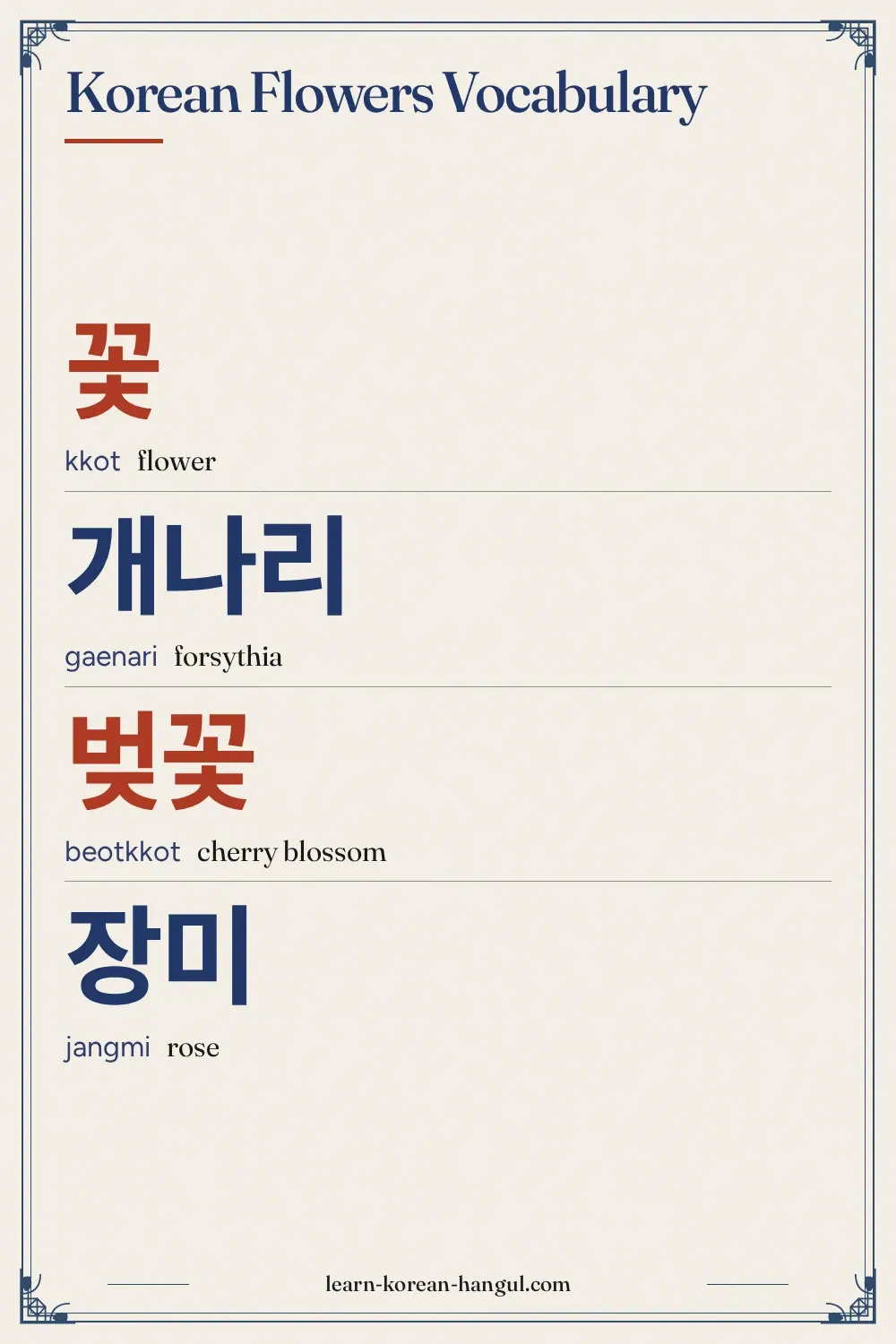
Korean Flowers Vocabulary at a Glance
Koreans talk about flowers by season, and the news treats the first blossom of the year as an event. This list follows that calendar: spring, summer, autumn and winter flowers, then the words for buying and giving them. It is a child of Plants and Flowers, which also covers trees, garden plants and plant parts. For one famous word, see cherry blossom in Korean.
| Group | Words | Use |
|---|---|---|
| Spring flowers | 7 | The first flowers of the year, from yellow to pink |
| Summer flowers | 7 | Roses, lotus and the national flower |
| Autumn flowers | 6 | Cosmos, chrysanthemums and autumn fields |
| Winter flowers | 5 | The few flowers that bloom in the cold |
| Bouquets and gifts | 5 | Buying, giving and reading the meaning of flowers |
Which Flower Names Should You Learn First?
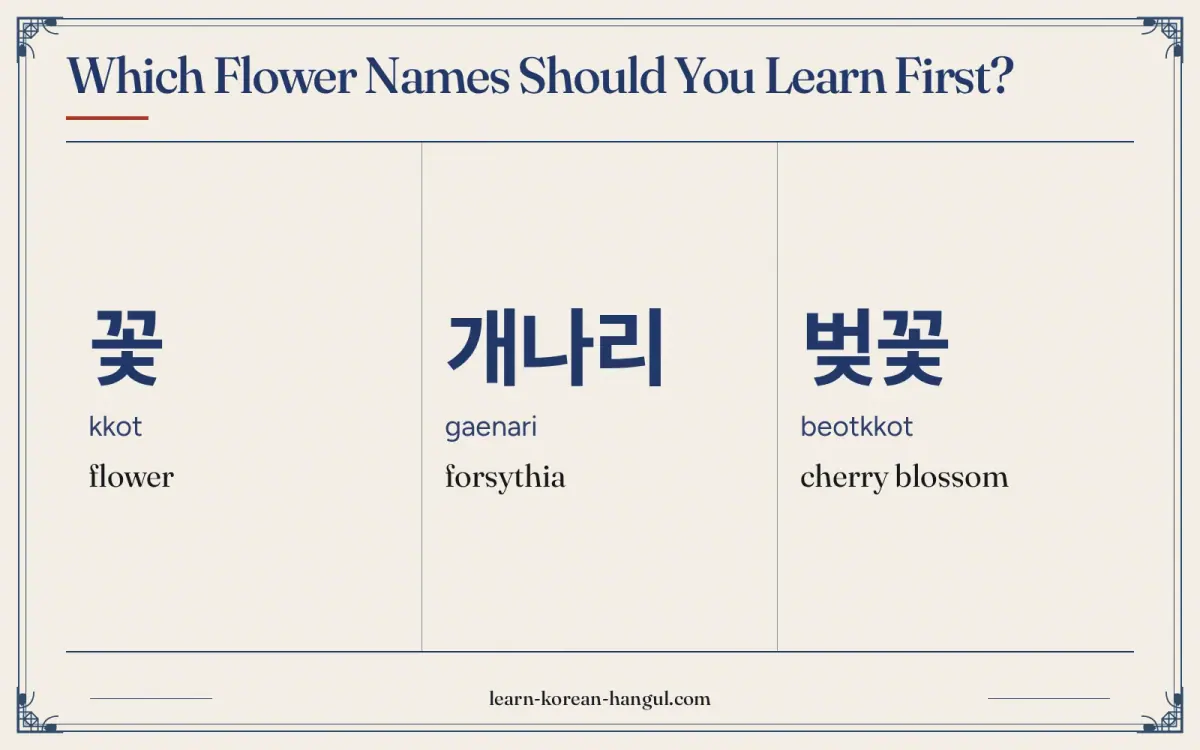
Learn 꽃, 장미, 벚꽃, 개나리 and 꽃다발 first. They cover the general word, the most famous flowers and a gift word. Then fill in the season you are in: 목련 and 진달래 in spring, 수국 and 연꽃 in summer, 코스모스 and 국화 in autumn.
- Words to say. 꽃, 장미, 벚꽃, 해바라기, 꽃다발, 꽃집.
- Words to recognise. 무궁화, 진달래, 매화, 동백. They appear in news, songs and festivals.
- Words to build. 꽃 + word: 꽃집, 꽃다발, 꽃바구니, 꽃말.
A good split to know: 벚꽃 is the blossom and 벚나무 is the tree. The scene below arranges flowers as a calendar, with ten of them numbered to match the list.
Word · 10
- 1
꽃
kkot
flower
- 2
개나리
gaenari
forsythia
- 3
벚꽃
beotkkot
cherry blossom
- 4
장미
jangmi
rose
- 5
연꽃
yeonkkot
lotus flower
- 6
무궁화
mugunghwa
rose of Sharon (national flower)
- 7
코스모스
koseumoseu
cosmos
- 8
국화
gukhwa
chrysanthemum
- 9
매화
maehwa
plum blossom
- 10
눈꽃
nunkkot
snow flower; hoarfrost on branches
Spring Flowers
Spring opens with a colour sequence. 개나리 (forsythia) comes first in yellow, then 진달래 (azalea) in pink, then 벚꽃 (cherry blossom) in white and pale pink. 목련 (magnolia) and 튤립 (tulips) follow. On Jeju Island, 유채꽃 turns the fields yellow. Starting with the general word 꽃, which you pronounce [꼳] alone and [꼬치] before 이, this group gives you the words you hear when spring is on the news.
| No. | Hangul | Revised Romanization | Meaning and note | Example sentence | Audio assetId |
|---|---|---|---|---|---|
| 1 | 꽃 | kkot | flower. Said [꼳] alone; [꼬치] before 이. The base of this whole page. | 꽃을 사요. (I buy flowers.) | au-pg-vocabulary-nature-plants-flowers-1; example: au-pg-vocabulary-nature-plants-flowers-31 |
| 2 | 개나리 | gaenari | forsythia. First yellow of spring. | 개나리가 노랗게 피었어요. (The forsythia has bloomed yellow.) | au-pg-vocabulary-nature-plants-flowers-2; example: au-pg-vocabulary-nature-plants-flowers-32 |
| 3 | 진달래 | jindallae | azalea. Pink flowers on hills; also 진달래꽃. | 진달래꽃이 분홍색이에요. (Azalea flowers are pink.) | au-pg-vocabulary-nature-plants-flowers-3; example: au-pg-vocabulary-nature-plants-flowers-33 |
| 4 | 벚꽃 | beotkkot | cherry blossom. Said [벋꼳]. Falling petals are 벚꽃잎. | 벚꽃이 떨어져요. (The cherry blossoms are falling.) | au-pg-vocabulary-nature-plants-flowers-4; example: au-pg-vocabulary-nature-plants-flowers-34 |
| 5 | 목련 | mongnyeon | magnolia. Said [몽년]: ㄱ before ㄹ turns to ㅇ, and ㄹ turns to ㄴ. | 목련이 하얘요. (The magnolia is white.) | au-pg-vocabulary-nature-plants-flowers-5; example: au-pg-vocabulary-nature-plants-flowers-35 |
| 6 | 튤립 | tyullip | tulip. Loanword. | 튤립을 심었어요. (I planted tulips.) | au-pg-vocabulary-nature-plants-flowers-6; example: au-pg-vocabulary-nature-plants-flowers-36 |
| 7 | 유채꽃 | yuchaekkot | rape blossom (canola flower). Said [유채꼳]. Famous on Jeju Island in spring. | 제주도에는 유채꽃이 많아요. (There are many rape blossoms on Jeju.) | au-pg-vocabulary-nature-plants-flowers-7; example: au-pg-vocabulary-nature-plants-flowers-37 |
Example Sentences
The frame is flower + 이/가 + colour adverb + 피었어요, for example 개나리가 노랗게 피었어요. The ending -게 turns a colour adjective into an adverb: 노랗다 becomes 노랗게. The past form 피었어요 describes a flower that is now open. For a flower that is falling, use 떨어져요. Read each sentence aloud after the audio.
The spring list is the longest because blossom season is short and many things bloom at once.
How Do You Say Summer Flowers in Korean?
Summer flowers are bold. 장미 and 해바라기 are the most famous, 연꽃 grows in ponds and 수국 fills temple gardens with blue and pink. The national flower, 무궁화, blooms from summer into early autumn, which makes it a flower you can find for months. 나팔꽃 opens in the morning, and 봉선화 is the balsam traditionally used to dye fingernails.
| No. | Hangul | Revised Romanization | Meaning and note | Example sentence | Audio assetId |
|---|---|---|---|---|---|
| 8 | 장미 | jangmi | rose. The flower of early summer and of gifts. | 장미에 가시가 있어요. (The rose has thorns.) | au-pg-vocabulary-nature-plants-flowers-8; example: au-pg-vocabulary-nature-plants-flowers-38 |
| 9 | 해바라기 | haebaragi | sunflower. Literally a thing that looks toward the sun. | 해바라기를 그려요. (I draw sunflowers.) | au-pg-vocabulary-nature-plants-flowers-9; example: au-pg-vocabulary-nature-plants-flowers-39 |
| 10 | 연꽃 | yeonkkot | lotus flower. Said [연꼳]. Grows in ponds. | 연꽃이 연못에 피어요. (Lotus flowers bloom in the pond.) | au-pg-vocabulary-nature-plants-flowers-10; example: au-pg-vocabulary-nature-plants-flowers-40 |
| 11 | 무궁화 | mugunghwa | rose of Sharon (national flower). Blooms for months in summer and early autumn. | 무궁화는 여름에 피어요. (The mugunghwa blooms in summer.) | au-pg-vocabulary-nature-plants-flowers-11; example: au-pg-vocabulary-nature-plants-flowers-41 |
| 12 | 수국 | suguk | hydrangea. Colours range from blue to pink. | 수국이 파랗게 피었어요. (The hydrangeas bloomed blue.) | au-pg-vocabulary-nature-plants-flowers-12; example: au-pg-vocabulary-nature-plants-flowers-42 |
| 13 | 나팔꽃 | napalkkot | morning glory. Said [나팔꼳]. 나팔 is trumpet. | 나팔꽃은 아침에 피어요. (Morning glories open in the morning.) | au-pg-vocabulary-nature-plants-flowers-13; example: au-pg-vocabulary-nature-plants-flowers-43 |
| 14 | 봉선화 | bongseonhwa | garden balsam. Traditionally used to dye nails orange-red. | 봉선화로 손톱을 물들여요. (I dye my nails with balsam.) | au-pg-vocabulary-nature-plants-flowers-14; example: au-pg-vocabulary-nature-plants-flowers-44 |
Several summer names end in 꽃 or 화. The ending 꽃 is native Korean and 화 is Sino-Korean, and both mean flower.
Autumn Flowers
Autumn flowers are linked to open fields and hillsides. 코스모스 lines roadsides, 국화 is the classic flower of the season and 구절초 is its wild white cousin. 맨드라미 is a red flower shaped like a crest, 꽃무릇 is a red lily and 억새 is silver grass, which is not a true flower but a seasonal symbol. Seasonal festivals are built around these flowers.
| No. | Hangul | Revised Romanization | Meaning and note | Example sentence | Audio assetId |
|---|---|---|---|---|---|
| 15 | 코스모스 | koseumoseu | cosmos. Loanword; lines roadsides in autumn. | 코스모스가 바람에 흔들려요. (The cosmos sway in the wind.) | au-pg-vocabulary-nature-plants-flowers-15; example: au-pg-vocabulary-nature-plants-flowers-45 |
| 16 | 국화 | gukhwa | chrysanthemum. Said [구콰]. The classic autumn flower. | 국화 향이 좋아요. (The chrysanthemum scent is nice.) | au-pg-vocabulary-nature-plants-flowers-16; example: au-pg-vocabulary-nature-plants-flowers-46 |
| 17 | 구절초 | gujeolcho | Korean wild chrysanthemum. White flowers on autumn hills. | 산에 구절초가 하얗게 피었어요. (Wild chrysanthemums bloomed white on the mountain.) | au-pg-vocabulary-nature-plants-flowers-17; example: au-pg-vocabulary-nature-plants-flowers-47 |
| 18 | 맨드라미 | maendeurami | cockscomb. A red, crest-shaped flower. | 맨드라미는 빨개요. (The cockscomb is red.) | au-pg-vocabulary-nature-plants-flowers-18; example: au-pg-vocabulary-nature-plants-flowers-48 |
| 19 | 억새 | eoksae | silver grass. Not a true flower but a symbol of autumn. | 억새밭이 넓어요. (The silver-grass field is wide.) | au-pg-vocabulary-nature-plants-flowers-19; example: au-pg-vocabulary-nature-plants-flowers-49 |
| 20 | 꽃무릇 | kkonmureut | red spider lily. Said [꼰무륻]. Blooms before its leaves. | 꽃무릇이 빨갛게 피었어요. (The red spider lilies bloomed red.) | au-pg-vocabulary-nature-plants-flowers-20; example: au-pg-vocabulary-nature-plants-flowers-50 |
국화 exists in two worlds. It is a cheerful autumn flower and, in white, a flower used at funerals, so choose it with care when giving a gift.
How Do You Say Winter Flowers in Korean?
Few flowers bloom in a Korean winter, which is why these five are celebrated. 동백 (camellia) opens in the south in the cold. 매화 (plum blossom) and 수선화 (daffodil) arrive in late winter. 복수초 is a small yellow flower that pushes through the snow. 눈꽃 is the odd one: snow flowers are frost formed on branches, and the word is used for the look of snow-covered trees.
| No. | Hangul | Revised Romanization | Meaning and note | Example sentence | Audio assetId |
|---|---|---|---|---|---|
| 21 | 동백 | dongbaek | camellia. Also 동백꽃; blooms in winter. | 동백꽃이 겨울에 피어요. (Camellias bloom in winter.) | au-pg-vocabulary-nature-plants-flowers-21; example: au-pg-vocabulary-nature-plants-flowers-51 |
| 22 | 매화 | maehwa | plum blossom. One of the first flowers of the year. | 매화가 일찍 피어요. (Plum blossoms bloom early.) | au-pg-vocabulary-nature-plants-flowers-22; example: au-pg-vocabulary-nature-plants-flowers-52 |
| 23 | 수선화 | suseonhwa | daffodil. Late winter to early spring. | 수선화 향기가 좋아요. (The daffodil fragrance is pleasant.) | au-pg-vocabulary-nature-plants-flowers-23; example: au-pg-vocabulary-nature-plants-flowers-53 |
| 24 | 눈꽃 | nunkkot | snow flower; hoarfrost on branches. Said [눈꼳]. Not a plant: frost shaped like blossoms. | 나뭇가지에 눈꽃이 피었어요. (Snow flowers have formed on the branches.) | au-pg-vocabulary-nature-plants-flowers-24; example: au-pg-vocabulary-nature-plants-flowers-54 |
| 25 | 복수초 | boksucho | adonis (blooms in snow). A small yellow flower that opens near the melting snow. | 복수초는 눈 속에서 피어요. (Adonis flowers bloom in the snow.) | au-pg-vocabulary-nature-plants-flowers-25; example: au-pg-vocabulary-nature-plants-flowers-55 |
The word 눈꽃 is a good example of the Korean habit of borrowing flower names for beauty in nature, as in 눈꽃 축제, a snow-flower festival.
Bouquets and Gifts
Flowers are common gifts at graduations, birthdays and openings. You buy them at a 꽃집. A 꽃다발 is a hand-held bouquet, and a 꽃바구니 is a basket. A 화환 is a large wreath on a stand, sent to a new shop or to a funeral. Korean tradition also has 꽃말, the meaning attached to each flower. The 꽃말 of 장미 is love in many sources, though meanings vary.
| No. | Hangul | Revised Romanization | Meaning and note | Example sentence | Audio assetId |
|---|---|---|---|---|---|
| 26 | 꽃집 | kkotjip | flower shop. Said [꼳찝]. | 꽃집에서 장미를 샀어요. (I bought roses at a flower shop.) | au-pg-vocabulary-nature-plants-flowers-26; example: au-pg-vocabulary-nature-plants-flowers-56 |
| 27 | 꽃다발 | kkotdabal | bouquet. Said [꼳따발]. 다발 means a bunch. | 졸업식에 꽃다발을 줬어요. (I gave a bouquet at the graduation.) | au-pg-vocabulary-nature-plants-flowers-27; example: au-pg-vocabulary-nature-plants-flowers-57 |
| 28 | 꽃바구니 | kkotbaguni | flower basket. Said [꼳빠구니]. | 꽃바구니를 받았어요. (I received a flower basket.) | au-pg-vocabulary-nature-plants-flowers-28; example: au-pg-vocabulary-nature-plants-flowers-58 |
| 29 | 화환 | hwahwan | floral wreath. Sent to openings and to funerals. | 개업 축하 화환이 있어요. (There is a congratulatory wreath for the opening.) | au-pg-vocabulary-nature-plants-flowers-29; example: au-pg-vocabulary-nature-plants-flowers-59 |
| 30 | 꽃말 | kkonmal | flower language (meaning of a flower). Said [꼰말]. The traditional meaning given to each flower. | 장미의 꽃말은 사랑이에요. (The flower meaning of the rose is love.) | au-pg-vocabulary-nature-plants-flowers-30; example: au-pg-vocabulary-nature-plants-flowers-60 |
Because the same gift word can fit a happy event or a sad one, the ribbon and the card tell you which. Look at the ribbon before you read the flower.
How Do You Pronounce These Words?
Flower names have many consonant sounds that change at the end of 꽃. Standard pronunciation follows the National Institute of Korean Language (국립국어원) rules, and the romanization follows the Revised Romanization of Korean, which does not mark every sound change.
| Spelling | Sounds like | What changes |
|---|---|---|
| 꽃다발 | [꼳따발] | Final ㅊ is said as [ㄷ], and ㄷ becomes tense [ㄸ]. |
| 꽃집 | [꼳찝] | The same stop before ㅈ, which becomes tense [ㅉ]. |
| 꽃말 | [꼰말] | Final [ㄷ] before ㅁ becomes [ㄴ]. |
| 목련 | [몽년] | ㄱ turns to [ㅇ] and ㄹ turns to [ㄴ]. |
| 연꽃 | [연꼳] | Final ㅊ is said as [ㄷ]. |
| 꽃이 | [꼬치] | Before a vowel, ㅊ moves to the next syllable. |
Remember the rule that 꽃 ends in a [ㄷ] sound when it stands alone or before a consonant, and in a ㅊ sound when a vowel follows. That one rule fixes the pronunciation of nearly every compound on this page.
Audio and Slow Playback
Each word and sentence has its own clip. The five clips below replay the hardest words slowly. Play one, repeat it aloud, then play it again and compare.
What Mistakes Do Learners Make with Flower Names?
Five mistakes come up again and again.
- Saying 꽃을 피어요. The verb 피다 is intransitive, so say 꽃이 피어요, the flower blooms.
- Pronouncing 꽃다발 as [꽃다발]. The standard is [꼳따발], with a tense ㄸ.
- Mixing 벚꽃 and 벚나무. 벚꽃 is the blossom and 벚나무 is the tree.
- Giving white 국화 as a cheerful gift. White chrysanthemums are used at funerals. Choose another flower for a celebration.
- Using 꽃말 to mean flower words. 꽃말 is the meaning given to a flower, such as love for a rose, not the word for it.
Verb choice and one-sound differences cause most errors. The practice section turns the list into drills.
Practice: Flashcards and Worksheet
Use three steps. Run the flashcard deck in recognition mode until the 30 words come quickly. Switch to listening mode, then take the quiz. The deck holds every word on this page with audio, and your progress stays in your browser. The vocabulary flashcard decks page lists the other decks.
Practice · 65
- 01꽃
Show answer
headword 1: flower
- 02개나리
Show answer
headword 2: forsythia
- 03진달래
Show answer
headword 3: azalea
- 04벚꽃
Show answer
headword 4: cherry blossom
- 05목련
Show answer
headword 5: magnolia
- 06튤립
Show answer
headword 6: tulip
- 07유채꽃
Show answer
headword 7: rape blossom (canola flower)
- 08장미
Show answer
headword 8: rose
- 09해바라기
Show answer
headword 9: sunflower
- 10연꽃
Show answer
headword 10: lotus flower
- 11무궁화
Show answer
headword 11: rose of Sharon (national flower)
- 12수국
Show answer
headword 12: hydrangea
- 13나팔꽃
Show answer
headword 13: morning glory
- 14봉선화
Show answer
headword 14: garden balsam
- 15코스모스
Show answer
headword 15: cosmos
- 16국화
Show answer
headword 16: chrysanthemum
- 17구절초
Show answer
headword 17: Korean wild chrysanthemum
- 18맨드라미
Show answer
headword 18: cockscomb
- 19억새
Show answer
headword 19: silver grass
- 20꽃무릇
Show answer
headword 20: red spider lily
- 21동백
Show answer
headword 21: camellia
- 22매화
Show answer
headword 22: plum blossom
- 23수선화
Show answer
headword 23: daffodil
- 24눈꽃
Show answer
headword 24: snow flower; hoarfrost on branches
- 25복수초
Show answer
headword 25: adonis (blooms in snow)
- 26꽃집
Show answer
headword 26: flower shop
- 27꽃다발
Show answer
headword 27: bouquet
- 28꽃바구니
Show answer
headword 28: flower basket
- 29화환
Show answer
headword 29: floral wreath
- 30꽃말
Show answer
headword 30: flower language (meaning of a flower)
- 31꽃을 사요.
Show answer
example sentence for 꽃
- 32개나리가 노랗게 피었어요.
Show answer
example sentence for 개나리
- 33진달래꽃이 분홍색이에요.
Show answer
example sentence for 진달래
- 34벚꽃이 떨어져요.
Show answer
example sentence for 벚꽃
- 35목련이 하얘요.
Show answer
example sentence for 목련
- 36튤립을 심었어요.
Show answer
example sentence for 튤립
- 37제주도에는 유채꽃이 많아요.
Show answer
example sentence for 유채꽃
- 38장미에 가시가 있어요.
Show answer
example sentence for 장미
- 39해바라기를 그려요.
Show answer
example sentence for 해바라기
- 40연꽃이 연못에 피어요.
Show answer
example sentence for 연꽃
- 41무궁화는 여름에 피어요.
Show answer
example sentence for 무궁화
- 42수국이 파랗게 피었어요.
Show answer
example sentence for 수국
- 43나팔꽃은 아침에 피어요.
Show answer
example sentence for 나팔꽃
- 44봉선화로 손톱을 물들여요.
Show answer
example sentence for 봉선화
- 45코스모스가 바람에 흔들려요.
Show answer
example sentence for 코스모스
- 46국화 향이 좋아요.
Show answer
example sentence for 국화
- 47산에 구절초가 하얗게 피었어요.
Show answer
example sentence for 구절초
- 48맨드라미는 빨개요.
Show answer
example sentence for 맨드라미
- 49억새밭이 넓어요.
Show answer
example sentence for 억새
- 50꽃무릇이 빨갛게 피었어요.
Show answer
example sentence for 꽃무릇
- 51동백꽃이 겨울에 피어요.
Show answer
example sentence for 동백
- 52매화가 일찍 피어요.
Show answer
example sentence for 매화
- 53수선화 향기가 좋아요.
Show answer
example sentence for 수선화
- 54나뭇가지에 눈꽃이 피었어요.
Show answer
example sentence for 눈꽃
- 55복수초는 눈 속에서 피어요.
Show answer
example sentence for 복수초
- 56꽃집에서 장미를 샀어요.
Show answer
example sentence for 꽃집
- 57졸업식에 꽃다발을 줬어요.
Show answer
example sentence for 꽃다발
- 58꽃바구니를 받았어요.
Show answer
example sentence for 꽃바구니
- 59개업 축하 화환이 있어요.
Show answer
example sentence for 화환
- 60장미의 꽃말은 사랑이에요.
Show answer
example sentence for 꽃말
- 61꽃다발
Show answer
slow playback: 꽃다발
- 62목련
Show answer
slow playback: 목련
- 63꽃말
Show answer
slow playback: 꽃말
- 64나팔꽃
Show answer
slow playback: 나팔꽃
- 65벚꽃
Show answer
slow playback: 벚꽃
Practice · 5
What does 꽃 (kkot) mean?
Show answer
flower
꽃 means flower. Example: 꽃을 사요. (I buy flowers.)
What does 벚꽃 (beotkkot) mean?
Show answer
cherry blossom
벚꽃 means cherry blossom. Example: 벚꽃이 떨어져요. (The cherry blossoms are falling.)
What does 해바라기 (haebaragi) mean?
Show answer
sunflower
해바라기 means sunflower. Example: 해바라기를 그려요. (I draw sunflowers.)
What does 구절초 (gujeolcho) mean?
Show answer
Korean wild chrysanthemum
구절초 means Korean wild chrysanthemum. Example: 산에 구절초가 하얗게 피었어요. (Wild chrysanthemums bloomed white on the mountain.)
What does 꽃바구니 (kkotbaguni) mean?
Show answer
flower basket
꽃바구니 means flower basket. Example: 꽃바구니를 받았어요. (I received a flower basket.)
Korean Flowers Vocabulary Worksheet (PDF)
A printable worksheet for these words (word list, matching, writing practice, fill-in-the-blank exercises and answer key) is available in A4 and US Letter from the download card on this page. For practice, make four columns, label them 봄, 여름, 가을 and 겨울, and write the flowers you know under each.
Where to Go Next
After this page, continue with Korean Trees and Plants Vocabulary, or review the seasons on Seasons. To move up a level, return to Plants and Flowers.
Frequently Asked Questions
How Do You Say Flower in Korean?
Flower is 꽃 (kkot). Alone it is said [꼳], and before 이 it is [꼬치], as in 꽃이 예뻐요. The word is the base of 꽃집 (flower shop), 꽃다발 (bouquet) and 꽃말 (flower meaning).
How Do You Pronounce 장미 (jangmi)?
Say jang-mi with two even syllables. The ㅈ is plain, with a soft release, and 미 is short. The word has no sound changes, so it is said as spelled. Press the audio button on this page to hear the word and the slow clip.
How Many Flower Names Should I Learn First?
Start with about six: 꽃, 장미, 벚꽃, 개나리, 해바라기 and 꽃다발. They cover the general word, the best-known flowers and the main gift word. The full list of 30 takes about six days at five new words a day, with a short review of earlier words each day.
Where Can I Practise Flower Names with Flashcards?
Use the deck on this page, which holds all 30 words with Hangul, romanization and audio, in recognition and listening modes. The vocabulary flashcard decks page lists the decks for other nature topics. Progress is saved only in your browser.
Is the Romanization on This Page Official?
It follows the Revised Romanization of Korean, which South Korea adopted on 7 July 2000 and whose rules the National Institute of Korean Language (국립국어원) publishes. It is a learning aid and does not mark every sound change, so rely on the Hangul and the audio.
Is There a Printable Worksheet for Flower Names?
A printable worksheet for these words (word list, matching, writing practice, fill-in-the-blank exercises and answer key) is available in A4 and US Letter from the download card on this page. For practice, use the flashcard deck, which carries the same 30 words, or copy the tables by hand. Sorting the flowers into four season columns is a quick self-test.