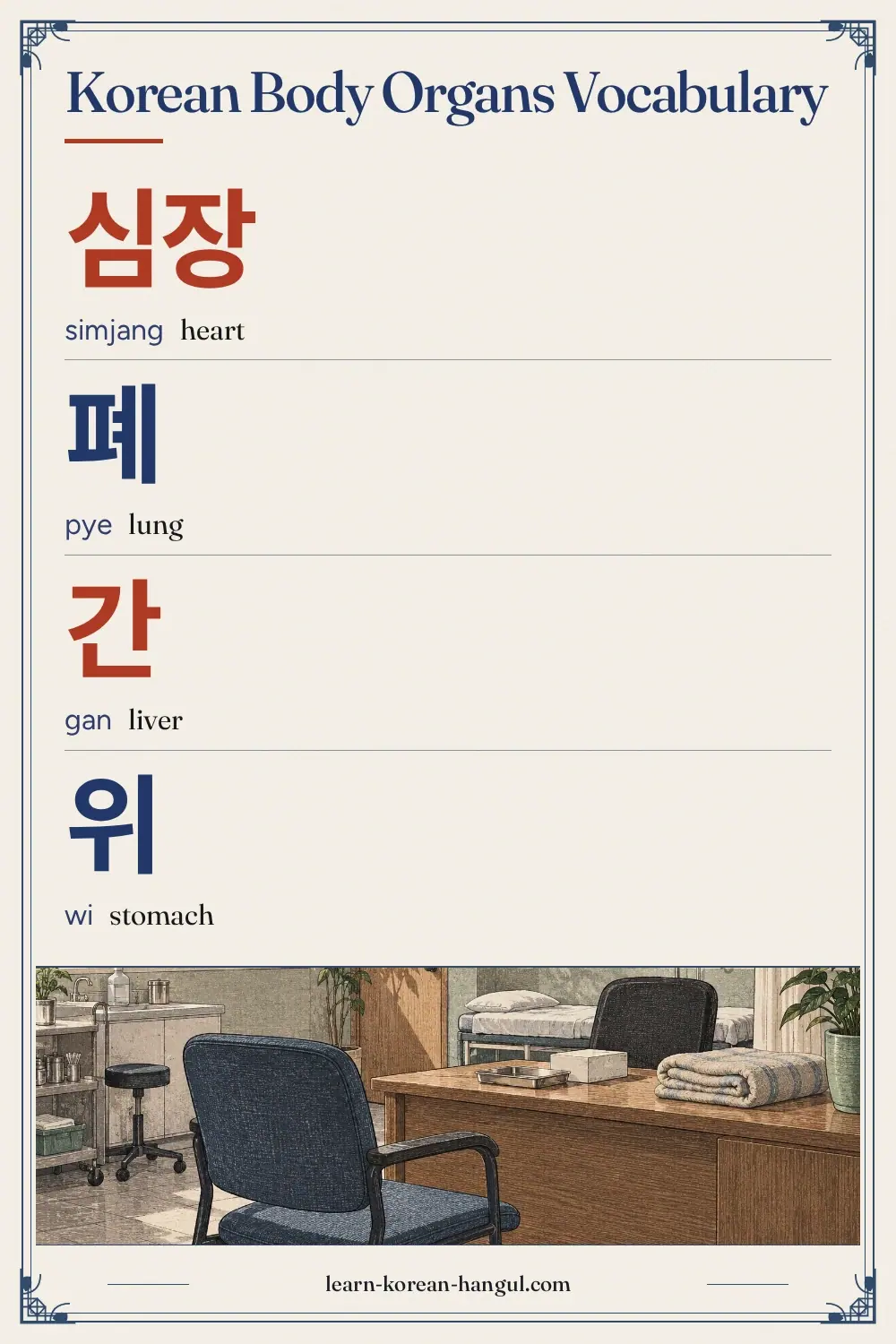
What you'll learn
- Match all 25 organ words to their English meanings.
- Say five of them aloud with the help of the Revised Romanization and the audio.
- Write two original sentences that use words such as 심장 (heart) and 폐 (lung).
- Tell an organ word from the everyday body part next to it, such as 위 (stomach) and 배 (belly).
Prerequisites: you can read Hangul and know the outer body words on Body Parts. Estimated time: about 75 minutes, plus short reviews on the following days.
Korean Body Organs Vocabulary at a Glance
The list has 25 words in five groups of five. It starts in the chest, moves down through the digestive system, goes up to the brain, and ends with the frame of the body and the blood. It belongs to Body Parts, which covers the outside of the body: head, arms, legs and hands.
| Group | Words | Use |
|---|---|---|
| Chest organs | 5 | Heart, lungs and breathing |
| Digestive organs | 5 | Stomach, liver and intestines |
| Brain and nerves | 5 | Thinking, feeling and the nervous system |
| Bones and muscles | 5 | The frame of the body |
| Blood and circulation | 5 | Blood, vessels and the kidneys |
This page is a themed list, so it gives you the words and a short model sentence for each one. For illness and doctor visits, continue with the health vocabulary, where symptoms and treatments are listed.
Which Body Organ Names Should You Learn First?
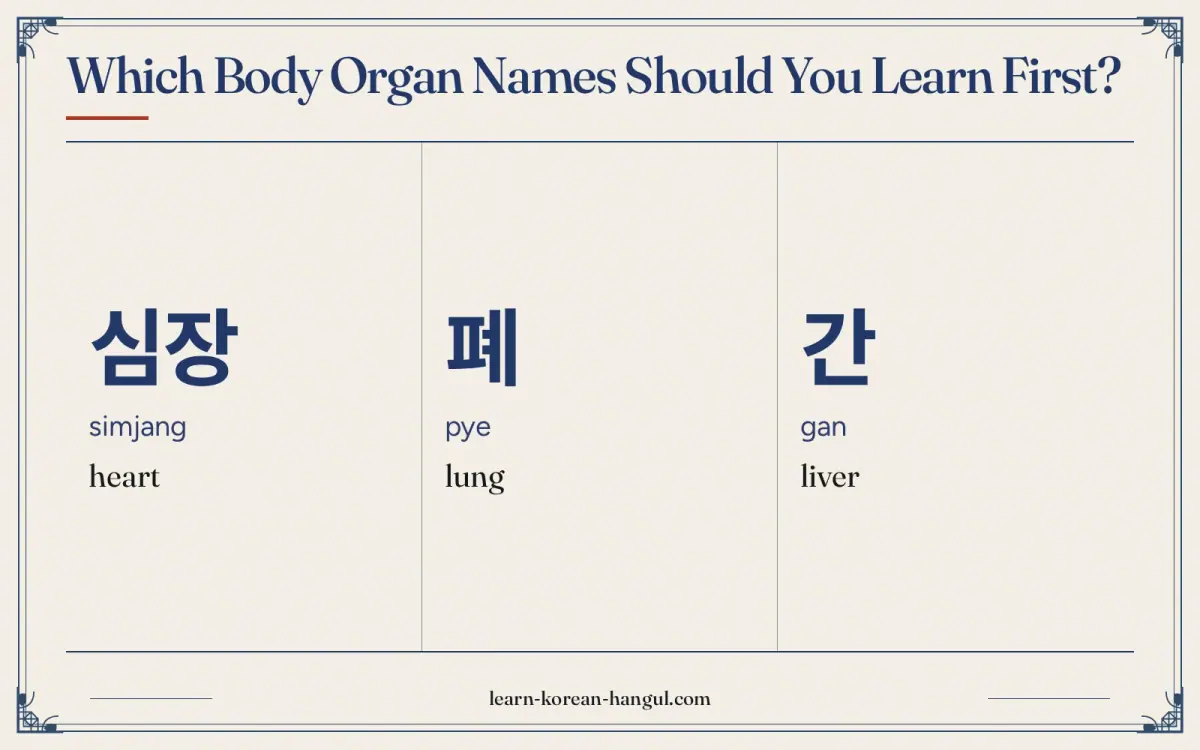
Learn 심장 (heart), 폐 (lung), 간 (liver), 위 (stomach) and 뇌 (brain) first. These five appear most often in health talk, news and school books. A short sentence such as 심장이 빨리 뛰어요 (my heart is beating fast) needs only the noun and a common verb. Then add the rest in this order:
- Step 1: the five core organs above.
- Step 2: 대장 and 소장 (the two intestines), plus 신장 (kidney) and 혈관 (blood vessel).
- Step 3: 뼈, 근육 and 관절, the words for the body's frame.
- Step 4: the medical extras, such as 횡격막, 척수 and 맥박.
The scene below numbers ten organs, so you can connect each word to a place in the body.
Word · 10
- 1
심장
simjang
heart
- 2
폐
pye
lung
- 3
간
gan
liver
- 4
위
wi
stomach
- 5
대장
daejang
large intestine
- 6
소장
sojang
small intestine
- 7
신장
sinjang
kidney
- 8
뇌
noe
brain
- 9
뼈
ppyeo
bone
- 10
혈관
hyeolgwan
blood vessel
Tap a number to hear the word. Notice how many names end in -장: it means an internal organ in many Sino-Korean words, which the next section explains.
Chest Organs
The chest holds the organs people mention most often. 심장 and 폐 are the headwords, and 가슴 is the everyday word for the chest as a body part. Doctors and patients use them together: you point to your 가슴 and name the organ that worries you.
| No. | Hangul | Revised Romanization | Meaning and note | Example sentence | Audio assetId |
|---|---|---|---|---|---|
| 1 | 심장 | simjang | heart. Sino-Korean, from 심 (heart) and 장 (organ). Also used figuratively for the centre of something. | 심장이 빨리 뛰어요. (simjangi ppalli ttwieoyo. My heart is beating fast.) | au-pg-vocabulary-people-body-organs-1; example: au-pg-vocabulary-people-body-organs-26 |
| 2 | 폐 | pye | lung. Medical and standard word. The older native word 허파 (heopa) is still heard. | 폐가 아파요. (pyega apayo. My lung hurts.) | au-pg-vocabulary-people-body-organs-2; example: au-pg-vocabulary-people-body-organs-27 |
| 3 | 기관지 | gigwanji | bronchial tube. The tubes that carry air to the lungs. Common in cough and cold talk. | 기관지가 약해요. (gigwanjiga yakaeyo. My bronchial tubes are weak.) | au-pg-vocabulary-people-body-organs-3; example: au-pg-vocabulary-people-body-organs-28 |
| 4 | 가슴 | gaseum | chest. Native word. It means the chest and also the breast area, and it is used for feelings too. | 가슴이 답답해요. (gaseumi dapdapaeyo. My chest feels tight.) | au-pg-vocabulary-people-body-organs-4; example: au-pg-vocabulary-people-body-organs-29 |
| 5 | 횡격막 | hoenggyeongmak | diaphragm. Sino-Korean. The muscle under the lungs that moves when you breathe. | 숨을 쉴 때 횡격막이 움직여요. (sumeul swil ttae hoenggyeongmagi umjigyeoyo. The diaphragm moves when you breathe.) | au-pg-vocabulary-people-body-organs-5; example: au-pg-vocabulary-people-body-organs-30 |
The -장 in 심장 is the same 장 (臟, organ) that ends 대장, 소장 and 신장 below. Once you know it, a new word ending in -장 is very likely an organ. 가슴 is the exception in this group, because it is a native word and names a part of the outside of the body as well. In the sentence 가슴이 답답해요, the word 답답해요 comes from the adjective 답답하다, which describes a stuffy or tight feeling.
How Do You Say Digestive Organs in Korean?
The digestive organs are 위, 간, 대장, 소장 and 식도. The group is called 소화 기관 (sohwa gigwan, digestive organs) in textbooks, and the whole system is the 소화계 (sohwagye). Learners meet 위 and 간 first, because both appear in health checks and in set phrases.
| No. | Hangul | Revised Romanization | Meaning and note | Example sentence | Audio assetId |
|---|---|---|---|---|---|
| 6 | 위 | wi | stomach. One syllable, same spelling as 위 (up, above). Context tells you which one. | 위가 아파서 약을 먹었어요. (wiga apaseo yageul meogeosseoyo. My stomach hurt, so I took medicine.) | au-pg-vocabulary-people-body-organs-6; example: au-pg-vocabulary-people-body-organs-31 |
| 7 | 간 | gan | liver. One syllable. Also the word for saltiness in cooking, so check the context. | 간 검사를 받아요. (gan geomsareul badayo. I am having a liver test.) | au-pg-vocabulary-people-body-organs-7; example: au-pg-vocabulary-people-body-organs-32 |
| 8 | 대장 | daejang | large intestine. Sino-Korean 대 (large) + 장 (organ). Not the same word as 대장 (a leader). | 대장 검사를 했어요. (daejang geomsareul haesseoyo. I had a colon check.) | au-pg-vocabulary-people-body-organs-8; example: au-pg-vocabulary-people-body-organs-33 |
| 9 | 소장 | sojang | small intestine. Sino-Korean 소 (small) + 장 (organ). It pairs with 대장. | 소장은 대장보다 길어요. (sojangeun daejangboda gireoyo. The small intestine is longer than the large intestine.) | au-pg-vocabulary-people-body-organs-9; example: au-pg-vocabulary-people-body-organs-34 |
| 10 | 식도 | sikdo | esophagus. From 식 (food) and 도 (road). The tube between the mouth and the stomach. | 식도는 입과 위를 연결해요. (sikdoneun ipgwa wireul yeongyeolhaeyo. The esophagus connects the mouth and the stomach.) | au-pg-vocabulary-people-body-organs-10; example: au-pg-vocabulary-people-body-organs-35 |
Do not confuse 위 (stomach) with 배 (belly). 배 is the outside of the body, the part you can pat, and it is the word you use for a stomach-ache in daily talk: 배가 아파요. 위 is the organ itself and is the word doctors and pharmacists use: 위가 안 좋아요 (my stomach is not good). The pair 대장 and 소장 is easy to remember because 대 and 소 mean big and small, as in 대형 (large size) and 소형 (small size). Watch out for the other 대장 (a leader or captain), which has the same spelling.
Brain and Nerves
Five words cover the nervous system. 뇌 is the organ, 두뇌 is the same organ seen as the seat of ability, 신경 means nerve, 척수 is the spinal cord, and 감각 is the sense of touch or feeling. They appear in medicine and also in everyday remarks about nerves and smartness.
| No. | Hangul | Revised Romanization | Meaning and note | Example sentence | Audio assetId |
|---|---|---|---|---|---|
| 11 | 뇌 | noe | brain. The everyday and medical word. One syllable, which most speakers say like nwe. | 뇌는 머리 안에 있어요. (noeneun meori ane isseoyo. The brain is inside the head.) | au-pg-vocabulary-people-body-organs-11; example: au-pg-vocabulary-people-body-organs-36 |
| 12 | 두뇌 | dunoe | brain (mental ability). Sino-Korean 두 (head) + 뇌 (brain). Used for intelligence. | 그 사람은 두뇌가 좋아요. (geu sarameun dunoega joayo. That person has a good brain.) | au-pg-vocabulary-people-body-organs-12; example: au-pg-vocabulary-people-body-organs-37 |
| 13 | 신경 | singyeong | nerve. Also means attention or worry, as in 신경 쓰다 (to care or fuss about). | 신경이 예민해요. (singyeongi yeminhaeyo. My nerves are sensitive.) | au-pg-vocabulary-people-body-organs-13; example: au-pg-vocabulary-people-body-organs-38 |
| 14 | 척수 | cheoksu | spinal cord. Sino-Korean 척 (spine) + 수 (marrow). Lies inside the 척추. | 척수는 척추 안에 있어요. (cheoksuneun cheokchu ane isseoyo. The spinal cord is inside the spine.) | au-pg-vocabulary-people-body-organs-14; example: au-pg-vocabulary-people-body-organs-39 |
| 15 | 감각 | gamgak | sense; feeling. The ability to feel touch, heat or pain. | 손가락에 감각이 없어요. (songarage gamgagi eopseoyo. I have no feeling in my finger.) | au-pg-vocabulary-people-body-organs-15; example: au-pg-vocabulary-people-body-organs-40 |
신경 is the most useful word here because it has a second life outside the body. 신경 쓰지 마세요 means do not worry about it, and the phrase 신경이 쓰이다 means something bothers you. Keep the literal body meaning and the figurative meaning in separate notes. 두뇌 is a good example of a word that is organ and ability in one: Koreans say a person has a good 두뇌 where English says a good head or a good brain.
How Do You Say Bones and Muscles in Korean?
The frame of the body has five words you will meet in sports, accidents and exercise talk. 뼈 is bone, 근육 is muscle, 관절 is joint, 척추 is the spine and 갈비뼈 is a rib. Only 뼈 is a native word; the others are Sino-Korean.
| No. | Hangul | Revised Romanization | Meaning and note | Example sentence | Audio assetId |
|---|---|---|---|---|---|
| 16 | 뼈 | ppyeo | bone. Native word. It starts with a tense ㅃ, written pp in Revised Romanization. | 뼈가 부러졌어요. (ppyeoga bureojyeosseoyo. A bone broke.) | au-pg-vocabulary-people-body-organs-16; example: au-pg-vocabulary-people-body-organs-41 |
| 17 | 근육 | geunyuk | muscle. Sino-Korean. Used in gym talk as well as in medicine. | 운동하면 근육이 생겨요. (undonghamyeon geunyugi saenggyeoyo. If you exercise, you build muscle.) | au-pg-vocabulary-people-body-organs-17; example: au-pg-vocabulary-people-body-organs-42 |
| 18 | 관절 | gwanjeol | joint. Sino-Korean 관 (connection) + 절 (joint). Knees and elbows are 관절. | 무릎 관절이 아파요. (mureup gwanjeori apayo. My knee joint hurts.) | au-pg-vocabulary-people-body-organs-18; example: au-pg-vocabulary-people-body-organs-43 |
| 19 | 척추 | cheokchu | spine. The line of bones down the back. Also called 등뼈 (deungppyeo). | 척추를 다쳤어요. (cheokchureul dachyeosseoyo. I hurt my spine.) | au-pg-vocabulary-people-body-organs-19; example: au-pg-vocabulary-people-body-organs-44 |
| 20 | 갈비뼈 | galbippyeo | rib. 갈비 (rib) + 뼈 (bone). 갈비 alone is also the food, ribs. | 갈비뼈는 가슴을 보호해요. (galbippyeoneun gaseumeul bohohaeyo. The ribs protect the chest.) | au-pg-vocabulary-people-body-organs-20; example: au-pg-vocabulary-people-body-organs-45 |
갈비뼈 shows how Korean builds new words by joining nouns: 갈비 plus 뼈 gives the rib bone, and 등 plus 뼈 gives 등뼈, the backbone. The same pattern gives 손뼈 (hand bone) and 다리뼈 (leg bone). In the examples, 부러졌어요 and 다쳤어요 are past tense forms of 부러지다 (to break, of a bone or branch) and 다치다 (to get hurt).
Blood and Circulation
This group links the blood to the organs that carry and clean it. 피 is the everyday word for blood, and 혈액 is the medical word. 혈관 are the vessels, 맥박 is the pulse, and 신장 is the kidney, which filters the blood.
| No. | Hangul | Revised Romanization | Meaning and note | Example sentence | Audio assetId |
|---|---|---|---|---|---|
| 21 | 피 | pi | blood. Native everyday word. Used in 피가 나요 (I am bleeding). | 피가 나요. (piga nayo. I am bleeding.) | au-pg-vocabulary-people-body-organs-21; example: au-pg-vocabulary-people-body-organs-46 |
| 22 | 혈액 | hyeoraek | blood (medical). Sino-Korean. Used on forms, in tests and in news. | 혈액 검사를 해요. (hyeoraek geomsareul haeyo. I have a blood test.) | au-pg-vocabulary-people-body-organs-22; example: au-pg-vocabulary-people-body-organs-47 |
| 23 | 혈관 | hyeolgwan | blood vessel. 혈 (blood) + 관 (tube). The ㄱ stays plain after ㄹ here. | 혈관을 따라 피가 흘러요. (hyeolgwaneul ttara piga heulleoyo. Blood flows along the vessels.) | au-pg-vocabulary-people-body-organs-23; example: au-pg-vocabulary-people-body-organs-48 |
| 24 | 맥박 | maekbak | pulse. Sino-Korean 맥 (pulse) + 박 (beat). Said with a tense second ㅂ. | 맥박을 재요. (maekbageul jaeyo. I take my pulse.) | au-pg-vocabulary-people-body-organs-24; example: au-pg-vocabulary-people-body-organs-49 |
| 25 | 신장 | sinjang | kidney. Also called 콩팥 (kongpat) in plain Korean, after the bean shape. 신장 also means height, which is a different word. | 신장은 피를 걸러요. (sinjangeun pireul geolleoyo. The kidneys filter the blood.) | au-pg-vocabulary-people-body-organs-25; example: au-pg-vocabulary-people-body-organs-50 |
The two blood words differ in register, not in meaning. 피 is what you say when you cut a finger, and 혈액 is what a nurse writes on the form. The same split is common in Korean: a native word for daily life and a Sino-Korean word for medicine and law. The verb in the vessel sentence, 흘러요, comes from 흐르다 and belongs to the 르 irregular class, which adds an extra ㄹ: 흐르다 becomes 흘러요. The kidney sentence uses 걸러요 from 거르다 in the same way.
Organ Words in Common Phrases
Organ words show up in sayings, and it is useful to know that the meaning is figurative. 간이 크다 (literally, the liver is big) means a person is bold or daring: 그 사람은 간이 커요 (that person is bold). Its opposite is 간이 작다 (the liver is small), a person who is timid. These are idioms. They do not describe a real liver, and a doctor would never use them. Another common phrase is 가슴이 두근거리다, which describes a pounding heart from nerves or excitement; the word for the organ there is 가슴, not 심장.
How Do You Pronounce Korean Body Organ Words?
Organ words are mostly short, but several change their sound inside the word. The National Institute of Korean Language (국립국어원) sets these changes in its standard pronunciation rules. Revised Romanization follows the spoken sound for nasal changes and linking, but it does not show tensing that comes from a neighbouring sound.
| Spelling | Sounds like | What changes |
|---|---|---|
| 횡격막 | [횡경막] | ㄱ turns into ㅇ before ㅁ. |
| 맥박 | [맥빡] | ㅂ is tensed after a final ㄱ, with no nasal change. |
| 식도 | [식또] | ㄷ is tensed after a final ㄱ. |
| 척수 | [척쑤] | ㅅ is tensed after a final ㄱ. |
| 혈액 | [혀랙] | The final ㄹ links to the vowel that follows. |
| 혈관 | [혈관] | No tensing: in Sino-Korean words ㄹ tenses only a following ㄷ, ㅅ or ㅈ. |
Audio and Slow Playback
Each word and sentence has its own clip. The five clips below play the harder words slowly. Play a clip, say the word, then play it again and compare the end of each syllable.
What Mistakes Do Learners Make with Body Organ Names?
Five patterns catch learners at the doctor's office.
- Using 위 for the belly. For a stomach-ache people say 배가 아파요. 위가 아파요 is correct but sounds more medical, as if you were describing the organ to a doctor.
- Mixing 대장 the organ with 대장 the leader. The spelling is the same. 대장 검사 means a colon check, while 골목대장 is the leader of the neighbourhood kids.
- Missing the second meaning of 신장. 신장 is also the formal word for a person's height, as on forms. Context decides: 신장 next to 체중 (body weight) on a form is height, while 신장이 안 좋아요 at the clinic is about the kidney. In plain talk the kidney is 콩팥.
- Taking idioms literally. 간이 크다 means bold, not that the liver is large. Learn it as one phrase.
- Reading 횡격막 as written. The sound is [횡경막]. The final ㄱ becomes ㅇ before ㅁ, so a speaker who says hoeng-gyeok-mak will be understood but sounds unnatural.
Learn the pair of registers first: native or everyday in the clinic waiting room, Sino-Korean in the examination room. The practice section turns the list into drills.
Practice: Flashcards and Worksheet
Study in three steps. First, run the deck in recognition mode until the 25 words feel familiar. Second, switch to listening mode and tap the clip before the card turns. Third, take the five-question quiz below. The deck stores your progress in your browser. The vocabulary flashcard decks page lists the other decks.
Practice · 55
- 01심장
Show answer
headword 1: heart
- 02폐
Show answer
headword 2: lung
- 03기관지
Show answer
headword 3: bronchial tube
- 04가슴
Show answer
headword 4: chest
- 05횡격막
Show answer
headword 5: diaphragm
- 06위
Show answer
headword 6: stomach
- 07간
Show answer
headword 7: liver
- 08대장
Show answer
headword 8: large intestine
- 09소장
Show answer
headword 9: small intestine
- 10식도
Show answer
headword 10: esophagus
- 11뇌
Show answer
headword 11: brain
- 12두뇌
Show answer
headword 12: brain (mental ability)
- 13신경
Show answer
headword 13: nerve
- 14척수
Show answer
headword 14: spinal cord
- 15감각
Show answer
headword 15: sense; feeling
- 16뼈
Show answer
headword 16: bone
- 17근육
Show answer
headword 17: muscle
- 18관절
Show answer
headword 18: joint
- 19척추
Show answer
headword 19: spine
- 20갈비뼈
Show answer
headword 20: rib
- 21피
Show answer
headword 21: blood
- 22혈액
Show answer
headword 22: blood (medical)
- 23혈관
Show answer
headword 23: blood vessel
- 24맥박
Show answer
headword 24: pulse
- 25신장
Show answer
headword 25: kidney
- 26심장이 빨리 뛰어요.
Show answer
example sentence for 심장
- 27폐가 아파요.
Show answer
example sentence for 폐
- 28기관지가 약해요.
Show answer
example sentence for 기관지
- 29가슴이 답답해요.
Show answer
example sentence for 가슴
- 30숨을 쉴 때 횡격막이 움직여요.
Show answer
example sentence for 횡격막
- 31위가 아파서 약을 먹었어요.
Show answer
example sentence for 위
- 32간 검사를 받아요.
Show answer
example sentence for 간
- 33대장 검사를 했어요.
Show answer
example sentence for 대장
- 34소장은 대장보다 길어요.
Show answer
example sentence for 소장
- 35식도는 입과 위를 연결해요.
Show answer
example sentence for 식도
- 36뇌는 머리 안에 있어요.
Show answer
example sentence for 뇌
- 37그 사람은 두뇌가 좋아요.
Show answer
example sentence for 두뇌
- 38신경이 예민해요.
Show answer
example sentence for 신경
- 39척수는 척추 안에 있어요.
Show answer
example sentence for 척수
- 40손가락에 감각이 없어요.
Show answer
example sentence for 감각
- 41뼈가 부러졌어요.
Show answer
example sentence for 뼈
- 42운동하면 근육이 생겨요.
Show answer
example sentence for 근육
- 43무릎 관절이 아파요.
Show answer
example sentence for 관절
- 44척추를 다쳤어요.
Show answer
example sentence for 척추
- 45갈비뼈는 가슴을 보호해요.
Show answer
example sentence for 갈비뼈
- 46피가 나요.
Show answer
example sentence for 피
- 47혈액 검사를 해요.
Show answer
example sentence for 혈액
- 48혈관을 따라 피가 흘러요.
Show answer
example sentence for 혈관
- 49맥박을 재요.
Show answer
example sentence for 맥박
- 50신장은 피를 걸러요.
Show answer
example sentence for 신장
- 51횡격막
Show answer
slow playback of 횡격막
- 52맥박
Show answer
slow playback of 맥박
- 53식도
Show answer
slow playback of 식도
- 54척수
Show answer
slow playback of 척수
- 55혈액
Show answer
slow playback of 혈액
Practice · 5
What does 심장 (simjang) mean?
Show answer
heart
심장 means heart. Example: 심장이 빨리 뛰어요. (My heart is beating fast.)
Which word is the organ for digestion that doctors call the stomach?
Show answer
위
위 is the stomach organ. 배 is the belly on the outside. Example: 위가 아파서 약을 먹었어요. (My stomach hurt, so I took medicine.)
What does 혈관 (hyeolgwan) mean?
Show answer
blood vessel
혈관 means blood vessel. Example: 혈관을 따라 피가 흘러요. (Blood flows along the vessels.)
Which word means spine?
Show answer
척추
척추 is the spine. 척수 is the spinal cord inside it. Example: 척추를 다쳤어요. (I hurt my spine.)
What does 간이 크다 mean as an idiom?
Show answer
to be bold
간이 크다 means a person is bold, literally the liver is big. Example: 그 사람은 간이 커요. (That person is bold.)
Korean Body Organs Vocabulary Worksheet (PDF)
A printable worksheet for these words (word list, matching, writing practice, fill-in-the-blank exercises and answer key) is available in A4 and US Letter from the download card on this page. For additional practice, copy the five groups by hand and say each word as you write it.
Where to Go Next
After this page, continue with the health vocabulary to use organ names with symptoms and the hospital, or return to Body Parts for the outside of the body.
Frequently Asked Questions
How Do You Say Heart in Korean?
Heart is 심장 (simjang). It has two syllables and no special sound change. The word is used for the organ and also for the centre of something. In daily talk you can also say 가슴 for the chest area when you feel nervous. The audio on this page plays 심장 and an example sentence.
How Do You Say Lung in Korean?
Lung is 폐 (pye). Korean does not mark the plural here, so 폐가 아파요 can mean my lung hurts or my lungs hurt. An older native word, 허파 (heopa), is still heard in daily speech. The standard allows 폐 to be said as pye or pe, and the audio plays one clear version.
How Many Body Organ Words Should I Learn First?
Five first: 심장, 폐, 간, 위 and 뇌. They let you name the main organs and follow a simple health conversation. At five new words a day the 25 words take a week with review. Add 대장, 소장, 신장 and 혈관 next.
What Does -장 Mean in Korean Organ Names?
In 심장, 대장, 소장 and 신장 the syllable 장 (臟) is a Sino-Korean element that means an internal organ. It helps you guess new organ names. It is not always an organ: 가장 and 시장 contain a different 장, so use it only as a hint.
Where Can I Practise Body Organ Words with Flashcards?
Use the vocabulary flashcard decks. The deck for this page holds all 25 words with Hangul, romanization and audio, in recognition and listening modes. Your progress stays in your browser. Give the group with 횡격막 and 맥박 extra time in listening mode.
Is There a Printable Worksheet for Body Organ Words?
A printable worksheet for these words (word list, matching, writing practice, fill-in-the-blank exercises and answer key) is available in A4 and US Letter from the download card on this page. For practice, the tables on this page can be copied by hand, and the deck carries the same 25 words.