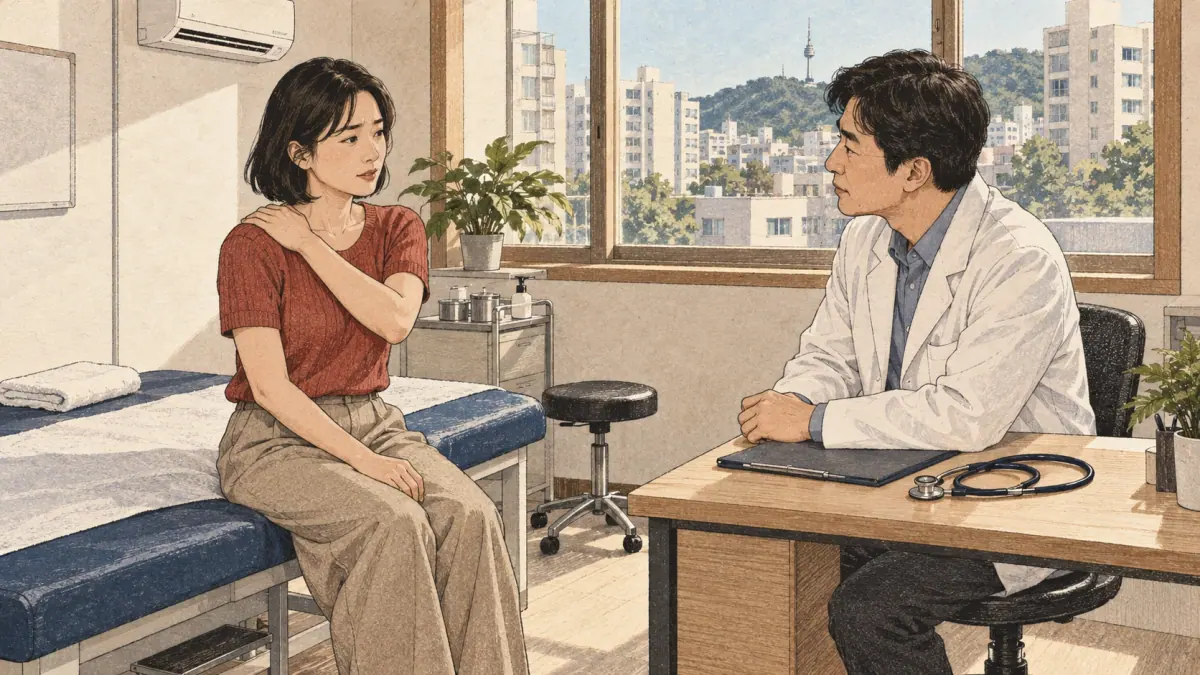
Korean Body Parts at a Glance
This list moves from the head down to the feet, then covers the torso and what is under the skin. It belongs to People and Relationships and links to the health words on health and medicine. Most body words are one syllable or two, native Korean, and used in the pattern body part + 이/가 + verb.
| Group | Words | Use |
|---|---|---|
| Head and face | 12 | The head, face and features |
| Arms and hands | 9 | From the shoulder to the fingernails |
| Legs and feet | 8 | From the hip to the sole |
| Torso and back | 8 | The body, neck, chest, belly and back |
| Skin, bones and blood | 8 | What is inside and on the body |
Which Body Part Words Should You Learn First?
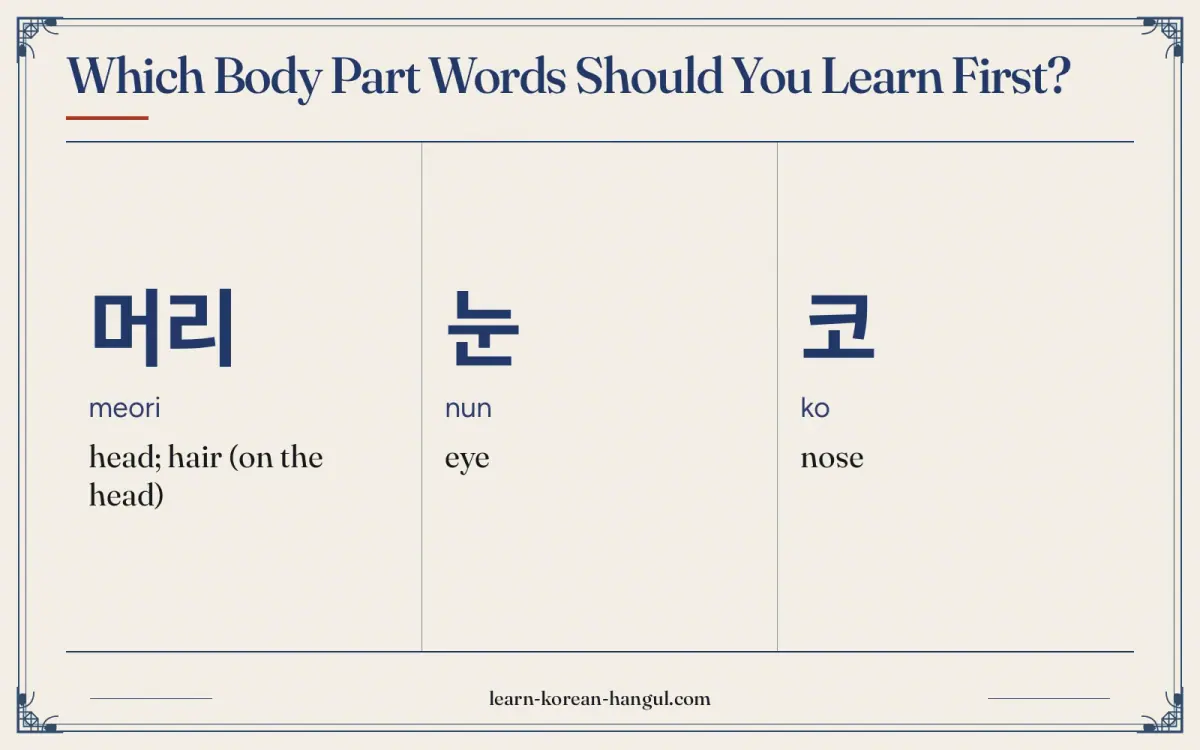
Learn 머리, 눈, 코, 입, 귀, 손, 발 and 배 first. They are short, common and the words for a doctor visit. Then add 팔, 다리, 등 and 목, which are the parts you describe when something hurts.
- Words to say. 머리, 눈, 코, 입, 귀, 손, 발, 배, 등.
- Words to recognise. 어깨, 무릎, 발목, 손목. They appear in sports and health talk.
- Words to attach to 아파요. 머리가, 배가, 목이, 허리가. These are the pain pattern you will use most.
Some words have more than one meaning. 눈 is eye and snow, 다리 is leg and bridge, 팔 is arm and eight, and 배 is belly, boat and pear. The scene below shows a labelled body figure with ten numbered parts.
Word · 10
- 1
머리
meori
head; hair (on the head)
- 2
눈
nun
eye
- 3
코
ko
nose
- 4
입
ip
mouth
- 5
귀
gwi
ear
- 6
팔
pal
arm
- 7
손
son
hand
- 8
다리
dari
leg
- 9
발
bal
foot
- 10
등
deung
back (of the body)
Head and Face
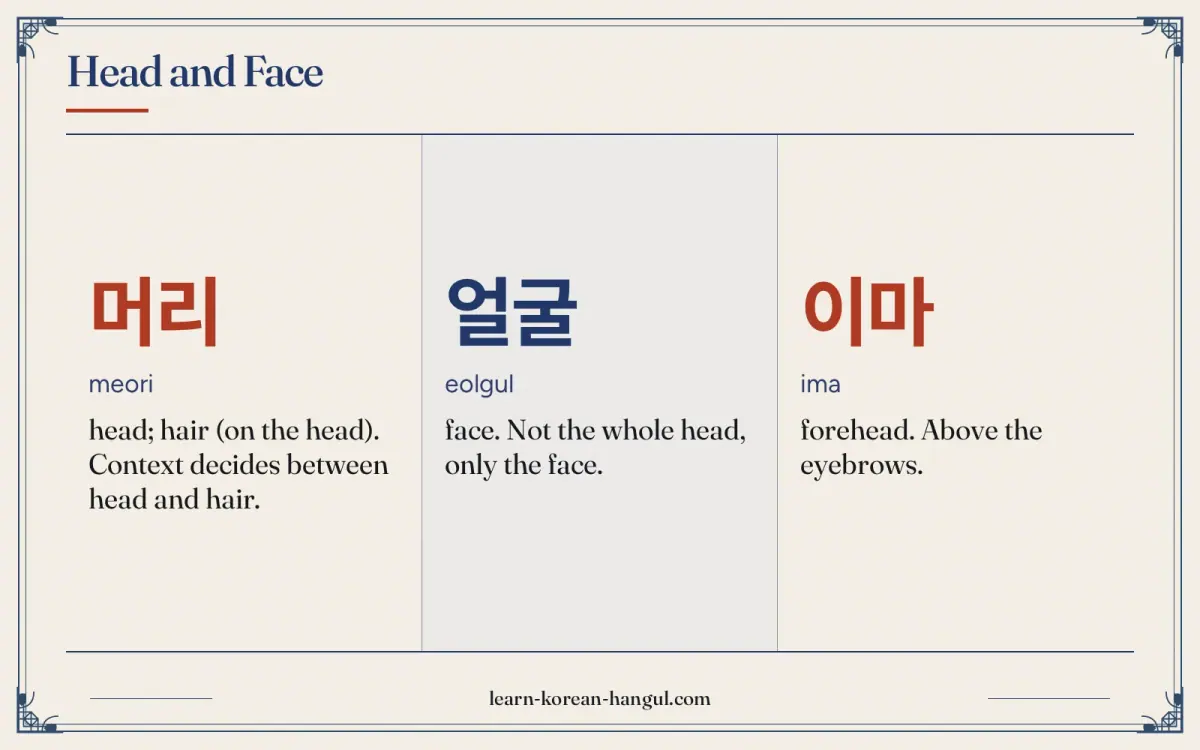
The head is 머리, and the face is 얼굴. The features follow in a fixed order: 이마 (forehead), 눈 (eye), 눈썹 (eyebrow), 코 (nose), 입 (mouth), 입술 (lip), 귀 (ear), 볼 (cheek), 턱 (jaw) and 혀 (tongue). 머리 also means the hair on the head, so 머리가 길어요 says the hair is long. For a single strand, see 머리카락 later in the list.
| No. | Hangul | Revised Romanization | Meaning and note | Example sentence | Audio assetId |
|---|---|---|---|---|---|
| 1 | 머리 | meori | head; hair (on the head). Context decides between head and hair. | 머리가 아파요. (I have a headache.) | au-pg-vocabulary-people-body-1; example: au-pg-vocabulary-people-body-46 |
| 2 | 얼굴 | eolgul | face. Not the whole head, only the face. | 얼굴이 빨개요. (Your face is red.) | au-pg-vocabulary-people-body-2; example: au-pg-vocabulary-people-body-47 |
| 3 | 이마 | ima | forehead. Above the eyebrows. | 이마가 넓어요. (The forehead is wide.) | au-pg-vocabulary-people-body-3; example: au-pg-vocabulary-people-body-48 |
| 4 | 눈 | nun | eye. Same spelling as 눈 (snow). | 눈이 커요. (The eyes are big.) | au-pg-vocabulary-people-body-4; example: au-pg-vocabulary-people-body-49 |
| 5 | 눈썹 | nunsseop | eyebrow. Said [눈썹]; 썹 has a tense ㅆ. | 눈썹이 짙어요. (The eyebrows are thick.) | au-pg-vocabulary-people-body-5; example: au-pg-vocabulary-people-body-50 |
| 6 | 코 | ko | nose. Also a nose-shaped thing. | 코가 막혔어요. (My nose is blocked.) | au-pg-vocabulary-people-body-6; example: au-pg-vocabulary-people-body-51 |
| 7 | 입 | ip | mouth. Said [입]; before 이 it is [이비]. | 입을 벌리세요. (Please open your mouth.) | au-pg-vocabulary-people-body-7; example: au-pg-vocabulary-people-body-52 |
| 8 | 입술 | ipsul | lip. Said [입쑬]. 입 + 술. | 입술이 말랐어요. (My lips are dry.) | au-pg-vocabulary-people-body-8; example: au-pg-vocabulary-people-body-53 |
| 9 | 귀 | gwi | ear. A single syllable with a glide. | 귀가 아파요. (My ear hurts.) | au-pg-vocabulary-people-body-9; example: au-pg-vocabulary-people-body-54 |
| 10 | 볼 | bol | cheek. Soft part of the face. | 볼이 통통해요. (The cheeks are chubby.) | au-pg-vocabulary-people-body-10; example: au-pg-vocabulary-people-body-55 |
| 11 | 턱 | teok | chin; jaw. Said [턱]. | 턱이 아파요. (My jaw hurts.) | au-pg-vocabulary-people-body-11; example: au-pg-vocabulary-people-body-56 |
| 12 | 혀 | hyeo | tongue. Used in doctor visits. | 혀를 내밀어 보세요. (Please stick out your tongue.) | au-pg-vocabulary-people-body-12; example: au-pg-vocabulary-people-body-57 |
Example Sentences
The pattern for pain is body part + 이/가 + 아파요, as in 귀가 아파요. 아프다 changes to 아파요 in the polite present. For a description, use body part + 이/가 + adjective, as in 눈이 커요. Korean usually drops the word for my because it is clear from the context. Say each sentence aloud after the audio.
The face has the largest group of words because it is the part people name most often. The arms and hands come next.
How Do You Say Arms and Hands in Korean?
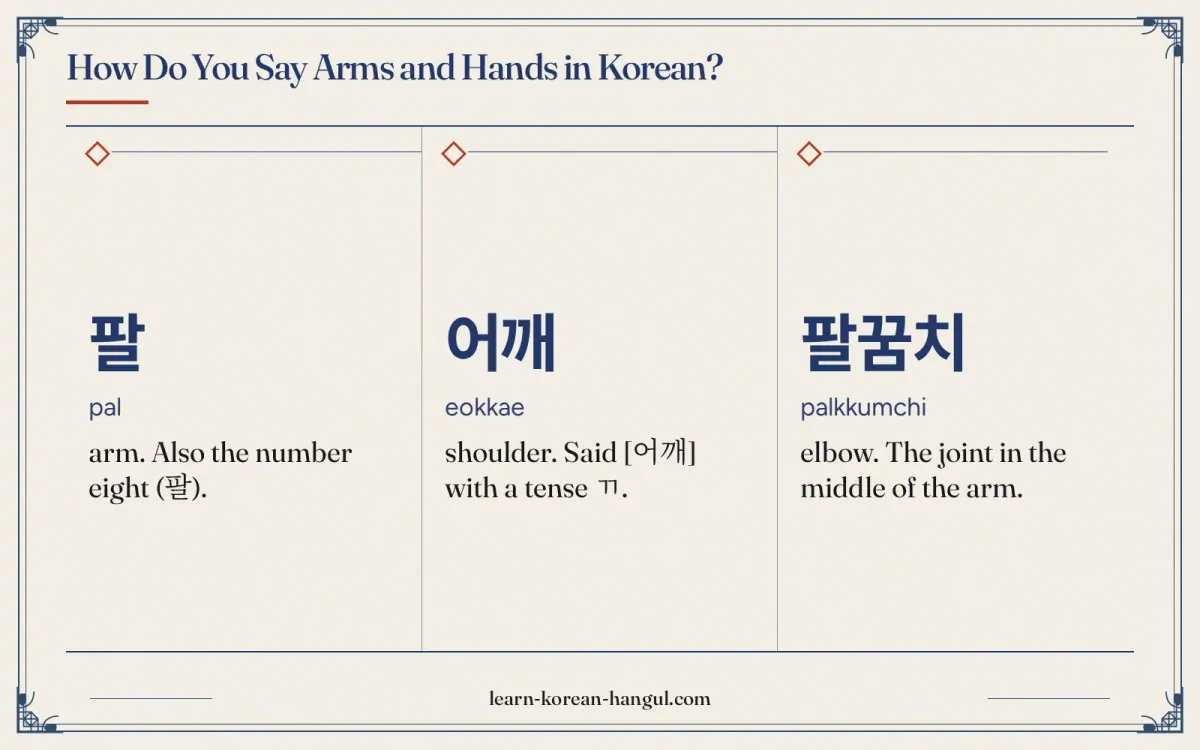
Korean separates the arm and the hand. 팔 is the arm, from the shoulder to the wrist, and 손 is the hand. The joints are 어깨 (shoulder), 팔꿈치 (elbow) and 손목 (wrist). The hand has 손가락 (finger), 손바닥 (palm), 손톱 (fingernail) and 주먹 (fist). The word 손 is also used in compounds for things you do by hand.
| No. | Hangul | Revised Romanization | Meaning and note | Example sentence | Audio assetId |
|---|---|---|---|---|---|
| 13 | 팔 | pal | arm. Also the number eight (팔). | 팔을 다쳤어요. (I hurt my arm.) | au-pg-vocabulary-people-body-13; example: au-pg-vocabulary-people-body-58 |
| 14 | 어깨 | eokkae | shoulder. Said [어깨] with a tense ㄲ. | 어깨가 아파요. (My shoulder hurts.) | au-pg-vocabulary-people-body-14; example: au-pg-vocabulary-people-body-59 |
| 15 | 팔꿈치 | palkkumchi | elbow. The joint in the middle of the arm. | 팔꿈치를 책상에 올리지 마세요. (Do not put your elbows on the desk.) | au-pg-vocabulary-people-body-15; example: au-pg-vocabulary-people-body-60 |
| 16 | 손목 | sonmok | wrist. Said [손목]. | 손목이 가늘어요. (The wrist is thin.) | au-pg-vocabulary-people-body-16; example: au-pg-vocabulary-people-body-61 |
| 17 | 손 | son | hand. The hand only, not the arm. | 손을 씻어요. (I wash my hands.) | au-pg-vocabulary-people-body-17; example: au-pg-vocabulary-people-body-62 |
| 18 | 손가락 | songarak | finger. Said [손까락]. 손 + 가락. | 손가락이 길어요. (The fingers are long.) | au-pg-vocabulary-people-body-18; example: au-pg-vocabulary-people-body-63 |
| 19 | 손바닥 | sonbadak | palm. Said [손빠닥]. 바닥 means floor or bottom. | 손바닥을 펴세요. (Please open your palm.) | au-pg-vocabulary-people-body-19; example: au-pg-vocabulary-people-body-64 |
| 20 | 손톱 | sontop | fingernail. A toenail is 발톱, with 발 (foot) in place of 손. | 손톱을 깎아요. (I cut my nails.) | au-pg-vocabulary-people-body-20; example: au-pg-vocabulary-people-body-65 |
| 21 | 주먹 | jumeok | fist. The verb is 쥐다 (to clench). | 주먹을 쥐어요. (I make a fist.) | au-pg-vocabulary-people-body-21; example: au-pg-vocabulary-people-body-66 |
If you hurt your hand, say 손을 다쳤어요. If you hurt your arm, say 팔을 다쳤어요. The two are different parts, so the right word matters at a clinic.
Legs and Feet
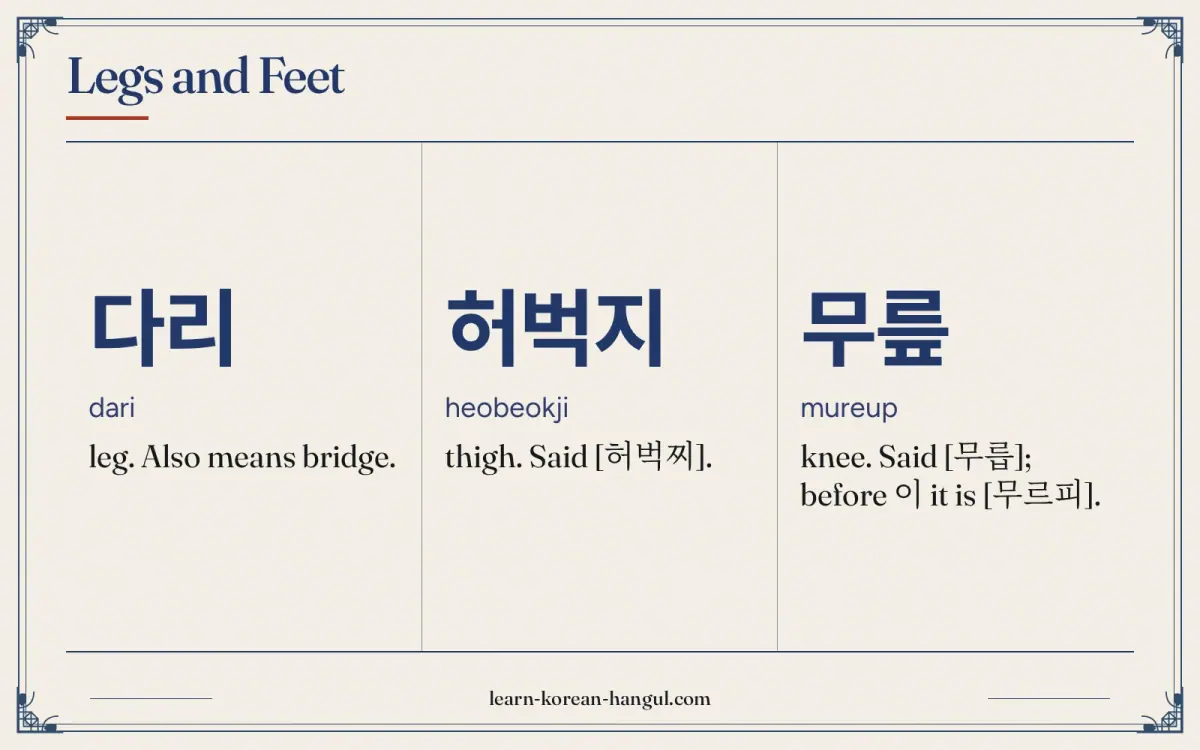
The leg is 다리, and the foot is 발. The leg has 허벅지 (thigh), 무릎 (knee), 종아리 (calf) and 발목 (ankle). The foot has 발가락 (toe) and 발바닥 (sole). The word 다리 is also a bridge, and the context shows which. The same pattern as the hand applies: 손 is to 팔 as 발 is to 다리.
| No. | Hangul | Revised Romanization | Meaning and note | Example sentence | Audio assetId |
|---|---|---|---|---|---|
| 22 | 다리 | dari | leg. Also means bridge. | 다리가 길어요. (The legs are long.) | au-pg-vocabulary-people-body-22; example: au-pg-vocabulary-people-body-67 |
| 23 | 허벅지 | heobeokji | thigh. Said [허벅찌]. | 허벅지가 아파요. (My thigh hurts.) | au-pg-vocabulary-people-body-23; example: au-pg-vocabulary-people-body-68 |
| 24 | 무릎 | mureup | knee. Said [무릅]; before 이 it is [무르피]. | 무릎이 아파요. (My knee hurts.) | au-pg-vocabulary-people-body-24; example: au-pg-vocabulary-people-body-69 |
| 25 | 종아리 | jongari | calf. The back of the lower leg. | 종아리에 쥐가 났어요. (I got a cramp in my calf.) | au-pg-vocabulary-people-body-25; example: au-pg-vocabulary-people-body-70 |
| 26 | 발목 | balmok | ankle. Said [발목]. | 발목을 삐었어요. (I sprained my ankle.) | au-pg-vocabulary-people-body-26; example: au-pg-vocabulary-people-body-71 |
| 27 | 발 | bal | foot. The foot only, not the leg. | 발이 커요. (The feet are big.) | au-pg-vocabulary-people-body-27; example: au-pg-vocabulary-people-body-72 |
| 28 | 발가락 | balgarak | toe. Said [발까락]. | 발가락이 열 개 있어요. (I have ten toes.) | au-pg-vocabulary-people-body-28; example: au-pg-vocabulary-people-body-73 |
| 29 | 발바닥 | balbadak | sole of the foot. Said [발빠닥]. | 발바닥이 뜨거워요. (The soles of my feet are hot.) | au-pg-vocabulary-people-body-29; example: au-pg-vocabulary-people-body-74 |
When you talk about being tired from walking, say 다리가 아파요 (my legs hurt) or 발이 아파요 (my feet hurt), depending on where it hurts.
How Do You Say Torso and Back in Korean?
몸 is the whole body. 목 joins the head and body and covers both the neck and the throat. Below it are 가슴 (chest), 배 (belly), 등 (back), 허리 (waist or lower back) and 엉덩이 (bottom). 배꼽 is the belly button. 배 has three meanings: belly, boat and pear. 등 also means a lamp or light. The sentence tells you which.
| No. | Hangul | Revised Romanization | Meaning and note | Example sentence | Audio assetId |
|---|---|---|---|---|---|
| 30 | 몸 | mom | body. The whole body. | 몸이 안 좋아요. (I do not feel well.) | au-pg-vocabulary-people-body-30; example: au-pg-vocabulary-people-body-75 |
| 31 | 목 | mok | neck; throat. Used for both neck and throat. | 목이 아파요. (My neck or throat hurts.) | au-pg-vocabulary-people-body-31; example: au-pg-vocabulary-people-body-76 |
| 32 | 가슴 | gaseum | chest. Also used for the heart in feelings. | 가슴이 두근거려요. (My heart is pounding.) | au-pg-vocabulary-people-body-32; example: au-pg-vocabulary-people-body-77 |
| 33 | 배 | bae | belly; stomach. Also boat and pear. | 배가 고파요. (I am hungry.) | au-pg-vocabulary-people-body-33; example: au-pg-vocabulary-people-body-78 |
| 34 | 등 | deung | back (of the body). Also lamp or light. | 등이 아파요. (My back hurts.) | au-pg-vocabulary-people-body-34; example: au-pg-vocabulary-people-body-79 |
| 35 | 허리 | heori | waist; lower back. Used for lower back pain. | 허리를 다쳤어요. (I hurt my lower back.) | au-pg-vocabulary-people-body-35; example: au-pg-vocabulary-people-body-80 |
| 36 | 엉덩이 | eongdeongi | buttocks; bottom. Casual and non-technical. | 넘어져서 엉덩이를 다쳤어요. (I fell and hurt my bottom.) | au-pg-vocabulary-people-body-36; example: au-pg-vocabulary-people-body-81 |
| 37 | 배꼽 | baekkop | belly button. Said [배꼽]. | 배꼽이 간지러워요. (My belly button is itchy.) | au-pg-vocabulary-people-body-37; example: au-pg-vocabulary-people-body-82 |
배가 고파요 means I am hungry, and 배가 아파요 means my stomach hurts. Those two sentences are among the first you will hear in daily life.
Skin, Bones and Blood
This group goes beneath the surface. 피부 is skin, 뼈 is bone, 근육 is muscle and 피 is blood. 땀 is sweat. 머리카락 is a strand of hair, and 치아 is the formal word for teeth. 심장 is the heart as an organ. For the feeling heart, use 마음. See Korean Body Organs Vocabulary.
| No. | Hangul | Revised Romanization | Meaning and note | Example sentence | Audio assetId |
|---|---|---|---|---|---|
| 38 | 피부 | pibu | skin. Used for the skin of the body. | 피부가 건조해요. (The skin is dry.) | au-pg-vocabulary-people-body-38; example: au-pg-vocabulary-people-body-83 |
| 39 | 뼈 | ppyeo | bone. Tense ㅃ at the start. | 뼈가 부러졌어요. (A bone broke.) | au-pg-vocabulary-people-body-39; example: au-pg-vocabulary-people-body-84 |
| 40 | 근육 | geunyuk | muscle. Said [그뉵]. | 운동하면 근육이 생겨요. (If you exercise, you build muscle.) | au-pg-vocabulary-people-body-40; example: au-pg-vocabulary-people-body-85 |
| 41 | 피 | pi | blood. The verb is 나다 (to come out). | 피가 나요. (I am bleeding.) | au-pg-vocabulary-people-body-41; example: au-pg-vocabulary-people-body-86 |
| 42 | 머리카락 | meorikarak | hair (strand). A single hair or the hair on the head. | 머리카락이 길어요. (The hair is long.) | au-pg-vocabulary-people-body-42; example: au-pg-vocabulary-people-body-87 |
| 43 | 치아 | chia | teeth. The formal word; 이 is the plain word. | 치아가 건강해요. (The teeth are healthy.) | au-pg-vocabulary-people-body-43; example: au-pg-vocabulary-people-body-88 |
| 44 | 심장 | simjang | heart (organ). For feelings, use 마음. | 심장이 빨리 뛰어요. (The heart beats fast.) | au-pg-vocabulary-people-body-44; example: au-pg-vocabulary-people-body-89 |
| 45 | 땀 | ttam | sweat. Tense ㄸ at the start. | 땀이 나요. (I am sweating.) | au-pg-vocabulary-people-body-45; example: au-pg-vocabulary-people-body-90 |
These words appear mostly in health talk, so learn them with a sentence such as 피가 나요 (I am bleeding) or 땀이 나요 (I am sweating). Both use the verb 나다, to come out.
Body-Part Idioms and Counting
Body words are the base of many Korean idioms. Two are common early: 손이 크다 means generous or given to large portions, and 발이 넓다 means well-connected, with a wide social network. Idioms like these are collected on Korean idioms.
| Idiom | Revised Romanization | Meaning |
|---|---|---|
| 손이 크다 | soni keuda | generous; gives large portions |
| 발이 넓다 | bari neolda | well-connected |
Body words are often counted with 개 for a single item, as in 손가락 열 개 (ten fingers). Pairs such as eyes and arms are often said with 두, as in 두 눈 and 두 팔. Check the listed counter before you count in a test.
How Do You Pronounce These Words?
Body words show two common sound changes: tensing, where the sound after a final consonant becomes tight, and linking, where a final consonant moves onto the next syllable. Standard pronunciation follows the National Institute of Korean Language (국립국어원) rules, and the romanization follows the Revised Romanization of Korean, which does not mark every sound change.
| Spelling | Sounds like | What changes |
|---|---|---|
| 입술 | [입쑬] | After final ㅂ, ㅅ becomes tense [ㅆ]. |
| 손가락 | [손까락] | After final ㄴ in a compound, ㄱ becomes tense [ㄲ]. |
| 손바닥 | [손빠닥] | The same: ㅂ becomes tense [ㅃ]. |
| 허벅지 | [허벅찌] | After final ㄱ, ㅈ becomes tense [ㅉ]. |
| 무릎 | [무릅] | Final ㅍ is said as [ㅂ]; before 이 it is [무르피]. |
| 근육 | [그뉵] | The final ㄴ of 근 moves onto the empty ㅇ of 육. |
The tense sounds in 손가락, 손바닥 and 발바닥 are a quick win. In these compounds, say the sound after 손 or 발 tight. Compare them with the plain sounds in 가슴 and 바닥 on its own.
Audio and Slow Playback
Each word and sentence has its own clip. The five clips below replay the hardest words slowly. Play one, repeat it aloud, then play it again and compare.
What Mistakes Do Learners Make with Body Part Words?
Five mistakes come up again and again.
- Adding my every time. 제 머리가 아파요 is correct but heavy. Say 머리가 아파요, since the owner is clear.
- Mixing up homophones. 눈 (eye or snow), 다리 (leg or bridge), 팔 (arm or eight) and 배 (belly, boat or pear) are spelled the same, and the rest of the sentence tells you which.
- Using 목 for only the neck. 목이 아파요 can mean my throat hurts, so the sentence decides. 목구멍 names the inside of the throat.
- Using 손 for arm. 손 is the hand. For the arm, say 팔.
- Using 머리 for hair only. 머리 is the head and also the hair. Say 머리카락 for a single hair.
Most mistakes here come from words with more than one meaning. Pair each word with a verb the first time you learn it. The practice section turns the list into drills.
Practice: Flashcards and Worksheet
Use three steps. Run the flashcard deck in recognition mode until the 45 words come quickly. Switch to listening mode, then take the quiz. The deck holds every word on this page with audio, and your progress stays in your browser. The vocabulary flashcard decks page lists the other decks.
Practice · 95
- 01머리
Show answer
headword 1: head; hair (on the head)
- 02얼굴
Show answer
headword 2: face
- 03이마
Show answer
headword 3: forehead
- 04눈
Show answer
headword 4: eye
- 05눈썹
Show answer
headword 5: eyebrow
- 06코
Show answer
headword 6: nose
- 07입
Show answer
headword 7: mouth
- 08입술
Show answer
headword 8: lip
- 09귀
Show answer
headword 9: ear
- 10볼
Show answer
headword 10: cheek
- 11턱
Show answer
headword 11: chin; jaw
- 12혀
Show answer
headword 12: tongue
- 13팔
Show answer
headword 13: arm
- 14어깨
Show answer
headword 14: shoulder
- 15팔꿈치
Show answer
headword 15: elbow
- 16손목
Show answer
headword 16: wrist
- 17손
Show answer
headword 17: hand
- 18손가락
Show answer
headword 18: finger
- 19손바닥
Show answer
headword 19: palm
- 20손톱
Show answer
headword 20: fingernail
- 21주먹
Show answer
headword 21: fist
- 22다리
Show answer
headword 22: leg
- 23허벅지
Show answer
headword 23: thigh
- 24무릎
Show answer
headword 24: knee
- 25종아리
Show answer
headword 25: calf
- 26발목
Show answer
headword 26: ankle
- 27발
Show answer
headword 27: foot
- 28발가락
Show answer
headword 28: toe
- 29발바닥
Show answer
headword 29: sole of the foot
- 30몸
Show answer
headword 30: body
- 31목
Show answer
headword 31: neck; throat
- 32가슴
Show answer
headword 32: chest
- 33배
Show answer
headword 33: belly; stomach
- 34등
Show answer
headword 34: back (of the body)
- 35허리
Show answer
headword 35: waist; lower back
- 36엉덩이
Show answer
headword 36: buttocks; bottom
- 37배꼽
Show answer
headword 37: belly button
- 38피부
Show answer
headword 38: skin
- 39뼈
Show answer
headword 39: bone
- 40근육
Show answer
headword 40: muscle
- 41피
Show answer
headword 41: blood
- 42머리카락
Show answer
headword 42: hair (strand)
- 43치아
Show answer
headword 43: teeth
- 44심장
Show answer
headword 44: heart (organ)
- 45땀
Show answer
headword 45: sweat
- 46머리가 아파요.
Show answer
example sentence for 머리
- 47얼굴이 빨개요.
Show answer
example sentence for 얼굴
- 48이마가 넓어요.
Show answer
example sentence for 이마
- 49눈이 커요.
Show answer
example sentence for 눈
- 50눈썹이 짙어요.
Show answer
example sentence for 눈썹
- 51코가 막혔어요.
Show answer
example sentence for 코
- 52입을 벌리세요.
Show answer
example sentence for 입
- 53입술이 말랐어요.
Show answer
example sentence for 입술
- 54귀가 아파요.
Show answer
example sentence for 귀
- 55볼이 통통해요.
Show answer
example sentence for 볼
- 56턱이 아파요.
Show answer
example sentence for 턱
- 57혀를 내밀어 보세요.
Show answer
example sentence for 혀
- 58팔을 다쳤어요.
Show answer
example sentence for 팔
- 59어깨가 아파요.
Show answer
example sentence for 어깨
- 60팔꿈치를 책상에 올리지 마세요.
Show answer
example sentence for 팔꿈치
- 61손목이 가늘어요.
Show answer
example sentence for 손목
- 62손을 씻어요.
Show answer
example sentence for 손
- 63손가락이 길어요.
Show answer
example sentence for 손가락
- 64손바닥을 펴세요.
Show answer
example sentence for 손바닥
- 65손톱을 깎아요.
Show answer
example sentence for 손톱
- 66주먹을 쥐어요.
Show answer
example sentence for 주먹
- 67다리가 길어요.
Show answer
example sentence for 다리
- 68허벅지가 아파요.
Show answer
example sentence for 허벅지
- 69무릎이 아파요.
Show answer
example sentence for 무릎
- 70종아리에 쥐가 났어요.
Show answer
example sentence for 종아리
- 71발목을 삐었어요.
Show answer
example sentence for 발목
- 72발이 커요.
Show answer
example sentence for 발
- 73발가락이 열 개 있어요.
Show answer
example sentence for 발가락
- 74발바닥이 뜨거워요.
Show answer
example sentence for 발바닥
- 75몸이 안 좋아요.
Show answer
example sentence for 몸
- 76목이 아파요.
Show answer
example sentence for 목
- 77가슴이 두근거려요.
Show answer
example sentence for 가슴
- 78배가 고파요.
Show answer
example sentence for 배
- 79등이 아파요.
Show answer
example sentence for 등
- 80허리를 다쳤어요.
Show answer
example sentence for 허리
- 81넘어져서 엉덩이를 다쳤어요.
Show answer
example sentence for 엉덩이
- 82배꼽이 간지러워요.
Show answer
example sentence for 배꼽
- 83피부가 건조해요.
Show answer
example sentence for 피부
- 84뼈가 부러졌어요.
Show answer
example sentence for 뼈
- 85운동하면 근육이 생겨요.
Show answer
example sentence for 근육
- 86피가 나요.
Show answer
example sentence for 피
- 87머리카락이 길어요.
Show answer
example sentence for 머리카락
- 88치아가 건강해요.
Show answer
example sentence for 치아
- 89심장이 빨리 뛰어요.
Show answer
example sentence for 심장
- 90땀이 나요.
Show answer
example sentence for 땀
- 91입술
Show answer
slow playback: 입술
- 92손바닥
Show answer
slow playback: 손바닥
- 93허벅지
Show answer
slow playback: 허벅지
- 94무릎
Show answer
slow playback: 무릎
- 95근육
Show answer
slow playback: 근육
Practice · 5
What does 팔 (pal) mean?
Show answer
arm
팔 means arm. Example: 팔을 다쳤어요. (I hurt my arm.)
What does 머리 (meori) mean?
Show answer
head; hair (on the head)
머리 means head; hair (on the head). Example: 머리가 아파요. (I have a headache.)
What does 목 (mok) mean?
Show answer
neck; throat
목 means neck; throat. Example: 목이 아파요. (My neck or throat hurts.)
What does 뼈 (ppyeo) mean?
Show answer
bone
뼈 means bone. Example: 뼈가 부러졌어요. (A bone broke.)
What does 땀 (ttam) mean?
Show answer
sweat
땀 means sweat. Example: 땀이 나요. (I am sweating.)
Korean Body Parts Worksheet (PDF)
A printable worksheet for these words (word list, matching, writing practice, fill-in-the-blank exercises and answer key) is available in A4 and US Letter from the download card on this page. For practice, draw a person and label ten parts in Korean, or stick notes on yourself before you read the lists aloud.
Where to Go Next
After this page, continue with Korean Body Organs Vocabulary or Personality and Appearance. For jobs that use these words, see Jobs and Occupations. To move up a level, return to People and Relationships.
Pages in This Section
See Korean Body Organs Vocabulary.
Frequently Asked Questions
How Do You Say Arm in Korean?
Arm is 팔 (pal). Say 팔을 다쳤어요 for I hurt my arm. 팔 is also the number eight in Sino-Korean numbers, so the sentence shows which one is meant. The hand is a different word, 손.
How Do You Pronounce 등 (deung)?
Say deung with one syllable. The vowel ㅡ is said with the lips spread and not rounded, and the word ends with ㅇ as in sing. Press the audio button on this page to hear the word and the slow clip.
How Many Body Part Words Should I Learn First?
Start with about eight: 머리, 눈, 코, 입, 귀, 손, 발 and 배. They are short and cover most doctor visits. Then add 팔, 다리, 등 and 목. The whole list of 45 takes about nine days at five new words a day, with a short review of earlier words each day.
Where Can I Practise Body Part Words with Flashcards?
Use the deck on this page, which holds all 45 words with Hangul, romanization and audio, in recognition and listening modes. The vocabulary flashcard decks page lists the decks for the other people topics. Progress is saved only in your browser.
Is the Romanization on This Page Official?
It follows the Revised Romanization of Korean, which South Korea adopted on 7 July 2000 and whose rules the National Institute of Korean Language (국립국어원) publishes. It is a learning aid and does not mark every sound change, so rely on the Hangul and the audio.
Is There a Printable Worksheet for Body Part Words?
A printable worksheet for these words (word list, matching, writing practice, fill-in-the-blank exercises and answer key) is available in A4 and US Letter from the download card on this page. For practice, use the flashcard deck, which carries the same 45 words, or copy the tables by hand. You can also draw a person and label ten parts in Korean from memory.