
Korean Emotions Vocabulary at a Glance
This page lists the noun forms of feelings. Many of them have an adjective partner that you use in everyday speech: 행복 is the noun and 행복해요 is I am happy. The adjectives are covered on Feeling Adjectives, and this list gives you the nouns that sit in news, songs, diaries and sentences like 걱정이 많아요. It belongs to People and Relationships.
| Group | Words | Use |
|---|---|---|
| Happy and positive | 8 | Joy, satisfaction, mood, luck and hope |
| Sad and lonely | 8 | Sadness, loneliness, regret and emotional hurt |
| Angry and annoyed | 8 | Anger, irritation, jealousy and stress |
| Worried and afraid | 8 | Worry, fear, nervousness and pressure |
| Surprised, moved, love and longing | 8 | Surprise, deep emotion, love and culture-bound feelings |
Which Emotion Words Should You Learn First?
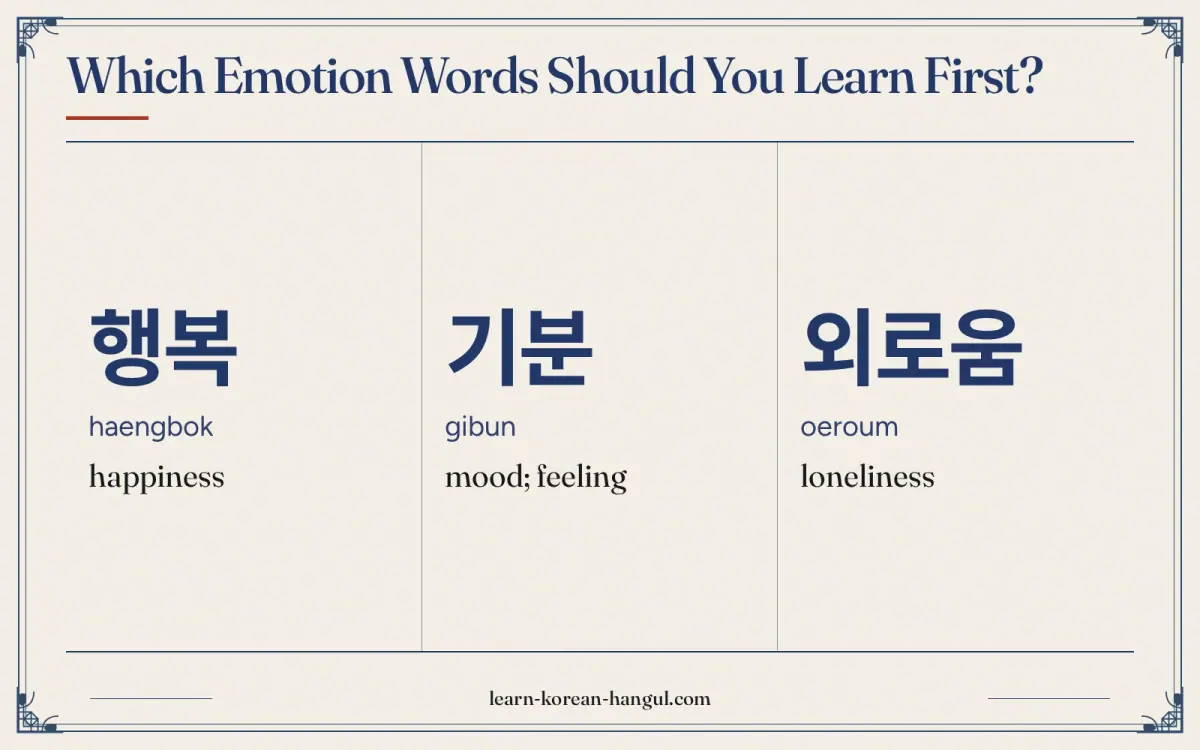
Learn 기분, 행복, 슬픔, 화, 걱정 and 사랑 first. They name the main feelings and give you the frame 기분이 좋아요 for daily use. Then add 외로움, 불안 and 짜증, which appear in conversation, and 정 and 눈치, which appear in culture talk.
- Words to say. 기분, 행복, 걱정, 사랑, 화, 감사.
- Words to recognise. 분노, 불안, 억울함, 공포. They appear in news and film.
- Words to learn as culture. 정, 눈치, 설렘, 그리움. They carry meanings English splits across several words.
Register matters: 분노 is the formal news word for anger, and 화 is the everyday word. The scene below shows a row of faces, with ten of them numbered to match the list.
Word · 10
- 1
행복
haengbok
happiness
- 2
기분
gibun
mood; feeling
- 3
외로움
oeroum
loneliness
- 4
화
hwa
anger
- 5
짜증
jjajeung
irritation
- 6
걱정
geokjeong
worry
- 7
불안
buran
anxiety; unease
- 8
놀람
nollam
surprise
- 9
그리움
geurium
longing; missing someone
- 10
눈치
nunchi
social awareness; reading the mood
Happy and Positive
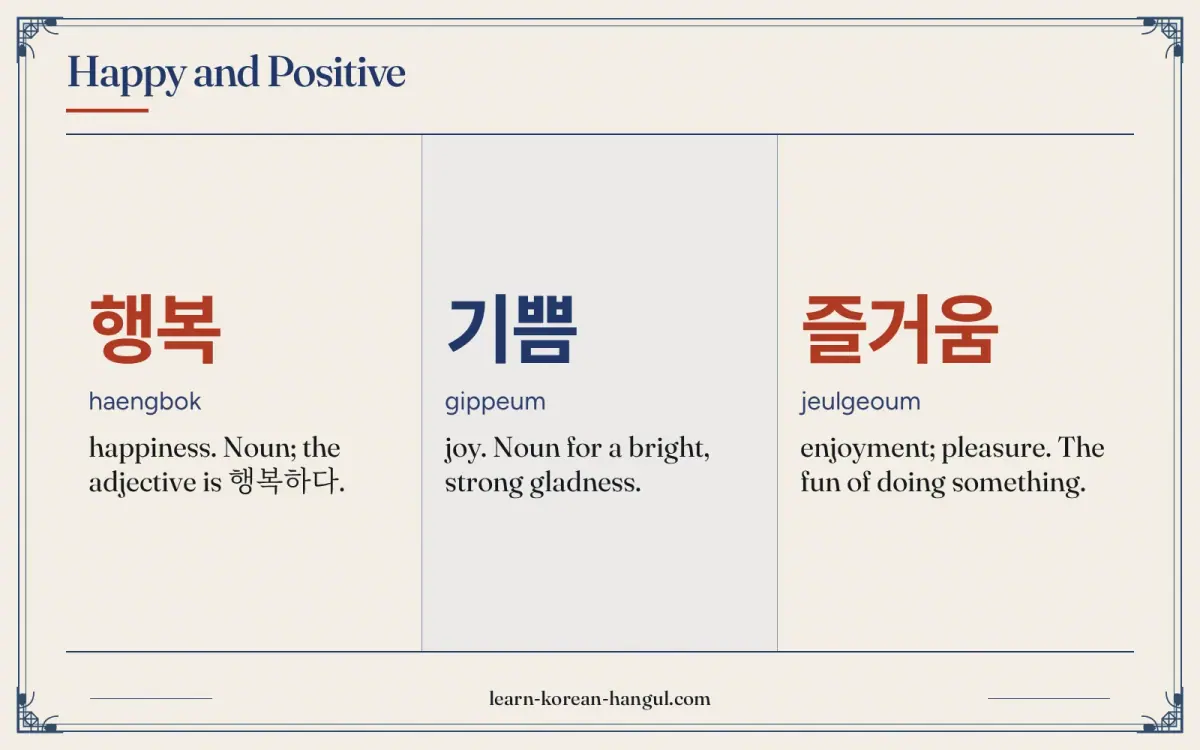
Positive feelings begin with 행복 (happiness), 기쁨 (joy) and 즐거움 (enjoyment). 웃음 is laughter or a smile, and 만족 is satisfaction. 기분 is not a feeling by itself but your mood at the moment, and it is the key word for asking how someone feels. 행운 (luck) and 꿈 (dream or hope) round out the group, since people talk about both with warm feelings.
| No. | Hangul | Revised Romanization | Meaning and note | Example sentence | Audio assetId |
|---|---|---|---|---|---|
| 1 | 행복 | haengbok | happiness. Noun; the adjective is 행복하다. | 가족과 함께라서 행복해요. (I am happy because I am with my family.) | au-pg-vocabulary-people-emotions-1; example: au-pg-vocabulary-people-emotions-41 |
| 2 | 기쁨 | gippeum | joy. Noun for a bright, strong gladness. | 기쁨의 눈물을 흘렸어요. (I shed tears of joy.) | au-pg-vocabulary-people-emotions-2; example: au-pg-vocabulary-people-emotions-42 |
| 3 | 즐거움 | jeulgeoum | enjoyment; pleasure. The fun of doing something. | 여행의 즐거움을 느꼈어요. (I felt the joy of travelling.) | au-pg-vocabulary-people-emotions-3; example: au-pg-vocabulary-people-emotions-43 |
| 4 | 웃음 | useum | laughter; smile. Said [우슴]. Noun of 웃다 (to laugh). | 웃음소리가 들려요. (I hear the sound of laughter.) | au-pg-vocabulary-people-emotions-4; example: au-pg-vocabulary-people-emotions-44 |
| 5 | 만족 | manjok | satisfaction. Common in reviews and surveys. | 결과에 만족해요. (I am satisfied with the result.) | au-pg-vocabulary-people-emotions-5; example: au-pg-vocabulary-people-emotions-45 |
| 6 | 기분 | gibun | mood; feeling. The word for how you feel right now. | 기분이 좋아요. (I feel good.) | au-pg-vocabulary-people-emotions-6; example: au-pg-vocabulary-people-emotions-46 |
| 7 | 행운 | haeng-un | good luck. Compare 운 (luck). | 행운을 빌어요. (I wish you luck.) | au-pg-vocabulary-people-emotions-7; example: au-pg-vocabulary-people-emotions-47 |
| 8 | 꿈 | kkum | dream; hope. Both a night dream and a life goal. | 꿈을 이루고 싶어요. (I want to achieve my dream.) | au-pg-vocabulary-people-emotions-8; example: au-pg-vocabulary-people-emotions-48 |
Example Sentences
The most useful frame is 기분이 + adjective. 기분이 좋아요 means I feel good, and 기분이 나빠요 means I feel bad or I am upset. The frame 기분이 어때요? asks how you feel. For other feelings, put the noun before 을/를 and use a verb such as 느끼다 (to feel): 행복을 느껴요. Say each sentence aloud after the audio.
Positive nouns often take 해요: 행복해요, 만족해요. The next group gives the sad nouns, which use different verbs.
How Do You Say Sad and Lonely in Korean?
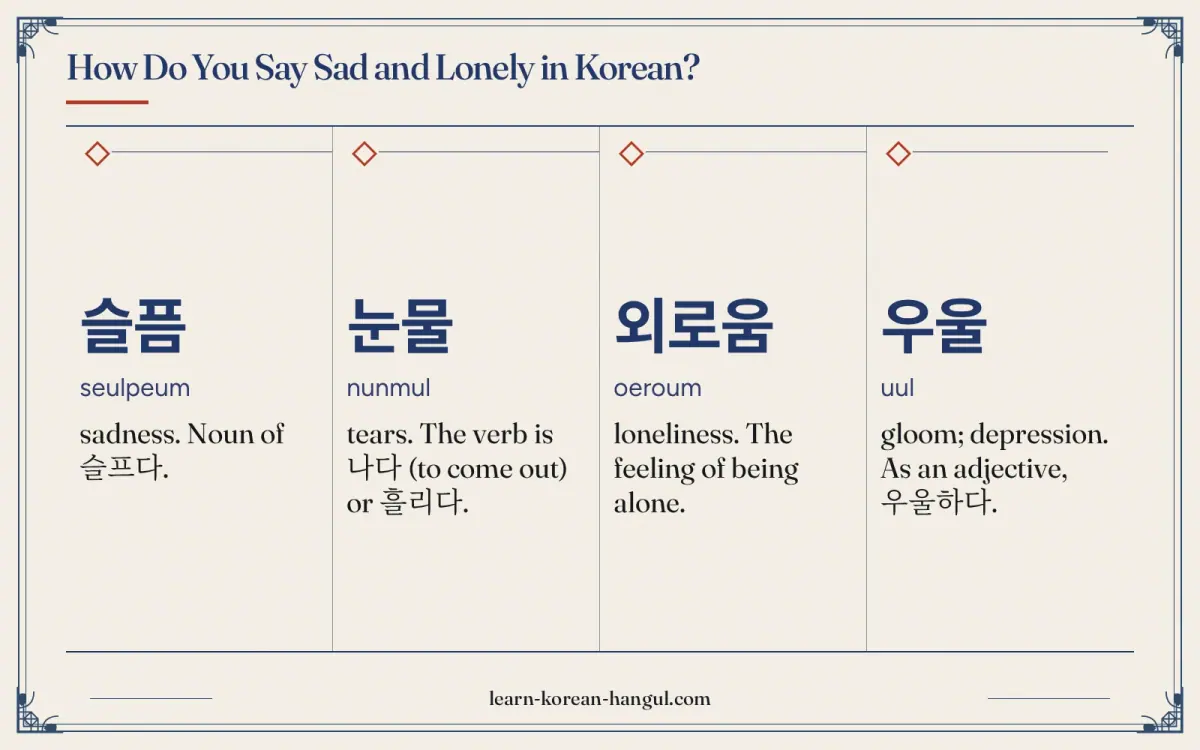
Sadness is 슬픔, and tears are 눈물. 외로움 is loneliness, the feeling of being alone, and 우울 is gloom. 실망 (disappointment) and 후회 (regret) come after something goes wrong. 아픔 and 상처 are about pain in the heart: 아픔 is the pain, and 상처 is the wound left behind. 상처 is used with 받다, to receive: 상처를 받았어요, I was hurt.
| No. | Hangul | Revised Romanization | Meaning and note | Example sentence | Audio assetId |
|---|---|---|---|---|---|
| 9 | 슬픔 | seulpeum | sadness. Noun of 슬프다. | 슬픔을 참았어요. (I held back my sadness.) | au-pg-vocabulary-people-emotions-9; example: au-pg-vocabulary-people-emotions-49 |
| 10 | 눈물 | nunmul | tears. The verb is 나다 (to come out) or 흘리다. | 눈물이 나요. (Tears come.) | au-pg-vocabulary-people-emotions-10; example: au-pg-vocabulary-people-emotions-50 |
| 11 | 외로움 | oeroum | loneliness. The feeling of being alone. | 외로움을 느껴요. (I feel loneliness.) | au-pg-vocabulary-people-emotions-11; example: au-pg-vocabulary-people-emotions-51 |
| 12 | 우울 | uul | gloom; depression. As an adjective, 우울하다. | 우울한 기분이에요. (I feel gloomy.) | au-pg-vocabulary-people-emotions-12; example: au-pg-vocabulary-people-emotions-52 |
| 13 | 실망 | silmang | disappointment. The verb is 실망하다. | 결과에 실망했어요. (I was disappointed with the result.) | au-pg-vocabulary-people-emotions-13; example: au-pg-vocabulary-people-emotions-53 |
| 14 | 후회 | huhoe | regret. The verb is 후회하다. | 후회하지 않아요. (I do not regret it.) | au-pg-vocabulary-people-emotions-14; example: au-pg-vocabulary-people-emotions-54 |
| 15 | 아픔 | apeum | pain; hurt (emotional). The noun of 아프다. | 마음의 아픔이 커요. (The pain in my heart is great.) | au-pg-vocabulary-people-emotions-15; example: au-pg-vocabulary-people-emotions-55 |
| 16 | 상처 | sangcheo | wound; emotional hurt. The verb is 받다 (to receive). | 말 때문에 상처를 받았어요. (I was hurt by the words.) | au-pg-vocabulary-people-emotions-16; example: au-pg-vocabulary-people-emotions-56 |
External pain and emotional pain share the verb 아프다, so 마음이 아파요 means my heart aches. For a deeper use of 마음, see the personality list at Personality and Appearance.
Angry and Annoyed
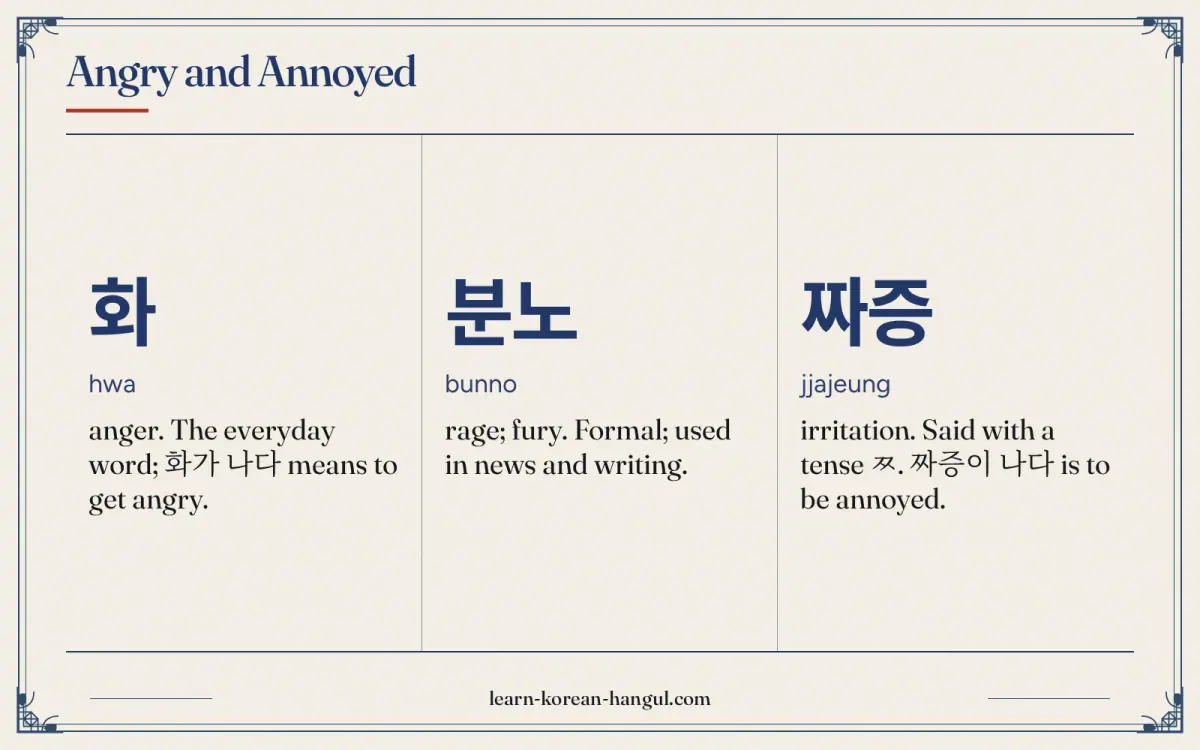
Everyday anger is 화, used in 화가 나요 (I get angry) or 화났어요 (I am angry). 분노 is the strong, formal version used in news and writing. 짜증 is the irritation of a small annoyance, 불만 is a complaint and 질투 is jealousy. 미움 is hatred or strong dislike. 스트레스 is stress, a loanword used just as in English. 억울함 is the sense that you were treated unfairly, and there is no one-word English match.
| No. | Hangul | Revised Romanization | Meaning and note | Example sentence | Audio assetId |
|---|---|---|---|---|---|
| 17 | 화 | hwa | anger. The everyday word; 화가 나다 means to get angry. | 화가 났어요. (I got angry.) | au-pg-vocabulary-people-emotions-17; example: au-pg-vocabulary-people-emotions-57 |
| 18 | 분노 | bunno | rage; fury. Formal; used in news and writing. | 분노를 참을 수 없어요. (I cannot hold back my anger.) | au-pg-vocabulary-people-emotions-18; example: au-pg-vocabulary-people-emotions-58 |
| 19 | 짜증 | jjajeung | irritation. Said with a tense ㅉ. 짜증이 나다 is to be annoyed. | 짜증이 나요. (I am annoyed.) | au-pg-vocabulary-people-emotions-19; example: au-pg-vocabulary-people-emotions-59 |
| 20 | 불만 | bulman | complaint; dissatisfaction. Common in service talk. | 불만이 많아요. (I have many complaints.) | au-pg-vocabulary-people-emotions-20; example: au-pg-vocabulary-people-emotions-60 |
| 21 | 미움 | mium | hatred; dislike. Noun of 밉다 (to be hateful). | 미움을 버렸어요. (I let go of my hatred.) | au-pg-vocabulary-people-emotions-21; example: au-pg-vocabulary-people-emotions-61 |
| 22 | 질투 | jiltu | jealousy. Used for envy in love and in rivalry. | 질투가 나요. (I feel jealous.) | au-pg-vocabulary-people-emotions-22; example: au-pg-vocabulary-people-emotions-62 |
| 23 | 스트레스 | seuteureseu | stress. Loanword; the verb is 받다. | 스트레스를 받아요. (I get stressed.) | au-pg-vocabulary-people-emotions-23; example: au-pg-vocabulary-people-emotions-63 |
| 24 | 억울함 | eogulham | a sense of being wronged. Said [어굴함]. No single English word. | 억울함을 느꼈어요. (I felt wronged.) | au-pg-vocabulary-people-emotions-24; example: au-pg-vocabulary-people-emotions-64 |
The verb 나다, to come out, pairs with 화, 짜증 and 땀. 화가 나요, 짜증이 나요 and 땀이 나요 all use it.
How Do You Say Worried and Afraid in Korean?
Worry is 걱정, and the polite request 걱정하지 마세요 means do not worry. 불안 is anxiety or unease with no clear cause, and 두려움 is fear with an object. 공포 is terror, and it also names the horror genre. 긴장 is nervous tension before an event, 부담 is the burden of pressure and 고민 is a worry you turn over in your mind. 당황 is the moment of being flustered when something goes wrong.
| No. | Hangul | Revised Romanization | Meaning and note | Example sentence | Audio assetId |
|---|---|---|---|---|---|
| 25 | 걱정 | geokjeong | worry. Said [걱쩡]. 걱정하지 마세요 means do not worry. | 걱정이 많아요. (I have many worries.) | au-pg-vocabulary-people-emotions-25; example: au-pg-vocabulary-people-emotions-65 |
| 26 | 불안 | buran | anxiety; unease. Said [부란]; as an adjective, 불안하다. | 불안한 마음이에요. (I feel uneasy.) | au-pg-vocabulary-people-emotions-26; example: au-pg-vocabulary-people-emotions-66 |
| 27 | 두려움 | duryeoum | fear. A slower, deeper fear. | 두려움을 이겨요. (I overcome fear.) | au-pg-vocabulary-people-emotions-27; example: au-pg-vocabulary-people-emotions-67 |
| 28 | 공포 | gongpo | terror; horror. Strong, sudden fear; also the horror genre. | 공포 영화를 봐요. (I watch a horror movie.) | au-pg-vocabulary-people-emotions-28; example: au-pg-vocabulary-people-emotions-68 |
| 29 | 긴장 | ginjang | tension; nervousness. The verb is 긴장되다 (to feel tense). | 면접 전에 긴장돼요. (I get nervous before an interview.) | au-pg-vocabulary-people-emotions-29; example: au-pg-vocabulary-people-emotions-69 |
| 30 | 부담 | budam | burden; pressure. Pressure from expectations. | 부담이 커요. (The burden is heavy.) | au-pg-vocabulary-people-emotions-30; example: au-pg-vocabulary-people-emotions-70 |
| 31 | 고민 | gomin | worry; trouble (thinking it over). A worry you turn over in your mind. | 고민이 있어요. (I have a worry.) | au-pg-vocabulary-people-emotions-31; example: au-pg-vocabulary-people-emotions-71 |
| 32 | 당황 | danghwang | being flustered. The verb is 당황하다. | 갑자기 당황했어요. (I was suddenly flustered.) | au-pg-vocabulary-people-emotions-32; example: au-pg-vocabulary-people-emotions-72 |
고민 differs from 걱정. A 고민 is a decision or problem you are thinking about, while 걱정 is a worry about what may happen.
How Do You Say Love and Longing in Korean?
놀람 is surprise and 감동 is the feeling of being moved. 사랑 is love in every sense: romantic, family and care. 그리움 is the longing for a person, a place or a time you miss, and 설렘 is the flutter of excitement before something good, such as a date or a trip. Two culture-bound words close the group. 정 is affection that builds over time, and 눈치 is the skill of reading a room. 감사 (gratitude) completes the group; it is the feeling behind 감사합니다 (thank you).
| No. | Hangul | Revised Romanization | Meaning and note | Example sentence | Audio assetId |
|---|---|---|---|---|---|
| 33 | 놀람 | nollam | surprise. Noun of 놀라다. | 놀람을 감출 수 없어요. (I cannot hide my surprise.) | au-pg-vocabulary-people-emotions-33; example: au-pg-vocabulary-people-emotions-73 |
| 34 | 감동 | gamdong | deep emotion; being moved. The verb is 감동하다. | 영화를 보고 감동했어요. (I was moved by watching the film.) | au-pg-vocabulary-people-emotions-34; example: au-pg-vocabulary-people-emotions-74 |
| 35 | 사랑 | sarang | love. Also the verb root of 사랑하다. | 가족의 사랑을 느꼈어요. (I felt my family's love.) | au-pg-vocabulary-people-emotions-35; example: au-pg-vocabulary-people-emotions-75 |
| 36 | 그리움 | geurium | longing; missing someone. Noun of 그립다. | 고향에 대한 그리움이 커요. (My longing for home is great.) | au-pg-vocabulary-people-emotions-36; example: au-pg-vocabulary-people-emotions-76 |
| 37 | 설렘 | seollem | flutter of excitement. Common in songs and K-drama. | 여행 전에는 설렘이 커요. (Before a trip, the excitement is great.) | au-pg-vocabulary-people-emotions-37; example: au-pg-vocabulary-people-emotions-77 |
| 38 | 정 | jeong | affection; deep bond. A bond built over time. No single English word. | 정이 많아요. (She is warm-hearted.) | au-pg-vocabulary-people-emotions-38; example: au-pg-vocabulary-people-emotions-78 |
| 39 | 눈치 | nunchi | social awareness; reading the mood. No single English word. | 눈치가 빨라요. (You are quick to read the mood.) | au-pg-vocabulary-people-emotions-39; example: au-pg-vocabulary-people-emotions-79 |
| 40 | 감사 | gamsa | gratitude; thanks. The noun inside 감사합니다; the verb is 감사하다. | 감사의 마음을 전하고 싶어요. (I want to express my gratitude.) | au-pg-vocabulary-people-emotions-40; example: au-pg-vocabulary-people-emotions-80 |
정 and 눈치 are not translated well by one English word, so learn them through the sentences. 정이 많다 describes someone warm, and 눈치가 없다 describes someone who misses social cues.
How Do You Pronounce These Words?
Several emotion nouns have sound changes at the end of a syllable. Standard pronunciation follows the National Institute of Korean Language (국립국어원) rules, and the romanization follows the Revised Romanization of Korean, which does not mark every sound change.
| Spelling | Sounds like | What changes |
|---|---|---|
| 불안 | [부란] | The final ㄹ of 불 moves onto the empty ㅇ of 안. |
| 걱정 | [걱쩡] | After final ㄱ, ㅈ is said as tense [ㅉ]. |
| 웃음 | [우슴] | The final ㅅ of 웃 moves onto the empty ㅇ of 음. |
| 억울함 | [어굴함] | The final ㄱ moves onto the empty ㅇ of 울, which sounds like 굴. |
| 행운 | [행운] | No linking: final ㅇ (ng) never moves to the next syllable, so say haeng-un. |
| 눈물 | [눈물] | No change; say both syllables clearly. |
Linking is the main sound habit. In 불안 and 웃음 the final consonant moves forward to the next syllable, so you hear 부란 and 우슴, not a break between the syllables. Tense ㅉ in 걱정 is the second thing to practise, and 행운 shows the one final consonant that never moves forward: ㅇ.
Audio and Slow Playback
Each word and sentence has its own clip. The five clips below replay the hardest words slowly. Play one, repeat it aloud, then play it again and compare.
What Mistakes Do Learners Make with Emotion Words?
Five mistakes come up again and again.
- Using 분노 in daily talk. For I am angry, say 화났어요 or 화가 나요. 분노 sounds like a headline.
- Using the noun as the whole sentence. 저는 행복이에요 is odd. Say 저는 행복해요 for I am happy, with the adjective.
- Translating 정 as love. 사랑 is love. 정 is the bond between people who have spent time together, and it can exist without romance.
- Reading 눈치 as eyesight. 눈치 is social awareness. 시력 is eyesight. 눈치가 없다 means a person misses the mood.
- Mixing 그리움 and 외로움. 그리움 is missing someone or something. 외로움 is feeling alone.
In every case a noun is used where English uses an adjective, or a culture-bound word is forced into one English match. The practice section turns the list into drills.
Practice: Flashcards and Worksheet
Use three steps. Run the flashcard deck in recognition mode until the 40 words come quickly. Switch to listening mode, then take the quiz. The deck holds every word on this page with audio, and your progress stays in your browser. The vocabulary flashcard decks page lists the other decks.
Practice · 85
- 01행복
Show answer
headword 1: happiness
- 02기쁨
Show answer
headword 2: joy
- 03즐거움
Show answer
headword 3: enjoyment; pleasure
- 04웃음
Show answer
headword 4: laughter; smile
- 05만족
Show answer
headword 5: satisfaction
- 06기분
Show answer
headword 6: mood; feeling
- 07행운
Show answer
headword 7: good luck
- 08꿈
Show answer
headword 8: dream; hope
- 09슬픔
Show answer
headword 9: sadness
- 10눈물
Show answer
headword 10: tears
- 11외로움
Show answer
headword 11: loneliness
- 12우울
Show answer
headword 12: gloom; depression
- 13실망
Show answer
headword 13: disappointment
- 14후회
Show answer
headword 14: regret
- 15아픔
Show answer
headword 15: pain; hurt (emotional)
- 16상처
Show answer
headword 16: wound; emotional hurt
- 17화
Show answer
headword 17: anger
- 18분노
Show answer
headword 18: rage; fury
- 19짜증
Show answer
headword 19: irritation
- 20불만
Show answer
headword 20: complaint; dissatisfaction
- 21미움
Show answer
headword 21: hatred; dislike
- 22질투
Show answer
headword 22: jealousy
- 23스트레스
Show answer
headword 23: stress
- 24억울함
Show answer
headword 24: a sense of being wronged
- 25걱정
Show answer
headword 25: worry
- 26불안
Show answer
headword 26: anxiety; unease
- 27두려움
Show answer
headword 27: fear
- 28공포
Show answer
headword 28: terror; horror
- 29긴장
Show answer
headword 29: tension; nervousness
- 30부담
Show answer
headword 30: burden; pressure
- 31고민
Show answer
headword 31: worry; trouble (thinking it over)
- 32당황
Show answer
headword 32: being flustered
- 33놀람
Show answer
headword 33: surprise
- 34감동
Show answer
headword 34: deep emotion; being moved
- 35사랑
Show answer
headword 35: love
- 36그리움
Show answer
headword 36: longing; missing someone
- 37설렘
Show answer
headword 37: flutter of excitement
- 38정
Show answer
headword 38: affection; deep bond
- 39눈치
Show answer
headword 39: social awareness; reading the mood
- 40감사
Show answer
headword 40: gratitude; thanks
- 41가족과 함께라서 행복해요.
Show answer
example sentence for 행복
- 42기쁨의 눈물을 흘렸어요.
Show answer
example sentence for 기쁨
- 43여행의 즐거움을 느꼈어요.
Show answer
example sentence for 즐거움
- 44웃음소리가 들려요.
Show answer
example sentence for 웃음
- 45결과에 만족해요.
Show answer
example sentence for 만족
- 46기분이 좋아요.
Show answer
example sentence for 기분
- 47행운을 빌어요.
Show answer
example sentence for 행운
- 48꿈을 이루고 싶어요.
Show answer
example sentence for 꿈
- 49슬픔을 참았어요.
Show answer
example sentence for 슬픔
- 50눈물이 나요.
Show answer
example sentence for 눈물
- 51외로움을 느껴요.
Show answer
example sentence for 외로움
- 52우울한 기분이에요.
Show answer
example sentence for 우울
- 53결과에 실망했어요.
Show answer
example sentence for 실망
- 54후회하지 않아요.
Show answer
example sentence for 후회
- 55마음의 아픔이 커요.
Show answer
example sentence for 아픔
- 56말 때문에 상처를 받았어요.
Show answer
example sentence for 상처
- 57화가 났어요.
Show answer
example sentence for 화
- 58분노를 참을 수 없어요.
Show answer
example sentence for 분노
- 59짜증이 나요.
Show answer
example sentence for 짜증
- 60불만이 많아요.
Show answer
example sentence for 불만
- 61미움을 버렸어요.
Show answer
example sentence for 미움
- 62질투가 나요.
Show answer
example sentence for 질투
- 63스트레스를 받아요.
Show answer
example sentence for 스트레스
- 64억울함을 느꼈어요.
Show answer
example sentence for 억울함
- 65걱정이 많아요.
Show answer
example sentence for 걱정
- 66불안한 마음이에요.
Show answer
example sentence for 불안
- 67두려움을 이겨요.
Show answer
example sentence for 두려움
- 68공포 영화를 봐요.
Show answer
example sentence for 공포
- 69면접 전에 긴장돼요.
Show answer
example sentence for 긴장
- 70부담이 커요.
Show answer
example sentence for 부담
- 71고민이 있어요.
Show answer
example sentence for 고민
- 72갑자기 당황했어요.
Show answer
example sentence for 당황
- 73놀람을 감출 수 없어요.
Show answer
example sentence for 놀람
- 74영화를 보고 감동했어요.
Show answer
example sentence for 감동
- 75가족의 사랑을 느꼈어요.
Show answer
example sentence for 사랑
- 76고향에 대한 그리움이 커요.
Show answer
example sentence for 그리움
- 77여행 전에는 설렘이 커요.
Show answer
example sentence for 설렘
- 78정이 많아요.
Show answer
example sentence for 정
- 79눈치가 빨라요.
Show answer
example sentence for 눈치
- 80감사의 마음을 전하고 싶어요.
Show answer
example sentence for 감사
- 81불안
Show answer
slow playback: 불안
- 82억울함
Show answer
slow playback: 억울함
- 83걱정
Show answer
slow playback: 걱정
- 84행운
Show answer
slow playback: 행운
- 85설렘
Show answer
slow playback: 설렘
Practice · 5
What does 기분 (gibun) mean?
Show answer
mood; feeling
기분 means mood; feeling. Example: 기분이 좋아요. (I feel good.)
What does 화 (hwa) mean?
Show answer
anger
화 means anger. Example: 화가 났어요. (I got angry.)
What does 슬픔 (seulpeum) mean?
Show answer
sadness
슬픔 means sadness. Example: 슬픔을 참았어요. (I held back my sadness.)
What does 짜증 (jjajeung) mean?
Show answer
irritation
짜증 means irritation. Example: 짜증이 나요. (I am annoyed.)
What does 정 (jeong) mean?
Show answer
affection; deep bond
정 means affection; deep bond. Example: 정이 많아요. (She is warm-hearted.)
Korean Emotions Vocabulary Worksheet (PDF)
A printable worksheet for these words (word list, matching, writing practice, fill-in-the-blank exercises and answer key) is available in A4 and US Letter from the download card on this page. For practice, write one sentence about today using the frame 오늘은 기분이 ... and a noun from the list.
Where to Go Next
After this page, continue with Korean Kids and Toys Vocabulary or Feeling Adjectives for the adjective forms. For phrases that say feelings aloud, see expressing feelings. To move up a level, return to People and Relationships.
Frequently Asked Questions
How Do You Say Anger in Korean?
Anger is 화 (hwa) in daily talk and 분노 (bunno) in formal writing. Say 화가 났어요 for I got angry. 분노 is the news word, as in 분노를 참을 수 없어요, I cannot hold back my anger.
How Do You Pronounce 불안 (buran)?
Say bu-ran. The final ㄹ of 불 moves onto the empty ㅇ of 안, so the word sounds like [부란]. Do not pause between the two syllables. Press the audio button on this page to hear the word and the slow clip.
How Many Emotion Words Should I Learn First?
Start with about six: 기분, 행복, 슬픔, 화, 걱정 and 사랑. They name the main feelings and give you the everyday frame 기분이 좋아요. The whole list of 40 takes about eight days at five new words a day, with a short review of earlier words each day.
Where Can I Practise Emotion Words with Flashcards?
Use the deck on this page, which holds all 40 words with Hangul, romanization and audio, in recognition and listening modes. The vocabulary flashcard decks page lists the decks for the other people topics. Progress is saved only in your browser.
Is the Romanization on This Page Official?
It follows the Revised Romanization of Korean, which South Korea adopted on 7 July 2000 and whose rules the National Institute of Korean Language (국립국어원) publishes. It is a learning aid and does not mark every sound change, so rely on the Hangul and the audio.
Is There a Printable Worksheet for Emotion Words?
An emotion-faces worksheet is available in A4 and US Letter; see the vocabulary worksheets page. For practice, use the flashcard deck, which carries the same 40 words, or copy the tables by hand. You can also write one diary line a day with a noun from the list.