What you'll learn
- Match all 30 kids and toy words to their English meanings.
- Say five of them aloud with the help of the Revised Romanization and the audio.
- Write two original sentences that use words such as 장난감 (toy) and 인형 (doll).
- Tell 아이, 어린이 and 애 apart, and know which baby-talk words are for small children only.
Prerequisites: you can read Hangul and know the polite ending -아요/-어요. Estimated time: about 75 minutes, plus short reviews on the following days.
Korean Kids and Toys Vocabulary at a Glance
The list has 30 words in five groups of six. It follows a child's day: play with toys indoors, go out to the playground, read a story, have a snack, and talk to a parent in the short sounds small children use. It sits in People and Relationships, next to the lists for family, feelings and jobs.
| Group | Words | Use |
|---|---|---|
| Toys | 6 | What children play with |
| Playground | 6 | Rides and places outdoors |
| Fairy tales and stories | 6 | Books and story characters |
| Kids' foods and snacks | 6 | Treats and drinks children ask for |
| Baby talk | 6 | Short words for small children |
This page is a themed list. If you want the single word for a toy with its meaning and one use, the dedicated page on toy in Korean gives that answer, and doll in Korean does the same for 인형.
Which Kids and Toy Words Should You Learn First?
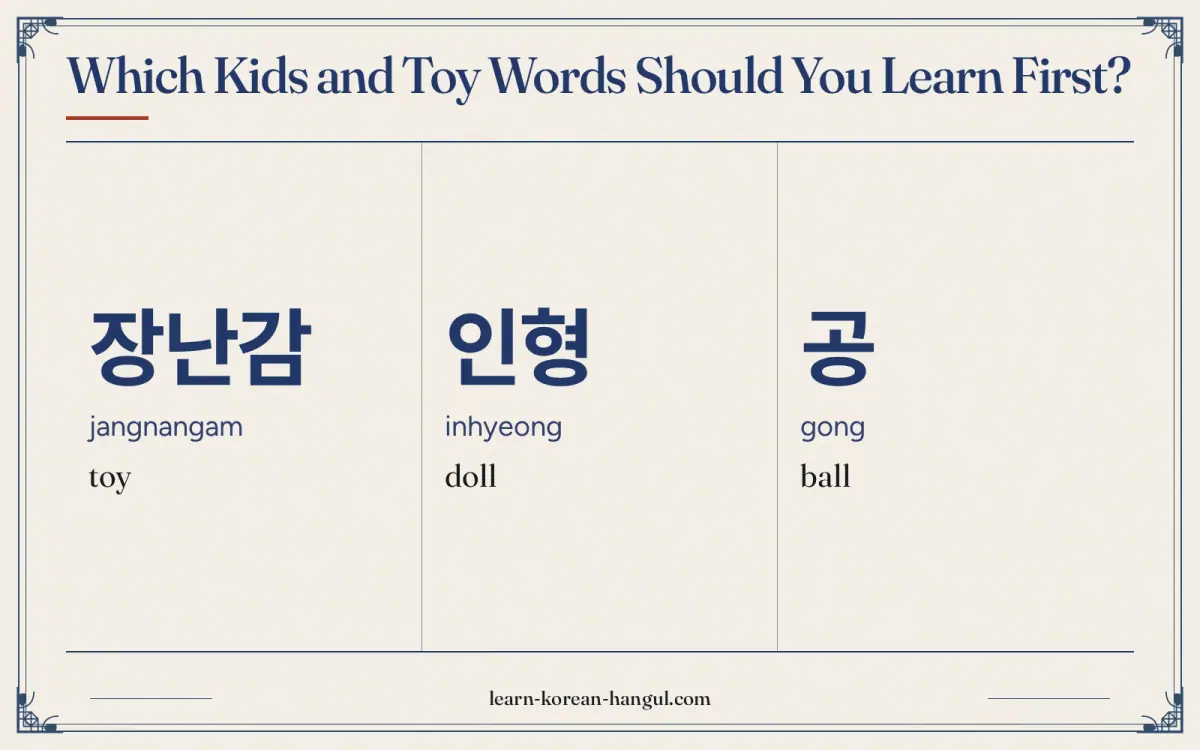
Learn 장난감 (toy), 인형 (doll), 공 (ball), 놀이터 (playground) and 과자 (snack) first. With only these five you can say what a child plays with and where. A short sentence such as 놀이터에서 놀아요 (I play at the playground) needs just one noun and one verb. Then follow this order:
- Step 1: the five words above.
- Step 2: the playground rides: 그네, 미끄럼틀 and 시소.
- Step 3: story words: 동화, 동화책 and 이야기.
- Step 4: the baby-talk group, which you mainly need if you spend time with small children.
The scene below numbers ten of the objects in the play area, so you can tie each word to something you can point at.
Word · 10
- 1
장난감
jangnangam
toy
- 2
인형
inhyeong
doll
- 3
공
gong
ball
- 4
풍선
pungseon
balloon
- 5
놀이터
noriteo
playground
- 6
그네
geune
swing
- 7
미끄럼틀
mikkeureomteul
slide
- 8
동화책
donghwachaek
storybook
- 9
과자
gwaja
snack; cookie
- 10
아이스크림
aiseukeurim
ice cream
Tap a number to hear the word. The words in this list are everyday nouns, and most take the particle 이/가 or 을/를 like any other noun.
Toys
The toy group starts with the general word 장난감 and then names five popular toys. Four of them, 공, 풍선, 블록 and 퍼즐, are single objects you can point at in a shop. 인형 is the doll or stuffed toy, and 장난감 is the umbrella word for all of them.
| No. | Hangul | Revised Romanization | Meaning and note | Example sentence | Audio assetId |
|---|---|---|---|---|---|
| 1 | 장난감 | jangnangam | toy. The general word. 장난 means play or mischief, and 감 means material. | 장난감이 많아요. (jangnangami manayo. There are many toys.) | au-pg-vocabulary-people-kids-1; example: au-pg-vocabulary-people-kids-31 |
| 2 | 인형 | inhyeong | doll. Also used for stuffed toys and puppets. | 인형이 귀여워요. (inhyeongi gwiyeowoyo. The doll is cute.) | au-pg-vocabulary-people-kids-2; example: au-pg-vocabulary-people-kids-32 |
| 3 | 공 | gong | ball. Native word. Also means a ball in sports. | 공을 던져요. (gongeul deonjyeoyo. I throw the ball.) | au-pg-vocabulary-people-kids-3; example: au-pg-vocabulary-people-kids-33 |
| 4 | 풍선 | pungseon | balloon. Sino-Korean in origin, with 풍 meaning wind. | 풍선을 불어요. (pungseoneul bureoyo. I blow up a balloon.) | au-pg-vocabulary-people-kids-4; example: au-pg-vocabulary-people-kids-34 |
| 5 | 블록 | beullok | block. Loanword from English. The final ㄱ is a stopped sound. | 블록을 쌓아요. (beullogeul ssaayo. I stack blocks.) | au-pg-vocabulary-people-kids-5; example: au-pg-vocabulary-people-kids-35 |
| 6 | 퍼즐 | peojeul | puzzle. Loanword from English. The word ends in a light ㄹ. | 아이가 퍼즐을 맞춰요. (aiga peojeureul matchwoyo. The child solves the puzzle.) | au-pg-vocabulary-people-kids-6; example: au-pg-vocabulary-people-kids-36 |
The verbs matter as much as the nouns. 던지다 (to throw), 불다 (to blow), 쌓다 (to stack) and 맞추다 (to fit together) are the actions children do with these toys, so learn each noun with its verb. Notice that 인형 covers stuffed toys too: a teddy bear is 곰 인형, with 곰 (bear) in front.
How Do You Say Playground in Korean?
Playground is 놀이터 (noriteo), made from 놀이 (play) and 터 (a place or site). The word names the whole area, and the rides inside have their own names: 그네 (swing), 미끄럼틀 (slide), 시소 (seesaw) and 철봉 (the horizontal bar). 모래 (sand) is the sandpit.
| No. | Hangul | Revised Romanization | Meaning and note | Example sentence | Audio assetId |
|---|---|---|---|---|---|
| 7 | 놀이터 | noriteo | playground. 놀이 (play) + 터 (place). Said [노리터]. | 놀이터에서 놀아요. (noriteoeseo norayo. I play at the playground.) | au-pg-vocabulary-people-kids-7; example: au-pg-vocabulary-people-kids-37 |
| 8 | 그네 | geune | swing. Also the name of a traditional swing used in folk games. | 그네를 타요. (geunereul tayo. I ride the swing.) | au-pg-vocabulary-people-kids-8; example: au-pg-vocabulary-people-kids-38 |
| 9 | 미끄럼틀 | mikkeureomteul | slide. From 미끄럼 (sliding) and 틀 (frame). The spelling has a tense ㄲ. | 미끄럼틀이 높아요. (mikkeureomteuri nopayo. The slide is high.) | au-pg-vocabulary-people-kids-9; example: au-pg-vocabulary-people-kids-39 |
| 10 | 시소 | siso | seesaw. Loanword from English. Two children sit at the ends. | 시소는 두 명이 타요. (sisoneun du myeongi tayo. Two people ride a seesaw.) | au-pg-vocabulary-people-kids-10; example: au-pg-vocabulary-people-kids-40 |
| 11 | 모래 | morae | sand. Native word. Beach sand and sandpit sand are both 모래. | 모래로 성을 만들어요. (moraero seongeul mandeureoyo. I make a castle out of sand.) | au-pg-vocabulary-people-kids-11; example: au-pg-vocabulary-people-kids-41 |
| 12 | 철봉 | cheolbong | horizontal bar. Sino-Korean 철 (iron) + 봉 (pole). Children hang from it. | 철봉에 매달려요. (cheolbonge maedallyeoyo. I hang from the bar.) | au-pg-vocabulary-people-kids-12; example: au-pg-vocabulary-people-kids-42 |
Rides use the verb 타다 (to ride), the same verb as for buses and bicycles. That is why you ride a swing in Korean: 그네를 타요, not 그네를 놀아요. The same is true of 미끄럼틀을 타요 (go down the slide) and 시소를 타요 (play on the seesaw). The particle 에서 marks the place where an activity happens, as in 놀이터에서 놀아요, while 에 would mark a destination, as in 놀이터에 가요 (I go to the playground).
Fairy Tales and Stories
Korean children grow up with folk tales as well as translated stories. Two classics are 흥부와 놀부 (Heungbu and Nolbu, two brothers, one kind and one greedy) and 선녀와 나무꾼 (the fairy and the woodcutter). The six words below name the books and the characters you meet in them.
| No. | Hangul | Revised Romanization | Meaning and note | Example sentence | Audio assetId |
|---|---|---|---|---|---|
| 13 | 동화 | donghwa | fairy tale. Sino-Korean 동 (child) + 화 (story). Also used for a children's story in general. | 동화를 읽어요. (donghwareul ilgeoyo. I read a fairy tale.) | au-pg-vocabulary-people-kids-13; example: au-pg-vocabulary-people-kids-43 |
| 14 | 동화책 | donghwachaek | storybook. 동화 + 책 (book). | 동화책을 빌렸어요. (donghwachaegeul billyeosseoyo. I borrowed a storybook.) | au-pg-vocabulary-people-kids-14; example: au-pg-vocabulary-people-kids-44 |
| 15 | 그림책 | geurimchaek | picture book. 그림 (picture) + 책 (book). For the youngest readers. | 그림책에 그림이 많아요. (geurimchaege geurimi manayo. The picture book has many pictures.) | au-pg-vocabulary-people-kids-15; example: au-pg-vocabulary-people-kids-45 |
| 16 | 이야기 | iyagi | story; talk. The general word. Also means a conversation or news. | 엄마가 이야기를 들려줘요. (eommaga iyagireul deullyeojwoyo. Mom tells me a story.) | au-pg-vocabulary-people-kids-16; example: au-pg-vocabulary-people-kids-46 |
| 17 | 공주 | gongju | princess. Sino-Korean 공 (public) + 주 (lord). The king's daughter. | 공주가 성에 살아요. (gongjuga seonge sarayo. The princess lives in a castle.) | au-pg-vocabulary-people-kids-17; example: au-pg-vocabulary-people-kids-47 |
| 18 | 도깨비 | dokkaebi | goblin. A figure from Korean folk tales who holds a magic club. Not a ghost. | 도깨비가 나와요. (dokkaebiga nawayo. A goblin appears.) | au-pg-vocabulary-people-kids-18; example: au-pg-vocabulary-people-kids-48 |
이야기 has two jobs. As a story it fits 이야기를 읽어요 (I read a story), and as a talk it fits 친구랑 이야기해요 (I talk with a friend). 도깨비 is worth a note, because English texts often call it a goblin, a ghost or a demon. A 도깨비 is a playful folk creature that can reward or trick people. The related word 귀신 means a ghost.
How Do You Say Kids' Foods and Snacks in Korean?
Children's food words are mostly short loanwords and plain native nouns. 과자 is the general snack, 간식 is the snack time or the snack itself, and 사탕, 젤리, 아이스크림 and 우유 name the treats and drinks children ask for most.
| No. | Hangul | Revised Romanization | Meaning and note | Example sentence | Audio assetId |
|---|---|---|---|---|---|
| 19 | 과자 | gwaja | snack; cookie. Covers packaged snacks, biscuits and crackers. | 과자를 먹어요. (gwajareul meogeoyo. I eat a snack.) | au-pg-vocabulary-people-kids-19; example: au-pg-vocabulary-people-kids-49 |
| 20 | 사탕 | satang | candy. Hard candy and lollipops. | 사탕이 달아요. (satangi darayo. The candy is sweet.) | au-pg-vocabulary-people-kids-20; example: au-pg-vocabulary-people-kids-50 |
| 21 | 젤리 | jelli | jelly candy. Loanword from English. Gummy sweets, not jam. | 젤리를 좋아해요. (jellireul joahaeyo. I like jelly candy.) | au-pg-vocabulary-people-kids-21; example: au-pg-vocabulary-people-kids-51 |
| 22 | 아이스크림 | aiseukeurim | ice cream. Loanword from English, written as one word. | 아이스크림이 차가워요. (aiseukeurimi chagawoyo. The ice cream is cold.) | au-pg-vocabulary-people-kids-22; example: au-pg-vocabulary-people-kids-52 |
| 23 | 우유 | uyu | milk. Cow's milk. Baby formula is 분유. | 아침에 우유를 마셔요. (achime uyureul masyeoyo. I drink milk in the morning.) | au-pg-vocabulary-people-kids-23; example: au-pg-vocabulary-people-kids-53 |
| 24 | 간식 | gansik | snack time; snack. Food eaten between meals. Often an afternoon snack. | 오후에 간식을 먹어요. (ohue gansigeul meogeoyo. I eat a snack in the afternoon.) | au-pg-vocabulary-people-kids-24; example: au-pg-vocabulary-people-kids-54 |
Two words look alike: 과자 is the thing you eat, usually dry and packaged, and 간식 is when or why you eat it. A parent can say 간식 시간이에요 (it is snack time) and then hand over a 과자. Notice that 젤리 means jelly candy, not jam. For jam, Korean uses the loanword 잼.
Baby Talk
Parents and grandparents use a separate set of short, repeated sounds with babies and toddlers. These are not slang for adults, and the words below are for small children only. Using them with an adult is either a joke or a mistake.
| No. | Hangul | Revised Romanization | Meaning and note | Example sentence | Audio assetId |
|---|---|---|---|---|---|
| 25 | 맘마 | mamma | food; mealtime (baby talk). A parent's word for food or eating. | 맘마 먹자. (mamma meokja. Let's eat (to a small child).) | au-pg-vocabulary-people-kids-25; example: au-pg-vocabulary-people-kids-55 |
| 26 | 까까 | kkakka | snack; sweets (baby talk). Baby talk for snacks and sweets. Tense ㄲ is written kk in RR. | 까까 먹고 싶어요. (kkakka meokgo sipeoyo. I want a snack.) | au-pg-vocabulary-people-kids-26; example: au-pg-vocabulary-people-kids-56 |
| 27 | 어부바 | eobuba | piggyback ride (baby talk). Said when a parent carries a child on the back. | 엄마, 어부바 해 줘요. (eomma, eobuba hae jwoyo. Mom, give me a piggyback ride.) | au-pg-vocabulary-people-kids-27; example: au-pg-vocabulary-people-kids-57 |
| 28 | 지지 | jiji | dirty; yucky (baby talk). What a parent says to stop a child touching something dirty. | 그건 지지야. (geugeon jijiya. That is dirty.) | au-pg-vocabulary-people-kids-28; example: au-pg-vocabulary-people-kids-58 |
| 29 | 응가 | eungga | poop (baby talk). Used by parents and toddlers for a bowel movement. | 응가 했어요. (eungga haesseoyo. I did a poop.) | au-pg-vocabulary-people-kids-29; example: au-pg-vocabulary-people-kids-59 |
| 30 | 아야 | aya | ouch (baby talk). What a child says when hurt, and what a parent says in play. | 아야, 아파요. (aya, apayo. Ouch, it hurts.) | au-pg-vocabulary-people-kids-30; example: au-pg-vocabulary-people-kids-60 |
Baby-talk words are shorter and more repeated than normal Korean, and they usually come with a gentle tone. The example for 맘마 uses the casual ending -자, which means let's. It is right for a parent speaking to a small child and wrong for an adult stranger. If you spend time around small children in Korea, you will hear these words more than any other group on this page.
아이, 어린이 and 애: Three Words for a Child
Korean has three common words for a child, and each fits a different situation. 아이 (ai) is the general word for a child of any age, used in 아이가 셋이에요 (I have three children). 어린이 (eorini) means a school-age child and is the word on signs, in schools and in the holiday 어린이날 (Children's Day, 5 May). 애 (ae) is a short, casual form of 아이, and it also works for your own child in speech: 우리 애는 여섯 살이에요 (my kid is six years old). When you count children, use the people counter 명 (myeong), as in 아이 두 명. See counting people for the counters.
How Do You Pronounce Korean Kids and Toy Words?
Most words on this list are said as they are written, but a few change their sound. The National Institute of Korean Language (국립국어원) sets these changes in its standard pronunciation rules. Revised Romanization writes tense consonants (kk, tt) when the spelling has them, but it does not show tensing that comes from a neighbouring sound.
| Spelling | Sounds like | What changes |
|---|---|---|
| 놀이터 | [노리터] | The final ㄹ links to the vowel that follows. |
| 읽어요 | [일거요] | The double final ㄹㄱ splits: ㄹ stays and ㄱ moves to the next syllable. |
| 까까 | [까까] | No change in sound. The tense ㄲ is in the spelling, so RR writes kk (kkakka). |
| 도깨비 | [도깨비] | The tense ㄲ is in the spelling, so RR writes kk (dokkaebi). |
| 미끄럼틀 | [미끄럼틀] | The tense ㄲ is in the spelling, so RR writes kk (mikkeureomteul). |
| 응가 | [응가] | No change in sound. The first syllable ends in the ng sound, then 가 follows. |
Audio and Slow Playback
Each word and sentence has its own clip. The five clips below play the harder words slowly. Play a clip, say the word, then play it again and compare the ends of the syllables.
What Mistakes Do Learners Make with Kids and Toy Words?
Five patterns catch beginners when they talk about children.
- Using baby talk with adults. 맘마, 까까 and 지지 are for small children. Said to an adult, they sound like teasing.
- Mixing up 아이, 어린이 and 애. 어린이 is the standard word for a school-age child, as in 어린이날. In casual talk about your own child, use 아이 or 애.
- Using 놀다 for the swing. A child rides a swing, so the verb is 타다: 그네를 타요. 놀다 is for the whole activity, as in 놀이터에서 놀아요.
- Reading 놀이터 as written. The sound is [노리터]. Saying nol-i-teo with a separate ㄹ sounds stiff.
- Counting children with 개. Use 명 for people: 아이 세 명, not 아이 세 개. 개 is for things.
If you learn the 타다 rule and the baby-talk limits, most of the trouble goes away. The practice section turns the list into drills.
Practice: Flashcards and Worksheet
Study in three steps. First, run the deck in recognition mode until the 30 words feel familiar. Second, switch to listening mode and tap the clip before the card turns. Third, take the five-question quiz below. The deck stores your progress in your browser. The vocabulary flashcard decks page lists the other decks.
Practice · 65
- 01장난감
Show answer
headword 1: toy
- 02인형
Show answer
headword 2: doll
- 03공
Show answer
headword 3: ball
- 04풍선
Show answer
headword 4: balloon
- 05블록
Show answer
headword 5: block
- 06퍼즐
Show answer
headword 6: puzzle
- 07놀이터
Show answer
headword 7: playground
- 08그네
Show answer
headword 8: swing
- 09미끄럼틀
Show answer
headword 9: slide
- 10시소
Show answer
headword 10: seesaw
- 11모래
Show answer
headword 11: sand
- 12철봉
Show answer
headword 12: horizontal bar
- 13동화
Show answer
headword 13: fairy tale
- 14동화책
Show answer
headword 14: storybook
- 15그림책
Show answer
headword 15: picture book
- 16이야기
Show answer
headword 16: story; talk
- 17공주
Show answer
headword 17: princess
- 18도깨비
Show answer
headword 18: goblin
- 19과자
Show answer
headword 19: snack; cookie
- 20사탕
Show answer
headword 20: candy
- 21젤리
Show answer
headword 21: jelly candy
- 22아이스크림
Show answer
headword 22: ice cream
- 23우유
Show answer
headword 23: milk
- 24간식
Show answer
headword 24: snack time; snack
- 25맘마
Show answer
headword 25: food; mealtime (baby talk)
- 26까까
Show answer
headword 26: snack; sweets (baby talk)
- 27어부바
Show answer
headword 27: piggyback ride (baby talk)
- 28지지
Show answer
headword 28: dirty; yucky (baby talk)
- 29응가
Show answer
headword 29: poop (baby talk)
- 30아야
Show answer
headword 30: ouch (baby talk)
- 31장난감이 많아요.
Show answer
example sentence for 장난감
- 32인형이 귀여워요.
Show answer
example sentence for 인형
- 33공을 던져요.
Show answer
example sentence for 공
- 34풍선을 불어요.
Show answer
example sentence for 풍선
- 35블록을 쌓아요.
Show answer
example sentence for 블록
- 36아이가 퍼즐을 맞춰요.
Show answer
example sentence for 퍼즐
- 37놀이터에서 놀아요.
Show answer
example sentence for 놀이터
- 38그네를 타요.
Show answer
example sentence for 그네
- 39미끄럼틀이 높아요.
Show answer
example sentence for 미끄럼틀
- 40시소는 두 명이 타요.
Show answer
example sentence for 시소
- 41모래로 성을 만들어요.
Show answer
example sentence for 모래
- 42철봉에 매달려요.
Show answer
example sentence for 철봉
- 43동화를 읽어요.
Show answer
example sentence for 동화
- 44동화책을 빌렸어요.
Show answer
example sentence for 동화책
- 45그림책에 그림이 많아요.
Show answer
example sentence for 그림책
- 46엄마가 이야기를 들려줘요.
Show answer
example sentence for 이야기
- 47공주가 성에 살아요.
Show answer
example sentence for 공주
- 48도깨비가 나와요.
Show answer
example sentence for 도깨비
- 49과자를 먹어요.
Show answer
example sentence for 과자
- 50사탕이 달아요.
Show answer
example sentence for 사탕
- 51젤리를 좋아해요.
Show answer
example sentence for 젤리
- 52아이스크림이 차가워요.
Show answer
example sentence for 아이스크림
- 53아침에 우유를 마셔요.
Show answer
example sentence for 우유
- 54오후에 간식을 먹어요.
Show answer
example sentence for 간식
- 55맘마 먹자.
Show answer
example sentence for 맘마
- 56까까 먹고 싶어요.
Show answer
example sentence for 까까
- 57엄마, 어부바 해 줘요.
Show answer
example sentence for 어부바
- 58그건 지지야.
Show answer
example sentence for 지지
- 59응가 했어요.
Show answer
example sentence for 응가
- 60아야, 아파요.
Show answer
example sentence for 아야
- 61미끄럼틀
Show answer
slow playback of 미끄럼틀
- 62놀이터
Show answer
slow playback of 놀이터
- 63도깨비
Show answer
slow playback of 도깨비
- 64어부바
Show answer
slow playback of 어부바
- 65동화책
Show answer
slow playback of 동화책
Practice · 5
What does 장난감 (jangnangam) mean?
Show answer
toy
장난감 means toy. Example: 장난감이 많아요. (There are many toys.)
Which verb goes with 그네 (swing)?
Show answer
타다
A swing is ridden, so Korean uses 타다. Example: 그네를 타요. (I ride the swing.)
What does 놀이터 (noriteo) mean?
Show answer
playground
놀이터 means playground. Example: 놀이터에서 놀아요. (I play at the playground.)
Which word is baby talk for a snack?
Show answer
까까
까까 is baby talk for a snack or sweets. 과자 and 간식 are the normal words. Example: 까까 먹고 싶어요. (I want a snack.)
Which word is the general word for a child of any age?
Show answer
아이
아이 is the general word for a child. 어린이 is a school-age child, as in 어린이날. Example: 아이가 셋이에요. (I have three children.)
Korean Kids and Toys Vocabulary Worksheet (PDF)
A printable worksheet for these words (word list, matching, writing practice, fill-in-the-blank exercises and answer key) is available in A4 and US Letter from the download card on this page. For additional practice, draw a toy box and a playground and write the Korean word next to each thing.
Where to Go Next
After this page, continue with Emotions to talk about how children feel, or return to People and Relationships for the other people lists.
Frequently Asked Questions
How Do You Say Toy in Korean?
Toy is 장난감 (jangnangam). It has three syllables, jang-nan-gam, and is said as written. For one named toy, use the specific noun, such as 인형 (doll) or 공 (ball). The single-word page on toy in Korean gives more detail.
How Do You Pronounce 인형 (inhyeong)?
Say in-hyeong as two syllables. The first ends in a soft n, the second starts with a gentle h and then the vowel hyeo, close to yuh. The word means doll, and the final ng is the same sound as in the English word song. Press the audio button on this page to hear it, then repeat it.
How Many Kids and Toy Words Should I Learn First?
Five first: 장난감, 인형, 공, 놀이터 and 과자. They let you name what a child plays with and where. At five new words a day the 30 words take about a week with review. Add the playground rides next.
Where Can I Practise Kids and Toy Words with Flashcards?
Use the vocabulary flashcard decks. The deck for this page holds all 30 words with Hangul, romanization and audio, in recognition and listening modes. Your progress stays in your browser. Give the baby-talk group extra time in listening mode, because those words are heard, not read.
Is the Romanization on This Page Official?
The romanization follows the Revised Romanization of Korean, the official system of the Republic of Korea since 2000. It is a learning aid, not a replacement for Hangul. Spellings you meet in other places, such as noliteo or nori-teo, are unofficial variants, so use Hangul and the audio as your guide.
Is There a Printable Worksheet for Kids and Toy Words?
A printable worksheet for these words (word list, matching, writing practice, fill-in-the-blank exercises and answer key) is available in A4 and US Letter from the download card on this page. For practice, the tables on this page can be copied by hand, and the deck carries the same 30 words.