
Korean Jobs Vocabulary at a Glance
This list has 50 job words in six groups. The groups follow the workplace: offices, hospitals, public service, schools and labs, the arts, and the trades. The list sits inside People and Relationships, between Relationships and Titles and Body Parts.
| Group | Words | Use |
|---|---|---|
| Office and business | 9 | Company, bank and sales jobs |
| Medical and care | 7 | Doctors, nurses and care professionals |
| Public service | 8 | Police, military and government jobs |
| Education and science | 7 | Teaching, research and technology jobs |
| Arts and media | 9 | Performers, writers and creators |
| Food, trades and service | 10 | Cooks, farmers, drivers and shop work |
Most entries are nouns made from a root plus a suffix, so the page also explains the suffix pattern. Rank words such as 부장 and 과장 belong to a different list, the company ranks page.
Which Job Words Should You Learn First?
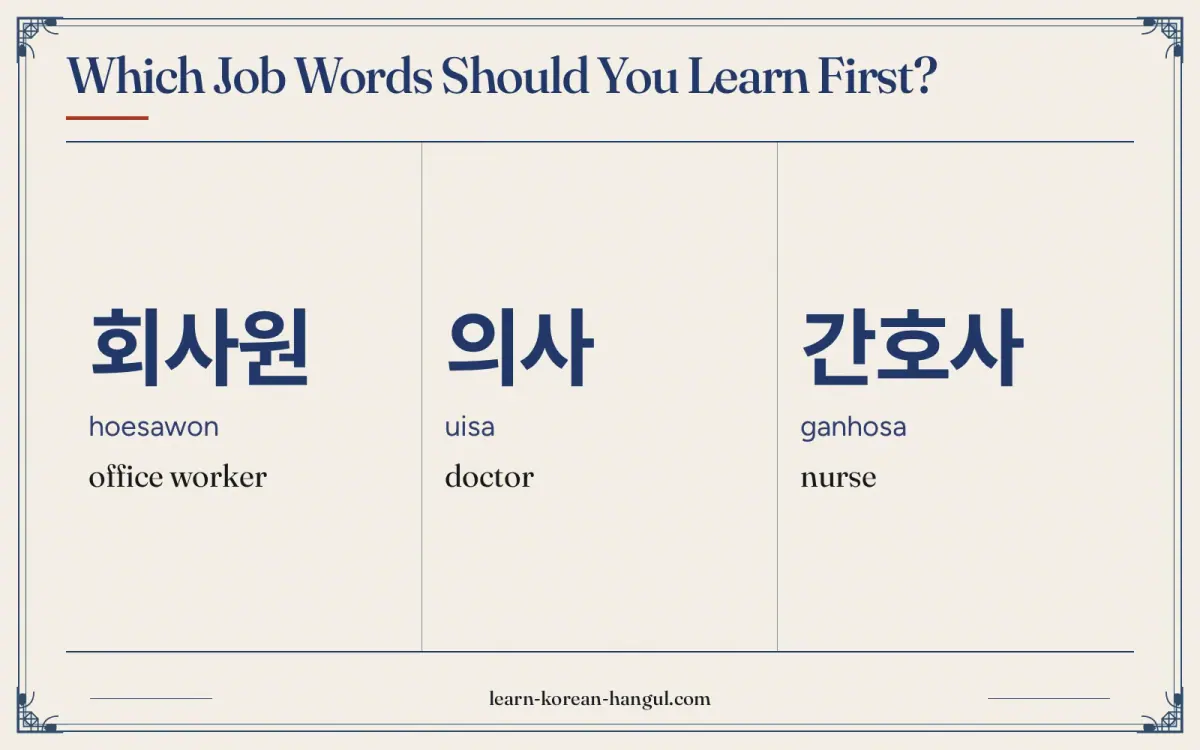
Learn 학생 (student), then 회사원, 의사, 선생님, 간호사 and 요리사. These six cover most introductions, and they follow one frame: job + 이에요 after a consonant or 예요 after a vowel. Add the job of the person you are talking to, using 선생님 for teachers and 사장님 for a shop owner or boss.
- Words to say about yourself. 회사원, 직원, 공무원, 주부, 아르바이트생.
- Words to recognise on signs and in the news. 경찰관, 소방관, 검사, 판사, 외교관.
- Words that double as titles. 선생님, 교수, 사장, 의사. Add 님 to address a person by their job.
In Korean, you often introduce a job with a place or a company first: 은행에서 일해요 (I work at a bank) or 회사에 다녀요 (I go to a company, i.e. I am an office worker). The job noun is the answer when someone asks directly.
Word · 8
- 1
회사원
hoesawon
office worker
- 2
의사
uisa
doctor
- 3
간호사
ganhosa
nurse
- 4
경찰관
gyeongchalgwan
police officer
- 5
소방관
sobanggwan
firefighter
- 6
선생님
seonsaengnim
teacher; also a polite title
- 7
요리사
yorisa
chef; cook
- 8
농부
nongbu
farmer
Office and Business
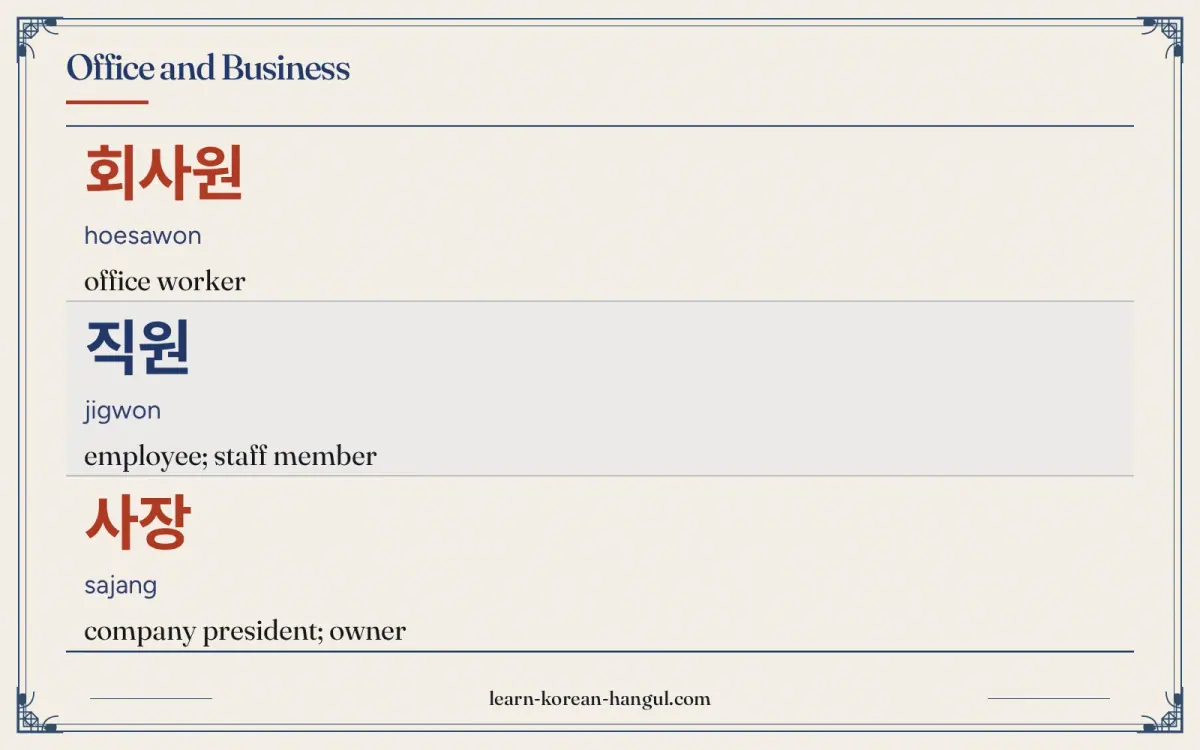
Most adults you meet will answer with a job from this group. The words describe people in an office, a bank or a shop, and several end in -원 (member of an organisation) or -사 (a skilled specialist).
| No. | Hangul | Revised Romanization | Meaning and note | Example sentence | Audio assetId |
|---|---|---|---|---|---|
| 1 | 회사원 | hoesawon | office worker. 회사 means company and 원 marks a member of an organisation. The most common answer to 무슨 일을 하세요? | 저는 회사원이에요. (I am an office worker.) | au-pg-vocabulary-people-jobs-1; example: au-pg-vocabulary-people-jobs-2 |
| 2 | 직원 | jigwon | employee; staff member. A person who works at a particular place. Also used for shop staff. | 이 가게 직원이에요. (I am a staff member at this shop.) | au-pg-vocabulary-people-jobs-3; example: au-pg-vocabulary-people-jobs-4 |
| 3 | 사장 | sajang | company president; owner. Also how people refer to a shop or restaurant owner. Address the person as 사장님. | 사장님은 지금 안 계세요. (The boss is not here now.) | au-pg-vocabulary-people-jobs-5; example: au-pg-vocabulary-people-jobs-6 |
| 4 | 비서 | biseo | secretary; assistant. A person who manages schedules and calls for a boss or an executive. | 비서가 전화를 받았어요. (The secretary answered the phone.) | au-pg-vocabulary-people-jobs-7; example: au-pg-vocabulary-people-jobs-8 |
| 5 | 회계사 | hoegyesa | accountant. 회계 means accounting and 사 marks a licensed specialist. | 회계사는 숫자를 잘 알아요. (An accountant knows numbers well.) | au-pg-vocabulary-people-jobs-9; example: au-pg-vocabulary-people-jobs-10 |
| 6 | 사업가 | saeopga | businessperson; entrepreneur. 사업 means business and 가 marks a person who does it professionally. Said [사업까]. | 그분은 사업가예요. (That person is a businessperson.) | au-pg-vocabulary-people-jobs-11; example: au-pg-vocabulary-people-jobs-12 |
| 7 | 변호사 | byeonhosa | lawyer. A licensed lawyer. Often paired with 사무실 (office). | 변호사를 만나요. (I am meeting a lawyer.) | au-pg-vocabulary-people-jobs-13; example: au-pg-vocabulary-people-jobs-14 |
| 8 | 은행원 | eunhaengwon | bank clerk. 은행 is bank and 원 marks the staff. Said [은행원]. | 은행원이 도와줘요. (The bank clerk helps me.) | au-pg-vocabulary-people-jobs-15; example: au-pg-vocabulary-people-jobs-16 |
| 9 | 판매원 | panmaewon | salesperson. A person who sells goods, often in a store or at a stand. | 백화점에서 판매원으로 일해요. (I work as a salesperson at a department store.) | au-pg-vocabulary-people-jobs-17; example: au-pg-vocabulary-people-jobs-18 |
Notice the suffix endings: 회사원, 은행원 and 판매원 all end in 원. The suffix means a member of a group, so you can build similar words when you meet a new workplace. The next group follows the same logic with different suffixes.
Medical and Care
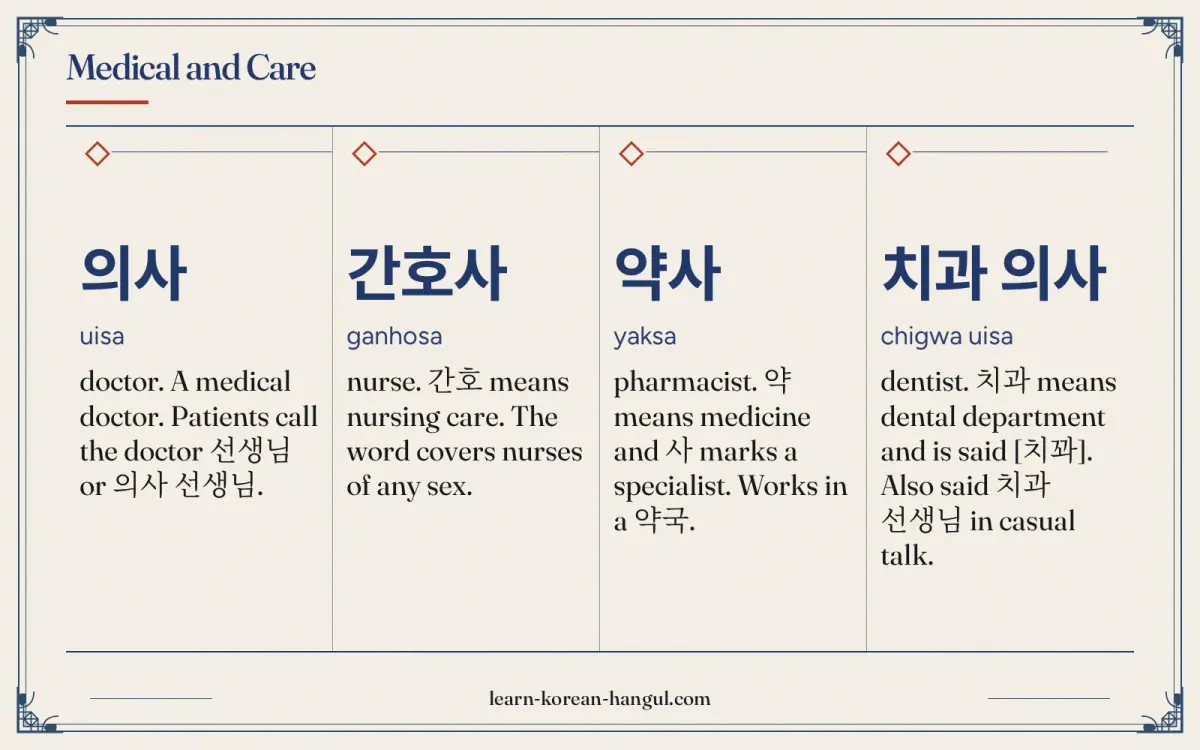
Medical jobs have the most fixed vocabulary, because each has a licensed title. Seven words cover the people you meet at a hospital, a pharmacy and a clinic.
| No. | Hangul | Revised Romanization | Meaning and note | Example sentence | Audio assetId |
|---|---|---|---|---|---|
| 10 | 의사 | uisa | doctor. A medical doctor. Patients call the doctor 선생님 or 의사 선생님. | 의사가 진찰해요. (The doctor examines the patient.) | au-pg-vocabulary-people-jobs-19; example: au-pg-vocabulary-people-jobs-20 |
| 11 | 간호사 | ganhosa | nurse. 간호 means nursing care. The word covers nurses of any sex. | 간호사가 주사를 놓아요. (The nurse gives an injection.) | au-pg-vocabulary-people-jobs-21; example: au-pg-vocabulary-people-jobs-22 |
| 12 | 약사 | yaksa | pharmacist. 약 means medicine and 사 marks a specialist. Works in a 약국. | 약사에게 물어봐요. (I ask the pharmacist.) | au-pg-vocabulary-people-jobs-23; example: au-pg-vocabulary-people-jobs-24 |
| 13 | 치과 의사 | chigwa uisa | dentist. 치과 means dental department and is said [치꽈]. Also said 치과 선생님 in casual talk. | 치과 의사를 만나요. (I see a dentist.) | au-pg-vocabulary-people-jobs-25; example: au-pg-vocabulary-people-jobs-26 |
| 14 | 한의사 | hanuisa | doctor of Korean medicine. 한 refers to traditional Korean medicine. A separate profession from 의사. | 한의사가 침을 놓아요. (The Korean-medicine doctor gives acupuncture.) | au-pg-vocabulary-people-jobs-27; example: au-pg-vocabulary-people-jobs-28 |
| 15 | 수의사 | suuisa | veterinarian. 수 here means beast or animal. Takes care of pets at an animal hospital. | 수의사가 강아지를 봐요. (The vet looks at the puppy.) | au-pg-vocabulary-people-jobs-29; example: au-pg-vocabulary-people-jobs-30 |
| 16 | 영양사 | yeongyangsa | dietitian. 영양 means nutrition. Often works at a school or hospital cafeteria. | 영양사가 식단을 짜요. (The dietitian plans the menu.) | au-pg-vocabulary-people-jobs-31; example: au-pg-vocabulary-people-jobs-32 |
The same pattern repeats: 간호사, 약사, 영양사 and 의사 all end in 사, a syllable that marks a trained specialist (written 師 or 士 in Chinese characters). For the hospital itself, see the hospital in korean page.
Public Service
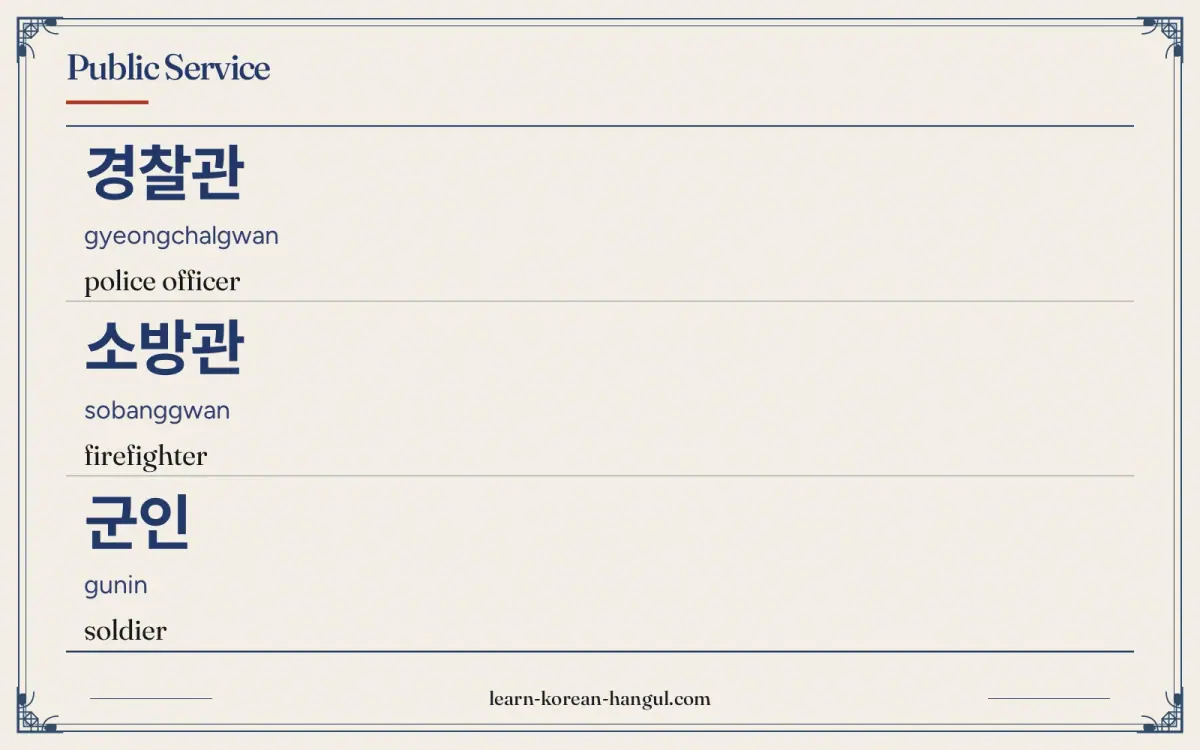
Public-service jobs appear constantly in news and drama. Eight words cover the people who protect, govern and judge, and several end in -관 (an official) or -인 (a person of that field).
| No. | Hangul | Revised Romanization | Meaning and note | Example sentence | Audio assetId |
|---|---|---|---|---|---|
| 17 | 경찰관 | gyeongchalgwan | police officer. 경찰 is police and 관 marks an official. Said [경찰관]. | 경찰관이 길을 알려 줘요. (The police officer shows the way.) | au-pg-vocabulary-people-jobs-33; example: au-pg-vocabulary-people-jobs-34 |
| 18 | 소방관 | sobanggwan | firefighter. 소방 means firefighting. Same 관 ending as 경찰관. | 소방관이 불을 꺼요. (The firefighter puts out the fire.) | au-pg-vocabulary-people-jobs-35; example: au-pg-vocabulary-people-jobs-36 |
| 19 | 군인 | gunin | soldier. 군 means army and 인 means person. Military service is a common topic in Korean drama, so the word comes up often. | 남동생은 군인이에요. (My younger brother is a soldier.) | au-pg-vocabulary-people-jobs-37; example: au-pg-vocabulary-people-jobs-38 |
| 20 | 공무원 | gongmuwon | civil servant. A government employee at any level. | 아버지는 공무원이세요. (My father is a civil servant.) | au-pg-vocabulary-people-jobs-39; example: au-pg-vocabulary-people-jobs-40 |
| 21 | 판사 | pansa | judge. Sits in court and decides cases. | 판사가 판결을 내려요. (The judge delivers the verdict.) | au-pg-vocabulary-people-jobs-41; example: au-pg-vocabulary-people-jobs-42 |
| 22 | 검사 | geomsa | prosecutor. Brings charges in court. Not the same word as 검사 meaning "an examination", which is spelled the same. | 검사가 조사해요. (The prosecutor investigates.) | au-pg-vocabulary-people-jobs-43; example: au-pg-vocabulary-people-jobs-44 |
| 23 | 외교관 | oegyogwan | diplomat. 외교 means diplomacy. Works at an embassy or in the foreign ministry. | 외교관은 대사관에서 일해요. (Diplomats work at an embassy.) | au-pg-vocabulary-people-jobs-45; example: au-pg-vocabulary-people-jobs-46 |
| 24 | 정치인 | jeongchiin | politician. 정치 means politics and 인 means person. Said [정치인]. | 정치인이 연설해요. (The politician gives a speech.) | au-pg-vocabulary-people-jobs-47; example: au-pg-vocabulary-people-jobs-48 |
One of these words has a trap. 검사 has two uses: prosecutor and "examination, inspection", as in 시력 검사 (eyesight test). Context decides which, so look at the word around it. The two meanings are different words that happen to be spelled the same.
Education and Science
Teachers and researchers share one title, 선생님, in daily speech, but the written words differ. Seven words cover schools, labs and engineering.
| No. | Hangul | Revised Romanization | Meaning and note | Example sentence | Audio assetId |
|---|---|---|---|---|---|
| 25 | 선생님 | seonsaengnim | teacher; also a polite title. The default word for a teacher, and a respectful address for doctors and other experts. The 님 makes it respectful. | 선생님이 질문해요. (The teacher asks a question.) | au-pg-vocabulary-people-jobs-49; example: au-pg-vocabulary-people-jobs-50 |
| 26 | 교사 | gyosa | teacher (formal). The formal occupation word. Used on forms and in news, not for addressing a person. | 저는 중학교 교사예요. (I am a middle school teacher.) | au-pg-vocabulary-people-jobs-51; example: au-pg-vocabulary-people-jobs-52 |
| 27 | 교수 | gyosu | professor. A university professor. Address the person as 교수님. | 교수님을 만났어요. (I met the professor.) | au-pg-vocabulary-people-jobs-53; example: au-pg-vocabulary-people-jobs-54 |
| 28 | 과학자 | gwahakja | scientist. 과학 means science and 자 marks a person of study. Said [과학짜]. | 과학자가 실험해요. (The scientist does an experiment.) | au-pg-vocabulary-people-jobs-55; example: au-pg-vocabulary-people-jobs-56 |
| 29 | 연구원 | yeonguwon | researcher. 연구 means research and 원 marks a member. Works at an institute or lab. | 연구원이 논문을 써요. (The researcher writes a paper.) | au-pg-vocabulary-people-jobs-57; example: au-pg-vocabulary-people-jobs-58 |
| 30 | 엔지니어 | enjinieo | engineer. A loanword from English "engineer". The Korean term 기술자 also exists. | 엔지니어가 기계를 고쳐요. (The engineer fixes the machine.) | au-pg-vocabulary-people-jobs-59; example: au-pg-vocabulary-people-jobs-60 |
| 31 | 프로그래머 | peurogeuraemeo | programmer. A loanword from English "programmer". Also 개발자 for software developer. | 프로그래머가 코드를 써요. (The programmer writes code.) | au-pg-vocabulary-people-jobs-61; example: au-pg-vocabulary-people-jobs-62 |
The ending -자 (as in 과학자 and 학자, scholar) marks someone who studies or works in a field. You can say 선생님 to a teacher at any level, but 교사 only describes the job in writing. Try to hear the difference: 선생님 is what students say, 교사 is what a form says.
Arts and Media
Arts jobs show up in K-drama and K-pop talk. These nine words name performers, writers, visual artists and journalists, and many are short and easy.
| No. | Hangul | Revised Romanization | Meaning and note | Example sentence | Audio assetId |
|---|---|---|---|---|---|
| 32 | 배우 | baeu | actor; actress. Korean does not split actor and actress. 배우 covers both. | 그 배우를 좋아해요. (I like that actor.) | au-pg-vocabulary-people-jobs-63; example: au-pg-vocabulary-people-jobs-64 |
| 33 | 가수 | gasu | singer. The standard word for a professional singer. | 가수가 노래해요. (The singer sings.) | au-pg-vocabulary-people-jobs-65; example: au-pg-vocabulary-people-jobs-66 |
| 34 | 작가 | jakga | writer; author. Also used for an artist who makes works. Said [작까]. | 작가가 소설을 써요. (The writer writes a novel.) | au-pg-vocabulary-people-jobs-67; example: au-pg-vocabulary-people-jobs-68 |
| 35 | 화가 | hwaga | painter. 화 refers to painting. The 가 suffix marks a professional. | 화가가 그림을 그려요. (The painter paints a picture.) | au-pg-vocabulary-people-jobs-69; example: au-pg-vocabulary-people-jobs-70 |
| 36 | 감독 | gamdok | director. For film and sports teams: 영화감독 is a film director and a coach can also be 감독. Said [감독]. | 감독이 배우를 불러요. (The director calls the actor.) | au-pg-vocabulary-people-jobs-71; example: au-pg-vocabulary-people-jobs-72 |
| 37 | 기자 | gija | journalist; reporter. Works for a newspaper or broadcaster. | 기자가 질문해요. (The reporter asks a question.) | au-pg-vocabulary-people-jobs-73; example: au-pg-vocabulary-people-jobs-74 |
| 38 | 디자이너 | dijaineo | designer. A loanword from English "designer". Used for fashion, graphic and product design. | 디자이너가 옷을 만들어요. (The designer makes clothes.) | au-pg-vocabulary-people-jobs-75; example: au-pg-vocabulary-people-jobs-76 |
| 39 | 사진작가 | sajinjakga | photographer (art). 사진 means photograph and 작가 means artist. A professional or art photographer. | 사진작가가 사진을 찍어요. (The photographer takes pictures.) | au-pg-vocabulary-people-jobs-77; example: au-pg-vocabulary-people-jobs-78 |
| 40 | 아나운서 | anaunseo | announcer; news anchor. A loanword from English "announcer". Reads news on television or radio. | 아나운서가 뉴스를 전해요. (The announcer delivers the news.) | au-pg-vocabulary-people-jobs-79; example: au-pg-vocabulary-people-jobs-80 |
Many arts words end in 가, as in 작가 and 화가; 가수 starts with 가 (song) and does not belong to this pattern. The ending 가 means a person with a specialised skill, so 음악가 (musician) and 만화가 (cartoonist) follow the same pattern. Korean fans also say 배우님 and 가수님 when speaking about a performer, adding 님 as a mark of respect.
Food, Trades and Service
The last group names the people who feed, drive and serve. Ten words cover the trades you meet every day, plus the part-time job that most students do.
| No. | Hangul | Revised Romanization | Meaning and note | Example sentence | Audio assetId |
|---|---|---|---|---|---|
| 41 | 요리사 | yorisa | chef; cook. 요리 means cooking. Works in a restaurant or hotel. | 요리사가 음식을 만들어요. (The chef makes food.) | au-pg-vocabulary-people-jobs-81; example: au-pg-vocabulary-people-jobs-82 |
| 42 | 제빵사 | jeppangsa | baker. 빵 means bread. A person who bakes for a living. | 제빵사가 빵을 구워요. (The baker bakes bread.) | au-pg-vocabulary-people-jobs-83; example: au-pg-vocabulary-people-jobs-84 |
| 43 | 농부 | nongbu | farmer. The standard word. 농사 is the act of farming. | 농부가 쌀을 키워요. (The farmer grows rice.) | au-pg-vocabulary-people-jobs-85; example: au-pg-vocabulary-people-jobs-86 |
| 44 | 어부 | eobu | fisherman. 부 marks a worker. Works on a fishing boat. | 어부가 바다에 나가요. (The fisherman goes out to sea.) | au-pg-vocabulary-people-jobs-87; example: au-pg-vocabulary-people-jobs-88 |
| 45 | 운전기사 | unjeongisa | driver (professional). 운전 means driving and 기사 means a skilled worker. A bus or company driver. | 운전기사가 문을 열어요. (The driver opens the door.) | au-pg-vocabulary-people-jobs-89; example: au-pg-vocabulary-people-jobs-90 |
| 46 | 택시 기사 | taeksi gisa | taxi driver. 택시 is taxi. Address the driver as 기사님. | 택시 기사님께 주소를 말해요. (I tell the taxi driver the address.) | au-pg-vocabulary-people-jobs-91; example: au-pg-vocabulary-people-jobs-92 |
| 47 | 미용사 | miyongsa | hairdresser. 미용 means beauty care. Works in a 미용실 (hair salon). | 미용사가 머리를 잘라요. (The hairdresser cuts hair.) | au-pg-vocabulary-people-jobs-93; example: au-pg-vocabulary-people-jobs-94 |
| 48 | 점원 | jeomwon | shop clerk. 점 means shop and 원 marks the staff. Customers get the attention of the clerk with 저기요. | 점원이 친절해요. (The clerk is kind.) | au-pg-vocabulary-people-jobs-95; example: au-pg-vocabulary-people-jobs-96 |
| 49 | 주부 | jubu | homemaker. A person, usually a woman, who runs the household. Also written 가정주부. | 어머니는 주부세요. (My mother is a homemaker.) | au-pg-vocabulary-people-jobs-97; example: au-pg-vocabulary-people-jobs-98 |
| 50 | 아르바이트생 | areubaiteusaeng | part-time worker. From German Arbeit. 알바 (alba) is the casual short form. 생 marks a student. | 저는 아르바이트생이에요. (I am a part-time worker.) | au-pg-vocabulary-people-jobs-99; example: au-pg-vocabulary-people-jobs-100 |
아르바이트 is the origin of the short word 알바, which is how students and workers refer to part-time jobs in daily speech. Use 아르바이트생 for the person and 아르바이트 for the job. Typical places are a 편의점 (convenience store), a 카페 and a 식당.
How Do the Suffixes -가, -사, -원, -관 and -자 Work?
Many job words are built from a root plus a short ending that says what kind of worker it is. Learning the five endings lets you guess and build words. The table shows each ending with examples from this page.
| Ending | Meaning | Examples on this page |
|---|---|---|
| -가 | a professional in a creative or specialist field | 작가, 화가, 사업가 |
| -사 | a licensed or skilled specialist | 간호사, 약사, 요리사, 미용사 |
| -원 | a member of an organisation | 회사원, 은행원, 공무원, 직원 |
| -관 | an official or officer | 경찰관, 소방관, 외교관 |
| -자 | a person who works with a subject | 과학자, 학자 |
The endings are Sino-Korean, so they combine with Sino-Korean roots. They do not attach to loanwords: a loanword such as 디자이너 or 엔지니어 keeps its English shape, which is why those words look so different from the rest.
How Do You Ask and Answer 무슨 일을 하세요?
The standard question is 무슨 일을 하세요? (What kind of work do you do?). The answer uses the job noun with 이에요 or 예요, or a workplace verb. Below are ten ready answers, each built from a word above.
| Answer | Meaning |
|---|---|
| 저는 회사원이에요. | I am an office worker. |
| 저는 의사예요. | I am a doctor. |
| 저는 교사예요. | I am a teacher. |
| 저는 간호사예요. | I am a nurse. |
| 저는 공무원이에요. | I am a civil servant. |
| 저는 요리사예요. | I am a chef. |
| 저는 디자이너예요. | I am a designer. |
| 저는 농부예요. | I am a farmer. |
| 저는 기자예요. | I am a journalist. |
| 저는 주부예요. | I am a homemaker. |
Use 이에요 after a consonant (회사원이에요) and 예요 after a vowel (의사예요). The question has a close relative, 직업이 뭐예요? (What is your occupation?), which uses 직업 (jigeop, occupation) and sounds more formal, like a form. For a student, the answer is 학생이에요, or 대학생이에요 for a university student. Learn more self-introduction lines on the introducing yourself page.
Which Job Titles Take 님?
A few titles also work as polite address. Add 님 to the title to speak to a person with respect.
- 선생님. Teachers, and also doctors, lawyers and other experts: 의사 선생님.
- 사장님. A boss, a shop owner or a restaurant owner. Customers use it as the default polite call.
- 교수님. A university professor.
- 기사님. A taxi or bus driver.
Some titles do not take 님 when you address the person. You would not call a colleague 회사원님. Use the person's name plus 씨 or the company rank instead. The terms of address page explains the full system.
Korean job titles are mostly gender-neutral. 배우 covers actor and actress, 의사 covers doctors of any sex, and there is no separate word like English "waitress". Where gender words still exist, they are add-ons such as 여배우 (actress) or 여의사 (woman doctor), used only when the sex matters.
Which Part-Time Jobs Appear in K-Drama?
Student and part-time work shows up a lot in drama and everyday talk. The words are 아르바이트생 (part-time worker), 편의점 직원 (convenience store staff), 카페 직원 (cafe staff) and 배달원 (delivery worker). The first is on this page. The next two join a workplace and 직원 (편의점 + 직원), and 배달원 joins 배달 (delivery) and the suffix 원. A drama line such as 편의점에서 알바해요 (I work part-time at a convenience store) uses the casual short form 알바.
How Do You Pronounce Korean Job Words?
Several job words contain sound changes that the spelling hides. The Revised Romanization of Korean records the spelling and ignores some changes, and the standard pronunciation rules published by the National Institute of Korean Language (국립국어원) give the spoken form.
| Spelling | Sounds like | What changes |
|---|---|---|
| 사업가 | [사업까] | After a final ㅂ, the ㄱ of 가 becomes a tense [ㄲ]. |
| 작가 | [작까] | After a final ㄱ, the ㄱ of 가 becomes a tense [ㄲ]. |
| 과학자 | [과학짜] | After a final ㄱ, the ㅈ of 자 becomes a tense [ㅉ]. |
| 경찰관 | [경찰관] | No change; the final ㄹ stays in the middle syllable. |
| 정치인 | [정치인] | No change; the syllables are said one by one. |
| 감독 | [감독] | The final ㄱ is not released at the end of the word. |
The tense [ㄲ] and [ㅉ] sounds in 작가 and 과학자 are the most common stumbling point. Say the second syllable tight, with no puff of air, as if you stopped just before saying it. The Hangul does not show this change, so the audio is the best guide.
Audio and Slow Playback
Each headword and each example sentence has its own audio clip. The clips below replay the trickiest words at a slower pace. Play one, repeat it aloud, then play it again and compare.
What Mistakes Do Learners Make with Job Words?
These five mistakes come up most when learners talk about work.
- Using 회사원 for every job. It means an office worker for a company. Doctors, teachers and farmers use their own titles.
- Adding 님 when talking about yourself. Say 저는 교사예요 when you are a teacher, and do not call yourself 교수님 or 사장님. 선생님 already contains 님, so adults avoid it about themselves, although teachers use it with young pupils.
- Looking for an "actress" word. 배우 covers both. Add 여 only when the sex matters.
- Mixing 검사 (prosecutor) with 검사 (examination). The sound is the same. Context shows which meaning applies.
- Using 직업 as the answer. 직업 means "occupation" as a category. The answer to 직업이 뭐예요? is the job itself, such as 의사예요.
If you remember only one, remember the 이에요 and 예요 frame, because it carries every answer.
Practice: Flashcards and Worksheet
Study in three steps. First, run the flashcard deck in recognition mode until you know each of the 50 words. Second, switch to listening mode and answer from the audio alone. Third, take the quiz. The deck covers all 50 words with audio, and your progress stays in your browser. The vocabulary flashcard decks page lists the other decks.
Practice · 105
- 01회사원
Show answer
headword 1: office worker
- 02저는 회사원이에요.
Show answer
example sentence for 회사원: I am an office worker.
- 03직원
Show answer
headword 2: employee; staff member
- 04이 가게 직원이에요.
Show answer
example sentence for 직원: I am a staff member at this shop.
- 05사장
Show answer
headword 3: company president; owner
- 06사장님은 지금 안 계세요.
Show answer
example sentence for 사장: The boss is not here now.
- 07비서
Show answer
headword 4: secretary; assistant
- 08비서가 전화를 받았어요.
Show answer
example sentence for 비서: The secretary answered the phone.
- 09회계사
Show answer
headword 5: accountant
- 10회계사는 숫자를 잘 알아요.
Show answer
example sentence for 회계사: An accountant knows numbers well.
- 11사업가
Show answer
headword 6: businessperson; entrepreneur
- 12그분은 사업가예요.
Show answer
example sentence for 사업가: That person is a businessperson.
- 13변호사
Show answer
headword 7: lawyer
- 14변호사를 만나요.
Show answer
example sentence for 변호사: I am meeting a lawyer.
- 15은행원
Show answer
headword 8: bank clerk
- 16은행원이 도와줘요.
Show answer
example sentence for 은행원: The bank clerk helps me.
- 17판매원
Show answer
headword 9: salesperson
- 18백화점에서 판매원으로 일해요.
Show answer
example sentence for 판매원: I work as a salesperson at a department store.
- 19의사
Show answer
headword 10: doctor
- 20의사가 진찰해요.
Show answer
example sentence for 의사: The doctor examines the patient.
- 21간호사
Show answer
headword 11: nurse
- 22간호사가 주사를 놓아요.
Show answer
example sentence for 간호사: The nurse gives an injection.
- 23약사
Show answer
headword 12: pharmacist
- 24약사에게 물어봐요.
Show answer
example sentence for 약사: I ask the pharmacist.
- 25치과 의사
Show answer
headword 13: dentist
- 26치과 의사를 만나요.
Show answer
example sentence for 치과 의사: I see a dentist.
- 27한의사
Show answer
headword 14: doctor of Korean medicine
- 28한의사가 침을 놓아요.
Show answer
example sentence for 한의사: The Korean-medicine doctor gives acupuncture.
- 29수의사
Show answer
headword 15: veterinarian
- 30수의사가 강아지를 봐요.
Show answer
example sentence for 수의사: The vet looks at the puppy.
- 31영양사
Show answer
headword 16: dietitian
- 32영양사가 식단을 짜요.
Show answer
example sentence for 영양사: The dietitian plans the menu.
- 33경찰관
Show answer
headword 17: police officer
- 34경찰관이 길을 알려 줘요.
Show answer
example sentence for 경찰관: The police officer shows the way.
- 35소방관
Show answer
headword 18: firefighter
- 36소방관이 불을 꺼요.
Show answer
example sentence for 소방관: The firefighter puts out the fire.
- 37군인
Show answer
headword 19: soldier
- 38남동생은 군인이에요.
Show answer
example sentence for 군인: My younger brother is a soldier.
- 39공무원
Show answer
headword 20: civil servant
- 40아버지는 공무원이세요.
Show answer
example sentence for 공무원: My father is a civil servant.
- 41판사
Show answer
headword 21: judge
- 42판사가 판결을 내려요.
Show answer
example sentence for 판사: The judge delivers the verdict.
- 43검사
Show answer
headword 22: prosecutor
- 44검사가 조사해요.
Show answer
example sentence for 검사: The prosecutor investigates.
- 45외교관
Show answer
headword 23: diplomat
- 46외교관은 대사관에서 일해요.
Show answer
example sentence for 외교관: Diplomats work at an embassy.
- 47정치인
Show answer
headword 24: politician
- 48정치인이 연설해요.
Show answer
example sentence for 정치인: The politician gives a speech.
- 49선생님
Show answer
headword 25: teacher; also a polite title
- 50선생님이 질문해요.
Show answer
example sentence for 선생님: The teacher asks a question.
- 51교사
Show answer
headword 26: teacher (formal)
- 52저는 중학교 교사예요.
Show answer
example sentence for 교사: I am a middle school teacher.
- 53교수
Show answer
headword 27: professor
- 54교수님을 만났어요.
Show answer
example sentence for 교수: I met the professor.
- 55과학자
Show answer
headword 28: scientist
- 56과학자가 실험해요.
Show answer
example sentence for 과학자: The scientist does an experiment.
- 57연구원
Show answer
headword 29: researcher
- 58연구원이 논문을 써요.
Show answer
example sentence for 연구원: The researcher writes a paper.
- 59엔지니어
Show answer
headword 30: engineer
- 60엔지니어가 기계를 고쳐요.
Show answer
example sentence for 엔지니어: The engineer fixes the machine.
- 61프로그래머
Show answer
headword 31: programmer
- 62프로그래머가 코드를 써요.
Show answer
example sentence for 프로그래머: The programmer writes code.
- 63배우
Show answer
headword 32: actor; actress
- 64그 배우를 좋아해요.
Show answer
example sentence for 배우: I like that actor.
- 65가수
Show answer
headword 33: singer
- 66가수가 노래해요.
Show answer
example sentence for 가수: The singer sings.
- 67작가
Show answer
headword 34: writer; author
- 68작가가 소설을 써요.
Show answer
example sentence for 작가: The writer writes a novel.
- 69화가
Show answer
headword 35: painter
- 70화가가 그림을 그려요.
Show answer
example sentence for 화가: The painter paints a picture.
- 71감독
Show answer
headword 36: director
- 72감독이 배우를 불러요.
Show answer
example sentence for 감독: The director calls the actor.
- 73기자
Show answer
headword 37: journalist; reporter
- 74기자가 질문해요.
Show answer
example sentence for 기자: The reporter asks a question.
- 75디자이너
Show answer
headword 38: designer
- 76디자이너가 옷을 만들어요.
Show answer
example sentence for 디자이너: The designer makes clothes.
- 77사진작가
Show answer
headword 39: photographer (art)
- 78사진작가가 사진을 찍어요.
Show answer
example sentence for 사진작가: The photographer takes pictures.
- 79아나운서
Show answer
headword 40: announcer; news anchor
- 80아나운서가 뉴스를 전해요.
Show answer
example sentence for 아나운서: The announcer delivers the news.
- 81요리사
Show answer
headword 41: chef; cook
- 82요리사가 음식을 만들어요.
Show answer
example sentence for 요리사: The chef makes food.
- 83제빵사
Show answer
headword 42: baker
- 84제빵사가 빵을 구워요.
Show answer
example sentence for 제빵사: The baker bakes bread.
- 85농부
Show answer
headword 43: farmer
- 86농부가 쌀을 키워요.
Show answer
example sentence for 농부: The farmer grows rice.
- 87어부
Show answer
headword 44: fisherman
- 88어부가 바다에 나가요.
Show answer
example sentence for 어부: The fisherman goes out to sea.
- 89운전기사
Show answer
headword 45: driver (professional)
- 90운전기사가 문을 열어요.
Show answer
example sentence for 운전기사: The driver opens the door.
- 91택시 기사
Show answer
headword 46: taxi driver
- 92택시 기사님께 주소를 말해요.
Show answer
example sentence for 택시 기사: I tell the taxi driver the address.
- 93미용사
Show answer
headword 47: hairdresser
- 94미용사가 머리를 잘라요.
Show answer
example sentence for 미용사: The hairdresser cuts hair.
- 95점원
Show answer
headword 48: shop clerk
- 96점원이 친절해요.
Show answer
example sentence for 점원: The clerk is kind.
- 97주부
Show answer
headword 49: homemaker
- 98어머니는 주부세요.
Show answer
example sentence for 주부: My mother is a homemaker.
- 99아르바이트생
Show answer
headword 50: part-time worker
- 100저는 아르바이트생이에요.
Show answer
example sentence for 아르바이트생: I am a part-time worker.
- 101사업가
Show answer
slow playback of 사업가
- 102작가
Show answer
slow playback of 작가
- 103과학자
Show answer
slow playback of 과학자
- 104아나운서
Show answer
slow playback of 아나운서
- 105제빵사
Show answer
slow playback of 제빵사
Practice · 5
What does 간호사 (ganhosa) mean?
Show answer
nurse
간호사 means nurse. Example: 간호사가 주사를 놓아요. (The nurse gives an injection.)
What does 공무원 (gongmuwon) mean?
Show answer
civil servant
공무원 means civil servant. Example: 아버지는 공무원이세요. (My father is a civil servant.)
What does 농부 (nongbu) mean?
Show answer
farmer
농부 means farmer. Example: 농부가 쌀을 키워요. (The farmer grows rice.)
What does 기자 (gija) mean?
Show answer
journalist; reporter
기자 means journalist; reporter. Example: 기자가 질문해요. (The reporter asks a question.)
What does 판매원 (panmaewon) mean?
Show answer
salesperson
판매원 means salesperson. Example: 백화점에서 판매원으로 일해요. (I work as a salesperson at a department store.)
Korean Jobs Vocabulary Worksheet (PDF)
A printable worksheet for these words (word list, matching, writing practice, fill-in-the-blank exercises and answer key) is available in A4 and US Letter from the download card on this page. For practice, copy the 50 words by hand and write the job next to each. Write three sentences about people you know, such as 아버지는 공무원이세요, to fix the frame.
Where to Go Next
After this page, continue with Body Parts, the next list in the section, or Relationships and Titles for the words used to address people. For work vocabulary inside a company, see company ranks. To move up a level, return to People and Relationships.
Frequently Asked Questions
How Do You Say Doctor in Korean?
Doctor is 의사 (uisa). Use it for the profession, as in 저는 의사예요 (I am a doctor). When you speak to a doctor, say 의사 선생님 or just 선생님. A dentist is 치과 의사, and a doctor of traditional Korean medicine is 한의사.
How Do You Say Actor in Korean?
Actor is 배우 (baeu). The word covers actors and actresses, so there is no separate word. If the sex matters, add 남 or 여 in front, as in 여배우 (actress). Say bae-u, with two clear vowels and no sound change.
How Do You Say Chef in Korean?
Chef is 요리사 (yorisa). 요리 means cooking and 사 marks a skilled worker, so the word also means cook. In a simple polite sentence, say 저는 요리사예요 (I am a chef). A baker is 제빵사.
How Do You Pronounce 배우?
Say bae-u. The first syllable 배 has the vowel ㅐ, close to the vowel in "bet", and the second syllable 우 is a rounded [u]. There is no sound change between them. Use the audio button on this page for the normal and slow versions.
What Does the Suffix -사 Mean in Korean Job Titles?
The ending 사 marks a licensed or skilled specialist. It appears in 간호사 (nurse), 약사 (pharmacist), 요리사 (chef) and 미용사 (hairdresser). It combines with Sino-Korean roots, so it is not attached to loanwords such as 디자이너.
Is the Romanization on This Page Official?
It follows the Revised Romanization of Korean, which South Korea adopted on 7 July 2000 and whose rules the National Institute of Korean Language (국립국어원) publishes. It is a learning aid and does not mark every sound change, so rely on the Hangul and the audio.