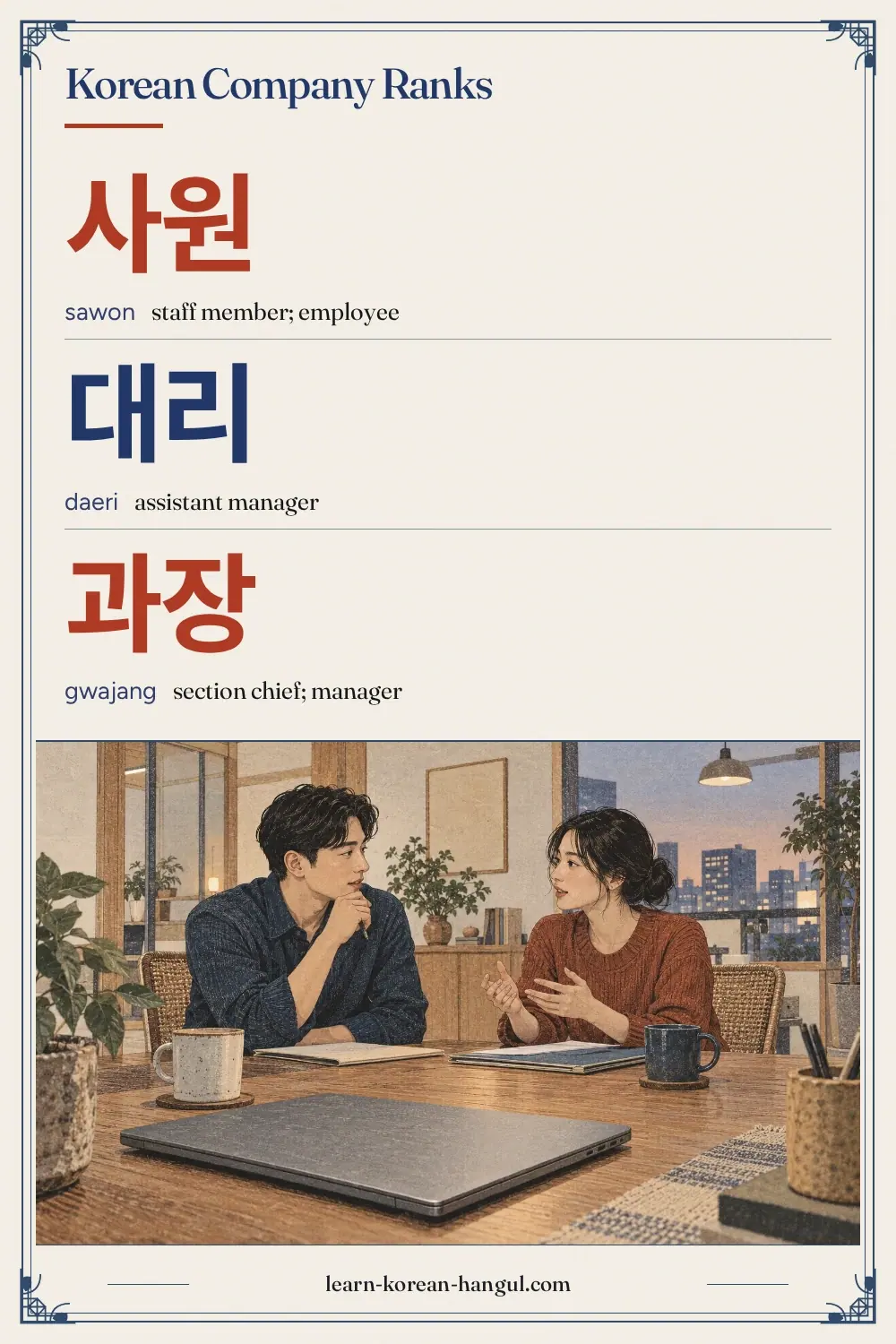
Korean Company Ranks at a Glance
The list has 30 words in five groups. It starts with the ranks of a typical large company and ends with titles you meet at a school, a hospital and a university. It belongs to Office and Business and it is the page to read before Korean Job Interview Vocabulary or Korean Email and Letters Vocabulary, because every email and every greeting in a Korean company depends on knowing who is above whom.
| Group | Words | Use |
|---|---|---|
| Entry to mid-level | 6 | Interns, staff, assistant managers and managers |
| Senior management | 6 | Deputy general managers, department heads and directors |
| Executives | 7 | Directors, presidents and chairmen |
| Titles with -님 | 5 | Respectful forms of address |
| Titles in other settings | 6 | Teachers, professors, doctors and seniors |
A common order of ranks in large companies, from the bottom, runs 사원, 대리, 과장, 차장, 부장, 이사, 상무, 전무, 사장 and 회장. Many firms add 주임 between 사원 and 대리, and 부사장 and 부회장 above their heads. This is a typical pattern, not a rule: ranks, names and the number of steps differ between companies, and some firms have simplified their titles in recent years. The ranks (직급) also differ from the positions (직책) that people hold, such as 팀장 (team leader). A rank says how senior a person is, and a position says what job they do today.
Some companies, especially in IT and start-ups, have replaced most of these ranks with one flat title such as 매니저 (manager) or 프로, or with the name plus 님. This varies from company to company, so check what a firm uses before you assume the ladder above. A business card (명함) shows the rank or position on the card, usually near the name, as in 영업부 과장 김민수. When you read it aloud, put the family name before the title and add 님: 김 과장님.
Which Company Ranks Should You Learn First?
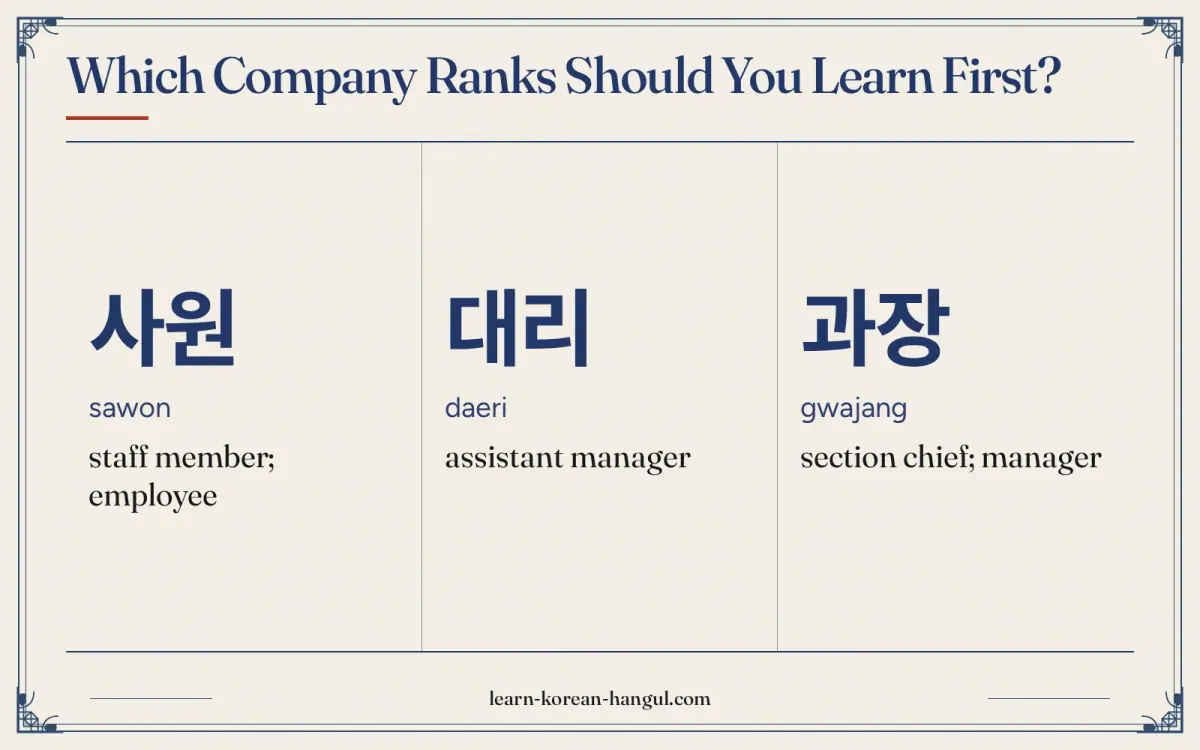
Learn 사원 (staff member), 대리 (assistant manager), 과장 (section chief), 부장 (department head) and 사장 (president) first. They are the ranks you hear most in daily talk and in dramas. Add 님 at once, because you will almost never use a rank without it.
- Words to say. 사원, 대리, 과장, 부장, 사장, 님.
- Words to recognise. 차장, 이사, 상무, 전무, 회장. They appear in news and on business cards.
- Words for other settings. 선생님, 교수, 박사, 선배.
The scene below shows an office floor with ten of the 30 words, from the newest staff member to the chairman's room. Play the clip on each item to hear the headword.
Word · 10
- 1
사원
sawon
staff member; employee
- 2
대리
daeri
assistant manager
- 3
과장
gwajang
section chief; manager
- 4
차장
chajang
deputy general manager
- 5
부장
bujang
department head; general manager
- 6
이사
isa
director (board level)
- 7
사장
sajang
president; company head; boss
- 8
회장
hoejang
chairman
- 9
님
nim
honorific suffix (Mr., Ms.)
- 10
선배
seonbae
senior (at school or work)
Entry to Mid-Level (사원, 대리, 과장)
Most careers begin here. An 인턴 works for a short time and a 신입사원 is someone newly hired. Then comes 사원, the base rank, and in some firms 주임. The first step with real responsibility is 대리, and a 과장 leads a section. The three words 사원, 대리 and 과장 are the ones most often heard, and many people in a company hold one of them.
| No. | Hangul | Revised Romanization | Meaning and note | Example sentence | Audio assetId |
|---|---|---|---|---|---|
| 1 | 인턴 | inteon | intern. A loanword. An intern is not a rank, but it is the step before one. | 인턴으로 일해요. (I work as an intern.) | au-pg-vocabulary-school-work-office-company-ranks-1; example: au-pg-vocabulary-school-work-office-company-ranks-31 |
| 2 | 신입사원 | sinipsawon | new employee. Said [시닙싸원]. 신입 means newly entering. | 저는 신입사원이에요. (I am a new employee.) | au-pg-vocabulary-school-work-office-company-ranks-2; example: au-pg-vocabulary-school-work-office-company-ranks-32 |
| 3 | 사원 | sawon | staff member; employee. The lowest regular rank in many companies. | 우리 팀에는 사원이 세 명 있어요. (Our team has three staff members.) | au-pg-vocabulary-school-work-office-company-ranks-3; example: au-pg-vocabulary-school-work-office-company-ranks-33 |
| 4 | 주임 | juim | senior staff member. Between 사원 and 대리 in some companies only. | 주임은 대리 아래예요. (A 주임 is below an assistant manager.) | au-pg-vocabulary-school-work-office-company-ranks-4; example: au-pg-vocabulary-school-work-office-company-ranks-34 |
| 5 | 대리 | daeri | assistant manager. Literally "acting for", the first rank with some responsibility. | 김 대리가 보고서를 써요. (Assistant Manager Kim writes the report.) | au-pg-vocabulary-school-work-office-company-ranks-5; example: au-pg-vocabulary-school-work-office-company-ranks-35 |
| 6 | 과장 | gwajang | section chief; manager. Leads a section. Often translated as "manager". | 과장은 팀을 이끌어요. (A section chief leads the team.) | au-pg-vocabulary-school-work-office-company-ranks-6; example: au-pg-vocabulary-school-work-office-company-ranks-36 |
The English glosses are approximate. 대리 is usually translated as "assistant manager", but it has no exact counterpart, and 과장, "section chief", is often translated as "manager". When a Korean person introduces themselves in English they choose the closest word, so you may see the same rank translated in more than one way. In Korean, the rank comes after the family name, as in 김 대리 or 박 과장, and never before it. The verb 이끌다 (to lead) in the sentence about the 과장 gives 이끌어요. The word 신입 also appears in 신입생 (new student).
How Do You Say Senior Management (차장, 부장, 이사) in Korean?
Above the section chief come the senior managers. A 차장 is the deputy of the department head, and a 부장 leads the department. The next step, 이사, is a director at board level, and from here the person is usually counted as an executive. The group also contains three titles for the head of a unit: 팀장, 실장 and 본부장. They name positions, not ranks, and they can be held by people of different ranks.
| No. | Hangul | Revised Romanization | Meaning and note | Example sentence | Audio assetId |
|---|---|---|---|---|---|
| 7 | 차장 | chajang | deputy general manager. Spelled like the train conductor 차장, so context decides. | 차장은 부장 아래예요. (A deputy general manager is below a department head.) | au-pg-vocabulary-school-work-office-company-ranks-7; example: au-pg-vocabulary-school-work-office-company-ranks-37 |
| 8 | 부장 | bujang | department head; general manager. Leads a department (부서). | 부장이 회의를 해요. (The department head holds a meeting.) | au-pg-vocabulary-school-work-office-company-ranks-8; example: au-pg-vocabulary-school-work-office-company-ranks-38 |
| 9 | 이사 | isa | director (board level). Spelled like 이사, moving house. Context decides. | 이사가 새 계획을 발표해요. (The director announces the new plan.) | au-pg-vocabulary-school-work-office-company-ranks-9; example: au-pg-vocabulary-school-work-office-company-ranks-39 |
| 10 | 팀장 | timjang | team leader. A position (직책), not a rank. A 과장 or a 차장 can be one. | 팀장이 일정을 정해요. (The team leader sets the schedule.) | au-pg-vocabulary-school-work-office-company-ranks-10; example: au-pg-vocabulary-school-work-office-company-ranks-40 |
| 11 | 실장 | siljang | head of an office unit. Said [실짱]. 실 is a room or unit. | 실장이 부서를 관리해요. (The head of the unit manages the department.) | au-pg-vocabulary-school-work-office-company-ranks-11; example: au-pg-vocabulary-school-work-office-company-ranks-41 |
| 12 | 본부장 | bonbujang | head of a division. 본부 is a headquarters or large division. | 본부장은 여러 부서를 이끌어요. (The division head leads several departments.) | au-pg-vocabulary-school-work-office-company-ranks-12; example: au-pg-vocabulary-school-work-office-company-ranks-42 |
Two traps hide in this group. First, 차장 is also the word for a train conductor and 이사 is also the word for moving house, so the same sound can name a person, an event or a title. Context settles it: 이사를 가요 is moving house, and 이사가 발표해요 is a director speaking. Second, the difference between a rank and a position. A person can be a 과장 by rank and a 팀장 by position, and the team leader may be younger or older than the members. In speech, people use the position if the person has one, as in 팀장님, and the rank if not. The sound of 실장 is [실짱], where the ㄹ of 실 makes the ㅈ tense.
Executives (상무, 전무, 사장, 회장)
The executive ranks are the top of the ladder, and they are the ones you see in the news. In many large companies, 상무 and 전무 sit above the 이사, and a 부사장 supports the 사장, the president. At the very top is the 회장, the chairman. 대표 is the title of the person who represents the company legally, and it is the word you use when you mean the CEO.
| No. | Hangul | Revised Romanization | Meaning and note | Example sentence | Audio assetId |
|---|---|---|---|---|---|
| 13 | 상무 | sangmu | managing director. The first executive rank in many large companies. | 상무가 회의에 참석해요. (The managing director attends the meeting.) | au-pg-vocabulary-school-work-office-company-ranks-13; example: au-pg-vocabulary-school-work-office-company-ranks-43 |
| 14 | 전무 | jeonmu | senior managing director. Above 상무 in companies that use both. | 전무는 상무보다 높아요. (A senior managing director ranks above a managing director.) | au-pg-vocabulary-school-work-office-company-ranks-14; example: au-pg-vocabulary-school-work-office-company-ranks-44 |
| 15 | 부사장 | busajang | vice president. 부 means vice. | 부사장이 사장을 도와요. (The vice president helps the president.) | au-pg-vocabulary-school-work-office-company-ranks-15; example: au-pg-vocabulary-school-work-office-company-ranks-45 |
| 16 | 사장 | sajang | president; company head; boss. In speech also the boss or the owner of a shop. | 사장이 직원들을 만나요. (The president meets the employees.) | au-pg-vocabulary-school-work-office-company-ranks-16; example: au-pg-vocabulary-school-work-office-company-ranks-46 |
| 17 | 부회장 | buhoejang | vice chairman. 부 plus 회장. | 부회장은 회장 다음이에요. (The vice chairman comes after the chairman.) | au-pg-vocabulary-school-work-office-company-ranks-17; example: au-pg-vocabulary-school-work-office-company-ranks-47 |
| 18 | 회장 | hoejang | chairman. Also the head of a club or association. | 회장이 인사말을 해요. (The chairman gives a speech.) | au-pg-vocabulary-school-work-office-company-ranks-18; example: au-pg-vocabulary-school-work-office-company-ranks-48 |
| 19 | 대표 | daepyo | representative; CEO. The formal title is 대표이사. Speech uses 대표. | 우리 회사 대표를 만나요. (I meet the CEO of our company.) | au-pg-vocabulary-school-work-office-company-ranks-19; example: au-pg-vocabulary-school-work-office-company-ranks-49 |
The word 사장 is the most flexible title in this list. In a company it is the president, but in daily life it means the boss or the owner of a business, and customers call the owner of a small shop 사장님. The word 회장 is just as flexible, because it also means the head of a club, an association or a residents' committee. The formal title of a company head is 대표이사, which joins the representative (대표) and the director (이사), and it appears in contracts and on business cards. The news uses these titles with the company name, so you will read 회장 and 사장 in articles about business. Which titles a given company uses is shown on its own site, not in a dictionary.
How Do You Say Titles with -님 in Korean?
In a Korean company you rarely call a colleague by name alone. You call them by rank plus 님, the respectful suffix: 김 과장님 or 박 부장님. When you talk to a person, you say the title with 님. When you talk about a person to someone senior, you also use it. The suffix 님 turns a plain rank into a polite form of address, and the pairs below are the ones you will hear most.
| No. | Hangul | Revised Romanization | Meaning and note | Example sentence | Audio assetId |
|---|---|---|---|---|---|
| 20 | 님 | nim | honorific suffix (Mr., Ms.). Added after a name or a title to show respect. | 이름 뒤에 님을 붙여요. (I add 님 after the name.) | au-pg-vocabulary-school-work-office-company-ranks-20; example: au-pg-vocabulary-school-work-office-company-ranks-50 |
| 21 | 과장님 | gwajangnim | section chief (with respect). The form used to speak to or about a 과장. | 과장님, 잠깐 시간 괜찮으세요? (Section Chief, do you have a moment?) | au-pg-vocabulary-school-work-office-company-ranks-21; example: au-pg-vocabulary-school-work-office-company-ranks-51 |
| 22 | 부장님 | bujangnim | department head (with respect). Often paired with the honorific verb ending -세요. | 부장님은 지금 회의 중이세요. (The department head is in a meeting now.) | au-pg-vocabulary-school-work-office-company-ranks-22; example: au-pg-vocabulary-school-work-office-company-ranks-52 |
| 23 | 사장님 | sajangnim | president; boss; shop owner (with respect). Also what customers call a shop owner. | 사장님, 안녕하세요. (Hello, boss.) | au-pg-vocabulary-school-work-office-company-ranks-23; example: au-pg-vocabulary-school-work-office-company-ranks-53 |
| 24 | 대표님 | daepyonim | CEO (with respect). Common in start-ups and smaller firms. | 대표님이 오셨어요. (The CEO has arrived.) | au-pg-vocabulary-school-work-office-company-ranks-24; example: au-pg-vocabulary-school-work-office-company-ranks-54 |
A few rules keep this natural. Use 님 for other people and never for yourself, so you say 저는 과장입니다, not 저는 과장님입니다. Place the family name first when you want to be specific: 김 과장님. Do not use 당신 (you) with a superior; use the title. The honorific verb ending -(으)세요 pairs with 님 titles, as in 부장님은 지금 회의 중이세요 and 대표님이 오셨어요, where 오시다 becomes 오셨어요 in the past. The honorific suffix also attaches to other roles, such as 선생님 (teacher) and 사모님 (a senior's wife or a shop owner's wife). The sunbae and hoobae page explains the wider system of seniority behind these forms.
Titles in Other Settings
Titles work the same way outside the office. Teachers are 선생님, professors are 교수, a principal is 교장 and the head of a hospital or an academy is 원장. A person with a doctorate is a 박사. All of these take 님 when you speak to them. The last word, 선배, is not a title but a relationship: someone who joined the school or company before you.
| No. | Hangul | Revised Romanization | Meaning and note | Example sentence | Audio assetId |
|---|---|---|---|---|---|
| 25 | 선생님 | seonsaengnim | teacher; respectful address. Used for teachers and for respected professionals. | 선생님이 교실에 계세요. (The teacher is in the classroom.) | au-pg-vocabulary-school-work-office-company-ranks-25; example: au-pg-vocabulary-school-work-office-company-ranks-55 |
| 26 | 교수 | gyosu | professor. Add 님 to address one: 교수님. | 저는 대학교 교수예요. (I am a university professor.) | au-pg-vocabulary-school-work-office-company-ranks-26; example: au-pg-vocabulary-school-work-office-company-ranks-56 |
| 27 | 박사 | baksa | doctor (PhD); expert. Said [박싸]. Add 님 to address one: 박사님. | 그는 경제학 박사예요. (He has a doctorate in economics.) | au-pg-vocabulary-school-work-office-company-ranks-27; example: au-pg-vocabulary-school-work-office-company-ranks-57 |
| 28 | 원장 | wonjang | head of a clinic, academy or institute. The person at the top of a 병원 or 학원. | 원장은 병원을 운영해요. (The director runs the hospital.) | au-pg-vocabulary-school-work-office-company-ranks-28; example: au-pg-vocabulary-school-work-office-company-ranks-58 |
| 29 | 교장 | gyojang | school principal. Addressed as 교장 선생님. | 교장 선생님이 말씀하세요. (The principal is speaking.) | au-pg-vocabulary-school-work-office-company-ranks-29; example: au-pg-vocabulary-school-work-office-company-ranks-59 |
| 30 | 선배 | seonbae | senior (at school or work). Someone who joined before you. The opposite is 후배. | 회사 선배가 도와줘요. (A senior at work helps me.) | au-pg-vocabulary-school-work-office-company-ranks-30; example: au-pg-vocabulary-school-work-office-company-ranks-60 |
The word 선생님 is broader than the English "teacher". It is also used for respected professionals such as doctors and lawyers, and it is a safe polite way to address someone whose job you do not know. A 교수 is addressed as 교수님, and 교장 is almost always said with 선생님 as 교장 선생님. The word 박사 is used for a person with a doctorate, and also for an expert in a field, as in 만물박사 (a person who knows a bit of everything). The word 선배 has the opposite 후배, a junior, and both are used at school and at work. The same titles appear in school life, which the School and Work hub also covers.
How Do You Pronounce These Words?
Most rank words are two or three Sino-Korean syllables with no sound change, which makes them easy to say. A few have tense sounds. In Sino-Korean words, a final ㄹ makes only a following ㄷ, ㅅ or ㅈ tense, so 실장 is [실짱], while 일반 (general) stays plain as [일반]. Standard pronunciation follows the National Institute of Korean Language (국립국어원) rules. Revised Romanization does not show tensing caused by a neighbouring sound.
| Spelling | Sounds like | What changes |
|---|---|---|
| 신입사원 | [시닙싸원] | The final ㄴ of 신 moves to the vowel of 입, and the ㅅ after the final ㅂ is tense. |
| 실장 | [실짱] | After the final ㄹ of a Sino-Korean syllable, the ㅈ is tense. |
| 박사 | [박싸] | After the final ㄱ, the ㅅ is tense. |
| 과장 | [과장] | No change: ㅈ after a vowel stays plain. |
| 부장님 | [부장님] | No change; the 님 keeps its n sound. |
Audio and Slow Playback
Each word and example has its own clip, and five more replay the hardest words slowly. Play 신입사원 first and listen for the tense 싸, then say 본부장 slowly in three even beats.
What Mistakes Do Learners Make with Company Ranks?
Five slips are common when learners use Korean titles.
- Calling someone by name alone. At work, say rank plus 님, as in 김 과장님. A first name alone sounds too familiar to a senior.
- Adding 님 to your own title. You are a 과장, not a 과장님. The suffix is for other people.
- Treating 팀장 as a rank. 팀장 is a position. A person can be a 과장 by rank and a 팀장 by position.
- Mixing up 차장 and 부장. 부장 is senior to 차장. A deputy (차장) works under a department head (부장).
- Using 당신 for "you". Do not use it with a superior. Use the title, or the title with 님.
When in doubt, use the title the person uses for themselves on a business card or in an email, and add 님. Ranks and their English translations differ between companies, so use this page as a guide to the common pattern and not as a rule for a specific firm.
Practice: Flashcards and Worksheet
Study in three steps. First, run the deck in recognition mode until the 30 words feel familiar. Second, switch to listening mode and play the clip before you flip each card. Third, take the five-question quiz. Your deck progress stays in your browser, and the vocabulary flashcard decks page lists the other decks.
Practice · 65
- 01인턴
Show answer
headword 1: intern
- 02신입사원
Show answer
headword 2: new employee
- 03사원
Show answer
headword 3: staff member; employee
- 04주임
Show answer
headword 4: senior staff member
- 05대리
Show answer
headword 5: assistant manager
- 06과장
Show answer
headword 6: section chief; manager
- 07차장
Show answer
headword 7: deputy general manager
- 08부장
Show answer
headword 8: department head; general manager
- 09이사
Show answer
headword 9: director (board level)
- 10팀장
Show answer
headword 10: team leader
- 11실장
Show answer
headword 11: head of an office unit
- 12본부장
Show answer
headword 12: head of a division
- 13상무
Show answer
headword 13: managing director
- 14전무
Show answer
headword 14: senior managing director
- 15부사장
Show answer
headword 15: vice president
- 16사장
Show answer
headword 16: president; company head; boss
- 17부회장
Show answer
headword 17: vice chairman
- 18회장
Show answer
headword 18: chairman
- 19대표
Show answer
headword 19: representative; CEO
- 20님
Show answer
headword 20: honorific suffix (Mr., Ms.)
- 21과장님
Show answer
headword 21: section chief (with respect)
- 22부장님
Show answer
headword 22: department head (with respect)
- 23사장님
Show answer
headword 23: president; boss; shop owner (with respect)
- 24대표님
Show answer
headword 24: CEO (with respect)
- 25선생님
Show answer
headword 25: teacher; respectful address
- 26교수
Show answer
headword 26: professor
- 27박사
Show answer
headword 27: doctor (PhD); expert
- 28원장
Show answer
headword 28: head of a clinic, academy or institute
- 29교장
Show answer
headword 29: school principal
- 30선배
Show answer
headword 30: senior (at school or work)
- 31인턴으로 일해요.
Show answer
example sentence for 인턴
- 32저는 신입사원이에요.
Show answer
example sentence for 신입사원
- 33우리 팀에는 사원이 세 명 있어요.
Show answer
example sentence for 사원
- 34주임은 대리 아래예요.
Show answer
example sentence for 주임
- 35김 대리가 보고서를 써요.
Show answer
example sentence for 대리
- 36과장은 팀을 이끌어요.
Show answer
example sentence for 과장
- 37차장은 부장 아래예요.
Show answer
example sentence for 차장
- 38부장이 회의를 해요.
Show answer
example sentence for 부장
- 39이사가 새 계획을 발표해요.
Show answer
example sentence for 이사
- 40팀장이 일정을 정해요.
Show answer
example sentence for 팀장
- 41실장이 부서를 관리해요.
Show answer
example sentence for 실장
- 42본부장은 여러 부서를 이끌어요.
Show answer
example sentence for 본부장
- 43상무가 회의에 참석해요.
Show answer
example sentence for 상무
- 44전무는 상무보다 높아요.
Show answer
example sentence for 전무
- 45부사장이 사장을 도와요.
Show answer
example sentence for 부사장
- 46사장이 직원들을 만나요.
Show answer
example sentence for 사장
- 47부회장은 회장 다음이에요.
Show answer
example sentence for 부회장
- 48회장이 인사말을 해요.
Show answer
example sentence for 회장
- 49우리 회사 대표를 만나요.
Show answer
example sentence for 대표
- 50이름 뒤에 님을 붙여요.
Show answer
example sentence for 님
- 51과장님, 잠깐 시간 괜찮으세요?
Show answer
example sentence for 과장님
- 52부장님은 지금 회의 중이세요.
Show answer
example sentence for 부장님
- 53사장님, 안녕하세요.
Show answer
example sentence for 사장님
- 54대표님이 오셨어요.
Show answer
example sentence for 대표님
- 55선생님이 교실에 계세요.
Show answer
example sentence for 선생님
- 56저는 대학교 교수예요.
Show answer
example sentence for 교수
- 57그는 경제학 박사예요.
Show answer
example sentence for 박사
- 58원장은 병원을 운영해요.
Show answer
example sentence for 원장
- 59교장 선생님이 말씀하세요.
Show answer
example sentence for 교장
- 60회사 선배가 도와줘요.
Show answer
example sentence for 선배
- 61신입사원
Show answer
slow playback: new employee
- 62실장
Show answer
slow playback: head of an office unit
- 63박사
Show answer
slow playback: doctor (PhD); expert
- 64본부장
Show answer
slow playback: head of a division
- 65대표님
Show answer
slow playback: CEO (with respect)
Practice · 5
What does 사원 (sawon) mean?
Show answer
staff member; employee
사원 means staff member; employee. Example: 우리 팀에는 사원이 세 명 있어요. (Our team has three staff members.)
What does 과장 (gwajang) mean?
Show answer
section chief; manager
과장 means section chief; manager. Example: 과장은 팀을 이끌어요. (A section chief leads the team.)
What does 팀장 (timjang) mean?
Show answer
team leader
팀장 means team leader. Example: 팀장이 일정을 정해요. (The team leader sets the schedule.)
What does 부사장 (busajang) mean?
Show answer
vice president
부사장 means vice president. Example: 부사장이 사장을 도와요. (The vice president helps the president.)
What does 대표님 (daepyonim) mean?
Show answer
CEO (with respect)
대표님 means CEO (with respect). Example: 대표님이 오셨어요. (The CEO has arrived.)
Korean Company Ranks Worksheet (PDF)
A printable worksheet for these words (word list, matching, writing practice, fill-in-the-blank exercises and answer key) is available in A4 and US Letter from the download card on this page. Meanwhile, copy the rank ladder from this page by hand, from 사원 to 회장, and say each rank with 님 aloud.
Where to Go Next
After this page, continue with Korean Job Interview Vocabulary for the words used to get a job, or with Korean Email and Letters Vocabulary for writing to a superior. To move up a level, return to Office and Business.
Frequently Asked Questions
How Do You Say Staff Member in Korean?
Staff member is 사원 (sawon), the base rank in many Korean companies. A new employee is a 신입사원, and an intern is an 인턴. The next ranks up are 대리, 과장 and 부장. To address a staff member politely, use the name plus 씨.
How Do You Pronounce 대리 (daeri)?
Say dae-ri in two beats. The dae starts with a soft d and the vowel ㅐ, close to the "e" in "bed". The ri is a quick tap of the tongue, between r and l. The standard pronunciation is [대리], with no sound change. Press the audio button to hear it.
How Many Company Ranks Should I Learn First?
Five: 사원, 대리, 과장, 부장 and 사장. They are the ranks you meet most. At five new words a day the full 30 take six days plus review. Learn 님 at the same time, because ranks are used with it.
Where Can I Practise Company Ranks with Flashcards?
Use the vocabulary flashcard decks. The deck for this page holds all 30 words with Hangul, romanization and audio. Your progress stays in your browser. Try recognition mode on the ladder from 사원 to 회장 until you can say the order without looking.
Is the Romanization on This Page Official?
It follows the Revised Romanization of Korean, which South Korea adopted on 7 July 2000 and whose rules the National Institute of Korean Language (국립국어원) publishes. It is a learning aid. It does not show tense sounds such as the ㅉ in [실짱], so rely on the Hangul and the audio.
Is There a Printable Worksheet for Company Ranks?
A printable worksheet for these words (word list, matching, writing practice, fill-in-the-blank exercises and answer key) is available in A4 and US Letter from the download card on this page. For practice, copy the tables by hand and write one example sentence for each of the five groups.