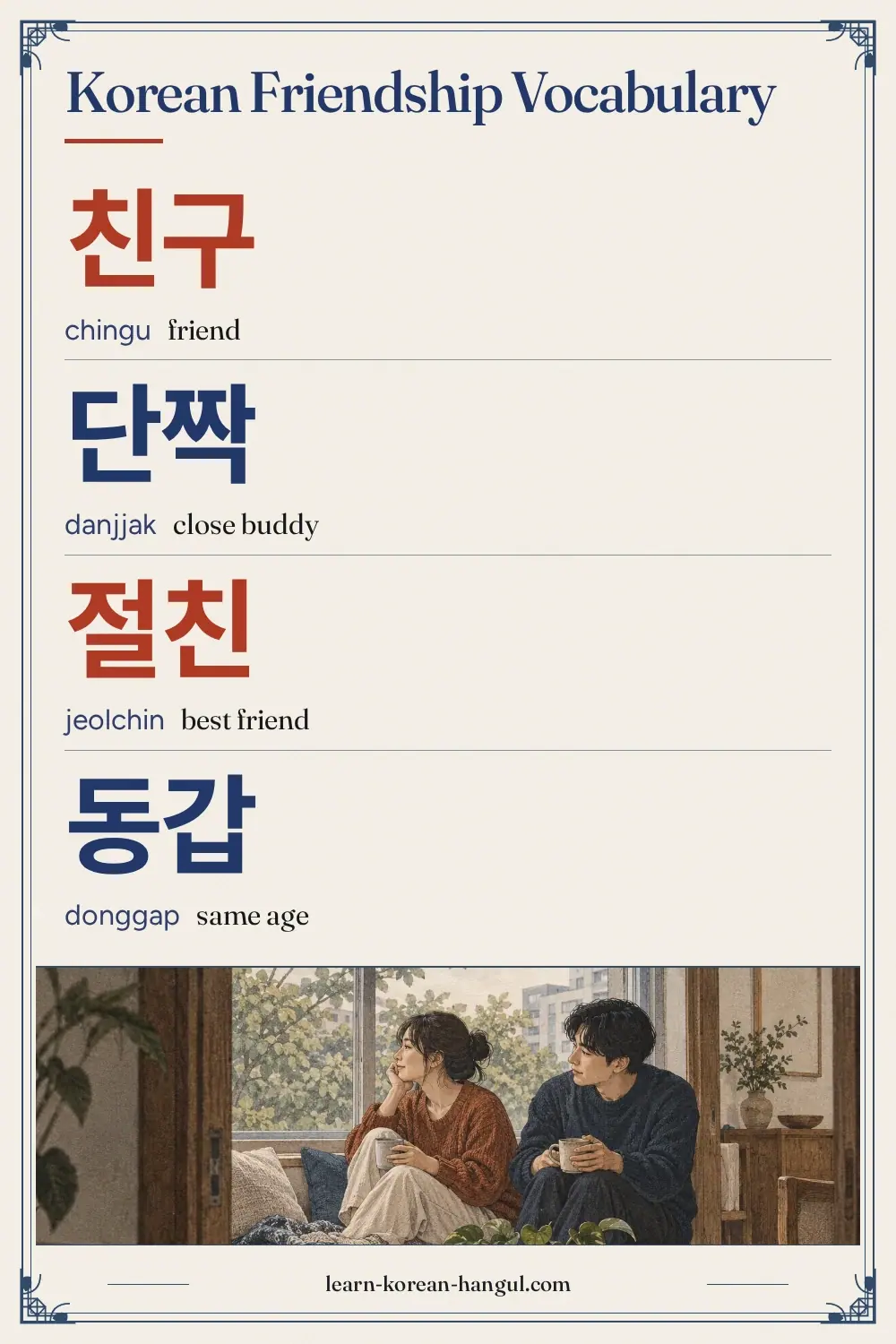
What you'll learn
- Match all 30 friendship words to their English meanings.
- Say five of them aloud with the help of the Revised Romanization and the audio.
- Write two original sentences that use words such as 친구 (friend) and 동갑 (same age).
- Choose the right good-bye for a friend who is leaving and a friend who is staying.
Prerequisites: you can read Hangul and know the polite ending -아요/-어요. Estimated time: about 75 minutes, plus short reviews on the following days.
Korean Friendship Vocabulary at a Glance
The list has 30 words in five groups of six. It follows a friendship: who the friends are, how you meet and talk, what goes right and wrong, how you stay in touch online, and how you say goodbye. It belongs to Relationships and Titles.
| Group | Words | Use |
|---|---|---|
| Types of friends | 6 | Who counts as a friend |
| Meeting and hanging out | 6 | Plans and time together |
| Trust and conflict | 6 | What holds a friendship together or breaks it |
| Online friends | 6 | Friends in apps and social media |
| Good-bye words for friends | 6 | Ways to part |
This page is a themed list. If you need the single word for friend with its meaning and one use, the dedicated page on friend in Korean gives that answer. Here the goal is the wider set of words around the friend.
Which Friendship Words Should You Learn First?
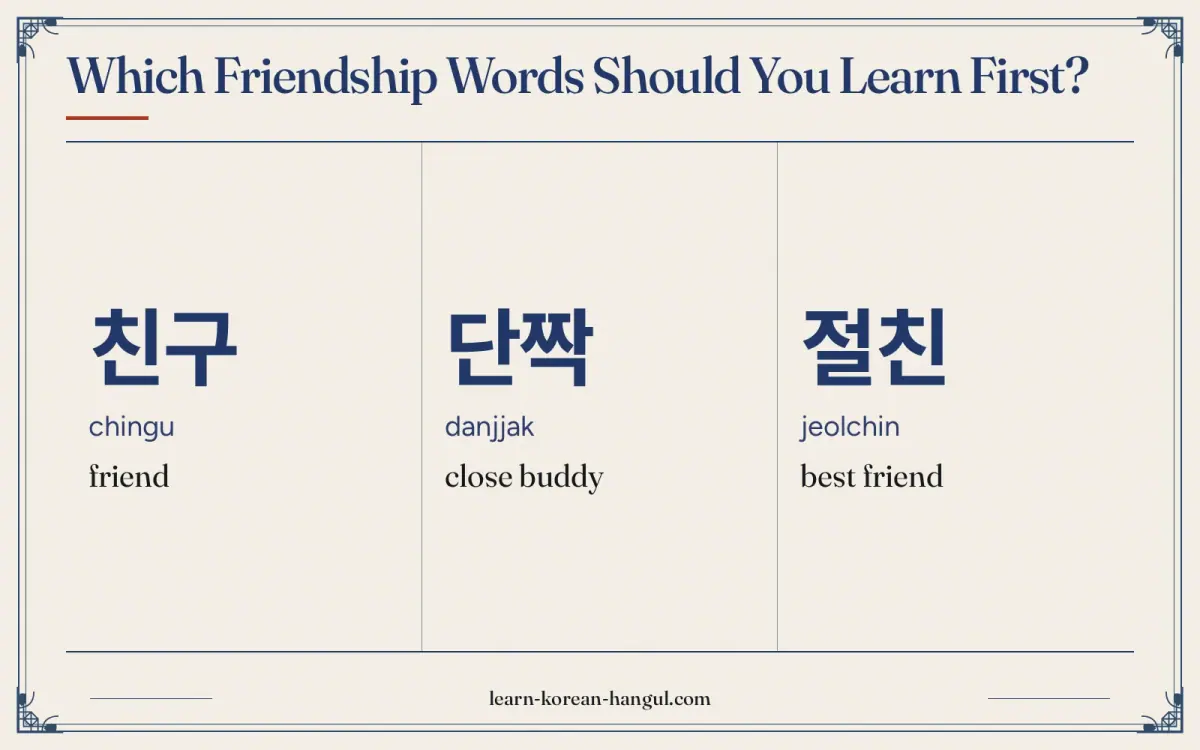
Learn 친구 (friend), 동갑 (same age), 약속 (appointment, plan), 같이 (together) and 안녕 (hi, bye) first. With these five you can arrange to meet a friend and say goodbye. A short sentence such as 친구와 약속이 있어요 (I have plans with a friend) needs only the nouns and a common verb. Then follow this order:
- Step 1: the five words above.
- Step 2: close friends: 단짝, 절친 and 동창.
- Step 3: meeting and talking: 모임, 수다 and 함께.
- Step 4: trust and conflict, then online friends and the good-bye phrases.
The scene below numbers ten of the objects and ideas from a meeting of friends, so you can tie each word to something you can point at.
Word · 10
- 1
친구
chingu
friend
- 2
단짝
danjjak
close buddy
- 3
절친
jeolchin
best friend
- 4
동갑
donggap
same age
- 5
약속
yaksok
appointment; promise
- 6
수다
suda
chatter; chat
- 7
우정
ujeong
friendship
- 8
화해
hwahae
making up
- 9
단톡방
dantokbang
group chat room
- 10
프로필
peuropil
profile
Tap a number to hear the word. Notice that several words come from Sino-Korean roots, such as 우정 and 화해, while 수다 and 싸움 are native words.
Types of Friends (친구, 단짝, 동갑)
Korean separates friends by how close they are and where they come from. 친구 is the general word. 단짝 and 절친 are the close ones, 동갑 names a friend of the same age, 동창 is someone from the same school, and 이웃 is a neighbor.
| No. | Hangul | Revised Romanization | Meaning and note | Example sentence | Audio assetId |
|---|---|---|---|---|---|
| 1 | 친구 | chingu | friend. The general word. In Korea it also implies a person of about your own age. | 친구를 만나요. (I meet a friend.) | au-pg-vocabulary-people-relationships-friendship-1; example: au-pg-vocabulary-people-relationships-friendship-31 |
| 2 | 단짝 | danjjak | close buddy. Friends who go everywhere together, like a pair. | 우리는 단짝이에요. (We are close buddies.) | au-pg-vocabulary-people-relationships-friendship-2; example: au-pg-vocabulary-people-relationships-friendship-32 |
| 3 | 절친 | jeolchin | best friend. Short for 절친한 친구 (a very close friend). Common among young people. | 그 사람은 제 절친이에요. (That person is my best friend.) | au-pg-vocabulary-people-relationships-friendship-3; example: au-pg-vocabulary-people-relationships-friendship-33 |
| 4 | 동갑 | donggap | same age. Two people born in the same year. Used as a noun for the friend. | 우리는 동갑이에요. (We are the same age.) | au-pg-vocabulary-people-relationships-friendship-4; example: au-pg-vocabulary-people-relationships-friendship-34 |
| 5 | 동창 | dongchang | schoolmate; alumnus. Someone from the same school or class, often used for adults. | 고등학교 동창을 만났어요. (I met a high school classmate.) | au-pg-vocabulary-people-relationships-friendship-5; example: au-pg-vocabulary-people-relationships-friendship-35 |
| 6 | 이웃 | iut | neighbor. A person who lives next door or nearby. Said [이욷]. | 이웃과 인사해요. (I greet my neighbor.) | au-pg-vocabulary-people-relationships-friendship-6; example: au-pg-vocabulary-people-relationships-friendship-36 |
친구 and 동갑 work together in Korean life. Because speech level depends on age, Koreans often ask 몇 살이에요? early in a first meeting, and a friend who turns out to be 동갑 can usually speak casually with you. The friend who is a year or two older is not called 친구 in everyday talk: a younger person may use 형, 누나, 오빠 or 언니 instead. See Oppa, Hyung, Unnie and Noona for those terms. 절친 is the opposite end of the closeness scale: it names how close you are, not how old.
How Do You Say Meeting and Hanging out in Korean?
These six words cover the plan, the gathering and the talk. 약속 is the plan you make, 만남 is the meeting, 모임 is a group gathering, 수다 is relaxed chatting, and 같이 and 함께 both mean together.
| No. | Hangul | Revised Romanization | Meaning and note | Example sentence | Audio assetId |
|---|---|---|---|---|---|
| 7 | 약속 | yaksok | appointment; promise. A plan with a time, and also a promise. Said [약쏙]. | 친구와 약속이 있어요. (I have plans with a friend.) | au-pg-vocabulary-people-relationships-friendship-7; example: au-pg-vocabulary-people-relationships-friendship-37 |
| 8 | 만남 | mannam | meeting; encounter. The noun for meeting. Often used for a meeting that matters. | 오랜만의 만남이에요. (It is a meeting after a long time.) | au-pg-vocabulary-people-relationships-friendship-8; example: au-pg-vocabulary-people-relationships-friendship-38 |
| 9 | 모임 | moim | gathering. A regular meeting of a group, such as a club or old friends. | 이번 주말에 모임이 있어요. (There is a gathering this weekend.) | au-pg-vocabulary-people-relationships-friendship-9; example: au-pg-vocabulary-people-relationships-friendship-39 |
| 10 | 수다 | suda | chatter; chat. A long, relaxed talk. Used in the phrase 수다를 떨다. | 친구와 수다를 떨어요. (I chat with a friend.) | au-pg-vocabulary-people-relationships-friendship-10; example: au-pg-vocabulary-people-relationships-friendship-40 |
| 11 | 같이 | gachi | together (everyday). Casual and common in speech. Said [가치]. | 같이 점심 먹어요. (Let's eat lunch together.) | au-pg-vocabulary-people-relationships-friendship-11; example: au-pg-vocabulary-people-relationships-friendship-41 |
| 12 | 함께 | hamkke | together (a little more formal). The more formal equivalent of 같이. Seen in writing and announcements. | 친구와 함께 여행해요. (I travel together with a friend.) | au-pg-vocabulary-people-relationships-friendship-12; example: au-pg-vocabulary-people-relationships-friendship-42 |
같이 and 함께 mean the same thing: with someone, together. 같이 is the easy everyday choice, and 함께 sounds slightly more careful, so you will see it on posters and hear it in speeches. The word 약속 has two meanings, plan and promise. The context decides: 약속이 있어요 means I have plans, while 약속할게요 means I promise. Notice the particle in 친구와: 와/과 means with, and it marks the person you do something with.
Trust and Conflict
A friendship has good and hard moments. 우정 is friendship itself, 의리 is the loyalty that Koreans value in friends, and 비밀 is a secret you keep. When something goes wrong, 싸움 is a fight, 오해 is a misunderstanding, and 화해 is making up.
| No. | Hangul | Revised Romanization | Meaning and note | Example sentence | Audio assetId |
|---|---|---|---|---|---|
| 13 | 우정 | ujeong | friendship. Sino-Korean 우 (friend) + 정 (feeling). The word for the bond. | 우리의 우정은 오래됐어요. (Our friendship is long-standing.) | au-pg-vocabulary-people-relationships-friendship-13; example: au-pg-vocabulary-people-relationships-friendship-43 |
| 14 | 의리 | uiri | loyalty. A strong value among Korean friends: standing by someone in trouble. | 그 친구는 의리가 있어요. (That friend is loyal.) | au-pg-vocabulary-people-relationships-friendship-14; example: au-pg-vocabulary-people-relationships-friendship-44 |
| 15 | 비밀 | bimil | secret. Also found in 비밀번호 (password). | 비밀을 지켜요. (I keep a secret.) | au-pg-vocabulary-people-relationships-friendship-15; example: au-pg-vocabulary-people-relationships-friendship-45 |
| 16 | 싸움 | ssaum | fight; quarrel. The noun from 싸우다 (to fight). Can be a quarrel or a physical fight. | 친구와 싸움을 했어요. (I had a fight with a friend.) | au-pg-vocabulary-people-relationships-friendship-16; example: au-pg-vocabulary-people-relationships-friendship-46 |
| 17 | 오해 | ohae | misunderstanding. Sino-Korean 오 (wrong) + 해 (understanding). | 오해가 있었어요. (There was a misunderstanding.) | au-pg-vocabulary-people-relationships-friendship-17; example: au-pg-vocabulary-people-relationships-friendship-47 |
| 18 | 화해 | hwahae | making up. The noun and the verb with 하다: 화해하다. | 친구와 화해했어요. (I made up with my friend.) | au-pg-vocabulary-people-relationships-friendship-18; example: au-pg-vocabulary-people-relationships-friendship-48 |
의리 deserves a note. It is more than loyalty: it means that you stand by a friend even when it costs you. People say 의리가 있다 (to have 의리) as a strong compliment. The set 싸움, 오해 and 화해 gives you a small story in three words: a fight, caused by a misunderstanding, ended by making up. For the related verb to trust, use 믿다, as in 친구를 믿어요 (I trust my friend). 오해 and 화해 can both take 하다: 오해하다 (to misunderstand) and 화해하다 (to make up), while 싸움 comes from the verb 싸우다 (to fight).
How Do You Say Online Friends in Korean?
Online friendship has its own words. The messaging app KakaoTalk (카카오톡, often shortened to 카톡) is used by most people in Korea, so 친구 추가 (add a friend) and 단톡방 (group chat room) come up constantly. 팔로우 and 팔로워 are used for social media in the same way as in English.
| No. | Hangul | Revised Romanization | Meaning and note | Example sentence | Audio assetId |
|---|---|---|---|---|---|
| 19 | 친구 추가 | chingu chuga | add friend. A button in messaging apps. Written with a space. | 카카오톡에서 친구 추가를 해요. (I add a friend on KakaoTalk.) | au-pg-vocabulary-people-relationships-friendship-19; example: au-pg-vocabulary-people-relationships-friendship-49 |
| 20 | 팔로우 | pallou | follow. Loanword. Takes 하다 as a verb: 팔로우하다. | 계정을 팔로우해요. (I follow the account.) | au-pg-vocabulary-people-relationships-friendship-20; example: au-pg-vocabulary-people-relationships-friendship-50 |
| 21 | 팔로워 | pallowo | follower. Loanword from English. The people who follow you. | 팔로워가 늘었어요. (My followers increased.) | au-pg-vocabulary-people-relationships-friendship-21; example: au-pg-vocabulary-people-relationships-friendship-51 |
| 22 | 메시지 | mesiji | message. Loanword from English, written 메시지 (also 메세지 in casual writing). | 친구한테 메시지를 보냈어요. (I sent a message to my friend.) | au-pg-vocabulary-people-relationships-friendship-22; example: au-pg-vocabulary-people-relationships-friendship-52 |
| 23 | 단톡방 | dantokbang | group chat room. Short for 단체 카톡방. Said [단톡빵]. | 단톡방에 초대했어요. (I invited someone to the group chat.) | au-pg-vocabulary-people-relationships-friendship-23; example: au-pg-vocabulary-people-relationships-friendship-53 |
| 24 | 프로필 | peuropil | profile. Loanword from English. The photo and status line on an app. | 프로필 사진을 바꿨어요. (I changed my profile photo.) | au-pg-vocabulary-people-relationships-friendship-24; example: au-pg-vocabulary-people-relationships-friendship-54 |
Note how many words are loanwords: 팔로우, 팔로워, 메시지 and 프로필 are English words written in Hangul. Only 단톡방 is a Korean blend. For the larger set of app and social media words, see social media vocabulary. The verb in the profile sentence, 바꿨어요, comes from 바꾸다 (to change), and the sentence shows a pattern you will use again: noun + 을/를 + verb.
Good-Bye Words for Friends
These six are the casual good-byes. They are for friends of the same age or close friends and, as casual speech, they are not for elders or strangers. Korean has two different goodbyes, depending on whether you are the one leaving or the one staying.
| No. | Hangul | Revised Romanization | Meaning and note | Example sentence | Audio assetId |
|---|---|---|---|---|---|
| 25 | 안녕 | annyeong | hi; bye (casual). Casual hello and goodbye between friends. Not for elders. | 안녕, 내일 봐. (Bye, see you tomorrow.) | au-pg-vocabulary-people-relationships-friendship-25; example: au-pg-vocabulary-people-relationships-friendship-55 |
| 26 | 잘 가 | jal ga | bye (to the one leaving). Said by the person who stays. Written with a space. | 잘 가, 조심해서 가. (Bye, take care on your way.) | au-pg-vocabulary-people-relationships-friendship-26; example: au-pg-vocabulary-people-relationships-friendship-56 |
| 27 | 잘 있어 | jal isseo | bye (to the one staying). Said by the person who leaves. Written with a space. | 나 먼저 갈게. 잘 있어. (I will go first. Bye.) | au-pg-vocabulary-people-relationships-friendship-27; example: au-pg-vocabulary-people-relationships-friendship-57 |
| 28 | 또 보자 | tto boja | see you again. 또 (again) + 보자 (let's see). Written with a space. | 오늘 재미있었어. 또 보자. (Today was fun. See you again.) | au-pg-vocabulary-people-relationships-friendship-28; example: au-pg-vocabulary-people-relationships-friendship-58 |
| 29 | 연락할게 | yeollakalge | I will be in touch. From 연락하다 (to contact). The ending -(으)ㄹ게 promises an action. Said [열라칼께]. | 집에 가서 연락할게. (I will message you when I get home.) | au-pg-vocabulary-people-relationships-friendship-29; example: au-pg-vocabulary-people-relationships-friendship-59 |
| 30 | 이따 봐 | itta bwa | see you in a bit. 이따 (a little later) + 봐 (see). Casual. | 이따 학교에서 봐. (See you at school in a bit.) | au-pg-vocabulary-people-relationships-friendship-30; example: au-pg-vocabulary-people-relationships-friendship-60 |
The two goodbyes depend on direction. 잘 가 (go well) is said to the person who leaves, and 잘 있어 (stay well) is said by the person who leaves to the one who stays. The ending -(으)ㄹ게 in 연락할게 is a promise from the speaker, and it is said with a tense [께]. All six in this group are casual. With someone older, use 안녕히 가세요 for someone who is leaving and 안녕히 계세요 for someone who is staying.
How Do You Pronounce Korean Friendship Words?
Most friendship words are easy, but several change their sound. The National Institute of Korean Language (국립국어원) sets these changes in its standard pronunciation rules. Revised Romanization follows the spoken sound for linking, but it does not show tensing caused by a neighbouring sound. Words that are spaced are romanized separately.
| Spelling | Sounds like | What changes |
|---|---|---|
| 약속 | [약쏙] | ㅅ is tensed after a final ㄱ. |
| 같이 | [가치] | ㅌ followed by 이 changes to ㅊ. |
| 단톡방 | [단톡빵] | ㅂ is tensed after a final ㄱ. |
| 연락할게 | [열라칼께] | ㄴ becomes ㄹ before ㄹ, ㄱ and ㅎ merge into ㅋ, and the -ㄹ게 ending is tensed. |
| 잘 있어 | [자리써] | In connected speech, the ㄹ links to the next word. RR keeps the words apart: jal isseo. |
Audio and Slow Playback
Each word and sentence has its own clip. The five clips below play the harder words slowly. Play a clip, say the word, then play it again and compare the ends of the syllables.
What Mistakes Do Learners Make with Friendship Words?
Five patterns catch learners when they talk about friends.
- Using casual speech with an older friend. 반말 is for friends of the same age or by agreement. Even friendly older people usually expect 요 endings until they say otherwise.
- Calling every acquaintance 친구. 친구 implies a real friend, usually of your age. For someone you know a little, use 지인 (acquaintance) or the person's name with 씨.
- Using 안녕 with elders. 안녕 is casual. To an older person, say 안녕하세요 when you meet and 안녕히 가세요 or 안녕히 계세요 when you part.
- Reading 같이 as written. The sound is [가치]. Saying gat-i with a separate ㅌ sounds stiff.
- Mixing up 잘 가 and 잘 있어. 잘 가 is said to the person who is leaving, and 잘 있어 is said by the person who is leaving.
If you keep the age rule and the two goodbyes in mind, most of the trouble goes away. The practice section turns the list into drills.
Practice: Flashcards and Worksheet
Study in three steps. First, run the deck in recognition mode until the 30 words feel familiar. Second, switch to listening mode and tap the clip before the card turns. Third, take the five-question quiz below. The deck stores your progress in your browser. The vocabulary flashcard decks page lists the other decks.
Practice · 65
- 01친구
Show answer
headword 1: friend
- 02단짝
Show answer
headword 2: close buddy
- 03절친
Show answer
headword 3: best friend
- 04동갑
Show answer
headword 4: same age
- 05동창
Show answer
headword 5: schoolmate; alumnus
- 06이웃
Show answer
headword 6: neighbor
- 07약속
Show answer
headword 7: appointment; promise
- 08만남
Show answer
headword 8: meeting; encounter
- 09모임
Show answer
headword 9: gathering
- 10수다
Show answer
headword 10: chatter; chat
- 11같이
Show answer
headword 11: together (everyday)
- 12함께
Show answer
headword 12: together (a little more formal)
- 13우정
Show answer
headword 13: friendship
- 14의리
Show answer
headword 14: loyalty
- 15비밀
Show answer
headword 15: secret
- 16싸움
Show answer
headword 16: fight; quarrel
- 17오해
Show answer
headword 17: misunderstanding
- 18화해
Show answer
headword 18: making up
- 19친구 추가
Show answer
headword 19: add friend
- 20팔로우
Show answer
headword 20: follow
- 21팔로워
Show answer
headword 21: follower
- 22메시지
Show answer
headword 22: message
- 23단톡방
Show answer
headword 23: group chat room
- 24프로필
Show answer
headword 24: profile
- 25안녕
Show answer
headword 25: hi; bye (casual)
- 26잘 가
Show answer
headword 26: bye (to the one leaving)
- 27잘 있어
Show answer
headword 27: bye (to the one staying)
- 28또 보자
Show answer
headword 28: see you again
- 29연락할게
Show answer
headword 29: I will be in touch
- 30이따 봐
Show answer
headword 30: see you in a bit
- 31친구를 만나요.
Show answer
example sentence for 친구
- 32우리는 단짝이에요.
Show answer
example sentence for 단짝
- 33그 사람은 제 절친이에요.
Show answer
example sentence for 절친
- 34우리는 동갑이에요.
Show answer
example sentence for 동갑
- 35고등학교 동창을 만났어요.
Show answer
example sentence for 동창
- 36이웃과 인사해요.
Show answer
example sentence for 이웃
- 37친구와 약속이 있어요.
Show answer
example sentence for 약속
- 38오랜만의 만남이에요.
Show answer
example sentence for 만남
- 39이번 주말에 모임이 있어요.
Show answer
example sentence for 모임
- 40친구와 수다를 떨어요.
Show answer
example sentence for 수다
- 41같이 점심 먹어요.
Show answer
example sentence for 같이
- 42친구와 함께 여행해요.
Show answer
example sentence for 함께
- 43우리의 우정은 오래됐어요.
Show answer
example sentence for 우정
- 44그 친구는 의리가 있어요.
Show answer
example sentence for 의리
- 45비밀을 지켜요.
Show answer
example sentence for 비밀
- 46친구와 싸움을 했어요.
Show answer
example sentence for 싸움
- 47오해가 있었어요.
Show answer
example sentence for 오해
- 48친구와 화해했어요.
Show answer
example sentence for 화해
- 49카카오톡에서 친구 추가를 해요.
Show answer
example sentence for 친구 추가
- 50계정을 팔로우해요.
Show answer
example sentence for 팔로우
- 51팔로워가 늘었어요.
Show answer
example sentence for 팔로워
- 52친구한테 메시지를 보냈어요.
Show answer
example sentence for 메시지
- 53단톡방에 초대했어요.
Show answer
example sentence for 단톡방
- 54프로필 사진을 바꿨어요.
Show answer
example sentence for 프로필
- 55안녕, 내일 봐.
Show answer
example sentence for 안녕
- 56잘 가, 조심해서 가.
Show answer
example sentence for 잘 가
- 57나 먼저 갈게. 잘 있어.
Show answer
example sentence for 잘 있어
- 58오늘 재미있었어. 또 보자.
Show answer
example sentence for 또 보자
- 59집에 가서 연락할게.
Show answer
example sentence for 연락할게
- 60이따 학교에서 봐.
Show answer
example sentence for 이따 봐
- 61단톡방
Show answer
slow playback of 단톡방
- 62연락할게
Show answer
slow playback of 연락할게
- 63약속
Show answer
slow playback of 약속
- 64같이
Show answer
slow playback of 같이
- 65동창
Show answer
slow playback of 동창
Practice · 5
What does 친구 (chingu) mean?
Show answer
friend
친구 means friend. Example: 친구를 만나요. (I meet a friend.)
What does 동갑 (donggap) mean?
Show answer
same age
동갑 means the same age. Example: 우리는 동갑이에요. (We are the same age.)
Which word means making up after a fight?
Show answer
화해
화해 means making up. Example: 친구와 화해했어요. (I made up with my friend.)
What does 단톡방 (dantokbang) mean?
Show answer
group chat room
단톡방 is a group chat room. Example: 단톡방에 초대했어요. (I invited someone to the group chat.)
Which goodbye does the person who is staying say to a friend who is leaving?
Show answer
잘 가
잘 가 is said by the person who stays to the one who leaves. Example: 잘 가, 조심해서 가. (Bye, take care on your way.)
Korean Friendship Vocabulary Worksheet (PDF)
A printable worksheet for these words (word list, matching, writing practice, fill-in-the-blank exercises and answer key) is available in A4 and US Letter from the download card on this page. For additional practice, write the five groups on cards and sort them by hand.
Where to Go Next
After this page, continue with Korean Dating Vocabulary for the next step in relationships, or with Korean Pregnancy and Baby Vocabulary for family words. For the online side, see the social media vocabulary.
Frequently Asked Questions
How Do You Say Friend in Korean?
Friend is 친구 (chingu). It is used for a friend of about your own age. For someone who is a few years older, a younger person usually uses a kinship term such as 형 or 언니 instead. The single-word page on friend in Korean gives more detail.
How Do You Say Same Age in Korean?
Same age is 동갑 (donggap), as in 우리는 동갑이에요 (we are the same age). It matters because friends of the same age can use casual speech with each other. Koreans often ask age early in a first meeting to find out which speech level to use.
How Do You Pronounce 친구 (chingu)?
Say chin-gu as two syllables. The first starts with an aspirated ch, said with a clear puff of air, then the vowel i as in see and an n. The second is gu with a soft g and the vowel u as in food. The stress is light and even. Press the audio button on this page to hear it, then repeat it.
How Many Friendship Words Should I Learn First?
Five first: 친구, 동갑, 약속, 같이 and 안녕. They let you arrange to meet a friend and say goodbye. At five new words a day the 30 words take about a week with review. Add the close-friend words and the online words next.
Where Can I Practise Friendship Words with Flashcards?
Use the vocabulary flashcard decks. The deck for this page holds all 30 words with Hangul, romanization and audio, in recognition and listening modes. Your progress stays in your browser. Give the good-bye group extra time in listening mode.
Is There a Printable Worksheet for Friendship Words?
A printable worksheet for these words (word list, matching, writing practice, fill-in-the-blank exercises and answer key) is available in A4 and US Letter from the download card on this page. For practice, the tables on this page can be copied by hand, and the deck carries the same 30 words.