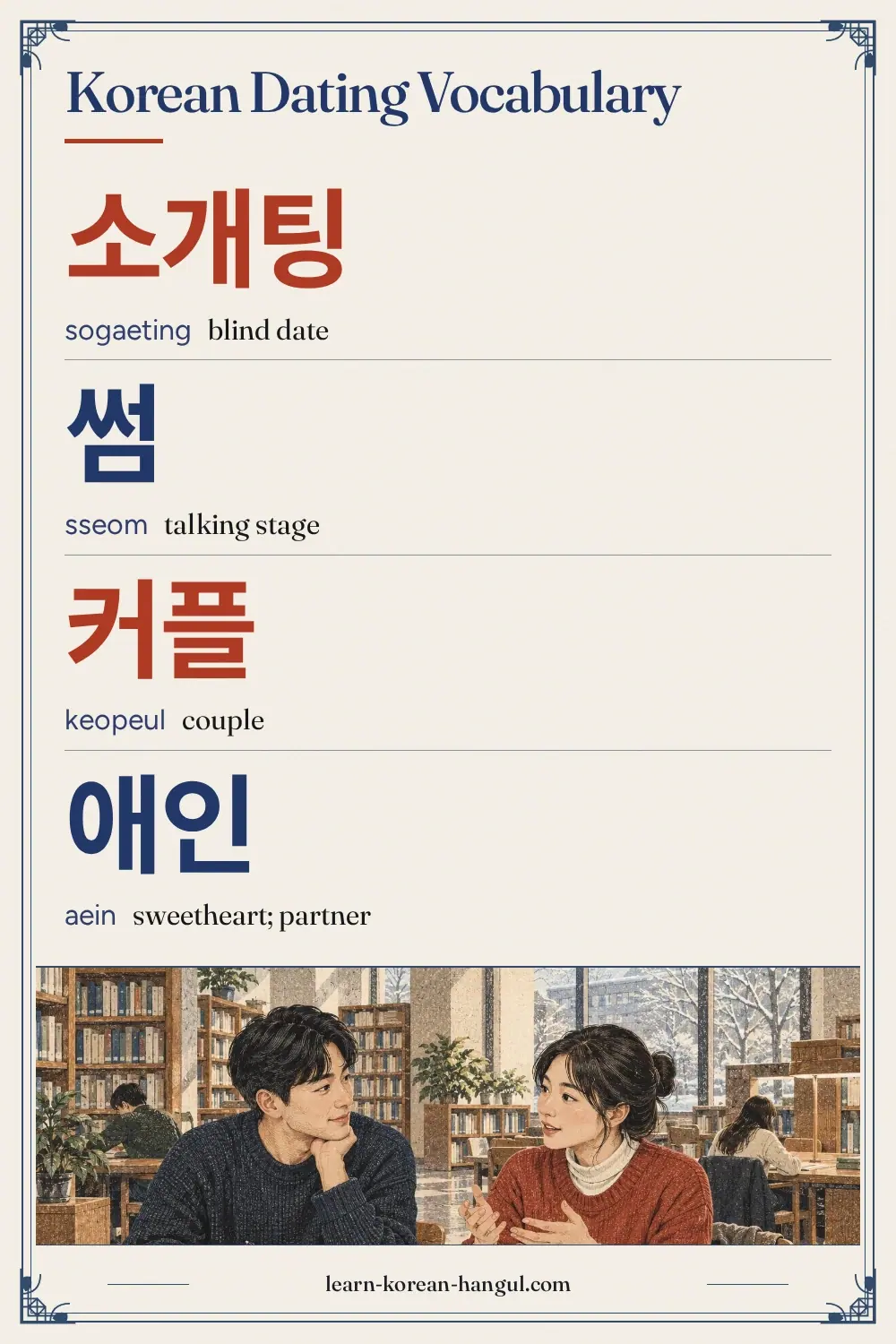
What you'll learn
- Match all 35 dating words to their English meanings.
- Say five of them aloud with the help of the Revised Romanization and the audio.
- Write two original sentences that use words such as 소개팅 (blind date) and 썸 (talking stage).
- Choose a pet name that fits the couple, and avoid the ones that are too intimate.
Prerequisites: you can read Hangul and know the polite ending -아요/-어요. Estimated time: about 90 minutes, plus short reviews on the following days.
Korean Dating Vocabulary at a Glance
The list has 35 words in five groups of seven. It follows a relationship in time: you meet someone, you become a couple, you go on dates and mark anniversaries, you may break up, and you use pet names along the way. It belongs to Relationships and Titles.
| Group | Words | Use |
|---|---|---|
| Meeting and talking | 7 | How a relationship starts |
| Being a couple | 7 | Words for partners and relationships |
| Dates and anniversaries | 7 | Days to celebrate and gifts to give |
| Breakups | 7 | Ending a relationship |
| Pet names | 7 | What couples call each other |
This page is a themed word list. For whole sentences such as saying I love you, the love and romance phrases page gives the ready-made lines. Here the goal is the vocabulary that those phrases are built from.
Which Dating Words Should You Learn First?
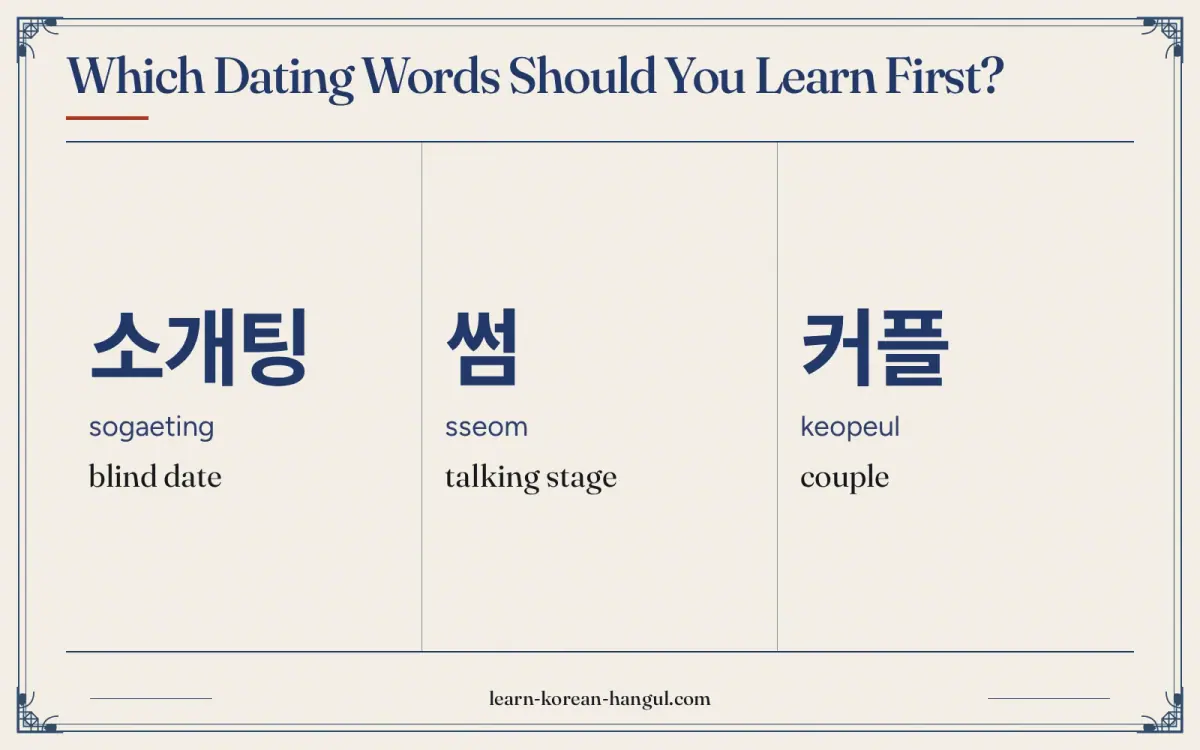
Learn 데이트 (date), 커플 (couple), 남자 친구 (boyfriend), 여자 친구 (girlfriend) and 사랑 words such as 첫사랑 (first love) first. With these you can follow most K-drama scenes and talk about your own relationship. A short sentence such as 주말에 데이트해요 (I have a date on the weekend) needs only the noun and the verb ending. Then follow this order:
- Step 1: 데이트, 커플, 남자 친구 and 여자 친구.
- Step 2: how a relationship starts: 소개팅, 썸, 고백 and 사귀다.
- Step 3: anniversaries and gifts: 기념일, 백일, 선물 and 꽃다발.
- Step 4: breakups and pet names, which depend on the relationship and are used carefully.
The scene below numbers ten of the objects and ideas from a cafe date, so you can tie each word to something you can point at.
Word · 10
- 1
소개팅
sogaeting
blind date
- 2
썸
sseom
talking stage
- 3
커플
keopeul
couple
- 4
애인
aein
sweetheart; partner
- 5
데이트
deiteu
date
- 6
기념일
ginyeomil
anniversary
- 7
커플링
keopeulling
couple ring
- 8
선물
seonmul
gift
- 9
꽃다발
kkotdabal
bouquet
- 10
이별
ibyeol
parting; breakup
Tap a number to hear the word. You will notice that many of these words are loanwords or short blends, and that Koreans use them every day, not only in dramas.
Meeting and Talking (소개팅, 썸)
Korean has special words for the steps before a relationship starts. 소개팅 is a blind date arranged by a friend, 썸 is the stage in between friendship and dating, and 고백 is the moment someone says how they feel. These words have no one-word English equivalent, so learn them as whole ideas.
| No. | Hangul | Revised Romanization | Meaning and note | Example sentence | Audio assetId |
|---|---|---|---|---|---|
| 1 | 소개팅 | sogaeting | blind date. From 소개 (introduction) + 팅, taken from 미팅 (meeting). A friend arranges it for two people. | 친구가 소개팅을 해 줬어요. (chinguga sogaetingeul hae jwosseoyo. My friend set me up on a blind date.) | au-pg-vocabulary-people-relationships-dating-1; example: au-pg-vocabulary-people-relationships-dating-36 |
| 2 | 썸 | sseom | talking stage. Slang from the English word something. Used in the phrase 썸을 타다. | 우리는 지금 썸을 타고 있어요. (urineun jigeum sseomeul tago isseoyo. We are in a talking stage right now.) | au-pg-vocabulary-people-relationships-dating-2; example: au-pg-vocabulary-people-relationships-dating-37 |
| 3 | 미팅 | miting | group blind date. A group meeting of men and women, common among university students. | 대학교 때 미팅을 많이 했어요. (daehakgyo ttae mitingeul mani haesseoyo. I went on many group blind dates in college.) | au-pg-vocabulary-people-relationships-dating-3; example: au-pg-vocabulary-people-relationships-dating-38 |
| 4 | 고백 | gobaek | confession of love. Also means a confession in general. Here, saying you like someone. | 어제 고백했어요. (eoje gobaekaesseoyo. I confessed my feelings yesterday.) | au-pg-vocabulary-people-relationships-dating-4; example: au-pg-vocabulary-people-relationships-dating-39 |
| 5 | 짝사랑 | jjaksarang | one-sided love. 짝 (one of a pair) + 사랑 (love). Said [짝싸랑]. | 오랫동안 그 사람을 짝사랑했어요. (oraetdongan geu sarameul jjaksaranghaesseoyo. I had a one-sided love for that person for a long time.) | au-pg-vocabulary-people-relationships-dating-5; example: au-pg-vocabulary-people-relationships-dating-40 |
| 6 | 첫사랑 | cheotsarang | first love. 첫 (first) + 사랑 (love). Said [첟싸랑]. | 첫사랑은 잊기 어려워요. (cheotsarangeun itgi eoryeowoyo. A first love is hard to forget.) | au-pg-vocabulary-people-relationships-dating-6; example: au-pg-vocabulary-people-relationships-dating-41 |
| 7 | 사귀다 | sagwida | to date; to make friends. The verb for being in a relationship. It takes 와/과 for the person you are dating. | 저는 민수 씨와 사귀어요. (jeoneun minsu ssiwa sagwieoyo. I am dating Minsu.) | au-pg-vocabulary-people-relationships-dating-7; example: au-pg-vocabulary-people-relationships-dating-42 |
썸 and 소개팅 are the culture words that learners ask about most. 썸 is not yet a relationship, and people say 썸을 타다 (to ride a 썸) for being in that stage. 소개팅 is one-to-one and arranged by a mutual friend, while 미팅 is a group event. 사귀다 is the verb for the relationship itself: in speech it is often shortened, so 사귀어요 may sound like [사겨요]. Note that 사귀다 also means making friends, as in 친구를 사귀다, so the object tells you which meaning is meant.
How Do You Say Being a Couple (커플, 애인) in Korean?
Once a relationship starts, the word for the pair is 커플, and the word for each person depends on the situation. 남자 친구 and 여자 친구 are the everyday words, 애인 and 연인 are more formal or literary, and 솔로 is the word for someone who is single.
| No. | Hangul | Revised Romanization | Meaning and note | Example sentence | Audio assetId |
|---|---|---|---|---|---|
| 8 | 커플 | keopeul | couple. Loanword from English. Covers any pair, married or not. | 우리는 커플이에요. (urineun keopeurieyo. We are a couple.) | au-pg-vocabulary-people-relationships-dating-8; example: au-pg-vocabulary-people-relationships-dating-43 |
| 9 | 애인 | aein | sweetheart; partner. Somewhat formal. Younger speakers often prefer 남자 친구 or 여자 친구. | 애인이 있어요. (aeini isseoyo. I have a partner.) | au-pg-vocabulary-people-relationships-dating-9; example: au-pg-vocabulary-people-relationships-dating-44 |
| 10 | 연인 | yeonin | lover; romantic partner. A neutral, slightly literary word often used in songs and news. | 두 사람은 연인이에요. (du sarameun yeoninieyo. The two are lovers.) | au-pg-vocabulary-people-relationships-dating-10; example: au-pg-vocabulary-people-relationships-dating-45 |
| 11 | 남자 친구 | namja chingu | boyfriend. Written with a space in running text. The closed form 남자친구 is common online. | 남자 친구를 소개할게요. (namja chingureul sogaehalgeyo. I will introduce my boyfriend.) | au-pg-vocabulary-people-relationships-dating-11; example: au-pg-vocabulary-people-relationships-dating-46 |
| 12 | 여자 친구 | yeoja chingu | girlfriend. Written with a space in running text. The closed form 여자친구 is common online. | 여자 친구가 생겼어요. (yeoja chinguga saenggyeosseoyo. I got a girlfriend.) | au-pg-vocabulary-people-relationships-dating-12; example: au-pg-vocabulary-people-relationships-dating-47 |
| 13 | 연애 | yeonae | romance; dating. The state of being in a romantic relationship. Said [여내]. | 연애는 처음이에요. (yeonaeneun cheoeumieyo. It is my first romance.) | au-pg-vocabulary-people-relationships-dating-13; example: au-pg-vocabulary-people-relationships-dating-48 |
| 14 | 솔로 | sollo | single person. Loanword from English solo. Used for someone with no partner. | 저는 아직 솔로예요. (jeoneun ajik solloyeyo. I am still single.) | au-pg-vocabulary-people-relationships-dating-14; example: au-pg-vocabulary-people-relationships-dating-49 |
남자 친구 usually means boyfriend, not a male friend. For a male friend who is not a partner, Koreans say 남사친 (남자 사람 친구), and for a female friend 여사친. The pair 남친 and 여친 are the short forms used in texts and social media. Choose 연인 when you want a neutral, written tone, and 남자 친구 or 여자 친구 in conversation. 솔로 is not an insult: people say it about themselves, often with humour, and a related word 솔로 탈출 means to leave the single life.
Dates and Anniversaries
Korean couples keep track of days. Many celebrate 백일 (the 100th day), then later milestones, and finally 주년 (anniversaries by year). The group also holds the gift words: 커플링, 선물 and 꽃다발.
| No. | Hangul | Revised Romanization | Meaning and note | Example sentence | Audio assetId |
|---|---|---|---|---|---|
| 15 | 데이트 | deiteu | date. Loanword from English. Takes 하다 as a verb: 데이트하다. | 주말에 데이트해요. (jumare deiteuhaeyo. I have a date on the weekend.) | au-pg-vocabulary-people-relationships-dating-15; example: au-pg-vocabulary-people-relationships-dating-50 |
| 16 | 기념일 | ginyeomil | anniversary. 기념 (commemoration) + 일 (day). Any special day, not only a wedding. | 오늘은 우리 기념일이에요. (oneureun uri ginyeomirieyo. Today is our anniversary.) | au-pg-vocabulary-people-relationships-dating-16; example: au-pg-vocabulary-people-relationships-dating-51 |
| 17 | 백일 | baegil | 100 days together. Couples count days from the day they got together. The same word is the baby's 100th day. | 사귄 지 백 일이 됐어요. (sagwin ji baek iri dwaesseoyo. It has been 100 days since we started dating.) | au-pg-vocabulary-people-relationships-dating-17; example: au-pg-vocabulary-people-relationships-dating-52 |
| 18 | 주년 | junyeon | anniversary (year count). A counter that follows a Sino-Korean number: 1주년, 2주년. | 오늘은 사귄 지 1주년이에요. (oneureun sagwin ji il junyeonieyo. Today is one year since we started dating.) | au-pg-vocabulary-people-relationships-dating-18; example: au-pg-vocabulary-people-relationships-dating-53 |
| 19 | 커플링 | keopeulling | couple ring. 커플 + ring. Matching rings that couples wear. | 커플링을 맞췄어요. (keopeullingeul matchwosseoyo. We had matching couple rings made.) | au-pg-vocabulary-people-relationships-dating-19; example: au-pg-vocabulary-people-relationships-dating-54 |
| 20 | 선물 | seonmul | gift. Used for any gift, not only romantic ones. | 여자 친구에게 선물을 줬어요. (yeoja chinguege seonmureul jwosseoyo. I gave my girlfriend a gift.) | au-pg-vocabulary-people-relationships-dating-20; example: au-pg-vocabulary-people-relationships-dating-55 |
| 21 | 꽃다발 | kkotdabal | bouquet. 꽃 (flower) + 다발 (bunch). Said [꼳따발]. | 꽃다발을 받았어요. (kkotdabareul badasseoyo. I received a bouquet.) | au-pg-vocabulary-people-relationships-dating-21; example: au-pg-vocabulary-people-relationships-dating-56 |
Counting days is a Korean habit that surprises many learners. A couple may celebrate 백일, then 200일, 300일, and then 1주년, using 일 (day) after a Sino-Korean number. How strongly a couple follows this varies a lot, so treat it as a custom, not a rule. The word 주년 follows a Sino-Korean number (일, 이, 삼), so one year is 일 주년 and the digit form 1주년 is usually written. The verb 사귀다 appears again here in the construction 사귄 지, meaning since we started dating, with 지 marking the time that has passed.
How Do You Say Breakups in Korean?
Breakup words are used in songs, dramas and daily talk. 이별 is the noun for parting, 헤어지다 is the everyday verb, and 차이다 is the passive verb for being dumped. Be careful with 바람, which means cheating when it is used with the verb 피우다.
| No. | Hangul | Revised Romanization | Meaning and note | Example sentence | Audio assetId |
|---|---|---|---|---|---|
| 22 | 이별 | ibyeol | parting; breakup. Sino-Korean 이 (separate) + 별 (part). Often heard in songs. | 이별은 힘들어요. (ibyeoreun himdeureoyo. Breakups are hard.) | au-pg-vocabulary-people-relationships-dating-22; example: au-pg-vocabulary-people-relationships-dating-57 |
| 23 | 헤어지다 | heeojida | to break up; to part. The everyday verb. Works for couples and for friends parting for the day. | 우리는 지난달에 헤어졌어요. (urineun jinandare heeojyeosseoyo. We broke up last month.) | au-pg-vocabulary-people-relationships-dating-23; example: au-pg-vocabulary-people-relationships-dating-58 |
| 24 | 차이다 | chaida | to be dumped. The passive of 차다 (to kick). Used with 한테 for the person who did it. | 남자 친구한테 차였어요. (namja chinguhante chayeosseoyo. I was dumped by my boyfriend.) | au-pg-vocabulary-people-relationships-dating-24; example: au-pg-vocabulary-people-relationships-dating-59 |
| 25 | 바람 | baram | cheating (in 바람을 피우다). Native word that also means wind. Learn the whole phrase. | 남자 친구가 바람을 피웠어요. (namja chinguga barameul piwosseoyo. My boyfriend cheated.) | au-pg-vocabulary-people-relationships-dating-25; example: au-pg-vocabulary-people-relationships-dating-60 |
| 26 | 전 애인 | jeon aein | ex. 전 (former) + 애인. Written with a space. In casual speech people also say 전 남친 (ex-boyfriend) and 전 여친 (ex-girlfriend). | 전 애인한테서 연락이 왔어요. (jeon aeinhanteseo yeollagi wasseoyo. I got a message from my ex.) | au-pg-vocabulary-people-relationships-dating-26; example: au-pg-vocabulary-people-relationships-dating-61 |
| 27 | 재회 | jaehoe | reunion; meeting again. Sino-Korean 재 (again) + 회 (meet). Used with 하다, and in dating talk it often means getting back together. | 두 사람이 재회했어요. (du sarami jaehoehaesseoyo. The two of them met again.) | au-pg-vocabulary-people-relationships-dating-27; example: au-pg-vocabulary-people-relationships-dating-62 |
| 28 | 미련 | miryeon | lingering feelings. Used in the phrase 미련이 남다, to still have feelings after something ends. | 아직 미련이 남아요. (ajik miryeoni namayo. I still have lingering feelings.) | au-pg-vocabulary-people-relationships-dating-28; example: au-pg-vocabulary-people-relationships-dating-63 |
헤어지다 is the safest word, because it works in many situations: friends who say goodbye at the end of an evening also use it, and you understand the meaning from the object and context. 차이다 and 바람을 피우다 are more emotional and are used with friends, not in formal talk. The word 바람 is a good example of why vocabulary should be learned in phrases: alone it means wind, but with 피우다 it means cheating. The sentence 전 애인한테서 uses 한테서 to show where something comes from, which is the usual particle for a source that is a person.
Pet Names (자기, 여보)
Pet names show how close two people are. 자기야 is the common word between young couples, 여보 belongs to married couples, and 당신 is used between spouses. 오빠 is a girlfriend's name for an older boyfriend and is used in many dramas. Choose the name that fits the relationship.
| No. | Hangul | Revised Romanization | Meaning and note | Example sentence | Audio assetId |
|---|---|---|---|---|---|
| 29 | 자기야 | jagiya | babe; honey. From 자기 (oneself). Used between close couples, mostly younger ones. | 자기야, 어디야? (jagiya, eodiya? Babe, where are you?) | au-pg-vocabulary-people-relationships-dating-29; example: au-pg-vocabulary-people-relationships-dating-64 |
| 30 | 여보 | yeobo | honey (spouses). Used between married couples, usually in a polite or warm tone. | 여보, 저녁 먹었어요? (yeobo, jeonyeok meogeosseoyo? Honey, did you eat dinner?) | au-pg-vocabulary-people-relationships-dating-30; example: au-pg-vocabulary-people-relationships-dating-65 |
| 31 | 당신 | dangsin | dear; you (between spouses). Used by spouses. Used with strangers, it sounds rude. | 당신을 사랑해요. (dangsineul saranghaeyo. I love you, dear.) | au-pg-vocabulary-people-relationships-dating-31; example: au-pg-vocabulary-people-relationships-dating-66 |
| 32 | 내 사랑 | nae sarang | my love. Written with a space. More dramatic than daily speech. | 내 사랑, 보고 싶어요. (nae sarang, bogo sipeoyo. My love, I miss you.) | au-pg-vocabulary-people-relationships-dating-32; example: au-pg-vocabulary-people-relationships-dating-67 |
| 33 | 애기야 | aegiya | baby; sweetie. A pet name from 애기 (baby). Soft and playful. | 애기야, 이리 와. (aegiya, iri wa. Baby, come here.) | au-pg-vocabulary-people-relationships-dating-33; example: au-pg-vocabulary-people-relationships-dating-68 |
| 34 | 오빠 | oppa | oppa; older brother. A girl or woman's word for an older brother or older boyfriend. | 오빠, 사랑해요. (oppa, saranghaeyo. Oppa, I love you.) | au-pg-vocabulary-people-relationships-dating-34; example: au-pg-vocabulary-people-relationships-dating-69 |
| 35 | 애교 | aegyo | charm; cute behavior. The cute, playful manner a person uses with someone they like. | 여자 친구가 애교를 부려요. (yeoja chinguga aegyoreul buryeoyo. My girlfriend acts cute.) | au-pg-vocabulary-people-relationships-dating-35; example: au-pg-vocabulary-people-relationships-dating-70 |
Pet names run from light to intimate. 자기야 is light and playful, 여보 is warm and married, and 내 사랑 is dramatic. 당신 needs more care: between spouses it is fine, but a learner who uses it to mean you with a stranger will sound hostile. 오빠 needs a note too, because it shows both closeness and age: a woman calls an older boyfriend 오빠, the same word she uses for an older brother, while a man calls an older male friend 형. See Oppa, Hyung, Unnie and Noona for the full set of terms.
How Do You Pronounce Korean Dating Words?
Dating words are mostly easy, but several change their sound. The National Institute of Korean Language (국립국어원) sets these changes in its standard pronunciation rules. Revised Romanization follows the spoken sound for linking, but it does not show tensing caused by a neighbouring sound.
| Spelling | Sounds like | What changes |
|---|---|---|
| 첫사랑 | [첟싸랑] | The final ㅅ is said as ㄷ, and the next ㅅ is tensed. |
| 짝사랑 | [짝싸랑] | The next ㅅ is tensed after a final ㄱ. |
| 백일 | [배길] | The final ㄱ links to the vowel that follows. |
| 연애 | [여내] | The final ㄴ links to the vowel that follows. |
| 꽃다발 | [꼳따발] | The final ㅊ is said as ㄷ, and the next ㄷ is tensed. |
| 헤어졌어요 | [헤어저써요] | The final ㅆ links to the vowel that follows. |
Audio and Slow Playback
Each word and sentence has its own clip. The five clips below play the harder words slowly. Play a clip, say the word, then play it again and compare the ends of the syllables.
What Mistakes Do Learners Make with Dating Words?
Five patterns catch learners when they talk about relationships.
- Taking 남자 친구 for a male friend. It means boyfriend. A male friend who is not a partner is a 남자 사람 친구, shortened to 남사친.
- Confusing the two uses of 자기. 자기소개 (self-introduction) uses 자기 for oneself, while 자기야 is a pet name for a partner. The ending 야 and the situation tell them apart.
- Using 당신 to mean you. With a stranger, it sounds rude. Use the person's name plus 씨 or a title instead.
- Mixing up the two patterns of 사귀다. With 와/과 it names the person you are dating: 민수 씨와 사귀어요. With 을/를 it means to make or get someone: 친구를 사귀어요 (I make friends), 여자 친구를 사귀었어요 (I got a girlfriend).
- Reading 첫사랑 as written. The sound is [첟싸랑]. The ㅅ at the end of 첫 is said as ㄷ, and the next ㅅ is tense.
If you keep the pet names to the right relationship and say the tense sounds, most of the trouble goes away. The practice section turns the list into drills.
Practice: Flashcards and Worksheet
Study in three steps. First, run the deck in recognition mode until the 35 words feel familiar. Second, switch to listening mode and tap the clip before the card turns. Third, take the five-question quiz below. The deck stores your progress in your browser. The vocabulary flashcard decks page lists the other decks.
Practice · 75
- 01소개팅
Show answer
headword 1: blind date
- 02썸
Show answer
headword 2: talking stage
- 03미팅
Show answer
headword 3: group blind date
- 04고백
Show answer
headword 4: confession of love
- 05짝사랑
Show answer
headword 5: one-sided love
- 06첫사랑
Show answer
headword 6: first love
- 07사귀다
Show answer
headword 7: to date; to make friends
- 08커플
Show answer
headword 8: couple
- 09애인
Show answer
headword 9: sweetheart; partner
- 10연인
Show answer
headword 10: lover; romantic partner
- 11남자 친구
Show answer
headword 11: boyfriend
- 12여자 친구
Show answer
headword 12: girlfriend
- 13연애
Show answer
headword 13: romance; dating
- 14솔로
Show answer
headword 14: single person
- 15데이트
Show answer
headword 15: date
- 16기념일
Show answer
headword 16: anniversary
- 17백일
Show answer
headword 17: 100 days together
- 18주년
Show answer
headword 18: anniversary (year count)
- 19커플링
Show answer
headword 19: couple ring
- 20선물
Show answer
headword 20: gift
- 21꽃다발
Show answer
headword 21: bouquet
- 22이별
Show answer
headword 22: parting; breakup
- 23헤어지다
Show answer
headword 23: to break up; to part
- 24차이다
Show answer
headword 24: to be dumped
- 25바람
Show answer
headword 25: cheating (in 바람을 피우다)
- 26전 애인
Show answer
headword 26: ex
- 27재회
Show answer
headword 27: reunion; getting back together
- 28미련
Show answer
headword 28: lingering feelings
- 29자기야
Show answer
headword 29: babe; honey
- 30여보
Show answer
headword 30: honey (spouses)
- 31당신
Show answer
headword 31: dear; you (between spouses)
- 32내 사랑
Show answer
headword 32: my love
- 33애기야
Show answer
headword 33: baby; sweetie
- 34오빠
Show answer
headword 34: oppa; older brother
- 35애교
Show answer
headword 35: charm; cute behavior
- 36친구가 소개팅을 해 줬어요.
Show answer
example sentence for 소개팅
- 37우리는 지금 썸을 타고 있어요.
Show answer
example sentence for 썸
- 38대학교 때 미팅을 많이 했어요.
Show answer
example sentence for 미팅
- 39어제 고백했어요.
Show answer
example sentence for 고백
- 40오랫동안 그 사람을 짝사랑했어요.
Show answer
example sentence for 짝사랑
- 41첫사랑은 잊기 어려워요.
Show answer
example sentence for 첫사랑
- 42저는 민수 씨와 사귀어요.
Show answer
example sentence for 사귀다
- 43우리는 커플이에요.
Show answer
example sentence for 커플
- 44애인이 있어요.
Show answer
example sentence for 애인
- 45두 사람은 연인이에요.
Show answer
example sentence for 연인
- 46남자 친구를 소개할게요.
Show answer
example sentence for 남자 친구
- 47여자 친구가 생겼어요.
Show answer
example sentence for 여자 친구
- 48연애는 처음이에요.
Show answer
example sentence for 연애
- 49저는 아직 솔로예요.
Show answer
example sentence for 솔로
- 50주말에 데이트해요.
Show answer
example sentence for 데이트
- 51오늘은 우리 기념일이에요.
Show answer
example sentence for 기념일
- 52사귄 지 백 일이 됐어요.
Show answer
example sentence for 백일
- 53오늘은 사귄 지 1주년이에요.
Show answer
example sentence for 주년
- 54커플링을 맞췄어요.
Show answer
example sentence for 커플링
- 55여자 친구에게 선물을 줬어요.
Show answer
example sentence for 선물
- 56꽃다발을 받았어요.
Show answer
example sentence for 꽃다발
- 57이별은 힘들어요.
Show answer
example sentence for 이별
- 58우리는 지난달에 헤어졌어요.
Show answer
example sentence for 헤어지다
- 59남자 친구한테 차였어요.
Show answer
example sentence for 차이다
- 60남자 친구가 바람을 피웠어요.
Show answer
example sentence for 바람
- 61전 애인한테서 연락이 왔어요.
Show answer
example sentence for 전 애인
- 62두 사람이 재회했어요.
Show answer
example sentence for 재회
- 63아직 미련이 남아요.
Show answer
example sentence for 미련
- 64자기야, 어디야?
Show answer
example sentence for 자기야
- 65여보, 저녁 먹었어요?
Show answer
example sentence for 여보
- 66당신을 사랑해요.
Show answer
example sentence for 당신
- 67내 사랑, 보고 싶어요.
Show answer
example sentence for 내 사랑
- 68애기야, 이리 와.
Show answer
example sentence for 애기야
- 69오빠, 사랑해요.
Show answer
example sentence for 오빠
- 70여자 친구가 애교를 부려요.
Show answer
example sentence for 애교
- 71소개팅
Show answer
slow playback of 소개팅
- 72짝사랑
Show answer
slow playback of 짝사랑
- 73첫사랑
Show answer
slow playback of 첫사랑
- 74꽃다발
Show answer
slow playback of 꽃다발
- 75연애
Show answer
slow playback of 연애
Practice · 5
What does 소개팅 (sogaeting) mean?
Show answer
blind date
소개팅 means a blind date arranged by a friend. Example: 친구가 소개팅을 해 줬어요. (My friend set me up on a blind date.)
Which word describes the stage between friendship and dating?
Show answer
썸
썸 is the talking stage. Example: 우리는 지금 썸을 타고 있어요. (We are in a talking stage right now.)
What does 남자 친구 usually mean?
Show answer
boyfriend
남자 친구 usually means boyfriend. A male friend is 남사친. Example: 남자 친구를 소개할게요. (I will introduce my boyfriend.)
Which pet name is used between married couples?
Show answer
여보
여보 is used between married couples. Example: 여보, 저녁 먹었어요? (Honey, did you eat dinner?)
What does 바람을 피우다 mean?
Show answer
to cheat
바람을 피우다 means to cheat. Example: 남자 친구가 바람을 피웠어요. (My boyfriend cheated.)
Korean Dating Vocabulary Worksheet (PDF)
A printable worksheet for these words (word list, matching, writing practice, fill-in-the-blank exercises and answer key) is available in A4 and US Letter from the download card on this page. For additional practice, write the five groups on cards and sort them by hand.
Where to Go Next
After this page, continue with Sunbae and Hoobae in Korean for school and work seniority, or with Korean Friendship Vocabulary for the friends in your life. The love and romance phrases give you whole lines to say.
Frequently Asked Questions
How Do You Say Blind Date in Korean?
A blind date is 소개팅 (sogaeting). A friend arranges it, usually for two people, and the meeting often happens in a cafe or restaurant. The group version with several people on each side is called 미팅. The word is informal and common among young people and in dramas.
How Do You Say Talking Stage in Korean?
The talking stage is 썸 (sseom), and the full phrase is 썸을 타다. It describes two people who are more than friends but are not yet a couple. The word comes from the English word something. It is informal slang and is not used in formal writing.
What Is the Difference between 애인, 연인 and 남자 친구?
남자 친구 and 여자 친구 are everyday words for a boyfriend or girlfriend. 애인 means partner or sweetheart and sounds slightly formal. 연인 is a neutral, somewhat literary word for a romantic partner, often found in songs and news. In conversation, most young speakers choose 남자 친구 or 여자 친구.
What Does 자기야 Mean in Korean?
자기야 is a pet name like babe or honey, used between close couples. The base word 자기 also means oneself, as in 자기소개, so the meaning depends on how it is said. It is light and playful. Between married couples, 여보 is the more common name.
Where Can I Practise Dating Words with Flashcards?
Use the vocabulary flashcard decks. The deck for this page holds all 35 words with Hangul, romanization and audio, in recognition and listening modes. Your progress stays in your browser. Give the pet names extra time in listening mode, because you will hear them more than you read them.
Is There a Printable Worksheet for Dating Words?
A printable worksheet for these words (word list, matching, writing practice, fill-in-the-blank exercises and answer key) is available in A4 and US Letter from the download card on this page. For practice, the tables on this page can be copied by hand, and the deck carries the same 35 words.