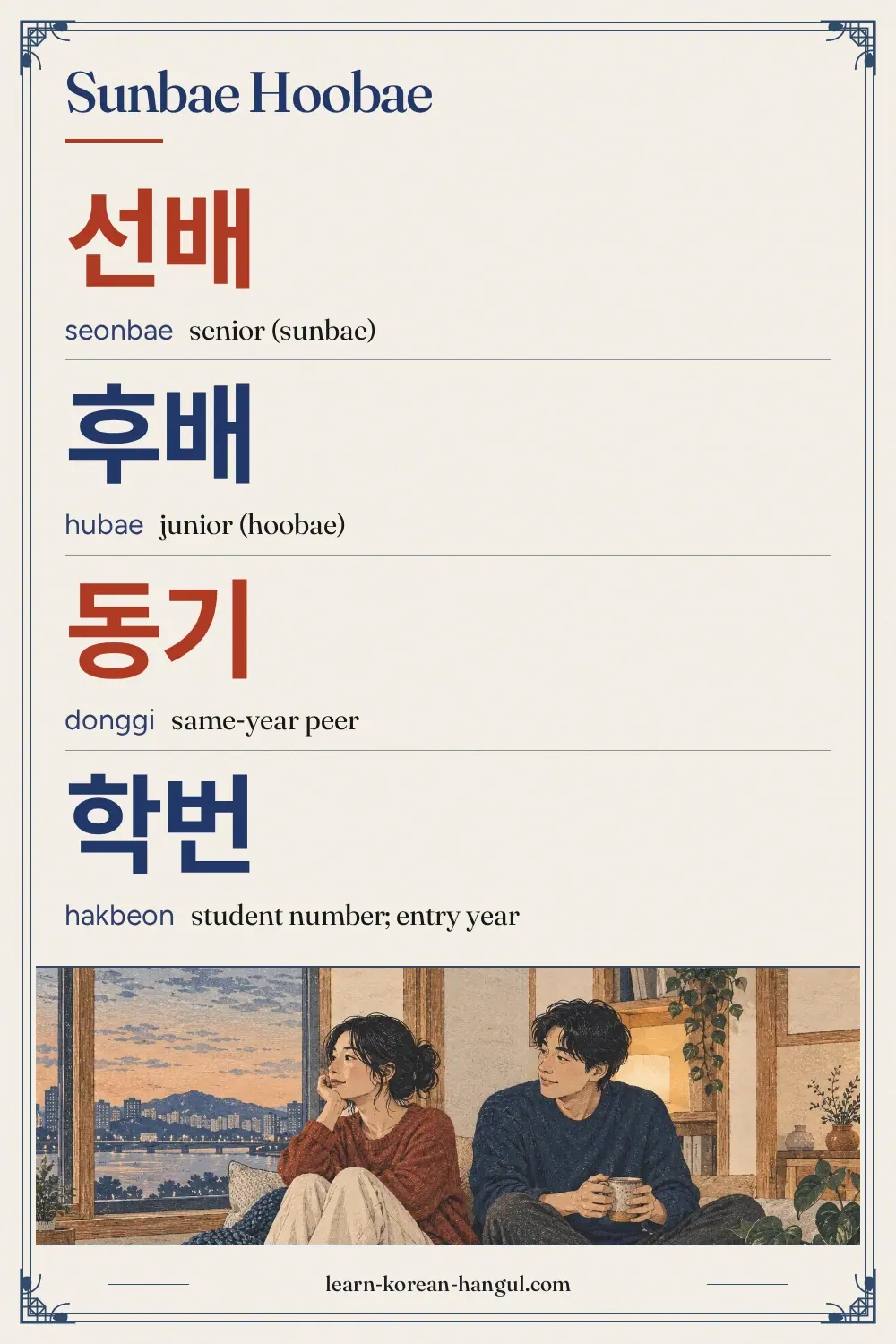
What you'll learn
- Match all 20 words to their English meanings.
- Say five of them aloud with the help of the Revised Romanization and the audio.
- Write two original sentences that use words such as 선배 (senior) and 후배 (junior).
- Choose between 선배, 선배님 and a job title when you speak to a senior.
Prerequisites: you can read Hangul and know the polite ending -아요/-어요. Estimated time: about 60 minutes, plus short reviews on the following days.
Sunbae Hoobae at a Glance
The list has 20 words in five groups of four. Sunbae hoobae is not about being older. It is about who joined first: the person who entered the school, club or company earlier is the 선배, and the person who entered later is the 후배. The groups go from the core pair to the places where you hear them and how to use them politely. The list belongs to Relationships and Titles.
| Group | Words | Use |
|---|---|---|
| Meaning and spelling | 4 | The core pair and the words around them |
| School usage | 4 | Words for students and clubs |
| Workplace usage | 4 | Words for new hires, ranks and colleagues |
| Titles with -님 | 4 | Respectful forms for seniors |
| Friendly usage and etiquette | 4 | Speech levels and addressing seniors |
This page is a word list with notes on use. The workplace words here overlap with the company ranks page, which lists job titles in order. Here the focus is how seniors and juniors address each other.
Which Sunbae and Hoobae Terms Should You Learn First?
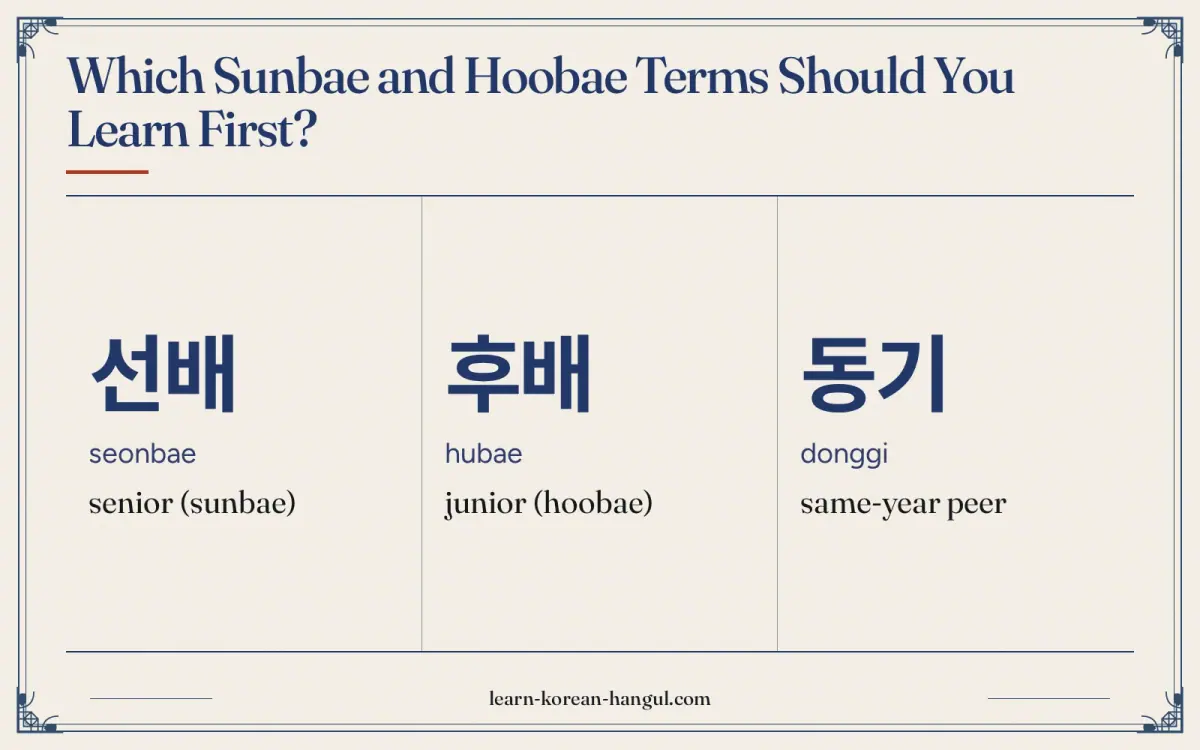
Learn 선배 (senior), 후배 (junior), 동기 (same-year peer), 신입 (new person) and 팀장님 (team leader) first. With these five you can describe who is above and below you at school or work. A short sentence such as 대학교 선배를 만났어요 (I met a university senior) needs only one noun. Then follow this order:
- Step 1: the five words above.
- Step 2: school words: 신입생, 새내기, 동아리 and 학번.
- Step 3: workplace words: 신입, 대리, 과장 and 팀장.
- Step 4: the -님 forms and the etiquette words 존댓말, 반말, 호칭 and 한턱.
The scene below numbers ten of the people and objects from a campus, so you can tie each word to something you can point at.
Word · 10
- 1
선배
seonbae
senior (sunbae)
- 2
후배
hubae
junior (hoobae)
- 3
동기
donggi
same-year peer
- 4
학번
hakbeon
student number; entry year
- 5
신입생
sinipsaeng
freshman; new student
- 6
새내기
saenaegi
freshman (friendly)
- 7
동아리
dongari
club; circle
- 8
신입
sinip
new employee; newcomer
- 9
팀장
timjang
team leader
- 10
존댓말
jondaenmal
honorific speech
Tap a number to hear the word. Notice that 선배 and 후배 describe a relationship, so each one only makes sense when the other is in the scene.
Meaning and Spelling (선배, 후배)
선배 and 후배 are a pair. The standard spelling in Hangul is 선배 and 후배, and the Revised Romanization is seonbae and hubae. 동기 names people who joined in the same year, and 학번 is the student number whose first digits show the year of entry. Together they place a person on the seniority ladder.
| No. | Hangul | Revised Romanization | Meaning and note | Example sentence | Audio assetId |
|---|---|---|---|---|---|
| 1 | 선배 | seonbae | senior (sunbae). A person who entered the school, club or company before you. | 대학교 선배를 만났어요. (I met a university senior.) | au-pg-vocabulary-people-relationships-sunbae-hoobae-1; example: au-pg-vocabulary-people-relationships-sunbae-hoobae-21 |
| 2 | 후배 | hubae | junior (hoobae). A person who entered after you. | 후배가 질문했어요. (A junior asked a question.) | au-pg-vocabulary-people-relationships-sunbae-hoobae-2; example: au-pg-vocabulary-people-relationships-sunbae-hoobae-22 |
| 3 | 동기 | donggi | same-year peer. A person who joined in the same year. Also used for colleagues who started together. | 입사 동기와 점심을 먹어요. (I eat lunch with a colleague who joined the same year.) | au-pg-vocabulary-people-relationships-sunbae-hoobae-3; example: au-pg-vocabulary-people-relationships-sunbae-hoobae-23 |
| 4 | 학번 | hakbeon | student number; entry year. The first digits show the year of entry, so people say 21학번. | 저는 21학번이에요. (I entered university in 2021.) | au-pg-vocabulary-people-relationships-sunbae-hoobae-4; example: au-pg-vocabulary-people-relationships-sunbae-hoobae-24 |
The Hangul spelling 선배 has several Roman spellings. Seonbae and hubae are the official Revised Romanization. Sunbae and hoobae are the spellings you will see in K-drama subtitles, fan sites and English articles, and they stay popular because they look more like the English pronunciation. Hubae is sometimes written hoobae. All of them point to the same two words, so you can use any of them when searching, but write seonbae and hubae when you follow the official system. The word 학번 shows how seniority works in practice: a person who is 19학번 is a 선배 to a 21학번, whatever their ages are.
How Do You Say School Usage in Korean?
School is where most Koreans first use 선배 and 후배. The school words in this group name the people and groups you meet in a new school year: 신입생 and the friendlier 새내기 for freshmen, 졸업생 for graduates, and 동아리 for a club, where seniors and juniors mix.
| No. | Hangul | Revised Romanization | Meaning and note | Example sentence | Audio assetId |
|---|---|---|---|---|---|
| 5 | 신입생 | sinipsaeng | freshman; new student. A student in the first year of a school or university. | 신입생 환영회에 갔어요. (I went to the freshman welcome party.) | au-pg-vocabulary-people-relationships-sunbae-hoobae-5; example: au-pg-vocabulary-people-relationships-sunbae-hoobae-25 |
| 6 | 새내기 | saenaegi | freshman (friendly). A native word for a new student, warmer than 신입생. Used mostly for university freshmen. | 올해 새내기가 됐어요. (This year I became a freshman.) | au-pg-vocabulary-people-relationships-sunbae-hoobae-6; example: au-pg-vocabulary-people-relationships-sunbae-hoobae-26 |
| 7 | 졸업생 | joreopsaeng | graduate; alumnus. A person who has finished the school. | 졸업생이 학교를 방문했어요. (A graduate visited the school.) | au-pg-vocabulary-people-relationships-sunbae-hoobae-7; example: au-pg-vocabulary-people-relationships-sunbae-hoobae-27 |
| 8 | 동아리 | dongari | club; circle. A student group for a hobby or sport. Seniors and juniors mix in it. | 동아리 선배가 친절해요. (The senior in my club is kind.) | au-pg-vocabulary-people-relationships-sunbae-hoobae-8; example: au-pg-vocabulary-people-relationships-sunbae-hoobae-28 |
A 동아리 is where the sunbae hoobae relationship is most visible. Seniors may organise events, welcome new members and treat juniors to a meal. The friendly word 새내기 is warmer than 신입생, and students often use it in club and campus talk. 졸업생 can also be a 선배: a graduate of your school is called a 선배 even when you have never met, which is why you hear 학교 선배 for someone who studied at the same school years earlier.
Workplace Usage
At work, seniority combines two things: the year you joined and your rank. The words here are 신입 for a new employee, 대리 and 과장 for two mid-level ranks, and 팀장 for the leader of a team. Rank decides how you address someone officially, and joining year decides who is a 선배.
| No. | Hangul | Revised Romanization | Meaning and note | Example sentence | Audio assetId |
|---|---|---|---|---|---|
| 9 | 신입 | sinip | new employee; newcomer. Short for 신입 사원. The newest person in the team. | 신입이라서 모르는 게 많아요. (I am new, so there is a lot I do not know.) | au-pg-vocabulary-people-relationships-sunbae-hoobae-9; example: au-pg-vocabulary-people-relationships-sunbae-hoobae-29 |
| 10 | 대리 | daeri | assistant manager. A rank above a regular employee. Used as a title. | 저는 대리예요. (I am an assistant manager.) | au-pg-vocabulary-people-relationships-sunbae-hoobae-10; example: au-pg-vocabulary-people-relationships-sunbae-hoobae-30 |
| 11 | 과장 | gwajang | manager (section chief). A rank above 대리 in many companies. Used as a title. | 김 과장이 회의에 왔어요. (Manager Kim came to the meeting.) | au-pg-vocabulary-people-relationships-sunbae-hoobae-11; example: au-pg-vocabulary-people-relationships-sunbae-hoobae-31 |
| 12 | 팀장 | timjang | team leader. The person in charge of a team. Not always a higher rank than 과장. | 팀장이 새 프로젝트를 설명했어요. (The team leader explained the new project.) | au-pg-vocabulary-people-relationships-sunbae-hoobae-12; example: au-pg-vocabulary-people-relationships-sunbae-hoobae-32 |
At work a 선배 is not always a boss. A 선배 can be a colleague who joined earlier in the same team, and a 후배 can have a higher rank, which makes the relationship more complex. Many workplaces use the title in daily talk, so 선배 is used when ranks are equal. Rank names such as 대리 and 과장 differ a little from company to company, so use the title the person actually uses.
How Do You Say Titles with -님 in Korean?
Add 님 to a title or to 선배 to make it respectful: 선배님, 팀장님, 대리님 and 과장님. In many workplaces and clubs, the title plus 님 replaces the person's name when you address them. Use 님 only for the person you speak to or about.
| No. | Hangul | Revised Romanization | Meaning and note | Example sentence | Audio assetId |
|---|---|---|---|---|---|
| 13 | 선배님 | seonbaenim | senior (honorific). 선배 + 님. Used for a senior you respect, especially when you do not know them well. | 선배님, 도와주셔서 감사합니다. (Senior, thank you for helping me.) | au-pg-vocabulary-people-relationships-sunbae-hoobae-13; example: au-pg-vocabulary-people-relationships-sunbae-hoobae-33 |
| 14 | 팀장님 | timjangnim | team leader (honorific). 팀장 + 님. Used when you address or refer to the leader. | 팀장님, 회의 시작할까요? (Team leader, shall we start the meeting?) | au-pg-vocabulary-people-relationships-sunbae-hoobae-14; example: au-pg-vocabulary-people-relationships-sunbae-hoobae-34 |
| 15 | 대리님 | daerinim | assistant manager (honorific). 대리 + 님. The normal way to address a 대리. | 대리님, 이 서류 확인해 주세요. (Assistant manager, please check this document.) | au-pg-vocabulary-people-relationships-sunbae-hoobae-15; example: au-pg-vocabulary-people-relationships-sunbae-hoobae-35 |
| 16 | 과장님 | gwajangnim | manager (honorific). 과장 + 님. The normal way to address a 과장. | 과장님은 오늘 출장 가셨어요. (The manager is on a business trip today.) | au-pg-vocabulary-people-relationships-sunbae-hoobae-16; example: au-pg-vocabulary-people-relationships-sunbae-hoobae-36 |
The suffix 님 is attached with no space. The pattern is the same for any title: 교수님 (professor), 사장님 (boss) and 선생님 (teacher). You do not add 님 to your own title, and you do not add 씨 after a title. Saying 대리님 is right, but 대리님씨 is not. If you do not know someone's title, use 선배님 for a person who has been at the place longer than you. The examples show the honorific verb forms that follow the titles: 가셨어요 and 주셔서 both contain the -(으)시- that respects the senior.
Friendly Usage and Etiquette
The last group is about how to use the words. 존댓말 is polite, respectful speech and 반말 is casual speech. 호칭 is the form of address you choose, and 한턱 is the treat a senior sometimes gives to a junior. These four words explain most of the etiquette.
| No. | Hangul | Revised Romanization | Meaning and note | Example sentence | Audio assetId |
|---|---|---|---|---|---|
| 17 | 존댓말 | jondaenmal | honorific speech. Polite speech with endings such as -요 and -습니다. Said [존댄말]. | 선배에게는 존댓말을 써요. (I use honorific speech with seniors.) | au-pg-vocabulary-people-relationships-sunbae-hoobae-17; example: au-pg-vocabulary-people-relationships-sunbae-hoobae-37 |
| 18 | 반말 | banmal | casual speech. Plain speech without 요. Used with close friends and younger people. | 동기끼리는 반말을 해요. (Same-year peers use casual speech with each other.) | au-pg-vocabulary-people-relationships-sunbae-hoobae-18; example: au-pg-vocabulary-people-relationships-sunbae-hoobae-38 |
| 19 | 호칭 | hoching | form of address. What you call a person: a name, a title or a kinship term. | 호칭이 어려워요. (Forms of address are hard.) | au-pg-vocabulary-people-relationships-sunbae-hoobae-19; example: au-pg-vocabulary-people-relationships-sunbae-hoobae-39 |
| 20 | 한턱 | hanteok | a treat. Used in 한턱내다, to treat someone to a meal or a drink. | 선배가 한턱냈어요. (The senior treated us.) | au-pg-vocabulary-people-relationships-sunbae-hoobae-20; example: au-pg-vocabulary-people-relationships-sunbae-hoobae-40 |
A good rule is to start with 존댓말 for every 선배 and move to 반말 only if the senior suggests it. Many people also use 존댓말 with a 후배 they do not know well, because politeness goes both ways at first. The treat is a common custom: in many groups the senior pays for the first meal and the junior pays later. The way the word is used differs among groups, so follow what your own group does.
선배 and 형: How They Differ
선배 is a position word, and 형 (hyeong) and 오빠 (oppa) are kinship words used for an older brother or an older friend. A man calls an older male friend 형, and a woman calls an older male friend 오빠. A 선배 may also be called 형 or 오빠 in a close club, but the word 선배 does not depend on age at all. A 후배 who is older than their 선배 still uses the title, and speech levels are agreed between the two. For the kinship terms, see Oppa, Hyung, Unnie and Noona.
A Short Dialogue between a Senior and a Junior
Here is a short exchange between a new club member and a senior. The junior uses polite speech and the senior uses a friendly, lighter style.
| Speaker | Korean | English |
|---|---|---|
| 후배 | 선배님, 안녕하세요. | Hello, senior. |
| 선배 | 안녕. 이번 학기에 동아리 들어왔지? | Hi. You joined the club this semester, right? |
| 후배 | 네, 잘 부탁드립니다. | Yes, I look forward to working with you. |
| 선배 | 응, 모르는 건 편하게 물어봐. | Sure, ask me anything you do not know. |
The junior says 선배님 and 부탁드립니다, which are respectful forms, and the senior answers in the casual 반말. This is a common pattern when the senior is older or joined earlier, although some seniors prefer to use polite speech with a junior they do not know well.
How Do You Pronounce These Words?
Most words on this list are said as they are written, but a few change their sound. The National Institute of Korean Language (국립국어원) sets these changes in its standard pronunciation rules. Revised Romanization follows the spoken sound for linking and nasal changes, but it does not show tensing caused by a neighbouring sound.
| Spelling | Sounds like | What changes |
|---|---|---|
| 학번 | [학뻔] | ㅂ is tensed after a final ㄱ. |
| 졸업생 | [조럽쌩] | The final ㅂ links to the vowel that follows, and ㅅ is tensed after ㅂ. |
| 존댓말 | [존댄말] | The final ㅅ is said as ㄷ, and then ㄷ turns into ㄴ before ㅁ. |
| 신입 | [시닙] | The final ㄴ links to the vowel that follows. |
| 선배 | [선배] | No change in sound. RR writes seonbae. |
| 후배 | [후배] | No change in sound. RR writes hubae. |
Audio and Slow Playback
Each word and sentence has its own clip. The five clips below play the harder words slowly. Play a clip, say the word, then play it again and compare the ends of the syllables.
What Mistakes Do Learners Make with Sunbae and Hoobae Terms?
Five patterns catch learners when they use these terms.
- Counting age instead of entry year. A 선배 is not older by definition. A person who enters a year later is a 후배 even if they are older.
- Calling a senior by name. In most clubs and workplaces, use 선배님 or the title plus 님, not the name alone.
- Adding 씨 to a title. 팀장님 is right and 팀장님 씨 is not. Use 님 for titles and 씨 for names.
- Using 반말 too early. Start with 존댓말 and move to 반말 only when the senior invites it.
- Reading 학번 as written. The sound is [학뻔]. The ㅂ after a final ㄱ is tense.
If you remember that seniority comes from the year you joined, most of the trouble goes away. The practice section turns the list into drills.
Practice: Flashcards and Worksheet
Study in three steps. First, run the deck in recognition mode until the 20 words feel familiar. Second, switch to listening mode and tap the clip before the card turns. Third, take the five-question quiz below. The deck stores your progress in your browser. The vocabulary flashcard decks page lists the other decks.
Practice · 45
- 01선배
Show answer
headword 1: senior (sunbae)
- 02후배
Show answer
headword 2: junior (hoobae)
- 03동기
Show answer
headword 3: same-year peer
- 04학번
Show answer
headword 4: student number; entry year
- 05신입생
Show answer
headword 5: freshman; new student
- 06새내기
Show answer
headword 6: freshman (friendly)
- 07졸업생
Show answer
headword 7: graduate; alumnus
- 08동아리
Show answer
headword 8: club; circle
- 09신입
Show answer
headword 9: new employee; newcomer
- 10대리
Show answer
headword 10: assistant manager
- 11과장
Show answer
headword 11: manager (section chief)
- 12팀장
Show answer
headword 12: team leader
- 13선배님
Show answer
headword 13: senior (honorific)
- 14팀장님
Show answer
headword 14: team leader (honorific)
- 15대리님
Show answer
headword 15: assistant manager (honorific)
- 16과장님
Show answer
headword 16: manager (honorific)
- 17존댓말
Show answer
headword 17: honorific speech
- 18반말
Show answer
headword 18: casual speech
- 19호칭
Show answer
headword 19: form of address
- 20한턱
Show answer
headword 20: a treat
- 21대학교 선배를 만났어요.
Show answer
example sentence for 선배
- 22후배가 질문했어요.
Show answer
example sentence for 후배
- 23입사 동기와 점심을 먹어요.
Show answer
example sentence for 동기
- 24저는 21학번이에요.
Show answer
example sentence for 학번
- 25신입생 환영회에 갔어요.
Show answer
example sentence for 신입생
- 26올해 새내기가 됐어요.
Show answer
example sentence for 새내기
- 27졸업생이 학교를 방문했어요.
Show answer
example sentence for 졸업생
- 28동아리 선배가 친절해요.
Show answer
example sentence for 동아리
- 29신입이라서 모르는 게 많아요.
Show answer
example sentence for 신입
- 30저는 대리예요.
Show answer
example sentence for 대리
- 31김 과장이 회의에 왔어요.
Show answer
example sentence for 과장
- 32팀장이 새 프로젝트를 설명했어요.
Show answer
example sentence for 팀장
- 33선배님, 도와주셔서 감사합니다.
Show answer
example sentence for 선배님
- 34팀장님, 회의 시작할까요?
Show answer
example sentence for 팀장님
- 35대리님, 이 서류 확인해 주세요.
Show answer
example sentence for 대리님
- 36과장님은 오늘 출장 가셨어요.
Show answer
example sentence for 과장님
- 37선배에게는 존댓말을 써요.
Show answer
example sentence for 존댓말
- 38동기끼리는 반말을 해요.
Show answer
example sentence for 반말
- 39호칭이 어려워요.
Show answer
example sentence for 호칭
- 40선배가 한턱냈어요.
Show answer
example sentence for 한턱
- 41학번
Show answer
slow playback of 학번
- 42졸업생
Show answer
slow playback of 졸업생
- 43존댓말
Show answer
slow playback of 존댓말
- 44동아리
Show answer
slow playback of 동아리
- 45선배님
Show answer
slow playback of 선배님
Practice · 5
What does 선배 (seonbae) mean?
Show answer
senior
선배 means senior: a person who joined the school or company before you. Example: 대학교 선배를 만났어요. (I met a university senior.)
What does 후배 (hubae) mean?
Show answer
junior
후배 means junior: a person who joined after you. Example: 후배가 질문했어요. (A junior asked a question.)
Which word means a person who joined in the same year?
Show answer
동기
동기 means a same-year peer. Example: 입사 동기와 점심을 먹어요. (I eat lunch with a colleague who joined the same year.)
Which form of address is correct for a team leader?
Show answer
팀장님
Use 님 with a title: 팀장님. Example: 팀장님, 회의 시작할까요? (Team leader, shall we start the meeting?)
What does 반말 mean?
Show answer
casual speech
반말 is casual speech without 요. Example: 동기끼리는 반말을 해요. (Same-year peers use casual speech with each other.)
Sunbae Hoobae Worksheet (PDF)
A printable worksheet for these words (word list, matching, writing practice, fill-in-the-blank exercises and answer key) is available in A4 and US Letter from the download card on this page. For additional practice, draw a seniority ladder and label each step with the Korean word.
Where to Go Next
After this page, continue with Korean Dating Vocabulary for the next relationship list, or with Oppa, Hyung, Unnie and Noona for the kinship terms that friends use.
Frequently Asked Questions
What Does Sunbae Hoobae Mean in Korean?
Sunbae hoobae (선배 후배) means senior and junior. A 선배 entered the school, club or company before you, and a 후배 entered after you. It depends on the year of entry, not on age. In English the words are often spelled sunbae and hoobae, and the official Revised Romanization is seonbae and hubae.
How Do You Pronounce 선배 (seonbae)?
Say seon-bae as two syllables. The first has the vowel eo, a relaxed sound close to the u in the English word bus, and ends in n. The second is bae, with a soft b and the vowel ae as in bed. Press the audio button on this page to hear it, then repeat it.
What Is the Difference between 선배 and 형?
선배 describes a position: someone who joined before you. 형 is what a man calls an older male friend, and it depends on age. A 선배 can be younger than you, but a 형 is older. Some close seniors are called both, but the words are not interchangeable.
How Many Sunbae and Hoobae Terms Should I Learn First?
Five first: 선배, 후배, 동기, 신입 and 팀장님. They let you describe who is above and below you at school or work. At five new words a day the 20 words take about four days with review. Add the etiquette words last.
Where Can I Practise Sunbae Hoobae Words with Flashcards?
Use the vocabulary flashcard decks. The deck for this page holds all 20 words with Hangul, romanization and audio, in recognition and listening modes. Your progress stays in your browser. Give the titles with 님 extra time in listening mode.
Is There a Printable Worksheet for Sunbae and Hoobae Terms?
A printable worksheet for these words (word list, matching, writing practice, fill-in-the-blank exercises and answer key) is available in A4 and US Letter from the download card on this page. For practice, the tables on this page can be copied by hand, and the deck carries the same 20 words.