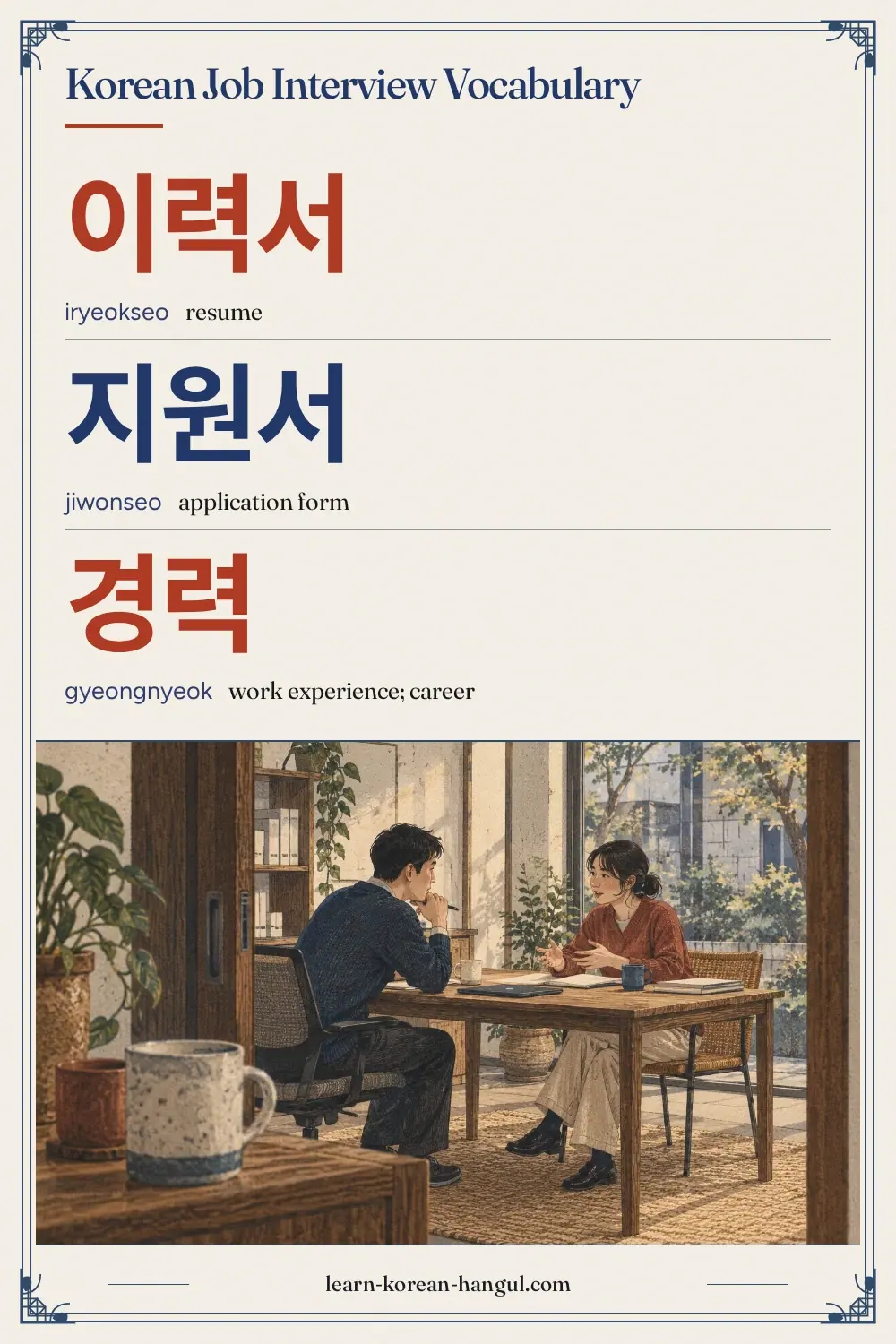
Korean Job Interview Vocabulary at a Glance
The list has 35 words in five groups of seven. It follows the order of a real application: you prepare documents, pass the screening, sit the interview, answer questions about your skills, and wait for the result. It belongs to Office and Business, and it pairs with the single-word pages on resume in Korean and interview in Korean, which go deeper on one word each. Most nouns here are Sino-Korean, built from short parts such as 서 (document), 력 (record) and 격 (standard), so the same pieces return in many words.
| Group | Words | Use |
|---|---|---|
| Application documents | 7 | Resume, letters, certificates and career records |
| Interview stages | 7 | Screening, tests, rounds and the people in the room |
| Questions and answers | 7 | What you are asked and how you reply |
| Skills and experience | 7 | Abilities, study, languages and character |
| Results and offers | 7 | Pass, fail, hiring, pay and the start date |
Interviews use a formal, polite style. Where this page gives a full sentence for you to say in the room, it ends in -ㅂ니다 or -습니다, the formal style. The example sentences in the tables use the everyday polite -요 style so that you can read them easily.
Which Job Interview Words Should You Learn First?
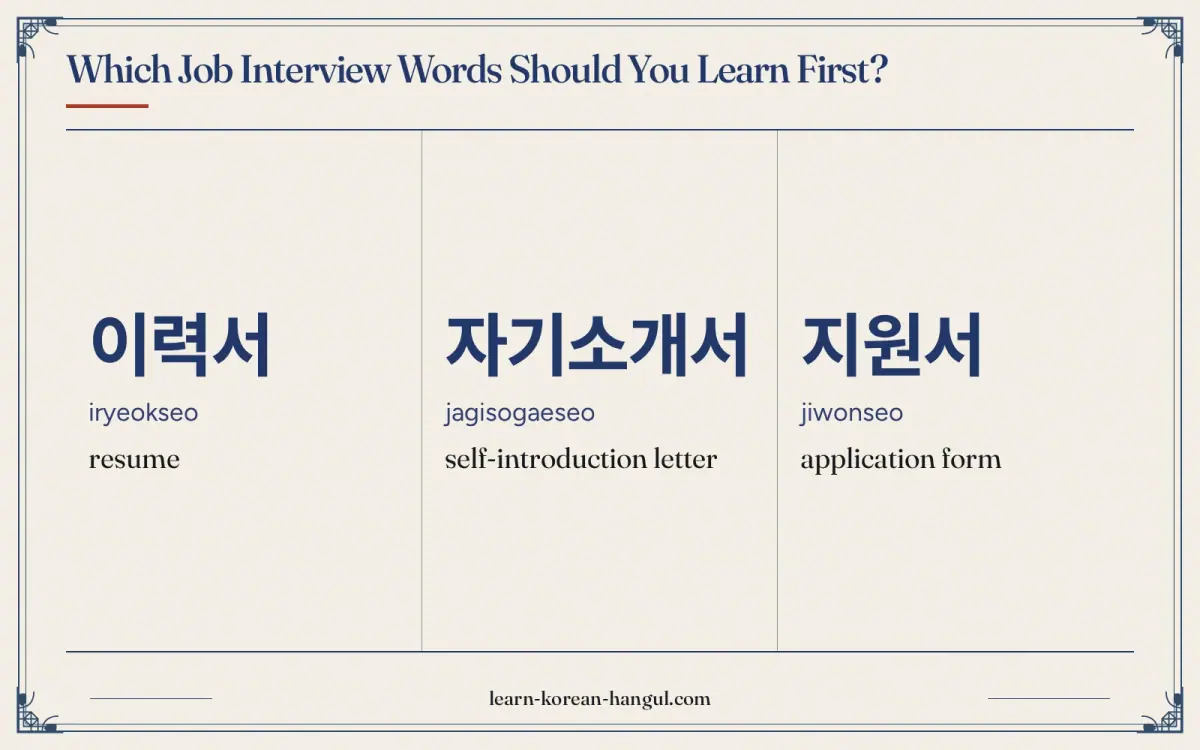
Learn 이력서 (resume), 면접 (interview), 지원 (application), 경력 (work experience) and 합격 (pass) first. Together they let you say that you sent a resume, that you have an interview and that you passed. 면접이 있어요 (I have an interview) is the most useful sentence on this page for a new learner.
- Words to say. 이력서, 면접, 지원, 경력, 장점, 합격. You will say these aloud in the room.
- Words to recognise. 서류 전형, 필기시험, 불합격, 수습 기간. You read them on job sites and in emails from companies.
- Words for the offer. 연봉, 입사, 채용. They come up once an offer is near, and they decide what you ask.
The scene below shows a desk with ten numbered objects and ideas from the list, so that you can tie each word to a picture.
Word · 10
- 1
이력서
iryeokseo
resume
- 2
자기소개서
jagisogaeseo
self-introduction letter
- 3
지원서
jiwonseo
application form
- 4
경력
gyeongnyeok
work experience; career
- 5
면접
myeonjeop
interview
- 6
면접관
myeonjeopgwan
interviewer
- 7
질문
jilmun
question
- 8
경험
gyeongheom
experience
- 9
합격
hapgyeok
pass; acceptance
- 10
연봉
yeonbong
annual salary
Application Documents
The first stage of any job hunt is paper. Korean employers often ask for an 이력서 (a list of your education and jobs) and a 자기소개서 (a written essay about yourself). People shorten the second one to 자소서 (jasoseo) in everyday talk. Three words end in 서, which means document, so you can spot them quickly: 이력서, 자기소개서 and 지원서.
| No. | Hangul | Revised Romanization | Meaning and note | Example sentence | Audio assetId |
|---|---|---|---|---|---|
| 1 | 이력서 | iryeokseo | resume. Said [이력써]. Lists your education, jobs and skills. | 이력서를 보내요. (I send my resume.) | au-pg-vocabulary-school-work-office-job-interview-1; example: au-pg-vocabulary-school-work-office-job-interview-36 |
| 2 | 자기소개서 | jagisogaeseo | self-introduction letter. A written essay about you; often shortened to 자소서. | 자기소개서를 써요. (I write my self-introduction letter.) | au-pg-vocabulary-school-work-office-job-interview-2; example: au-pg-vocabulary-school-work-office-job-interview-37 |
| 3 | 지원서 | jiwonseo | application form. 지원 (applying) plus 서 (document). | 지원서를 내요. (I hand in my application form.) | au-pg-vocabulary-school-work-office-job-interview-3; example: au-pg-vocabulary-school-work-office-job-interview-38 |
| 4 | 지원 | jiwon | application; applying. The noun base of 지원하다, to apply. | 이 회사에 지원해요. (I apply to this company.) | au-pg-vocabulary-school-work-office-job-interview-4; example: au-pg-vocabulary-school-work-office-job-interview-39 |
| 5 | 경력 | gyeongnyeok | work experience; career. Said [경녁]. Past jobs counted in years. | 경력이 오 년이에요. (I have five years of experience.) | au-pg-vocabulary-school-work-office-job-interview-5; example: au-pg-vocabulary-school-work-office-job-interview-40 |
| 6 | 학력 | hangnyeok | educational background. Said [항녁]. Schools and degrees you finished. | 학력을 써요. (I write my educational background.) | au-pg-vocabulary-school-work-office-job-interview-6; example: au-pg-vocabulary-school-work-office-job-interview-41 |
| 7 | 자격증 | jagyeokjeung | qualification certificate. Said [자격쯩]. A licence or exam certificate. | 자격증이 있어요. (I have a certificate.) | au-pg-vocabulary-school-work-office-job-interview-7; example: au-pg-vocabulary-school-work-office-job-interview-42 |
Example Sentences
The most useful frame is 서류 + 를/을 + a verb. You 써요 (write) a letter, 내요 (hand in) a form and 보내요 (send) a resume. Say each sentence aloud after the audio, and notice that 경력이 오 년이에요 uses the Sino-Korean number 오 with 년 (year).
지원 is the root of several useful words. 지원하다 is the verb, 지원서 is the form and 지원자 (in the next group) is the person. The particle 에 marks the place you apply to, as in 이 회사에 지원해요. Remember that 경력 counts what you did at work, while 학력 counts what you studied.
How Do You Say Interview Stages in Korean?
A Korean hiring process is described as a chain of stages, and each stage has a name. The employer first screens the papers, which is the 서류 전형. Some companies add a written test, and then comes the 면접, sometimes in more than one round. The words below name the stages and the people involved.
| No. | Hangul | Revised Romanization | Meaning and note | Example sentence | Audio assetId |
|---|---|---|---|---|---|
| 8 | 서류 전형 | seoryu jeonhyeong | document screening. The first stage, where the employer reads papers. | 서류 전형에 합격했어요. (I passed the document screening.) | au-pg-vocabulary-school-work-office-job-interview-8; example: au-pg-vocabulary-school-work-office-job-interview-43 |
| 9 | 필기시험 | pilgisiheom | written test. 필기 means writing by hand. | 필기시험이 있어요. (There is a written test.) | au-pg-vocabulary-school-work-office-job-interview-9; example: au-pg-vocabulary-school-work-office-job-interview-44 |
| 10 | 면접 | myeonjeop | interview. The word for the meeting itself. | 내일 면접이 있어요. (I have an interview tomorrow.) | au-pg-vocabulary-school-work-office-job-interview-10; example: au-pg-vocabulary-school-work-office-job-interview-45 |
| 11 | 면접관 | myeonjeopgwan | interviewer. Said [면접꽌]. 관 marks a person in an office. | 면접관이 질문해요. (The interviewer asks a question.) | au-pg-vocabulary-school-work-office-job-interview-11; example: au-pg-vocabulary-school-work-office-job-interview-46 |
| 12 | 최종 면접 | choejong myeonjeop | final interview. 최종 means last or final. | 최종 면접은 금요일이에요. (The final interview is on Friday.) | au-pg-vocabulary-school-work-office-job-interview-12; example: au-pg-vocabulary-school-work-office-job-interview-47 |
| 13 | 지원자 | jiwonja | applicant. 지원 plus 자, a person. | 지원자가 많아요. (There are many applicants.) | au-pg-vocabulary-school-work-office-job-interview-13; example: au-pg-vocabulary-school-work-office-job-interview-48 |
| 14 | 인사팀 | insatim | HR team. 인사 here means personnel. | 인사팀에 전화해요. (I call the HR team.) | au-pg-vocabulary-school-work-office-job-interview-14; example: au-pg-vocabulary-school-work-office-job-interview-49 |
전형 means screening or selection, and it appears in the name of each stage, such as 서류 전형. The suffix 자 means person, so 지원자 is a person who applies, and 관 in 면접관 marks an official who conducts something. Notice that 인사 has two meanings. As a greeting it means hello (인사하다), and in 인사팀 it means personnel. Context tells you which.
Questions and Answers
Most Korean interviews follow a pattern. You introduce yourself, explain why you applied, and talk about your strengths and weaknesses. Each part has a standard name, and interviewers use them as headings when they speak. Knowing the names means you can guess the question before the interviewer finishes it.
| No. | Hangul | Revised Romanization | Meaning and note | Example sentence | Audio assetId |
|---|---|---|---|---|---|
| 15 | 질문 | jilmun | question. Something you ask someone. | 질문을 받아요. (I receive a question.) | au-pg-vocabulary-school-work-office-job-interview-15; example: au-pg-vocabulary-school-work-office-job-interview-50 |
| 16 | 답변 | dapbyeon | answer; reply. A formal reply, used in interviews and letters. | 답변을 준비해요. (I prepare an answer.) | au-pg-vocabulary-school-work-office-job-interview-16; example: au-pg-vocabulary-school-work-office-job-interview-51 |
| 17 | 자기소개 | jagisogae | self-introduction. The spoken introduction in the room. | 자기소개를 해요. (I introduce myself.) | au-pg-vocabulary-school-work-office-job-interview-17; example: au-pg-vocabulary-school-work-office-job-interview-52 |
| 18 | 지원 동기 | jiwon donggi | reason for applying. Almost every interview asks this. | 지원 동기를 말해요. (I state my reason for applying.) | au-pg-vocabulary-school-work-office-job-interview-18; example: au-pg-vocabulary-school-work-office-job-interview-53 |
| 19 | 장점 | jangjeom | strength; good point. Said [장쩜]. Paired with 단점. | 제 장점은 책임감이에요. (My strength is a sense of responsibility.) | au-pg-vocabulary-school-work-office-job-interview-19; example: au-pg-vocabulary-school-work-office-job-interview-54 |
| 20 | 단점 | danjeom | weakness; weak point. Said [단쩜]. The opposite of 장점. | 제 단점을 알아요. (I know my weakness.) | au-pg-vocabulary-school-work-office-job-interview-20; example: au-pg-vocabulary-school-work-office-job-interview-55 |
| 21 | 포부 | pobu | aspiration; ambition. What you hope to achieve at the company. | 입사 후 포부를 말해요. (I talk about my ambitions after joining.) | au-pg-vocabulary-school-work-office-job-interview-21; example: au-pg-vocabulary-school-work-office-job-interview-56 |
장점 and 단점 are a pair, and they both end in 점, which means point. They also work outside interviews, for example when you compare two phones. 질문 and 답변 are partners too: you 받아요 (receive) a question and you 준비해요 (prepare) an answer. A 지원 동기 answer is where most candidates are judged, so learners often practise this one out loud first.
How Do You Say Skills and Experience in Korean?
Once the interviewer has heard your introduction, the questions turn to what you can do. The next seven words name your abilities, your studies and your character. Several of them also end in 하다 or 한 when you use them to describe a person, such as 성실한 사람 (a diligent person).
| No. | Hangul | Revised Romanization | Meaning and note | Example sentence | Audio assetId |
|---|---|---|---|---|---|
| 22 | 경험 | gyeongheom | experience. Broader than 경력; any experience, not only jobs. | 해외 경험이 있어요. (I have experience abroad.) | au-pg-vocabulary-school-work-office-job-interview-22; example: au-pg-vocabulary-school-work-office-job-interview-57 |
| 23 | 능력 | neungnyeok | ability. Said [능녁]. What a person can do. | 능력이 중요해요. (Ability is important.) | au-pg-vocabulary-school-work-office-job-interview-23; example: au-pg-vocabulary-school-work-office-job-interview-58 |
| 24 | 전공 | jeongong | major; field of study. The subject you studied at university. | 전공은 경영학이에요. (My major is business administration.) | au-pg-vocabulary-school-work-office-job-interview-24; example: au-pg-vocabulary-school-work-office-job-interview-59 |
| 25 | 인턴 | inteon | intern. Loanword from English. | 작년에 인턴을 했어요. (I worked as an intern last year.) | au-pg-vocabulary-school-work-office-job-interview-25; example: au-pg-vocabulary-school-work-office-job-interview-60 |
| 26 | 외국어 | oegugeo | foreign language. Said [외구거]. 외국 is foreign country; 어 is language. | 외국어를 잘해요. (I am good at foreign languages.) | au-pg-vocabulary-school-work-office-job-interview-26; example: au-pg-vocabulary-school-work-office-job-interview-61 |
| 27 | 성실 | seongsil | diligence; sincerity. Usually seen as 성실하다 or 성실한. | 저는 성실한 사람이에요. (I am a diligent person.) | au-pg-vocabulary-school-work-office-job-interview-27; example: au-pg-vocabulary-school-work-office-job-interview-62 |
| 28 | 책임감 | chaegimgam | sense of responsibility. Said [채김감]. 감 means feeling. | 책임감이 강해요. (I have a strong sense of responsibility.) | au-pg-vocabulary-school-work-office-job-interview-28; example: au-pg-vocabulary-school-work-office-job-interview-63 |
Two nouns here are easy to mix up. 경력 (in the first group) is work history that you count in years. 경험 is any experience, such as living abroad or joining a club. In your 자기소개서 you can list both. The suffix 감 in 책임감 turns a word into a feeling, as in 성취감 (sense of achievement), so it is worth remembering as a word-building piece.
Results and Offers
The last group covers what happens after the interview. You wait for a result, you hear 합격 or 불합격, and if it is good news you talk about pay and the start date. These words also appear on job sites and in letters from the company, so you will read them more often than you say them.
| No. | Hangul | Revised Romanization | Meaning and note | Example sentence | Audio assetId |
|---|---|---|---|---|---|
| 29 | 합격 | hapgyeok | pass; acceptance. Said [합껵]. Used for exams and for hiring. | 면접에 합격했어요. (I passed the interview.) | au-pg-vocabulary-school-work-office-job-interview-29; example: au-pg-vocabulary-school-work-office-job-interview-64 |
| 30 | 불합격 | bulhapgyeok | failure to pass; rejection. Said [불합껵]. 불 is a negative prefix. | 불합격 소식을 들었어요. (I heard the news that I did not pass.) | au-pg-vocabulary-school-work-office-job-interview-30; example: au-pg-vocabulary-school-work-office-job-interview-65 |
| 31 | 최종 합격 | choejong hapgyeok | final acceptance. The result after the last round. | 최종 합격을 축하해요. (Congratulations on your final acceptance.) | au-pg-vocabulary-school-work-office-job-interview-31; example: au-pg-vocabulary-school-work-office-job-interview-66 |
| 32 | 채용 | chaeyong | hiring; recruitment. The company's side of 지원. | 회사가 직원을 채용해요. (The company hires staff.) | au-pg-vocabulary-school-work-office-job-interview-32; example: au-pg-vocabulary-school-work-office-job-interview-67 |
| 33 | 연봉 | yeonbong | annual salary. 연 is year; 봉 is pay. | 연봉이 높아요. (The annual salary is high.) | au-pg-vocabulary-school-work-office-job-interview-33; example: au-pg-vocabulary-school-work-office-job-interview-68 |
| 34 | 입사 | ipsa | joining a company. Said [입싸]. The opposite is 퇴사. | 다음 달에 입사해요. (I join the company next month.) | au-pg-vocabulary-school-work-office-job-interview-34; example: au-pg-vocabulary-school-work-office-job-interview-69 |
| 35 | 수습 기간 | suseup gigan | probation period. A trial period at the start of a job. | 수습 기간은 삼 개월이에요. (The probation period is three months.) | au-pg-vocabulary-school-work-office-job-interview-35; example: au-pg-vocabulary-school-work-office-job-interview-70 |
합격 and 불합격 are opposites made with the negative prefix 불. 지원 and 채용 are opposites in another sense: 지원 is the candidate's act, and 채용 is the company's act. 연봉 counts pay by the year, while the monthly figure has its own word, 월급 (wolgeup). Always check which one a job post uses before you compare offers. Two more phrases appear in offer letters and job posts: 근무 시간 (geunmu sigan, working hours) and 합격 통보 (hapgyeok tongbo, notice that you passed).
Which Job Interview Words Are Spoken and Which Are Written?
Some words live on paper and some live in the room. 이력서, 자기소개서, 지원서, 학력 and 자격증 are mostly written: you see them on forms and job sites, and you say them only when you talk about the document. 자기소개, 지원 동기, 장점, 단점 and 포부 are spoken: the interviewer says them as headings, and you answer under each one. 합격, 불합격 and 입사 are both, since you read them in a message and say them to a friend.
The style changes too. In the room, the formal polite style is the safe choice. A short model self-introduction looks like this: 안녕하세요. 저는 김민수입니다. 경영학을 전공했습니다. 이 회사에 지원했습니다. 감사합니다. Each sentence ends in -ㅂ니다 or -습니다, the formal polite ending. The everyday -요 ending is fine for the example sentences in this list, but listen to what the interviewer uses and follow it.
How Do You Pronounce Job Interview Words?
Interview words are mostly Sino-Korean, and they show the same few sound changes again and again. The standard pronunciation rules of the National Institute of Korean Language (국립국어원) describe each one. The Revised Romanization of Korean shows ㄴ-insertion and ㄹ assimilation, but it does not show tensing caused by a neighbouring sound, so rely on the Hangul and the audio.
| Spelling | Sounds like | What changes |
|---|---|---|
| 이력서 | [이력써] | After the final ㄱ of 력, the ㅅ of 서 is said tense. |
| 경력 | [경녁] | After ㅇ, the ㄹ is said as ㄴ. |
| 자격증 | [자격쯩] | After the final ㄱ of 격, the ㅈ of 증 is said tense. |
| 장점 | [장쩜] | The ㅈ of 점 is said tense; the spelling does not show it. |
| 합격 | [합껵] | After the final ㅂ, the ㄱ is said tense. |
| 책임감 | [채김감] | The final ㄱ of 책 moves onto the empty ㅇ of 임. |
| 외국어 | [외구거] | The final ㄱ of 국 moves onto the empty ㅇ of 어. |
Two habits cover most of the list. First, a final consonant moves forward when the next syllable begins with ㅇ, so 책임감 sounds like chae-gim-gam and 외국어 sounds like oe-gu-geo. Second, a tense sound appears after a final ㄱ or ㅂ in many Sino-Korean words, as in 합격 and 이력서. Learn the spoken form with the spelling, and do not pause between syllables.
Audio and Slow Playback
Each word and sentence has its own clip. Five clips replay the hardest words slowly: a resume, work experience, a certificate, a sense of responsibility and a pass. Play one, repeat it aloud, then play it again and compare.
What Mistakes Do Learners Make with Job Interview Words?
Five confusions come up again and again.
- Mixing 자기소개서 and 자기소개. 자기소개서 is the written letter that you send before the interview, and it ends in 서 (document). 자기소개 is what you say in the room. When a form asks for a 자기소개서 it wants writing, and when the interviewer says 자기소개 it wants speech.
- Saying 면접을 해요 for your own interview. The candidate 보다 an interview: 면접을 봐요, I have an interview. 면접을 해요 sounds more like the company's side, the one who conducts it.
- Using 경험 for a job record. 경력 is work history counted in years, as in 경력이 오 년이에요. 경험 is any experience, as in 해외 경험. On a form, the box marked 경력 wants jobs.
- Reading 지원 and 지원서 as the same word. 지원 is the act of applying and 지원서 is the form. You 지원해요 (apply) and you 내요 (hand in) a 지원서.
- Comparing 연봉 with a monthly figure. 연봉 is the annual salary. The monthly pay is 월급. A number that looks small may be monthly, so check the word before you compare.
In all five cases, one English word hides two Korean words, or one Korean word is used for a different action. Keep the pairs together, such as 자기소개서 and 자기소개, 보다 and 하다, and 연봉 and 월급, and the rest of the 35 words stay in place.
Practice: Flashcards and Worksheet
Study in three steps. First, run the deck in recognition mode until the 35 words come quickly. Second, switch to listening mode and play the clip before you flip each card. Third, take the five-question quiz. Progress stays in your browser, and the vocabulary flashcard decks page lists the other decks.
Practice · 35
- 01이력서
Show answer
iryeokseo
resume
- 02자기소개서
Show answer
jagisogaeseo
self-introduction letter
- 03지원서
Show answer
jiwonseo
application form
- 04지원
Show answer
jiwon
application; applying
- 05경력
Show answer
gyeongnyeok
work experience; career
- 06학력
Show answer
hangnyeok
educational background
- 07자격증
Show answer
jagyeokjeung
qualification certificate
- 08서류 전형
Show answer
seoryu jeonhyeong
document screening
- 09필기시험
Show answer
pilgisiheom
written test
- 10면접
Show answer
myeonjeop
interview
- 11면접관
Show answer
myeonjeopgwan
interviewer
- 12최종 면접
Show answer
choejong myeonjeop
final interview
- 13지원자
Show answer
jiwonja
applicant
- 14인사팀
Show answer
insatim
HR team
- 15질문
Show answer
jilmun
question
- 16답변
Show answer
dapbyeon
answer; reply
- 17자기소개
Show answer
jagisogae
self-introduction
- 18지원 동기
Show answer
jiwon donggi
reason for applying
- 19장점
Show answer
jangjeom
strength; good point
- 20단점
Show answer
danjeom
weakness; weak point
- 21포부
Show answer
pobu
aspiration; ambition
- 22경험
Show answer
gyeongheom
experience
- 23능력
Show answer
neungnyeok
ability
- 24전공
Show answer
jeongong
major; field of study
- 25인턴
Show answer
inteon
intern
- 26외국어
Show answer
oegugeo
foreign language
- 27성실
Show answer
seongsil
diligence; sincerity
- 28책임감
Show answer
chaegimgam
sense of responsibility
- 29합격
Show answer
hapgyeok
pass; acceptance
- 30불합격
Show answer
bulhapgyeok
failure to pass; rejection
- 31최종 합격
Show answer
choejong hapgyeok
final acceptance
- 32채용
Show answer
chaeyong
hiring; recruitment
- 33연봉
Show answer
yeonbong
annual salary
- 34입사
Show answer
ipsa
joining a company
- 35수습 기간
Show answer
suseup gigan
probation period
Practice · 5
What does 이력서 (iryeokseo) mean?
Show answer
resume
이력서 means resume. Example: 이력서를 보내요. (I send my resume.)
What does 면접관 (myeonjeopgwan) mean?
Show answer
interviewer
면접관 means interviewer. Example: 면접관이 질문해요. (The interviewer asks a question.)
What does 지원 동기 (jiwon donggi) mean?
Show answer
reason for applying
지원 동기 means reason for applying. Example: 지원 동기를 말해요. (I state my reason for applying.)
What does 합격 (hapgyeok) mean?
Show answer
pass; acceptance
합격 means pass; acceptance. Example: 면접에 합격했어요. (I passed the interview.)
What does 연봉 (yeonbong) mean?
Show answer
annual salary
연봉 means annual salary. Example: 연봉이 높아요. (The annual salary is high.)
Korean Job Interview Vocabulary Worksheet (PDF)
A printable worksheet for these words (word list, matching, writing practice, fill-in-the-blank exercises and answer key) is available in A4 and US Letter from the download card on this page. For additional practice, write a three-line 자기소개 of your own with the words 전공, 경력 and 장점, and say it aloud.
Where to Go Next
After this page, continue with Korean Company Ranks and Job Titles or Korean Email and Letters Vocabulary. The spoken part of an interview starts with introducing yourself. To move up a level, return to Office and Business.
Frequently Asked Questions
How Do You Say Resume in Korean?
Resume is 이력서 (iryeokseo), said [이력써]. 이력 means record of your history and 서 means document. A self-introduction letter is a different document, 자기소개서. The single-word page on resume in Korean gives more detail.
How Do You Pronounce 자기소개서 (jagisogaeseo)?
Say ja-gi-so-gae-seo in five even beats. There are no sound changes, so each syllable keeps its spelling. The ㅅ in 소 and 서 is a plain s, and 개 is said gae. People often shorten the word to 자소서 (jasoseo). Press the audio button on this page to hear the word and the slow clip.
How Many Job Interview Words Should I Learn First?
Start with about six: 이력서, 면접, 지원, 경력, 장점 and 합격. They let you say that you sent a resume, have an interview and passed. The whole list of 35 takes about seven days at five new words a day, with a short review of earlier words each day.
Where Can I Practise Job Interview Words with Flashcards?
Use the deck on this page, which holds all 35 words with Hangul, romanization and audio, in recognition and listening modes. The vocabulary flashcard decks page lists the decks for other topics. Progress is saved only in your browser.
Is the Romanization on This Page Official?
It follows the Revised Romanization of Korean, which South Korea adopted in 2000 and whose rules the National Institute of Korean Language (국립국어원) publishes. It is a learning aid, and it does not show tensing caused by a neighbouring sound, so rely on the Hangul and the audio.
Is There a Printable Worksheet for Job Interview Words?
A printable worksheet for these words (word list, matching, writing practice, fill-in-the-blank exercises and answer key) is available in A4 and US Letter from the download card on this page. For practice, use the flashcard deck, which carries the same 35 words, or copy the tables by hand.