Korean University Majors Vocabulary at a Glance
The list has 40 words in five groups, and it follows the path of a student: you choose a university and a degree, pick a major, settle into campus life, pay for it, and perhaps go abroad. It belongs to School. The general school words, from kindergarten to high school, are on that page, and the exam words are on Korean Exams and Grades Vocabulary. For the single word, see university in Korean. Nearly all the words are Sino-Korean, built from pieces such as 학 (study), 과 (department) and 금 (money).
| Group | Words | Use |
|---|---|---|
| University and degrees | 8 | Levels of study and the degrees you earn |
| Majors | 10 | Fields of study from business to psychology |
| Campus life | 8 | Lectures, clubs, dormitories and credits |
| Money and scholarships | 7 | Tuition, scholarships, loans and part-time work |
| Study abroad | 7 | Exchange, language training, visas and the Korean test |
Anyone planning to study in Korea will meet these words on websites and forms. The example sentences in the tables use the everyday polite -요 style so that you can read them easily.
Which University Words Should You Learn First?
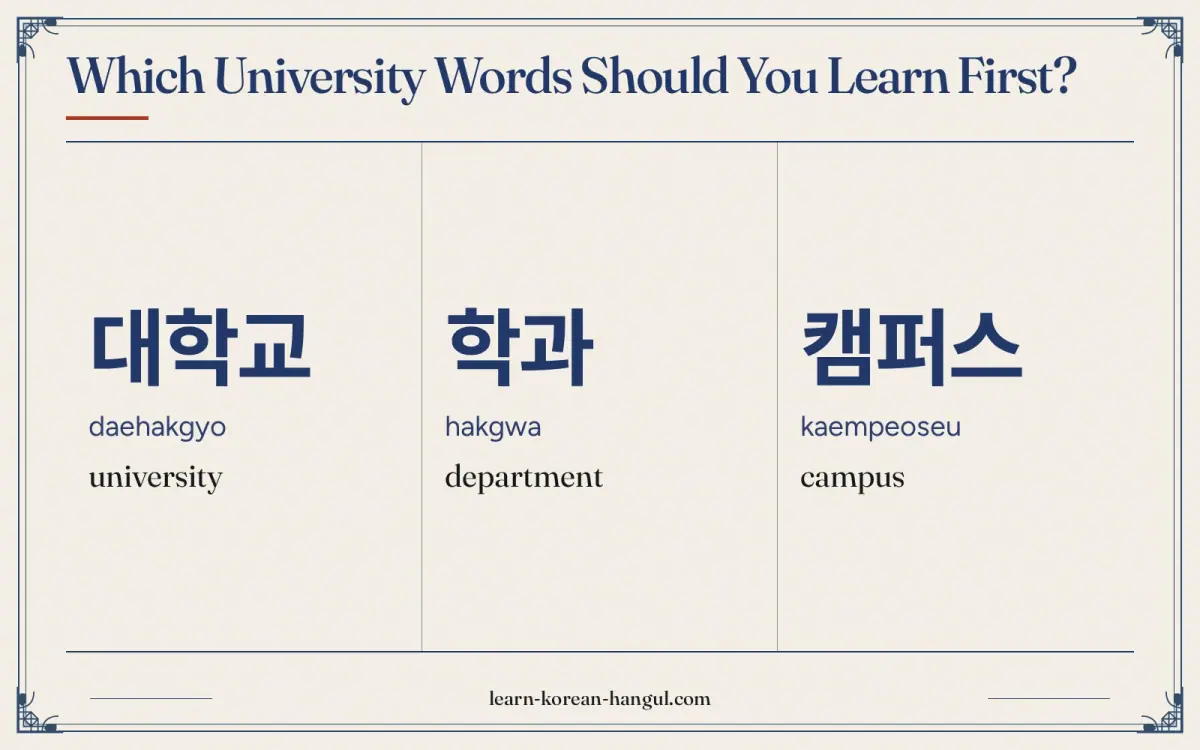
Learn 대학교 (university), 전공 (major), 학과 (department), 강의 (lecture) and 장학금 (scholarship) first. They let you say where you study, what you study and how you pay. 전공이 뭐예요? (What is your major?) is the question every new classmate will ask you.
- Words to say. 대학교, 전공, 학과, 강의, 동아리, 기숙사. They fill small talk on campus.
- Words to recognise. 학부, 학위, 수강 신청, 학점, 입학 허가. You read them on websites and forms.
- Words for money. 등록금, 장학금, 학비, 생활비. They matter when you plan to study in Korea.
The scene below shows a campus with ten numbered places and ideas from the list, so that you can tie each word to a picture.
Word · 10
- 1
대학교
daehakgyo
university
- 2
학과
hakgwa
department
- 3
캠퍼스
kaempeoseu
campus
- 4
강의
gangui
lecture; course
- 5
교수님
gyosunim
professor
- 6
동아리
dongari
club; student circle
- 7
기숙사
gisuksa
dormitory
- 8
장학금
janghakgeum
scholarship
- 9
유학
yuhak
study abroad
- 10
비자
bija
visa
University and Degrees
Higher education in Korea is described in levels, and each level has a Sino-Korean name. A 대학교 is a university, and a 대학원 is the graduate school above it. The degrees you earn are named with 사 (scholar) and 위 (rank), so a 학사 is a bachelor's degree, a 석사 is a master's and a 박사 is a doctorate.
| No. | Hangul | Revised Romanization | Meaning and note | Example sentence | Audio assetId |
|---|---|---|---|---|---|
| 1 | 대학교 | daehakgyo | university. Said [대학꾜]. Often shortened to 대학. | 대학교가 서울에 있어요. (The university is in Seoul.) | au-pg-vocabulary-school-work-school-university-1; example: au-pg-vocabulary-school-work-school-university-41 |
| 2 | 대학원 | daehagwon | graduate school. Said [대하권]. 원 is an institute. | 대학원에 가고 싶어요. (I want to go to graduate school.) | au-pg-vocabulary-school-work-school-university-2; example: au-pg-vocabulary-school-work-school-university-42 |
| 3 | 학부 | hakbu | undergraduate level. Said [학뿌]. The level below 대학원. | 학부에서 경제학을 공부해요. (I study economics as an undergraduate.) | au-pg-vocabulary-school-work-school-university-3; example: au-pg-vocabulary-school-work-school-university-43 |
| 4 | 학과 | hakgwa | department. Said [학꽈]. Your home department in a faculty. | 어느 학과예요? (Which department are you in?) | au-pg-vocabulary-school-work-school-university-4; example: au-pg-vocabulary-school-work-school-university-44 |
| 5 | 학위 | hagwi | academic degree. Said [하귀]. 위 means rank. | 학위를 받았어요. (I received a degree.) | au-pg-vocabulary-school-work-school-university-5; example: au-pg-vocabulary-school-work-school-university-45 |
| 6 | 학사 | haksa | bachelor's degree. Said [학싸]. 사 means scholar. | 학사 학위가 있어요. (I have a bachelor's degree.) | au-pg-vocabulary-school-work-school-university-6; example: au-pg-vocabulary-school-work-school-university-46 |
| 7 | 석사 | seoksa | master's degree. Said [석싸]. | 석사 과정이에요. (I am in a master's programme.) | au-pg-vocabulary-school-work-school-university-7; example: au-pg-vocabulary-school-work-school-university-47 |
| 8 | 박사 | baksa | doctorate; PhD. Said [박싸]. Also a title for a doctor of study. | 박사 과정을 마쳤어요. (I finished the doctoral programme.) | au-pg-vocabulary-school-work-school-university-8; example: au-pg-vocabulary-school-work-school-university-48 |
Example Sentences
Questions about study use 어느 (which) or 뭐 (what): 어느 학과예요? and 전공이 뭐예요? Say each sentence aloud after the audio, and notice that both end with 예요, the copula after a word that ends in a vowel.
학부 and 대학원 are two levels of the same university. A student at the first level is a 대학생 (university student), and one at the second is a 대학원생 (graduate student). 학과 means a department, and it is the word that comes before the major in speech: 경영학과 is the business department. 박사 also works as a title in front of a name, in the same way that Doctor does in English.
How Do You Say Majors in Korean?
Most Korean majors are named with the ending 학, which means study of, and sometimes 과, which means department. So 경영학 is business administration and 경영학과 is the department of business administration. This group gives you ten common majors, and the same ending lets you read many more.
| No. | Hangul | Revised Romanization | Meaning and note | Example sentence | Audio assetId |
|---|---|---|---|---|---|
| 9 | 전공 | jeongong | major; field of study. The subject you specialise in. | 전공이 뭐예요? (What is your major?) | au-pg-vocabulary-school-work-school-university-9; example: au-pg-vocabulary-school-work-school-university-49 |
| 10 | 복수 전공 | boksu jeongong | double major. Said [복쑤 전공]. 복수 means plural. | 복수 전공을 해요. (I do a double major.) | au-pg-vocabulary-school-work-school-university-10; example: au-pg-vocabulary-school-work-school-university-50 |
| 11 | 경영학 | gyeongyeonghak | business administration. 학 means study of. | 경영학을 전공해요. (I major in business administration.) | au-pg-vocabulary-school-work-school-university-11; example: au-pg-vocabulary-school-work-school-university-51 |
| 12 | 경제학 | gyeongjehak | economics. 경제 is the economy. | 경제학이 재미있어요. (Economics is interesting.) | au-pg-vocabulary-school-work-school-university-12; example: au-pg-vocabulary-school-work-school-university-52 |
| 13 | 법학 | beophak | law (as a field). Said [버팍]. 법 is law. | 법학을 공부해요. (I study law.) | au-pg-vocabulary-school-work-school-university-13; example: au-pg-vocabulary-school-work-school-university-53 |
| 14 | 공학 | gonghak | engineering. The broad field of engineering. | 공학이 어려워요. (Engineering is hard.) | au-pg-vocabulary-school-work-school-university-14; example: au-pg-vocabulary-school-work-school-university-54 |
| 15 | 의학 | uihak | medicine (as a field). 의 here means medicine. | 의학을 배워요. (I learn medicine.) | au-pg-vocabulary-school-work-school-university-15; example: au-pg-vocabulary-school-work-school-university-55 |
| 16 | 문학 | munhak | literature. The study of written works. | 한국 문학을 읽어요. (I read Korean literature.) | au-pg-vocabulary-school-work-school-university-16; example: au-pg-vocabulary-school-work-school-university-56 |
| 17 | 심리학 | simnihak | psychology. Said [심니학]. 심리 is the mind. | 심리학에 관심이 있어요. (I am interested in psychology.) | au-pg-vocabulary-school-work-school-university-17; example: au-pg-vocabulary-school-work-school-university-57 |
| 18 | 컴퓨터공학 | keompyuteogonghak | computer engineering. 컴퓨터 plus 공학. | 컴퓨터공학과에 다녀요. (I attend the computer engineering department.) | au-pg-vocabulary-school-work-school-university-18; example: au-pg-vocabulary-school-work-school-university-58 |
The ending 학 is the key to this group. Add 학 to a subject word and you get the field: 경제 (economy) becomes 경제학 (economics), and 문 (writing) becomes 문학 (literature). Add 과 to the field and you get the department: 경제학과 is the economics department. The particle 을/를 follows the field you study, as in 경영학을 전공해요, and 에 follows the department you attend, as in 컴퓨터공학과에 다녀요. 복수 전공 is a double major, and the single word is 전공. Some names are longer: the English department is often 영어영문학과 (yeongeoyeongmunhakgwa), English language and literature, built from 영어 (English) and 영문학 (English literature).
Campus Life
University life in Korea is built around lectures, clubs and the dormitory. The words in this group describe a normal day on campus. They also show up in dramas and on university websites.
| No. | Hangul | Revised Romanization | Meaning and note | Example sentence | Audio assetId |
|---|---|---|---|---|---|
| 19 | 캠퍼스 | kaempeoseu | campus. Loanword from English. | 캠퍼스가 넓어요. (The campus is wide.) | au-pg-vocabulary-school-work-school-university-19; example: au-pg-vocabulary-school-work-school-university-59 |
| 20 | 강의 | gangui | lecture; course. The standard allows [강의] and [강이]. | 강의를 들어요. (I attend a lecture.) | au-pg-vocabulary-school-work-school-university-20; example: au-pg-vocabulary-school-work-school-university-60 |
| 21 | 교수님 | gyosunim | professor. 님 is respectful; do not drop it. | 교수님이 설명해요. (The professor explains.) | au-pg-vocabulary-school-work-school-university-21; example: au-pg-vocabulary-school-work-school-university-61 |
| 22 | 동아리 | dongari | club; student circle. A native word for a group with a shared hobby. | 동아리에 들어가요. (I join a club.) | au-pg-vocabulary-school-work-school-university-22; example: au-pg-vocabulary-school-work-school-university-62 |
| 23 | 기숙사 | gisuksa | dormitory. Said [기숙싸]. | 기숙사에서 살아요. (I live in the dormitory.) | au-pg-vocabulary-school-work-school-university-23; example: au-pg-vocabulary-school-work-school-university-63 |
| 24 | 학점 | hakjeom | credit; grade point. Said [학쩜]. Both the credits you earn and the grade. | 학점이 좋아요. (My grades are good.) | au-pg-vocabulary-school-work-school-university-24; example: au-pg-vocabulary-school-work-school-university-64 |
| 25 | 과제 | gwaje | assignment. Work you hand in for a course. | 과제가 많아요. (There are many assignments.) | au-pg-vocabulary-school-work-school-university-25; example: au-pg-vocabulary-school-work-school-university-65 |
| 26 | 수강 신청 | sugang sincheong | course registration. 수강 is taking a course; 신청 is applying. | 수강 신청을 해요. (I register for courses.) | au-pg-vocabulary-school-work-school-university-26; example: au-pg-vocabulary-school-work-school-university-66 |
강의 is the word for a lecture in a university, while 수업 is the general word for a lesson at any school. A professor gives a 강의, and a school teacher gives a 수업. 학점 has two meanings: the credits you collect and the grade you get. The context tells you which is meant, as in 학점이 좋아요 (my grades are good) and 학점이 부족해요 (I do not have enough credits). The verb 들어가다 means to go in, and it is the verb for joining a club. Students also talk about 학식 (haksik, said [학씩]), the cheap meals in the campus cafeteria.
Money and Scholarships
Money matters when you plan to study. The words below name the cost of university, the help you can get with it, and the part-time work that many students do. If you plan to study in Korea, expect to meet most of them on a university website.
| No. | Hangul | Revised Romanization | Meaning and note | Example sentence | Audio assetId |
|---|---|---|---|---|---|
| 27 | 등록금 | deungnokgeum | tuition fee. Said [등녹끔]. The fee paid each term. | 등록금이 비싸요. (The tuition is expensive.) | au-pg-vocabulary-school-work-school-university-27; example: au-pg-vocabulary-school-work-school-university-67 |
| 28 | 장학금 | janghakgeum | scholarship. Said [장학끔]. Money given for study. | 장학금을 받았어요. (I received a scholarship.) | au-pg-vocabulary-school-work-school-university-28; example: au-pg-vocabulary-school-work-school-university-68 |
| 29 | 장학생 | janghaksaeng | scholarship student. Said [장학쌩]. | 저는 장학생이에요. (I am a scholarship student.) | au-pg-vocabulary-school-work-school-university-29; example: au-pg-vocabulary-school-work-school-university-69 |
| 30 | 학비 | hakbi | school fees; study costs. Said [학삐]. A wider word than 등록금. | 학비를 내요. (I pay the school fees.) | au-pg-vocabulary-school-work-school-university-30; example: au-pg-vocabulary-school-work-school-university-70 |
| 31 | 학자금 대출 | hakjageum daechul | student loan. 학자금 is [학짜금], money for study. 대출 is a loan. | 학자금 대출을 신청해요. (I apply for a student loan.) | au-pg-vocabulary-school-work-school-university-31; example: au-pg-vocabulary-school-work-school-university-71 |
| 32 | 생활비 | saenghwalbi | living costs. Money for daily life. | 생활비가 많이 들어요. (Living costs a lot.) | au-pg-vocabulary-school-work-school-university-32; example: au-pg-vocabulary-school-work-school-university-72 |
| 33 | 아르바이트 | areubaiteu | part-time job. Often shortened to 알바 (alba). | 아르바이트를 해요. (I have a part-time job.) | au-pg-vocabulary-school-work-school-university-33; example: au-pg-vocabulary-school-work-school-university-73 |
The three money words 등록금, 학비 and 장학금 are easy to mix up. 등록금 is the tuition paid to the university each term, 학비 is the wider cost of study, and 장학금 is money that you receive and do not pay back. The ending 금 means money, as in 장학금, 등록금 and 현금 (cash). The verb 들다 here means to cost, so 생활비가 많이 들어요 is living costs a lot. 아르바이트 comes from the German word Arbeit, and in speech it shortens to 알바.
Study Abroad
Many learners read this page because they plan to study in Korea or send a student there. The last group names the people, the paperwork and the programmes of study abroad. It ends with the Test of Proficiency in Korean, whose short name, TOPIK, you will see in almost every application.
| No. | Hangul | Revised Romanization | Meaning and note | Example sentence | Audio assetId |
|---|---|---|---|---|---|
| 34 | 유학 | yuhak | study abroad. 학 is study. | 미국으로 유학을 가요. (I go abroad to study in the US.) | au-pg-vocabulary-school-work-school-university-34; example: au-pg-vocabulary-school-work-school-university-74 |
| 35 | 유학생 | yuhaksaeng | international student. Said [유학쌩]. | 한국에는 유학생이 많아요. (There are many international students in Korea.) | au-pg-vocabulary-school-work-school-university-35; example: au-pg-vocabulary-school-work-school-university-75 |
| 36 | 교환 학생 | gyohwan haksaeng | exchange student. Said [교환 학쌩]. | 교환 학생으로 가요. (I go as an exchange student.) | au-pg-vocabulary-school-work-school-university-36; example: au-pg-vocabulary-school-work-school-university-76 |
| 37 | 어학연수 | eohangnyeonsu | language training abroad. Said [어항년수]. 어학 is language study. | 어학연수를 가요. (I go for language training.) | au-pg-vocabulary-school-work-school-university-37; example: au-pg-vocabulary-school-work-school-university-77 |
| 38 | 비자 | bija | visa. Loanword from English. | 비자를 신청해요. (I apply for a visa.) | au-pg-vocabulary-school-work-school-university-38; example: au-pg-vocabulary-school-work-school-university-78 |
| 39 | 입학 허가 | iphak heoga | admission approval. Said [이팍 허가]. The university's yes. | 입학 허가를 받았어요. (I received my admission approval.) | au-pg-vocabulary-school-work-school-university-39; example: au-pg-vocabulary-school-work-school-university-79 |
| 40 | 한국어능력시험 | hangugeoneungnyeoksiheom | Test of Proficiency in Korean (TOPIK). Said [한구거능녁씨험]. Often called TOPIK. | 한국어능력시험을 준비해요. (I prepare for TOPIK.) | au-pg-vocabulary-school-work-school-university-40; example: au-pg-vocabulary-school-work-school-university-80 |
유학 and 유학생 share 학 with the words in the earlier groups. A student who goes abroad is a 유학생, and one on a short exchange is a 교환 학생. Many universities also run an 어학당 (eohakdang, said [어학땅]), a Korean language institute where international students often study before or alongside a degree. The long name 한국어능력시험 is broken into 한국어 (the Korean language), 능력 (ability) and 시험 (test), and it is easy to read once you see the pieces. For dates, fees and rules of the test, the official source is topik.go.kr.
What Do You Need to Study at a Korean University?
Each university sets its own rules, and they can change from year to year, so the university's own website is the source to trust. Most applications use the same set of words from this page. You apply for a 학과, you may need proof of Korean ability such as the 한국어능력시험 (TOPIK), you wait for an 입학 허가, and then you apply for a 비자. The money words, 등록금, 장학금 and 생활비, are the ones to check early. For the test itself, read the TOPIK exam guide and check topik.go.kr for the current dates and rules.
A short sentence you might write in an application is 저는 한국어를 공부하고 있습니다 (I am studying Korean). It uses the formal polite -ㅂ니다/-습니다 style, which is the right style for a letter to a university.
How Do You Pronounce University Words?
University words are almost all Sino-Korean, and they share a small set of sound changes. The standard pronunciation rules of the National Institute of Korean Language (국립국어원) describe each one. The Revised Romanization of Korean shows ㄴ-insertion, as in eohangnyeonsu, but it does not show tensing caused by a neighbouring sound, so rely on the Hangul and the audio.
| Spelling | Sounds like | What changes |
|---|---|---|
| 대학원 | [대하권] | The final ㄱ of 학 moves onto the empty ㅇ of 원. |
| 학과 | [학꽈] | After the final ㄱ, the ㄱ of 과 is said tense. |
| 학사 | [학싸] | After the final ㄱ, the ㅅ of 사 is said tense. |
| 기숙사 | [기숙싸] | After the final ㄱ of 숙, the ㅅ of 사 is said tense. |
| 장학금 | [장학끔] | After the final ㄱ of 학, the ㄱ of 금 is said tense. |
| 어학연수 | [어항년수] | A ㄴ is added before 연, and the ㄱ of 학 becomes ㅇ before it. |
| 법학 | [버팍] | The final ㅂ moves forward and joins ㅎ into a strong ㅍ sound. |
Three habits cover most of the list. After a final ㄱ, the next consonant is said tense, as in 학과, 학사, 기숙사 and 장학금. A final consonant moves forward before ㅇ, as in 대학원. And before ㅇ-initial words such as 연, a ㄴ sound is added, so 어학연수 sounds like eo-hang-nyeon-su. Learn the spoken form with the spelling, and do not pause between syllables.
Audio and Slow Playback
Each word and sentence has its own clip. Five clips replay the hardest words slowly: graduate school, scholarship, dormitory, language training abroad and the Korean test. Play one, repeat it aloud, then play it again and compare.
What Mistakes Do Learners Make with University Words?
Five confusions come up again and again.
- Calling a graduate student 대학생. A 대학생 is a university student at the first level. A student in a master's or doctoral programme is a 대학원생. Use the second when someone says they study at a 대학원.
- Mixing 전공 and 학과. 전공 is the subject you specialise in, and 학과 is the department that teaches it. Say 전공이 뭐예요? (What is your major?) and 어느 학과예요? (Which department are you in?).
- Mixing 등록금, 학비 and 장학금. 등록금 is the tuition fee, 학비 is the wider cost of study, and 장학금 is a scholarship that you do not repay. 장학금 can cover 등록금, but they are not the same word.
- Using 수업 for a university lecture. 수업 is a lesson at any level. At university, a lecture is a 강의, and signing up for courses is 수강 신청. Both appear on a university timetable.
- Using 아르바이트 for a full-time job. 아르바이트 is a part-time or short job, often done by students. A regular full-time position is a 정규직 (jeonggyujik), and the place you work is your 직장 (workplace). People shorten 아르바이트 to 알바 in speech.
In each case a neighbouring word does a nearby job. Keep the pairs together, such as 대학생 and 대학원생, 전공 and 학과, and 강의 and 수업, and the rest of the 40 words stay in place.
Practice: Flashcards and Worksheet
Study in three steps. First, run the deck in recognition mode until the 40 words come quickly. Second, switch to listening mode and play the clip before you flip each card. Third, take the five-question quiz. Progress stays in your browser, and the vocabulary flashcard decks page lists the other decks.
Practice · 40
- 01대학교
Show answer
daehakgyo
university
- 02대학원
Show answer
daehagwon
graduate school
- 03학부
Show answer
hakbu
undergraduate level
- 04학과
Show answer
hakgwa
department
- 05학위
Show answer
hagwi
academic degree
- 06학사
Show answer
haksa
bachelor's degree
- 07석사
Show answer
seoksa
master's degree
- 08박사
Show answer
baksa
doctorate; PhD
- 09전공
Show answer
jeongong
major; field of study
- 10복수 전공
Show answer
boksu jeongong
double major
- 11경영학
Show answer
gyeongyeonghak
business administration
- 12경제학
Show answer
gyeongjehak
economics
- 13법학
Show answer
beophak
law (as a field)
- 14공학
Show answer
gonghak
engineering
- 15의학
Show answer
uihak
medicine (as a field)
- 16문학
Show answer
munhak
literature
- 17심리학
Show answer
simnihak
psychology
- 18컴퓨터공학
Show answer
keompyuteogonghak
computer engineering
- 19캠퍼스
Show answer
kaempeoseu
campus
- 20강의
Show answer
gangui
lecture; course
- 21교수님
Show answer
gyosunim
professor
- 22동아리
Show answer
dongari
club; student circle
- 23기숙사
Show answer
gisuksa
dormitory
- 24학점
Show answer
hakjeom
credit; grade point
- 25과제
Show answer
gwaje
assignment
- 26수강 신청
Show answer
sugang sincheong
course registration
- 27등록금
Show answer
deungnokgeum
tuition fee
- 28장학금
Show answer
janghakgeum
scholarship
- 29장학생
Show answer
janghaksaeng
scholarship student
- 30학비
Show answer
hakbi
school fees; study costs
- 31학자금 대출
Show answer
hakjageum daechul
student loan
- 32생활비
Show answer
saenghwalbi
living costs
- 33아르바이트
Show answer
areubaiteu
part-time job
- 34유학
Show answer
yuhak
study abroad
- 35유학생
Show answer
yuhaksaeng
international student
- 36교환 학생
Show answer
gyohwan haksaeng
exchange student
- 37어학연수
Show answer
eohangnyeonsu
language training abroad
- 38비자
Show answer
bija
visa
- 39입학 허가
Show answer
iphak heoga
admission approval
- 40한국어능력시험
Show answer
hangugeoneungnyeoksiheom
Test of Proficiency in Korean (TOPIK)
Practice · 5
What does 대학원 (daehagwon) mean?
Show answer
graduate school
대학원 means graduate school. Example: 대학원에 가고 싶어요. (I want to go to graduate school.)
What does 경영학 (gyeongyeonghak) mean?
Show answer
business administration
경영학 means business administration. Example: 경영학을 전공해요. (I major in business administration.)
What does 학점 (hakjeom) mean?
Show answer
credit; grade point
학점 means credit; grade point. Example: 학점이 좋아요. (My grades are good.)
What does 장학금 (janghakgeum) mean?
Show answer
scholarship
장학금 means scholarship. Example: 장학금을 받았어요. (I received a scholarship.)
What does 어학연수 (eohangnyeonsu) mean?
Show answer
language training abroad
어학연수 means language training abroad. Example: 어학연수를 가요. (I go for language training.)
Korean University Majors Vocabulary Worksheet (PDF)
A printable worksheet for these words (word list, matching, writing practice, fill-in-the-blank exercises and answer key) is available in A4 and US Letter from the download card on this page. For additional practice, write three lines about your own studies, using 전공, 학과 and 강의.
Where to Go Next
After this page, continue with Korean Exams and Grades Vocabulary for the tests that lead here, or read the TOPIK exam guide if you plan to study in Korea. To move up a level, return to School.
Frequently Asked Questions
How Do You Say University in Korean?
University is 대학교 (daehakgyo), said [대학꾜]. In everyday talk it is often shortened to 대학. The school above it is a 대학원 (graduate school). The single-word page on university in Korean gives more detail.
How Do You Say Major in Korean?
Major is 전공 (jeongong). Ask 전공이 뭐예요? to find out what someone studies. Many majors end in 학, which means study of, as in 경영학 (business administration) and 심리학 (psychology). The department is the same word with 과, as in 경영학과.
How Many University Words Should I Learn First?
Start with five: 대학교, 전공, 학과, 강의 and 장학금. They let you say where you study, what you study and how you pay. The whole list of 40 takes about eight days at five new words a day, with a short review of earlier words each day.
Do I Need TOPIK to Study at a Korean University?
Many universities ask for proof of Korean ability, and TOPIK is the usual test, but each university sets its own rules, and they can change. Check the university's own admission page and topik.go.kr for the current rules. The word to look for is 한국어능력시험.
Where Can I Practise University Words with Flashcards?
Use the deck on this page, which holds all 40 words with Hangul, romanization and audio, in recognition and listening modes. The vocabulary flashcard decks page lists the decks for other topics. Progress is saved only in your browser.
Is the Romanization on This Page Official?
It follows the Revised Romanization of Korean, which South Korea adopted in 2000 and whose rules the National Institute of Korean Language (국립국어원) publishes. It is a learning aid, and it does not show tensing caused by a neighbouring sound, so rely on the Hangul and the audio.