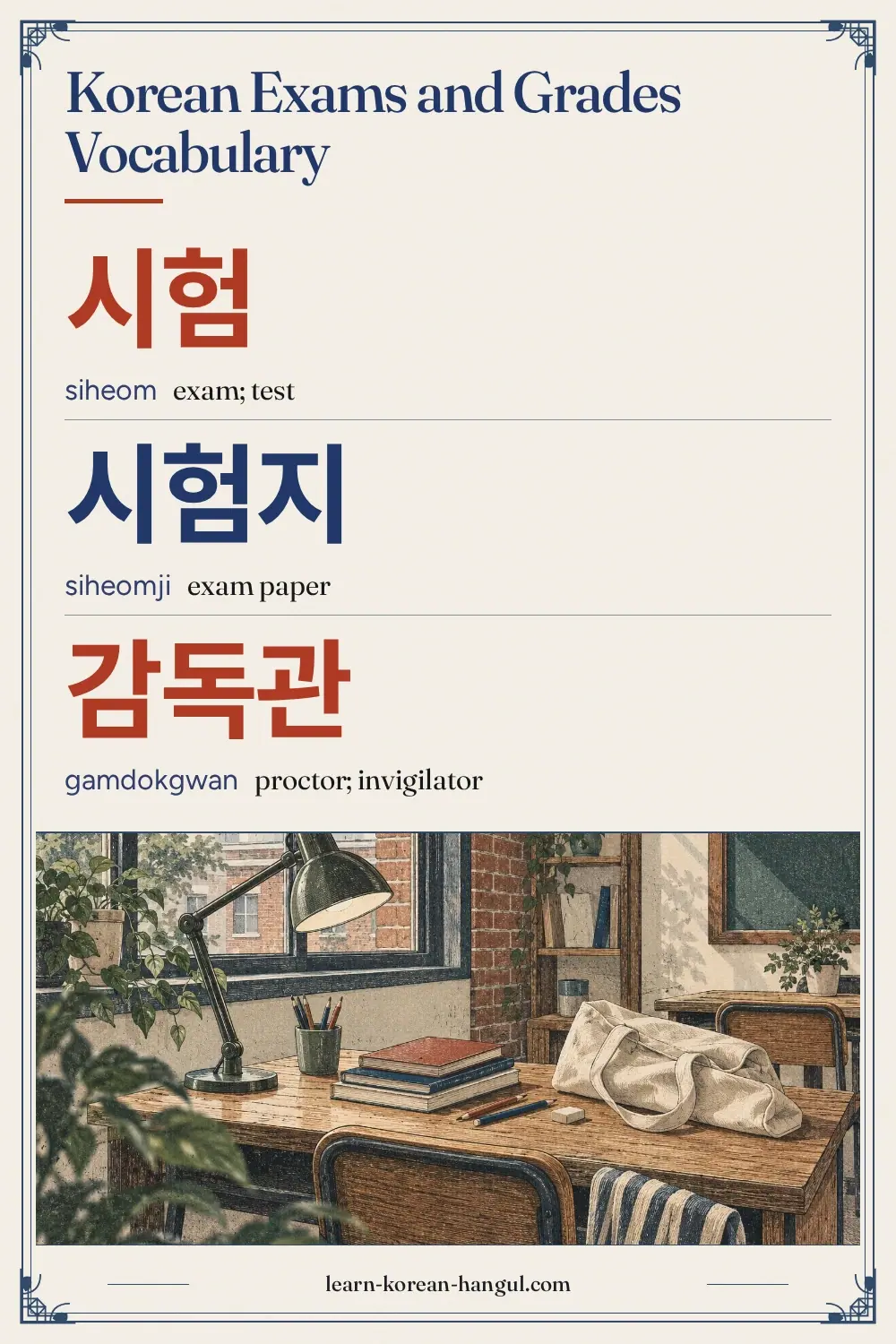
Korean Exams and Grades Vocabulary at a Glance
The list has 35 words in five groups of seven, and the groups follow the life of an exam. First you learn what kinds of exam there are, then how scores and grades are named, what happens when you pass or fail, how students prepare, and what happens on the day. It belongs to School. The basic exam words, such as 문제 (question) and 정답 (correct answer), are on Korean Classroom Vocabulary, and this page goes further. Many of the words are Sino-Korean, and a few pieces return often: 시험 (exam), 점 (point) and 격 (standard).
| Group | Words | Use |
|---|---|---|
| Kinds of exam | 7 | Midterms, finals, quizzes and the national entrance exam |
| Scores and grades | 7 | Points, averages, rank and level |
| Passing and failing | 7 | Pass, fail, retake and cutoff |
| Preparing and studying | 7 | Review, memorising, cramming and candidates |
| Exam day and results | 7 | The hall, the proctor, question types and the report card |
Exams are a large part of school life in Korea, and the words appear in dramas, news and everyday talk. Many middle and high schools hold a 중간고사 and a 기말고사 in each of the two semesters, but each school sets its own dates. The example sentences in the tables use the everyday polite -요 style so that you can read them easily.
Which Exams and Grades Words Should You Learn First?
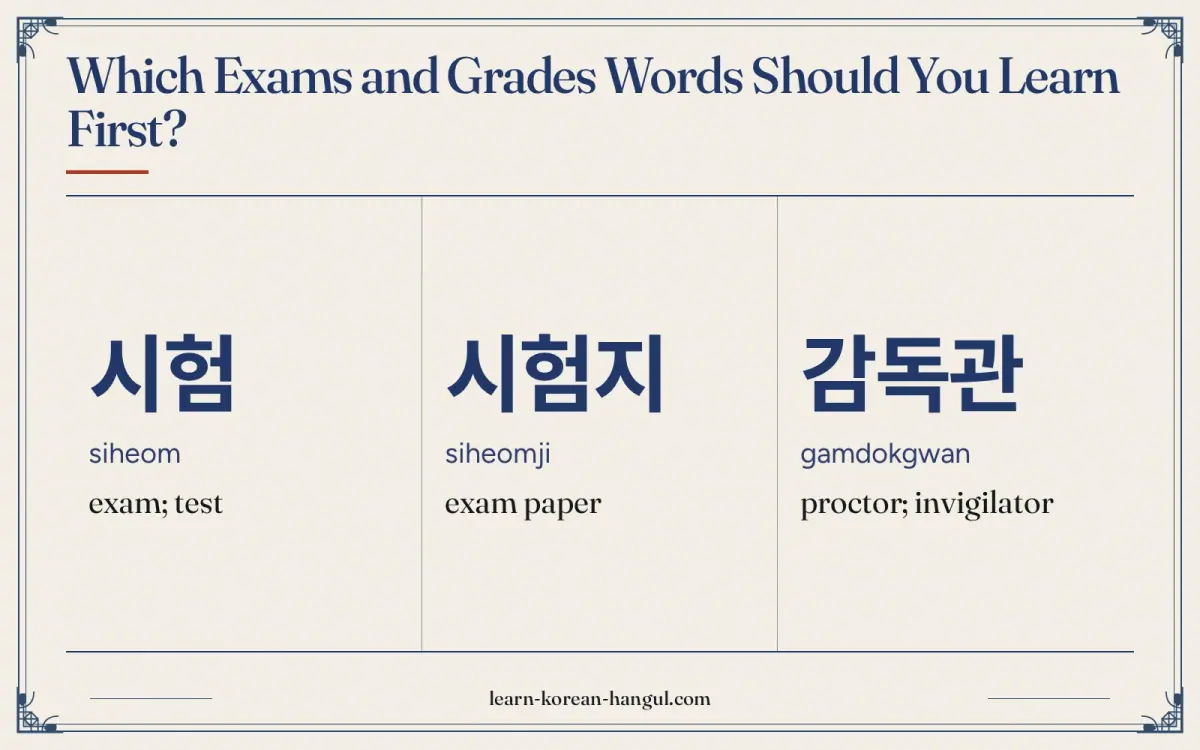
Learn 시험 (exam), 점수 (score), 합격 (pass), 복습 (review) and 성적표 (report card) first. They let you say that you have an exam, ask about a score and say that you passed. 내일 시험이 있어요 (I have an exam tomorrow) is the most useful sentence on this page for a new learner.
- Words to say. 시험, 점수, 합격, 복습, 공부. They fill everyday talk about study.
- Words to recognise. 중간고사, 기말고사, 수능, 성적표. You see them on notices and in the news.
- Words for results. 만점, 등수, 등급, 불합격. They describe how an exam went.
The scene below shows an exam hall with ten numbered objects and ideas from the list, so that you can tie each word to a picture.
Word · 10
- 1
시험
siheom
exam; test
- 2
시험지
siheomji
exam paper
- 3
감독관
gamdokgwan
proctor; invigilator
- 4
점수
jeomsu
score; points
- 5
만점
manjeom
perfect score
- 6
성적표
seongjeokpyo
report card
- 7
합격자
hapgyeokja
successful candidate
- 8
복습
bokseup
review
- 9
수험표
suheompyo
exam admission ticket
- 10
시험장
siheomjang
exam hall; test site
Kinds of Exam
Korean has a name for each exam in the school year. The 시험 is the general word, and the 고사 in 중간고사 and 기말고사 also means exam, but it is used for the big school tests. A short test in class has a lighter name. The last two words in this group belong to the university path.
| No. | Hangul | Revised Romanization | Meaning and note | Example sentence | Audio assetId |
|---|---|---|---|---|---|
| 1 | 시험 | siheom | exam; test. You take it with 보다. | 시험을 봐요. (I take an exam.) | au-pg-vocabulary-school-work-school-exams-grades-1; example: au-pg-vocabulary-school-work-school-exams-grades-36 |
| 2 | 중간고사 | junggangosa | midterm exam. 중간 is the middle; 고사 is an exam. | 다음 주에 중간고사가 있어요. (There are midterms next week.) | au-pg-vocabulary-school-work-school-exams-grades-2; example: au-pg-vocabulary-school-work-school-exams-grades-37 |
| 3 | 기말고사 | gimalgosa | final exam. 기말 is the end of a term. | 기말고사가 끝났어요. (The final exams are over.) | au-pg-vocabulary-school-work-school-exams-grades-3; example: au-pg-vocabulary-school-work-school-exams-grades-38 |
| 4 | 쪽지 시험 | jjokji siheom | pop quiz. Said [쪽찌 시험]. 쪽지 is a small slip of paper. | 쪽지 시험을 봤어요. (I took a pop quiz.) | au-pg-vocabulary-school-work-school-exams-grades-4; example: au-pg-vocabulary-school-work-school-exams-grades-39 |
| 5 | 모의고사 | mouigosa | mock exam. 모의 means a practice version. | 모의고사를 풀어요. (I do a mock exam.) | au-pg-vocabulary-school-work-school-exams-grades-5; example: au-pg-vocabulary-school-work-school-exams-grades-40 |
| 6 | 수능 | suneung | college entrance exam. Short for 대학수학능력시험 (daehaksuhangneungnyeoksiheom). | 수능을 준비해요. (I prepare for the college entrance exam.) | au-pg-vocabulary-school-work-school-exams-grades-6; example: au-pg-vocabulary-school-work-school-exams-grades-41 |
| 7 | 입학시험 | iphaksiheom | entrance exam. Said [이팍씨험]. An exam for getting into a school. | 입학시험에 합격했어요. (I passed the entrance exam.) | au-pg-vocabulary-school-work-school-exams-grades-7; example: au-pg-vocabulary-school-work-school-exams-grades-42 |
Example Sentences
The verb for taking an exam is 보다, as in 시험을 봐요, and the verb for solving practice questions is 풀다, as in 모의고사를 풀어요. The particle 에 follows an exam you pass, as in 입학시험에 합격했어요. Say each sentence aloud after the audio.
수능 is the best-known exam word in Korea. It is a national exam that students take to enter university, usually held in November, and it is often called by its short name. The exact date and rules are announced each year by the organisers, so check the official announcement for the current year. 쪽지 시험 literally means a note-slip exam, which hints at how short it is. 고사 (考査) is a formal word, and learners meet it mostly in 중간고사 and 기말고사.
Scores and Grades
A score is a number, and a grade is a place on a scale. Korean separates the two clearly. You get a 점수 on a test, you can work out a 평균 for the term, and you hold a 등수 or 등급 in your class. Learn the counters 점 (points) and 등 (place) with the numbers, and the group comes together.
| No. | Hangul | Revised Romanization | Meaning and note | Example sentence | Audio assetId |
|---|---|---|---|---|---|
| 8 | 점수 | jeomsu | score; points. Said [점쑤]. The number you get on a test. | 점수가 높아요. (The score is high.) | au-pg-vocabulary-school-work-school-exams-grades-8; example: au-pg-vocabulary-school-work-school-exams-grades-43 |
| 9 | 평균 | pyeonggyun | average. Used for scores, speeds and prices. | 평균이 팔십 점이에요. (The average is eighty points.) | au-pg-vocabulary-school-work-school-exams-grades-9; example: au-pg-vocabulary-school-work-school-exams-grades-44 |
| 10 | 만점 | manjeom | perfect score. Said [만쩜]. 만 means full. | 만점을 받았어요. (I got a perfect score.) | au-pg-vocabulary-school-work-school-exams-grades-10; example: au-pg-vocabulary-school-work-school-exams-grades-45 |
| 11 | 백 점 | baek jeom | 100 points. Sino-Korean number plus the counter 점. | 이번에는 백 점이에요. (This time it is 100 points.) | au-pg-vocabulary-school-work-school-exams-grades-11; example: au-pg-vocabulary-school-work-school-exams-grades-46 |
| 12 | 총점 | chongjeom | total score. Said [총쩜]. 총 means total. | 총점을 계산해요. (I calculate the total score.) | au-pg-vocabulary-school-work-school-exams-grades-12; example: au-pg-vocabulary-school-work-school-exams-grades-47 |
| 13 | 등수 | deungsu | rank; place. Said [등쑤]. Your position among many. | 반에서 등수가 올랐어요. (My rank in class went up.) | au-pg-vocabulary-school-work-school-exams-grades-13; example: au-pg-vocabulary-school-work-school-exams-grades-48 |
| 14 | 등급 | deunggeup | grade; level. A level on a scale. | 등급을 확인해요. (I check my grade level.) | au-pg-vocabulary-school-work-school-exams-grades-14; example: au-pg-vocabulary-school-work-school-exams-grades-49 |
점 is a counter, so it follows a Sino-Korean number: 구십 점 is 90 points, and 백 점 is 100. 등 is a counter for place: 일 등 is first place and 이 등 is second place. The word 등수 asks for a place with a number, as in 몇 등이에요? (What place are you?). Do not mix 등수 with 등급. 등수 is your rank among others, and 등급 is a band or level on a scale.
Passing and Failing
Every exam ends in a result. Korean uses a pair of formal words for pass and fail, a word for failing a course, and a few words that belong to the university path. This is also where you meet 재수, a Korea-specific word with no single English match.
| No. | Hangul | Revised Romanization | Meaning and note | Example sentence | Audio assetId |
|---|---|---|---|---|---|
| 15 | 합격 | hapgyeok | pass; acceptance. Said [합껵]. Used for exams and for hiring. | 시험에 합격했어요. (I passed the exam.) | au-pg-vocabulary-school-work-school-exams-grades-15; example: au-pg-vocabulary-school-work-school-exams-grades-50 |
| 16 | 불합격 | bulhapgyeok | failure to pass. Said [불합껵]. 불 is a negative prefix. | 이번에는 불합격이에요. (This time it is a fail.) | au-pg-vocabulary-school-work-school-exams-grades-16; example: au-pg-vocabulary-school-work-school-exams-grades-51 |
| 17 | 합격자 | hapgyeokja | successful candidate. Said [합껵짜]. 자 means person. | 합격자를 발표해요. (They announce the successful candidates.) | au-pg-vocabulary-school-work-school-exams-grades-17; example: au-pg-vocabulary-school-work-school-exams-grades-52 |
| 18 | 낙제 | nakje | failing a course or year. Said [낙쩨]. Not enough to move up. | 수학에서 낙제했어요. (I failed math.) | au-pg-vocabulary-school-work-school-exams-grades-18; example: au-pg-vocabulary-school-work-school-exams-grades-53 |
| 19 | 재시험 | jaesiheom | retest; resit. 재 means again. | 재시험을 봐요. (I take a retest.) | au-pg-vocabulary-school-work-school-exams-grades-19; example: au-pg-vocabulary-school-work-school-exams-grades-54 |
| 20 | 재수 | jaesu | retaking the entrance exam. A year spent to try the university exam again. | 재수를 해요. (I am retaking the entrance exam.) | au-pg-vocabulary-school-work-school-exams-grades-20; example: au-pg-vocabulary-school-work-school-exams-grades-55 |
| 21 | 커트라인 | keoteurain | cutoff line. Loanword from English cut line. | 커트라인이 높아요. (The cutoff is high.) | au-pg-vocabulary-school-work-school-exams-grades-21; example: au-pg-vocabulary-school-work-school-exams-grades-56 |
합격 and 불합격 are opposites, made with the prefix 불. 합격자 turns the result into a person with 자. 재시험 and 재수 both start with 재, which means again, but they are not the same. A 재시험 is a resit of one test at the same school, and 재수 is a whole year spent to retake the university entrance exam. A student who does this is a 재수생.
How Do You Say Preparing for an Exam in Korean?
Korean students talk about studying in several set ways. There is steady study, review, memorising, and the famous last-minute cram. The words below name what you do before an exam and the people who do it.
| No. | Hangul | Revised Romanization | Meaning and note | Example sentence | Audio assetId |
|---|---|---|---|---|---|
| 22 | 시험 범위 | siheom beomwi | exam scope. Said [시험 버뮈]. The chapters that will be tested. | 시험 범위를 확인해요. (I check the exam scope.) | au-pg-vocabulary-school-work-school-exams-grades-22; example: au-pg-vocabulary-school-work-school-exams-grades-57 |
| 23 | 시험 공부 | siheom gongbu | studying for an exam. 공부 is study. | 시험 공부를 해요. (I study for the exam.) | au-pg-vocabulary-school-work-school-exams-grades-23; example: au-pg-vocabulary-school-work-school-exams-grades-58 |
| 24 | 복습 | bokseup | review. Said [복씁]. Going over what you learned. | 복습을 해요. (I review.) | au-pg-vocabulary-school-work-school-exams-grades-24; example: au-pg-vocabulary-school-work-school-exams-grades-59 |
| 25 | 암기 | amgi | memorisation. Learning by heart. | 단어를 암기해요. (I memorise words.) | au-pg-vocabulary-school-work-school-exams-grades-25; example: au-pg-vocabulary-school-work-school-exams-grades-60 |
| 26 | 벼락치기 | byeorakchigi | cramming. Casual. Studying at the last minute. | 벼락치기를 했어요. (I crammed.) | au-pg-vocabulary-school-work-school-exams-grades-26; example: au-pg-vocabulary-school-work-school-exams-grades-61 |
| 27 | 수험생 | suheomsaeng | exam candidate. Someone preparing for a big exam. | 수험생이 많아요. (There are many candidates.) | au-pg-vocabulary-school-work-school-exams-grades-27; example: au-pg-vocabulary-school-work-school-exams-grades-62 |
| 28 | 수험표 | suheompyo | exam admission ticket. A slip with your number and seat. | 수험표를 챙겨요. (I get my admission ticket ready.) | au-pg-vocabulary-school-work-school-exams-grades-28; example: au-pg-vocabulary-school-work-school-exams-grades-63 |
벼락치기 is a casual word and comes from 벼락, a lightning strike, because the study comes in a sudden flash. It describes the night before an exam. 복습 (review) has a partner, 예습 (preview), which means going over the next lesson in advance, so students speak of 예습과 복습 as a pair. 수험생 and 수험표 share 수험, which means taking an exam, so you can guess the second word once you know the first. Two more words belong to the Korean way of preparing: 학원 (hagwon), a private academy that many students attend after school, and 과외 (gwaoe), private tutoring. The study verbs themselves, such as 공부하다 and 외우다 (to memorise), are taught on the verb pages; this list keeps to nouns.
Exam Day and Results
The last group is the day itself and what follows. You enter a hall, a proctor watches, you answer one kind of question or the other, a teacher marks the paper, and a report card comes home. These seven words complete the exam from start to finish.
| No. | Hangul | Revised Romanization | Meaning and note | Example sentence | Audio assetId |
|---|---|---|---|---|---|
| 29 | 시험장 | siheomjang | exam hall; test site. 장 means a place. | 시험장에 일찍 가요. (I go to the exam hall early.) | au-pg-vocabulary-school-work-school-exams-grades-29; example: au-pg-vocabulary-school-work-school-exams-grades-64 |
| 30 | 감독관 | gamdokgwan | proctor; invigilator. Said [감독꽌]. 관 marks an official. | 감독관이 와요. (The proctor comes.) | au-pg-vocabulary-school-work-school-exams-grades-30; example: au-pg-vocabulary-school-work-school-exams-grades-65 |
| 31 | 시험지 | siheomji | exam paper. 지 means paper. | 시험지를 받아요. (I receive the exam paper.) | au-pg-vocabulary-school-work-school-exams-grades-31; example: au-pg-vocabulary-school-work-school-exams-grades-66 |
| 32 | 객관식 | gaekgwansik | multiple-choice. Said [객꽌식]. 식 means type. | 객관식 문제를 풀어요. (I solve multiple-choice questions.) | au-pg-vocabulary-school-work-school-exams-grades-32; example: au-pg-vocabulary-school-work-school-exams-grades-67 |
| 33 | 주관식 | jugwansik | short-answer; written-answer. The opposite of 객관식. | 주관식이 어려워요. (The written-answer part is hard.) | au-pg-vocabulary-school-work-school-exams-grades-33; example: au-pg-vocabulary-school-work-school-exams-grades-68 |
| 34 | 채점 | chaejeom | marking; grading. 점 is a point. | 선생님이 채점해요. (The teacher marks the papers.) | au-pg-vocabulary-school-work-school-exams-grades-34; example: au-pg-vocabulary-school-work-school-exams-grades-69 |
| 35 | 성적표 | seongjeokpyo | report card. Standard [성적표], though [성쩍표] is often heard. 표 is a chart. | 성적표를 받았어요. (I got my report card.) | au-pg-vocabulary-school-work-school-exams-grades-35; example: au-pg-vocabulary-school-work-school-exams-grades-70 |
객관식 and 주관식 are a pair. 객관 means looking at a thing from outside, and 주관 means looking from inside, so a 객관식 question has one fixed answer to choose and a 주관식 question asks you to write. Both end in 식, a type. 성적표 is made of 성적 (results) and 표 (chart).
What Do TOPIK and School Exams Have in Common?
The words in this list also appear when learners talk about the Test of Proficiency in Korean, TOPIK. Its notices use words such as 시험, 점수, 등급, 시험장 and 수험표, just like a school test. The test dates, fees, levels and rules are set by the organisers and can change, so check the official site, topik.go.kr, for the current details. For a guide to the test, see the TOPIK exam guide. Do not rely on a news report or a forum post for dates and rules.
A school exam and a national exam share a pattern. You collect a 수험표, you go to a 시험장, you sit a 객관식 and a 주관식 part, and later a result is announced as 합격 or 불합격. If you know the words in this order, you can follow a notice from start to finish.
How Do You Pronounce Exams and Grades Words?
Exam words are Sino-Korean, and tense sounds appear in many of them. The standard pronunciation rules of the National Institute of Korean Language (국립국어원) describe each one. The Revised Romanization of Korean does not show tensing caused by a neighbouring sound, and it keeps the h in nouns such as iphaksiheom, so rely on the Hangul and the audio.
| Spelling | Sounds like | What changes |
|---|---|---|
| 점수 | [점쑤] | The ㅅ of 수 is said tense after 점. |
| 만점 | [만쩜] | The ㅈ of 점 is said tense after the final ㄴ of 만. |
| 합격 | [합껵] | After the final ㅂ, the ㄱ is said tense. |
| 낙제 | [낙쩨] | After the final ㄱ of 낙, the ㅈ of 제 is said tense. |
| 복습 | [복씁] | After the final ㄱ of 복, the ㅅ of 습 is said tense, and the final ㅂ stays. |
| 입학시험 | [이팍씨험] | The final ㅂ of 입 and the ㅎ of 학 join into a strong ㅍ sound; the ㅅ of 시 is tense after ㄱ. |
| 객관식 | [객꽌식] | After the final ㄱ of 객, the ㄱ of 관 is said tense. |
Two habits cover most of the list. After a final ㄱ or ㅂ, the next consonant is said tense, as in 합격, 낙제, 복습 and 객관식. And in some Sino-Korean words a tense sound appears after other finals too, as in 점수 and 만점, even though the spelling shows a plain consonant. Learn the spoken form with the spelling, and do not pause between syllables.
Audio and Slow Playback
Each word and sentence has its own clip. Five clips replay the hardest words slowly: score, perfect score, a successful candidate, review and an entrance exam. Play one, repeat it aloud, then play it again and compare.
What Mistakes Do Learners Make with Exams and Grades Words?
Five confusions come up again and again.
- Saying 시험을 해요 for taking an exam. You take an exam with 보다: 시험을 봐요. 시험을 치르다 (to sit an exam) is a more formal alternative, as in 시험을 치렀어요. 시험을 해요 does not mean taking an exam.
- Mixing 점수 and 성적. 점수 is a number, as in 점수가 높아요. 성적 is your results in general, as in 성적이 좋아요. A report card is a 성적표, and a single test gives a 점수.
- Using only 통과 for passing an exam. 통과 (passing through) can be used for a test or a check, but 합격 is the usual word for passing an exam, especially an entrance or qualifying exam: 시험에 합격했어요.
- Treating 재시험 and 재수 as one word. 재시험 is a resit of a single test at your school. 재수 is spending a year to retake the national university exam. The first is small, and the second changes a whole year.
- Confusing 등수 and 등급. 등수 is your place among others, as in 반에서 삼 등. 등급 is a level on a scale. A top place is a small number, such as 일 등, while 등급 names a band on a scale.
In each case a nearby word does a different job. Keep the pairs together, such as 보다 and 하다, 점수 and 성적, and 재시험 and 재수, and the rest of the 35 words stay in place.
Practice: Flashcards and Worksheet
Study in three steps. First, run the deck in recognition mode until the 35 words come quickly. Second, switch to listening mode and play the clip before you flip each card. Third, take the five-question quiz. Progress stays in your browser, and the vocabulary flashcard decks page lists the other decks.
Practice · 35
- 01시험
Show answer
siheom
exam; test
- 02중간고사
Show answer
junggangosa
midterm exam
- 03기말고사
Show answer
gimalgosa
final exam
- 04쪽지 시험
Show answer
jjokji siheom
pop quiz
- 05모의고사
Show answer
mouigosa
mock exam
- 06수능
Show answer
suneung
college entrance exam
- 07입학시험
Show answer
iphaksiheom
entrance exam
- 08점수
Show answer
jeomsu
score; points
- 09평균
Show answer
pyeonggyun
average
- 10만점
Show answer
manjeom
perfect score
- 11백 점
Show answer
baek jeom
100 points
- 12총점
Show answer
chongjeom
total score
- 13등수
Show answer
deungsu
rank; place
- 14등급
Show answer
deunggeup
grade; level
- 15합격
Show answer
hapgyeok
pass; acceptance
- 16불합격
Show answer
bulhapgyeok
failure to pass
- 17합격자
Show answer
hapgyeokja
successful candidate
- 18낙제
Show answer
nakje
failing a course or year
- 19재시험
Show answer
jaesiheom
retest; resit
- 20재수
Show answer
jaesu
retaking the entrance exam
- 21커트라인
Show answer
keoteurain
cutoff line
- 22시험 범위
Show answer
siheom beomwi
exam scope
- 23시험 공부
Show answer
siheom gongbu
studying for an exam
- 24복습
Show answer
bokseup
review
- 25암기
Show answer
amgi
memorisation
- 26벼락치기
Show answer
byeorakchigi
cramming
- 27수험생
Show answer
suheomsaeng
exam candidate
- 28수험표
Show answer
suheompyo
exam admission ticket
- 29시험장
Show answer
siheomjang
exam hall; test site
- 30감독관
Show answer
gamdokgwan
proctor; invigilator
- 31시험지
Show answer
siheomji
exam paper
- 32객관식
Show answer
gaekgwansik
multiple-choice
- 33주관식
Show answer
jugwansik
short-answer; written-answer
- 34채점
Show answer
chaejeom
marking; grading
- 35성적표
Show answer
seongjeokpyo
report card
Practice · 5
What does 중간고사 (junggangosa) mean?
Show answer
midterm exam
중간고사 means midterm exam. Example: 다음 주에 중간고사가 있어요. (There are midterms next week.)
What does 만점 (manjeom) mean?
Show answer
perfect score
만점 means perfect score. Example: 만점을 받았어요. (I got a perfect score.)
What does 낙제 (nakje) mean?
Show answer
failing a course or year
낙제 means failing a course or year. Example: 수학에서 낙제했어요. (I failed math.)
What does 복습 (bokseup) mean?
Show answer
review
복습 means review. Example: 복습을 해요. (I review.)
What does 채점 (chaejeom) mean?
Show answer
marking; grading
채점 means marking; grading. Example: 선생님이 채점해요. (The teacher marks the papers.)
Korean Exams and Grades Vocabulary Worksheet (PDF)
A printable worksheet for these words (word list, matching, writing practice, fill-in-the-blank exercises and answer key) is available in A4 and US Letter from the download card on this page. For additional practice, write three lines about your last exam, using 시험, 점수 and 성적표.
Where to Go Next
After this page, continue with Korean University Majors Vocabulary or go back to Korean Stationery Vocabulary for the things on your desk. For the national language test, read the TOPIK exam guide. To move up a level, return to School.
Frequently Asked Questions
How Do You Say Exam in Korean?
Exam is 시험 (siheom). You take one with the verb 보다, so 시험을 봐요 means I take an exam. A midterm is 중간고사 and a final is 기말고사. The single-word page on exam in Korean gives more detail.
How Do You Pronounce 점수 (jeomsu)?
Say jeom-su in two beats, with the second consonant tense: [점쑤]. The ㅅ of 수 sounds strong, although the spelling shows a plain ㅅ. The ㅓ in 점 is a relaxed, unrounded vowel. Press the audio button on this page to hear the word and the slow clip.
How Many Exams and Grades Words Should I Learn First?
Start with five: 시험, 점수, 합격, 복습 and 성적표. They let you say that you have an exam, ask about a score and say that you passed. The whole list of 35 takes about seven days at five new words a day, with a short review of earlier words each day.
What Is 수능 in Korea?
수능 (suneung) is the short name of 대학수학능력시험, the national college entrance exam. Students take it to enter university. The date and rules are announced each year, so check the official announcement for the current year.
Where Can I Practise Exam Words with Flashcards?
Use the deck on this page, which holds all 35 words with Hangul, romanization and audio, in recognition and listening modes. The vocabulary flashcard decks page lists the decks for other topics. Progress is saved only in your browser.
Is the Romanization on This Page Official?
It follows the Revised Romanization of Korean, which South Korea adopted in 2000 and whose rules the National Institute of Korean Language (국립국어원) publishes. It is a learning aid, and it does not show tensing caused by a neighbouring sound, so rely on the Hangul and the audio.