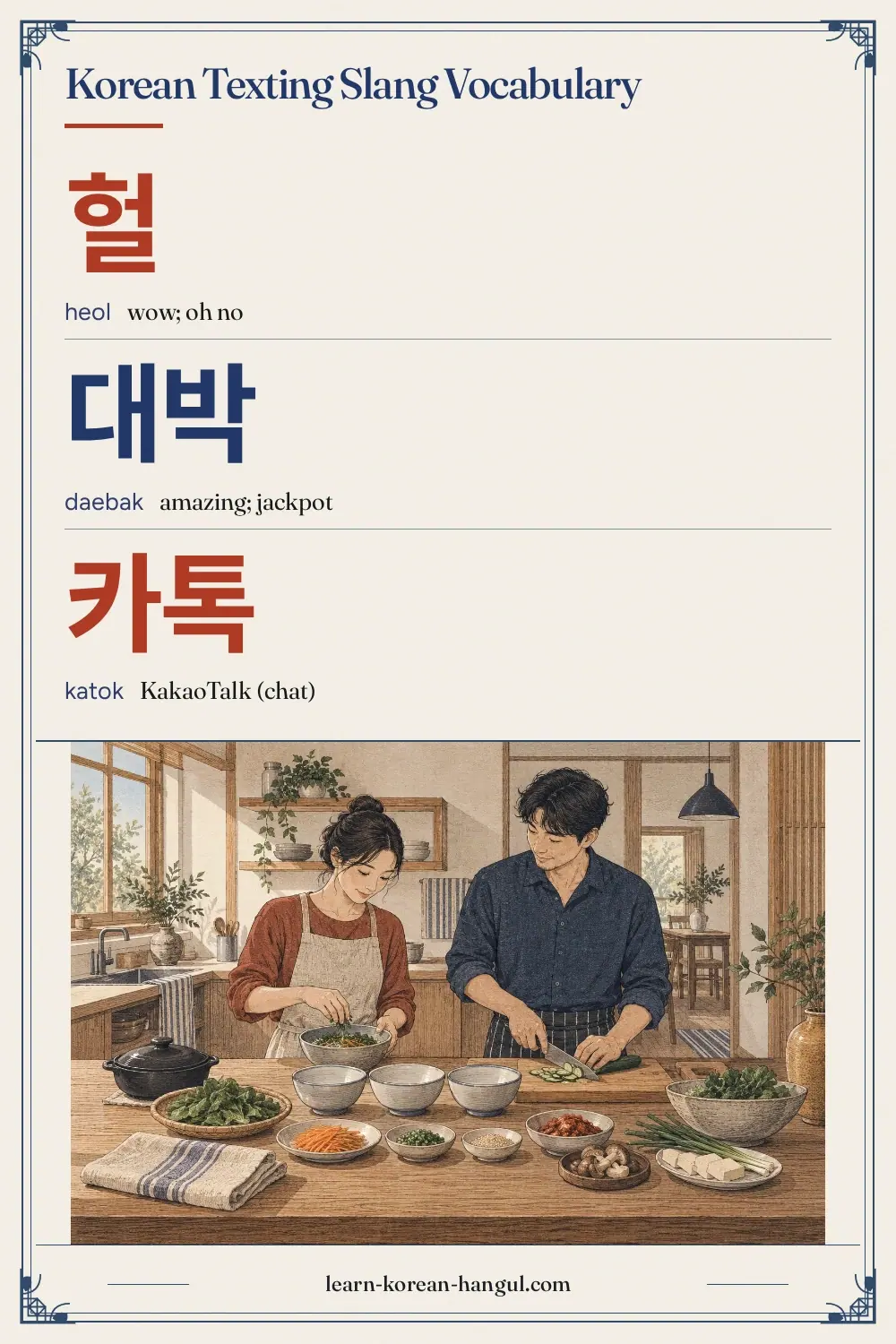
Korean Texting Slang Vocabulary at a Glance
The list has 25 entries in five groups of five. About half are letter strings, such as ㅋㅋ, ㅎㅎ and ㅠㅠ, that have no standard spelling and are used as pictures or sounds. The rest are ordinary words: interjections like 헐 and 대박 and chat nouns like 메시지. It belongs to Texting Shortcuts.
| Group | Words | Use |
|---|---|---|
| Laughter | 5 | ㅋㅋ, ㅎㅎ and written laughs |
| Crying | 5 | ㅠㅠ, ㅜㅜ and crying sounds |
| Surprise | 5 | ㄷㄷ, 헐 and spoken interjections |
| Emoticons | 5 | Faces and the word for emoticon |
| Kakao stickers and chat words | 5 | App, message, reply and tone |
Letter strings have no official spelling, so the romanization given for them is a conventional learning aid. For the plain-word entries, see lol in Korean and haha in Korean.
Which Texting Emoticons Should You Learn First?
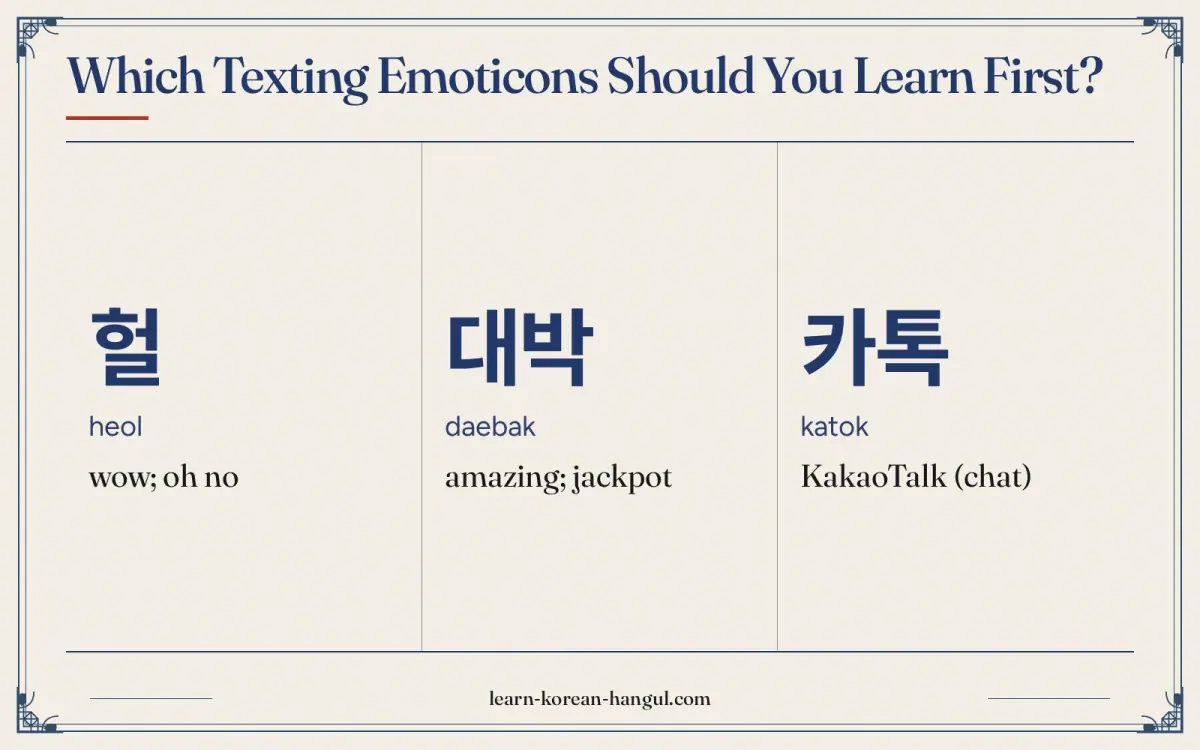
Learn ㅋㅋ (laugh), ㅎㅎ (soft laugh), ㅠㅠ (crying face), 헐 (wow) and ^^ (smile) first. They cover most messages from friends. If you remember one rule, make it this: ㅋㅋ and ㅎㅎ are casual, so keep them for friends of your own age and for family.
- Entries to use. ㅋㅋ, ㅎㅎ, ㅠㅠ, 헐, ^^.
- Entries to recognise. ㄷㄷ, ㅡㅡ, 대박, 깜짝. Your friends will send them, and you may not want to.
- Entries for formal chat. 하하 and ^^, with polite sentence endings.
The scene below shows a phone chat with ten bubbles numbered to match the list.
Word · 10
- 1
ㅋㅋ
keukeu
haha; lol
- 2
ㅎㅎ
heuheu
hehe; soft laugh
- 3
ㅠㅠ
yuyu
crying face
- 4
ㅜㅜ
uu
sad face
- 5
ㄷㄷ
deoldeol
trembling; shiver
- 6
헐
heol
wow; oh no
- 7
대박
daebak
amazing; jackpot
- 8
^^
useum
smile
- 9
ㅡㅡ
jjajeung
annoyed face
- 10
카톡
katok
KakaoTalk (chat)
Laughter (ㅋㅋ, ㅎㅎ, ㅋㅋㅋㅋ)
Korean chat writes laughter with single letters, not with syllables. The consonant ㅋ (kieuk) stands for the k sound of a laugh like 크크, and ㅎ (hieut) stands for the breathy h of 흐흐. Because each letter is a sound by itself, the length of the row is the volume of the laugh. Two letters are a chuckle and a long row is helpless laughter. The same sounds are also written as ordinary words, such as 하하 and 킥킥.
| No. | Hangul | Revised Romanization | Meaning and note | Example sentence | Audio assetId |
|---|---|---|---|---|---|
| 1 | ㅋㅋ | keukeu | haha; lol. The default chat laugh. | 그 영상 웃겨요 ㅋㅋ (That video is funny, lol.) | au-pg-vocabulary-slang-texting-emoticons-1; example: au-pg-vocabulary-slang-texting-emoticons-26 |
| 2 | ㅋㅋㅋㅋ | keukeukeukeu | hahaha (strong). More letters mean a bigger laugh. | ㅋㅋㅋㅋ 진짜 웃겨요 (Hahaha, it is really funny.) | au-pg-vocabulary-slang-texting-emoticons-2; example: au-pg-vocabulary-slang-texting-emoticons-27 |
| 3 | ㅎㅎ | heuheu | hehe; soft laugh. A gentler, friendlier laugh. | 알겠어요 ㅎㅎ (Got it, hehe.) | au-pg-vocabulary-slang-texting-emoticons-3; example: au-pg-vocabulary-slang-texting-emoticons-28 |
| 4 | 하하 | haha | haha (spoken). A written-out laugh that suits more formal chat. | 하하, 정말 재미있어요. (Haha, it is really fun.) | au-pg-vocabulary-slang-texting-emoticons-4; example: au-pg-vocabulary-slang-texting-emoticons-29 |
| 5 | 킥킥 | kikik | giggle. A sound word; also written 키득키득. | 친구가 킥킥 웃어요. (My friend giggles.) | au-pg-vocabulary-slang-texting-emoticons-5; example: au-pg-vocabulary-slang-texting-emoticons-30 |
Letter strings have no fixed spelling, so ㅋㅋ, ㅋㅋㅋ and ㅋㅋㅋㅋㅋ are all fine. What matters is the hierarchy: ㅎㅎ is soft and friendly, ㅋㅋ is the neutral laugh, and a long row of ㅋ is loud. The names of the two letters are 키읔 and 히읗, listed on consonant names. The verbs here are regular: 웃기다 (be funny) gives 웃겨요, and 웃다 (laugh) gives 웃어요.
How Do You Say Crying (ㅠㅠ, ㅜㅜ) in Korean?
Crying is drawn, not spelled. The vowels ㅠ and ㅜ look like a pair of eyes with tears running down, so a chat message ending in ㅠㅠ reads as a crying face. The two vowels differ in the number of tear lines: ㅠ has two strokes below, like heavier tears, while ㅜ has one. Crying sounds, such as 흑흑 and 엉엉, are written as ordinary syllables.
| No. | Hangul | Revised Romanization | Meaning and note | Example sentence | Audio assetId |
|---|---|---|---|---|---|
| 6 | ㅠㅠ | yuyu | crying face. Two long tears. | 시험이 어려워요 ㅠㅠ (The test is hard, boo-hoo.) | au-pg-vocabulary-slang-texting-emoticons-6; example: au-pg-vocabulary-slang-texting-emoticons-31 |
| 7 | ㅜㅜ | uu | sad face. A smaller, quieter sadness. | 비가 와요 ㅜㅜ (It is raining, sigh.) | au-pg-vocabulary-slang-texting-emoticons-7; example: au-pg-vocabulary-slang-texting-emoticons-32 |
| 8 | 흑흑 | heukheuk | sob sound. A sound for quiet crying. | 흑흑, 너무 슬퍼요. (Sob, I am so sad.) | au-pg-vocabulary-slang-texting-emoticons-8; example: au-pg-vocabulary-slang-texting-emoticons-33 |
| 9 | 엉엉 | eongeong | wailing. A sound for loud crying. | 아이가 엉엉 울어요. (The child wails.) | au-pg-vocabulary-slang-texting-emoticons-9; example: au-pg-vocabulary-slang-texting-emoticons-34 |
| 10 | 눈물 | nunmul | tears. 눈 is eye; 물 is water. | 눈물이 나요. (Tears come.) | au-pg-vocabulary-slang-texting-emoticons-10; example: au-pg-vocabulary-slang-texting-emoticons-35 |
The letters are used because their shape matches the face, not for their sound. Most readers say nothing for them; when people do read them aloud, half jokingly, they say 유유 or 우우, which is what the clips play. In speech people say 슬퍼요 (I am sad) for the feeling instead. 눈물이 나요 uses the verb 나다 (come out), which makes 나요, and the same verb appears in 땀이 나요 (I sweat).
Surprise (ㄷㄷ, 헐)
Surprise has two kinds of word. One is a letter string, ㄷㄷ, that shows a shiver. The others are spoken interjections, such as 헐 and 대박, that people say aloud as well as type. The interjections carry more weight than the letter strings, so they are the better ones to learn first.
| No. | Hangul | Revised Romanization | Meaning and note | Example sentence | Audio assetId |
|---|---|---|---|---|---|
| 11 | ㄷㄷ | deoldeol | trembling; shiver. From 덜덜, a shaking sound. | 무서워요 ㄷㄷ (It is scary, I am shaking.) | au-pg-vocabulary-slang-texting-emoticons-11; example: au-pg-vocabulary-slang-texting-emoticons-36 |
| 12 | 헐 | heol | wow; oh no. Said alone or in a sentence. | 헐, 진짜예요? (Wow, really?) | au-pg-vocabulary-slang-texting-emoticons-12; example: au-pg-vocabulary-slang-texting-emoticons-37 |
| 13 | 대박 | daebak | amazing; jackpot. Good surprise; also luck. | 이 노래 대박이에요. (This song is amazing.) | au-pg-vocabulary-slang-texting-emoticons-13; example: au-pg-vocabulary-slang-texting-emoticons-38 |
| 14 | 어머 | eomeo | oh my. Mostly used by women. | 어머, 예뻐요. (Oh, it is pretty.) | au-pg-vocabulary-slang-texting-emoticons-14; example: au-pg-vocabulary-slang-texting-emoticons-39 |
| 15 | 깜짝 | kkamjjak | startled; suddenly. Often in 깜짝 놀라다. | 깜짝 놀랐어요. (I was startled.) | au-pg-vocabulary-slang-texting-emoticons-15; example: au-pg-vocabulary-slang-texting-emoticons-40 |
The letter ㄷ stands for the first sound of 덜덜, so ㄷㄷ is an initial-letter shortening of a word. The same trick is behind many chat spellings, such as ㅇㅇ for 응, yes. Because 헐 and 대박 can be positive or negative, the rest of the sentence tells the reader which. The adjectives 무섭다 and 예쁘다 make 무서워요 and 예뻐요, both with a change in the stem.
How Do You Say Emoticons (^^, ㅡㅡ) in Korean?
Korean emoticons are read upright, unlike the Western ones, which are tilted sideways. The face ^^ is a pair of closed smiling eyes, and ㅡㅡ is a pair of flat eyes with no mouth. Neither has a name that you say aloud, so each entry here lists a nearby word. The noun 이모티콘 covers all of these faces, and also the animated stickers inside chat apps.
| No. | Hangul | Revised Romanization | Meaning and note | Example sentence | Audio assetId |
|---|---|---|---|---|---|
| 16 | ^^ | useum | smile. Closed smiling eyes; the nearby word is 웃음 (smile). | 고마워요 ^^ (Thank you, with a smile.) | au-pg-vocabulary-slang-texting-emoticons-16; example: au-pg-vocabulary-slang-texting-emoticons-41 |
| 17 | ㅡㅡ | jjajeung | annoyed face. Flat, unamused eyes; the nearby word is 짜증 (irritation). | 또 늦었어요 ㅡㅡ (Late again, annoyed.) | au-pg-vocabulary-slang-texting-emoticons-17; example: au-pg-vocabulary-slang-texting-emoticons-42 |
| 18 | ;; | sigeunttam | awkward sweat. Drops of cold sweat; the nearby word is 식은땀 (cold sweat). | 미안해요 ;; (Sorry, awkward.) | au-pg-vocabulary-slang-texting-emoticons-18; example: au-pg-vocabulary-slang-texting-emoticons-43 |
| 19 | 하트 | hateu | heart. The loanword for the shape. | 하트를 보내요. (I send a heart.) | au-pg-vocabulary-slang-texting-emoticons-19; example: au-pg-vocabulary-slang-texting-emoticons-44 |
| 20 | 이모티콘 | imotikon | emoticon. Loanword. | 이모티콘을 보내요. (I send an emoticon.) | au-pg-vocabulary-slang-texting-emoticons-20; example: au-pg-vocabulary-slang-texting-emoticons-45 |
ㅡㅡ is the one to treat with care. It looks neutral, but it shows irritation or disbelief, so sending it to someone you do not know well can read as rude. The smiling ^^ is the safest of the faces and works with people you respect. The verbs here are regular: 보내다 (send) gives 보내요, and 늦다 (be late) gives the past 늦었어요.
Kakao Stickers and Chat Words
Most Korean chat happens in KakaoTalk, which people shorten to 카톡 and which gives its name to a common verb, 카톡하다 (to message on KakaoTalk). Its animated 스티커 stand in for faces and for whole sentences. These last five words are the plain chat vocabulary around the emoticons: the app, the message, the reply, the sticker and the tone of voice that decides which laughter you can use.
| No. | Hangul | Revised Romanization | Meaning and note | Example sentence | Audio assetId |
|---|---|---|---|---|---|
| 21 | 카톡 | katok | KakaoTalk (chat). Short for 카카오톡. | 카톡으로 보내요. (I send it by KakaoTalk.) | au-pg-vocabulary-slang-texting-emoticons-21; example: au-pg-vocabulary-slang-texting-emoticons-46 |
| 22 | 메시지 | mesiji | message. Loanword. | 메시지가 와요. (A message arrives.) | au-pg-vocabulary-slang-texting-emoticons-22; example: au-pg-vocabulary-slang-texting-emoticons-47 |
| 23 | 답장 | dapjang | reply. Said [답짱]. | 답장을 해요. (I write a reply.) | au-pg-vocabulary-slang-texting-emoticons-23; example: au-pg-vocabulary-slang-texting-emoticons-48 |
| 24 | 스티커 | seutikeo | sticker. Loanword. | 스티커를 보내요. (I send a sticker.) | au-pg-vocabulary-slang-texting-emoticons-24; example: au-pg-vocabulary-slang-texting-emoticons-49 |
| 25 | 말투 | maltu | way of speaking; tone. The tone of a message. | 말투가 귀여워요. (The way of speaking is cute.) | au-pg-vocabulary-slang-texting-emoticons-25; example: au-pg-vocabulary-slang-texting-emoticons-50 |
말투 is the word that explains this page. Laughter and faces are part of a person's tone, and a tone suited to friends is not suited to a teacher, a customer or a manager. In messages to people above you, use full sentences, polite endings and, if you laugh at all, a written-out 하하 or a single ^^. The adjective 귀엽다 (be cute) makes 귀여워요.
How Do You Pronounce These Words?
Letter strings have no syllables, so there is nothing to read. People do not say the names of the letters aloud, such as 키읔 for ㅋ. They say the sound the letters stand for, with a vowel added. The ordinary words follow the standard pronunciation rules of the National Institute of Korean Language (국립국어원). The audio for a letter string reads its spoken form, which the table lists.
| Spelling | Sounds like | What changes |
|---|---|---|
| ㅋㅋ | [크크] | The letter ㅋ gets the vowel ㅡ when read aloud. |
| ㅎㅎ | [흐흐] or [히히] | The letter ㅎ gets a vowel; the vowel changes the mood. |
| ㄷㄷ | [덜덜] | A shortening of 덜덜, a shaking sound. |
| 답장 | [답짱] | After final ㅂ, the ㅈ is tense. |
| 킥킥 | [킥킥] | Final ㄱ is held, not released. |
Audio and Slow Playback
Each entry has its own clip, and five more replay the least obvious ones slowly. For the letter strings, the clip says the spoken form: the entry ㅋㅋ plays 크크 and the entry ㅠㅠ plays 유유. Play, repeat and compare.
What Mistakes Do Learners Make with Texting Emoticons?
Five mistakes cause most awkward messages.
- Using ㅋㅋ with a senior or a customer. It reads as casual or even mocking. Use polite sentence endings and, if you must, a single ^^.
- Reading ㅡㅡ as neutral. It looks calm but shows irritation. Do not send it to someone you do not know well.
- Mixing up ㅠㅠ and ㅜㅜ. ㅠㅠ is heavier crying, ㅜㅜ is quieter sadness. Both are about feelings, so avoid them in apologies to a boss.
- Typing the consonant name. To type a laugh you press ㅋ, not the syllable 키읔. 키읔 is the name of the letter and appears in class, not in chat.
- Using jamo chat in writing. ㅋㅋ and ㅎㅎ belong to chat. In an essay, an exam, an email or a form, write full sentences instead.
The pattern is the same in all five: match the face to the person. For a person you respect, choose the plain word.
Practice: Flashcards and Worksheet
Study in three steps. First, run the deck in recognition mode until the 25 entries are familiar. Second, switch to listening mode and play the clip before you flip each card. Third, take the five-question quiz. Progress stays in your browser, and the vocabulary flashcard decks page lists the other decks.
Practice · 55
- 01크크
Show answer
headword 1: haha; lol (spoken form of ㅋㅋ)
- 02크크크크
Show answer
headword 2: hahaha (strong) (spoken form of ㅋㅋㅋㅋ)
- 03흐흐
Show answer
headword 3: hehe; soft laugh (spoken form of ㅎㅎ)
- 04하하
Show answer
headword 4: haha (spoken)
- 05킥킥
Show answer
headword 5: giggle
- 06유유
Show answer
headword 6: crying face (spoken form of ㅠㅠ)
- 07우우
Show answer
headword 7: sad face (spoken form of ㅜㅜ)
- 08흑흑
Show answer
headword 8: sob sound
- 09엉엉
Show answer
headword 9: wailing
- 10눈물
Show answer
headword 10: tears
- 11덜덜
Show answer
headword 11: trembling; shiver (spoken form of ㄷㄷ)
- 12헐
Show answer
headword 12: wow; oh no
- 13대박
Show answer
headword 13: amazing; jackpot
- 14어머
Show answer
headword 14: oh my
- 15깜짝
Show answer
headword 15: startled; suddenly
- 16웃음
Show answer
headword 16: smile (spoken form of ^^)
- 17짜증
Show answer
headword 17: annoyed face (spoken form of ㅡㅡ)
- 18식은땀
Show answer
headword 18: awkward sweat (spoken form of ;;)
- 19하트
Show answer
headword 19: heart
- 20이모티콘
Show answer
headword 20: emoticon
- 21카톡
Show answer
headword 21: KakaoTalk (chat)
- 22메시지
Show answer
headword 22: message
- 23답장
Show answer
headword 23: reply
- 24스티커
Show answer
headword 24: sticker
- 25말투
Show answer
headword 25: way of speaking; tone
- 26그 영상 웃겨요 ㅋㅋ
Show answer
example sentence for ㅋㅋ
- 27ㅋㅋㅋㅋ 진짜 웃겨요
Show answer
example sentence for ㅋㅋㅋㅋ
- 28알겠어요 ㅎㅎ
Show answer
example sentence for ㅎㅎ
- 29하하, 정말 재미있어요.
Show answer
example sentence for 하하
- 30친구가 킥킥 웃어요.
Show answer
example sentence for 킥킥
- 31시험이 어려워요 ㅠㅠ
Show answer
example sentence for ㅠㅠ
- 32비가 와요 ㅜㅜ
Show answer
example sentence for ㅜㅜ
- 33흑흑, 너무 슬퍼요.
Show answer
example sentence for 흑흑
- 34아이가 엉엉 울어요.
Show answer
example sentence for 엉엉
- 35눈물이 나요.
Show answer
example sentence for 눈물
- 36무서워요 ㄷㄷ
Show answer
example sentence for ㄷㄷ
- 37헐, 진짜예요?
Show answer
example sentence for 헐
- 38이 노래 대박이에요.
Show answer
example sentence for 대박
- 39어머, 예뻐요.
Show answer
example sentence for 어머
- 40깜짝 놀랐어요.
Show answer
example sentence for 깜짝
- 41고마워요 ^^
Show answer
example sentence for ^^
- 42또 늦었어요 ㅡㅡ
Show answer
example sentence for ㅡㅡ
- 43미안해요 ;;
Show answer
example sentence for ;;
- 44하트를 보내요.
Show answer
example sentence for 하트
- 45이모티콘을 보내요.
Show answer
example sentence for 이모티콘
- 46카톡으로 보내요.
Show answer
example sentence for 카톡
- 47메시지가 와요.
Show answer
example sentence for 메시지
- 48답장을 해요.
Show answer
example sentence for 답장
- 49스티커를 보내요.
Show answer
example sentence for 스티커
- 50말투가 귀여워요.
Show answer
example sentence for 말투
- 51ㅋㅋ
Show answer
slow playback of ㅋㅋ
- 52ㅠㅠ
Show answer
slow playback of ㅠㅠ
- 53ㄷㄷ
Show answer
slow playback of ㄷㄷ
- 54;;
Show answer
slow playback of ;;
- 55답장
Show answer
slow playback of 답장
Practice · 5
What does ㅋㅋ (keukeu) mean?
Show answer
haha; lol
ㅋㅋ means haha; lol. Example: 그 영상 웃겨요 ㅋㅋ (That video is funny, lol.)
What does ㅎㅎ (heuheu) mean?
Show answer
hehe; soft laugh
ㅎㅎ means hehe; soft laugh. Example: 알겠어요 ㅎㅎ (Got it, hehe.)
What does ㅠㅠ (yuyu) mean?
Show answer
crying face
ㅠㅠ means crying face. Example: 시험이 어려워요 ㅠㅠ (The test is hard, boo-hoo.)
What does 헐 (heol) mean?
Show answer
wow; oh no
헐 means wow; oh no. Example: 헐, 진짜예요? (Wow, really?)
What does 카톡 (katok) mean?
Show answer
KakaoTalk (chat)
카톡 means KakaoTalk (chat). Example: 카톡으로 보내요. (I send it by KakaoTalk.)
Korean Laughing and Crying Emoticons Worksheet (PDF)
A printable worksheet for these words (word list, matching, writing practice, fill-in-the-blank exercises and answer key) is available in A4 and US Letter from the download card on this page. For practice, write five short chat lines for friends and rewrite each as a message to a teacher.
Where to Go Next
After this page, return to Texting Shortcuts for the other chat abbreviations. To learn the letter names behind the symbols, see consonant names.
Frequently Asked Questions
How Do You Say Haha in Korean?
The most common chat laugh is ㅋㅋ (keukeu). A softer laugh is ㅎㅎ, and a written-out laugh is 하하. The spoken sound is 크크 or 하하. The single-word page on haha in Korean gives more detail.
How Do You Pronounce ㅎㅎ (hieut hieut)?
The letter ㅎ is named 히읗 (hieut), but people do not say that name for a laugh. They say the sound it stands for, 흐흐 or 히히, with a breathy h. Press the audio button to hear the spoken form.
How Many Texting Emoticons Should I Learn First?
Five: ㅋㅋ, ㅎㅎ, ㅠㅠ, 헐 and ^^. At five new entries a day the 25 take five days plus review. Learn the tone rule with them, so you know which are safe with whom.
What Is the Difference between ㅋㅋ and ㅎㅎ?
ㅋㅋ is the neutral, louder laugh, and ㅎㅎ is soft and friendly. ㅋㅋ can read as mocking in the wrong context, while ㅎㅎ rarely does. ㅎㅎ is common in friendly messages to classmates and coworkers, but with a teacher or manager most people leave both out.
Where Can I Practise Texting Emoticons with Flashcards?
Use the vocabulary flashcard decks. The deck for this page holds all 25 entries with Hangul, romanization and audio. Run it in recognition mode first, then switch to listening mode. Your progress stays in your browser.
Is There a Printable Worksheet for Texting Emoticons?
A printable worksheet for these words (word list, matching, writing practice, fill-in-the-blank exercises and answer key) is available in A4 and US Letter from the download card on this page. For practice, copy the tables on this page by hand or use the deck.