
Korean Texting Abbreviations at a Glance
Korean texting abbreviations work in a way that has no close match in English. Instead of dropping vowels, Koreans type only the first consonants of a word, so 감사 (thanks) becomes ㄱㅅ and 죄송 (sorry) becomes ㅈㅅ. Others copy a sound or a face: ㅋㅋ is the sound of a laugh, and ㅠㅠ is a drawing of two eyes crying. This page teaches 35 of them together with the plain Korean behind each.
| Group | Words | Use |
|---|---|---|
| Laughing and crying | 7 | Showing a reaction |
| Agree and refuse | 7 | Answering yes, no and maybe |
| Greetings and thanks | 7 | Hello, thanks, sorry and goodbye |
| Emoticons and stickers | 7 | Chat features and chat habits |
| Typos and spacing | 7 | Writing rules and letter names |
There are two reasons for the habit. The first is speed: on the common 2-set keyboard, consonants are on the left and vowels on the right, so a consonant-only message is quick to type. The second is tone: a short ㅇㅇ sounds relaxed, a full 네, 알겠습니다 sounds careful, and the choice tells the reader how close you feel to them.
The 35 words are in five groups. Fuller chat sentences are on the texting phrases page, and typing the letters is explained on the typing Korean page. This page sits inside Korean Slang.
Which Texting Abbreviations Should You Learn First?
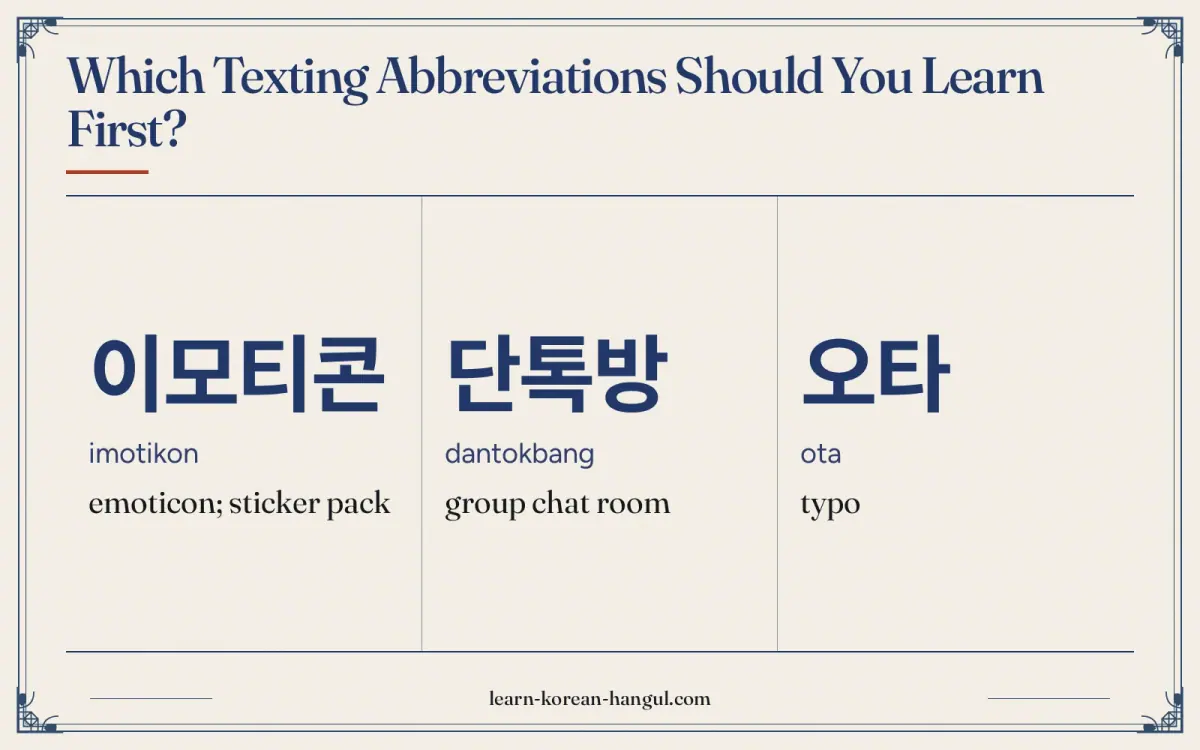
Learn ㅋㅋ, ㅠㅠ, ㅇㅇ, ㄱㅅ and ㅇㅋ first. They are the shortcuts that appear in almost every chat with a Korean friend, and you can recognise them without knowing the rest. Then add the greeting shortcuts and the chat words, because those let you follow a group chat.
- Day one (7 words). The reaction signs: ㅋㅋ, ㅋㅋㅋ, ㅎㅎ, ㅠㅠ, ㅜㅜ, ㄷㄷ and ㄱㅇㅇ.
- Day two (7 words). The answers: ㅇㅇ, ㄴㄴ, ㅇㅋ, ㅇㅈ, ㅇㅎ, ㅁㄹ and ㄹㅇ.
- Day three (7 words). The greetings: ㅎㅇ, ㄱㅅ, ㅈㅅ, ㅊㅋ, ㅅㄱ, ㅂㅂ and ㄱㄷ.
- Day four (7 words). The chat words: 이모티콘, 스티커, 카톡, 단톡방, 읽씹, 프사 and 답장.
- Day five (7 words). The writing words: 오타, 띄어쓰기, 맞춤법, 초성, 자음, 모음 and 자모.
At 7 words a day, the list takes five days plus review. The scene below puts eight of the words on one picture.
Word · 8
- 1
ㅋㅋ
keukeu
laughing; lol
- 2
ㅠㅠ
yuyu
crying emoticon
- 3
ㅇㅇ
eungeung
yeah
- 4
ㅎㅇ
hai
hi
- 5
ㅈㅅ
joesong
sorry
- 6
이모티콘
imotikon
emoticon; sticker pack
- 7
단톡방
dantokbang
group chat room
- 8
오타
ota
typo
In the Read as column, the first three groups show the spoken word that each shortcut stands for: ㅇㅇ is read 응응, ㄱㅅ is read 감사 and ㅂㅂ is read 바이바이. The Revised Romanization follows that reading as well. For the last two groups the column shows the word's origin or full form. Some shortcuts come from English, such as ㅇㅋ from OK and ㄴㄴ from no no, and the Konglish and loanwords page explains how English words are written in Hangul.
Laughing and Crying (ㅋㅋ, ㅠㅠ)
Laughing and crying signs are the most common texting abbreviations. ㅋㅋ is the laugh, and more ㅋ means a bigger laugh: ㅋㅋㅋ is a real laugh. ㅎㅎ is softer and friendlier. ㅠㅠ and ㅜㅜ draw crying eyes, and ㄷㄷ is the shaking of fear. ㄱㅇㅇ stands for 귀여워, which means cute.
| No. | Hangul | Revised Romanization | Read as | Meaning | Example sentence | Audio assetId |
|---|---|---|---|---|---|---|
| 1 | ㅋㅋ | keukeu | 크크 | laughing; lol | 이 영상 진짜 웃겨 ㅋㅋ (This video is really funny, lol.) | au-pg-vocabulary-slang-texting-1; example: au-pg-vocabulary-slang-texting-36 |
| 2 | ㅋㅋㅋ | keukeukeu | 크크크 | haha | 아까 그 말 기억나? ㅋㅋㅋ (Do you remember what you said earlier? Haha.) | au-pg-vocabulary-slang-texting-2; example: au-pg-vocabulary-slang-texting-37 |
| 3 | ㅎㅎ | hihi | 히히 | hehe; soft laugh | 알겠어요 ㅎㅎ (Got it, hehe.) | au-pg-vocabulary-slang-texting-3; example: au-pg-vocabulary-slang-texting-38 |
| 4 | ㅠㅠ | yuyu | 유유 | crying emoticon | 시험이 너무 어려워 ㅠㅠ (The exam is so hard, boo-hoo.) | au-pg-vocabulary-slang-texting-4; example: au-pg-vocabulary-slang-texting-39 |
| 5 | ㅜㅜ | uu | 우우 | sad face | 비가 와서 못 나가 ㅜㅜ (It is raining, so I cannot go out, sigh.) | au-pg-vocabulary-slang-texting-5; example: au-pg-vocabulary-slang-texting-40 |
| 6 | ㄷㄷ | deoldeol | 덜덜 | trembling; shaking with fear | 공포 영화 봤어 ㄷㄷ (I watched a horror film, I am shaking.) | au-pg-vocabulary-slang-texting-6; example: au-pg-vocabulary-slang-texting-41 |
| 7 | ㄱㅇㅇ | gwiyeowo | 귀여워 | cute | 강아지 사진 봐 ㄱㅇㅇ (Look at the puppy photo, so cute.) | au-pg-vocabulary-slang-texting-7; example: au-pg-vocabulary-slang-texting-42 |
Every sign has a name that people say aloud. ㅋㅋ is read 크크, because the letter ㅋ makes a k sound with a puff of air, and ㅎㅎ is read 히히 or 흐흐. The letters ㅠ and ㅜ are drawings, not sounds, so Koreans may say the sob sound 엉엉 for ㅠㅠ. The reading yuyu follows the Korean names of the vowels ㅠ and ㅜ.
A laugh sign can be too strong or too weak. A long ㅋㅋㅋㅋㅋ with a teacher can feel careless. A single ㅎㅎ is gentle and friendly and is safe with classmates and colleagues. The Korean laughing and crying emoticons page covers these signs in more depth.
Example Sentences
Each example is a short chat line. In the first three groups the line is written in casual style, as friends type it, and in the last two groups it is polite 해요 style. Most follow the pattern noun + 이/가 + adjective, as in 맞춤법이 어려워요, or noun + 을/를 + verb, as in 답장을 기다려요. Say each line aloud, using the spoken word in place of the letters, then swap the noun: replace 답장 with 소식 and you get 소식을 기다려요, which is also natural.
How Do You Say Agree and Refuse (ㅇㅇ, ㄴㄴ) in Korean?
Answer shortcuts say yes, no or I see. ㅇㅇ is a casual yes, from 응응. ㄴㄴ is a friendly refusal, read as 노노 from the English no no. ㅇㅋ is OK, and ㅇㅈ is I agree, from 인정. ㅇㅎ shows you understood, from 아하. ㅁㄹ means I do not know, from 몰라, and ㄹㅇ means for real.
| No. | Hangul | Revised Romanization | Read as | Meaning | Example sentence | Audio assetId |
|---|---|---|---|---|---|---|
| 8 | ㅇㅇ | eungeung | 응응 | yeah | ㅇㅇ, 맞아 (Yeah, that is right.) | au-pg-vocabulary-slang-texting-8; example: au-pg-vocabulary-slang-texting-43 |
| 9 | ㄴㄴ | nono | 노노 | no, no | ㄴㄴ, 그건 아니야 (No, no, that is not it.) | au-pg-vocabulary-slang-texting-9; example: au-pg-vocabulary-slang-texting-44 |
| 10 | ㅇㅋ | okei | 오케이 | OK | ㅇㅋ, 그럼 일곱 시에 봐 (OK, then see you at seven.) | au-pg-vocabulary-slang-texting-10; example: au-pg-vocabulary-slang-texting-45 |
| 11 | ㅇㅈ | injeong | 인정 | agreed | ㅇㅈ, 그 영화 진짜 좋았어 (Agreed, that movie was really good.) | au-pg-vocabulary-slang-texting-11; example: au-pg-vocabulary-slang-texting-46 |
| 12 | ㅇㅎ | aha | 아하 | I see | ㅇㅎ, 이제 알아 (I see, now I know.) | au-pg-vocabulary-slang-texting-12; example: au-pg-vocabulary-slang-texting-47 |
| 13 | ㅁㄹ | molla | 몰라 | I do not know | ㅁㄹ, 나도 처음 봐 (I do not know, I am seeing it for the first time too.) | au-pg-vocabulary-slang-texting-13; example: au-pg-vocabulary-slang-texting-48 |
| 14 | ㄹㅇ | real | 레알 | really; for real | ㄹㅇ 맛있어 (It is really delicious.) | au-pg-vocabulary-slang-texting-14; example: au-pg-vocabulary-slang-texting-49 |
These are short because the answers are short. Between friends, ㅇㅇ is the normal way to say yes, but it is too casual for a teacher. A polite reply to an older person is 네 or 넵. Note that ㅁㄹ can sound blunt, and ㄹㅇ is from the English real.
Some shortcuts have two meanings. ㅇㅈ is most often 인정, but the same two letters can stand for other words, so the context decides. If you are not sure, ask the sender.
Greetings and Thanks (ㄱㅅ, ㅂㅂ)
Greeting shortcuts open and close a chat. ㅎㅇ is hi, from 하이, and ㅂㅂ is bye-bye. ㄱㅅ is thanks, from 감사, and ㅈㅅ is sorry, from 죄송. ㅊㅋ is congratulations, from 축하, ㅅㄱ is good work, from 수고, and ㄱㄷ is wait, from 기다려.
| No. | Hangul | Revised Romanization | Read as | Meaning | Example sentence | Audio assetId |
|---|---|---|---|---|---|---|
| 15 | ㅎㅇ | hai | 하이 | hi | ㅎㅇ, 잘 지냈어? (Hi, how have you been?) | au-pg-vocabulary-slang-texting-15; example: au-pg-vocabulary-slang-texting-50 |
| 16 | ㄱㅅ | gamsa | 감사 | thanks | ㄱㅅ, 잘 받았어 (Thanks, I received it well.) | au-pg-vocabulary-slang-texting-16; example: au-pg-vocabulary-slang-texting-51 |
| 17 | ㅈㅅ | joesong | 죄송 | sorry | ㅈㅅ, 늦었어 (Sorry, I am late.) | au-pg-vocabulary-slang-texting-17; example: au-pg-vocabulary-slang-texting-52 |
| 18 | ㅊㅋ | chukha | 축하 | congrats | ㅊㅋ, 합격했어? (Congrats, did you pass?) | au-pg-vocabulary-slang-texting-18; example: au-pg-vocabulary-slang-texting-53 |
| 19 | ㅅㄱ | sugo | 수고 | good work | ㅅㄱ, 오늘도 열심히 했어 (Good work, you did your best today too.) | au-pg-vocabulary-slang-texting-19; example: au-pg-vocabulary-slang-texting-54 |
| 20 | ㅂㅂ | baibai | 바이바이 | bye-bye | ㅂㅂ, 내일 봐 (Bye-bye, see you tomorrow.) | au-pg-vocabulary-slang-texting-20; example: au-pg-vocabulary-slang-texting-55 |
| 21 | ㄱㄷ | gidaryeo | 기다려 | wait | ㄱㄷ, 지금 나가 (Wait, I am heading out now.) | au-pg-vocabulary-slang-texting-21; example: au-pg-vocabulary-slang-texting-56 |
The shortcut is shorter than the polite word it comes from. 감사 and 죄송 already sound formal, and ㄱㅅ and ㅈㅅ make them casual. To a boss or an elder, write the whole sentence: 감사합니다 and 죄송합니다. The word ㅊㅋ is from 축하, said [추카], and it stands for a casual congrats.
ㅅㄱ comes from 수고, which thanks someone for their effort. Use it with friends and juniors, and with an elder write a full thanks instead. For more full-sentence greetings, see thank you, sorry and please.
How Do You Say Emoticons and Stickers in Korean?
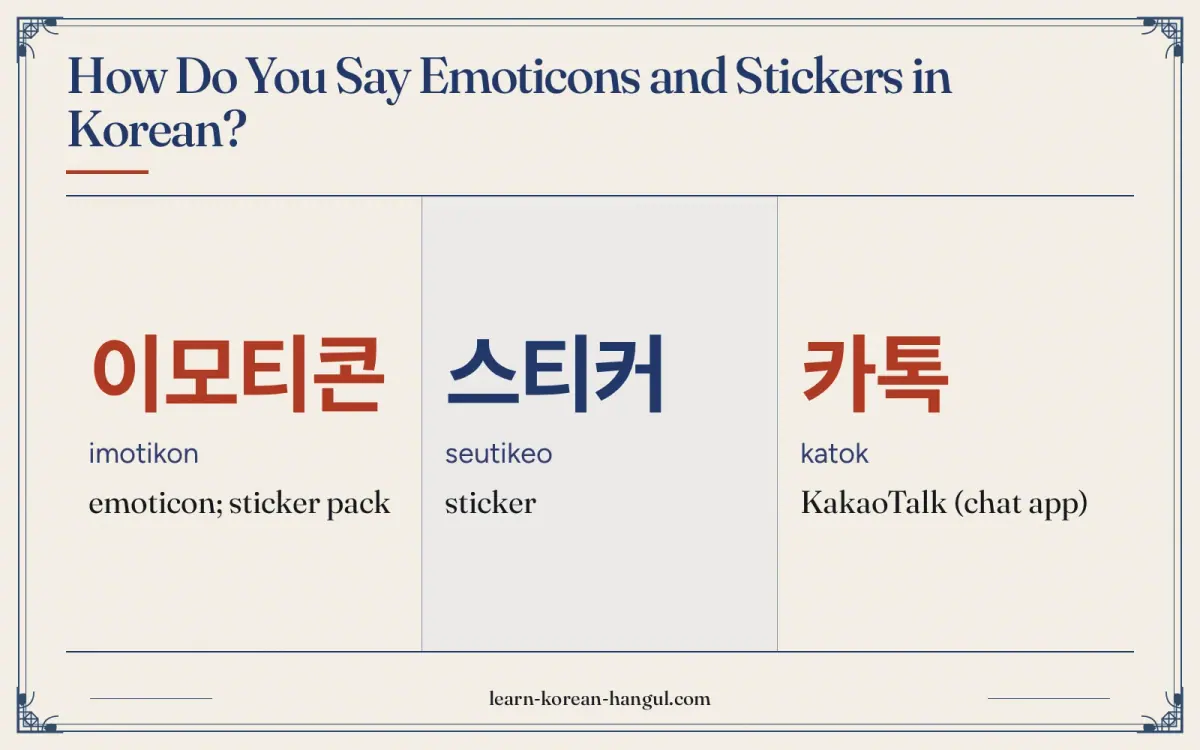
Chat apps add words of their own. An 이모티콘 is an emoticon pack, and a 스티커 is one sticker. 카톡 is short for 카카오톡, the chat app most Koreans use, and a 단톡방 is a group chat room. If someone reads your message and does not answer, that is 읽씹, and you can change your 프사 (profile photo) to show your mood. A 답장 is a reply.
| No. | Hangul | Revised Romanization | Read as | Meaning | Example sentence | Audio assetId |
|---|---|---|---|---|---|---|
| 22 | 이모티콘 | imotikon | loanword | emoticon; sticker pack | 새 이모티콘을 샀어요. (I bought a new emoticon pack.) | au-pg-vocabulary-slang-texting-22; example: au-pg-vocabulary-slang-texting-57 |
| 23 | 스티커 | seutikeo | loanword | sticker | 카톡에서 스티커를 보내요. (I send a sticker on KakaoTalk.) | au-pg-vocabulary-slang-texting-23; example: au-pg-vocabulary-slang-texting-58 |
| 24 | 카톡 | katok | 카카오톡 | KakaoTalk (chat app) | 카톡으로 사진을 보냈어요. (I sent the photo by KakaoTalk.) | au-pg-vocabulary-slang-texting-24; example: au-pg-vocabulary-slang-texting-59 |
| 25 | 단톡방 | dantokbang | 단체 톡방 | group chat room | 단톡방에 친구가 많아요. (There are many friends in the group chat room.) | au-pg-vocabulary-slang-texting-25; example: au-pg-vocabulary-slang-texting-60 |
| 26 | 읽씹 | ikssip | 읽고 씹다 | read and ignored | 답장이 없으면 읽씹이에요. (If there is no reply, it is read and ignored.) | au-pg-vocabulary-slang-texting-26; example: au-pg-vocabulary-slang-texting-61 |
| 27 | 프사 | peusa | 프로필 사진 | profile photo | 프사를 바꿨어요. (I changed my profile photo.) | au-pg-vocabulary-slang-texting-27; example: au-pg-vocabulary-slang-texting-62 |
| 28 | 답장 | dapjang | Sino-Korean | reply | 답장을 기다려요. (I am waiting for a reply.) | au-pg-vocabulary-slang-texting-28; example: au-pg-vocabulary-slang-texting-63 |
읽씹 is short for 읽고 씹다, which means to read and then ignore, and it is a very common complaint among friends. 단톡방 and 프사 are shortenings too: 단톡방 comes from 단체 톡방 and 프사 from 프로필 사진. The word 카톡 is also used as a verb in daily talk.
In Korea, a sticker can say as much as a sentence, and people choose their sticker packs with care. For the full list of faces, see the laughing and crying emoticons page.
Typos and Spacing
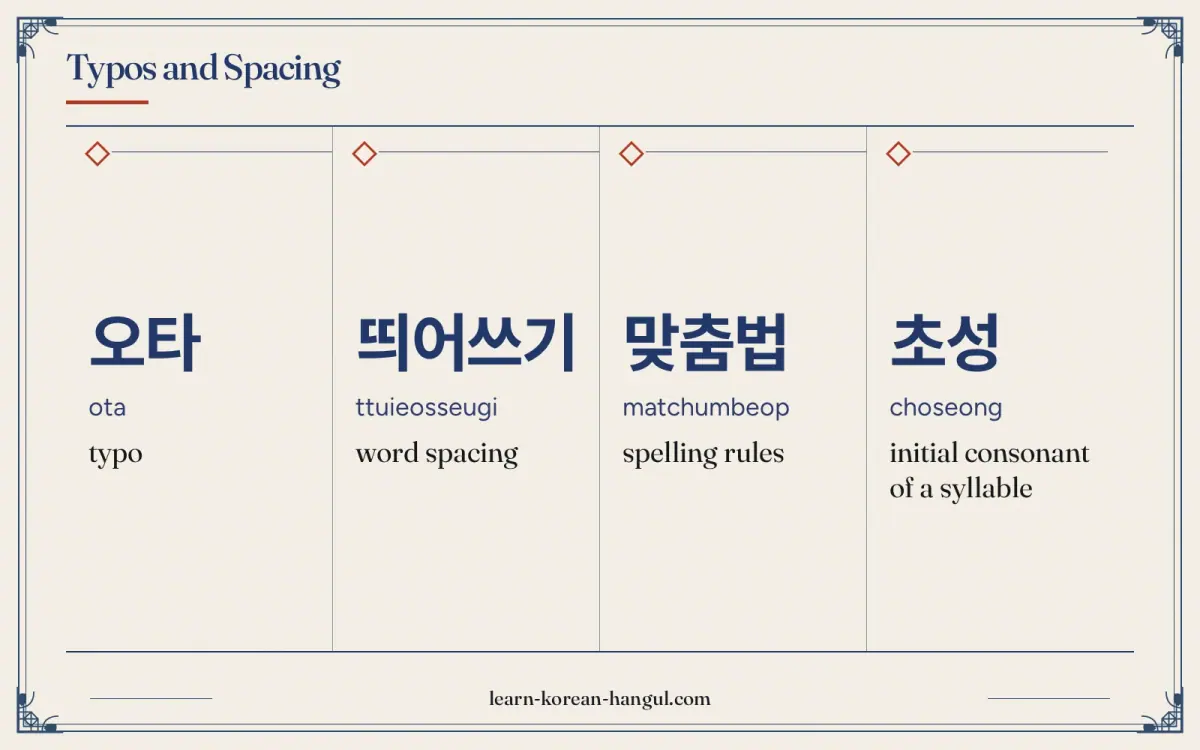
Typos and spacing are part of chat too. An 오타 is a typo, and 띄어쓰기 is the spacing between words. The 맞춤법 are the spelling rules. In chat, many people type only the 초성, the first consonant of each syllable, and the letters themselves are called 자음 (consonants), 모음 (vowels) and 자모 (the letters together).
| No. | Hangul | Revised Romanization | Read as | Meaning | Example sentence | Audio assetId |
|---|---|---|---|---|---|---|
| 29 | 오타 | ota | Sino-Korean | typo | 오타가 있어요. (There is a typo.) | au-pg-vocabulary-slang-texting-29; example: au-pg-vocabulary-slang-texting-64 |
| 30 | 띄어쓰기 | ttuieosseugi | native | word spacing | 띄어쓰기를 틀렸어요. (I got the word spacing wrong.) | au-pg-vocabulary-slang-texting-30; example: au-pg-vocabulary-slang-texting-65 |
| 31 | 맞춤법 | matchumbeop | mixed | spelling rules | 맞춤법이 어려워요. (The spelling rules are difficult.) | au-pg-vocabulary-slang-texting-31; example: au-pg-vocabulary-slang-texting-66 |
| 32 | 초성 | choseong | Sino-Korean | initial consonant of a syllable | 초성만 쓰면 짧아요. (If you write only the initial consonants, it is short.) | au-pg-vocabulary-slang-texting-32; example: au-pg-vocabulary-slang-texting-67 |
| 33 | 자음 | jaeum | Sino-Korean | consonant letter | ㄱ은 자음이에요. (ㄱ is a consonant.) | au-pg-vocabulary-slang-texting-33; example: au-pg-vocabulary-slang-texting-68 |
| 34 | 모음 | moeum | Sino-Korean | vowel letter | ㅏ는 모음이에요. (ㅏ is a vowel.) | au-pg-vocabulary-slang-texting-34; example: au-pg-vocabulary-slang-texting-69 |
| 35 | 자모 | jamo | Sino-Korean | a letter of Hangul | 기본 자모는 스물네 개예요. (There are 24 basic Hangul letters.) | au-pg-vocabulary-slang-texting-35; example: au-pg-vocabulary-slang-texting-70 |
Korean chat is relaxed about spelling. People skip spaces, mistype and repair with a second message that starts with a star: *졸려. This is normal between friends, but a work message or a message to a teacher should follow 맞춤법. The 초성 game is also a popular quiz: guess the word from its initial consonants, such as ㄱㅅ for 감사.
The word 자모 is the official name for the letters of Hangul. The basic set is 24 letters, 14 consonants and 10 vowels. If you want to learn the letters themselves, start with the Hangul hub.
Decoding Ten Chat Strings
Decoding is the best skill for a beginner. The table shows ten strings, the plain Korean behind each, and the meaning. Cover the middle column and try to guess it.
| Chat string | Plain Korean | Meaning |
|---|---|---|
| ㅇㅇ | 응응 | yeah |
| ㄱㅅ | 감사 | thanks |
| ㅈㅅ | 죄송 | sorry |
| ㅊㅋ | 축하 | congrats |
| ㅅㄱ | 수고 | good work |
| ㅇㅈ | 인정 | agreed |
| ㅁㄹ | 몰라 | I do not know |
| ㄱㄷ | 기다려 | wait |
| ㄱㅊ | 괜찮아 | it is fine |
| ㅇㄷ | 어디 | where |
The method is the same for each: say the first consonant of each syllable in your head, then guess a common word that fits. For ㄱㅊ the answer is 괜찮아, said [괜차나]. For ㅇㄷ the answer is 어디, as in 어디야?, which means where are you? Two letters can fit several words, so use the context. A message of three or four shortcuts in a row, such as ㅎㅇ ㅇㅋ ㄱㅅ, is easier to read than it looks, because each one is a common word. When in doubt, reply with the full word and let the other person confirm.
How Do You Pronounce These Words?
Say the plain word, not the letter names, and follow the usual pronunciation rules. The table lists the changes that learners most often miss.
| Spelling | Pronunciation | What happens |
|---|---|---|
| ㅊㅋ (축하) | [추카] | Final ㄱ and ㅎ join into an aspirated ㅋ, and the sound moves to the next syllable |
| 읽씹 | [익씹] | The final cluster ㄺ is said as ㄱ before a consonant |
| 맞춤법 | [맏춤뻡] | The final ㅈ of 맞 is said as ㄷ, and 법 is said tense, [뻡], as it often is at the end of a compound |
| 답장 | [답짱] | The ㅈ after a final ㅂ becomes tense |
| 단톡방 | [단톡빵] | The ㅂ after a final ㄱ becomes tense, and the ㄱ does not turn into ng |
| 띄어쓰기 | [띠어쓰기] | The vowel ㅢ after ㄸ is said as ㅣ |
The Revised Romanization of 읽씹 is ikssip, because ss is a written tense letter. It does not show tensing caused by a neighbouring sound, so dapjang, dantokbang and matchumbeop look the same as the spelling. Learn the Hangul and use the audio to hear the real sound. The rules come from the Standard Pronunciation rules (표준 발음법) of the 국립국어원.
Audio and Slow Playback
Each word has a normal clip, and 5 key words also have a slow clip at 0.8 times the speed: ㅋㅋ, ㅠㅠ, ㅇㅇ, ㄱㅅ and 읽씹. Nothing plays until you press a button.
Listen to ㅋㅋ first. The audio says 크크: two even beats, each with a puff of air on the ㅋ and an unrounded ㅡ.
What Mistakes Do Learners Make with Texting Abbreviations?
- Reading the shortcut by its letter names. ㄱㅅ is read 감사 (gamsa), and nobody says giyeok-siot.
- Using ㅇㅇ or ㅋㅋ with a teacher, a boss or an elder. Write 네 or a full polite sentence.
- Sending a long string of ㅋㅋㅋㅋㅋ to someone you do not know well. One ㅎㅎ is safer.
- Reading ㅠㅠ as a word. It is a picture of crying eyes, and the sound people make for it is 엉엉.
- Writing 읽씹 as 일씹. The word is 읽씹, said [익씹].
The fifth mistake changes the sound, and the others change the register or the meaning. The next section turns the list into practice.
Practice: Flashcards and Worksheet
Drill these words with the Texting Shortcuts flashcards, which hold the chat shortcuts with audio, and find more decks in the vocabulary flashcard decks. A printable worksheet for these words (word list, matching, writing practice, fill-in-the-blank exercises and answer key) is available in A4 and US Letter from the download card on this page. A printable worksheet for these words (word list, matching, writing practice, fill-in-the-blank exercises and answer key) is available in A4 and US Letter from the download card on this page. Progress in the decks is saved only in your browser.
Korean Texting Abbreviations Worksheet
Try this five-question check, then say the 35 words aloud once more.
Practice · 5
What does ㅠㅠ mean?
Show answer
crying emoticon
ㅠㅠ (yuyu) means crying emoticon.
What does ㅇㅇ mean?
Show answer
yeah
ㅇㅇ (eungeung) means yeah.
What does ㅇㅈ mean?
Show answer
agreed
ㅇㅈ (injeong) means agreed.
What does ㄱㅅ mean?
Show answer
thanks
ㄱㅅ (gamsa) means thanks.
What does 이모티콘 mean?
Show answer
emoticon; sticker pack
이모티콘 (imotikon) means emoticon; sticker pack.
Where to Go Next
This list sits inside Korean Slang. After Korean texting abbreviations, many learners move on to Internet Slang and Abbreviations for wider slang, or to Korean Swear Words to recognise the rough words that chat and dramas use.
Pages in This Section
One deeper page expands this topic. Korean Laughing and Crying Emoticons goes through laughter, crying, surprise and face emoticons one by one, with 25 entries, and it adds the Kakao sticker words. Open it when you want the full range of faces and sounds that this page only samples.
Frequently Asked Questions
How Do You Say Crying Emoticon in Korean?
The crying emoticon is ㅠㅠ (yuyu). It is not a word but a picture of two eyes with tears, and in speech people say the sob sound 엉엉 (eongeong). For example, 시험이 너무 어려워 ㅠㅠ means the exam is so hard, boo-hoo. The smaller sad face is ㅜㅜ. Press the audio button to hear the word.
How Do You Pronounce ㅋㅋㅋ (keukeukeu)?
ㅋㅋㅋ is read 크크크 (keukeukeu), in three even beats. Each beat starts with an aspirated ㅋ, with a clear puff of air, and has the vowel ㅡ, made with unrounded lips. More ㅋ means a bigger laugh, so ㅋㅋㅋ is a real laugh and ㅋㅋ is a smaller one. Use the slow clip to match the rhythm.
How Many Texting Abbreviations Should I Learn First?
Learn five first: ㅋㅋ, ㅠㅠ, ㅇㅇ, ㄱㅅ and ㅇㅋ. That takes one day. Then add the other reaction signs, the answers, the greetings and the chat words. The whole list of 35 takes five days at 7 words a day, one group a day, with review on the sixth day.
Where Can I Practise Texting Abbreviations with Flashcards?
Use the Texting Shortcuts flashcards, which hold 23 chat shortcuts with audio, and the vocabulary flashcard decks, which list every deck. Progress stays in your browser.
Is the Romanization on This Page Official?
It follows the Revised Romanization of Korean, which South Korea officially adopted on 7 July 2000 and whose rules the National Institute of Korean Language (국립국어원) publishes. For a jamo shortcut, the romanization follows the spoken word, such as gamsa for ㄱㅅ. It is a learning aid that does not mark every sound change, so use the audio to hear the real sound.
Is There a Printable Worksheet for Texting Abbreviations?
A printable worksheet for these words (word list, matching, writing practice, fill-in-the-blank exercises and answer key) is available in A4 and US Letter from the download card on this page. For practice, copy the tables above by hand: write the shortcut, cover the plain-Korean column, and check your answers against the page.