Korean Military Service Vocabulary at a Glance
Korean military service vocabulary is the set of words you meet when a Korean friend talks about 군대, in a drama set in a barracks, or in a news story about enlistment. South Korea has a system of compulsory military service, and it applies mainly to men, so these words come up in ordinary conversation far more than in many other countries. This page holds 30 words in five groups. Each one has Hangul, Revised Romanization, audio and one example sentence, and all 30 are Sino-Korean words.
| Group | Words | Use |
|---|---|---|
| Service and ranks | 8 | Naming the system and the four enlisted ranks |
| Basic training | 6 | Following a recruit's first weeks |
| Barracks life | 6 | Describing daily life on a base |
| Leave and discharge | 6 | Talking about time off and the end of service |
| Exemptions and alternatives | 4 | Reading about exemption and alternative service |
This list belongs to Korean Society Vocabulary. The rules of service, such as how long it lasts and who must serve, are set by law and change over time. This page gives no figures for that reason. For current rules, use the official pages of the Military Manpower Administration (병무청).
Which Military Service Words Should You Learn First?
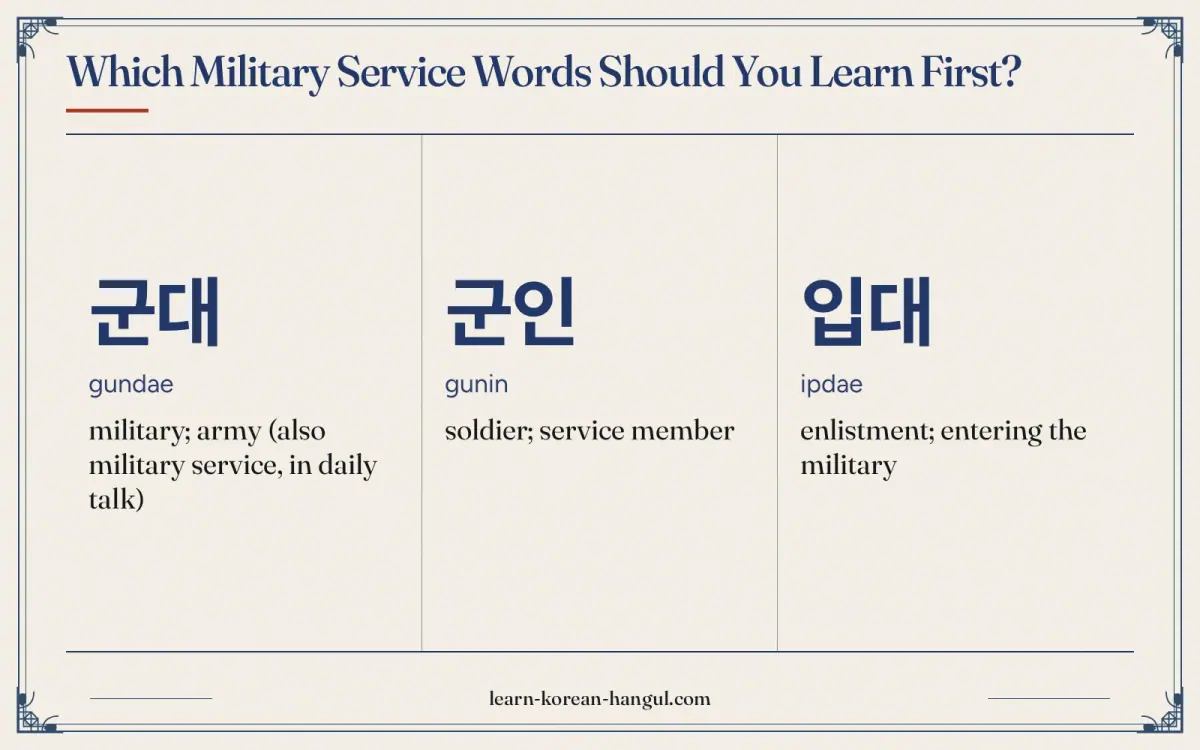
Learn 군대, 입대, 전역, 휴가 and 군필 first. They are the words that Korean speakers use in everyday talk, in dramas and on variety shows. The rank names and the barracks words are useful next, because they appear in stories about soldiers.
- Day one (7 words). 군대, 군인, 입대, 전역, 제대, 군필 and 휴가.
- Day two (6 words). The formal words 병역 and 군복무, and the ranks in order: 이병, 일병, 상병 and 병장.
- Day three (5 words). The training words: 훈련소, 훈련병, 훈련, 신병 and 군복.
- Day four (6 words). The barracks words: 부대, 생활관, 내무반, 점호, 초소 and 면회.
- Day five (6 words). The leave, exemption and system words: 외박, 외출, 면제, 대체복무, 병무청 and 예비군.
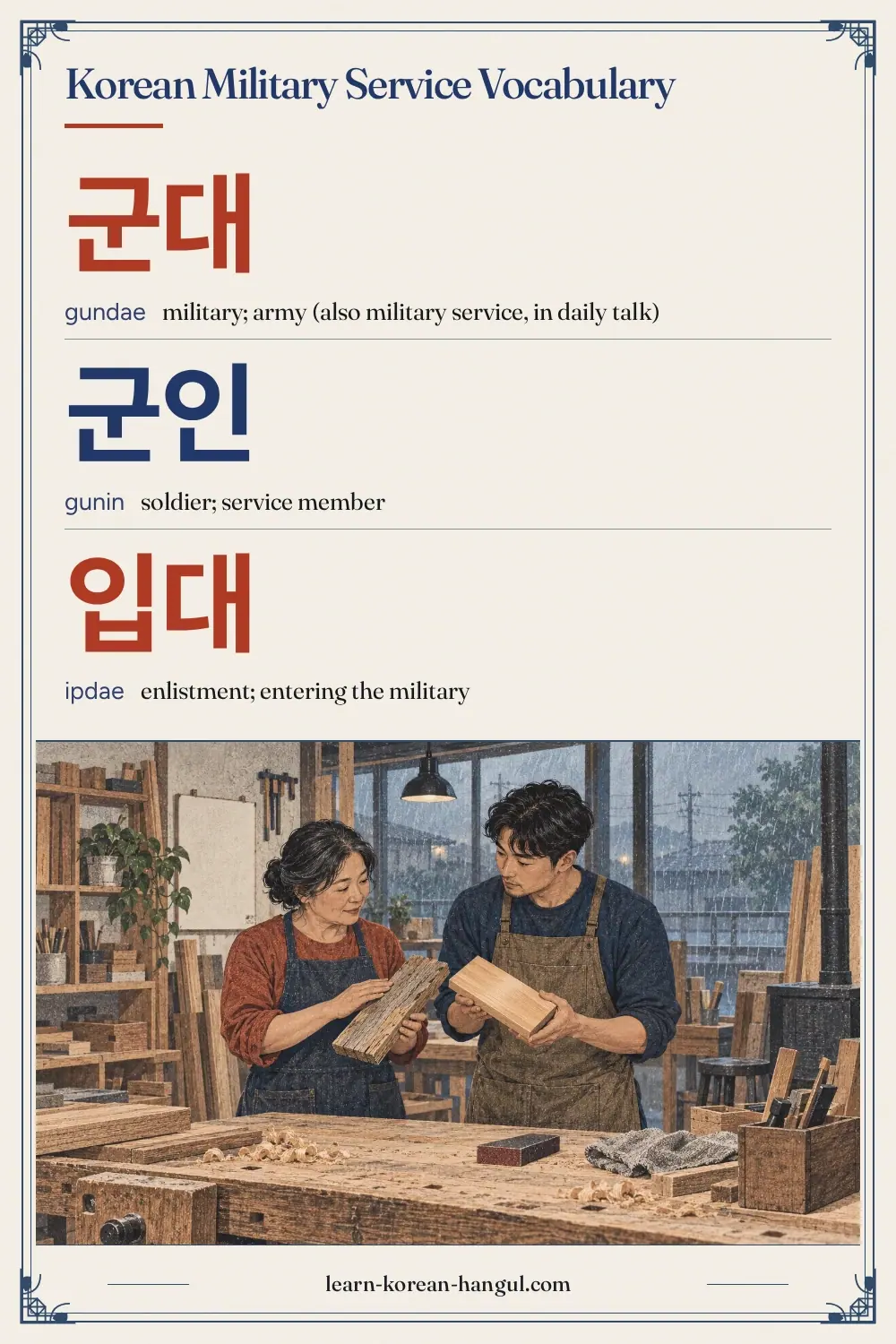
At about 6 words a day (7 + 6 + 5 + 6 + 6 = 30), the list takes five days. The scene below puts eight of the words on one picture.
Word · 8
- 1
군대
gundae
military; army (also military service, in daily talk)
- 2
군인
gunin
soldier; service member
- 3
입대
ipdae
enlistment; entering the military
- 4
훈련소
hullyeonso
training centre (for recruits)
- 5
부대
budae
unit; military base
- 6
휴가
hyuga
leave; vacation
- 7
전역
jeonyeok
discharge from active duty
- 8
군필
gunpil
having completed military service
All 30 words are Sino-Korean, and that has a practical benefit: many share syllables. The syllable 병 (soldier) appears in 이병, 일병, 상병, 병장, 훈련병, 신병 and 병역. Once you know it, ranks and recruits become easy to read.
Service and Ranks
The general word for the military is 군대. Informally, 군대 also means the period of service itself, as in 군대에 가다 (to go into the military). A person who serves is a 군인. The formal word for the duty is 병역, and the period of serving is the 군복무. The four enlisted ranks go in this order: 이병, 일병, 상병 and 병장.
| No. | Hangul | Revised Romanization | Origin | Meaning | Example sentence | Audio assetId |
|---|---|---|---|---|---|---|
| 1 | 군대 | gundae | Sino-Korean | military; army (also military service, in daily talk) | 그는 군대에 갔어요. (He went into the military.) | au-pg-vocabulary-society-military-1; example: au-pg-vocabulary-society-military-31 |
| 2 | 군인 | gunin | Sino-Korean | soldier; service member | 아버지는 군인이에요. (My father is a soldier.) | au-pg-vocabulary-society-military-2; example: au-pg-vocabulary-society-military-32 |
| 3 | 병역 | byeongnyeok | Sino-Korean | military duty (formal) | 병역에 대해 알고 싶어요. (I want to know about military duty.) | au-pg-vocabulary-society-military-3; example: au-pg-vocabulary-society-military-33 |
| 4 | 군복무 | gunbongmu | Sino-Korean | military service (the period of serving) | 군복무를 마쳤어요. (I finished my military service.) | au-pg-vocabulary-society-military-4; example: au-pg-vocabulary-society-military-34 |
| 5 | 이병 | ibyeong | Sino-Korean | private (lowest enlisted rank) | 이병은 가장 낮은 계급이에요. (A private is the lowest rank.) | au-pg-vocabulary-society-military-5; example: au-pg-vocabulary-society-military-35 |
| 6 | 일병 | ilbyeong | Sino-Korean | private first class | 이병 다음 계급은 일병이에요. (The rank after private is private first class.) | au-pg-vocabulary-society-military-6; example: au-pg-vocabulary-society-military-36 |
| 7 | 상병 | sangbyeong | Sino-Korean | corporal | 상병은 일병보다 계급이 높아요. (A corporal ranks higher than a private first class.) | au-pg-vocabulary-society-military-7; example: au-pg-vocabulary-society-military-37 |
| 8 | 병장 | byeongjang | Sino-Korean | sergeant (highest enlisted rank) | 병장은 병사 중에서 가장 높은 계급이에요. (A sergeant is the highest rank among enlisted soldiers.) | au-pg-vocabulary-society-military-8; example: au-pg-vocabulary-society-military-38 |
The table below puts the four ranks in a line, with the usual English name. The English names are approximate, because Korea's ranks do not match another country's system exactly.
| Order | Hangul | Approximate English |
|---|---|---|
| 1 | 이병 | private |
| 2 | 일병 | private first class |
| 3 | 상병 | corporal |
| 4 | 병장 | sergeant |
Officers have their own ranks and a separate title, 장교 (janggyo), and professional non-commissioned soldiers are 부사관 (busagwan). These two words are outside the 30, but you will see them next to the four ranks above. In 이병 and 일병, the numbers 이 (2) and 일 (1) count classes, and a lower class number means a higher rank. So 일병 outranks 이병, and each rank is best learned as one whole word.
Example Sentences
The examples use the pattern noun + 은/는 + noun + 이에요/예요 for definitions, such as 아버지는 군인이에요 (My father is a soldier). They also use the past tense for finished events, such as 군복무를 마쳤어요 (I finished my military service). Say each one aloud, then swap in another word from the same table.
How Do You Say Basic Training in Korean?
A man who is called up goes through 입대 (enlistment). New recruits are 신병, and during their first weeks they are 훈련병 at a 훈련소 (training centre), where they do basic 훈련 (training). They are given a 군복 (uniform). After training they are posted to a unit.
| No. | Hangul | Revised Romanization | Origin | Meaning | Example sentence | Audio assetId |
|---|---|---|---|---|---|---|
| 9 | 입대 | ipdae | Sino-Korean | enlistment; entering the military | 다음 달에 입대해요. (I will enlist next month.) | au-pg-vocabulary-society-military-9; example: au-pg-vocabulary-society-military-39 |
| 10 | 훈련소 | hullyeonso | Sino-Korean | training centre (for recruits) | 훈련소에서 기본 훈련을 받아요. (Recruits get basic training at the training centre.) | au-pg-vocabulary-society-military-10; example: au-pg-vocabulary-society-military-40 |
| 11 | 훈련병 | hullyeonbyeong | Sino-Korean | recruit in training | 훈련병은 매일 일찍 일어나요. (Recruits get up early every day.) | au-pg-vocabulary-society-military-11; example: au-pg-vocabulary-society-military-41 |
| 12 | 훈련 | hullyeon | Sino-Korean | training; drill | 훈련이 힘들어요. (The training is hard.) | au-pg-vocabulary-society-military-12; example: au-pg-vocabulary-society-military-42 |
| 13 | 신병 | sinbyeong | Sino-Korean | new recruit | 신병이 부대에 도착했어요. (A new recruit arrived at the unit.) | au-pg-vocabulary-society-military-13; example: au-pg-vocabulary-society-military-43 |
| 14 | 군복 | gunbok | Sino-Korean | military uniform | 군복을 입어요. (I wear a military uniform.) | au-pg-vocabulary-society-military-14; example: au-pg-vocabulary-society-military-44 |
Notice that 훈련 is said [훌련]. The ㄴ in 훈 becomes an ㄹ sound before the ㄹ in 련, and Revised Romanization shows that change as hullyeon. The same change appears in 훈련소 and 훈련병.
Barracks Life
A recruit lives and works in a 부대 (unit or base). The place where soldiers live together is a 생활관 today, and the older word is 내무반. You will still hear 내무반 in older stories and in the talk of older people. Each evening the unit holds a 점호 (roll call). A soldier on duty stands guard at a 초소 (guard post). Family and friends come to a 면회 (visit).
| No. | Hangul | Revised Romanization | Origin | Meaning | Example sentence | Audio assetId |
|---|---|---|---|---|---|---|
| 15 | 부대 | budae | Sino-Korean | unit; military base | 부대는 산 근처에 있어요. (The unit is near a mountain.) | au-pg-vocabulary-society-military-15; example: au-pg-vocabulary-society-military-45 |
| 16 | 생활관 | saenghwalgwan | Sino-Korean | barracks (living quarters) | 생활관에서 동료와 같이 지내요. (I live together with my comrades in the barracks.) | au-pg-vocabulary-society-military-16; example: au-pg-vocabulary-society-military-46 |
| 17 | 내무반 | naemuban | Sino-Korean | barracks room (older word) | 예전에는 내무반이라고 불렀어요. (In the past it was called a barracks room.) | au-pg-vocabulary-society-military-17; example: au-pg-vocabulary-society-military-47 |
| 18 | 점호 | jeomho | Sino-Korean | roll call | 저녁에 점호를 해요. (We have roll call in the evening.) | au-pg-vocabulary-society-military-18; example: au-pg-vocabulary-society-military-48 |
| 19 | 초소 | choso | Sino-Korean | guard post | 초소에서 경계를 서요. (I stand guard at the guard post.) | au-pg-vocabulary-society-military-19; example: au-pg-vocabulary-society-military-49 |
| 20 | 면회 | myeonhoe | Sino-Korean | visit (to a soldier) | 일요일에 면회를 갈 거예요. (I will go to visit on Sunday.) | au-pg-vocabulary-society-military-20; example: au-pg-vocabulary-society-military-50 |
The word pair 생활관 and 내무반 is a good example of vocabulary that changes. A drama set in the past will say 내무반, and a recent report will say 생활관. Both mean the room where soldiers sleep.
How Do You Say Leave and Discharge in Korean?
A soldier gets 휴가 (leave) or a shorter 외박 (overnight pass) or 외출 (a pass to go out for the day). Going home on leave is described with 나오다 (to come out), and going back is 복귀 (return to the unit). The end of service is 전역, and in daily talk it is 제대. A man who has finished service is 군필.
| No. | Hangul | Revised Romanization | Origin | Meaning | Example sentence | Audio assetId |
|---|---|---|---|---|---|---|
| 21 | 휴가 | hyuga | Sino-Korean | leave; vacation | 휴가를 나와서 가족을 만났어요. (I came out on leave and met my family.) | au-pg-vocabulary-society-military-21; example: au-pg-vocabulary-society-military-51 |
| 22 | 외박 | oebak | Sino-Korean | overnight pass | 주말에 외박을 나왔어요. (I came out on an overnight pass at the weekend.) | au-pg-vocabulary-society-military-22; example: au-pg-vocabulary-society-military-52 |
| 23 | 외출 | oechul | Sino-Korean | pass to go out; outing | 오늘 오후에 외출을 나갔어요. (I went out on a pass this afternoon.) | au-pg-vocabulary-society-military-23; example: au-pg-vocabulary-society-military-53 |
| 24 | 전역 | jeonyeok | Sino-Korean | discharge from active duty | 내년에 전역해요. (I will be discharged next year.) | au-pg-vocabulary-society-military-24; example: au-pg-vocabulary-society-military-54 |
| 25 | 제대 | jedae | Sino-Korean | discharge (everyday word) | 그는 작년에 제대했어요. (He was discharged last year.) | au-pg-vocabulary-society-military-25; example: au-pg-vocabulary-society-military-55 |
| 26 | 군필 | gunpil | Sino-Korean | having completed military service | 그는 군필이에요. (He has completed his military service.) | au-pg-vocabulary-society-military-26; example: au-pg-vocabulary-society-military-56 |
You will often hear the question 군필이에요? ("Have you completed military service?"). It is a yes-or-no question, so it ends with a rise. The opposite of 군필 is 미필 (mipil, not yet completed). The pair is common in stories and in job or dating talk, but it is a personal topic, so treat it with some care when you ask a real person.
Exemptions and Alternatives
Not everyone serves in the military. 면제 means exemption, for example for health reasons, and 대체복무 is alternative service done outside the military. The office that handles the system is the 병무청, the Military Manpower Administration. After discharge, a man belongs to the 예비군 (reserve forces) for a set period and joins periodic training.
| No. | Hangul | Revised Romanization | Origin | Meaning | Example sentence | Audio assetId |
|---|---|---|---|---|---|---|
| 27 | 면제 | myeonje | Sino-Korean | exemption | 건강 때문에 병역을 면제받았어요. (He was exempted from military duty for health reasons.) | au-pg-vocabulary-society-military-27; example: au-pg-vocabulary-society-military-57 |
| 28 | 대체복무 | daechebongmu | Sino-Korean | alternative service | 대체복무는 군대 밖에서 하는 복무예요. (Alternative service is service done outside the military.) | au-pg-vocabulary-society-military-28; example: au-pg-vocabulary-society-military-58 |
| 29 | 병무청 | byeongmucheong | Sino-Korean | Military Manpower Administration | 병무청에서 안내문이 왔어요. (A notice came from the Military Manpower Administration.) | au-pg-vocabulary-society-military-29; example: au-pg-vocabulary-society-military-59 |
| 30 | 예비군 | yebigun | Sino-Korean | reserve forces | 예비군 훈련이 있어요. (There is reserve forces training.) | au-pg-vocabulary-society-military-30; example: au-pg-vocabulary-society-military-60 |
The rules for who is exempt, who does alternative service and how long the reserve period lasts are set by law and can change. The page does not list them. Use the 병무청 website for current information, and ask a person who knows the system for a real case.
How Do You Pronounce These Words?
Several words in this list change in speech, because Sino-Korean syllables join. The table lists the changes that learners most often miss. Brackets show the spoken sound.
| Spelling | Pronunciation | What happens |
|---|---|---|
| 입대 | [입때] | The ㄷ after a final ㅂ is said tense |
| 병역 | [병녁] | A ㄴ sound is inserted before 역, and Revised Romanization writes byeongnyeok |
| 훈련 | [훌련] | The ㄴ before ㄹ becomes ㄹ, so you hear hul-lyeon |
| 전역 | [저녁] | The final ㄴ moves onto the vowel of 역, so it sounds like 저녁 (evening) |
| 군인 | [구닌] | The final ㄴ moves onto the vowel of 인 |
| 군복무 | [군봉무] | The final ㄱ of 복 becomes the ng sound before the nasal ㅁ, and Revised Romanization writes gunbongmu |
| 병장 | [병장] | The ㅇ at the end of 병 is the ng sound, with no change |
The rules come from the Standard Pronunciation rules (표준 발음법) of the 국립국어원. The romanization in the word tables is a learning aid. It writes the ㄴ-insertion in byeongnyeok, the nasal sound in gunbongmu and the ㄹ assimilation in hullyeon, but it does not show tensing such as [입때].
Audio and Slow Playback
Each word has a normal clip. Five words with tricky sounds also have a slow clip at 0.8 times the speed: 입대, 병역, 훈련, 전역 and 군인. Nothing plays until you press a button. The audio is generated with text-to-speech and checked by a Korean teacher before publication.
Listen to 전역 first. You should hear jeo-nyeok, the same sound as the word for evening. Context tells them apart.
What Mistakes Do Learners Make with Military Service Words?
- Confusing 전역 with 저녁. Both sound like [저녁]. 전역 is discharge, and 저녁 is evening. The context decides, as in 내년에 전역해요 (I will be discharged next year) and 저녁에 점호를 해요 (roll call is in the evening).
- Mixing 전역 and 제대. Both mean leaving active service. 전역 is the official word, and 제대 is the everyday one. In writing and formal speech, use 전역.
- Using 군대 only for the place. Wrong: 군대 as a building only. Correct: 군대 also means the whole military and, in daily talk, the period of service.
- Saying ipdae with a plain d. Wrong: ip-dae with a soft d. Correct: [입때], with a tense d.
- Reading the ranks as plain numbers. Wrong: thinking 이병 (2) is above 일병 (1) because 2 is bigger. Correct: the class number counts down, so 일병 is higher than 이병.
- Using 내무반 for a modern base. It is understood, but 생활관 is the usual word now.
Mistakes one, three and five change the meaning, mistake four changes the sound, and mistakes two and six change how natural you sound.
Everyday Words and Drama Words
Not every word is equally likely to come up. The table sorts them by where you are most likely to hear them.
| Where you meet it | Words |
|---|---|
| Daily talk | 군대, 입대, 제대, 군필, 휴가, 훈련 |
| Stories about soldiers | 이병, 일병, 상병, 병장, 점호, 면회, 외박 |
| Official writing | 병역, 군복무, 전역, 면제, 대체복무, 병무청 |
If you watch Korean dramas, the second row will help most. The K-drama phrases page has the sentences that go with these scenes. For a single word and its usage, see military service in Korean.
Practice: Flashcards and Worksheet
Drill these words with the vocabulary flashcard decks. A printable worksheet for these words (word list, matching, writing practice, fill-in-the-blank exercises and answer key) is available in A4 and US Letter from the download card on this page. Progress in the decks is saved only in your browser.
Military Service Vocabulary Worksheet
Try this five-question check, then say all 30 words aloud once more.
Practice · 5
What does 군대 mean?
Show answer
military; army (also military service, in daily talk)
군대 (gundae) means military; army (also military service, in daily talk).
What does 입대 mean?
Show answer
enlistment; entering the military
입대 (ipdae) means enlistment; entering the military.
What does 병장 mean?
Show answer
sergeant (highest enlisted rank)
병장 (byeongjang) means sergeant (highest enlisted rank).
What does 휴가 mean?
Show answer
leave; vacation
휴가 (hyuga) means leave; vacation.
What does 전역 mean?
Show answer
discharge from active duty
전역 (jeonyeok) means discharge from active duty.
Where to Go Next
This list sits inside Korean Society Vocabulary. After Korean military service vocabulary, many learners move on to Korean Law and Crime Vocabulary, which shares the Sino-Korean building blocks, or to Korean Renting and Housing Vocabulary.
Frequently Asked Questions
How Do You Say Military in Korean?
Military is 군대 (gundae). It is a Sino-Korean word, and in daily talk it also means military service, as in 군대에 갔어요 (he went into the military). The formal word for the duty is 병역 (byeongnyeok). A soldier is 군인 (gunin). Press the audio button to hear the word.
How Do You Pronounce 입대 (ipdae)?
입대 is said [입때], ip-ddae, in two beats. The ㅂ at the end of 입 is closed and not released, and the ㄷ that follows it is said tense, with no puff of air. Revised Romanization writes ipdae and does not show the tensing. Use the slow clip to match the rhythm.
How Many Military Service Words Should I Learn First?
Learn five first: 군대, 입대, 전역, 휴가 and 군필. That takes one day. Then add the ranks, the training words and the barracks words. The whole list of 30 takes five days at about 6 words a day, with review on the sixth day.
Where Can I Practise Military Service Words with Flashcards?
Use the vocabulary flashcard decks, which list every deck with audio. A deck for these words is planned. Progress stays in your browser. Until then, copy a table above onto cards: Hangul on one side, English on the other, and say each word aloud as you flip it.
Is the Romanization on This Page Official?
It follows the Revised Romanization of Korean, which South Korea officially adopted on 7 July 2000 and whose rules the National Institute of Korean Language (국립국어원) publishes. It is a learning aid that does not show tensing caused by a neighbouring sound, so learn the Hangul and use the audio to hear the real sound.
Is There a Printable Worksheet for Military Service Words?
A printable worksheet for these words (word list, matching, writing practice, fill-in-the-blank exercises and answer key) is available in A4 and US Letter from the download card on this page. For practice, write the Hangul from memory, cover the English column and check your answers against the tables above.