
Korean Society Vocabulary at a Glance
Korean society vocabulary is the language of public life. It is what you read in a newspaper, hear in a news report and see in a notice from your building. Each topic has its own list of 30 to 35 words, so this page only routes you. It belongs to Korean Vocabulary, and the single word is on the society in Korean page.
| List | Words | Best for | Level |
|---|---|---|---|
| Korean Environment Vocabulary | 35 | Climate, pollution, recycling and energy | B1 |
| Korean Politics and Government Vocabulary | 35 | The government, elections, parties and policies | B1 |
| Korean Law and Crime Vocabulary | 35 | Laws, police, courts and everyday legal terms | B1 |
| Korean Military Service Vocabulary | 30 | Enlistment, ranks, barracks life and discharge | B1 |
| Korean Renting and Housing Vocabulary | 35 | Jeonse, wolse, deposits, contracts and moving | B1 |
| Korean News and Media Vocabulary | 35 | News types, headlines, broadcasts and online news | B1 |
| Korean Finance and Stocks Vocabulary | 35 | Stocks, investing, banks, taxes and economic news | B2 |
Which List Should You Open First?
Open the list that matches what you need this week. A learner who lives in Korea meets the housing and recycling words first. A reader of news starts with the news list. A student preparing for reading tests may begin with politics or law, since news-style topics are common there; the official TOPIK site, topik.go.kr, describes what each exam tests.
- To rent a home. Start with Korean Renting and Housing Vocabulary, then read the house vocabulary list.
- To sort trash and follow the weather. Start with Korean Environment Vocabulary.
- To read the news. Start with Korean News and Media Vocabulary, then Korean Politics and Government Vocabulary.
- To follow a court story or a contract. Start with Korean Law and Crime Vocabulary.
- To understand a common topic in Korean life. Open Korean Military Service Vocabulary.




Environment
The environment list has 35 words on climate, pollution, recycling, energy and nature. It begins with 환경 (hwangyeong), the environment, and 기후변화 (climate change), and it explains how Korean households sort trash into general waste, food waste and recyclables, which is daily vocabulary for anyone living in Korea.
What Is in the Politics and Government List?
The politics and government list has 35 words for the president, the National Assembly, elections and local government, such as 정부 (government), 선거 (election) and 국회 (National Assembly). The definitions stay neutral: no party or politician is named, and the words are taught as vocabulary, not as opinion.
Law and Crime
The law and crime list has 35 words for laws, police, courts, trials and everyday legal terms, from 법 (law) to 법원 (court) and 계약서 (contract). It also shows how endings such as -죄 and -권 build legal words. It teaches vocabulary only, and it is not legal advice.
What Is in the Military Service List?
The military service list has 30 words about enlistment, ranks, barracks life, leave and discharge, such as 군대 (military) and 입대 (enlistment). Military service is a common topic in Korean conversation and drama, so these words help you follow stories and small talk. It gives no service lengths or rules.
Housing and Renting
The housing and renting list has 35 words for housing types, deposits, rent, contracts and moving. It explains 전세 (a large deposit with no monthly rent) and 월세 (monthly rent), which confuse many newcomers, and it shows how to read a rental listing.
What Is in the News and Media List?
The news and media list has 35 words for news types, newspapers, headlines, social media news and opinion, such as 뉴스 (news), 속보 (breaking news) and 헤드라인 (headline). It shows how headlines drop particles and endings, which helps with every other list on this page.
Finance and Stocks
The finance and stocks list has 35 words in five groups of seven: markets and stocks, investing, banks and insurance, taxes, and economic news, starting with 주식 (stock). The words are for reading and talking, not financial advice. For everyday money words, see the Korean won page.
Why Are so Many Society Words Sino-Korean?
Public-life words are mostly Sino-Korean, which means they are built from Chinese-character parts. Korean borrowed these parts long ago for law, government and science, and the same parts appear again and again. If you know that 법 means law, then 법원, 법률 and 헌법 are no longer three new words. The table shows four parts that open many lists.
| Part | Meaning | Words you can read |
|---|---|---|
| 법 | law | 법원 (court), 법률 (law), 헌법 (constitution) |
| 정 | government, politics | 정부 (government), 정치 (politics), 정책 (policy) |
| 오염 | pollution | 대기오염 (air pollution), 수질오염 (water pollution) |
| 군 | military | 군대 (military), 군인 (soldier), 군복무 (military service) |
The Sino-Korean words page explains how to read these parts, and each topic list marks the origin of every word.
How Do Headlines Write Society News?
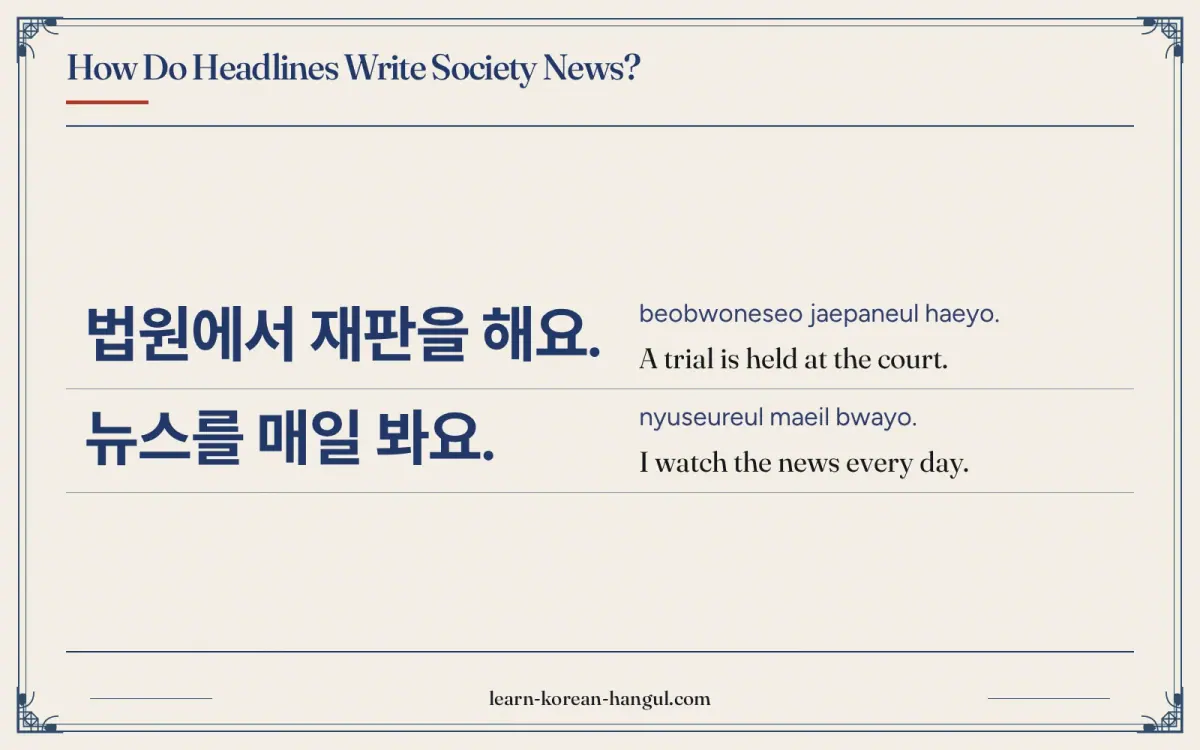
News headlines pack the facts into nouns, with no particles and no polite endings. A reader adds the missing pieces. The table decodes two headlines, and the real-world texts section has more reading practice.
| Headline | Plain sentence | Meaning |
|---|---|---|
| 정부, 새 정책 발표 | 정부가 새 정책을 발표했다 | The government announced a new policy |
| 법원, 재판 연기 | 법원이 재판을 연기했다 | The court postponed the trial |
Written news ends its sentences with the plain -다 form, as in 발표했다, and not with -요. Here are three sample sentences in the spoken polite style, with audio.
정부는 새 정책을 발표했어요.
jeongbuneun sae jeongchaegeul balpyohaesseoyo.
The government announced a new policy.
법원에서 재판을 해요.
beobwoneseo jaepaneul haeyo.
A trial is held at the court.
뉴스를 매일 봐요.
nyuseureul maeil bwayo.
I watch the news every day.
A Note on Politics and Sensitive Topics
Politics, law and the military are topics where opinions run strong. The lists teach words and meanings only. They do not name parties or politicians, and they take no side. The example sentences are neutral statements, such as 정부는 새 정책을 발표했어요. When you talk about these topics in Korean, listen first, and use polite speech, since opinions on public matters can be personal.
What Do All the Lists Have in Common?
All the topic lists follow one format, so you can move from one to another without learning a new layout.
- Hangul and Revised Romanization. Every word is written in Hangul with a romanization as a learning aid, never on its own.
- One example sentence. A short polite sentence shows the word in use.
- Groups of about seven. The lists are split into groups so you can learn a few words a day.
- An origin label. The tables mark native, Sino-Korean, loanword and mixed words.
- Pronunciation notes. Each list explains the sound changes that learners most often miss.
Hear one word from each list before you choose. Nothing plays until you press a button.
Practice: Flashcards and Worksheet
Drill society words with the vocabulary flashcard decks. A printable worksheet for these words (word list, matching, writing practice and answer key) is available in A4 and US Letter from the download card on this page. Try this quick check on one word from each list.
Korean Society Vocabulary Worksheet
Practice · 5
What does 환경 mean?
Show answer
environment
환경 (hwangyeong) means environment.
What does 정부 mean?
Show answer
government
정부 (jeongbu) means government.
What does 법원 mean?
Show answer
court
법원 (beobwon) means court.
What does 군대 mean?
Show answer
military
군대 (gundae) means military.
What does 전세 mean?
Show answer
lump-sum deposit rental
전세 (jeonse) means lump-sum deposit rental.
Where to Go Next
This hub sits inside Korean Vocabulary. After Korean society vocabulary, many learners move on to Korean Pronouns, Question Words and Connectors, the small words that hold news sentences together. Topic lists in other areas are on the Korean Vocabulary hub.
Frequently Asked Questions
Which List in Korean Society Vocabulary Should I Start With?
Start with the list that matches your goal. For news and daily life, open Korean News and Media Vocabulary first. If you live in Korea, open Korean Renting and Housing Vocabulary and Korean Environment Vocabulary, because you meet those words every week. For general reading, start with Korean Politics and Government Vocabulary. All the lists are written at B1, an editorial estimate and not an official level.
How Are the Lists in Korean Society Vocabulary Organised?
Each list is its own page with 30 to 35 words, split into groups of about seven. Every word has Hangul, Revised Romanization, audio and one example sentence, and every list has a pronunciation table and a short quiz. This hub only helps you choose, so the full teaching is on the topic pages.
Do These Lists Include Verbs and Adjectives?
Almost all the entries are nouns, because society topics are named with nouns. The verbs and adjectives that go with them, such as 발표하다 (to announce) or 보호하다 (to protect), are covered in the verbs hub. Example sentences show how the nouns work with common verbs.
Where Can I Find Flashcards and Worksheets for These Topics?
The vocabulary flashcard decks page lists every deck, with audio, and the vocabulary worksheets page lists the printable sheets. Decks for the society lists are planned and not all are published yet. Progress in the decks stays in your browser.
Why Do so Many Society Words Look Alike?
Most of them are Sino-Korean, which means they are built from a small set of Chinese-character parts that repeat. For example, 법 (law) appears in 법원 (court), 법률 (law) and 헌법 (constitution). Once you learn a part, you can read many new words. The Sino-Korean words page explains the idea.