Korean Law and Crime Vocabulary at a Glance
Korean law and crime vocabulary is the set of words you meet in news reports, dramas and everyday paperwork about rules, courts and crimes. Most of them are Sino-Korean words, which means they were built from Chinese-origin syllables and are read with Korean sounds. That is good news for a learner, because the same syllables repeat. Once you know 죄 (crime) and 권 (right), you can read many new terms. This page holds 35 words in five groups, and every word has Hangul, Revised Romanization, audio and one example sentence.
| Group | Words | Use |
|---|---|---|
| Laws and rights | 7 | Talking about rules, duties and basic rights |
| Police and courts | 7 | Naming the people and places of the justice system |
| Crimes | 7 | Reading and discussing crime news |
| Lawyers and trials | 7 | Following a trial and its verdict |
| Everyday legal terms | 7 | Contracts, reports, deposits and fines |
This list sits inside Korean Society Vocabulary. The words offer vocabulary only and are not legal advice. A contract or a court case in Korea should be handled with a qualified professional, and this page cannot say how any law applies to you.
Which Law and Crime Words Should You Learn First?
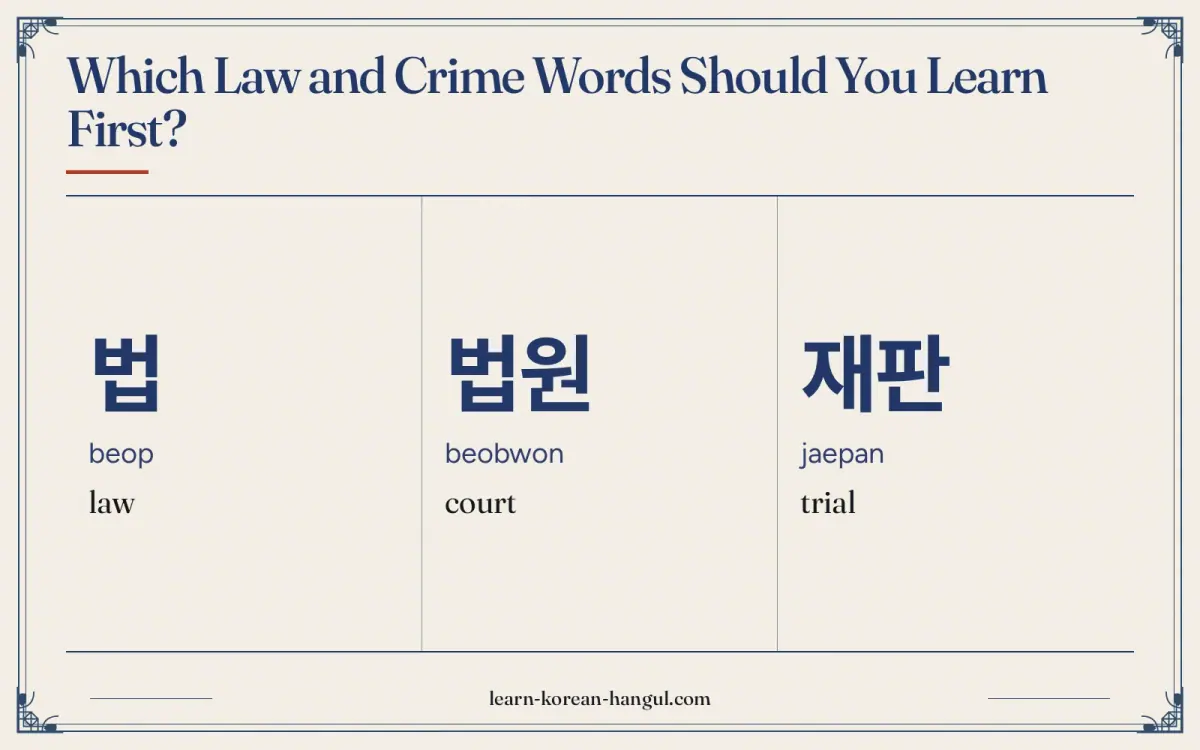
Start with the words that appear outside the courtroom: 법, 경찰, 신고, 계약 and 벌금. You will hear or read them in daily life, for example on signs, in apartment paperwork and in the news. Words such as 피고인 and 원고 mostly appear in trial reports, so they can wait.
- Day one (8 words). 법, 법원, 경찰, 경찰서, 검찰, 신고, 범죄 and 증거.
- Day two (6 words). The rights words: 법률, 헌법, 권리, 인권, 의무 and 규칙.
- Day three (7 words). The trial words: 재판, 판사, 검사, 변호사, 판결, 유죄 and 무죄.
- Day four (8 words). The crime words and the people in a case: 사기, 절도, 폭행, 음주운전, 도둑, 피고인, 원고 and 증인.
- Day five (6 words). The paperwork words: 계약, 계약서, 보증금, 합의, 소송 and 벌금.
At 6 to 8 words a day (8 + 6 + 7 + 8 + 6 = 35), the list takes five days. The scene below puts eight of the words on one picture, so you can link each word to an image.
Word · 8
- 1
법
beop
law
- 2
법원
beobwon
court
- 3
재판
jaepan
trial
- 4
판사
pansa
judge
- 5
변호사
byeonhosa
lawyer
- 6
범죄
beomjoe
crime
- 7
증거
jeunggeo
evidence
- 8
계약
gyeyak
contract
By origin, 34 of the 35 words are Sino-Korean. The only native Korean word is 도둑 (thief). That is typical for legal language, which was written in Chinese characters for centuries. The origin column in each table marks the word type.
Laws and Rights
A 법 is a law, and 법률 is a law as it is written down by the legislature. The 헌법, the constitution, sits at the top. A 권리 is a right that a person holds, and an 의무 is a duty that a person owes. Both end up in the news as pairs, as in 권리와 의무 (rights and duties). 인권 means human rights, and 규칙 is a plain rule, such as a school rule or a game rule, with no court involved.
| No. | Hangul | Revised Romanization | Origin | Meaning | Example sentence | Audio assetId |
|---|---|---|---|---|---|---|
| 1 | 법 | beop | Sino-Korean | law | 모든 사람이 법을 지켜요. (Everyone obeys the law.) | au-pg-vocabulary-society-law-1; example: au-pg-vocabulary-society-law-36 |
| 2 | 법률 | beomnyul | Sino-Korean | statute; law as written | 새로운 법률이 생겼어요. (A new law has been made.) | au-pg-vocabulary-society-law-2; example: au-pg-vocabulary-society-law-37 |
| 3 | 헌법 | heonbeop | Sino-Korean | constitution | 헌법은 가장 중요한 법이에요. (The constitution is the most important law.) | au-pg-vocabulary-society-law-3; example: au-pg-vocabulary-society-law-38 |
| 4 | 권리 | gwolli | Sino-Korean | right (legal or moral) | 모든 사람은 권리가 있어요. (Everyone has rights.) | au-pg-vocabulary-society-law-4; example: au-pg-vocabulary-society-law-39 |
| 5 | 인권 | ingwon | Sino-Korean | human rights | 인권은 모든 사람에게 중요해요. (Human rights matter to everyone.) | au-pg-vocabulary-society-law-5; example: au-pg-vocabulary-society-law-40 |
| 6 | 의무 | uimu | Sino-Korean | duty; obligation | 세금을 내는 것은 시민의 의무예요. (Paying taxes is a citizen's duty.) | au-pg-vocabulary-society-law-6; example: au-pg-vocabulary-society-law-41 |
| 7 | 규칙 | gyuchik | Sino-Korean | rule | 학교에는 규칙이 있어요. (There are rules at school.) | au-pg-vocabulary-society-law-7; example: au-pg-vocabulary-society-law-42 |
The words 법 and 법률 overlap. Use 법 when you talk about law in general or about a named law, as in 법을 지켜요. Use 법률 when the text is about the written text of a specific law, as in 새로운 법률. In daily speech, 법 is far more common.
Example Sentences
The examples in this group follow two simple patterns. The first is noun + 이/가 + 있어요, as in 권리가 있어요 (there are rights). The second is noun + 을/를 + verb, as in 법을 지켜요 (obey the law). Say each sentence aloud, then replace the noun with another word from the same table. For instance, 모든 사람은 권리가 있어요 becomes 모든 사람은 의무가 있어요 when you swap 권리 for 의무.
How Do You Say Police and Courts in Korean?
The police are 경찰, and the building is a 경찰서. A court is a 법원. The person who leads a trial is a 판사 (judge), and the person who brings a criminal case against a suspect is a 검사 (prosecutor). The prosecutors as a body, or their office, are the 검찰. A trial itself is a 재판.
| No. | Hangul | Revised Romanization | Origin | Meaning | Example sentence | Audio assetId |
|---|---|---|---|---|---|---|
| 8 | 경찰 | gyeongchal | Sino-Korean | police | 경찰이 도착했어요. (The police have arrived.) | au-pg-vocabulary-society-law-8; example: au-pg-vocabulary-society-law-43 |
| 9 | 경찰서 | gyeongchalseo | Sino-Korean | police station | 경찰서는 우리 집 근처에 있어요. (The police station is near my home.) | au-pg-vocabulary-society-law-9; example: au-pg-vocabulary-society-law-44 |
| 10 | 법원 | beobwon | Sino-Korean | court | 법원은 시청 옆에 있어요. (The court is next to city hall.) | au-pg-vocabulary-society-law-10; example: au-pg-vocabulary-society-law-45 |
| 11 | 재판 | jaepan | Sino-Korean | trial | 재판은 내일 열려요. (The trial opens tomorrow.) | au-pg-vocabulary-society-law-11; example: au-pg-vocabulary-society-law-46 |
| 12 | 판사 | pansa | Sino-Korean | judge | 그 사람은 판사예요. (That person is a judge.) | au-pg-vocabulary-society-law-12; example: au-pg-vocabulary-society-law-47 |
| 13 | 검사 | geomsa | Sino-Korean | prosecutor | 검사는 범죄를 조사해요. (A prosecutor investigates crimes.) | au-pg-vocabulary-society-law-13; example: au-pg-vocabulary-society-law-48 |
| 14 | 검찰 | geomchal | Sino-Korean | prosecution; the prosecutors' office | 검찰이 사건을 조사하고 있어요. (The prosecution is looking into the case.) | au-pg-vocabulary-society-law-14; example: au-pg-vocabulary-society-law-49 |
Three of these words end in the suffix -사 (person in a profession): 판사, 검사 and, in the next groups, 변호사. The suffix -사 is easy to spot, which makes new job titles easier to guess. Notice also that 경찰서 is made of 경찰 (police) plus 서 (署, office). The 서 in 계약서 (written contract) is a different character (書, document) that happens to sound the same.
Crimes
A crime in general is a 범죄. The word 사기 is fraud or a scam, 절도 is theft, and 폭행 is assault. Drunk driving is 음주운전, and the evidence in a case is the 증거. The only native Korean word in the list is 도둑, which is the everyday word for a thief or burglar. News reports prefer 절도범 (theft offender) over 도둑, but people say 도둑 when they talk at home.
| No. | Hangul | Revised Romanization | Origin | Meaning | Example sentence | Audio assetId |
|---|---|---|---|---|---|---|
| 15 | 범죄 | beomjoe | Sino-Korean | crime | 범죄를 보면 경찰에 신고하세요. (If you see a crime, report it to the police.) | au-pg-vocabulary-society-law-15; example: au-pg-vocabulary-society-law-50 |
| 16 | 사기 | sagi | Sino-Korean | fraud; scam | 인터넷 사기를 조심하세요. (Be careful of online scams.) | au-pg-vocabulary-society-law-16; example: au-pg-vocabulary-society-law-51 |
| 17 | 절도 | jeoldo | Sino-Korean | theft | 절도 사건이 있었어요. (There was a theft case.) | au-pg-vocabulary-society-law-17; example: au-pg-vocabulary-society-law-52 |
| 18 | 폭행 | pokhaeng | Sino-Korean | assault; violence | 폭행은 큰 범죄예요. (Assault is a serious crime.) | au-pg-vocabulary-society-law-18; example: au-pg-vocabulary-society-law-53 |
| 19 | 음주운전 | eumjuunjeon | Sino-Korean | drunk driving | 음주운전은 위험해요. (Drunk driving is dangerous.) | au-pg-vocabulary-society-law-19; example: au-pg-vocabulary-society-law-54 |
| 20 | 도둑 | doduk | native | thief; burglar | 집에 도둑이 들어왔어요. (A thief got into the house.) | au-pg-vocabulary-society-law-20; example: au-pg-vocabulary-society-law-55 |
| 21 | 증거 | jeunggeo | Sino-Korean | evidence | 증거가 필요해요. (Evidence is needed.) | au-pg-vocabulary-society-law-21; example: au-pg-vocabulary-society-law-56 |
The glosses here are neutral definitions, and the page avoids describing any real case. Notice that in 폭행 the final ㄱ of 폭 and the ㅎ of 행 merge into an aspirated k sound: [포캥]. The next section looks at that in the sound notes.
Reading Legal Terms: -죄, -권, -인, -사 and -금
Legal Korean is built from short Sino-Korean pieces. If you recognise the piece, you can guess much of the meaning of a word you have never seen. The table shows the five most useful pieces.
| Piece | Meaning | Words on this page | Another word you can read |
|---|---|---|---|
| -죄 (joe) | crime; guilt | 범죄, 유죄, 무죄 | 살인죄 (salinjoe, the crime of murder) |
| -권 (gwon) | right | 인권 | 저작권 (jeojakgwon, copyright) |
| -인 (in) | person | 피고인, 증인 | 보증인 (bojeungin, guarantor) |
| -사 (sa) | professional | 판사, 검사, 변호사 | 회계사 (hoegyesa, accountant) |
| -금 (geum) | money | 보증금, 벌금 | 계약금 (gyeyakgeum, down payment) |
This kind of pattern reading is one reason Sino-Korean words are worth learning as families rather than one by one. The Sino-Korean words list works the same way for other topics.
How Do You Say Lawyers and Trials in Korean?
A lawyer is a 변호사. In a trial, the 원고 is the plaintiff who brings a case, and the 피고인 is the person accused of a crime. A person who speaks about what they saw is a 증인. The 판결 is the court's ruling. A guilty verdict is 유죄, and a not-guilty verdict is 무죄. Both end in 죄 (crime or guilt), so 유 (have) and 무 (not have) are the only parts that change.
| No. | Hangul | Revised Romanization | Origin | Meaning | Example sentence | Audio assetId |
|---|---|---|---|---|---|---|
| 22 | 변호사 | byeonhosa | Sino-Korean | lawyer | 변호사를 만났어요. (I met a lawyer.) | au-pg-vocabulary-society-law-22; example: au-pg-vocabulary-society-law-57 |
| 23 | 피고인 | pigoin | Sino-Korean | defendant | 피고인에게는 변호사를 만날 권리가 있어요. (The defendant has the right to meet a lawyer.) | au-pg-vocabulary-society-law-23; example: au-pg-vocabulary-society-law-58 |
| 24 | 원고 | wongo | Sino-Korean | plaintiff | 원고가 증거를 제출했어요. (The plaintiff submitted evidence.) | au-pg-vocabulary-society-law-24; example: au-pg-vocabulary-society-law-59 |
| 25 | 증인 | jeungin | Sino-Korean | witness (in court) | 증인이 법원에 왔어요. (The witness came to the court.) | au-pg-vocabulary-society-law-25; example: au-pg-vocabulary-society-law-60 |
| 26 | 판결 | pangyeol | Sino-Korean | verdict; ruling | 판결이 오늘 나왔어요. (The ruling came out today.) | au-pg-vocabulary-society-law-26; example: au-pg-vocabulary-society-law-61 |
| 27 | 유죄 | yujoe | Sino-Korean | guilty (verdict) | 법원은 유죄라고 판결했어요. (The court ruled that he was guilty.) | au-pg-vocabulary-society-law-27; example: au-pg-vocabulary-society-law-62 |
| 28 | 무죄 | mujoe | Sino-Korean | not guilty; innocent (verdict) | 피고인은 무죄라는 판결을 받았어요. (The defendant received a not-guilty verdict.) | au-pg-vocabulary-society-law-28; example: au-pg-vocabulary-society-law-63 |
Korean courts also use 피고 for a defendant in a civil case. In news about criminal trials, you will see 피고인. The page keeps to 피고인, because it is the term for a person accused in a criminal trial.
Everyday Legal Terms (계약, 신고)
Most learners meet legal Korean through paperwork, not through trials. A 계약 is a contract, and the paper itself is a 계약서. When you rent a home, you usually pay a 보증금, a deposit that is returned at the end of the contract. When you tell the authorities about a crime, a loss or a problem, you make a 신고. If two sides settle without a judge, that is a 합의. A lawsuit is a 소송, and a money penalty is a 벌금.
| No. | Hangul | Revised Romanization | Origin | Meaning | Example sentence | Audio assetId |
|---|---|---|---|---|---|---|
| 29 | 계약 | gyeyak | Sino-Korean | contract | 집 계약을 했어요. (I signed a contract for a home.) | au-pg-vocabulary-society-law-29; example: au-pg-vocabulary-society-law-64 |
| 30 | 계약서 | gyeyakseo | Sino-Korean | written contract | 계약서를 꼼꼼히 읽으세요. (Read the contract carefully.) | au-pg-vocabulary-society-law-30; example: au-pg-vocabulary-society-law-65 |
| 31 | 신고 | singo | Sino-Korean | report (to the authorities) | 휴대폰을 잃어버려서 신고했어요. (I lost my phone, so I reported it.) | au-pg-vocabulary-society-law-31; example: au-pg-vocabulary-society-law-66 |
| 32 | 보증금 | bojeunggeum | Sino-Korean | deposit (security deposit) | 보증금은 계약이 끝나면 돌려받아요. (You get the deposit back when the contract ends.) | au-pg-vocabulary-society-law-32; example: au-pg-vocabulary-society-law-67 |
| 33 | 합의 | habui | Sino-Korean | agreement; settlement | 두 사람은 합의를 했어요. (The two people reached an agreement.) | au-pg-vocabulary-society-law-33; example: au-pg-vocabulary-society-law-68 |
| 34 | 소송 | sosong | Sino-Korean | lawsuit | 소송은 시간이 오래 걸려요. (A lawsuit takes a long time.) | au-pg-vocabulary-society-law-34; example: au-pg-vocabulary-society-law-69 |
| 35 | 벌금 | beolgeum | Sino-Korean | fine (money penalty) | 벌금을 냈어요. (I paid a fine.) | au-pg-vocabulary-society-law-35; example: au-pg-vocabulary-society-law-70 |
The housing words in this group connect directly to renting and housing, where 보증금 appears next to 월세 (monthly rent) and 전세 (a lump-sum deposit rental). For a single-word lookup, the pages for law in Korean and police in Korean go deeper into one word each.
How Do You Pronounce These Words?
Many Sino-Korean law words change in speech. The table lists the changes that learners most often miss. Brackets show the spoken sound. The romanization in the word tables follows RR, which shows some of these changes and not others.
| Spelling | Pronunciation | What happens |
|---|---|---|
| 법원 | [버붠] | The final ㅂ of 법 moves onto the vowel of 원, so you hear beo-bwon |
| 법률 | [범뉼] | The ㄹ becomes ㄴ after ㅂ, and the ㅂ turns into ㅁ before ㄴ |
| 권리 | [궐리] | The ㄴ before ㄹ becomes ㄹ, so you hear gwol-li |
| 인권 | [인꿘] | The ㄱ of 권 is said tense after ㄴ in this word |
| 절도 | [절또] | In Sino-Korean words, ㄷ after ㄹ is said tense |
| 폭행 | [포캥] | The final ㄱ and the ㅎ join into an aspirated k sound |
| 합의 | [하븨] | The final ㅂ moves onto 의, so you hear ha-bui (some speakers say [하비]) |
| 계약 | [계약] | Many speakers say 계 as [게], so [게약] is also common |
The rules come from the Standard Pronunciation rules (표준 발음법) of the 국립국어원. Revised Romanization writes 폭행 as pokhaeng, because it keeps the h in a noun. It shows assimilation, as in gwolli, but it does not show tensing caused by a neighbouring sound, so 절도 stays jeoldo.
Audio and Slow Playback
Each word has a normal clip. Five words with tricky sounds also have a slow clip at 0.8 times the speed: 법원, 인권, 절도, 폭행 and 합의. Nothing plays until you press a button. The audio is generated with text-to-speech and checked by a Korean teacher before publication.
Listen to 법원 first. You should hear beo-bwon, with the ㅂ joined to the next syllable and no pause between the two.
What Mistakes Do Learners Make with Law and Crime Words?
- Mixing the two meanings of 검사. Wrong: reading 검사 only as "inspection". Correct: 검사 is "prosecutor" in a court story and "check-up or test" in a hospital or factory story. The spelling is the same, and the context decides.
- Using 법 for the court. Wrong: 법에 갔어요 for "I went to court". Correct: 법원에 갔어요. A 법 is a law, and a 법원 is the place.
- Confusing 재판 and 소송. A 재판 is the trial, the process before a judge. A 소송 is the lawsuit as a whole, from filing to the end. People say 소송을 내다 (file a lawsuit) but 재판을 받다 (go through a trial).
- Treating 신고 as "tell on someone" only. 신고 is a neutral report to an authority, including a lost item, a move or a fire. It is not a charge against a person.
- Saying beop-won with a gap. Wrong: pausing between 법 and 원. Correct: link them as [버붠].
- Using 피고인 or 원고 in daily talk. They sound stiff outside a court story. In daily speech, use the person's role in a plain way.
The first two mistakes change the meaning, the next two change how well you describe the process, and the last two change how natural you sound.
Everyday Words and Written Words
Not every word in the list is equally common in speech. The table sorts them by where you are most likely to hear them.
| Where you meet it | Words |
|---|---|
| Daily speech | 법, 경찰, 신고, 계약, 도둑, 벌금, 규칙 |
| Paperwork and housing | 계약서, 보증금, 합의, 소송 |
| News and writing | 법률, 헌법, 판결, 피고인, 원고, 증인, 검찰 |
If your goal is to read news, learn the third row early. If your goal is to live in Korea, learn the first two rows first.
Practice: Flashcards and Worksheet
Drill these words with the vocabulary flashcard decks. A printable worksheet for these words (word list, matching, writing practice, fill-in-the-blank exercises and answer key) is available in A4 and US Letter from the download card on this page. Progress in the decks is saved only in your browser.
Law and Crime Vocabulary Worksheet
Try this five-question check, then say all 35 words aloud once more.
Practice · 5
What does 법 mean?
Show answer
law
법 (beop) means law.
What does 재판 mean?
Show answer
trial
재판 (jaepan) means trial.
What does 범죄 mean?
Show answer
crime
범죄 (beomjoe) means crime.
What does 변호사 mean?
Show answer
lawyer
변호사 (byeonhosa) means lawyer.
What does 보증금 mean?
Show answer
deposit (security deposit)
보증금 (bojeunggeum) means deposit (security deposit).
Where to Go Next
This list sits inside Korean Society Vocabulary. Contracts and deposits also appear in renting and housing, so that list is a natural next step. After Korean law and crime vocabulary, many learners move on to Korean Politics and Government Vocabulary, which covers the bodies that make the laws, or to Korean Military Service Vocabulary.
Frequently Asked Questions
How Do You Say Law in Korean?
Law is 법 (beop). It is a Sino-Korean word with one syllable, and it is also the first part of 법원 (court) and 법률 (statute). To say you obey the law, use 법을 지켜요 (beobeul jikyeoyo). Press the audio button to hear the word.
How Do You Pronounce 법원 (beobwon)?
법원 is said [버붠], beo-bwon, in two beats. The final ㅂ of 법 moves onto the vowel of the next syllable, so the two syllables join with no pause. The vowel ㅓ is a relaxed, unrounded sound, and the ㅝ in the second syllable glides from w to eo. Use the slow clip to match the rhythm.
How Many Law and Crime Words Should I Learn First?
Learn five first: 법, 경찰, 신고, 계약 and 벌금. That takes one day. Then add the court words, the crime words and the paperwork words. The whole list of 35 takes five days at 6 to 8 words a day, with review on the sixth day.
Where Can I Practise Law and Crime Words with Flashcards?
Use the vocabulary flashcard decks, which list every deck with audio. A deck for these words is planned. Progress stays in your browser. Until then, copy a table above onto cards: Hangul on one side, English on the other, and say each word aloud as you flip it.
Is the Romanization on This Page Official?
It follows the Revised Romanization of Korean, which South Korea officially adopted on 7 July 2000 and whose rules the National Institute of Korean Language (국립국어원) publishes. It is a learning aid that does not show tensing caused by a neighbouring sound, so learn the Hangul and use the audio to hear the real sound.
Is There a Printable Worksheet for Law and Crime Words?
A printable worksheet for these words (word list, matching, writing practice, fill-in-the-blank exercises and answer key) is available in A4 and US Letter from the download card on this page. For practice, write the Hangul from memory, cover the English column and check your answers against the tables above.