Korean Renting an Apartment Vocabulary at a Glance
Korean renting an apartment vocabulary starts with a system that surprises many foreigners. Besides ordinary monthly rent (월세), Korea has 전세, in which a tenant pays a large lump-sum deposit and pays no monthly rent, and gets the whole deposit back when the contract ends. A middle form, 반전세, mixes both. Because of this, a rental listing is written differently from one in many other countries, and you need these words to read it.
| Group | Words | Use |
|---|---|---|
| Types of housing | 7 | Saying what kind of home |
| Jeonse and wolse | 7 | Deposit, rent and monthly fees |
| Contracts and fees | 7 | Dealing with agents and landlords |
| Moving | 7 | Moving in and out |
| Neighbours and building rules | 7 | Living in the building |
The 35 words fall into five groups. You use the first group to say what kind of home you want, the second to talk about money, the third to deal with the agent and the landlord, the fourth to move in and out, and the fifth to live in the building. The amounts and terms in this page are general descriptions, and every contract is different, so ask a professional about a real contract.
For the furniture and rooms inside the home, see the house vocabulary list, and for single words, apartment in Korean and deposit in Korean. This page sits inside Korean Society Vocabulary.
Which Renting and Housing Words Should You Learn First?
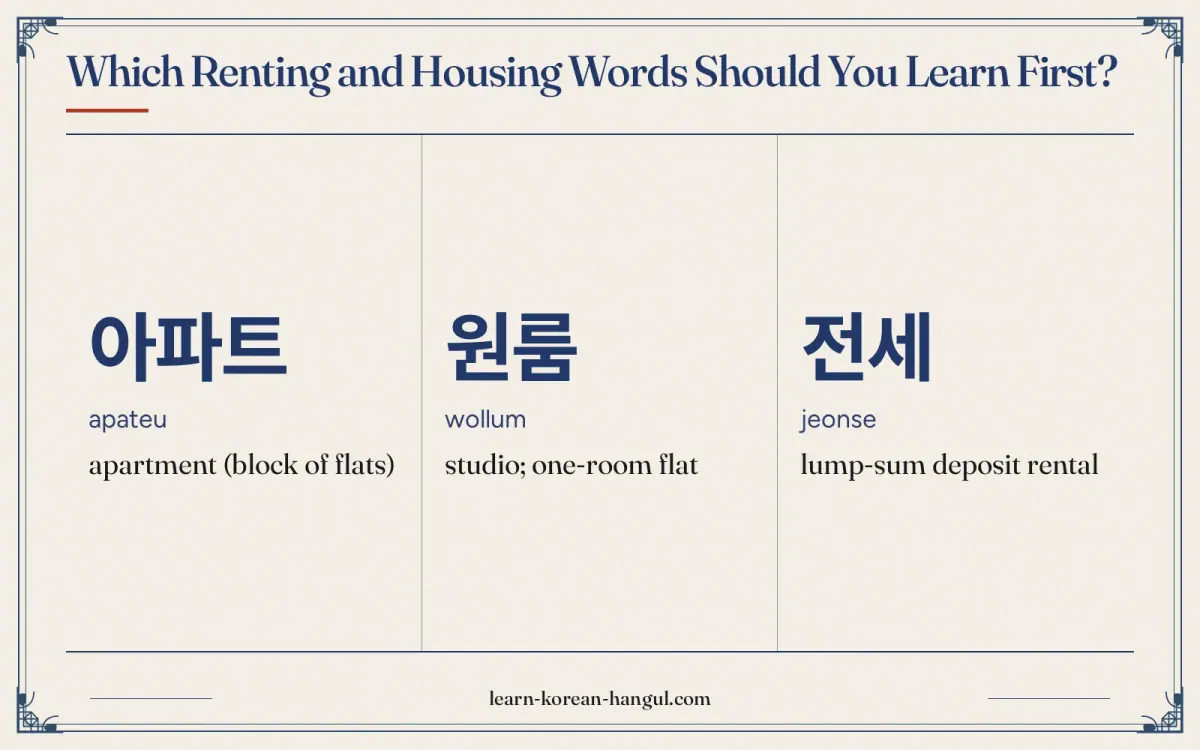
Learn 월세, 전세, 보증금, 집주인 and 계약서 first. They are the words you need to read a listing and to talk to an agent. Then add the housing types and the moving words, because you need them at the start and the end of your stay.
- Day one (7 words). The housing types: 집, 아파트, 원룸, 투룸, 오피스텔, 빌라 and 고시원.
- Day two (7 words). The money words: 전세, 월세, 보증금, 반전세, 관리비, 집세 and 임대료.
- Day three (7 words). The contract words: 계약서, 집주인, 세입자, 부동산, 중개 수수료, 확정일자 and 계약금.
- Day four (7 words). The moving words: 이사, 이삿짐, 이삿짐센터, 전입신고, 열쇠, 입주 and 퇴거.
- Day five (7 words). The building words: 이웃, 경비실, 관리사무소, 엘리베이터, 주차, 층간소음 and 공동현관.
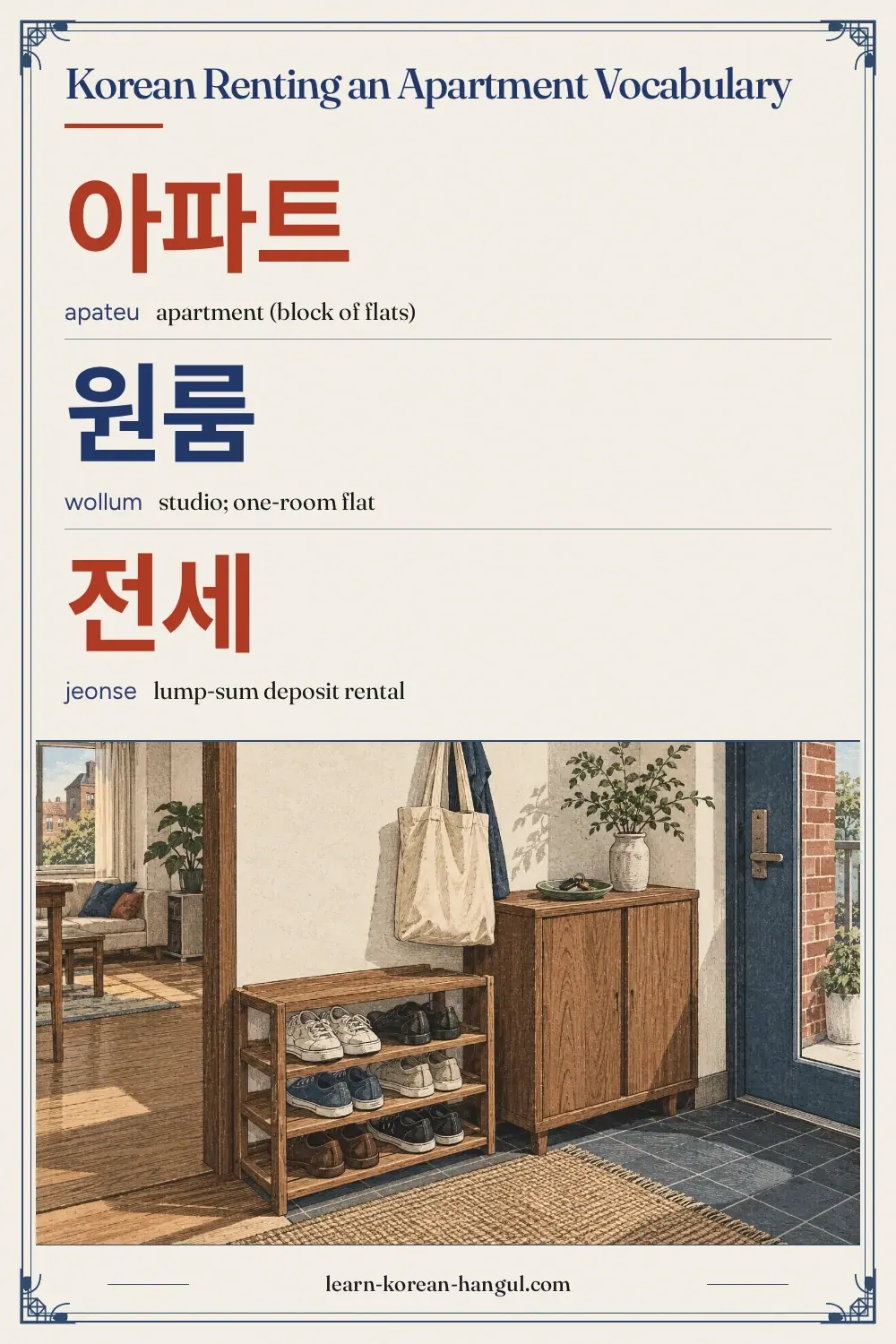
At 7 words a day, the list takes five days plus review. The scene below puts eight of the words on one picture.
Word · 8
- 1
아파트
apateu
apartment (block of flats)
- 2
원룸
wollum
studio; one-room flat
- 3
전세
jeonse
lump-sum deposit rental
- 4
월세
wolse
monthly rent
- 5
보증금
bojeunggeum
deposit
- 6
계약서
gyeyakseo
contract; lease
- 7
이사
isa
moving house
- 8
입주
ipju
moving in
By origin, the list has 22 Sino-Korean words, 6 loanwords, 4 mixed words and 3 native words. Housing and contract words are mostly Sino-Korean, because law and property words come from Chinese-character parts, and the housing types are mostly loanwords, such as 원룸 and 오피스텔. The Origin column in each table marks them.
Types of Housing
Housing types describe the kind of home you rent. A 아파트 is an apartment in a large complex, and a 빌라 is a smaller low-rise building. A 원룸 is a studio with one room, a 투룸 has two, and an 오피스텔 is a studio-style flat in a building that also has offices. A 고시원 is a very small rented room, often cheap and with shared facilities.
| No. | Hangul | Revised Romanization | Origin | Meaning | Example sentence | Audio assetId |
|---|---|---|---|---|---|---|
| 1 | 집 | jip | native | home; house | 새 집을 구해요. (I am looking for a new home.) | au-pg-vocabulary-society-housing-1; example: au-pg-vocabulary-society-housing-36 |
| 2 | 아파트 | apateu | loanword | apartment (block of flats) | 아파트에 살아요. (I live in an apartment.) | au-pg-vocabulary-society-housing-2; example: au-pg-vocabulary-society-housing-37 |
| 3 | 원룸 | wollum | loanword | studio; one-room flat | 원룸은 방이 하나예요. (A wollum has one room.) | au-pg-vocabulary-society-housing-3; example: au-pg-vocabulary-society-housing-38 |
| 4 | 투룸 | turum | loanword | two-room flat | 투룸은 방이 두 개예요. (A turum has two rooms.) | au-pg-vocabulary-society-housing-4; example: au-pg-vocabulary-society-housing-39 |
| 5 | 오피스텔 | opiseutel | loanword | officetel (studio-style building) | 오피스텔에는 작은 부엌이 있어요. (An officetel has a small kitchen.) | au-pg-vocabulary-society-housing-5; example: au-pg-vocabulary-society-housing-40 |
| 6 | 빌라 | billa | loanword | villa (low-rise apartment building) | 빌라는 보통 낮은 건물이에요. (A villa is usually a low building.) | au-pg-vocabulary-society-housing-6; example: au-pg-vocabulary-society-housing-41 |
| 7 | 고시원 | gosiwon | Sino-Korean | gosiwon (very small rented room) | 고시원은 방이 아주 작아요. (A gosiwon room is very small.) | au-pg-vocabulary-society-housing-7; example: au-pg-vocabulary-society-housing-42 |
Most of these are loanwords written in Hangul, and some have a Korean meaning that differs from the English one. In English a villa is a grand house, but a Korean 빌라 is a modest low-rise building. An 오피스텔 comes from the English words office and hotel. The first examples in the table use the pattern place + 에 + verb, as in 아파트에 살아요.
The word 집 is the plain word for home or house, and the house in Korean page covers it. The house vocabulary flashcards cover the rooms and furniture inside.
Example Sentences
Each example is a short polite sentence. Most follow the pattern noun + 이/가 + adjective, as in 집세가 너무 비싸요, or noun + 을/를 + verb, as in 계약서에 이름을 써요. Say each one aloud, then swap the noun: replace 이름 with 주소 (address) and you get 계약서에 주소를 써요, which is also natural.
How Do You Say Jeonse and Wolse in Korean?
Money words describe how you pay for a home. With 전세, you give the landlord a very large 보증금 (deposit) and pay no monthly rent. With 월세, you pay a smaller deposit and rent every month. With 반전세, you pay a medium deposit and a smaller rent. On top of that there is a 관리비, a monthly maintenance fee.
| No. | Hangul | Revised Romanization | Origin | Meaning | Example sentence | Audio assetId |
|---|---|---|---|---|---|---|
| 8 | 전세 | jeonse | Sino-Korean | lump-sum deposit rental | 전세는 큰 보증금을 내는 방식이에요. (Jeonse is a system in which you pay a large deposit.) | au-pg-vocabulary-society-housing-8; example: au-pg-vocabulary-society-housing-43 |
| 9 | 월세 | wolse | Sino-Korean | monthly rent | 월세는 매달 내요. (Wolse is paid every month.) | au-pg-vocabulary-society-housing-9; example: au-pg-vocabulary-society-housing-44 |
| 10 | 보증금 | bojeunggeum | Sino-Korean | deposit | 보증금은 계약이 끝나면 돌려받아요. (You get the deposit back when the contract ends.) | au-pg-vocabulary-society-housing-10; example: au-pg-vocabulary-society-housing-45 |
| 11 | 반전세 | banjeonse | Sino-Korean | half-jeonse (deposit plus monthly rent) | 반전세는 보증금과 월세를 같이 내요. (With banjeonse you pay both a deposit and monthly rent.) | au-pg-vocabulary-society-housing-11; example: au-pg-vocabulary-society-housing-46 |
| 12 | 관리비 | gwallibi | Sino-Korean | maintenance fee | 관리비는 월세와 따로 내요. (The maintenance fee is paid separately from the rent.) | au-pg-vocabulary-society-housing-12; example: au-pg-vocabulary-society-housing-47 |
| 13 | 집세 | jipse | mixed | house rent | 집세가 너무 비싸요. (The rent is too expensive.) | au-pg-vocabulary-society-housing-13; example: au-pg-vocabulary-society-housing-48 |
| 14 | 임대료 | imdaeryo | Sino-Korean | rent (formal) | 임대료는 집주인이 정해요. (The landlord sets the rent.) | au-pg-vocabulary-society-housing-14; example: au-pg-vocabulary-society-housing-49 |
The table below shows the cost pattern of each type in general terms. The numbers vary by city, area and building, and the amounts are decided in each contract.
| Type | Deposit | Monthly payment | At the end |
|---|---|---|---|
| 전세 | Very large | No rent (only 관리비) | Whole deposit is returned |
| 반전세 | Medium | Smaller rent | Deposit is returned |
| 월세 | Small | Full rent | Deposit is returned, minus any unpaid amounts |
The word 집세 is the general word for house rent, and 임대료 is the formal word you see in contracts and notices. 월세 is also the name of the type. If you hear someone say 월세 얼마예요?, they mean how much is the rent? The Korean won page explains how to read money amounts.
Contracts and Fees
Contract words appear when you sign. The 집주인 is the landlord, and you are the 세입자, the tenant. You usually find a home through a 부동산, a real estate agency, and pay a 중개 수수료, the brokerage fee. You pay a 계약금 when you sign, and the 계약서 is the lease. After signing, a 확정일자 stamp on the lease helps protect your deposit.
| No. | Hangul | Revised Romanization | Origin | Meaning | Example sentence | Audio assetId |
|---|---|---|---|---|---|---|
| 15 | 계약서 | gyeyakseo | Sino-Korean | contract; lease | 계약서에 이름을 써요. (I write my name on the contract.) | au-pg-vocabulary-society-housing-15; example: au-pg-vocabulary-society-housing-50 |
| 16 | 집주인 | jipjuin | mixed | landlord; owner of the home | 집주인에게 전화했어요. (I called the landlord.) | au-pg-vocabulary-society-housing-16; example: au-pg-vocabulary-society-housing-51 |
| 17 | 세입자 | seipja | Sino-Korean | tenant | 저는 이 집의 세입자예요. (I am the tenant of this home.) | au-pg-vocabulary-society-housing-17; example: au-pg-vocabulary-society-housing-52 |
| 18 | 부동산 | budongsan | Sino-Korean | real estate; estate agency | 부동산에서 집을 소개해 줘요. (The estate agency introduces homes.) | au-pg-vocabulary-society-housing-18; example: au-pg-vocabulary-society-housing-53 |
| 19 | 중개 수수료 | junggae susuryo | Sino-Korean | brokerage fee | 중개 수수료는 부동산에 내요. (You pay the brokerage fee to the agency.) | au-pg-vocabulary-society-housing-19; example: au-pg-vocabulary-society-housing-54 |
| 20 | 확정일자 | hwakjeongilja | Sino-Korean | confirmed date stamp on a lease | 계약 후에 확정일자를 받아요. (After signing, you get the confirmed date stamp.) | au-pg-vocabulary-society-housing-20; example: au-pg-vocabulary-society-housing-55 |
| 21 | 계약금 | gyeyakgeum | Sino-Korean | down payment on a contract | 계약금을 먼저 보냈어요. (I sent the down payment first.) | au-pg-vocabulary-society-housing-21; example: au-pg-vocabulary-society-housing-56 |
확정일자 is a date stamp that the authorities put on a lease. Together with the move-in registration (전입신고), it is one of the steps that tenants take to protect the deposit. These are general descriptions and not legal advice, so check the current rules with an official office or a professional before you sign anything.
Note that 부동산 means both real estate as a thing and the agency office, as in 부동산에 가요 (I go to the estate agency). The agent is called 공인중개사 in official terms, though most people just say 부동산 사장님.
How Do You Say Moving in Korean?
Moving words cover the day you arrive and the day you leave. 이사 is moving house, and the belongings are 이삿짐. Many people hire an 이삿짐센터, a moving company. After you move, you do a 전입신고 to register your new address. You receive the 열쇠 (key) when you move in, which is 입주, and leaving at the end is 퇴거.
| No. | Hangul | Revised Romanization | Origin | Meaning | Example sentence | Audio assetId |
|---|---|---|---|---|---|---|
| 22 | 이사 | isa | Sino-Korean | moving house | 다음 주에 이사해요. (I am moving next week.) | au-pg-vocabulary-society-housing-22; example: au-pg-vocabulary-society-housing-57 |
| 23 | 이삿짐 | isatjim | mixed | moving goods; belongings to move | 이삿짐이 너무 많아요. (I have too many things to move.) | au-pg-vocabulary-society-housing-23; example: au-pg-vocabulary-society-housing-58 |
| 24 | 이삿짐센터 | isatjimsenteo | mixed | moving company | 이삿짐센터에 전화했어요. (I called a moving company.) | au-pg-vocabulary-society-housing-24; example: au-pg-vocabulary-society-housing-59 |
| 25 | 전입신고 | jeonipsingo | Sino-Korean | move-in address registration | 이사한 후에 전입신고를 해요. (After moving, I register my new address.) | au-pg-vocabulary-society-housing-25; example: au-pg-vocabulary-society-housing-60 |
| 26 | 열쇠 | yeolsoe | native | key | 집주인에게 열쇠를 받았어요. (I got the key from the landlord.) | au-pg-vocabulary-society-housing-26; example: au-pg-vocabulary-society-housing-61 |
| 27 | 입주 | ipju | Sino-Korean | moving in | 새 아파트에 입주해요. (I am moving into a new apartment.) | au-pg-vocabulary-society-housing-27; example: au-pg-vocabulary-society-housing-62 |
| 28 | 퇴거 | toego | Sino-Korean | moving out | 퇴거 날짜는 계약서에 있어요. (The move-out date is in the contract.) | au-pg-vocabulary-society-housing-28; example: au-pg-vocabulary-society-housing-63 |
전입신고 is the official registration of your new address, normally done at a local office or online. It matters for the deposit and for other services. The word is built from 전입 (moving in) and 신고 (report), and it is a good example of how Sino-Korean parts combine.
On modern buildings, a door code often replaces a metal key, but people still say 열쇠 or 키. 입주 and 퇴거 are formal words from contracts. In speech, people say 이사 들어와요 (moving in) and 이사 나가요 (moving out).
Neighbours and Building Rules
Building words are about living in an apartment block. Your 이웃 is a neighbour. At the entrance there is often a 경비실, the guard office, and the 관리사무소 handles repairs and notices. There is an 엘리베이터 and a 주차 area. The biggest daily complaint is 층간소음, noise from the floor above or below.
| No. | Hangul | Revised Romanization | Origin | Meaning | Example sentence | Audio assetId |
|---|---|---|---|---|---|---|
| 29 | 이웃 | iut | native | neighbour | 이웃과 인사해요. (I greet my neighbours.) | au-pg-vocabulary-society-housing-29; example: au-pg-vocabulary-society-housing-64 |
| 30 | 경비실 | gyeongbisil | Sino-Korean | guard office | 택배는 경비실에 있어요. (The parcels are in the guard office.) | au-pg-vocabulary-society-housing-30; example: au-pg-vocabulary-society-housing-65 |
| 31 | 관리사무소 | gwallisamuso | Sino-Korean | management office | 관리사무소에 문의해요. (I ask the management office.) | au-pg-vocabulary-society-housing-31; example: au-pg-vocabulary-society-housing-66 |
| 32 | 엘리베이터 | ellibeiteo | loanword | elevator | 엘리베이터가 고장 났어요. (The elevator is broken.) | au-pg-vocabulary-society-housing-32; example: au-pg-vocabulary-society-housing-67 |
| 33 | 주차 | jucha | Sino-Korean | parking | 주차 자리가 없어요. (There is no parking space.) | au-pg-vocabulary-society-housing-33; example: au-pg-vocabulary-society-housing-68 |
| 34 | 층간소음 | cheunggansoeum | Sino-Korean | noise between floors | 층간소음 때문에 힘들어요. (It is hard because of the noise from upstairs.) | au-pg-vocabulary-society-housing-34; example: au-pg-vocabulary-society-housing-69 |
| 35 | 공동현관 | gongdonghyeongwan | Sino-Korean | shared building entrance | 공동현관 비밀번호를 알아요. (I know the shared-entrance passcode.) | au-pg-vocabulary-society-housing-35; example: au-pg-vocabulary-society-housing-70 |
층간소음 (noise between floors) is a well-known source of conflict in Korean apartment blocks, so it is worth knowing. Many buildings have notices about quiet hours. The word is built from 층 (floor), 간 (between) and 소음 (noise).
공동현관 is the shared entrance of the building, and many buildings protect it with a passcode. Parcels often go to the 경비실, and you can ask the staff there about 택배 (parcels). For other building words, see the house vocabulary list.
Reading a Rental Listing
Korean listings put the money in a short form. The table decodes a sample line.
| On the listing | Plain reading | Meaning |
|---|---|---|
| 원룸 | 방이 하나인 집 | A one-room flat |
| 보증금 1000 / 월세 50 | 보증금이 천만 원, 월세가 오십만 원 | Deposit 10 million won, rent 500,000 won per month |
| 관리비 7만 원 | 관리비가 칠만 원 | Maintenance fee 70,000 won |
| 전세 2억 | 전세 보증금이 이억 원 | Jeonse with a 200 million won deposit |
The numbers are made-up examples to show the pattern. In the shorthand 1000/50, the first number is the deposit and the second is the monthly rent, and both are in units of 만 원 (ten thousand won). Besides the deposit, your monthly cost is the rent plus the 관리비, so always ask what the maintenance fee covers. The 억 in 전세 2억 means one hundred million, so 2억 is two hundred million won.
How Do You Pronounce These Words?
Housing words are long, and many change their sounds when syllables meet. The table lists the changes that learners most often miss.
| Spelling | Pronunciation | What happens |
|---|---|---|
| 월세 | [월쎄] | In a Sino-Korean word, ㅅ after ㄹ becomes tense |
| 집세 | [집쎄] | The ㅅ after a final ㅂ becomes tense |
| 세입자 | [세입짜] | The ㅈ after a final ㅂ becomes tense |
| 계약서 | [계약써] | The ㅅ after a final ㄱ becomes tense |
| 관리비 | [괄리비] | The ㄴ before ㄹ is said as ㄹ |
| 원룸 | [월룸] | The ㄴ before ㄹ is said as ㄹ, as in 관리비 |
| 확정일자 | [확쩡일짜] | The ㅈ after ㄱ, and the ㅈ after ㄹ, both become tense |
| 전입신고 | [저닙신고] | The final ㄴ of 전 moves to the empty ㅇ of 입 |
The Revised Romanization shows the ㄹ assimilation in gwallibi and wollum and the linking in jeonipsingo. It does not show tensing caused by a neighbouring sound, so wolse, jipse and gyeyakseo look the same as the spelling. Learn the Hangul and use the audio to hear the real sound. The rules come from the Standard Pronunciation rules (표준 발음법) of the 국립국어원.
Audio and Slow Playback
Each word has a normal clip, and 5 key words also have a slow clip at 0.8 times the speed: 전세, 월세, 보증금, 확정일자 and 이사. Nothing plays until you press a button.
Listen to 월세 first. You should hear two beats, [월쎄], with a tense ㅆ and the vowel ㅔ made with a mid-open mouth.
What Mistakes Do Learners Make with Renting and Housing Words?
- Thinking 전세 means a low rent. It means a very large deposit with no monthly rent, which is returned at the end.
- Reading 월세 as wol-se with a plain ㅅ. The spoken form is [월쎄].
- Forgetting the 관리비. The listed rent can leave it out, so ask what the maintenance fee covers.
- Thinking 빌라 means a grand house. In Korea it is a modest low-rise building.
- Mixing 집주인 and 세입자. The 집주인 owns the home, and the 세입자 rents it.
The second mistake changes the sound, and the others change the meaning. The next section turns the list into practice.
Practice: Flashcards and Worksheet
Drill these words with the vocabulary flashcard decks. A printable worksheet for these words (word list, matching, writing practice, fill-in-the-blank exercises and answer key) is available in A4 and US Letter from the download card on this page. A printable worksheet for these words (word list, matching, writing practice, fill-in-the-blank exercises and answer key) is available in A4 and US Letter from the download card on this page. Progress in the decks is saved only in your browser.
Korean Renting an Apartment Vocabulary Worksheet
Try this five-question check, then say the 35 words aloud once more.
Practice · 5
What does 전세 mean?
Show answer
lump-sum deposit rental
전세 (jeonse) means lump-sum deposit rental.
What does 월세 mean?
Show answer
monthly rent
월세 (wolse) means monthly rent.
What does 보증금 mean?
Show answer
deposit
보증금 (bojeunggeum) means deposit.
What does 계약서 mean?
Show answer
contract; lease
계약서 (gyeyakseo) means contract; lease.
What does 이사 mean?
Show answer
moving house
이사 (isa) means moving house.
Where to Go Next
This list sits inside Korean Society Vocabulary. After Korean renting an apartment vocabulary, many learners move on to Korean News and Media Vocabulary for the words in news stories, or to Korean Military Service Vocabulary for another everyday topic in Korean life.
Frequently Asked Questions
How Do You Say Lump-Sum Deposit Rental in Korean?
A lump-sum deposit rental is 전세 (jeonse). The tenant pays a very large deposit to the landlord, pays no monthly rent, and gets the deposit back when the contract ends. For example, 전세는 큰 보증금을 내는 방식이에요 means jeonse is a system in which you pay a large deposit. Press the audio button to hear the word.
How Do You Pronounce 월세 (wolse)?
월세 is said [월쎄], in two beats. The first syllable 월 starts with a w glide and ends in an l sound, and the ㅅ of 세 becomes tense after it, so you hear a sharper s. The vowel ㅔ is a mid-open vowel. It means monthly rent. Use the slow clip to match the rhythm.
How Many Renting and Housing Words Should I Learn First?
Learn five first: 월세, 전세, 보증금, 집주인 and 계약서. That takes one day. Then add the housing types, the other money words, the contract words and the moving words. The whole list of 35 takes five days at 7 words a day, one group a day, with review on the sixth day.
Where Can I Practise Renting and Housing Words with Flashcards?
Use the house vocabulary flashcards for the rooms and furniture, and the vocabulary flashcard decks, which list every deck with audio. A deck for the renting words is planned. Progress stays in your browser.
Is the Romanization on This Page Official?
It follows the Revised Romanization of Korean, which South Korea officially adopted on 7 July 2000 and whose rules the National Institute of Korean Language (국립국어원) publishes. It is a learning aid that does not mark every sound change, so learn the Hangul and use the audio to hear the real sound.
Is There a Printable Worksheet for Renting and Housing Words?
A printable worksheet for these words (word list, matching, writing practice, fill-in-the-blank exercises and answer key) is available in A4 and US Letter from the download card on this page. For practice, copy the tables above by hand: write the Hangul, cover the English column, and check your answers against the page.