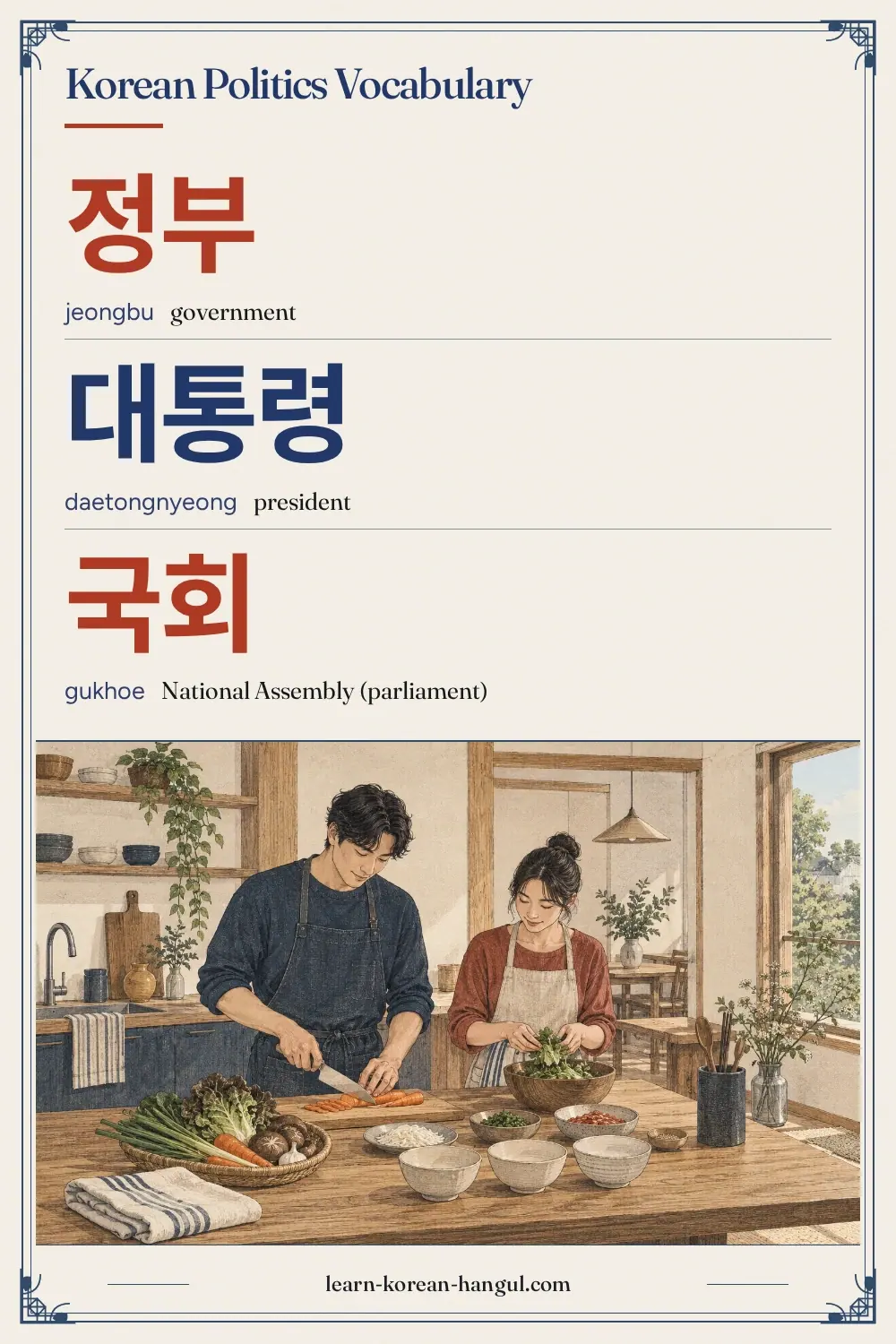
Korean Politics Vocabulary at a Glance
Korean politics vocabulary is the set of words used in the news, in school civics and in everyday talk about government and elections. Nearly all of them are Sino-Korean words, built from Chinese-origin syllables, and the same syllables return again and again: 정 (government), 선 (choose), 표 (vote), 당 (party). This page holds 35 words in five groups. Each word has Hangul, Revised Romanization, audio and one example sentence. All the definitions are neutral: the page names no parties or politicians and takes no side.
| Group | Words | Use |
|---|---|---|
| Government bodies | 7 | Naming the main offices and institutions |
| Elections | 7 | Following an election from vote to result |
| Parties and politicians | 7 | Talking about parties, pledges and speeches |
| Laws and policies | 7 | Reading about bills, budgets and the three powers |
| Local government | 7 | Naming city, district and provincial offices |
The list belongs to Korean Society Vocabulary. If you only want one word, the single-word pages for government in Korean, election in Korean and president in Korean give a deeper answer.
Which Politics and Government Words Should You Learn First?
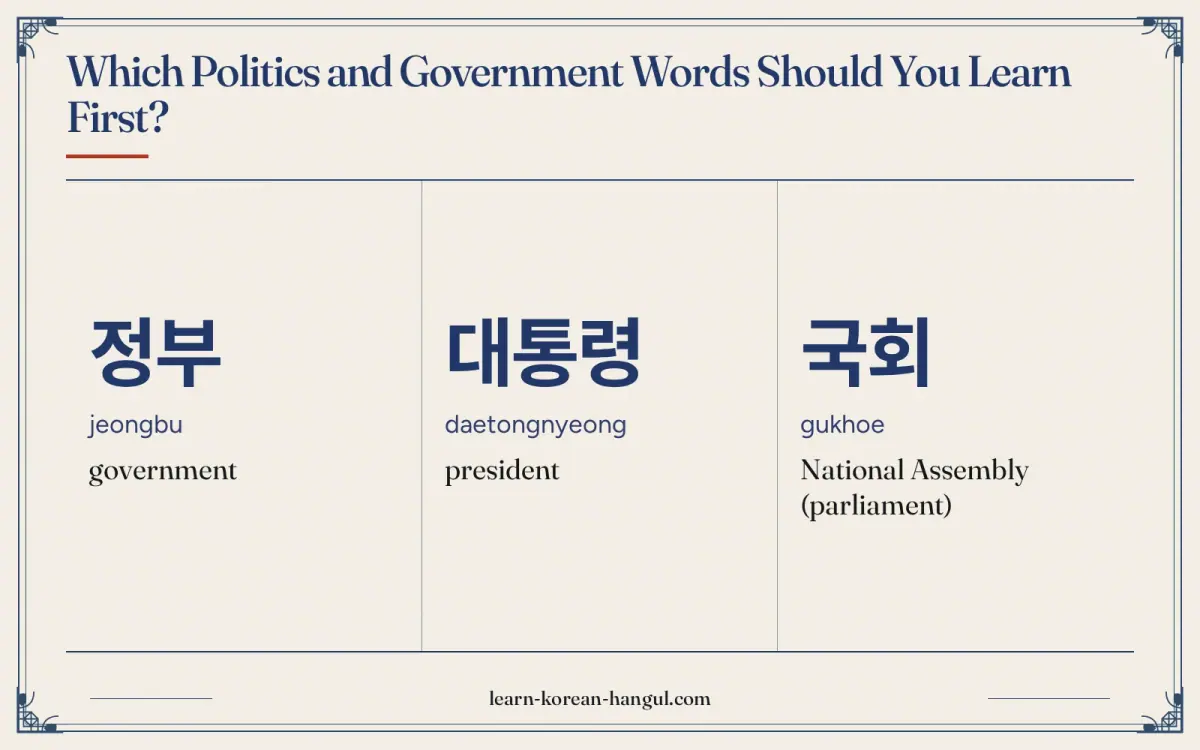
Learn 정부, 대통령, 선거, 투표 and 후보 first. They cover most headlines, and you can read them from the first week. The institutions and the local government words come next, because they appear in school books and in notices from your local office.
- Day one. 정부, 대통령, 국회, 정치, 선거, 투표 and 후보.
- Day two. The election result words: 당선, 낙선, 개표 and 유권자, plus 국회의원 and 총리.
- Day three. The party words: 정당, 여당, 야당, 정치인, 공약 and 연설.
- Day four. The law and policy words: 정책, 법안, 예산, 개혁, 입법, 행정 and 사법.
- Day five. The local words: 지방자치, 시장, 도지사, 시청, 구청, 시의회 and 주민, plus 장관 and 대법원.
At 7 words a day, the list takes five days. The scene below puts eight of the words on one picture.
Word · 8
- 1
정부
jeongbu
government
- 2
대통령
daetongnyeong
president
- 3
국회
gukhoe
National Assembly (parliament)
- 4
선거
seongeo
election
- 5
투표
tupyo
vote; voting
- 6
후보
hubo
candidate
- 7
시청
sicheong
city hall
- 8
주민
jumin
resident
Because every word is Sino-Korean, the order of syllables is part of the meaning. The word 투표 (vote) is built from 투 (throw in) and 표 (ticket), and 개표 (count) opens (개) the tickets. When you notice 표, you can guess both words.
Government Bodies
The 정부 is the government, in the sense of the executive branch that runs the country. The 대통령 is the president, and the 총리 is the prime minister. A 장관 is the minister who leads a ministry. The legislature is the 국회, the National Assembly, and each of its members is a 국회의원. At the top of the court system is the 대법원.
| No. | Hangul | Revised Romanization | Origin | Meaning | Example sentence | Audio assetId |
|---|---|---|---|---|---|---|
| 1 | 정부 | jeongbu | Sino-Korean | government | 정부가 새로운 정책을 발표했어요. (The government announced a new policy.) | au-pg-vocabulary-society-politics-1; example: au-pg-vocabulary-society-politics-36 |
| 2 | 대통령 | daetongnyeong | Sino-Korean | president | 대통령은 나라의 대표예요. (The president is the representative of the country.) | au-pg-vocabulary-society-politics-2; example: au-pg-vocabulary-society-politics-37 |
| 3 | 국회 | gukhoe | Sino-Korean | National Assembly (parliament) | 국회는 법을 만들어요. (The National Assembly makes laws.) | au-pg-vocabulary-society-politics-3; example: au-pg-vocabulary-society-politics-38 |
| 4 | 국회의원 | gukhoeuiwon | Sino-Korean | member of the National Assembly | 국회의원은 선거로 뽑아요. (Members of the National Assembly are chosen by election.) | au-pg-vocabulary-society-politics-4; example: au-pg-vocabulary-society-politics-39 |
| 5 | 총리 | chongni | Sino-Korean | prime minister | 총리는 대통령을 도와요. (The prime minister assists the president.) | au-pg-vocabulary-society-politics-5; example: au-pg-vocabulary-society-politics-40 |
| 6 | 장관 | janggwan | Sino-Korean | minister (head of a ministry) | 장관이 국회에 나왔어요. (The minister appeared at the National Assembly.) | au-pg-vocabulary-society-politics-6; example: au-pg-vocabulary-society-politics-41 |
| 7 | 대법원 | daebeobwon | Sino-Korean | Supreme Court | 대법원은 가장 높은 법원이에요. (The Supreme Court is the highest court.) | au-pg-vocabulary-society-politics-7; example: au-pg-vocabulary-society-politics-42 |
The word 정부 can also mean "the administration" in a broad sense. In English, "government" sometimes includes the legislature and the courts. In Korean news, 정부 normally means the executive branch only, and 국회 and 법원 are named separately.
Example Sentences
The examples in this group are short statements of the form subject + 은/는 + noun + 이에요/예요, or subject + 이/가 + verb. Several use the polite ending -아요 or -어요, such as 만들어요 (make) and 도와요 (help). Say each sentence aloud, then swap one noun, for instance 국회는 법을 만들어요 becomes 정부는 정책을 만들어요.
How Do You Say Elections in Korean?
An election is a 선거. The act of voting is a 투표, and a person who is eligible to vote is a 유권자. A person who runs for office is a 후보. After the vote, the 개표 is the count. Someone who wins is 당선, and someone who loses is 낙선. Both end in 선, which comes from the same character as 선거 (choose), so 선거, 당선 and 낙선 are one family.
| No. | Hangul | Revised Romanization | Origin | Meaning | Example sentence | Audio assetId |
|---|---|---|---|---|---|---|
| 8 | 선거 | seongeo | Sino-Korean | election | 이번 선거에 관심이 있어요. (I am interested in this election.) | au-pg-vocabulary-society-politics-8; example: au-pg-vocabulary-society-politics-43 |
| 9 | 투표 | tupyo | Sino-Korean | vote; voting | 내일 투표해요. (I will vote tomorrow.) | au-pg-vocabulary-society-politics-9; example: au-pg-vocabulary-society-politics-44 |
| 10 | 후보 | hubo | Sino-Korean | candidate | 후보가 세 명이에요. (There are three candidates.) | au-pg-vocabulary-society-politics-10; example: au-pg-vocabulary-society-politics-45 |
| 11 | 당선 | dangseon | Sino-Korean | winning an election; being elected | 그 후보가 당선됐어요. (That candidate was elected.) | au-pg-vocabulary-society-politics-11; example: au-pg-vocabulary-society-politics-46 |
| 12 | 낙선 | nakseon | Sino-Korean | losing an election | 그는 낙선했어요. (He lost the election.) | au-pg-vocabulary-society-politics-12; example: au-pg-vocabulary-society-politics-47 |
| 13 | 유권자 | yugwonja | Sino-Korean | voter; eligible voter | 유권자는 투표할 권리가 있어요. (Voters have the right to vote.) | au-pg-vocabulary-society-politics-13; example: au-pg-vocabulary-society-politics-48 |
| 14 | 개표 | gaepyo | Sino-Korean | vote counting | 개표는 저녁에 시작해요. (Vote counting starts in the evening.) | au-pg-vocabulary-society-politics-14; example: au-pg-vocabulary-society-politics-49 |
The pair 당선 and 낙선 is easy to mix up because the two words differ in only one syllable. Learn them as a pair: 당 (hit, win) is the winner, and 낙 (fall) is the one who falls.
Parties and Politicians
Politics in general is 정치, and a politician is a 정치인. A political party is a 정당. The party that leads the government is the 여당, and the main party or parties outside the government are the 야당. Before an election, candidates make a 공약, a pledge, and give a 연설, a speech.
| No. | Hangul | Revised Romanization | Origin | Meaning | Example sentence | Audio assetId |
|---|---|---|---|---|---|---|
| 15 | 정치 | jeongchi | Sino-Korean | politics | 정치에 관심이 있어요. (I am interested in politics.) | au-pg-vocabulary-society-politics-15; example: au-pg-vocabulary-society-politics-50 |
| 16 | 정치인 | jeongchiin | Sino-Korean | politician | 그 정치인은 연설을 잘해요. (That politician is good at speeches.) | au-pg-vocabulary-society-politics-16; example: au-pg-vocabulary-society-politics-51 |
| 17 | 정당 | jeongdang | Sino-Korean | political party | 한국에는 여러 정당이 있어요. (There are several political parties in Korea.) | au-pg-vocabulary-society-politics-17; example: au-pg-vocabulary-society-politics-52 |
| 18 | 여당 | yeodang | Sino-Korean | ruling party | 여당은 정부를 이끄는 정당이에요. (The ruling party is the party that leads the government.) | au-pg-vocabulary-society-politics-18; example: au-pg-vocabulary-society-politics-53 |
| 19 | 야당 | yadang | Sino-Korean | opposition party | 야당은 여당과 다른 의견을 말해요. (The opposition party gives views that differ from the ruling party.) | au-pg-vocabulary-society-politics-19; example: au-pg-vocabulary-society-politics-54 |
| 20 | 공약 | gongyak | Sino-Korean | campaign pledge | 후보들이 공약을 발표했어요. (The candidates announced their pledges.) | au-pg-vocabulary-society-politics-20; example: au-pg-vocabulary-society-politics-55 |
| 21 | 연설 | yeonseol | Sino-Korean | speech | 대통령이 연설을 했어요. (The president gave a speech.) | au-pg-vocabulary-society-politics-21; example: au-pg-vocabulary-society-politics-56 |
The word pair 여당 and 야당 is useful in news reading. Both end in 당 (party), and the first syllable decides which side: 여 (with) and 야 (out in the field). This page does not name any real party. The names of parties change often, and the right way to read them is to learn the word 정당 first and then the name.
The Three Powers: 입법, 행정, 사법
Korean civics books describe government as three powers, and the words for them are 입법, 행정 and 사법. They sit in the Laws and policies group, and the table shows which body is linked with each.
| Power | Meaning | Body that carries it out | Example in this list |
|---|---|---|---|
| 입법 | law-making | 국회 | 법안 (bill) |
| 행정 | administration | 정부 | 정책 (policy) |
| 사법 | the judiciary | 법원 | 대법원 (Supreme Court) |
These three words give a quick map of the topic. When you meet a new political word in the news, ask which of the three it belongs to. The word 법안 is part of 입법, 정책 is part of 행정, and 판결 is part of 사법, as you can see on the law and crime vocabulary page.
How Do You Say Laws and Policies in Korean?
A 정책 is a policy, and a 법안 is a bill, a proposed law that the National Assembly discusses. The 예산 is the budget, and a 개혁 is a reform. The three powers 입법, 행정 and 사법 also belong here.
| No. | Hangul | Revised Romanization | Origin | Meaning | Example sentence | Audio assetId |
|---|---|---|---|---|---|---|
| 22 | 정책 | jeongchaek | Sino-Korean | policy | 새 정책이 발표됐어요. (A new policy has been announced.) | au-pg-vocabulary-society-politics-22; example: au-pg-vocabulary-society-politics-57 |
| 23 | 법안 | beoban | Sino-Korean | bill (proposed law) | 국회가 법안을 논의해요. (The National Assembly discusses the bill.) | au-pg-vocabulary-society-politics-23; example: au-pg-vocabulary-society-politics-58 |
| 24 | 예산 | yesan | Sino-Korean | budget | 정부가 내년 예산을 정해요. (The government sets next year's budget.) | au-pg-vocabulary-society-politics-24; example: au-pg-vocabulary-society-politics-59 |
| 25 | 개혁 | gaehyeok | Sino-Korean | reform | 교육 개혁에 대한 기사를 읽었어요. (I read an article about education reform.) | au-pg-vocabulary-society-politics-25; example: au-pg-vocabulary-society-politics-60 |
| 26 | 입법 | ipbeop | Sino-Korean | legislation; law-making | 입법은 국회가 해요. (The National Assembly does the law-making.) | au-pg-vocabulary-society-politics-26; example: au-pg-vocabulary-society-politics-61 |
| 27 | 행정 | haengjeong | Sino-Korean | administration (running the government) | 행정은 정부가 맡아요. (The government handles administration.) | au-pg-vocabulary-society-politics-27; example: au-pg-vocabulary-society-politics-62 |
| 28 | 사법 | sabeop | Sino-Korean | the judiciary; the administration of justice | 사법은 법원이 맡아요. (The courts handle the administration of justice.) | au-pg-vocabulary-society-politics-28; example: au-pg-vocabulary-society-politics-63 |
The difference between 정책 and 법안 is useful. A 정책 is a plan or approach of the government, and a 법안 is a text that may become a law. A 정책 may need a 법안, but many policies do not.
Local Government
Korea has local governments as well as the national one, and the word for the system is 지방자치. The head of a city is a 시장, and the head of a province is a 도지사. The main offices are the 시청 (city hall) and the 구청 (district office). The elected body of a city is the 시의회, and the people who live there are 주민.
| No. | Hangul | Revised Romanization | Origin | Meaning | Example sentence | Audio assetId |
|---|---|---|---|---|---|---|
| 29 | 지방자치 | jibangjachi | Sino-Korean | local autonomy; local self-government | 지방자치는 지역 사람들이 지역을 운영하는 제도예요. (Local self-government is a system where local people run their own area.) | au-pg-vocabulary-society-politics-29; example: au-pg-vocabulary-society-politics-64 |
| 30 | 시장 | sijang | Sino-Korean | mayor (also: market) | 시장은 시를 대표해요. (The mayor represents the city.) | au-pg-vocabulary-society-politics-30; example: au-pg-vocabulary-society-politics-65 |
| 31 | 도지사 | dojisa | Sino-Korean | provincial governor | 도지사는 도의 일을 맡아요. (The governor handles the affairs of the province.) | au-pg-vocabulary-society-politics-31; example: au-pg-vocabulary-society-politics-66 |
| 32 | 시청 | sicheong | Sino-Korean | city hall | 시청 앞에서 만나요. (Let's meet in front of city hall.) | au-pg-vocabulary-society-politics-32; example: au-pg-vocabulary-society-politics-67 |
| 33 | 구청 | gucheong | Sino-Korean | district office | 구청에서 서류를 받았어요. (I received a document at the district office.) | au-pg-vocabulary-society-politics-33; example: au-pg-vocabulary-society-politics-68 |
| 34 | 시의회 | siuihoe | Sino-Korean | city council | 시의회가 회의를 열어요. (The city council holds a meeting.) | au-pg-vocabulary-society-politics-34; example: au-pg-vocabulary-society-politics-69 |
| 35 | 주민 | jumin | Sino-Korean | resident | 주민들이 투표해요. (The residents vote.) | au-pg-vocabulary-society-politics-35; example: au-pg-vocabulary-society-politics-70 |
Notice the pattern 시 (city), 도 (province) and 구 (district). They attach to many words: 시청, 시장, 시의회, 도지사, 구청. If you move to Korea, 구청 and 주민센터 (juminsenteo, a neighbourhood office, now officially called 행정복지센터 in many areas) are the offices you are most likely to visit for official paperwork.
How Do You Pronounce These Words?
Several words in this list change in speech. The table lists the changes that learners most often miss. Brackets show the spoken sound.
| Spelling | Pronunciation | What happens |
|---|---|---|
| 국회 | [구쾨] | The final ㄱ and the ㅎ join into an aspirated k sound; Revised Romanization keeps the h in a noun, as gukhoe |
| 대통령 | [대통녕] | The ㄹ becomes ㄴ after ㅇ, and Revised Romanization writes daetongnyeong |
| 총리 | [총니] | The ㄹ becomes ㄴ after ㅇ, and Revised Romanization writes chongni |
| 낙선 | [낙썬] | The ㅅ after a final ㄱ is said tense |
| 유권자 | [유꿘자] | The ㄱ of 권 is said tense in this word |
| 입법 | [입뻡] | Both ㅂ sounds are pronounced, and the second is tense |
| 사법 | [사뻡] | The ㅂ of 법 is said tense in this Sino-Korean word |
| 법안 | [버반] | The final ㅂ of 법 moves onto the vowel of 안 |
The rules come from the Standard Pronunciation rules (표준 발음법) of the 국립국어원. Revised Romanization is a learning aid. It writes the ㄹ change in chongni and the h in gukhoe, but it does not show tensing such as [낙썬].
Audio and Slow Playback
Each word has a normal clip. Five words with tricky sounds also have a slow clip at 0.8 times the speed: 국회, 대통령, 낙선, 유권자 and 사법. Nothing plays until you press a button. The audio is generated with text-to-speech and checked by a Korean teacher before publication.
Listen to 국회 first. You should hear a single, light k-hw sound at the start, [구쾨], and not a hard g followed by a separate h.
What Mistakes Do Learners Make with Politics and Government Words?
- Mixing 시장 (mayor) and 시장 (market). The two words share the same spelling and sound. In 시장은 시를 대표해요, the mayor is meant. In 시장에 가요, it means "I am going to the market". The verb and the sentence decide.
- Using 정부 for the National Assembly. Wrong: 정부가 법을 만들어요 for "the legislature makes laws". Correct: 국회가 법을 만들어요. The 정부 runs the country, and the 국회 makes the laws.
- Mixing 대통령 and 총리. The 대통령 is the president, and the 총리 is the prime minister who assists. They are different offices.
- Mixing 선거 and 투표. A 선거 is the whole election. A 투표 is the act of casting a vote. You say 선거를 하다 only about the event as a whole, and 투표를 하다 about the act.
- Saying daetongnyeong with a hard ryeong. Wrong: dae-tong-ryeong. Correct: [대통녕], with the ㄹ said as n.
- Swapping 당선 and 낙선. Check the first syllable: 당 (win) and 낙 (fall).
Mistakes 1, 2, 3 and 6 change the meaning, and mistakes 4 and 5 change how natural you sound.
Everyday Words and News Words
Not every word is equally likely in speech. The table sorts them by where you meet them.
| Where you meet it | Words |
|---|---|
| Daily talk | 정치, 투표, 선거, 시장, 주민, 시청 |
| News and headlines | 정부, 대통령, 국회, 정당, 여당, 야당, 법안, 예산, 정책 |
| Official and civics writing | 입법, 행정, 사법, 지방자치, 개혁, 유권자 |
If your goal is to read Korean news, the second row will help the most. The real-world texts page shows how to read signs and notices, which is a good next skill after the vocabulary.
Practice: Flashcards and Worksheet
Drill these words with the vocabulary flashcard decks. A printable worksheet for these words (word list, matching, writing practice, fill-in-the-blank exercises and answer key) is available in A4 and US Letter from the download card on this page. Progress in the decks is saved only in your browser.
Politics and Government Vocabulary Worksheet
Try this five-question check, then say all 35 words aloud once more.
Practice · 5
What does 정부 mean?
Show answer
government
정부 (jeongbu) means government.
What does 국회 mean?
Show answer
National Assembly (parliament)
국회 (gukhoe) means National Assembly (parliament).
What does 선거 mean?
Show answer
election
선거 (seongeo) means election.
What does 당선 mean?
Show answer
winning an election; being elected
당선 (dangseon) means winning an election; being elected.
What does 시청 mean?
Show answer
city hall
시청 (sicheong) means city hall.
Where to Go Next
This list sits inside Korean Society Vocabulary. After Korean politics vocabulary, many learners move on to Korean Environment Vocabulary, which covers a topic that politics often debates, or to Korean Law and Crime Vocabulary, which follows the courts side of the three powers.
Frequently Asked Questions
How Do You Say Government in Korean?
Government is 정부 (jeongbu). It is a Sino-Korean word that normally means the executive branch that runs the country. The legislature is 국회 and the courts are 법원. To say the government announced something, use 정부가 발표했어요 (jeongbuga balpyohaesseoyo). Press the audio button to hear the word.
How Do You Pronounce 대통령 (daetongnyeong)?
대통령 is said [대통녕], dae-tong-nyeong, in three beats. The ㄹ of 령 becomes an n sound after the ng sound of 통, which is why Revised Romanization writes nyeong and not ryeong. The vowel ㅕ is a y glide plus eo, with the lips relaxed. Use the slow clip to match the rhythm.
How Many Politics and Government Words Should I Learn First?
Learn five first: 정부, 대통령, 선거, 투표 and 후보. That takes one day. Then add the institutions, the party words, the law words and the local government words. The whole list of 35 takes five days at 7 words a day, with review on the sixth day.
Where Can I Practise Politics and Government Words with Flashcards?
Use the vocabulary flashcard decks, which list every deck with audio. A deck for these words is planned. Progress stays in your browser. Until then, copy a table above onto cards: Hangul on one side, English on the other, and say each word aloud as you flip it.
Is the Romanization on This Page Official?
It follows the Revised Romanization of Korean, which South Korea officially adopted on 7 July 2000 and whose rules the National Institute of Korean Language (국립국어원) publishes. It is a learning aid that does not show tensing caused by a neighbouring sound, so learn the Hangul and use the audio to hear the real sound.
Is There a Printable Worksheet for Politics and Government Words?
A printable worksheet for these words (word list, matching, writing practice, fill-in-the-blank exercises and answer key) is available in A4 and US Letter from the download card on this page. For practice, write the Hangul from memory, cover the English column and check your answers against the tables above.