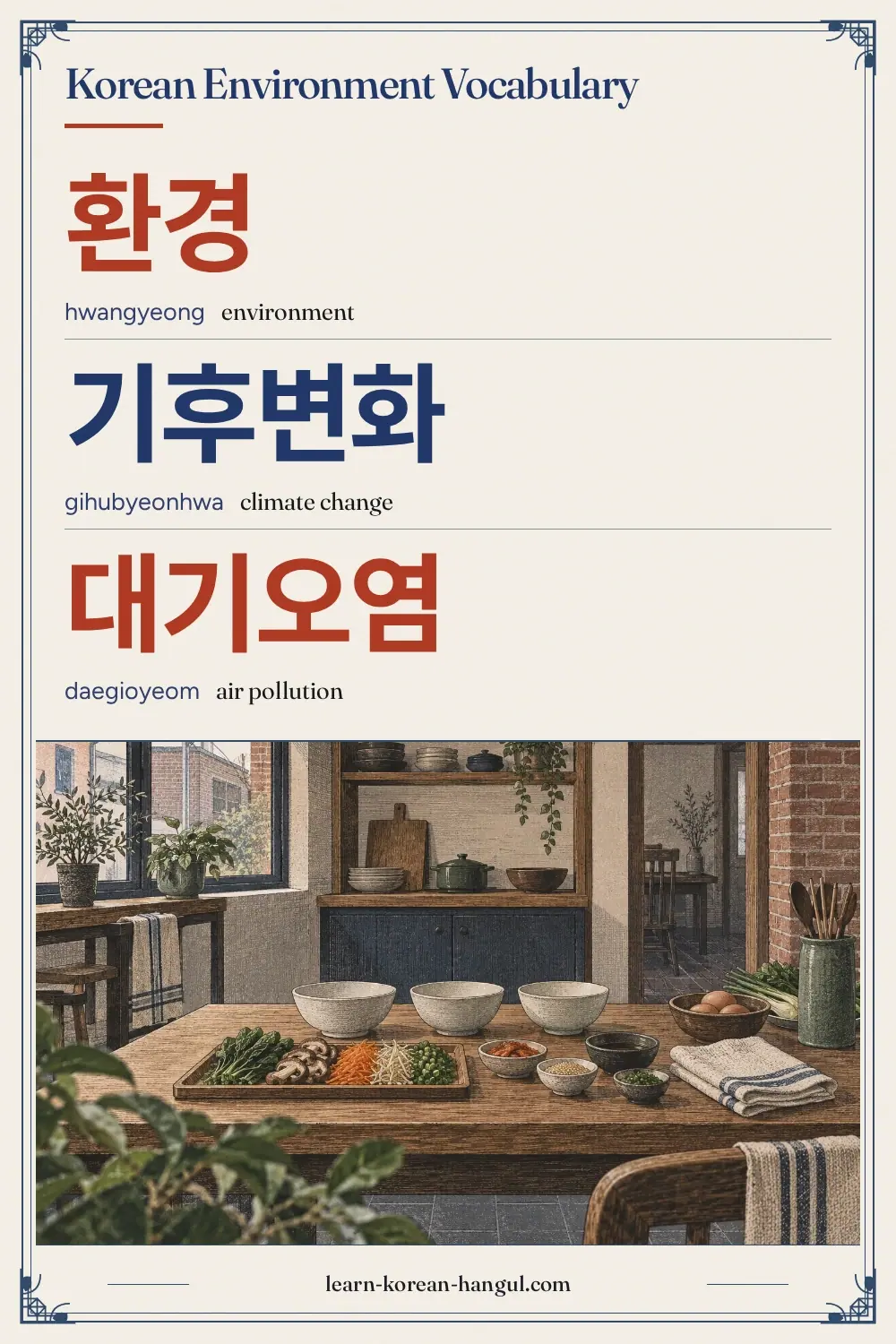
Korean Environment Vocabulary at a Glance
Korean environment vocabulary is easier than it looks, because most of the words are built from Chinese-character parts that repeat. The part 오염 (pollution) appears in 대기오염 (air pollution) and 수질오염 (water pollution), and the part 에너지 (energy) is in 재생에너지 (renewable energy). Once you know a part, you can read many words. The words are also part of daily life in Korea, where every household sorts trash by type.
| Group | Words | Use |
|---|---|---|
| Climate and weather | 7 | Talking about the planet and its climate |
| Pollution | 7 | Air, water and noise problems |
| Recycling and waste | 7 | Sorting trash at home |
| Energy | 7 | Power, fuels and saving |
| Nature protection | 7 | Wildlife, resources and goals |
The 35 words fall into five groups. Climate and weather words come first, then pollution, then recycling and waste, then energy, and last the words about protecting nature. You can learn them in any order, but the recycling words are the most useful if you live in Korea, because you need them every week.
The matching single-word pages give a fuller answer for the biggest terms: environment in Korean, climate change in Korean, recycling in Korean and pollution in Korean. This list sits inside Korean Society Vocabulary.
Which Environment Words Should You Learn First?
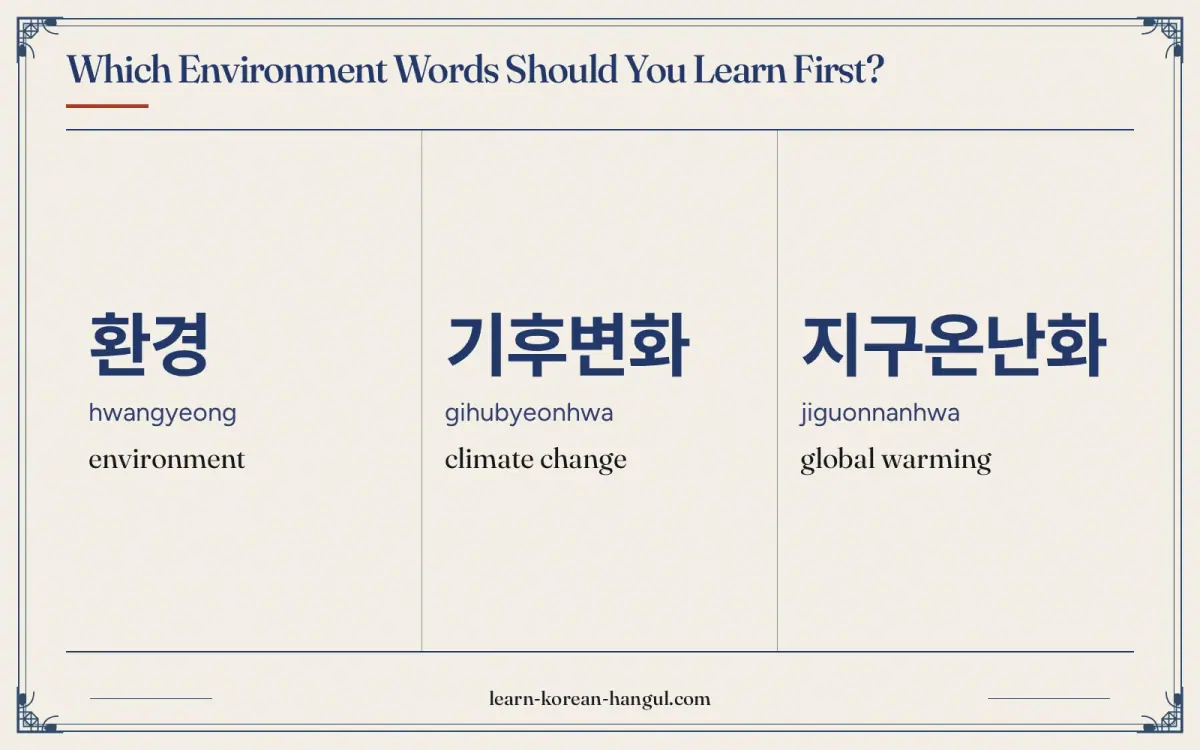
Learn 환경, 기후변화, 쓰레기, 재활용 and 분리수거 first. They are the words that appear in news headlines, school notices and the instructions at your apartment's trash area. Then add the pollution words, since the fine dust forecast is part of the daily weather report in Korea.
- Day one (7 words). The climate words: 환경, 기후, 기후변화, 지구, 지구온난화, 탄소 and 온실가스.
- Day two (7 words). The pollution words: 오염, 대기오염, 미세먼지, 수질오염, 소음, 매연 and 공해.
- Day three (7 words). The recycling words: 재활용, 쓰레기, 분리수거, 종량제 봉투, 음식물 쓰레기, 일회용품 and 플라스틱.
- Day four (7 words). The energy words: 에너지, 재생에너지, 태양광, 풍력, 전기, 절약 and 석유.
- Day five (7 words). The nature words: 자연, 생태계, 멸종, 보호, 자원, 지속 가능 and 탄소 중립.
At 7 words a day, the list takes five days plus review. The scene below puts eight of the words on one picture.
Word · 8
- 1
환경
hwangyeong
environment
- 2
기후변화
gihubyeonhwa
climate change
- 3
지구온난화
jiguonnanhwa
global warming
- 4
대기오염
daegioyeom
air pollution
- 5
미세먼지
misemeonji
fine dust
- 6
분리수거
bullisugeo
sorting recyclables
- 7
종량제 봉투
jongnyangje bongtu
volume-rate trash bag
- 8
풍력
pungnyeok
wind power
By origin, the list has 28 Sino-Korean words, 4 mixed words, 2 loanwords and 1 native word. Sino-Korean words dominate because science and public policy use words built from Chinese-character parts. The Origin column in each table marks them, and the Sino-Korean words page explains how to read the parts.
Climate and Weather
Climate words describe the planet and its changes. 환경 is the environment in general, 기후 is the climate of a place, and 기후변화 is climate change. Our 지구 is the Earth, and 지구온난화 is global warming. Two causes are often named together: 탄소 (carbon) and 온실가스 (greenhouse gases).
| No. | Hangul | Revised Romanization | Origin | Meaning | Example sentence | Audio assetId |
|---|---|---|---|---|---|---|
| 1 | 환경 | hwangyeong | Sino-Korean | environment | 환경을 보호해요. (We protect the environment.) | au-pg-vocabulary-society-environment-1; example: au-pg-vocabulary-society-environment-36 |
| 2 | 기후 | gihu | Sino-Korean | climate | 한국의 기후는 사계절이 뚜렷해요. (Korea has a climate with four distinct seasons.) | au-pg-vocabulary-society-environment-2; example: au-pg-vocabulary-society-environment-37 |
| 3 | 기후변화 | gihubyeonhwa | Sino-Korean | climate change | 기후변화는 큰 문제예요. (Climate change is a big problem.) | au-pg-vocabulary-society-environment-3; example: au-pg-vocabulary-society-environment-38 |
| 4 | 지구 | jigu | Sino-Korean | Earth; the planet | 지구는 하나뿐이에요. (There is only one Earth.) | au-pg-vocabulary-society-environment-4; example: au-pg-vocabulary-society-environment-39 |
| 5 | 지구온난화 | jiguonnanhwa | Sino-Korean | global warming | 지구온난화 때문에 여름이 더워요. (Because of global warming, summers are hot.) | au-pg-vocabulary-society-environment-5; example: au-pg-vocabulary-society-environment-40 |
| 6 | 탄소 | tanso | Sino-Korean | carbon | 탄소를 줄여요. (We cut carbon.) | au-pg-vocabulary-society-environment-6; example: au-pg-vocabulary-society-environment-41 |
| 7 | 온실가스 | onsilgaseu | mixed | greenhouse gas | 온실가스는 기후변화의 원인이에요. (Greenhouse gases are a cause of climate change.) | au-pg-vocabulary-society-environment-7; example: au-pg-vocabulary-society-environment-42 |
Notice how the words stack. 기후 plus 변화 (change) makes 기후변화, and 지구 plus 온난화 (warming) makes 지구온난화. News headlines stack nouns in this way without particles, and the Korean news headlines page shows how to read them. Many writers leave out the space in 기후변화, though 기후 변화 is also seen, so either spelling is fine.
Example Sentences
Each example is a short polite sentence. Most follow the pattern noun + 을/를 + verb, as in 플라스틱 병을 모아요, or noun + 이/가 + adjective, as in 전기 절약이 중요해요. Say each one aloud, then swap the noun: replace 병 with 컵 and you get 플라스틱 컵을 모아요, which is also natural.
How Do You Say Pollution in Korean?
Pollution words name what is wrong with the air, the water and the city. The general word is 오염. The main types are 대기오염 (air pollution) and 수질오염 (water pollution). In Korea the daily weather report includes 미세먼지, the fine dust that hangs in the air, and on bad days people wear masks. 소음 is noise, 매연 is exhaust fumes and 공해 is pollution seen as a public nuisance.
| No. | Hangul | Revised Romanization | Origin | Meaning | Example sentence | Audio assetId |
|---|---|---|---|---|---|---|
| 8 | 오염 | oyeom | Sino-Korean | pollution | 공기 오염이 심해요. (The air pollution is serious.) | au-pg-vocabulary-society-environment-8; example: au-pg-vocabulary-society-environment-43 |
| 9 | 대기오염 | daegioyeom | Sino-Korean | air pollution | 대기오염은 건강에 나빠요. (Air pollution is bad for your health.) | au-pg-vocabulary-society-environment-9; example: au-pg-vocabulary-society-environment-44 |
| 10 | 미세먼지 | misemeonji | mixed | fine dust | 오늘은 미세먼지가 많아요. (There is a lot of fine dust today.) | au-pg-vocabulary-society-environment-10; example: au-pg-vocabulary-society-environment-45 |
| 11 | 수질오염 | sujiloyeom | Sino-Korean | water pollution | 강의 수질오염이 걱정이에요. (I worry about the pollution of the river water.) | au-pg-vocabulary-society-environment-11; example: au-pg-vocabulary-society-environment-46 |
| 12 | 소음 | soeum | Sino-Korean | noise | 밤에는 소음이 심해요. (The noise is bad at night.) | au-pg-vocabulary-society-environment-12; example: au-pg-vocabulary-society-environment-47 |
| 13 | 매연 | maeyeon | Sino-Korean | exhaust fumes | 버스에서 매연이 나와요. (Fumes come out of the bus.) | au-pg-vocabulary-society-environment-13; example: au-pg-vocabulary-society-environment-48 |
| 14 | 공해 | gonghae | Sino-Korean | pollution as a public nuisance | 도시에는 공해가 많아요. (There is a lot of pollution in cities.) | au-pg-vocabulary-society-environment-14; example: au-pg-vocabulary-society-environment-49 |
오염 is a formal, news-style word. In everyday talk people name the problem more directly: 공기가 안 좋아요 (the air is bad) or 미세먼지가 심해요 (the fine dust is serious). 공해 is older and wider than 오염: it covers noise and smoke too, as in 소음 공해 (noise pollution).
The pollution in Korean page covers the single word 오염 in more depth.
Recycling and Waste
Recycling words matter most if you live in Korea. Households sort 쓰레기 into three kinds: general waste, which goes in a 종량제 봉투 bought by volume; 음식물 쓰레기, the food waste, which goes in its own bin or bag; and recyclables, which are sorted on 분리수거 day. The recyclables include 플라스틱, paper, cans and glass. The goal is to reduce 일회용품, the disposable goods.
| No. | Hangul | Revised Romanization | Origin | Meaning | Example sentence | Audio assetId |
|---|---|---|---|---|---|---|
| 15 | 재활용 | jaehwaryong | Sino-Korean | recycling | 이 병은 재활용할 수 있어요. (This bottle can be recycled.) | au-pg-vocabulary-society-environment-15; example: au-pg-vocabulary-society-environment-50 |
| 16 | 쓰레기 | sseuregi | native | trash; garbage | 쓰레기를 버려 주세요. (Please throw away the trash.) | au-pg-vocabulary-society-environment-16; example: au-pg-vocabulary-society-environment-51 |
| 17 | 분리수거 | bullisugeo | Sino-Korean | sorting recyclables | 일주일에 한 번 분리수거를 해요. (I sort the recycling once a week.) | au-pg-vocabulary-society-environment-17; example: au-pg-vocabulary-society-environment-52 |
| 18 | 종량제 봉투 | jongnyangje bongtu | Sino-Korean | volume-rate trash bag | 종량제 봉투에 쓰레기를 넣어요. (I put the trash in a volume-rate bag.) | au-pg-vocabulary-society-environment-18; example: au-pg-vocabulary-society-environment-53 |
| 19 | 음식물 쓰레기 | eumsingmul sseuregi | mixed | food waste | 음식물 쓰레기는 따로 버려요. (Food waste is thrown away separately.) | au-pg-vocabulary-society-environment-19; example: au-pg-vocabulary-society-environment-54 |
| 20 | 일회용품 | ilhoeyongpum | Sino-Korean | disposable goods | 일회용품을 줄여요. (We cut down on disposable goods.) | au-pg-vocabulary-society-environment-20; example: au-pg-vocabulary-society-environment-55 |
| 21 | 플라스틱 | peullaseutik | loanword | plastic | 플라스틱 병을 모아요. (I collect plastic bottles.) | au-pg-vocabulary-society-environment-21; example: au-pg-vocabulary-society-environment-56 |
The system is local, so the rules differ between cities and districts: the colour of the bag, the collection days and the food-waste rules can all vary. Look at the notice at your building's trash area, which usually shows the pictures. The word 종량제 means a system that charges by volume, so a bigger bag costs more.
분리수거 is pronounced [불리수거] and not bun-ri, and 쓰레기 is the same word that is used as an insult for a person, so use it for things. The trash in Korean page explains the difference. For household cleaning words, see cleaning and laundry.
How Do You Say Energy in Korean?
Energy words appear in news about prices and the future. 에너지 is energy in general, and 전기 is electricity. 재생에너지 is renewable energy, with 태양광 (solar power) and 풍력 (wind power) as the best-known kinds. 석유 is oil, a fuel people try to use less. When people want to cut their bills, they talk about 절약, saving.
| No. | Hangul | Revised Romanization | Origin | Meaning | Example sentence | Audio assetId |
|---|---|---|---|---|---|---|
| 22 | 에너지 | eneoji | loanword | energy | 에너지를 아껴요. (We save energy.) | au-pg-vocabulary-society-environment-22; example: au-pg-vocabulary-society-environment-57 |
| 23 | 재생에너지 | jaesaengeneoji | mixed | renewable energy | 재생에너지는 환경에 좋아요. (Renewable energy is good for the environment.) | au-pg-vocabulary-society-environment-23; example: au-pg-vocabulary-society-environment-58 |
| 24 | 태양광 | taeyanggwang | Sino-Korean | solar power | 지붕에 태양광 패널이 있어요. (There are solar panels on the roof.) | au-pg-vocabulary-society-environment-24; example: au-pg-vocabulary-society-environment-59 |
| 25 | 풍력 | pungnyeok | Sino-Korean | wind power | 바다에 풍력 발전기가 있어요. (There are wind turbines at sea.) | au-pg-vocabulary-society-environment-25; example: au-pg-vocabulary-society-environment-60 |
| 26 | 전기 | jeongi | Sino-Korean | electricity | 전기 요금이 올랐어요. (The electricity bill went up.) | au-pg-vocabulary-society-environment-26; example: au-pg-vocabulary-society-environment-61 |
| 27 | 절약 | jeoryak | Sino-Korean | saving; economising | 전기 절약이 중요해요. (Saving electricity is important.) | au-pg-vocabulary-society-environment-27; example: au-pg-vocabulary-society-environment-62 |
| 28 | 석유 | seogyu | Sino-Korean | oil; petroleum | 석유는 한정된 자원이에요. (Oil is a limited resource.) | au-pg-vocabulary-society-environment-28; example: au-pg-vocabulary-society-environment-63 |
에너지 is a loanword and 전기 is Sino-Korean, and both are in daily use. The word 재생 means to regenerate or play again, and it is the same 재생 that you see on a music player's play button. That tells you that 재생에너지 means energy that renews itself.
A common phrase is 에너지 절약, energy saving, which you see on stickers near light switches and in building notices.
Nature Protection
Nature words are about what is at stake. 자연 is nature, and the 생태계 is an ecosystem, the web of living things in one place. 멸종 is extinction, 보호 is protection and 자원 are resources. Two goals are common in news: a 지속 가능 (sustainable) way of living, and 탄소 중립, which means a state in which a country adds no extra carbon to the air.
| No. | Hangul | Revised Romanization | Origin | Meaning | Example sentence | Audio assetId |
|---|---|---|---|---|---|---|
| 29 | 자연 | jayeon | Sino-Korean | nature | 주말에는 자연 속에서 쉬어요. (At weekends I rest in nature.) | au-pg-vocabulary-society-environment-29; example: au-pg-vocabulary-society-environment-64 |
| 30 | 생태계 | saengtaegye | Sino-Korean | ecosystem | 강의 생태계가 중요해요. (The river ecosystem is important.) | au-pg-vocabulary-society-environment-30; example: au-pg-vocabulary-society-environment-65 |
| 31 | 멸종 | myeoljong | Sino-Korean | extinction | 멸종은 동물이 완전히 사라지는 거예요. (Extinction is when animals disappear completely.) | au-pg-vocabulary-society-environment-31; example: au-pg-vocabulary-society-environment-66 |
| 32 | 보호 | boho | Sino-Korean | protection | 숲을 보호해요. (We protect the forest.) | au-pg-vocabulary-society-environment-32; example: au-pg-vocabulary-society-environment-67 |
| 33 | 자원 | jawon | Sino-Korean | resource | 물은 소중한 자원이에요. (Water is a precious resource.) | au-pg-vocabulary-society-environment-33; example: au-pg-vocabulary-society-environment-68 |
| 34 | 지속 가능 | jisok ganeung | Sino-Korean | sustainable | 지속 가능한 방법을 찾아요. (We look for a sustainable way.) | au-pg-vocabulary-society-environment-34; example: au-pg-vocabulary-society-environment-69 |
| 35 | 탄소 중립 | tanso jungnip | Sino-Korean | carbon neutrality | 정부는 탄소 중립을 목표로 해요. (The government aims for carbon neutrality.) | au-pg-vocabulary-society-environment-35; example: au-pg-vocabulary-society-environment-70 |
지속 가능 is built from 지속 (to continue) and 가능 (possible), so it is possible to continue. In writing it is often joined to a noun with the ending 한: 지속 가능한 발전 (sustainable development). 탄소 중립 is spelled with a space and read as [탄소 중닙].
The next section sorts three words that learners mix up: 환경, 자연 and 생태계.
Environment, Nature and Ecosystem
Three words can all be translated as nature or environment, but they point to different things. The table shows the difference.
| Word | Focus | Example |
|---|---|---|
| 환경 | The surroundings that affect living things, including cities and workplaces | 환경 문제, 일하는 환경 |
| 자연 | Mountains, rivers, plants and animals, apart from people | 자연 속에서, 자연을 사랑해요 |
| 생태계 | The web of living things and their habitat in one place | 숲의 생태계, 바다 생태계 |
환경 is the widest word and it is not only about nature. A 일하는 환경 is a working environment, and a 좋은 환경 can be a quiet neighbourhood. 자연 is closer to the English nature, and it stands in contrast to the human world. 생태계 is a science word, used for a forest, a river or the sea. If you are unsure, use 환경 for problems and policy, 자연 for scenery and 생태계 for science.
Environment Words in Headlines
News writers pack environment words into short headline phrases. The table decodes three of them.
| Headline phrase | Plain reading | Meaning |
|---|---|---|
| 미세먼지 주의보 | 미세먼지가 심하니 조심하세요 | A fine-dust advisory: take care |
| 탄소 배출 감소 | 탄소를 내보내는 양이 줄었다 | Carbon emissions fell |
| 일회용품 사용 줄이기 | 일회용품을 덜 쓰기 | Using fewer disposable goods |
The new words in these phrases are 주의보 (advisory), 배출 (emission or discharge) and 감소 (decrease). Headlines usually drop particles and endings, so you need to add them back in your head. For more practice, read the weather report on a Korean news site: the line about 미세먼지 appears every day.
How Do You Pronounce These Words?
Many environment words are long, and several change their sounds when syllables meet. The table lists the changes that learners most often miss.
| Spelling | Pronunciation | What happens |
|---|---|---|
| 분리수거 | [불리수거] | The ㄴ before ㄹ is said as ㄹ |
| 종량제 | [종냥제] | After ㅇ, the ㄹ of 량 is said as ㄴ |
| 풍력 | [풍녁] | After ㅇ, the ㄹ of 력 is said as ㄴ |
| 석유 | [서규] | The final ㄱ of 석 moves to the empty ㅇ of 유 |
| 음식물 | [음싱물] | The final ㄱ of 식 is said as ng before ㅁ |
| 멸종 | [멸쫑] | In a Sino-Korean word, ㅈ after ㄹ becomes tense |
| 절약 | [저략] | The final ㄹ of 절 moves to the empty ㅇ of 약 |
The Revised Romanization shows the ㄹ assimilation and the ㄴ sounds (bullisugeo, jongnyangje, pungnyeok), and it shows the linking in seogyu and jeoryak. It does not show tensing caused by a neighbouring sound, so myeoljong looks the same as the spelling. Learn the Hangul and use the audio to hear the real sound. The rules come from the Standard Pronunciation rules (표준 발음법) of the 국립국어원.
Audio and Slow Playback
Each word has a normal clip, and 5 key words also have a slow clip at 0.8 times the speed: 기후변화, 지구온난화, 종량제 봉투, 일회용품 and 지속 가능. Nothing plays until you press a button.
Listen to 기후변화 first. You should hear four even beats, gi-hu-byeon-hwa, with no stress and a clear ㅎ at the end.
What Mistakes Do Learners Make with Environment Words?
- Reading 분리수거 as bun-ri-su-geo. The spoken form is [불리수거].
- Using 쓰레기 for a person. For things it is neutral, but for a person it is a serious insult.
- Treating 환경, 자연 and 생태계 as the same. 환경 is the widest word, 자연 is scenery and wildlife, and 생태계 is a science word.
- Mixing food waste with general trash. Food waste has its own container or bag.
- Writing 기후변화 and 기후 변화 as if they were different. Both spellings are seen, so choose one and stay consistent.
The first mistake changes the sound, and the others change the meaning or the habit. The next section turns the list into practice.
Practice: Flashcards and Worksheet
Drill these words with the vocabulary flashcard decks. A printable worksheet for these words (word list, matching, writing practice, fill-in-the-blank exercises and answer key) is available in A4 and US Letter from the download card on this page. A printable worksheet for these words (word list, matching, writing practice, fill-in-the-blank exercises and answer key) is available in A4 and US Letter from the download card on this page. Progress in the decks is saved only in your browser.
Korean Environment Vocabulary Worksheet
Try this five-question check, then say the 35 words aloud once more.
Practice · 5
What does 환경 mean?
Show answer
environment
환경 (hwangyeong) means environment.
What does 기후변화 mean?
Show answer
climate change
기후변화 (gihubyeonhwa) means climate change.
What does 미세먼지 mean?
Show answer
fine dust
미세먼지 (misemeonji) means fine dust.
What does 재활용 mean?
Show answer
recycling
재활용 (jaehwaryong) means recycling.
What does 에너지 mean?
Show answer
energy
에너지 (eneoji) means energy.
Where to Go Next
This list sits inside Korean Society Vocabulary. After Korean environment vocabulary, many learners move on to Korean Politics and Government Vocabulary for the words behind policy, or to Korean Law and Crime Vocabulary for rules and courts.
Frequently Asked Questions
How Do You Say Environment in Korean?
The environment is 환경 (hwangyeong). It is a Sino-Korean word used for the natural environment and for any surroundings, as in 환경을 보호해요 (hwangyeongeul bohohaeyo), which means we protect the environment. For nature itself, use 자연 (jayeon). Press the audio button to hear the word.
How Do You Pronounce 기후변화 (gihubyeonhwa)?
기후변화 is said gi-hu-byeon-hwa, in four even beats. The ㅎ in 후 is a breathy h, the vowel ㅕ in 변 starts with a y glide, and the last syllable 화 is a w glide plus the vowel ㅏ. It is spelled with or without a space, and the sound is the same. Use the slow clip to match the rhythm.
How Many Environment Words Should I Learn First?
Learn five first: 환경, 기후변화, 쓰레기, 재활용 and 분리수거. That takes one day. Then add the pollution words, the energy words and the nature words. The whole list of 35 takes five days at 7 words a day, one group a day, with review on the sixth day.
Where Can I Practise Environment Words with Flashcards?
Use the vocabulary flashcard decks, which list every deck with audio. A deck for these words is planned. The recycling words are best practised at home, by reading the notice at your trash area. Progress stays in your browser.
Is the Romanization on This Page Official?
It follows the Revised Romanization of Korean, which South Korea officially adopted on 7 July 2000 and whose rules the National Institute of Korean Language (국립국어원) publishes. It is a learning aid that does not mark every sound change, so learn the Hangul and use the audio to hear the real sound.
Is There a Printable Worksheet for Environment Words?
A printable worksheet for these words (word list, matching, writing practice, fill-in-the-blank exercises and answer key) is available in A4 and US Letter from the download card on this page. For practice, copy the tables above by hand: write the Hangul, cover the English column, and check your answers against the page.