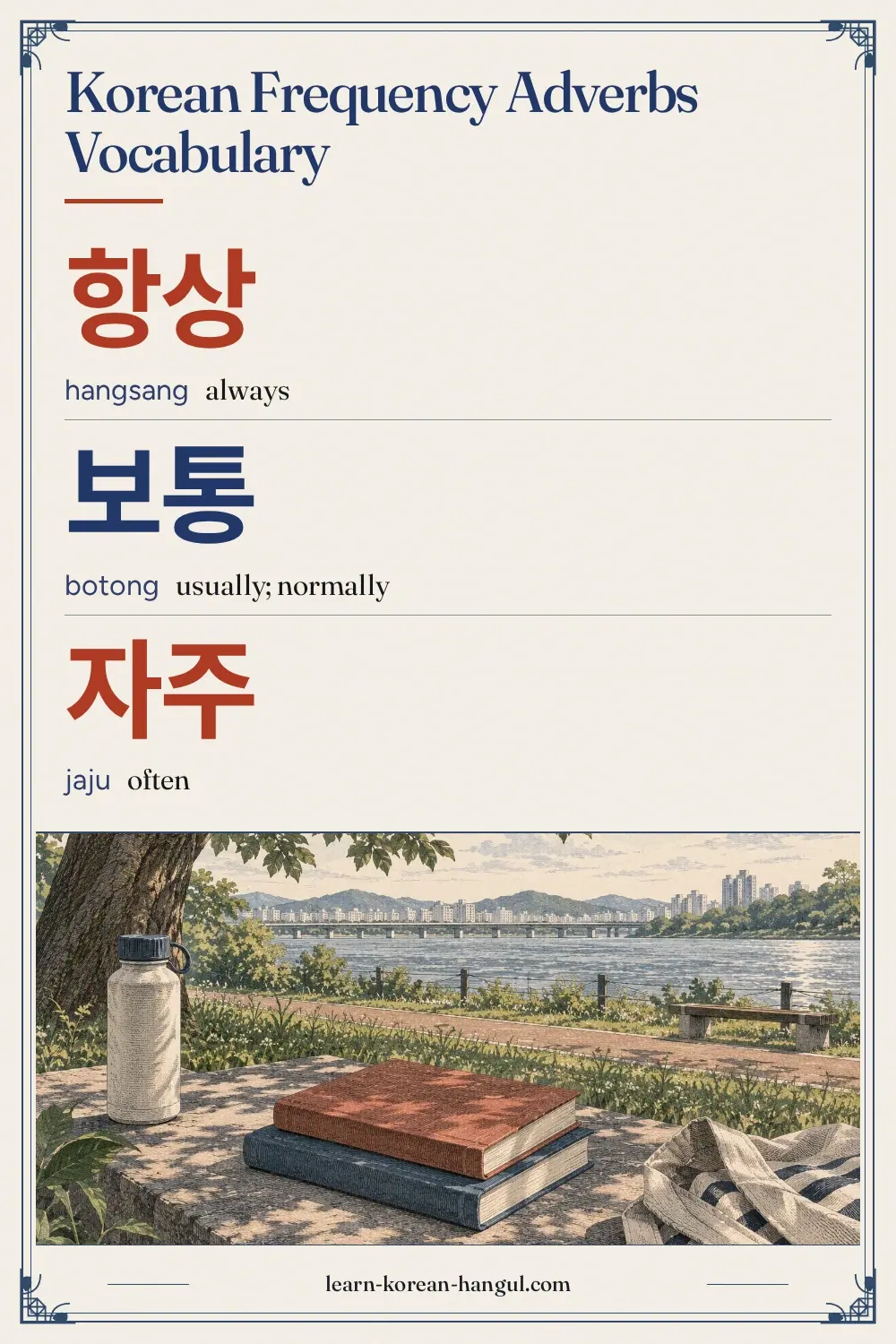
Korean Frequency Adverbs Vocabulary at a Glance
An adverb of frequency answers the question 얼마나 자주? (how often?). In Korean it sits before the verb, usually after the subject and the time word, and it takes no particle: 저는 항상 일찍 일어나요. The most important fact is the negative group. 전혀, 별로, 절대 and 한 번도 mean "never" or "not much" only when the verb is negative, which is the opposite of English "never", where the verb is positive.
This page sits under Time Expressions, beside Korean Parts of the Day.
| Group | Words | What it covers |
|---|---|---|
| Always and usually | 5 | 항상, 늘, 보통, 주로, 대개 |
| Often and sometimes | 4 | 자주, 종종, 가끔, 때때로 |
| Rarely and never | 5 | 거의, 별로, 전혀, 절대, 한 번도 |
| Every day, week, month, year | 4 | 매일, 매주, 매달, 매년 |
| Times per period | 2 | 번, 다시 |
Which Frequency Adverbs Should You Learn First?
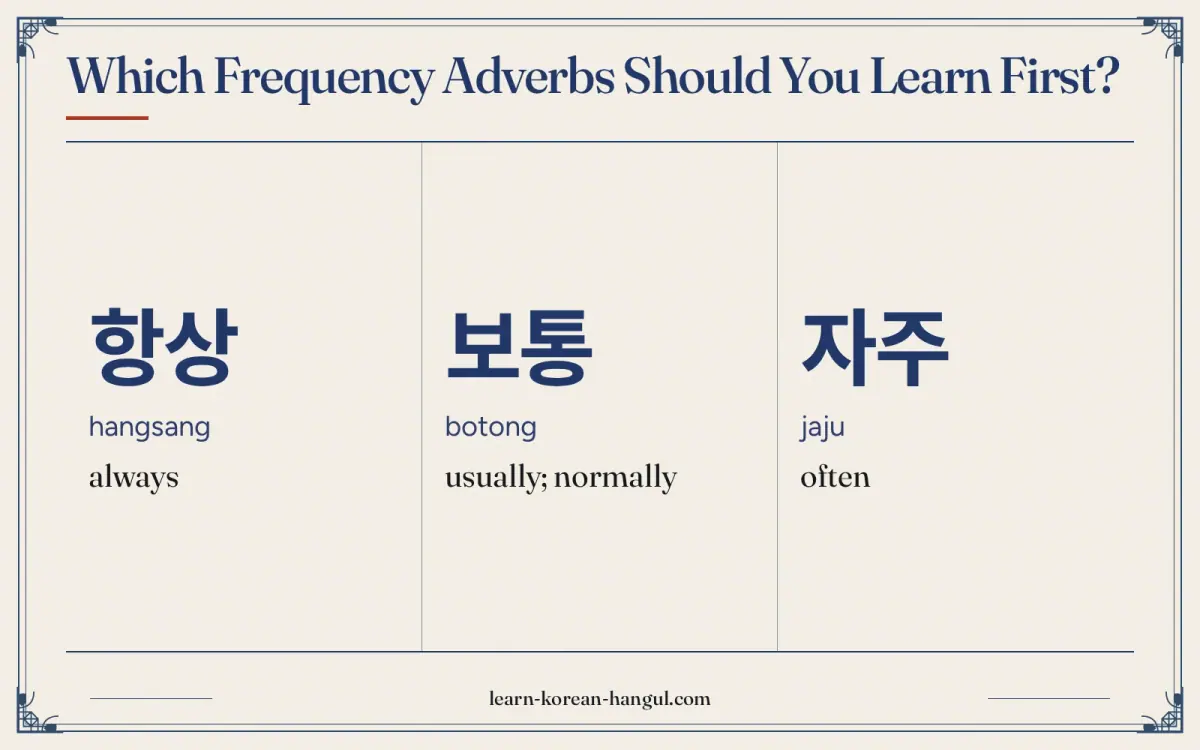
Learn the ladder from top to bottom with the middle first: 항상, 자주, 가끔, 거의 and 전혀. These five give you the whole range. Then add 보통, which answers "what do you usually do?", and 매일. The rest are alternatives of the same rung.
- Say first. 항상, 보통, 자주, 가끔, 매일, 전혀.
- Know the grammar. 전혀, 별로, 절대 and 한 번도 need a negative verb.
- Recognise. 늘, 종종, 때때로, 대개, 주로. They are common in reading.
The scene below is a weekly planner showing a habit repeated on different numbers of days.
Word · 10
- 1
항상
hangsang
always
- 2
보통
botong
usually; normally
- 3
자주
jaju
often
- 4
가끔
gakkeum
sometimes
- 5
거의
geoui
almost; hardly
- 6
전혀
jeonhyeo
not at all
- 7
절대
jeoldae
never; absolutely not
- 8
매일
maeil
every day
- 9
매주
maeju
every week
- 10
번
beon
time; occasion (counter)
Always and Usually
The top rung has five words. 항상 and 늘 mean "always"; 항상 is the standard choice and 늘 is shorter and warmer. 보통 and 대개 mean "usually", which is not quite "always". 주로 means "mostly" and points at the main option: 주로 집에서 공부해요 says "I mostly study at home", with the idea that sometimes I do not.
| No. | Hangul | Revised Romanization | Meaning and note | Example sentence | Audio assetId |
|---|---|---|---|---|---|
| 1 | 항상 | hangsang | always. The top rung. Works with a positive verb. | 항상 일찍 일어나요. (I always get up early.) | au-pg-vocabulary-time-time-expressions-frequency-adverbs-1; example: au-pg-vocabulary-time-time-expressions-frequency-adverbs-21 |
| 2 | 늘 | neul | always; all the time. Shorter and more spoken than 항상. | 제 친구는 늘 웃어요. (My friend is always smiling.) | au-pg-vocabulary-time-time-expressions-frequency-adverbs-2; example: au-pg-vocabulary-time-time-expressions-frequency-adverbs-22 |
| 3 | 보통 | botong | usually; normally. What happens on an ordinary day. | 보통 일곱 시에 일어나요. (I usually get up at seven.) | au-pg-vocabulary-time-time-expressions-frequency-adverbs-3; example: au-pg-vocabulary-time-time-expressions-frequency-adverbs-23 |
| 4 | 주로 | juro | mostly; mainly. Names the main place, time or way. | 주로 집에서 공부해요. (I mostly study at home.) | au-pg-vocabulary-time-time-expressions-frequency-adverbs-4; example: au-pg-vocabulary-time-time-expressions-frequency-adverbs-24 |
| 5 | 대개 | daegae | mostly; in most cases. Slightly more general than 보통. | 대개 지하철로 가요. (I mostly go by subway.) | au-pg-vocabulary-time-time-expressions-frequency-adverbs-5; example: au-pg-vocabulary-time-time-expressions-frequency-adverbs-25 |
Example Sentences
The frame is subject + frequency + other details + verb, as in 저는 보통 일곱 시에 일어나요. Subjects are often dropped in Korean, so the adverb ends up first. Play the sentence, repeat it, then change the adverb to see the meaning move up or down the ladder.
How Do You Say Often and Sometimes in Korean?
The middle of the ladder has four words. 자주 is "often" and is the everyday word. 종종 is "from time to time" and sounds a little more careful. 가끔 is "sometimes" and is the one you will hear most in speech. 때때로 is "at times" and appears more in writing. Use 자주 for many times a week and 가끔 for a few times a month.
| No. | Hangul | Revised Romanization | Meaning and note | Example sentence | Audio assetId |
|---|---|---|---|---|---|
| 6 | 자주 | jaju | often. Frequent but not constant. | 자주 커피를 마셔요. (I often drink coffee.) | au-pg-vocabulary-time-time-expressions-frequency-adverbs-6; example: au-pg-vocabulary-time-time-expressions-frequency-adverbs-26 |
| 7 | 종종 | jongjong | from time to time. Mildly more formal than 자주. | 종종 친구와 영화를 봐요. (I see a movie with a friend from time to time.) | au-pg-vocabulary-time-time-expressions-frequency-adverbs-7; example: au-pg-vocabulary-time-time-expressions-frequency-adverbs-27 |
| 8 | 가끔 | gakkeum | sometimes. Occasional. The ㄲ is tense. | 가끔 도서관에 가요. (I sometimes go to the library.) | au-pg-vocabulary-time-time-expressions-frequency-adverbs-8; example: au-pg-vocabulary-time-time-expressions-frequency-adverbs-28 |
| 9 | 때때로 | ttaettaero | at times. A written style word; 가끔 is more spoken. | 때때로 비가 와요. (It rains at times.) | au-pg-vocabulary-time-time-expressions-frequency-adverbs-9; example: au-pg-vocabulary-time-time-expressions-frequency-adverbs-29 |
The sound of 가끔 is a good first test. The ㄲ is a tense consonant, so say it with a stop before the second syllable and no puff of air.
Rarely and Never
English "never" is a positive-form word in a positive sentence. Korean uses a frequency word plus a negative verb. Five words belong here. 거의 is "almost", and 거의 안 means "hardly ever". 별로 is "not very" and is soft. 전혀 is "not at all" and is firm. 절대 is "never" in the sense of "absolutely not", and is stronger than 전혀. 한 번도 is "not even once" and describes experience.
A quick way to feel the differences:
| Sentence | Meaning |
|---|---|
| 커피를 거의 안 마셔요. | I hardly ever drink coffee. |
| 커피를 별로 안 마셔요. | I do not drink coffee much. |
| 커피를 전혀 안 마셔요. | I do not drink coffee at all. |
| 커피를 절대 안 마셔요. | I never drink coffee (I refuse to). |
| No. | Hangul | Revised Romanization | Meaning and note | Example sentence | Audio assetId |
|---|---|---|---|---|---|
| 10 | 거의 | geoui | almost; hardly. With 안 it means hardly ever. With 매일 it means almost every day. Said [거의/거이]. | 커피를 거의 안 마셔요. (I hardly ever drink coffee.) | au-pg-vocabulary-time-time-expressions-frequency-adverbs-10; example: au-pg-vocabulary-time-time-expressions-frequency-adverbs-30 |
| 11 | 별로 | byeollo | not much; not very. Comes before a negative. | 별로 안 좋아해요. (I do not like it much.) | au-pg-vocabulary-time-time-expressions-frequency-adverbs-11; example: au-pg-vocabulary-time-time-expressions-frequency-adverbs-31 |
| 12 | 전혀 | jeonhyeo | not at all. Comes before a negative; the strongest everyday one. Said [전혀]; in everyday speech the ㅎ weakens, so it often sounds like [저녀]. | 전혀 몰라요. (I do not know at all.) | au-pg-vocabulary-time-time-expressions-frequency-adverbs-12; example: au-pg-vocabulary-time-time-expressions-frequency-adverbs-32 |
| 13 | 절대 | jeoldae | never; absolutely not. Needs a negative verb to mean never. Said [절때]. | 절대 안 해요. (I would never do it.) | au-pg-vocabulary-time-time-expressions-frequency-adverbs-13; example: au-pg-vocabulary-time-time-expressions-frequency-adverbs-33 |
| 14 | 한 번도 | han beondo | not even once; never. Literally even once. Needs a negative verb. | 한 번도 안 가 봤어요. (I have never been there.) | au-pg-vocabulary-time-time-expressions-frequency-adverbs-14; example: au-pg-vocabulary-time-time-expressions-frequency-adverbs-34 |
For the negative itself, see the negation lesson. The short form uses 안 before the verb and the long form uses 지 않다, and both work with these adverbs.
How Do You Say Every X (매일, 매주) in Korean?
매 is a prefix that means every. Add it to a time word and you get an adverb: 매일 (every day), 매주 (every week), 매달 (every month), 매년 (every year). They need no particle, and they can combine with a day name: 매주 토요일 means every Saturday. In writing, 매월 appears on notices as a stiffer form of 매달.
| No. | Hangul | Revised Romanization | Meaning and note | Example sentence | Audio assetId |
|---|---|---|---|---|---|
| 15 | 매일 | maeil | every day. 매 means every. A noun used as an adverb. | 매일 한국어를 공부해요. (I study Korean every day.) | au-pg-vocabulary-time-time-expressions-frequency-adverbs-15; example: au-pg-vocabulary-time-time-expressions-frequency-adverbs-35 |
| 16 | 매주 | maeju | every week. No particle needed. | 매주 토요일에 청소해요. (I clean every Saturday.) | au-pg-vocabulary-time-time-expressions-frequency-adverbs-16; example: au-pg-vocabulary-time-time-expressions-frequency-adverbs-36 |
| 17 | 매달 | maedal | every month. Also 매월 in written notices. | 매달 친구를 만나요. (I meet a friend every month.) | au-pg-vocabulary-time-time-expressions-frequency-adverbs-17; example: au-pg-vocabulary-time-time-expressions-frequency-adverbs-37 |
| 18 | 매년 | maenyeon | every year. Said [매년]. | 매년 여름에 여행을 가요. (I travel every summer.) | au-pg-vocabulary-time-time-expressions-frequency-adverbs-18; example: au-pg-vocabulary-time-time-expressions-frequency-adverbs-38 |
Note 거의 pairs with 매일 as a positive: 거의 매일 운동해요 means "I exercise almost every day". The negative sense of 거의 appears only with a negative verb.
Times per Period
To say how many times, use period + 에 + number + 번. The number is native Korean: 한 번, 두 번, 세 번. So 일주일에 두 번 is twice a week, 하루에 세 번 is three times a day, and 일 년에 한 번 is once a year. Put 에 after the period, which marks "per". The count word 번 also means "turn" or "time", as in 한 번 더 (one more time).
| No. | Hangul | Revised Romanization | Meaning and note | Example sentence | Audio assetId |
|---|---|---|---|---|---|
| 19 | 번 | beon | time; occasion (counter). Counts how many times, with native numbers: 한 번, 두 번, 세 번. | 일 년에 두 번 가요. (I go twice a year.) | au-pg-vocabulary-time-time-expressions-frequency-adverbs-19; example: au-pg-vocabulary-time-time-expressions-frequency-adverbs-39 |
| 20 | 다시 | dasi | again. Repeats an action from the start. | 다시 말해 주세요. (Please say it again.) | au-pg-vocabulary-time-time-expressions-frequency-adverbs-20; example: au-pg-vocabulary-time-time-expressions-frequency-adverbs-40 |
Combine the pieces to describe a habit: 저는 보통 일주일에 두 번 운동해요 means "I usually exercise twice a week". Here 보통 is the rung and 일주일에 두 번 is the rate, and the two do not conflict. For the days and weeks themselves, see Time Expressions.
How Do You Pronounce These Words?
Frequency words are short, but they have tense sounds and two vowel details. Standard pronunciation follows the National Institute of Korean Language (국립국어원) rules, and the romanization follows the Revised Romanization of Korean.
| Spelling | Sounds like | What changes |
|---|---|---|
| 가끔 | [가끔] | Tense ㄲ; hold the stop. |
| 때때로 | [때때로] | Two tense ㄸ syllables. |
| 절대 | [절때] | ㄷ after ㄹ is tense. |
| 전혀 | [전혀], often [저녀] | In everyday speech the ㅎ weakens and the ㄴ links forward. |
| 거의 | [거의] or [거이] | ㅢ may be said as [이] in this position. |
| 매년 | [매년] | No change; keep the ㄴ clear. |
The pair to practise is 전혀 and 절대. Both start with 전 or 절 and both go with a negative verb, so a clear first syllable keeps them apart.
Audio and Slow Playback
Each word and sentence has its own clip. The clips below replay the trickiest words slowly. Play one, repeat it, then play it again and compare.
What Mistakes Do Learners Make with Frequency Adverbs?
Five mistakes come up often.
- Using 절대 or 전혀 with a positive verb. 절대 먹어요 does not mean "I never eat". Say 절대 안 먹어요.
- Putting the adverb after the verb. Korean verbs come last, so the adverb goes before the verb: 항상 일찍 일어나요.
- Using 가끔 for "often". 가끔 is "sometimes"; 자주 is "often".
- Using Sino-Korean numbers with 번. Say 두 번 and 세 번, not 이 번 and 삼 번.
- Adding 에 to 매일 or 매주. Say 매일 운동해요, not 매일에.
The first mistake is the one worth drilling, because it changes the meaning of the whole sentence.
Practice: Flashcards and Worksheet
Run the deck in recognition mode until the ladder comes in order, then switch to listening mode and take the quiz. The deck holds all 20 words with audio, and your progress stays in your browser. The vocabulary flashcard decks page lists the other decks.
Practice · 45
- 01항상
Show answer
headword 1: always
- 02늘
Show answer
headword 2: always; all the time
- 03보통
Show answer
headword 3: usually; normally
- 04주로
Show answer
headword 4: mostly; mainly
- 05대개
Show answer
headword 5: mostly; in most cases
- 06자주
Show answer
headword 6: often
- 07종종
Show answer
headword 7: from time to time
- 08가끔
Show answer
headword 8: sometimes
- 09때때로
Show answer
headword 9: at times
- 10거의
Show answer
headword 10: almost; hardly
- 11별로
Show answer
headword 11: not much; not very
- 12전혀
Show answer
headword 12: not at all
- 13절대
Show answer
headword 13: never; absolutely not
- 14한 번도
Show answer
headword 14: not even once; never
- 15매일
Show answer
headword 15: every day
- 16매주
Show answer
headword 16: every week
- 17매달
Show answer
headword 17: every month
- 18매년
Show answer
headword 18: every year
- 19번
Show answer
headword 19: time; occasion (counter)
- 20다시
Show answer
headword 20: again
- 21항상 일찍 일어나요.
Show answer
example sentence for 항상
- 22제 친구는 늘 웃어요.
Show answer
example sentence for 늘
- 23보통 일곱 시에 일어나요.
Show answer
example sentence for 보통
- 24주로 집에서 공부해요.
Show answer
example sentence for 주로
- 25대개 지하철로 가요.
Show answer
example sentence for 대개
- 26자주 커피를 마셔요.
Show answer
example sentence for 자주
- 27종종 친구와 영화를 봐요.
Show answer
example sentence for 종종
- 28가끔 도서관에 가요.
Show answer
example sentence for 가끔
- 29때때로 비가 와요.
Show answer
example sentence for 때때로
- 30커피를 거의 안 마셔요.
Show answer
example sentence for 거의
- 31별로 안 좋아해요.
Show answer
example sentence for 별로
- 32전혀 몰라요.
Show answer
example sentence for 전혀
- 33절대 안 해요.
Show answer
example sentence for 절대
- 34한 번도 안 가 봤어요.
Show answer
example sentence for 한 번도
- 35매일 한국어를 공부해요.
Show answer
example sentence for 매일
- 36매주 토요일에 청소해요.
Show answer
example sentence for 매주
- 37매달 친구를 만나요.
Show answer
example sentence for 매달
- 38매년 여름에 여행을 가요.
Show answer
example sentence for 매년
- 39일 년에 두 번 가요.
Show answer
example sentence for 번
- 40다시 말해 주세요.
Show answer
example sentence for 다시
- 41가끔
Show answer
slow playback: 가끔
- 42때때로
Show answer
slow playback: 때때로
- 43전혀
Show answer
slow playback: 전혀
- 44절대
Show answer
slow playback: 절대
- 45거의
Show answer
slow playback: 거의
Practice · 5
What does 항상 (hangsang) mean?
Show answer
always
항상 means always. Example: 항상 일찍 일어나요. (I always get up early.)
What does 가끔 (gakkeum) mean?
Show answer
sometimes
가끔 means sometimes. Example: 가끔 도서관에 가요. (I sometimes go to the library.)
What does 전혀 (jeonhyeo) mean?
Show answer
not at all
전혀 means not at all. Example: 전혀 몰라요. (I do not know at all.)
What does 매주 (maeju) mean?
Show answer
every week
매주 means every week. Example: 매주 토요일에 청소해요. (I clean every Saturday.)
What does 보통 (botong) mean?
Show answer
usually; normally
보통 means usually; normally. Example: 보통 일곱 시에 일어나요. (I usually get up at seven.)
Korean Frequency Adverbs Worksheet (PDF)
A printable worksheet for these words (word list, matching, writing practice, fill-in-the-blank exercises and answer key) is available in A4 and US Letter from the download card on this page. For practice, write seven days across a page, tick the days you do one habit and write the adverb that matches the count.
Where to Go Next
Continue with Korean Parts of the Day to say when in the day a habit happens, or go back to Time Expressions.
Frequently Asked Questions
How Do You Say Always, Often, Sometimes and Never in Korean?
Always is 항상 (hangsang), often is 자주 (jaju), sometimes is 가끔 (gakkeum), and never is 절대 or 전혀 with a negative verb, as in 절대 안 먹어요. Rarely is 거의 안, "hardly ever".
Why Do 전혀 and 절대 Need a Negative Verb?
전혀 means not at all and 절대 means absolutely not, so each one needs a negative to complete its meaning. English "never" carries the negative inside the word, while Korean splits it into a frequency word plus a negative verb, such as 안 or 지 않다. Without the negative, 절대 먹어요 does not say "I never eat".
What Is the Difference between 보통 and 항상?
항상 means always, with no exceptions in view. 보통 means usually, what happens on an ordinary day while allowing exceptions. 보통 일곱 시에 일어나요 means "I usually get up at seven", and 항상 일곱 시에 일어나요 means "I always get up at seven".
How Do You Say Twice a Week in Korean?
Say 일주일에 두 번. The pattern is period + 에 + native number + 번. So once a day is 하루에 한 번, three times a month is 한 달에 세 번 and once a year is 일 년에 한 번.
Do 매일 and 매주 Take the Particle 에?
No. 매일, 매주, 매달 and 매년 are used as adverbs without a particle: 매일 운동해요. A day name after 매주 does take 에 when the sentence needs it, as in 매주 토요일에 청소해요.
Is the Romanization on This Page Official?
It follows the Revised Romanization of Korean, which South Korea adopted on 7 July 2000 and whose rules the National Institute of Korean Language (국립국어원) publishes. It is a learning aid and does not mark every sound change, so rely on the Hangul and the audio.