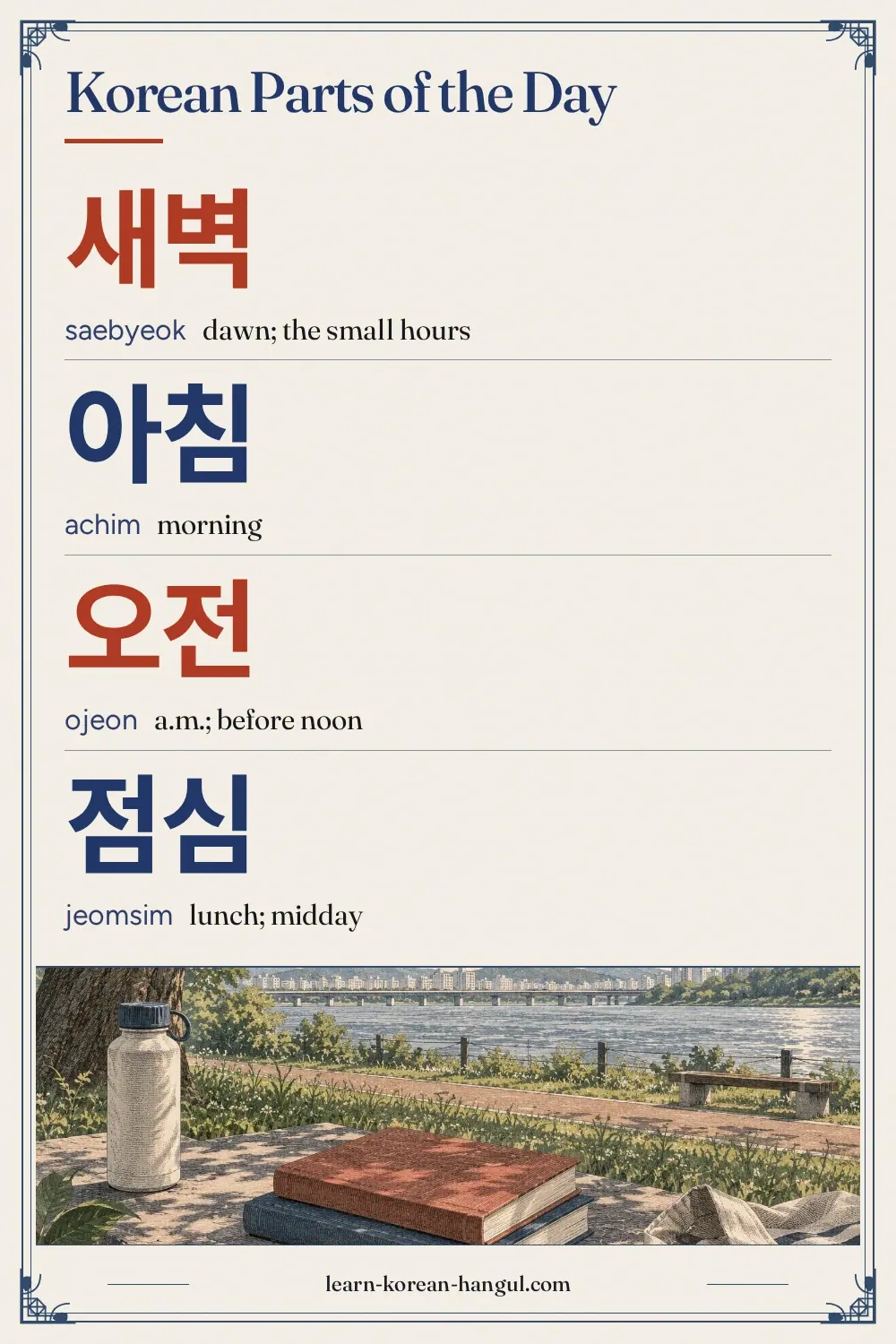
Korean Parts of the Day at a Glance
English has morning, afternoon, evening and night. Korean has more slots, and three of its words do double duty: 아침, 점심 and 저녁 each name both a part of the day and the meal eaten then. The extra slot is 새벽, the hours before sunrise, which English splits between "late night" and "early morning". The page is a child of Time Expressions and sits next to Korean Relative Time Words and Korean Frequency Adverbs.
| Group | Words | What it covers |
|---|---|---|
| Dawn to morning | 6 | 새벽, sunrise, morning, breakfast, a.m., going to work |
| Noon and afternoon | 5 | noon, daytime, lunch, lunchtime, p.m. |
| Evening | 4 | evening, dinner, sunset glow, leaving work |
| Night and midnight | 6 | night, midnight and late-night words |
| Greetings by time | 4 | hello, good night, sleep well, have a good day |
The boundaries between the slots are loose. As an editorial guide only, 새벽 is roughly from midnight to first light, 아침 from first light to about nine, 점심 around noon, 오후 from noon to about six, 저녁 from late afternoon into the evening, and 밤 from about nine at night. People set their own limits.
Which Parts of the Day Should You Learn First?
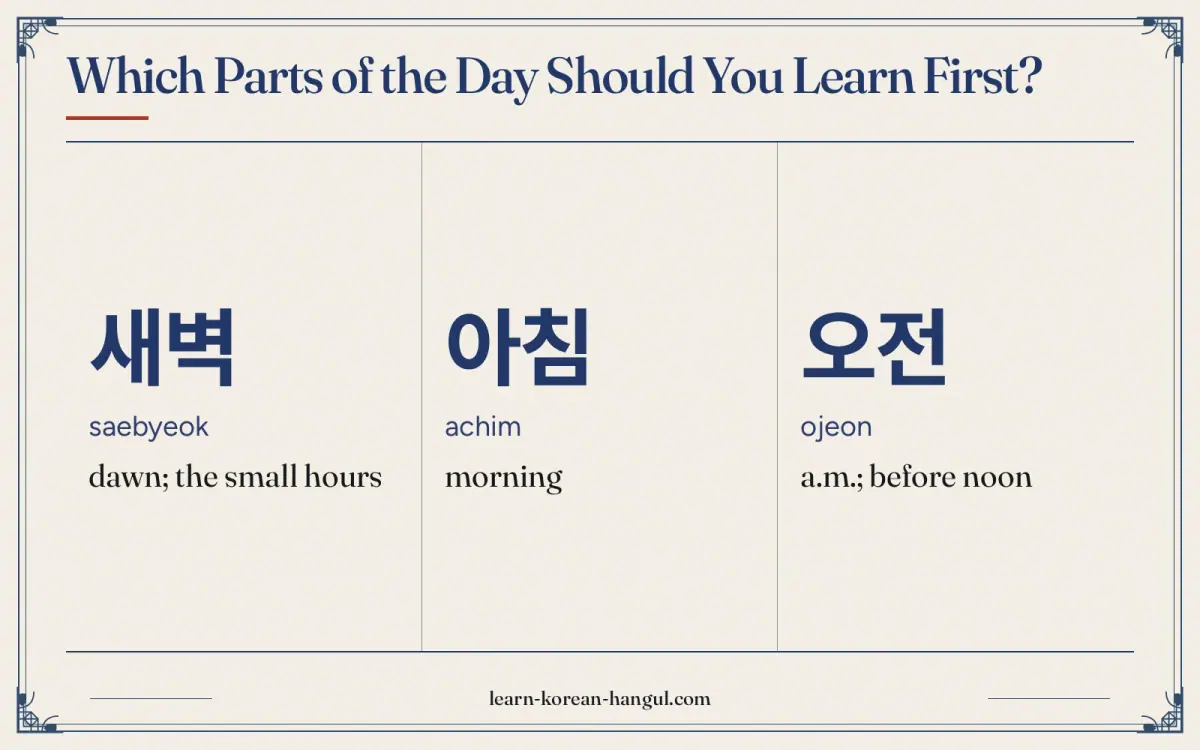
Start with 아침, 점심, 저녁 and 밤, then add 오전 and 오후, because those two go in front of a clock time. Next learn 새벽, because Koreans use it for the pre-dawn hours where English would say "night". The rest are used by topic: work (출근, 퇴근), meals (아침밥, 저녁밥) and sleep (자정, 한밤중).
- Say first. 아침, 점심, 저녁, 밤, 오전, 오후.
- Say for work. 출근, 퇴근, 점심시간.
- Recognise. 야간, 심야, 정오, 자정. They appear in schedules and signs.
The scene below shows one day as a sun-to-moon arc with the main slots as numbered items.
Word · 10
- 1
새벽
saebyeok
dawn; the small hours
- 2
아침
achim
morning
- 3
오전
ojeon
a.m.; before noon
- 4
점심
jeomsim
lunch; midday
- 5
오후
ohu
afternoon; p.m.
- 6
저녁
jeonyeok
evening; dinner
- 7
노을
noeul
sunset glow
- 8
밤
bam
night
- 9
자정
jajeong
midnight
- 10
출근
chulgeun
going to work
Dawn to Morning
새벽 is the first slot. It begins in the dark and ends when the sky is light, and a Korean speaker will use it for a 4 a.m. start or a 5 a.m. run. 아침 follows: it is the morning proper and the breakfast meal. 아침밥 names the meal alone, and 밥 is the word for cooked rice or a meal. 오전 is the label that goes before a clock time, as in 오전 아홉 시. 출근 starts the working day.
| No. | Hangul | Revised Romanization | Meaning and note | Example sentence | Audio assetId |
|---|---|---|---|---|---|
| 1 | 새벽 | saebyeok | dawn; the small hours. Before sunrise; from the dark hours to first light. | 새벽에 일어났어요. (I woke up at dawn.) | au-pg-vocabulary-time-time-expressions-parts-of-day-1; example: au-pg-vocabulary-time-time-expressions-parts-of-day-26 |
| 2 | 해돋이 | haedoji | sunrise. The sun coming up as an event. Said [해도지]. | 새해 첫 해돋이를 봤어요. (I watched the first sunrise of the new year.) | au-pg-vocabulary-time-time-expressions-parts-of-day-2; example: au-pg-vocabulary-time-time-expressions-parts-of-day-27 |
| 3 | 아침 | achim | morning. The morning hours. Also breakfast. | 아침에 커피를 마셔요. (I drink coffee in the morning.) | au-pg-vocabulary-time-time-expressions-parts-of-day-3; example: au-pg-vocabulary-time-time-expressions-parts-of-day-28 |
| 4 | 아침밥 | achimbap | breakfast. The meal only, with 밥 meaning rice or meal. Said [아침빱]. | 아침밥을 먹었어요. (I ate breakfast.) | au-pg-vocabulary-time-time-expressions-parts-of-day-4; example: au-pg-vocabulary-time-time-expressions-parts-of-day-29 |
| 5 | 오전 | ojeon | a.m.; before noon. Goes before the clock time. | 오전에는 수업이 있어요. (I have class in the morning.) | au-pg-vocabulary-time-time-expressions-parts-of-day-5; example: au-pg-vocabulary-time-time-expressions-parts-of-day-30 |
| 6 | 출근 | chulgeun | going to work. Used for the start of the working day. | 아침 여덟 시에 출근해요. (I go to work at eight in the morning.) | au-pg-vocabulary-time-time-expressions-parts-of-day-6; example: au-pg-vocabulary-time-time-expressions-parts-of-day-31 |
Example Sentences
The frame is time slot + 에 + verb. 아침에 커피를 마셔요 says what you do in the morning, and 아침밥을 먹었어요 says you had the meal. The difference is the particle: 에 marks a time, 을/를 marks the thing eaten. Play the sentence, repeat it, then swap the slot.
How Do You Say Noon and Afternoon in Korean?
Midday has four neighbours. 정오 is the exact moment, 낮 is the bright part of the day, 점심 is the meal and the time around it, and 오후 is the afternoon after noon. 점심시간 is the break itself and is the word on office schedules. A useful point: 점심 can mean both lunch and noon, so 점심에 만나요 is "Let us meet at lunchtime".
| No. | Hangul | Revised Romanization | Meaning and note | Example sentence | Audio assetId |
|---|---|---|---|---|---|
| 7 | 정오 | jeongo | noon. Exactly twelve o'clock; the formal word. | 정오에 만나요. (We meet at noon.) | au-pg-vocabulary-time-time-expressions-parts-of-day-7; example: au-pg-vocabulary-time-time-expressions-parts-of-day-32 |
| 8 | 낮 | nat | daytime. The bright hours; opposite of 밤. Said [낟]. | 낮에는 일해요. (I work during the day.) | au-pg-vocabulary-time-time-expressions-parts-of-day-8; example: au-pg-vocabulary-time-time-expressions-parts-of-day-33 |
| 9 | 점심 | jeomsim | lunch; midday. Both the meal and the time around noon. | 점심 먹었어요? (Have you eaten lunch?) | au-pg-vocabulary-time-time-expressions-parts-of-day-9; example: au-pg-vocabulary-time-time-expressions-parts-of-day-34 |
| 10 | 점심시간 | jeomsimsigan | lunchtime. The break itself. | 점심시간은 한 시간이에요. (Lunchtime is one hour.) | au-pg-vocabulary-time-time-expressions-parts-of-day-10; example: au-pg-vocabulary-time-time-expressions-parts-of-day-35 |
| 11 | 오후 | ohu | afternoon; p.m. Goes before the clock time. | 오후에 산책해요. (I take a walk in the afternoon.) | au-pg-vocabulary-time-time-expressions-parts-of-day-11; example: au-pg-vocabulary-time-time-expressions-parts-of-day-36 |
Notice 낮, which sounds like [낟]. The final ㅈ is said as [ㄷ], so the word is short and closed.
Evening
The evening group links the sun and the clock. 저녁 is the evening and dinner, 저녁밥 is the meal alone, 노을 is the red sky that Koreans often photograph, and 퇴근 is leaving work. 퇴근 is also used for the commute home: 퇴근 시간 is rush hour in the evening, a phrase you will see on traffic reports.
| No. | Hangul | Revised Romanization | Meaning and note | Example sentence | Audio assetId |
|---|---|---|---|---|---|
| 12 | 저녁 | jeonyeok | evening; dinner. Also the evening meal. | 저녁에 산책해요. (I take a walk in the evening.) | au-pg-vocabulary-time-time-expressions-parts-of-day-12; example: au-pg-vocabulary-time-time-expressions-parts-of-day-37 |
| 13 | 저녁밥 | jeonyeokbap | dinner. The meal only. Said [저녁빱]. | 저녁밥은 여섯 시에 먹어요. (I eat dinner at six.) | au-pg-vocabulary-time-time-expressions-parts-of-day-13; example: au-pg-vocabulary-time-time-expressions-parts-of-day-38 |
| 14 | 노을 | noeul | sunset glow. The red sky at the end of the day. | 노을이 예뻐요. (The sunset glow is pretty.) | au-pg-vocabulary-time-time-expressions-parts-of-day-14; example: au-pg-vocabulary-time-time-expressions-parts-of-day-39 |
| 15 | 퇴근 | toegeun | leaving work. Used for the end of the working day. | 여섯 시에 퇴근해요. (I leave work at six.) | au-pg-vocabulary-time-time-expressions-parts-of-day-15; example: au-pg-vocabulary-time-time-expressions-parts-of-day-40 |
저녁 can mean 6 p.m. dinner or 8 p.m. evening, depending on the speaker. If you want to be clear, add the clock time: 저녁 일곱 시에 만나요 means "Let us meet at seven in the evening". For the single word, see evening in korean.
How Do You Say Night and Midnight in Korean?
Six words cover the dark hours. 밤 is the plain night. 한밤중 is deep night. 자정 is exactly twelve. 야간 and 심야 are formal: 야간 appears in notices, as in 야간 근무 (night duty) or 야간 운전 (night driving), and 심야 appears for late-night services, such as 심야 버스 (late-night bus). 밤새 means through the whole night.
| No. | Hangul | Revised Romanization | Meaning and note | Example sentence | Audio assetId |
|---|---|---|---|---|---|
| 16 | 밤 | bam | night. The dark hours. Also means chestnut. | 밤에 책을 읽어요. (I read at night.) | au-pg-vocabulary-time-time-expressions-parts-of-day-16; example: au-pg-vocabulary-time-time-expressions-parts-of-day-41 |
| 17 | 한밤중 | hanbamjung | the middle of the night. The deepest part of the night. Said [한밤쭝]. | 한밤중에 전화가 왔어요. (A call came in the middle of the night.) | au-pg-vocabulary-time-time-expressions-parts-of-day-17; example: au-pg-vocabulary-time-time-expressions-parts-of-day-42 |
| 18 | 자정 | jajeong | midnight. Exactly twelve at night. | 자정이 지났어요. (Midnight has passed.) | au-pg-vocabulary-time-time-expressions-parts-of-day-18; example: au-pg-vocabulary-time-time-expressions-parts-of-day-43 |
| 19 | 야간 | yagan | night (formal). Used in notices and schedules, not in speech about your own evening. | 야간 근무가 있어요. (There is night duty.) | au-pg-vocabulary-time-time-expressions-parts-of-day-19; example: au-pg-vocabulary-time-time-expressions-parts-of-day-44 |
| 20 | 심야 | simya | late night. Around and after midnight; used for services and late-night rates. | 심야 버스를 탔어요. (I took the late-night bus.) | au-pg-vocabulary-time-time-expressions-parts-of-day-20; example: au-pg-vocabulary-time-time-expressions-parts-of-day-45 |
| 21 | 밤새 | bamsae | all night. Through the whole night. | 밤새 공부했어요. (I studied all night.) | au-pg-vocabulary-time-time-expressions-parts-of-day-21; example: au-pg-vocabulary-time-time-expressions-parts-of-day-46 |
밤 versus 야간 is a register difference. In speech, you go out at 밤, but a sign says 야간. Use 밤 for your own life, and 야간 when reading rules, shifts and schedules. 밤 also means chestnut, so check the verb: 밤을 먹어요 usually means chestnuts. For the single word, see night in korean, and for the morning word, morning in korean.
Greetings by Time
Korean has no standard separate greetings for morning, afternoon and evening. 안녕하세요 is hello at any hour, and 좋은 아침 (good morning) is a casual, English-influenced phrase heard among friends and coworkers. The time of day appears mainly in the farewells: 좋은 하루 보내세요 is said when you part during the day, 잘 자요 is for friends going to bed, and 안녕히 주무세요 is for elders and for respect. The honorific verb 주무시다 is the respectful form of 자다 (to sleep); this is a good example of vocabulary tied to politeness. For more greetings, see greetings.
| No. | Hangul | Revised Romanization | Meaning and note | Example sentence | Audio assetId |
|---|---|---|---|---|---|
| 22 | 안녕하세요 | annyeonghaseyo | hello (any time of day). Korean does not split hello into morning, afternoon and evening forms. | 안녕하세요. 만나서 반가워요. (Hello. Nice to meet you.) | au-pg-vocabulary-time-time-expressions-parts-of-day-22; example: au-pg-vocabulary-time-time-expressions-parts-of-day-47 |
| 23 | 안녕히 주무세요 | annyeonghi jumuseyo | good night (to an elder). Honorific; said when someone goes to bed. | 할머니, 안녕히 주무세요. (Grandmother, good night.) | au-pg-vocabulary-time-time-expressions-parts-of-day-23; example: au-pg-vocabulary-time-time-expressions-parts-of-day-48 |
| 24 | 잘 자요 | jal jayo | sleep well. Polite and friendly, for peers and younger people. | 잘 자요. 내일 만나요. (Sleep well. See you tomorrow.) | au-pg-vocabulary-time-time-expressions-parts-of-day-24; example: au-pg-vocabulary-time-time-expressions-parts-of-day-49 |
| 25 | 좋은 하루 보내세요 | joeun haru bonaeseyo | have a good day. A polite farewell in the morning or afternoon. | 좋은 하루 보내세요. (Have a good day.) | au-pg-vocabulary-time-time-expressions-parts-of-day-25; example: au-pg-vocabulary-time-time-expressions-parts-of-day-50 |
How Do You Pronounce These Words?
Many of the words end in a consonant that changes before the next sound. Standard pronunciation follows the National Institute of Korean Language (국립국어원) rules, and the romanization follows the Revised Romanization of Korean.
| Spelling | Sounds like | What changes |
|---|---|---|
| 해돋이 | [해도지] | ㄷ before 이 is said as [ㅈ]. |
| 아침밥 | [아침빱] | In this compound the ㅂ of 밥 is said tense, which the spelling does not show. |
| 저녁밥 | [저녁빱] | ㅂ after final ㄱ is tense. |
| 한밤중 | [한밤쭝] | In this compound the ㅈ of 중 is said tense. |
| 낮 | [낟] | Final ㅈ is said as [ㄷ]. |
| 심야 | [시먀] | The final ㅁ moves to 야. |
The pair to practise is 아침 and 점심. The two endings, 침 and 심, are close in sound; check the first consonant ㅊ against ㅅ.
Audio and Slow Playback
Each word and sentence has its own clip. The clips below replay the trickiest words slowly. Play one, repeat it, then play it again and compare.
What Mistakes Do Learners Make with Parts of the Day?
Five mistakes come up often.
- Confusing the meal with the time. 아침을 먹어요 is "I eat breakfast", and 아침에 먹어요 is "I eat in the morning".
- Using 밤 for 6 p.m. English "evening" is 저녁; 밤 is for the dark hours.
- Missing 새벽. Saying 밤 three o'clock for 3 a.m. is understood, but 새벽 세 시 is the natural form.
- Putting the clock time before 오전. The label comes first: 오전 아홉 시, not 아홉 시 오전.
- Using 야간 in casual speech. Say 밤 for your own night plans.
Mistake 3 is the one that most shows an English habit, since English splits the hours differently.
Practice: Flashcards and Worksheet
Run the deck in recognition mode until the slots come in order, then switch to listening mode and take the quiz. The deck holds all 25 words with audio, and your progress stays in your browser. The vocabulary flashcard decks page lists the other decks.
Practice · 55
- 01새벽
Show answer
headword 1: dawn; the small hours
- 02해돋이
Show answer
headword 2: sunrise
- 03아침
Show answer
headword 3: morning
- 04아침밥
Show answer
headword 4: breakfast
- 05오전
Show answer
headword 5: a.m.; before noon
- 06출근
Show answer
headword 6: going to work
- 07정오
Show answer
headword 7: noon
- 08낮
Show answer
headword 8: daytime
- 09점심
Show answer
headword 9: lunch; midday
- 10점심시간
Show answer
headword 10: lunchtime
- 11오후
Show answer
headword 11: afternoon; p.m.
- 12저녁
Show answer
headword 12: evening; dinner
- 13저녁밥
Show answer
headword 13: dinner
- 14노을
Show answer
headword 14: sunset glow
- 15퇴근
Show answer
headword 15: leaving work
- 16밤
Show answer
headword 16: night
- 17한밤중
Show answer
headword 17: the middle of the night
- 18자정
Show answer
headword 18: midnight
- 19야간
Show answer
headword 19: night (formal)
- 20심야
Show answer
headword 20: late night
- 21밤새
Show answer
headword 21: all night
- 22안녕하세요
Show answer
headword 22: hello (any time of day)
- 23안녕히 주무세요
Show answer
headword 23: good night (to an elder)
- 24잘 자요
Show answer
headword 24: sleep well
- 25좋은 하루 보내세요
Show answer
headword 25: have a good day
- 26새벽에 일어났어요.
Show answer
example sentence for 새벽
- 27새해 첫 해돋이를 봤어요.
Show answer
example sentence for 해돋이
- 28아침에 커피를 마셔요.
Show answer
example sentence for 아침
- 29아침밥을 먹었어요.
Show answer
example sentence for 아침밥
- 30오전에는 수업이 있어요.
Show answer
example sentence for 오전
- 31아침 여덟 시에 출근해요.
Show answer
example sentence for 출근
- 32정오에 만나요.
Show answer
example sentence for 정오
- 33낮에는 일해요.
Show answer
example sentence for 낮
- 34점심 먹었어요?
Show answer
example sentence for 점심
- 35점심시간은 한 시간이에요.
Show answer
example sentence for 점심시간
- 36오후에 산책해요.
Show answer
example sentence for 오후
- 37저녁에 산책해요.
Show answer
example sentence for 저녁
- 38저녁밥은 여섯 시에 먹어요.
Show answer
example sentence for 저녁밥
- 39노을이 예뻐요.
Show answer
example sentence for 노을
- 40여섯 시에 퇴근해요.
Show answer
example sentence for 퇴근
- 41밤에 책을 읽어요.
Show answer
example sentence for 밤
- 42한밤중에 전화가 왔어요.
Show answer
example sentence for 한밤중
- 43자정이 지났어요.
Show answer
example sentence for 자정
- 44야간 근무가 있어요.
Show answer
example sentence for 야간
- 45심야 버스를 탔어요.
Show answer
example sentence for 심야
- 46밤새 공부했어요.
Show answer
example sentence for 밤새
- 47안녕하세요. 만나서 반가워요.
Show answer
example sentence for 안녕하세요
- 48할머니, 안녕히 주무세요.
Show answer
example sentence for 안녕히 주무세요
- 49잘 자요. 내일 만나요.
Show answer
example sentence for 잘 자요
- 50좋은 하루 보내세요.
Show answer
example sentence for 좋은 하루 보내세요
- 51해돋이
Show answer
slow playback: 해돋이
- 52아침밥
Show answer
slow playback: 아침밥
- 53한밤중
Show answer
slow playback: 한밤중
- 54심야
Show answer
slow playback: 심야
- 55안녕히 주무세요
Show answer
slow playback: 안녕히 주무세요
Practice · 5
What does 새벽 (saebyeok) mean?
Show answer
dawn; the small hours
새벽 means dawn; the small hours. Example: 새벽에 일어났어요. (I woke up at dawn.)
What does 저녁 (jeonyeok) mean?
Show answer
evening; dinner
저녁 means evening; dinner. Example: 저녁에 산책해요. (I take a walk in the evening.)
What does 퇴근 (toegeun) mean?
Show answer
leaving work
퇴근 means leaving work. Example: 여섯 시에 퇴근해요. (I leave work at six.)
What does 자정 (jajeong) mean?
Show answer
midnight
자정 means midnight. Example: 자정이 지났어요. (Midnight has passed.)
What does 아침밥 (achimbap) mean?
Show answer
breakfast
아침밥 means breakfast. Example: 아침밥을 먹었어요. (I ate breakfast.)
Korean Parts of the Day Worksheet (PDF)
A printable worksheet for these words (word list, matching, writing practice, fill-in-the-blank exercises and answer key) is available in A4 and US Letter from the download card on this page. For practice, draw a half circle, divide it into five slots and write the Hangul name of each, then add one verb you do in it.
Where to Go Next
Continue with Korean Relative Time Words to move between days and weeks, or Korean Frequency Adverbs to say how often you do something. To go up, return to Time Expressions.
Frequently Asked Questions
How Do You Say Morning, Afternoon, Evening and Night in Korean?
Morning is 아침 (achim), afternoon is 오후 (ohu), evening is 저녁 (jeonyeok) and night is 밤 (bam). Midday is 점심 (jeomsim) and the hours before sunrise are 새벽 (saebyeok). Add 에 to say in that part of the day, as in 저녁에.
What Is 새벽 in Korean?
새벽 means dawn or the small hours: the dark hours before sunrise. Koreans use it where English says "early morning" or "late night", as in 새벽 세 시, three in the morning. It is a separate slot between 밤 and 아침.
Why Do 아침, 점심 and 저녁 Also Mean Meals?
Korean names each meal after the time it is eaten. 아침 is morning and breakfast, 점심 is midday and lunch, and 저녁 is evening and dinner. To mean only the meal, add 밥: 아침밥, 저녁밥. The particle shows which: 아침을 먹어요 is breakfast and 아침에 먹어요 is in the morning.
What Is the Difference between 밤 and 야간?
밤 is the ordinary word for night, used in speech and daily life. 야간 is the formal word, used in notices and schedules, as in 야간 근무 (night duty). Use 밤 for your own plans and 야간 when you read rules or timetables.
Is There a Korean Good Morning?
안녕하세요 works at any time of day and is the usual greeting. 좋은 아침 (good morning) exists, but it is a casual phrase influenced by English. Time-specific wishes appear at parting: 좋은 하루 보내세요 for a good day, and 안녕히 주무세요 or 잘 자요 at bedtime.
Is the Romanization on This Page Official?
It follows the Revised Romanization of Korean, which South Korea adopted on 7 July 2000 and whose rules the National Institute of Korean Language (국립국어원) publishes. It is a learning aid and does not mark every sound change, so rely on the Hangul and the audio.