
What you will be able to do (about 30 minutes)
- Copy a Korean sentence at an even size on ruled lines.
- Leave a correct space between words.
- Write the same sentence on lines, between two lines and with no lines at all.
- Check spacing against an answer key.
Download the Korean Handwriting Practice Sheet
The download has one file for A4 and one for US Letter. The pages are the same, so pick the file that matches your paper. No sign-up is needed.
Korean Handwriting Practice Sheet
Download PDF (A4) PDF (US Letter)
Preview
Three Line Styles on One Page
The next section describes each line style and says why it is there.
What Is on Each Page?
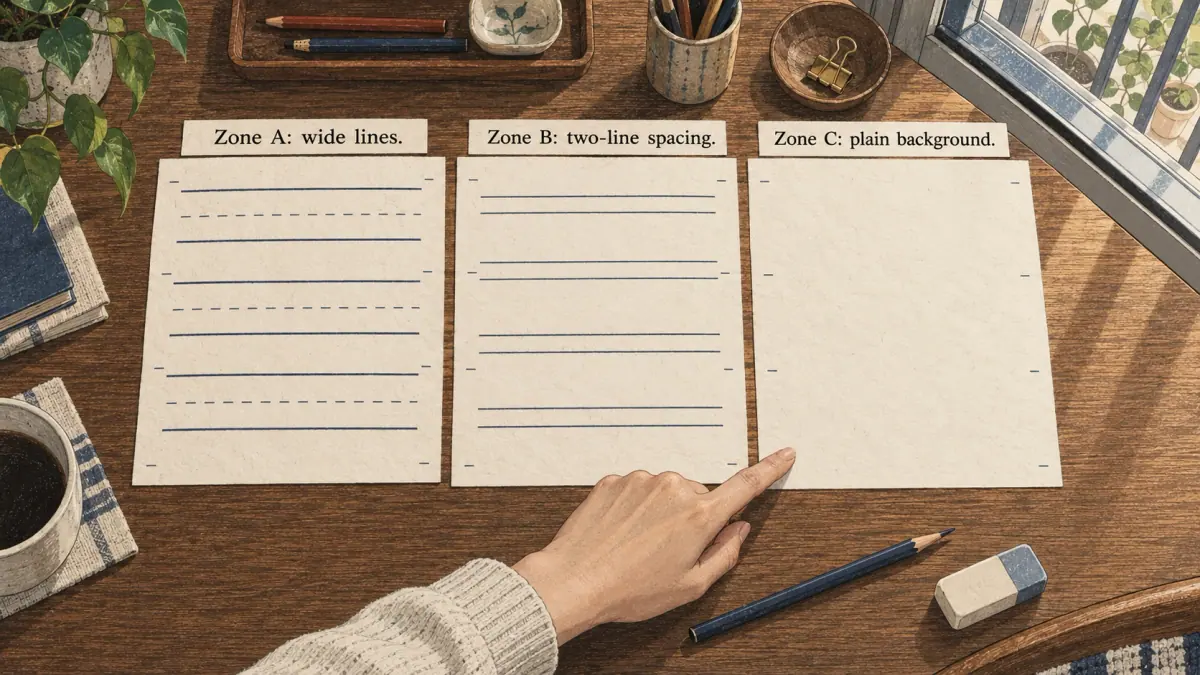
The practice page has three zones, each with a different amount of support. Zone A gives the most help and zone C gives almost none. The idea is to remove the guide lines step by step, which is how handwriting moves from copying to independent writing.
Zone A: wide lines. The top has a model line and four copy lines, each 14 mm high. Each line has a solid baseline and a dashed midline. The model is 안녕하세요., and the last copy line holds a second model, 만나서 반가워요. Wide lines give room for the whole block, including the final consonant.
Zone B: two-line spacing. The middle has five bands. Each band sits between two solid lines, 9 mm apart, with a 7 mm gap before the next band. Block heights match the band height, so every block should touch both lines. The model in band 1 is 저는 한글을 배워요.
Zone C: plain background. The bottom has four plain strips with no lines. In strips 1 to 3 you write the first three sentences again from memory. Strip 4 starts with one new sentence, 오늘은 날씨가 좋아요., printed small at the left for you to copy. Without lines, your own sense of size and spacing takes over.
Answer key. The second sheet shows the four sentences with their romanization, meaning and word spacing.
| Sentence | Sound (Revised Romanization) | Meaning | Words | Spaces |
|---|---|---|---|---|
| 안녕하세요. | annyeonghaseyo | Hello. | 1 | 0 |
| 만나서 반가워요. | mannaseo bangawoyo | Nice to meet you. | 2 | 1 |
| 저는 한글을 배워요. | jeoneun hangeureul baewoyo | I am learning Hangul. | 3 | 2 |
| 오늘은 날씨가 좋아요. | oneureun nalssiga joayo | The weather is nice today. | 3 | 2 |
Now that the zones are clear, the next section explains how to work through them.
How Do I Use This Sheet?
Copy one line, then write one line alone, and keep that rhythm through the whole page. Copying one line shows you the target, and writing the next line alone shows what you remember. Follow these steps:
- Read the model sentence aloud, slowly, before you write.
- Copy the model onto the first line, matching its size.
- Cover the model, and write the sentence again on the next line.
- Compare the two lines. Fix one thing at a time: size, spacing or shape.
- Move down through zones A, B and C in order.
Use a soft pencil (HB or 2B) so your lines are clear and easy to erase. You will know the page worked when the blocks in your last line are the same height as the first and the spaces are the same width.
The lesson on korean handwriting explains why some letters change shape in fast writing, and the page on how to write korean covers the basics of stroke order that this sheet assumes.
What Is the Answer Key For?
The answer key is for checking after you finish, not for copying while you write. It lists each sentence with its number of words and spaces. Count the gaps in your own lines: 안녕하세요. has no space, 만나서 반가워요. has one, and the last two sentences have two. If your count differs, you have joined or split a word.
How Tall Should Hangul Blocks Be?
Hangul blocks are roughly square, and every block in a line should be about the same height. Unlike the Latin alphabet, Hangul has no capital letters, and no letters with tails that drop below the line. A block with a final consonant, such as 한, is not taller than a block without one, such as 가. The final consonant is written smaller to fit in the same square.
In handwriting, a space between words is typically about half the width of a block. A gap that is as wide as a whole block looks like a missing letter, and a gap that is too narrow joins two words. Spacing rules are covered in korean spacing rules.
Print Settings
The sheet prints well in black and white. Use these settings:
- Paper: A4 (210 by 297 mm) or US Letter (8.5 by 11 inches), using the matching file.
- Scale: 100 percent, with "fit to page" turned off, so that the 14 mm and 9 mm line heights are accurate.
- Margins: 12 mm on every side, with room for a hole punch.
- Colour: black and white is enough. The ruled lines are light gray, and the models are dark gray.
If you want to use ink, print a spare copy and write on that one only after you have practised in pencil.
Mistakes to Watch For
Handwriting mistakes show up in a whole line, not in one letter. Look for these three:
- Ignoring spacing. Words run together, or gaps are too wide. Use the answer key to count the spaces, and leave a gap about half a block wide.
- Slanting. The line drifts upwards or downwards across the page. Keep your wrist still and let the hand move across the paper, and use the baseline as an anchor.
- Rushing. Fast writing turns ㅇ into an oval and ㄹ into a zigzag before the print form is stable. Slow down for the first two zones.
One more habit to avoid is changing block size when you reach the end of a line. If a word does not fit, start it on the next line.
What Should I Practice Next?
Once you can hold size and spacing on lines, practise on a fixed grid, where each box takes one block. The next printable is the korean manuscript paper printable. For letter recognition on screen, use the korean alphabet flashcards or take the hangul alphabet quiz. All the printables are gathered on the korean printables page.
This sheet is for printed, upright handwriting of short sentences. It does not teach cursive forms, calligraphy or the stroke order of single letters. Used in two or three short sessions, the korean handwriting practice sheet gives you a steady size, a clear baseline and the right word spacing.
Frequently Asked Questions
Which paper size?
The download includes both A4 (210 by 297 mm) and US Letter (8.5 by 11 inches), with the same line heights and the same 12 mm margins. Choose the file that matches your printer, and print at 100 percent scale. If the page is shrunk to fit, the 14 mm and 9 mm lines will no longer be accurate.
Can I use ink?
You can, but pencil is better for the first pass. A soft pencil lets you erase a block that came out too tall or too wide before the mistake becomes a habit. Print a second copy of the page if you want a clean sheet for ink after you have practised the sentences once or twice.
Is there a model line?
Yes. Zone A starts with a model line, 안녕하세요., and ends with a second model, 만나서 반가워요. Zone B starts with 저는 한글을 배워요. as its model. Zone C has no lines and only one small model, 오늘은 날씨가 좋아요., at the start of strip 4; the other three strips are written from memory. The answer key lists all four sentences with their sounds and meanings.
Is it for beginners?
Yes, if you can already read Hangul blocks slowly. The sheet does not teach letter shapes or stroke order from scratch, and it assumes you know how consonants and vowels combine into blocks. If you are still learning the letters, start with the consonant and vowel worksheets and come back here afterwards.
Is the worksheet free to print?
Free for personal and classroom use. Teachers may print copies for their students. No reselling or republishing online.
May I use these worksheets in class?
Free for personal and classroom use. Teachers may print copies for their students. No reselling or republishing online.
Free for personal and classroom use. Teachers may print copies for their students. No reselling or republishing online.