
What you will be able to do (about 30 minutes)
- Write a title, a name and a paragraph in the 원고지 layout.
- Give each character, space and punctuation mark its own box.
- Write numerals two to a box.
- Check the box positions against an answer key.
Download the Korean Manuscript Paper Printable
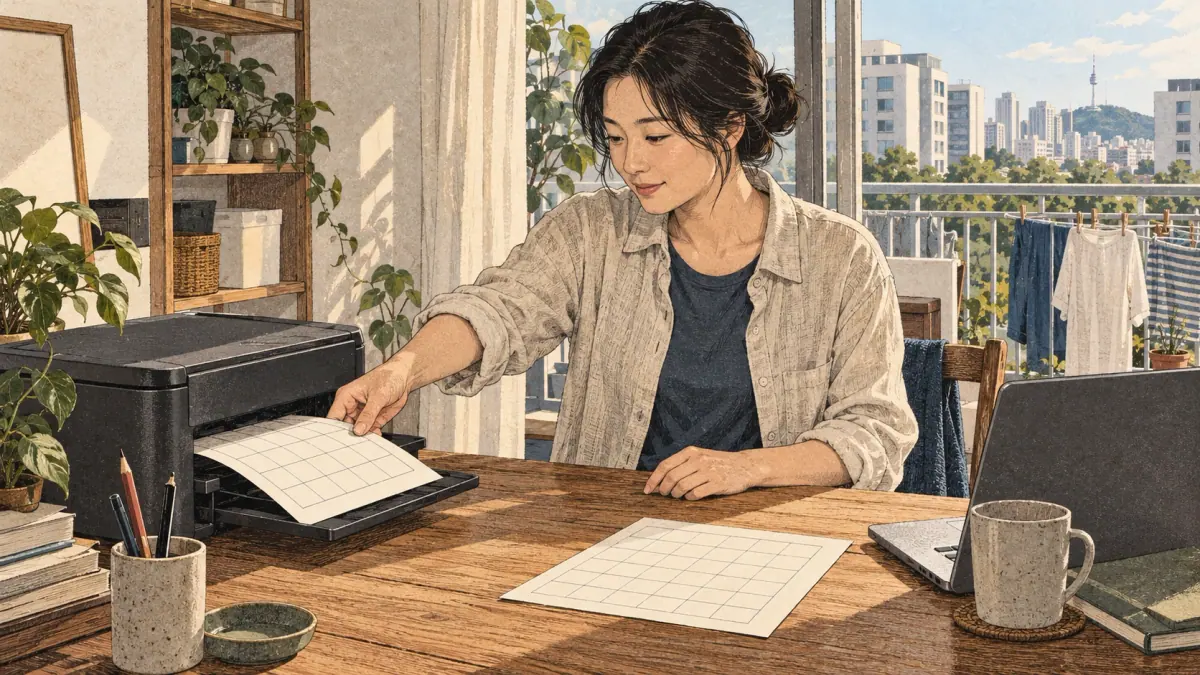
Both paper sizes are in the download, with the same grid in each. Choose the one that matches your printer. There is no sign-up step.
Korean Manuscript Paper Printable (원고지)
Download PDF (A4) PDF (US Letter)
Preview
Standard 원고지 Grid
The next section lists what is printed on the page.
What Is on Each Page?

The practice page is one 원고지 grid, and the answer key is a second sheet. The grid is the standard shape: 20 boxes across and 10 rows down.
Between rows there is a blank band, which on real manuscript paper leaves room for a teacher's corrections.Row by row. The page uses its rows in this way:
| Row | Content | Boxes used |
|---|---|---|
| 1 | Left empty | none |
| 2 | Title 한글 연습, centred, dotted model | 8 to 12, with box 10 empty |
| 3 | Name 홍길동, on the right, dotted model | 17 to 19 |
| 4 | Left empty | none |
| 5 | First body line: 나는 한글을 배워요. | 2 to 12, with boxes 1, 4 and 8 empty |
| 6 | Numerals 2026년, to copy | 2 to 4 |
| 7 to 10 | Empty rows for free writing | all |
Usage key. A short key at the bottom of the page lists the five rules for filling boxes. It repeats the rules in the next section, so you can read them while you write.
Answer key. The second sheet shows the filled boxes for rows 2, 3, 5 and 6, number by number.
This layout is the one used on this sheet. School rules for the position of the title and the name can vary a little by teacher and by test, so treat the rows above as a practice pattern. Next, here are the rules for filling each box.
What Are the Rules for Filling the Boxes?

The rules for 원고지 are simple, and five of them cover most of a first sheet. Learn these five, and the rest is practice.
- One character per box. Each syllable block fills one box. In 한글, 한 takes one box and 글 takes the next.
- A space between words takes one box. In 나는 한글을, the space after 나는 is an empty box. This is the same word-space rule as in normal writing, described in korean spacing rules.
- Numerals and lowercase Latin letters go two to a box. The year 2026 is written 20 in one box and 26 in the next, and 년 follows in a third. A capital Latin letter takes a whole box on its own.
- Punctuation takes one box. The period after 배워요 gets its own box, written in the lower left of the box.
- A new paragraph starts one box in. The first box of the line stays empty.
For example, the sentence 나는 한글을 배워요. fills boxes 2 to 12 on row 5: 나 (2), 는 (3), an empty box (4), 한 (5), 글 (6), 을 (7), an empty box (8), 배 (9), 워 (10), 요 (11) and the period (12). Box 1 is empty because it is the start of a paragraph.
How Do I Use This Sheet?

Start each paragraph one box in and keep one block per box, and then work through the sheet from top to bottom. Follow these steps:
- Read the usage key at the bottom of the page.
- Trace the title 한글 연습 in row 2 and the name 홍길동 in row 3, noting that both sit away from the left edge.
- Trace the sentence in row 5, and say each block aloud as you fill its box.
- Copy the numerals in row 6 as 20, 26 and 년.
- Write a new sentence of your own in rows 7 to 10, leaving box 1 empty at the start of the paragraph.
You will know it works when no box holds two blocks and every empty box is where a space belongs. The sheet pairs well with the korean alphabet flashcards, which keep the letters fresh, and with the lesson on how to write korean.
What Is the Answer Key For?
The answer key is for checking box positions after you finish. It lists, box by box, which characters go into rows 2, 3, 5 and 6. Compare the position of every empty box first, because spacing errors are the most common problem. Then check the characters. Keep the key face down while you write.
Print Settings
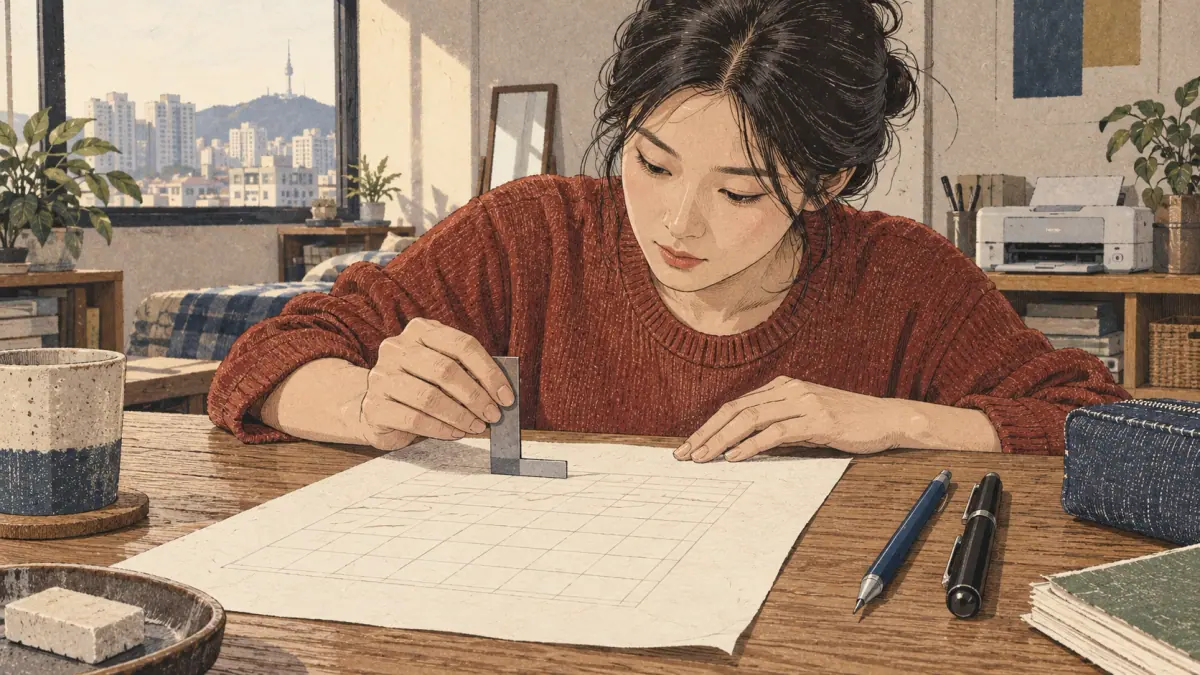
The grid must be printed at its true size so the boxes stay square. Use these settings:
- Paper: A4 (210 by 297 mm) or US Letter (8.5 by 11 inches). Use the matching file.
- Scale: 100 percent, with "fit to page" off. Each box should measure 9 mm.
- Margins: 12 mm on every side, with room for a hole punch.
- Colour: black and white is enough. Box lines are gray and the models are dotted.
A fine pencil or a 0.5 mm pen works best, because the boxes are small. If your pen is thicker, write the blocks smaller instead of enlarging the box.
Mistakes to Watch For
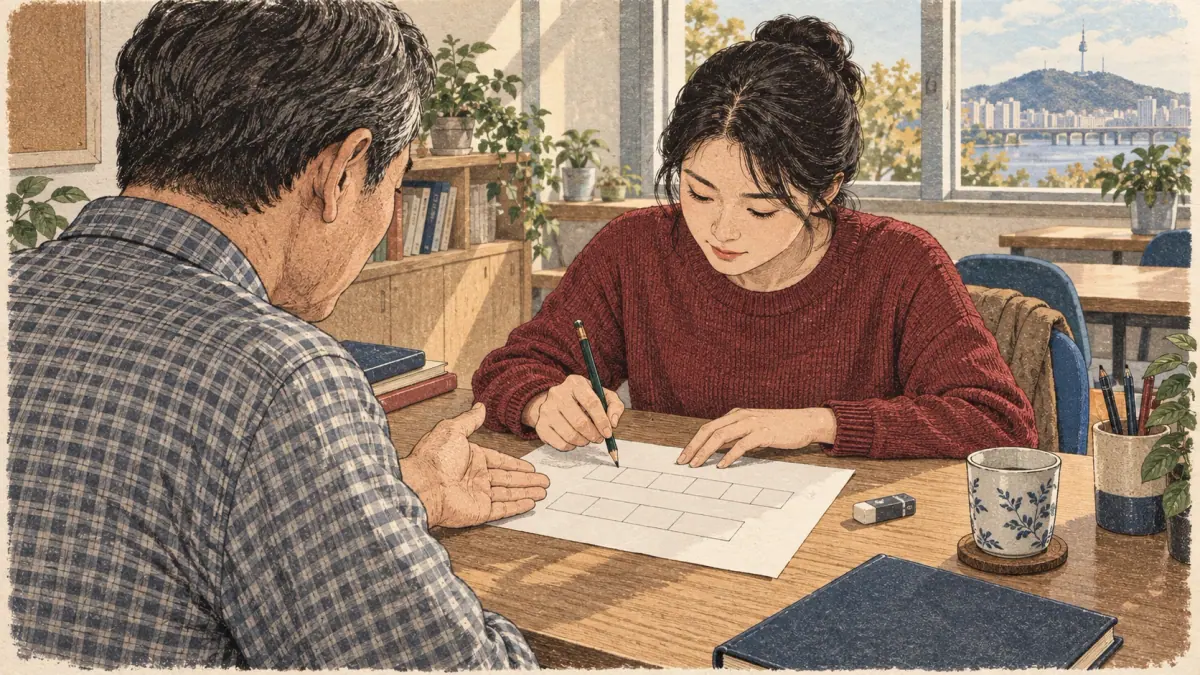
The most frequent problems on 원고지 come from treating a box like a free line of writing.
- Putting two blocks in one box. A box holds exactly one block. If your writing is too wide, make each block narrower.
- Leaving no empty box between words. Writers often fill every box and leave no empty boxes between words. The result reads as one long word.
- Skipping the title row. The title has its own row, and the body starts below it. Do not start the body in row 2.
- Writing 2026 in four boxes. Numerals go two to a box, so 2026 takes two boxes.
A calm pace helps with all four. Count boxes with your pencil tip before you write a line.
What Should I Practice Next?
Once you can fill a 원고지 grid, go back to free handwriting with the korean handwriting practice sheet, or study how blocks are built with the blank hangul syllable template. For on-screen letter practice, take the hangul alphabet quiz. All the printables are listed on the korean printables page.
This sheet covers the grid, the five box rules and one worked sentence. It does not cover every punctuation rule, the correction marks a teacher uses, or how to lay out dialogue and quotations. Used for a short session each day, the korean manuscript paper printable gives you the box-by-box habit that Korean school writing expects.
Frequently Asked Questions
What is 원고지?
원고지 (wongoji) is Korean manuscript paper: a grid of square boxes in which each box holds one character. The standard sheet has 20 boxes per row and 10 rows, so it holds 200 characters. Schools use it to teach spacing, punctuation and neat handwriting, because every space and every mark has a fixed box.
How many boxes?
The standard sheet on this page has 200 boxes: 20 across and 10 down. Each box is 9 mm square, and each row is followed by a blank band for corrections. Because numerals and lowercase Latin letters go two to a box, a line of 20 boxes can hold up to 40 digits, while Korean text takes one block per box.
Is it used today?
Korean schools still use 원고지 to teach writing, and some essay and writing contests ask for it. Most everyday writing is typed, so the paper matters most for students and for learners who want to practise spacing and punctuation. If you are preparing for a specific test, check its own instructions first.
Do I need a pen?
No. Pencil is fine, and it is better for a first attempt, because boxes are small and spacing mistakes are easy to make. Use a fine pencil or a 0.5 mm pen. If you want to write in ink, print a second copy and move to ink after you have practised the sentence once.
Is the worksheet free to print?
Free for personal and classroom use. Teachers may print copies for their students. No reselling or republishing online.
May I use these worksheets in class?
Free for personal and classroom use. Teachers may print copies for their students. No reselling or republishing online.
Free for personal and classroom use. Teachers may print copies for their students. No reselling or republishing online.