What you'll learn
- Pick the right thanks word for a friend, a peer, a teacher, a host and a coworker.
- Build a message from thanks, reason, result and wish.
- Use 덕분에 to say that someone's help produced a good result.
- Spot a politeness mismatch before you press send.
Before you start: you should know the polite ending -아요/어요 and the formal ending -ㅂ니다/습니다. The lesson on Korean speech levels explains both. Audio plays only when you press a button.
What Is a Korean Thank You Message?
A Korean thank you message is a short written note, text or card that thanks someone for a specific favour. It is more than the single word "thanks". A good message says what the person did, what it meant to you and a wish for them, and it uses the level that fits the relationship.
Here is the shortest useful example.
- 도와주셔서 감사합니다. (dowajusyeoseo gamsahamnida.) = "Thank you for helping me."
The sentence has two pieces. 도와주셔서 is "because you helped me", built from 도와주다 ("to help") with the honorific -시- and the reason ending -아/어서. 감사합니다 is the formal "thank you". The honorific points at the helper, so the sentence respects the reader twice.
도와주셔서 감사합니다.
dowajusyeoseo gamsahamnida.
Thank you for helping me.
Spoken, 감사합니다 sounds like [감사함니다], with the ㅂ turning into an m sound before ㄴ. RR writes gamsahamnida, which already shows the change. The next section explains why English speakers often get the register wrong.
Why Do English Speakers Struggle with Thank-You Messages in Korean?
English uses one word, "thanks" or "thank you", for everyone, and adds warmth with extra words. Korean changes the word itself with the reader. Choosing the wrong level is the commonest problem, and it works in two directions.
- Too casual. Sending 고마워 to a teacher sounds like talking to a classmate.
- Too stiff. Sending 감사드립니다 to a close friend sounds like a business letter, and the friend may laugh.
- No reason. "Thank you!" alone is polite, but Korean messages usually name the favour. 도와주셔서 감사합니다 says more than 감사합니다.
- No result. English writers often stop at the favour. Korean messages often add what the help led to.
An example shows the difference. An English message might say "Thanks for your help yesterday!" A natural Korean message says 어제 도와주셔서 감사합니다. 덕분에 잘 해결했어요. ("Thank you for helping yesterday. Thanks to you, it worked out.") The second sentence is the result.
Now that the gap is clear, the next section builds a message from its parts.
How Is a Thank-You Message Built?
Build a message in four steps: thanks, reason, result, wish. Short messages may use only the first two. Longer notes use all four, and each part is one sentence.
- Thanks. The word 감사합니다 or the form that fits the reader.
- Reason. The favour, in the pattern verb + -아/어 주셔서: 도와주셔서 ("for helping"), 가르쳐 주셔서 ("for teaching"), 초대해 주셔서 ("for inviting me").
- Result. What the help led to, with 덕분에: 덕분에 잘 해결했어요.
- Wish. A short good wish: 건강하세요, 행복하세요, 또 연락드릴게요.
The word 덕분에 (deokbune) [덕뿌네] means "thanks to you". It carries a good result, so it only goes with positive outcomes. For a negative outcome, Korean uses 때문에 ("because of"), which does not thank anyone. The table compares them.
| Word | RR | Meaning | Use it when |
|---|---|---|---|
| 덕분에 | deokbune | thanks to | the result is good and you credit the person |
| 때문에 | ttaemune | because of | you state a cause, good or bad |
| -아/어서 | -a/eoseo | because | you give a plain reason |
For example, 선생님 덕분에 시험을 잘 봤어요 (seonsaengnim deokbune siheomeul jal bwasseoyo) means "Thanks to my teacher, I did well on the test", and 비 때문에 늦었어요 (bi ttaemune neujeosseoyo) means "I was late because of the rain".
선생님 덕분에 시험을 잘 봤어요.
seonsaengnim deokbune siheomeul jal bwasseoyo.
Thanks to my teacher, I did well on the test.
With the parts known, the next question is which level to use.
Which Politeness Level Should I Use?
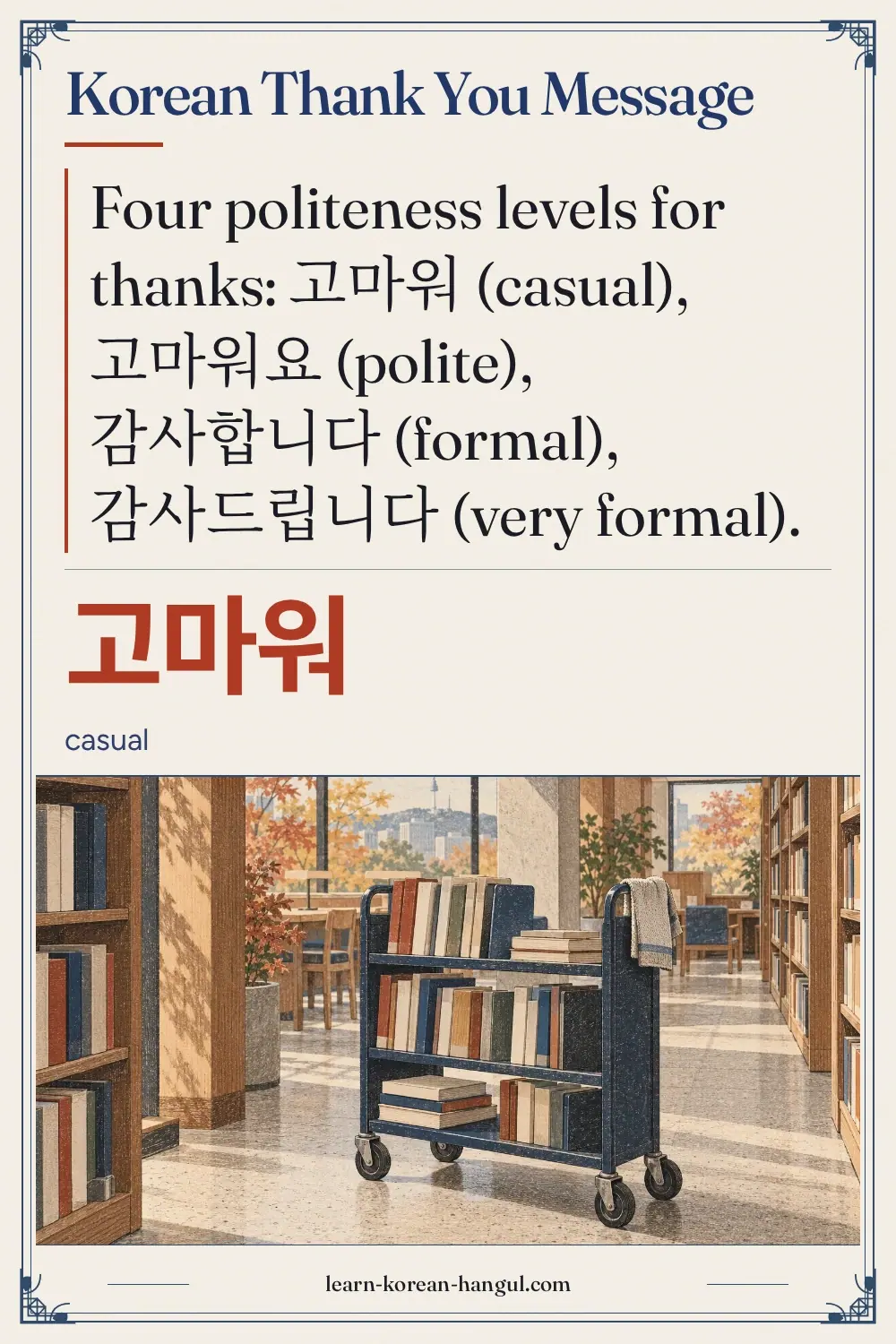
Choose the level by who reads the message, using the table below. The same thanks changes form four times.
| Level | Message | RR | Reader |
|---|---|---|---|
| Casual | 도와줘서 고마워. | dowajwoseo gomawo. | close friend, younger person |
| Polite | 도와줘서 고마워요. | dowajwoseo gomawoyo. | peer, acquaintance |
| Formal | 도와주셔서 감사합니다. | dowajusyeoseo gamsahamnida. | teacher, boss, older person |
| Very formal | 도와주셔서 진심으로 감사드립니다. | dowajusyeoseo jinsimeuro gamsadeurimnida. | formal letter, client, senior |
Three details deserve attention.
First, the honorific -시- appears from the formal level up, because the helper is someone to respect. At the casual and polite levels the plain 도와줘서 is natural.
Second, 감사드립니다 uses the humble verb 드리다 ("to give humbly"), so it lowers the writer and raises the reader. That makes it the most deferential of the four.
Third, 고맙습니다 (gomapseumnida) [고맙씀니다] is another formal form that comes from the native word 고맙다. Many speakers use 감사합니다 for seniors and 고맙습니다 for a warm tone with equals, but both occur widely. This is a tendency, not a fixed rule.
Levels set, the next section gives five full messages.
What Are Five Model Messages?
Here are five complete messages for five readers. Each uses the four-part build and the level from the table. Read them first and then listen.
1. A close friend (casual).
어제 도와줘서 정말 고마워! 덕분에 시험 잘 봤어. 다음에 내가 맛있는 거 살게.
RR: eoje dowajwoseo jeongmal gomawo! deokbune siheom jal bwasseo. daeume naega masinneun geo salge. (The last sentence promises "Next time I'll buy something tasty.") The 살게 ending [살께] is a casual promise, and RR writes -ge.
2. A peer or coworker (polite).
어제 도와줘서 고마워요. 덕분에 일이 빨리 끝났어요. 다음에 커피 살게요.
RR: eoje dowajwoseo gomawoyo. deokbune iri ppalli kkeunnasseoyo. daeume keopi salgeyo. [살께요]
3. A teacher (formal).
선생님, 한 학기 동안 가르쳐 주셔서 감사합니다. 선생님 덕분에 한국어가 재미있어졌습니다. 건강하세요.
RR: seonsaengnim, han hakgi dongan gareuchyeo jusyeoseo gamsahamnida. seonsaengnim deokbune hangugeoga jaemiisseojyeotseumnida. geonganghaseyo.
4. A host after dinner (formal).
어제 맛있는 저녁을 차려 주셔서 정말 감사합니다. 잘 먹었습니다. 다음에는 제가 대접하겠습니다.
RR: eoje masinneun jeonyeogeul charyeo jusyeoseo jeongmal gamsahamnida. jal meogeotseumnida. daeumeneun jega daejeopagetseumnida. The verb 대접하다 ("to treat someone") shows aspiration in RR (daejeopagetseumnida) because ㅂ and ㅎ join into a ㅍ sound.
5. A senior coworker or client (very formal).
바쁘신 중에도 도와주셔서 진심으로 감사드립니다. 덕분에 프로젝트를 잘 마무리했습니다. 앞으로도 잘 부탁드립니다.
RR: bappeusin jungedo dowajusyeoseo jinsimeuro gamsadeurimnida. deokbune peurojekteureul jal mamurihaetseumnida. apeurodo jal butakdeurimnida.
어제 맛있는 저녁을 차려 주셔서 정말 감사합니다.
eoje masinneun jeonyeogeul charyeo jusyeoseo jeongmal gamsahamnida.
Thank you very much for preparing such a delicious dinner yesterday.
Pronunciation notes: 맛있는 sounds like [마신는], 먹었습니다 like [머거씀니다], and 부탁드립니다 like [부탁뜨림니다]. RR shows the nasal change in masinneun but not the tensing in butakdeurimnida.
The five messages show the build. The next section adds a personal touch.
How Do I Add a Personal Touch?
Name one specific detail. A detail turns a standard thank-you into a message the reader remembers. Three ways work well.
- Name the item. 선물 감사합니다 (seonmul gamsahamnida, "Thank you for the gift") becomes 예쁜 스카프 정말 마음에 들어요 (yeppeun seukapeu jeongmal maeume deureoyo), "I really like the pretty scarf".
- Name the effect. 덕분에 잘 해결했어요, 덕분에 즐거웠어요 (deokbune jeulgeowosseoyo, "Thanks to you it was fun").
- Name your plan. 또 연락드릴게요 (tto yeollakdeurilgeyo) [열락뜨릴께요], "I will contact you again".
For a card, Korean cards often use a set phrase. Three are common:
- 감사의 마음을 전합니다. (gamsaui maeumeul jeonhamnida.) = "I convey my gratitude."
- 항상 고맙습니다. (hangsang gomapseumnida.) = "Thank you always."
- 늘 행복하세요. (neul haengbokaseyo.) = "Please always be happy."
Two annual days call for cards in Korea: 스승의 날 (seuseungui nal, Teachers' Day, 15 May) and 어버이날 (eobeoinal, Parents' Day, 8 May). A teacher card could read 스승의 날 축하드립니다. 항상 감사드립니다. (seuseungui nal chukadeurimnida. hangsang gamsadeurimnida.) RR shows the aspiration in the verb 축하드립니다, while the noun 축하 is chukha.
Which words should you not use in a card? Avoid ㅋㅋ and long strings of exclamation marks in a message to a teacher or senior. Next, a worked example puts the pieces together.
Worked Example: 도와주셔서 정말 감사합니다.
The task: write a short thank-you message to a colleague who helped you prepare a presentation. The colleague is a few years senior, so the level is formal.
- Choose the level. A senior colleague calls for formal 감사합니다, with the honorific -시-.
- Write the thanks and the reason. 발표 준비를 도와주셔서 정말 감사합니다. (balpyo junbireul dowajusyeoseo jeongmal gamsahamnida.) "Thank you very much for helping me prepare the presentation."
- Add the result. 덕분에 발표를 잘 마쳤습니다. (deokbune balpyoreul jal machyeotseumnida.) "Thanks to you, I finished the presentation well." 마쳤습니다 is the past of 마치다 ("to finish").
- Add the wish. 주말 잘 보내세요. (jumal jal bonaeseyo.) "Have a good weekend."
- Join the sentences. 발표 준비를 도와주셔서 정말 감사합니다. 덕분에 발표를 잘 마쳤습니다. 주말 잘 보내세요.
발표 준비를 도와주셔서 정말 감사합니다.
balpyo junbireul dowajusyeoseo jeongmal gamsahamnida.
Thank you very much for helping me prepare the presentation.
You will know it works when the reader can see what they did and what it led to. The most common slip is dropping the honorific -시-. 도와줘서 감사합니다 is common in speech, but it leaves the helper without the honorific, which sounds uneven in a formal written message. Use 도와주셔서.
The message is complete, so the next section covers the mistakes learners make.
What Mistakes Do Learners Make in Korean Thank-You Messages?
Learners usually make five mistakes, and each has a quick repair.
- Mixing levels. Learners often assume 고마워 and 감사합니다 can go in one sentence. Actually, one message keeps one level. Fix: 도와줘서 고마워요 (polite) or 도와주셔서 감사합니다 (formal).
- Using 감사합니다 alone every time. The word is correct, but a message with a reason and a result is warmer. Fix: add 도와주셔서 and 덕분에.
- Using 덕분에 for a bad outcome. Actually, 덕분에 credits a person for something good. Fix: use 때문에 for neutral or bad causes.
- Dropping the honorific. 도와줘서 감사합니다 is uneven. Fix: 도와주셔서 감사합니다.
- Stiff words with a friend. 진심으로 감사드립니다 to a close friend is too stiff. Fix: 정말 고마워.
A quick register check before you send: Who reads it? Is the thanks word at the same level as the verb? Did I name the favour? An honest limit: this lesson gives safe defaults for five relationships. Families, workplaces and friend groups all set their own habits, and a close friend may prefer a joke to a formal note. For more thanks and apology phrases, see the lesson on polite Korean phrases.
Practice and Answers
Try the four items before you read the answers.
- Choose the level. Which fits a message to your teacher: 도와줘서 고마워 / 도와주셔서 감사합니다 / 도와줘서 땡큐?
- Add the result. Complete: 어제 도와주셔서 감사합니다. ___ 잘 해결했어요. Choose 덕분에 or 때문에.
- Translate. "Thank you for inviting me." Use the formal style.
- Write your own. Write a three-sentence thank-you message to a host who cooked dinner. Include the thanks, a result or detail and a wish.
Practice · 5
Which thanks fits a message to your teacher?
Show answer
도와주셔서 감사합니다
도와주셔서 감사합니다 uses the honorific and the formal thanks, so it fits a teacher.
Which word credits a person for a good result?
Show answer
덕분에
덕분에 means thanks to and goes with good results. 때문에 only states a cause.
Which is the most formal thanks?
Show answer
감사드립니다
감사드립니다 uses the humble verb 드리다 and is the most deferential of the four.
What belongs at the end of a card?
Show answer
a short wish such as 건강하세요
Cards and short messages often end with a wish such as 건강하세요 or 늘 행복하세요.
Which line adds a personal touch to thanks for a gift?
Show answer
예쁜 스카프 정말 마음에 들어요
Naming the item, the pretty scarf, is the specific detail that makes a thank-you personal.
Answer key
- 도와주셔서 감사합니다. It uses the honorific and the formal thanks. The other two are casual or mixed with English.
- 덕분에. The result is good, so 덕분에 credits the helper.
- 초대해 주셔서 감사합니다. (chodaehae jusyeoseo gamsahamnida.)
- Answers vary. A model: 어제 맛있는 저녁을 차려 주셔서 정말 감사합니다. 덕분에 즐거운 시간을 보냈습니다. 건강하세요. Check that the thanks word, the verb and the wish are at the same level.
A rule of thumb for checking your own message: if you could read it aloud to the person's face, the level is probably right.
Where to Go Next
After this lesson you can write a short, level-appropriate thank-you message. This lesson covers messages and cards, but not long speeches or formal ceremony wording.
- Learn how to address a parcel in the lesson on the Korean envelope address format.
- Compare it with a longer note in the Korean letter format lesson.
- Study birthday and celebration wording in the lesson on celebration phrases.
- Review the levels in Korean speech levels.
- Return to how to write a letter in Korean to see every message lesson in the set.
With these steps, a Korean thank you message becomes a four-part habit: thanks, reason, result, wish.
Audio, Review Status and Scope
Min-ji Park reviewed and signed off this page on 15 October 2026. Min-ji Park reviewed and signed off the Korean on this page on 15 October 2026.
Frequently Asked Questions
How do I say thank you in a message in Korean?
Use the thanks word that fits the reader and name the favour: 도와줘서 고마워 for a close friend, 도와줘서 고마워요 for a peer, and 도와주셔서 감사합니다 for a teacher or senior. Add 덕분에 and the result, and finish with a short wish such as 건강하세요.
What is the difference between 고마워요 and 감사합니다?
고마워요 is polite and warm, used with peers and acquaintances. 감사합니다 is formal and suits teachers, bosses, clients and public settings. 고마워요 comes from the native word 고맙다, and 감사합니다 from the Sino-Korean 감사. Both are correct; the level of the reader decides.
How do I thank a teacher in Korean?
Use the formal level with the honorific -시-: 선생님, 가르쳐 주셔서 감사합니다. Add what you gained: 선생님 덕분에 한국어가 재미있어졌습니다. End with a wish such as 건강하세요 and sign with 제자 and your name plus 올림. Avoid 고마워 and ㅋㅋ.
How do I write a Korean thank-you card?
Write the recipient with 께 or 에게, one or two sentences of thanks, and a wish. Set phrases include 감사의 마음을 전합니다, 항상 고맙습니다 and 늘 행복하세요. For Teachers' Day on 15 May, 스승의 날 축하드립니다. 항상 감사드립니다 is a common card line.