Key facts
- Dates run from largest to smallest: 2026년 10월 9일 (year, month, day).
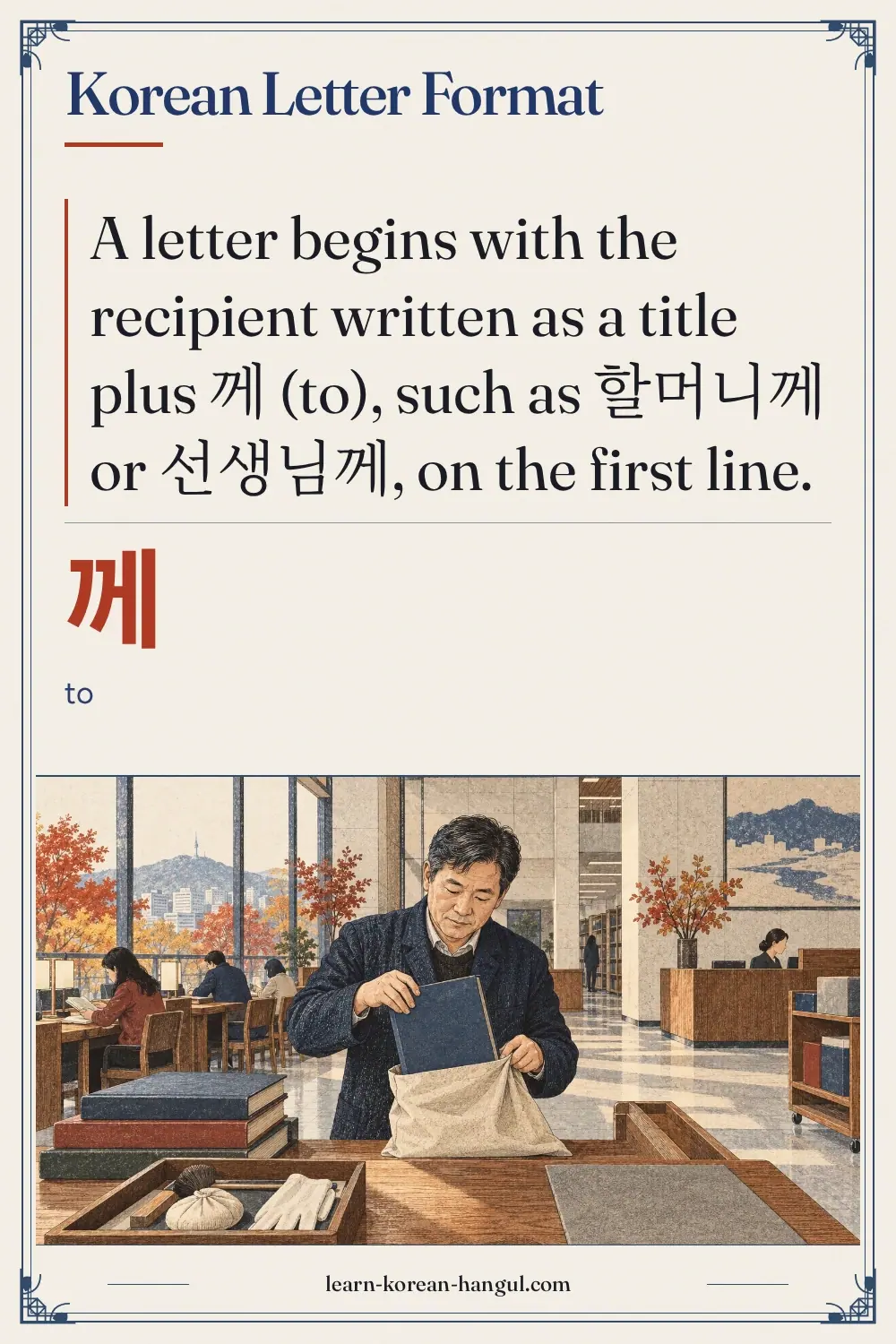
- 께 is the honorific "to" for elders. For friends and younger people, use 에게 or the name with 에게.
What you'll learn
- Name the six parts of a Korean letter and put them in order.
- Choose 께 or 에게, and 올림 or 드림, for the person you write to.
- Write a ten-line polite letter to a grandparent and a formal note to a teacher.
- Write the date in Korean order.
Before you start: you should read Hangul and know the polite ending -아요/어요. If you want to write by hand, the lesson on Korean handwriting shows the letter shapes. Audio plays only when you press a button.
What Is the Korean Letter Format?
The Korean letter format is a set of fixed positions for who the letter is to, how it begins, what it says, how it ends, when it was written and who wrote it. English letters mark the same things with "Dear" at the top and "Yours" at the bottom. Korean letters mark them with a particle at the top and a word meaning "from" at the bottom.
| Part | Korean name | Example | RR |
|---|---|---|---|
| 1. Recipient | 받는 사람 | 할머니께 | halmeonikke |
| 2. Greeting | 인사말 | 잘 지내고 계신가요? | jal jinaego gyesingayo? |
| 3. Body | 본문 | 저는 잘 지내고 있어요. | jeoneun jal jinaego isseoyo. |
| 4. Closing wish | 맺음말 | 늘 건강하세요. | neul geonganghaseyo. |
| 5. Date | 날짜 | 2026년 10월 9일 | (see the date section) |
| 6. Sender | 보내는 사람 | 손녀 에밀리 올림 | sonnyeo emilli ollim |
The date is written with numerals and read with Sino-Korean numbers. The section on closing a letter covers the reading.
Why does the recipient go first? In Korean, who you write to controls the level of the whole letter, so the reader sees the relationship before the first sentence. The format is therefore a social choice as much as a layout.
The table gives the shape. The next section explains why English speakers often get the order wrong.
Why Do English Speakers Find the Korean Letter Format Hard?
English speakers usually write "Dear Grandma" at the top and "Love, Emily" at the bottom. Korean letters do not have a word for "dear" in the same slot, and the sender is not "love" but "the one who offers this". Three habits need to change.
- The recipient has a particle. Instead of "Dear Grandma", write 할머니께 ("to Grandma"). The particle 께 shows respect, so it replaces both the word "Dear" and the politeness.
- The sender word is a verb form. 올림 (from 올리다, "to offer up") and 드림 (from 드리다, "to give humbly") mean "offered by". They sit after the name, as in 에밀리 올림.
- Dates start with the year. English "9 October 2026" becomes 2026년 10월 9일, with the largest unit first, as in a postal address.
A fourth habit is less obvious. Family letters often put a relationship word before the sender's name: 손녀 에밀리 올림 ("from granddaughter Emily"). The word 손녀 (sonnyeo) tells the reader who is writing, even before the name.
Once the order is clear, each part needs the right words. The first one is the recipient line.
How Do I Address the Person in a Korean Letter?
Write the recipient's title or name followed by 께 for an elder or 에게 for a friend or younger person. 께 is the honorific form of the particle 에게 ("to"), so the choice carries the respect.
| Recipient | Form | RR |
|---|---|---|
| Grandmother | 할머니께 | halmeonikke |
| Parents | 부모님께 | bumonimkke |
| Teacher | 선생님께 | seonsaengnimkke |
| Friend or sibling | 민지에게 | minji-ege |
| Younger person, warm tone | 사랑하는 민지에게 | saranghaneun minji-ege |
The title comes first and 께 attaches directly: 선생님께, not 선생님 께. You can also add a name before the title, as in 김민수 선생님께. For a friend, a warm adjective can come before the name, such as 보고 싶은 (bogo sipeun, "whom I miss") or 사랑하는 (saranghaneun, "whom I love").
할머니, 안녕하세요? 에밀리예요.
halmeoni, annyeonghaseyo? emilliyeyo.
Grandma, hello. It is Emily.
After the recipient line, the writer often repeats the title once in the first sentence, as in the example, which makes the letter feel like speech. The next part is the greeting.
How Do I Begin a Korean Letter?
Begin with 안녕하세요 and then a question about the reader's health. The standard question for an elder is 잘 지내고 계신가요? The honorific verb 계시다 replaces 있다, and -고 계시다 means "to be doing". The question shows interest before you say anything about yourself.
잘 지내고 계신가요?
jal jinaego gyesingayo?
Are you doing well?
Other openings, from warm to formal:
- 잘 지내? (jal jinae?) = "How are you?" Casual, for a close friend.
- 잘 지내고 계신가요? = polite, for grandparents and relatives.
- 잘 지내고 계십니까? (jal jinaego gyesimnikka?) = formal, for a teacher or an older stranger.
- 요즘 날씨가 많이 추워졌는데 건강하세요? (yojeum nalssiga mani chuwojyeonneunde geonganghaseyo?) = "The weather has become cold lately. Are you well?" A seasonal opening like this is a long-standing letter custom, and it works well with grandparents.
The pronunciation of 지내고 계신가요 is [지내고 계신가요], and some speakers say 계 as [게]. RR writes the spelling, gyesingayo.
You will know the opening works when it asks about the reader and not about you. After the greeting, the body tells your news.
What Goes in the Body of a Korean Letter?
Put two or three pieces of news in short sentences, then a wish or promise. A ten-line letter needs only four lines of body: your own news, one event, a worry about the reader, and a promise to meet.
The level follows the recipient. For grandparents and relatives, use the polite -아요/어요 style. For a teacher or a formal letter, use -습니다. Do not mix the two in one letter. The lesson on Korean speech levels explains the choice.
Useful body sentences:
- 저는 한국어 공부를 열심히 하고 있어요. (jeoneun hangugeo gongbureul yeolsimhi hago isseoyo.) [열씸히] = "I am studying Korean hard."
- 지난주에는 친구들과 한강에 다녀왔어요. (jinanjueneun chingudeulgwa hangange danyeowasseoyo.) = "Last week I went to the Han River with friends."
- 날씨가 추워졌으니 감기 조심하세요. (nalssiga chuwojyeosseuni gamgi josimhaseyo.) = "It has become cold, so please be careful not to catch a cold."
- 곧 찾아뵐게요. (got chajaboelgeyo.) [곧 차자뵐께요] = "I will visit you soon."
곧 찾아뵐게요.
got chajaboelgeyo.
I will visit you soon.
The verb 찾아뵙다 is a humble verb for visiting a respected person, so it suits grandparents and teachers. The ending -(으)ㄹ게요 makes a promise to the listener, and it is spoken [차자뵐께요], with a tense ㄲ after -ㄹ. RR writes -ge-.
For a letter to a friend, drop the honorifics: 잘 지내? 나는 잘 지내. 곧 만나자. (jal jinae? naneun jal jinae. got mannaja.) = "How are you? I am well. Let's meet soon." Casual letters use -어/아, and they pair with 에게 or a nickname.
The body is the longest part. The close is short and has fixed words, which the next section covers.
How Do I Close and Sign a Korean Letter?
Close with a wish for the reader's health, then the date on one line, then the sender on the next line. This order is the same for every kind of letter.
The closing wish. The most common wish is 늘 건강하세요 (neul geonganghaseyo), "Please always stay healthy". Others include 감기 조심하세요 (gamgi josimhaseyo, "Be careful of colds") and 항상 행복하세요 (hangsang haengbokaseyo, "Please always be happy"). RR shows the aspiration in the verb 행복하세요, because ㄱ and ㅎ join into a ㅋ sound. For a teacher, 건강하시기 바랍니다 (geonganghasigi baramnida) is a formal wish.
The date. Write year, month and day with the counters 년, 월 and 일: 2026년 10월 9일. The numbers are Sino-Korean, and two months have special readings: 6월 is 유월 (yuwol) and 10월 is 시월 (siwol), not 육월 or 십월. Put the date on the line before the signature, right-aligned if you write by hand.
The signature. Use the relationship word, your name and the closing word: 손녀 에밀리 올림, 제자 에밀리 올림 ("from pupil Emily"), 아들 민수 드림 ("from son Minsu"). 올림 is slightly more formal than 드림 and is a common choice for grandparents, parents and teachers. Both words are correct. For a friend, use the name with a subject-style ending, as in 에밀리가 (emilliga), "from Emily", or just the name.
A note on handwriting: many Korean writers use a blue or black pen, and a traditional belief says that writing a person's name in red ink is unlucky, so people avoid red for names. Treat this as a custom, not a rule.
With the six parts in hand, a worked example shows the whole letter.
Worked Example: 할머니께
This ten-line letter goes to a grandmother in polite style. Read it first, then listen to the lines you want.
할머니께
할머니, 안녕하세요? 에밀리예요. 잘 지내고 계신가요? 저는 한국어 공부를 열심히 하고 있어요. 지난주에는 친구들과 한강에 다녀왔어요. 날씨가 추워졌으니 감기 조심하세요. 곧 찾아뵐게요. 늘 건강하세요.
2026년 10월 9일 손녀 에밀리 올림
Step by step:
- Check the recipient line. 할머니께 is alone on the first line, and the 께 shows respect.
- Check the greeting. 안녕하세요? 에밀리예요. says hello and gives your name. 예요 follows the vowel ㅣ of 에밀리.
- Check the body. Lines 4 to 6 give news and a worry. Line 7 gives a promise.
- Check the close. The wish, the date and the signature each have their own line.
- Check the level. Every sentence ends in -요, and there is no -습니다. That keeps the letter consistent.
You will know it works when a grandparent could read it aloud as speech. The most common slip is mixing in a casual ending, such as 곧 갈게 ("I'll go soon"), halfway through.
Now compare a formal letter to a teacher. It uses -습니다 and the teacher's title.
선생님께
선생님, 안녕하십니까? 에밀리입니다. 지난 학기에 가르쳐 주셔서 정말 감사했습니다. 선생님 덕분에 한국어가 많이 늘었습니다. 앞으로도 열심히 공부하겠습니다. 건강하시기 바랍니다.
2026년 10월 9일 제자 에밀리 올림
The key sentence is below.
지난 학기에 가르쳐 주셔서 정말 감사했습니다.
jinan hakgie gareuchyeo jusyeoseo jeongmal gamsahaetseumnida.
Thank you very much for teaching me last semester.
The sentence uses -아/어 주셔서 ("because you did it for me") with the past-tense thanks 감사했습니다. The spoken form is [지난 학끼에 가르쳐 주셔서 정말 감사핻씀니다]. A teacher-style letter is shorter and more formal, and it is common at the end of a school year.
The two letters cover the main cases. The next section covers the mistakes that appear most often.
What Mistakes Do Learners Make in a Korean Letter?
Learners usually make five mistakes, and each has a quick repair.
- Writing "dear" as a word. Learners often assume the first line needs a word for "dear" before every name. Actually, 사랑하는 ("whom I love") suits close friends and family, and a teacher or elder is addressed with the title plus 께. Fix: 선생님께.
- Using 에게 for an elder. Actually, 에게 is for equals and younger people. Fix: 께 for grandparents, parents and teachers.
- Starting with the date. English letters often put the date at the top. Actually, Korean letters put the date near the end, before the signature. Fix: move 2026년 10월 9일 to the bottom.
- Writing the date as day-month-year. Actually, Korean goes from the largest unit. Fix: 2026년 10월 9일, not 9일 10월 2026년.
- Mixing -요 and -습니다. Actually, one letter keeps one level. Fix: choose -요 for family and -습니다 for formal letters.
An honest limit: letter custom changes over time, and many Koreans now send messages instead of letters. The seasonal opening and the weather greeting are most at home in handwritten letters and cards. For emails, use the shape in the lesson on how to write an email in Korean.
Practice and Answers
Try the four items before you read the answers.
- Choose the particle. Which particle goes after 선생님 in the first line: 에게 / 께 / 한테?
- Fix the date. Rewrite 9일 10월 2026년 in Korean order.
- Translate. "Please always stay healthy." Use the polite style.
- Write your own. Write a ten-line letter to a grandparent or teacher using the six parts. Use 올림 and the date.
Practice · 5
Which particle goes after 선생님 on the first line of a letter?
Show answer
께
께 is the honorific particle meaning to. 에게 and 한테 are for equals and younger people.
Which order is the Korean date?
Show answer
2026년 10월 9일
Korean dates go from the largest unit to the smallest: year, month, day.
Which word signs a letter to a grandparent?
Show answer
올림
올림 means from, offered up, and suits grandparents, parents and teachers. 드림 is also correct.
How is 10월 read?
Show answer
시월
10월 is read 시월. 6월 is read 유월.
Where does the date go in a Korean letter?
Show answer
On the line before the signature
Korean letters put the date near the end, on its own line just before the signature.
Answer key
- 께. 선생님께 is the correct form, since 께 is the honorific "to".
- 2026년 10월 9일. The year comes first.
- 늘 건강하세요. (neul geonganghaseyo.)
- Answers vary. A model has a recipient line with 께, a greeting with a health question, three body lines, a closing wish, a date and a signature with 올림. Check that every sentence has the same level.
A rule of thumb for checking your own letter: read the first line and the last line. If you know who it is to and who it is from, the frame is complete.
Where to Go Next
After this lesson you can write a short, polite letter by hand or by email. This lesson covers the format and two model letters, but not long literary letters or postal addresses.
- Practise a short note of thanks in the Korean thank you message lesson.
- Learn to address an envelope in the lesson on the Korean envelope address format.
- Read a short story built on a letter in The Letter.
- Review the levels in Korean speech levels and the humble verbs in Korean honorifics.
- Return to how to write a letter in Korean to see every message lesson in the set.
With these steps, the Korean letter format becomes six fixed positions that you fill with your own news.
Audio, Review Status and Scope
Min-ji Park reviewed and signed off this page on 15 October 2026. Min-ji Park reviewed and signed off the Korean on this page on 15 October 2026.
Frequently Asked Questions
How do I start a Korean letter?
Write the recipient on the first line as a title plus 께, such as 할머니께 or 선생님께. Then greet them and ask about their health: 안녕하세요? 잘 지내고 계신가요? For a friend or younger person, use the name plus 에게 and a casual greeting such as 잘 지내?
What does 드림 mean in a letter?
드림 comes from 드리다, the humble verb to give, and means from or offered by. It follows the sender's name, as in 아들 민수 드림. 올림, from 올리다, means the same and is a little more formal. Both suit letters to elders; between friends the name alone is enough.
Should I use formal or polite style in a letter?
Match the reader. Use the polite -아요/어요 style for grandparents, parents and relatives, and the formal -ㅂ니다/습니다 style for a teacher, a formal thank-you or an older stranger. Keep one style through the whole letter, because mixing levels looks careless.
How do I end a Korean letter?
End with a wish for the reader's health, such as 늘 건강하세요. Then write the date on its own line, 2026년 10월 9일, and sign on the next line with a relationship word, your name and 올림 or 드림, for example 손녀 에밀리 올림.
How do I write the date in a Korean letter?
Write year, month and day in that order with the counters 년, 월 and 일: 2026년 10월 9일. Read the numbers with Sino-Korean words, with two special readings: 6월 is 유월 and 10월 is 시월. Place the date on the line before the signature.