
What you will learn
- Decide between 공부하다 and 공부를 하다 with a particle test.
- Write twelve common 하다 verbs in their one-word and spaced forms.
- Place 안 and 못 correctly: 공부 안 해요, 운동 못 해요.
- Apply the same frame to 되다 verbs and the pair 잘하다 and 잘 하다.
Before you start: you should know the polite present 해요 and the object particle 을/를. See Korean particles spacing for the spacing of particles. Time: about 25 minutes.
What Is Korean Hada Verbs Spacing?
Korean hada verbs spacing is the set of rules for writing a noun and 하다 together or apart. A 하다 verb (hada verb) is a verb made from a noun plus the suffix 하다 ("to do"). A suffix (접미사) is a word part that attaches to the end of a word and cannot stand alone in that role. So the noun 공부 ("study") plus 하다 becomes the verb 공부하다 ("to study").
The spacing rule follows from this. Dictionary verbs are one word: 공부하다, 운동하다, 요리하다. But 하다 also exists as an independent verb ("to do"), and then a noun with a particle can stand in front of it: 공부를 하다, which means "to do studying". The 한글 맞춤법 (Hangeul Orthography) of the National Institute of Korean Language (국립국어원) treats particles as attached to the noun before them, and so the particle is what creates the space.
Compare the two, with audio.
저는 매일 한국어를 공부해요.
jeoneun maeil hangugeoreul gongbuhaeyo.
I study Korean every day.
저는 매일 한국어 공부를 해요.
jeoneun maeil hangugeo gongbureul haeyo.
I do Korean study every day.
Both sentences are correct and mean almost the same. The first uses the one-word verb, and the second turns 공부 into an object. The spoken forms are [공부해요] and [공부를 해요]. First, here is why English speakers find the choice hard.
Why Do English Speakers Struggle with Hada Verbs Spacing?
English speakers struggle because English does not mark the difference, and because the two versions are so close in meaning. Three habits cause errors.
- Both look possible. "Study" and "do study" are both fine in English, so learners treat 공부 해요 and 공부해요 as equal. Only one of them is written that way.
- The particle is easy to drop in speech. In speech, 공부 해요 sounds the same as 공부해요, and learners copy the spoken style into writing.
- Adverbs look like part of the verb. 열심히하다 feels like a unit, but 열심히 is an adverb and stays apart.
The next section starts with the attached form, which you will use most often.
When Is 하다 Attached?
하다 is attached when the noun and 하다 together form a dictionary verb and nothing stands between them. This covers most of the 하다 verbs you meet. The table shows twelve of them, each with the one-word form and the spaced form that appears when a particle is added.
| Noun | One word | RR | With a particle | RR |
|---|---|---|---|---|
| 공부 (study) | 공부하다 | gongbuhada | 공부를 하다 | gongbureul hada |
| 운동 (exercise) | 운동하다 | undonghada | 운동을 하다 | undongeul hada |
| 요리 (cooking) | 요리하다 | yorihada | 요리를 하다 | yorireul hada |
| 청소 (cleaning) | 청소하다 | cheongsohada | 청소를 하다 | cheongsoreul hada |
| 전화 (phone call) | 전화하다 | jeonhwahada | 전화를 하다 | jeonhwareul hada |
| 사랑 (love) | 사랑하다 | saranghada | 사랑을 하다 | sarangeul hada |
| 생각 (thought) | 생각하다 | saenggakada | 생각을 하다 | saenggageul hada |
| 일 (work) | 일하다 | ilhada | 일을 하다 | ireul hada |
| 말 (word) | 말하다 | malhada | 말을 하다 | mareul hada |
| 이야기 (story) | 이야기하다 | iyagihada | 이야기를 하다 | iyagireul hada |
| 쇼핑 (shopping) | 쇼핑하다 | syopinghada | 쇼핑을 하다 | syopingeul hada |
| 운전 (driving) | 운전하다 | unjeonhada | 운전을 하다 | unjeoneul hada |
In the verb column, Revised Romanization (RR, the official Latin spelling) writes the ㅎ of 하다 as aspiration when a stop comes before it: 생각하다 is saenggakada, and 생각해요 is saenggakaeyo. After other sounds, RR keeps the h: malhada, ilhada.
Adjectives follow the first column only. 건강하다 ("be healthy"), 행복하다 ("be happy") and 조용하다 ("be quiet") are always one word, because the noun cannot take a particle and stay an adjective. Nothing like 건강을 하다 exists. For the polite forms, 행복해요 is said [행보캐요] and RR writes haengbokaeyo.
Some 하다 verbs are not built on a noun at all. 좋아하다 ("to like") is made from the word 좋아, and it is always one word: 좋아해요, 안 좋아해요.
Next comes the case where 하다 is separate.
When Is 하다 Separate?
하다 is separate when a particle, an adverb or another word stands in front of it. The noun with its particle is one word, and 하다 is the next. Use the particle test to decide.
The particle test. Try to insert 를, 도 or 만 after the noun.
- Say the verb: 공부해요.
- Insert a particle after the noun: 공부를 해요, 공부도 해요 or 공부만 해요.
- If a particle fits, the spaced form is available: write the particle attached to the noun and leave a space before 하다.
- If no particle fits, as with an adjective, the form is always a single word.
주말에는 운동도 하고 요리도 해요.
jumareneun undongdo hago yorido haeyo.
At weekends I exercise and cook, too.
Particles do real work in these sentences. 도 means "also", 만 means "only", and 는/은 contrasts. Each makes the sentence say something that the one-word verb cannot.
Adverbs. An adverb stays apart from 하다, even though no particle is present. 열심히 하세요 ("Do your best"), 조용히 하세요 ("Be quiet") and 깨끗이 하세요 ("Make it clean") are all spaced, because 열심히, 조용히 and 깨끗이 are adverbs and not nouns.
도서관에서는 조용히 하세요.
doseogwaneseoneun joyonghi haseyo.
Please be quiet in the library.
The pair 조용히 하세요 is the polite request form (하세요). The adjective 조용하다 and the adverb 조용히 are different words.
What about 잘하다 and 못하다?
잘하다 is one dictionary verb, and 잘 하다 as two words is a less common option. This pair is a grey area, so use the attached form for the usual meanings.
잘하다 means "to be good at", "to do well" or "to do the right thing". 한국어를 잘해요 means "I am good at Korean", and 잘했어요! means "Well done!". Writing 잘 하다 with a space treats 잘 as a plain adverb in front of 하다. You see it when someone wants to stress how a thing is done, but 잘하다 as one word is safer in most sentences.
저는 한국어를 잘해요.
jeoneun hangugeoreul jalhaeyo.
I am good at Korean.
못하다 has a similar two-way choice with a clearer meaning. 못하다 as one word means "to be poor at" something, as in 노래를 못해요 ("I am bad at singing"). 못 하다 as two words means "to be unable to do", usually because of a circumstance, as in 일이 많아서 운동을 못 했어요 ("I had a lot of work, so I couldn't exercise"). The second sentence is pronounced [이리 마나서 운동을 모태써요]: the final ㅅ of 못 joins the following ㅎ and becomes aspirated ㅌ.
일이 많아서 운동을 못 했어요.
iri manaseo undongeul mot haesseoyo.
I had a lot of work, so I couldn't exercise.
RR writes the two words apart (mot haesseoyo), and does not show the spoken change across the space. For the meaning of 못, see the lessons on Korean 못 negation and negation with 하다 verbs.
Where Do 안 and 못 Go?
안 and 못 go between the noun and 하다, because the noun is a separate unit in the negative. 공부하다 becomes 공부 안 해요 ("I don't study"), and 운동하다 becomes 운동 못 해요 ("I can't exercise"). The form 안 공부해요 is not the standard placement.
| Positive | Negative with 안 | Negative with 못 |
|---|---|---|
| 공부해요 | 공부 안 해요 | 공부 못 해요 |
| 운동해요 | 운동 안 해요 | 운동 못 해요 |
| 청소해요 | 청소 안 해요 | 청소 못 해요 |
Verbs that are not built on a noun, such as 좋아하다, put the negative first: 안 좋아해요. The negation lessons list the exceptions. Learners may also hear 안 공부해요 in casual speech, but the standard placement is 공부 안 해요.
오늘은 공부 안 해요.
oneureun gongbu an haeyo.
I'm not studying today.
How Do 되다 Verbs Work?
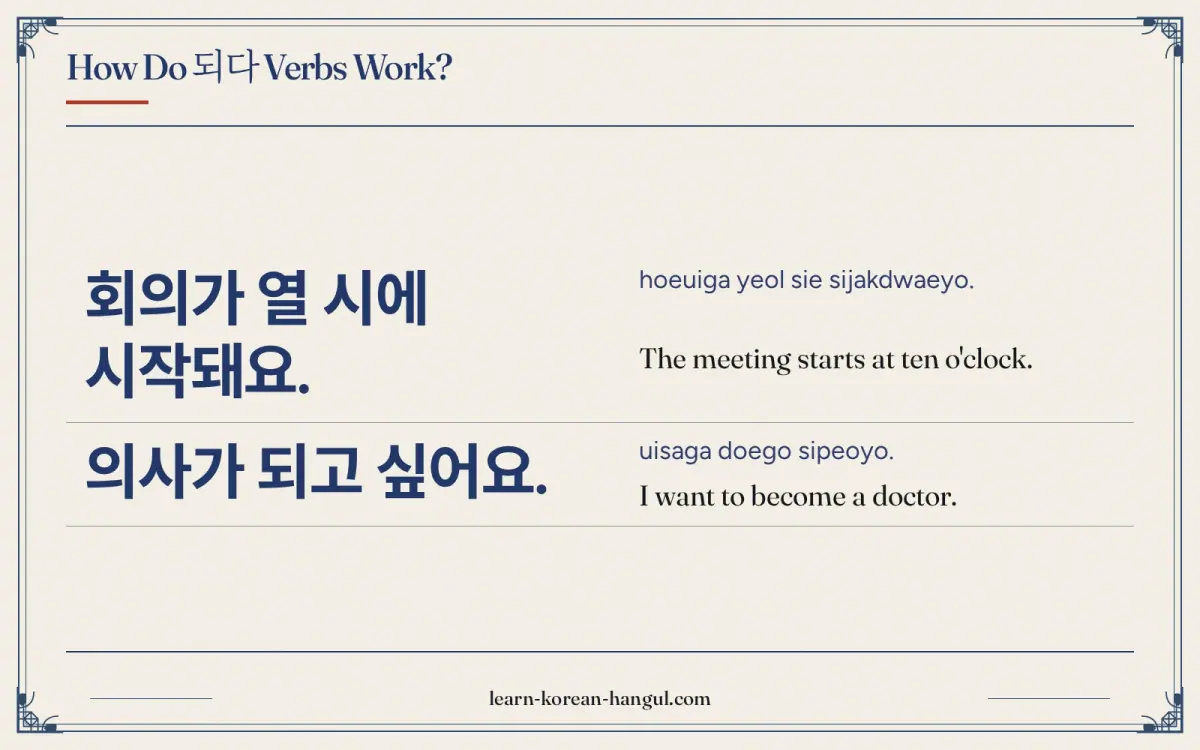
되다 verbs follow the same frame: a noun plus 되다 is one word when the verb is in the dictionary, and a particle breaks it apart. 되다 is the passive and "become" partner of 하다. Compare 사용하다 ("to use") with 사용되다 ("to be used").
| One word | With a particle | Meaning |
|---|---|---|
| 사용되다 (sayongdoeda) | 사용이 되다 | be used |
| 시작되다 (sijakdoeda) | 시작이 되다 | be started, begin |
| 결정되다 (gyeoljeongdoeda) | 결정이 되다 | be decided |
| 준비되다 (junbidoeda) | 준비가 되다 | be ready |
The polite forms are 사용돼요 and 시작돼요, written with 돼, not 되. The spelling of 돼요 and 되요 has its own lesson: 되 vs 돼.
회의가 열 시에 시작돼요.
hoeuiga yeol sie sijakdwaeyo.
The meeting starts at ten o'clock.
The independent verb 되다, meaning "to become", is always apart from the word before it: 의사가 되다 ("to become a doctor"). The particle 이/가 marks the thing you become.
의사가 되고 싶어요.
uisaga doego sipeoyo.
I want to become a doctor.
For the passive meaning of these verbs, see Korean passive verbs.
Worked Example: 공부해요
You will work through one verb in five forms. It shows every rule on this page.
- Start from the noun. 공부 means "study".
- Add 하다 with no particle. 공부하다 is a single dictionary verb. The polite form is 공부해요. Write it as one word.
- Add the object particle. 공부를 해요. The particle attaches to the noun, and 해요 is a separate word.
- Change the particle to add meaning. 공부도 해요 ("study, too") and 공부만 해요 ("only study"). Spacing stays the same.
- Negate. 공부 안 해요 and 공부 못 해요 put 안 and 못 between the noun and 하다.
Checkpoint: you have it right if only the particle forms and the negative forms have a space. Check that you did not write 공부 해요 or 안 공부해요.
What Mistakes Do Learners Make with Hada Verbs Spacing?
Learners often assume that a space before 하다 is always safe. It is not, and five habits cause errors.
- Spacing a dictionary verb. 공부 해요 and 운동 해요 should be 공부해요 and 운동해요.
- Attaching a particle. 공부를해요 should be 공부를 해요. The particle attaches to the noun, and 하다 is separate.
- Attaching an adverb. 열심히하세요 should be 열심히 하세요.
- Putting the negative first. 안 공부해요 should be 공부 안 해요.
- Writing 되요 for 돼요. The polite form of 사용되다 is 사용돼요.
Practice and Answer Key
Correct the spacing in each sentence. Every item has one error.
| Item | Sentence |
|---|---|
| 1 | 매일 운동 해요. |
| 2 | 매일 운동을해요. |
| 3 | 숙제 도 해요. |
| 4 | 도서관에서는 조용히하세요. |
| 5 | 열심히하세요. |
| 6 | 이 앱은 많이 사용 돼요. |
| 7 | 이 앱이 많이 사용이돼요. |
| 8 | 의사가되고 싶어요. |
| 9 | 오늘은 청소안 해요. |
| 10 | 요리 를 해요. |
Answers.
- 매일 운동해요. (one dictionary verb)
- 매일 운동을 해요. (the particle attaches to the noun)
- 숙제도 해요. (the particle attaches)
- 도서관에서는 조용히 하세요. (an adverb stays apart)
- 열심히 하세요.
- 이 앱은 많이 사용돼요. (a 되다 verb is one word)
- 이 앱이 많이 사용이 돼요. (a particle breaks the verb apart)
- 의사가 되고 싶어요. (the verb 되다 stands apart)
- 오늘은 청소 안 해요. (안 sits between the noun and 하다)
- 요리를 해요.
Practice · 5
Which is the standard way to write 'I study'?
Show answer
공부해요
공부하다 is a dictionary verb, so 공부해요 is one word.
Which is correct with the object particle?
Show answer
공부를 해요
The particle attaches to the noun, and 해요 is a separate word.
How do you write 'Be quiet' politely?
Show answer
조용히 하세요
조용히 is an adverb, so it stays apart from 하세요.
Where does 안 go with 공부하다?
Show answer
공부 안 해요
안 goes between the noun and 하다: 공부 안 해요.
Which is the correct polite form of 사용되다?
Show answer
사용돼요
되다 verbs are one word, and the polite form is spelled 돼요.
Where to Go Next
You can now space 하다 and 되다 verbs and place 안 and 못 correctly. You have finished the spacing lessons, so the next step is the spelling section: start with Korean spelling rules. To review the particle side of the rule, return to Korean particles spacing, and for the whole set go back to Korean spacing rules. For verb forms, see Korean verbs.
What this lesson does not cover. It does not list every 하다 verb or settle every borderline case such as 잘하다 and 잘 하다. It also does not teach the grammar of the passive. The rules come from the 한글 맞춤법 of the National Institute of Korean Language (국립국어원) and its dictionary.
In short, Korean hada verbs spacing writes a dictionary 하다 verb as one word, separates 하다 when a particle or an adverb comes before it, and puts 안 and 못 between the noun and 하다.
Frequently Asked Questions
Is It 공부하다 or 공부 하다?
Write 공부하다 as one word. It is a dictionary verb made of the noun 공부 and the suffix 하다. A space is only correct when something sits in between, as in 공부를 하다 or 공부도 하다. The same goes for 운동하다, 요리하다 and every other verb of this type.
What Is the Difference between 잘하다 and 잘 하다?
잘하다 is one dictionary verb meaning to be good at or to do well, as in 한국어를 잘해요. Two words, 잘 하다, treat 잘 as a plain adverb in front of 하다, and this is rarely needed. This pair is a grey area, so when you mean skill or approval, write 잘하다 as one word.
Do 되다 Verbs Follow the Same Rule?
Yes. A noun plus 되다 is one word when the verb is in the dictionary: 사용되다, 시작되다, 결정되다. With a particle it is spaced: 사용이 되다. The independent verb 되다, meaning to become, always stays apart: 의사가 되다. Spell the polite form 돼요, not 되요.
Can I Insert a Particle before 하다?
Yes, with most noun-based verbs. 공부하다 can become 공부를 하다, 공부도 하다 or 공부만 하다, and each particle forces a space. Adjectives such as 건강하다 and 행복하다 do not allow it: 건강을 하다 is not Korean. That is a quick test: if the particle fits, you may separate it.
Where Do 안 and 못 Go with a 하다 Verb?
They go between the noun and 하다: 공부 안 해요, 운동 못 해요. Writing 안 공부해요 is not the standard form. Verbs that are not built on a noun, such as 좋아하다, take the negative in front of the whole verb: 안 좋아해요. Check the negation lesson for the exceptions.