What you'll learn
- Attach any particle to the word before it with no space.
- Write double and triple particle strings as one unit, such as 학교에서만은.
- Add Korean particles to numerals and foreign words, such as 3개를 and iPhone이.
- Tell 공부를 하다 from 공부하다.
Prerequisites: you know the eojeol idea from Spacing in Korean. Time: about 30 minutes.
Key facts
- A particle attaches to the word before it with no space (Article 41).
- The rule applies after numerals, foreign words and other particles.
- A string of particles stays in one unit.
- 공부를 하다 has a space only because the particle 를 sits before 하다.
Listen to three words where the particle is part of the unit.
The next section defines the terms.
What Is Korean Particles Spacing?
Korean particles spacing is the rule that a particle (조사) is written without a space after the word it marks. A particle is a small marker that shows what role a noun plays in the sentence: topic, subject, object, place, direction and so on. The rule is Article 41 of the Hangul Orthography (한글 맞춤법), published by the National Institute of Korean Language (국립국어원).
The rule is easy to state and easy to break, because English works the other way. English prepositions such as "to" and "in" are separate words in front of the noun. Korean particles come after the noun and join it.
| English | Korean | Units |
|---|---|---|
| as for me | 저는 | 1 |
| to school | 학교에 | 1 |
| the book (object) | 책을 | 1 |
| with a friend | 친구와 | 1 |
Every Korean row is one unit. The particle is written inside the unit even though it is a word class of its own. The Korean particles section teaches what each particle means, and this lesson only covers how to write them. The next section explains why English speakers find this hard.
Why Do English Speakers Struggle with Particle Spacing?
English speakers look for small words and put spaces around them. Prepositions are small words, so a learner thinks 에 and 을 deserve the same treatment.
A second problem is the sound. In speech the particle runs into the noun: 학교에 is said [학꾜에]. The listener hears one unit, and the writer should write one unit. The sound and the spelling agree here, so the rule is a good one to trust your ear on.
Two habits help.
- Say the phrase aloud. If there is no pause before the particle, there is no space.
- Write the noun and the particle together, then add the space after the particle.
The next section shows where particles attach.
Where Do Particles Attach?
Particles attach to the end of nouns, pronouns and numerals, and also to adverbs, endings and other particles. The first group is the one that matters most to learners.
| Word class | Example | With particle | Meaning |
|---|---|---|---|
| noun | 학교 | 학교에 | to school |
| noun | 책 | 책을 | the book (object) |
| pronoun | 저 | 저는 | as for me |
| pronoun | 우리 | 우리가 | we (subject) |
| place word | 여기 | 여기서 | here, at this place (short for 여기에서) |
| ending | 먹어 | 먹어도 | even if I eat |
Particles can also follow a verb ending, as in 먹어도 and 먹고는, but this lesson focuses on noun particles. A particle never has its own space in any of these cases.
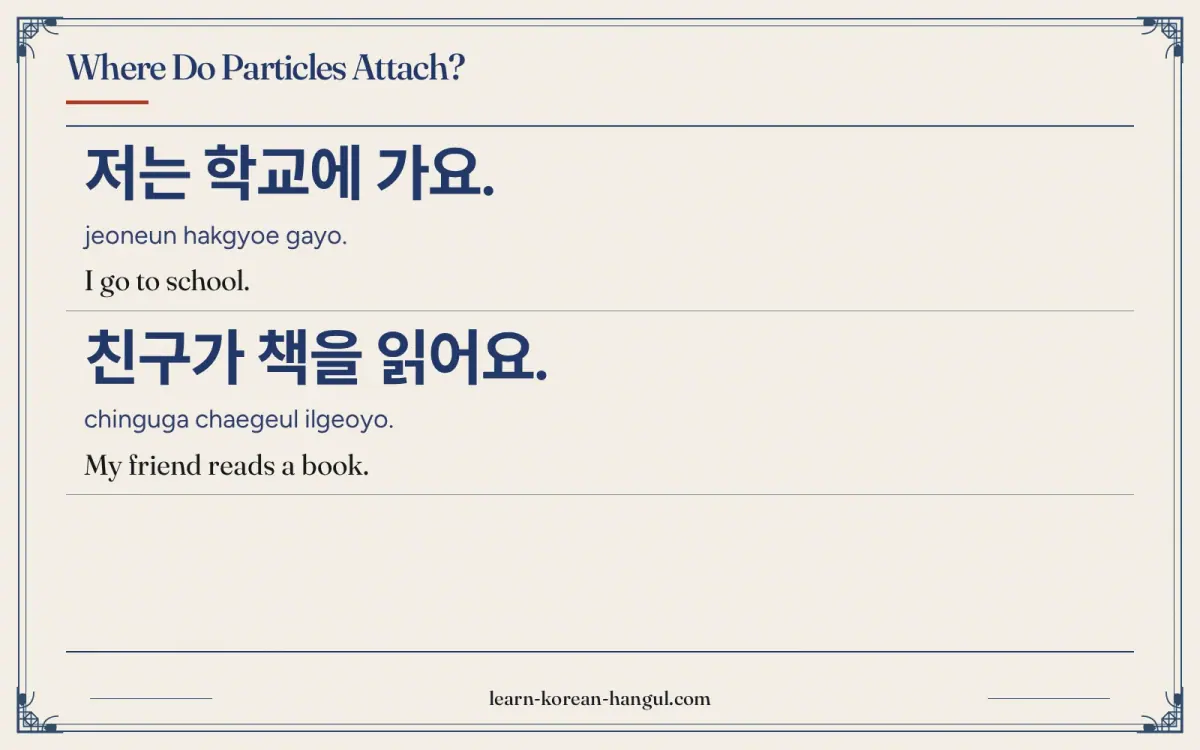
저는 학교에 가요.
jeoneun hakgyoe gayo.
I go to school.
친구가 책을 읽어요.
chinguga chaegeul ilgeoyo.
My friend reads a book.
A small group of particle-like words needs care. 만큼, 대로 and 뿐 are particles after nouns but dependent nouns after a modifier, and 밖에 is a particle when it means "only" but a noun plus particle when it means "outside". The pairs below show the difference.
| Particle (attached) | Separate noun (spaced) |
|---|---|
| 너만큼 (as much as you) | 노력한 만큼 (as much as you worked) |
| 나대로 (my own way) | 약속한 대로 (as promised) |
| 하나밖에 없어요 (there is only one) | 집 밖에 나가요 (go outside the house) |
The spacing of dependent nouns has its own lesson: Korean dependent nouns spacing. The next section covers two special cases.
What about Numerals and Foreign Words?
Particles attach after numerals and after foreign words, just as they attach after Korean nouns. The choice of particle form depends on how the word is said, not on how it is written.
Numerals. A numeral plus counter, then a particle, is written as one unit when Arabic digits are used: 3개를, 10명이, 2026년에는. With Hangul numbers the counter is separated from the number but not from its particle: 세 개를, 열 명이. The counter lessons cover the first space.
사과를 세 개 샀어요.
sagwareul se gae sasseoyo.
I bought three apples.
Foreign words. A word written in Latin letters takes the Hangul particle directly: iPhone이, PC를, K-pop은. A Hangul spelling works the same way: 아이폰이. The particle form follows the sound.
| Written | Said as | Ends in | Particles | Spoken |
|---|---|---|---|---|
| iPhone | 아이폰 | consonant ㄴ | iPhone이 / 은 / 을 | [아이포니] |
| K-pop | 케이팝 | consonant ㅂ | K-pop이 / 은 / 을 | [케이파비] |
| PC | 피시 | vowel | PC가 / 는 / 를 | [피시가] |
| USB | 유에스비 | vowel | USB가 / 는 / 를 | [유에스비가] |
The same logic applies to digits read aloud. The digit 3 is read 삼, which ends in ㅁ, so the topic form is 3은 and not 3는. Always say the word first, then pick the particle form. The next section covers strings of particles.
How Do Double Particles Work?
Double particles are two or more particles in a row, and the whole string attaches to the noun with no spaces inside. Each particle adds one layer of meaning, and Korean allows several layers on one noun.
| Written | Built from | Meaning | Spoken |
|---|---|---|---|
| 학교에서는 | 학교 + 에서 + 는 | at school (as for) | [학꾜에서는] |
| 학교에서만 | 학교 + 에서 + 만 | only at school | [학꾜에서만] |
| 학교에서만은 | 학교 + 에서 + 만 + 은 | only at school (topic) | [학꾜에서마는] |
| 한국에서도 | 한국 + 에서 + 도 | in Korea too | [한구게서도] |
| 친구에게도 | 친구 + 에게 + 도 | to a friend too | [친구에게도] |
| 서울에서부터는 | 서울 + 에서 + 부터 + 는 | starting from Seoul | [서우레서부터는] |
The longest string a beginner meets is probably 학교에서만은, which has three particles. It is one unit, with the stress on the noun and no break inside. Revised Romanization writes it as hakgyoeseomaneun. The syllable 만은 is said [마는] because the final ㄴ of 만 links to the vowel of 은.
학교에서만은 조용해요.
hakgyoeseomaneun joyonghaeyo.
At school at least, I am quiet.
서울에서부터는 기차를 타요.
seoureseobuteoneun gichareul tayo.
From Seoul on, I take the train.
The order of the particles is not free. Place, then limit (만, 도), then topic (은/는) is the common order. The topic particle 은/는 comes last, as in the table. The topic and subject particles section explains the topic marker in detail.
The next section deals with the verb 하다.
What about 공부를 하다 and 공부하다?
공부하다 is one verb written without a space, and 공부를 하다 is a noun plus particle plus verb, written with a space. Both mean "to study". The difference is whether a particle sits between 공부 and 하다.
| Written | Structure | Spoken | Meaning |
|---|---|---|---|
| 공부하다 | 공부 + 하다 (one verb) | [공부하다] | to study |
| 공부를 하다 | 공부 + 를 + 하다 | [공부를 하다] | to do studying |
| 공부 하다 | noun + space + verb | — | incorrect |
| 공부를하다 | no space after 를 | — | incorrect |
Many nouns work this way: 운동하다 and 운동을 하다, 일하다 and 일을 하다. The full set of 하다 verbs is the subject of Korean hada verbs spacing. For now, remember the particle rule: if 를 is written, the space follows it.
저는 매일 한국어를 공부해요.
jeoneun maeil hangugeoreul gongbuhaeyo.
I study Korean every day.
저는 매일 한국어 공부를 해요.
jeoneun maeil hangugeo gongbureul haeyo.
I do Korean study every day.
The next section shows a worked example.
Worked Example: 학교에서만은
To write "only at school (as for)" correctly, follow five steps.
- Start with the noun. The noun is 학교, "school".
- Add the place particle. 에서 means "at" or "in" a place of action, so 학교 + 에서 gives 학교에서.
- Add the limit particle. 만 means "only", so 학교에서 + 만 gives 학교에서만.
- Add the topic particle. 은 marks the topic, so 학교에서만 + 은 gives 학교에서만은.
- Add the space after the string. The next word starts a new unit: 학교에서만은 조용해요.
You'll know it worked when the whole string has no space inside it. The test is the pause check: say it aloud, and the voice does not stop until after 은.
The same steps handle any chain. For 서울에서부터는, start with 서울, add 에서, add 부터 ("from"), add 는. The result is one unit with four layers.
The next section lists the mistakes learners make.
What Mistakes Do Learners Make with Particle Spacing?
The table shows eight common errors, each with its fix.
| Wrong | Right | Reason |
|---|---|---|
| 저 는 | 저는 | the particle attaches |
| 학교 에 | 학교에 | the particle attaches |
| 책 을 | 책을 | the particle attaches |
| 친구 와 | 친구와 | the particle attaches |
| 학교 에서 만은 | 학교에서만은 | the whole string stays together |
| 한국어 도 | 한국어도 | 도 is a particle |
| 선생님 께서 | 선생님께서 | the honorific particle attaches |
| 아이폰 이 | 아이폰이 | a foreign word also takes an attached particle |
Learners make four underlying mistakes. Each has a one-step fix.
Learners often assume particles are small separate words. Actually the spelling rule joins them to the previous word. Fix: attach every particle.
Learners often assume foreign words cannot take particles. Actually iPhone이 and PC를 are standard. Fix: write the particle directly and choose its form by the sound.
Learners often assume a double particle needs a space. Actually the whole string is one unit. Fix: say the string aloud and write it without a pause.
Learners often put a space after 하다 nouns. Actually 공부하다 is one verb. Fix: use 공부하다, or add 를 and then a space.
An honest limit: this lesson gives the rule for particles and does not cover every word that looks like a particle. Words such as 만큼, 대로, 뿐 and 밖에 can be particles or dependent nouns, and the choice depends on what comes before. When in doubt, check the Standard Korean Language Dictionary (표준국어대사전). A spell checker catches many spacing errors, and the Korean spell checker guide explains how.
The next section tests the rule.
Practice and Answer Key
Correct the spacing in each sentence.
- 저 는 학생이에요.
- 학교 에서 공부해요.
- 친구 와 영화 를 봐요.
- 한국 에서도 먹어요.
- 학교 에서만 은 조용해요.
- 아이폰 이 좋아요.
- 공부 를 해요.
- 선생님 께서 오셨어요.
- 서울 부터 부산 까지 가요.
- 하나 밖에 없어요.
Practice · 8
Which is correct?
Show answer
저는 학생이에요.
The particle 는 attaches to 저.
Which is correct?
Show answer
학교에서 공부해요.
The particle 에서 attaches to 학교.
Which is correct?
Show answer
친구와 영화를 봐요.
Both 와 and 를 attach to the word before them.
Which is correct?
Show answer
학교에서만은 조용해요.
The whole particle string 에서만은 stays attached to 학교.
Which is correct?
Show answer
아이폰이 좋아요.
A particle attaches to a loanword as well.
Which is correct?
Show answer
공부를 해요.
를 attaches to 공부, and the space comes after it.
Which is correct?
Show answer
서울부터 부산까지 가요.
부터 and 까지 are particles and attach.
Which is correct for 'there is only one'?
Show answer
하나밖에 없어요.
Here 밖에 is a particle meaning only, so it attaches to 하나.
Answer key
- 저는 학생이에요.
- 학교에서 공부해요.
- 친구와 영화를 봐요.
- 한국에서도 먹어요.
- 학교에서만은 조용해요.
- 아이폰이 좋아요.
- 공부를 해요.
- 선생님께서 오셨어요.
- 서울부터 부산까지 가요.
- 하나밖에 없어요.
A score of 9 or 10 means the attaching habit is working. If you missed item 10, review the table that contrasts 밖에 as a particle with 집 밖에 as a noun plus particle. The next section points to what follows.
Where to Go Next after Korean Particles Spacing
After Korean particles spacing, continue to Korean dependent nouns spacing, where the rule flips: dependent nouns such as 수 and 것 are separate words. Seeing both side by side is the quickest way to feel the difference.
For the whole set, return to Korean spacing rules, and for the spelling side see Korean spelling rules. This lesson covers the Article 41 rule for particles. It does not cover every case in which a particle-like word is really a noun. About this page. Last updated 2026-10-09. The Korean text, spoken forms and Revised Romanization were reviewed and signed off by Min-ji Park on 15 October 2026. Romanization is shown only as a learning aid.
Frequently Asked Questions
Is there a space before a particle? No. A Korean particle is written attached to the word before it, as in 학교에, 책을 and 저는. The rule comes from Article 41 of the Hangul Orthography. English prepositions stand before the noun and take a space, but a Korean particle follows the noun and joins it, so adding a space before it is a spelling error.
How do I add a particle to an English word? Write the particle directly after the English letters, as in iPhone이 or PC를, or spell the word in Hangul, as in 아이폰이. Choose the particle form by how the word is said. 아이폰 ends in ㄴ, so it takes 이, 은 and 을. 피시 ends in a vowel, so it takes 가, 는 and 를.
Is there a space in 공부를 하다? Yes, but only because the particle 를 sits between 공부 and 하다. With a particle there, 하다 is a separate verb, so the spelling is 공부를 하다. Without the particle, the two join into one verb, 공부하다. The forms 공부 하다 and 공부를하다 are both wrong. Both correct spellings mean "to study".
How do I write two particles together? Write them in a row with no spaces, in the order they attach, as in 학교에서는 and 학교에서만은. Each particle adds one layer of meaning: 에서 means "at", 만 means "only" and 은 marks the topic. The whole string forms a single unit, so the word and all of its particles stay together.