What you'll learn
- Choose 안 or 않 in any negative sentence with a one-question test.
- Write both negative patterns for the same verb: 안 가요 and 가지 않아요.
- Say 않아요 as [아나요] and 않다 as [안타].
- Fix the common errors 하지 안아요 and 안 하지 않아요.
Prerequisites: you know what a verb and an adverb are. Time: about 25 minutes.
Key facts
- 안 comes before the verb or adjective and takes no ending.
- 않 is a verb stem. It follows -지 and always has an ending after it.
- 안 먹어요 and 먹지 않아요 both mean "I do not eat".
- 않 has a weak ㅎ: 않아요 is [아나요] and 않다 is [안타].
Listen to the same meaning built in the two ways.
The next section explains what each negative is made of.
What Is 안 vs 않?
안 is a separate word meaning "not", and 않 is the stem of the helper verb 않다, "to not do". A helper verb is a verb that follows the main verb and adds a grammatical meaning. 않다 is such a verb: it follows the main verb's -지 form and carries the tense and politeness ending itself.
The two words have the same origin. 안 is the short form of the adverb 아니 ("not"), and 않다 is the short form of 아니하다. Both therefore mean "not". Korean uses the short word for the quick negative and the longer verb chain for the careful one.
| Pattern | Name | Built from | Example | Meaning |
|---|---|---|---|---|
| 안 + verb | short negation | 안 (adverb) + verb | 안 먹어요 | I do not eat |
| verb + -지 + 않다 | long negation | verb stem + -지 + 않 + ending | 먹지 않아요 | I do not eat |
Because 안 is a word on its own, it takes a space after it. Because 않 is a stem, it is written together with its ending (않아요). A helper verb is spaced from the main verb, so 먹지 않아요 has one space between 먹지 and 않아요. The Korean negation section teaches the meanings of both patterns in depth. The next section explains why English speakers confuse them.
Why Do English Speakers Struggle with 안 and 않?
English speakers hear one sound, [안], and see two spellings with the same meaning. English "not" has no matching pair. The letters differ only by a silent ㅎ, which looks like a typing slip, so many learners treat the pair as one word with two spellings.
The pair is also hard because the ㅎ in 않 disappears in speech before vowels. Say 않아요 and you hear [아나요], with no trace of the ㅎ or of a final ㄴ sound that would tell you it is 않 and not 안. In writing, the ㅎ is what marks the helper verb.
There is a fast way out. Ignore the sound and look at the word before it. When -지 is attached to that word, the only choice is 않. When there is no -지, the only choice is 안. The next two sections show each case.
When Do You Use 안?
Use 안 when you put "not" directly before a verb or adjective. The word after 안 is the full verb or adjective with its own ending. 안 itself never takes an ending and never follows -지.
| Verb or adjective | With 안 | Meaning |
|---|---|---|
| 가다 (to go) | 안 가요 | I do not go |
| 먹다 (to eat) | 안 먹어요 | I do not eat |
| 오다 (to come) | 안 와요 | I do not come |
| 마시다 (to drink) | 안 마셔요 | I do not drink |
| 좋다 (to be good) | 안 좋아요 | It is not good |
| 예쁘다 (to be pretty) | 안 예뻐요 | It is not pretty |
All of these forms come from the standard conjugation of each word. Notice that the verb after 안 is conjugated as usual: 먹어요, 와요, 마셔요. Only 안 is added in front.
With 하다 verbs, 안 goes between the noun and 하다: 공부 안 해요, "I do not study". The long form attaches differently: 공부하지 않아요. Both mean the same thing.
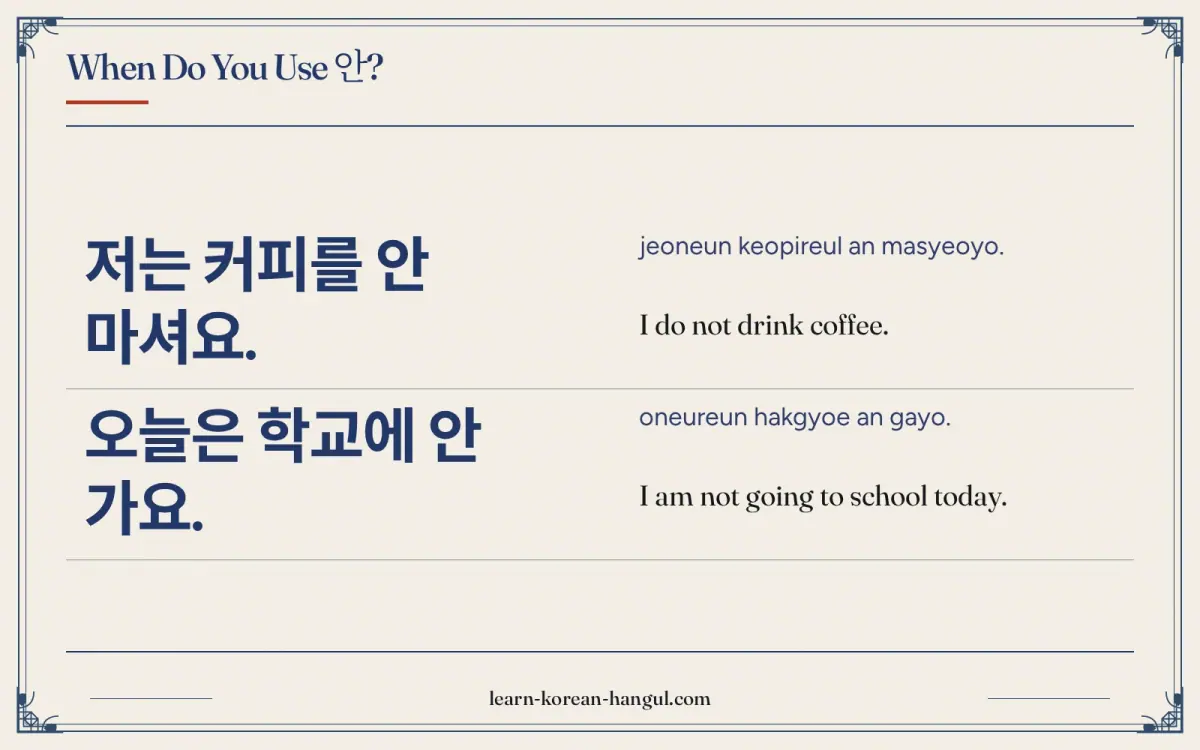
저는 커피를 안 마셔요.
jeoneun keopireul an masyeoyo.
I do not drink coffee.
오늘은 학교에 안 가요.
oneureun hakgyoe an gayo.
I am not going to school today.
The next section covers 않.
When Do You Use 않?
Use 않 only after -지. The verb chain is main verb stem + -지 + 않다, and 않다 then takes whatever ending the sentence needs. The result is that 않 is always followed by another sound or ending, such as 아요, 았어요, 는, 고 or 으면.
| Main verb | Long negation | Meaning |
|---|---|---|
| 가다 | 가지 않아요 | I do not go |
| 먹다 | 먹지 않아요 | I do not eat |
| 오다 | 오지 않아요 | I do not come |
| 마시다 | 마시지 않아요 | I do not drink |
| 좋다 | 좋지 않아요 | It is not good |
| 예쁘다 | 예쁘지 않아요 | It is not pretty |
The helper verb 않다 itself conjugates like any regular verb. It follows the same pattern as other 아/어 verbs: 않아요, 않았어요, 않아서, 않으면, 않는다. In every form the stem 않 stays the same.
Two spoken details help you check your spelling by ear. First, -지 before 않 is tensed after a stop final such as ㄱ or ㅂ: 먹지 is said [먹찌] and 맵지 [맵찌]. Second, 가지 않아요 is said [가지 아나요], and Revised Romanization writes it as gaji anayo.
저는 고기를 먹지 않아요.
jeoneun gogireul meokji anayo.
I do not eat meat.
이 음식은 맵지 않아요.
i eumsigeun maepji anayo.
This food is not spicy.
The next section asks whether the two patterns are interchangeable.
Are 안 and -지 않다 Interchangeable?
Mostly yes, but not in commands, suggestions or some fixed expressions. In a plain statement, 안 가요 and 가지 않아요 mean the same thing, and either is correct. Speakers often choose the short form in conversation and the long form in writing, in careful speech or in formal speech.
Three situations show where the two patterns part.
- Commands and suggestions. The negative command uses -지 마세요, not 안 and not 않. 가지 마세요 means "Please do not go". 가지 않으세요? is a question: "Aren't you going?" The same difference applies to suggestions: 가지 말자 means "Let's not go".
- Formal register. The formal ending is written 가지 않습니다 and said [가지 안씀니다]. 안 갑니다 is also correct. Careful writing leans toward the long form.
- Words with their own negative partner. 있다 ("to exist") pairs with 없다, and 알다 ("to know") pairs with 모르다. Learners therefore say 없어요 rather than 안 있어요, and 몰라요 rather than 안 알아요.
A special case is 안 돼요. 안 돼요 means "that is not allowed" or "that is no good". The word 안 is the adverb here, and 돼요 is the contracted form of 되어요. See 되 vs 돼 for why the letter is 돼 here.
The next section shows how 않 is pronounced.
How Is 않 Pronounced?
않 is pronounced by two rules from the Standard Pronunciation Rules (표준 발음법): the final ㅎ is silent before a vowel, and it merges with the next consonant before a consonant. The National Institute of Korean Language (국립국어원) publishes these rules in its standard pronunciation guide. A syllable like 않 has two final letters, ㄴ and ㅎ, which is called a double final consonant. See the double batchim lesson for the full set.
| Written | Spoken | Rule | Revised Romanization |
|---|---|---|---|
| 않아요 | [아나요] | ㅎ is silent before a vowel; ㄴ moves to the next block | anayo |
| 않았어요 | [아나써요] | the same; ㅆ is the written past-tense letter | anasseoyo |
| 않으면 | [아느면] | the same | aneumyeon |
| 않다 | [안타] | ㅎ and ㄷ merge into ㅌ | anta |
| 않고 | [안코] | ㅎ and ㄱ merge into ㅋ | anko |
| 않지 | [안치] | ㅎ and ㅈ merge into ㅊ | anchi |
| 않는다 | [안는다] | ㅎ drops before ㄴ | anneunda |
| 않습니다 | [안씀니다] | ㅎ + ㅅ gives [ㅆ]; ㅂ becomes ㅁ before ㄴ | anseumnida |
The silent ㅎ is the reason you cannot tell 안 from 않 by ear. Compare 안 가요 [안 가요] with 가지 않아요 [가지 아나요]. The syllable that carries the negative changes shape, but the speaker's mouth does not pause at all. The Korean h deletion lesson explains the sound rule in general.
The next section builds a full sentence from scratch.
Worked Example: 안 먹어요
To write "I do not eat breakfast" both ways, start from the verb 먹다 and follow five steps.
- Find the dictionary form. The verb is 먹다, "to eat", and the stem is 먹.
- Choose the pattern. For the short negative, put 안 in front. For the long negative, attach -지 to the stem and add 않다.
- Short negative. 안 + 먹어요 gives 안 먹어요. Write a space after 안.
- Long negative. 먹 + 지 + 않아요 gives 먹지 않아요. The word right before 않 ends in -지.
- Add the object. Both sentences keep the same object: 아침을 안 먹어요 and 아침을 먹지 않아요.
You'll know it worked when you can point to -지 in the long sentence and see that 안 does not appear there. A sentence with both, such as 아침을 안 먹지 않아요, would mean a double negative, "I do not not eat".
저는 아침을 안 먹어요.
jeoneun achimeul an meogeoyo.
I do not eat breakfast.
저는 아침을 먹지 않아요.
jeoneun achimeul meokji anayo.
I do not eat breakfast.
The next section lists the mistakes learners make most often.
What Mistakes Do Learners Make with 안 and 않?
Learners make four predictable mistakes, and each one comes from trusting the ear.
Learners often assume the spelling follows the sound. Actually 안아요 and 않아요 sound alike, but only 않아요 exists after -지. Wrong: 먹지 안아요. Right: 먹지 않아요. Fix: look for -지 before the word.
Learners often assume 않 can stand alone like 안. Actually 않 is a stem and cannot appear without an ending. Wrong: 저는 않 가요. Right: 저는 안 가요. Fix: if you can put 않 straight before a verb with no -지, change it to 안.
Learners often assume the two can be stacked for emphasis. Actually stacking gives a double negative. Wrong: 안 가지 않아요. Right: 안 가요 or 가지 않아요. Fix: pick one pattern per clause.
Learners often join 안 to the verb. Actually 안 is a separate word. Wrong: 안가요. Right: 안 가요. Fix: leave a space after 안, as in 안 먹어요 and 안 와요. A few real words begin with 안, such as 안되다 for work that goes badly, but learners should keep to the spaced adverb.
An honest limit: the test tells you which spelling the pattern needs, and it does not tell you which pattern the speaker meant. Both 안 갈 거예요 and 가지 않을 거예요 mean "I will not go". Choose the one that fits the register, and use the other when you need variety. Note too that the contraction -잖아요, as in 그렇잖아요, comes from -지 않아요, so the 않 is hidden there.
The next section tests the rule on ten sentences.
Practice and Answer Key
Choose 안 or 않 for each blank. Write the whole sentence.
- 저는 커피를 __ 마셔요.
- 주말에는 학교에 가지 __아요.
- 오늘은 비가 오지 __았어요.
- 아직 점심을 __ 먹었어요.
- 이 음식은 맵지 __아요.
- 숙제를 __ 해서 선생님이 화가 났어요.
- 걱정하지 __아도 돼요.
- 밤에는 커피를 __ 마시는 게 좋아요.
- 그 영화는 재미있지 __습니다.
- 저는 고기를 __ 먹어요.
Practice · 10
Which is correct? 저는 커피를 ___ 마셔요.
Show answer
안
No -지 comes before the blank, so write 안.
Which is correct? 주말에는 학교에 가지 ___아요.
Show answer
않
-지 comes right before, so write 않: 가지 않아요.
Which is correct? 오늘은 비가 오지 ___았어요.
Show answer
않
-지 comes right before, so write 않: 오지 않았어요.
Which is correct? 아직 점심을 ___ 먹었어요.
Show answer
안
The adverb 안 stands before 먹었어요: 안 먹었어요.
Which is correct? 이 음식은 맵지 ___아요.
Show answer
않
맵지 ends in -지, so write 않아요.
Which is correct? 숙제를 ___ 해서 선생님이 화가 났어요.
Show answer
안
No -지 precedes it, so write 안 해서.
Which is correct? 걱정하지 ___아도 돼요.
Show answer
않
하지 ends in -지, so write 않아도.
Which is correct? 밤에는 커피를 ___ 마시는 게 좋아요.
Show answer
안
The adverb 안 stands before the verb: 안 마시는.
Which is correct? 그 영화는 재미있지 ___습니다.
Show answer
않
재미있지 ends in -지, so write 않습니다.
Which is correct? 저는 고기를 ___ 먹어요.
Show answer
안
No -지 precedes it, so write 안 먹어요.
Answer key
- 안. 저는 커피를 안 마셔요.
- 않. 주말에는 학교에 가지 않아요.
- 않. 오늘은 비가 오지 않았어요.
- 안. 아직 점심을 안 먹었어요.
- 않. 이 음식은 맵지 않아요.
- 안. 숙제를 안 해서 선생님이 화가 났어요.
- 않. 걱정하지 않아도 돼요.
- 안. 밤에는 커피를 안 마시는 게 좋아요.
- 않. 그 영화는 재미있지 않습니다.
- 안. 저는 고기를 안 먹어요.
A score of 9 or 10 means the -지 test works for you. If you missed 3 or 7, look again at the forms 않았어요 and 않아도, because the ending that follows 않 hides the pattern. The next section points to what comes after this lesson.
Where to Go Next after 안 vs 않
After 안 vs 않, continue to 에요 vs 예요 vs 이에요, which deals with the "to be" ending and its negative 아니에요. Both lessons fix errors that involve a small word before an ending.
If you want the grammar behind the negatives, the Korean negation section covers 안, 못, -지 않다 and -지 못하다 together. For the general rules of Korean writing, return to Korean spelling rules, and for how to write the space after 안, see Korean spacing rules.
This lesson covers 안 vs 않 in the polite and plain styles. It does not cover 못 (cannot) or the older forms 아니하다 and 아니 in formal documents. About this page. Last updated 2026-10-09. The Korean text, spoken forms and Revised Romanization were reviewed and signed off by Min-ji Park on 15 October 2026. Romanization is shown only as a learning aid.
Frequently Asked Questions
What is the difference between 안 and 않? 안 is a separate adverb that means "not" and sits before a verb or adjective, as in 안 가요. 않 is the stem of the helper verb 않다 and appears only after -지, as in 가지 않아요. Both make a plain negative, but they build the sentence in different ways, so the spelling depends on the pattern.
Can I use 안 and -지 않다 interchangeably? Often yes, because 안 가요 and 가지 않아요 both mean "I do not go". The -지 않다 pattern sounds a little more careful and is common in writing. Commands and suggestions differ, since they use -지 마세요 and -지 말자 instead. And 안 cannot take an ending, while 않 always needs one.
Why do I write 하지 않아요? The long negative pattern is verb stem + -지 + 않다. The helper verb 않다 carries the polite ending, so its stem 않 is written with 아요 after it. The writer never puts 안 after -지, so 하지 안아요 is wrong. The rule is that -지 right before the word means 않.
How do I pronounce 않아요? Say [아나요]. The ㅎ at the bottom of 않 is silent before a vowel, and the ㄴ moves to the next block. Before a consonant the ㅎ merges with it, so 않다 is [안타], 않고 is [안코] and 않지 is [안치]. Revised Romanization follows these sounds, giving anayo and anta.