What you'll learn
- Add 이에요 or 예요 to any noun by checking its last letter.
- Spell the negative 아니에요 and avoid 아니예요.
- Apply the rule to names, such as 민수예요 and 지은이에요.
- Sort 15 nouns by their endings.
Prerequisites: you know the polite ending 이에요/예요 from the 이에요/예요 to be lesson. Time: about 25 minutes.
Key facts
- Consonant ending: 이에요. Vowel ending: 예요.
- The negative is 아니에요, never 아니예요.
- 예요 is said [예요], and often [에요] in everyday speech.
- Names follow the same rule as other nouns.
Listen to the three endings side by side.
The next section explains what each ending is made of.
What Is 에요 vs 예요 vs 이에요?
이에요 is the polite present form of the copula 이다 ("to be") after a noun with a final consonant. 예요 is the shortened version of 이에요 after a noun without a final consonant. 에요 is the ending part itself, and it appears alone only in 아니에요. A copula is a linking word that joins a noun to what it is, like "is" in "She is a doctor".
The two forms are the same word in two shapes. The stem 이 plus the ending 에요 gives 이에요. After a vowel, the stem 이 and the 에 of 에요 merge into 예, which gives 예요: 의사 + 이에요 becomes 의사예요. The shortened 예요 is the form standard writing uses after a vowel.
| Noun | Last letter | Ending | Written form | Spoken | RR |
|---|---|---|---|---|---|
| 책 | final ㄱ | 이에요 | 책이에요 | [채기에요] | chaegieyo |
| 학생 | final ㅇ | 이에요 | 학생이에요 | [학쌩이에요] | haksaengieyo |
| 의사 | vowel ㅏ | 예요 | 의사예요 | [의사예요] | uisayeyo |
| 커피 | vowel ㅣ | 예요 | 커피예요 | [커피예요] | keopiyeyo |
The first noun in the table shows linking. When the noun ends in a consonant, that consonant moves onto the following syllable in speech. 책이에요 is therefore said [채기에요], and the National Institute of Korean Language (국립국어원) describes this in its Standard Pronunciation Rules (표준 발음법). The Korean liaison section covers the rule in detail. The next section explains why English speakers find the choice hard.
Why Do English Speakers Struggle with 에요, 예요 and 이에요?
English speakers expect "is" to be one word, so three Korean endings for one idea feels arbitrary. English changes "to be" by person (am, is, are) but never by the last letter of the next word. Korean does the opposite: the ending ignores the person and follows the noun's last letter.
There is also a sound problem. In everyday speech, 예요 is often said [에요], so a learner who listens for the ㅖ will not hear it. The site gives 예요 first and notes that [에요] is the common spoken variant. The sounds blur, but the spelling stays fixed.
The fix is the same as in other spelling pairs. Ignore the sound and look at the noun. If you can see a letter under the last vowel, add 이에요. If you cannot, add 예요. The next section turns that into a table.
Which Noun Takes Which Ending?
A noun takes 이에요 when its last written syllable has a final consonant (받침), and 예요 when it does not. A 받침 is the letter under the vowel in a syllable block. Final ㅇ counts, because ㅇ at the bottom of a block is a real consonant letter, as in 학생.
| Noun | Meaning | Last syllable | Ending | Full form |
|---|---|---|---|---|
| 책 | book | 책 has ㄱ | 이에요 | 책이에요 |
| 학생 | student | 생 has ㅇ | 이에요 | 학생이에요 |
| 선생님 | teacher | 님 has ㅁ | 이에요 | 선생님이에요 |
| 가방 | bag | 방 has ㅇ | 이에요 | 가방이에요 |
| 한국 사람 | Korean person | 람 has ㅁ | 이에요 | 한국 사람이에요 |
| 회사원 | office worker | 원 has ㄴ | 이에요 | 회사원이에요 |
| 이름 | name | 름 has ㅁ | 이에요 | 이름이에요 |
| 물 | water | 물 has ㄹ | 이에요 | 물이에요 |
| 의사 | doctor | 사 has none | 예요 | 의사예요 |
| 커피 | coffee | 피 has none | 예요 | 커피예요 |
| 우유 | milk | 유 has none | 예요 | 우유예요 |
| 친구 | friend | 구 has none | 예요 | 친구예요 |
| 아이 | child | 이 has none | 예요 | 아이예요 |
| 사과 | apple | 과 has none | 예요 | 사과예요 |
| 나라 | country | 라 has none | 예요 | 나라예요 |
The rule follows the written 받침, not the letter's shape. A noun like 아이 ends in the vowel ㅣ, so it takes 예요 even though its last letter is part of an 이 block. The number 이 ("two") and the word 이 ("tooth") behave the same way: 이예요 is correct. The casual endings use the same split, so 책이야 and 의사야 match 책이에요 and 의사예요.
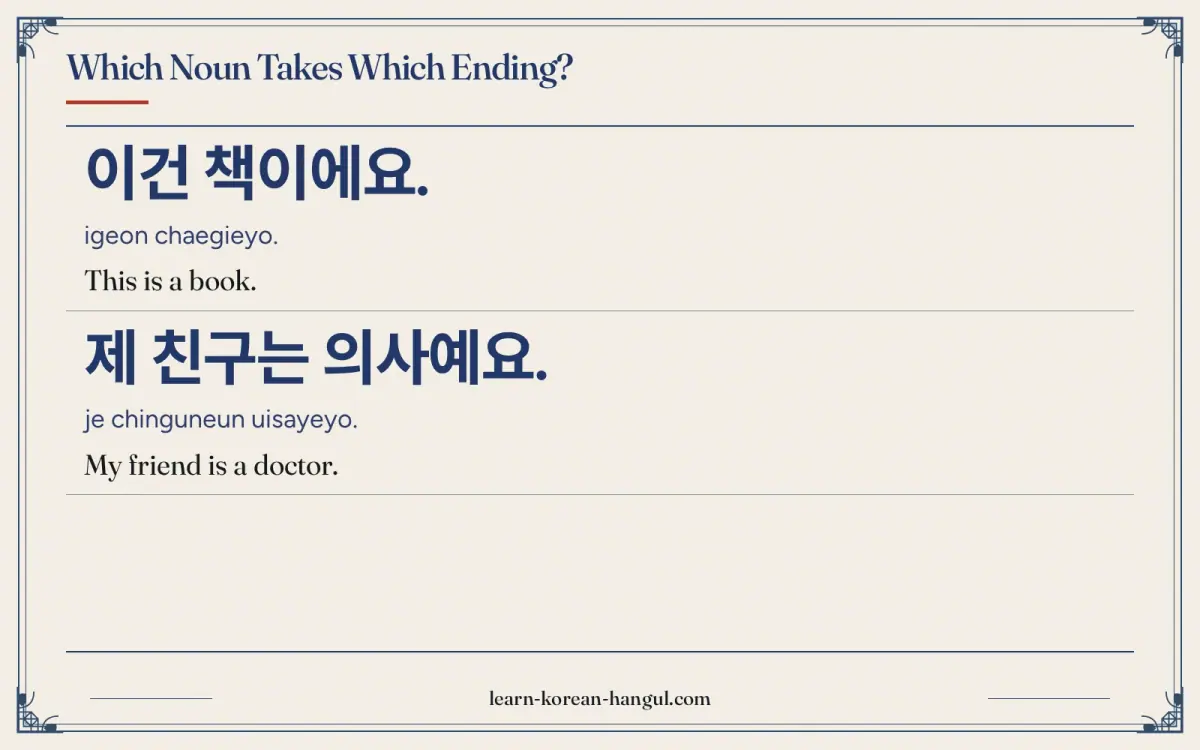
이건 책이에요.
igeon chaegieyo.
This is a book.
제 친구는 의사예요.
je chinguneun uisayeyo.
My friend is a doctor.
The grammar of the ending itself is in the 이에요/예요 to be lesson, and the polite speech section places it among the speech styles. The next section covers the negative.
What about the Negative 아니에요?
The negative is 아니에요, written with 에요 after 아니, and it never becomes 아니예요. 아니다 ("to be not") is a separate word with the stem 아니. Its polite ending 에요 attaches directly, and there is no hidden 이 to merge into 예. That is why the spelling cannot be 아니예요.
| Positive | Negative | Meaning |
|---|---|---|
| 학생이에요 | 학생이 아니에요 | is / is not a student |
| 의사예요 | 의사가 아니에요 | is / is not a doctor |
| 책이에요 | 책이 아니에요 | is / is not a book |
| 커피예요 | 커피가 아니에요 | is / is not coffee |
Two points make the table easier to use. First, the noun before 아니에요 takes the subject particle 이 after a consonant and 가 after a vowel: 학생이 아니에요, 의사가 아니에요. This 이 is a particle, not the copula. Second, 아니에요 also works alone as a reply: "No" or "It isn't". A short written form, 아녜요, exists for 아니에요, and 아니예요 is not standard.
저는 학생이 아니에요.
jeoneun haksaengi anieyo.
I am not a student.
이건 커피가 아니에요.
igeon keopiga anieyo.
This is not coffee.
The 아니에요 not to be lesson teaches the negative in full, and the Korean negation section compares it with 안 and 못. The next section covers names.
How Are Names Handled?
A name is a noun, so the last letter of the name decides the ending. Names that end in a consonant take 이에요, and names that end in a vowel take 예요.
| Name | Last letter | Written form | Spoken | RR |
|---|---|---|---|---|
| 민수 | vowel ㅜ | 민수예요 | [민수예요] | minsuyeyo |
| 하나 | vowel ㅏ | 하나예요 | [하나예요] | hanayeyo |
| 수지 | vowel ㅣ | 수지예요 | [수지예요] | sujiyeyo |
| 지은 | final ㄴ | 지은이에요 | [지으니에요] | jieunieyo |
| 민준 | final ㄴ | 민준이에요 | [민주니에요] | minjunieyo |
| 서연 | final ㄴ | 서연이에요 | [서여니에요] | seoyeonieyo |
In an introduction, the order is the name, then the ending: 제 이름은 민수예요 means "My name is Minsu". A common learner slip is writing 민수이에요, which keeps the full 이에요 after a vowel. Standard writing contracts it to 민수예요.
The casual copula follows the same split: 나는 민수야 after a vowel-ending name and 나는 지은이야 after a consonant-ending one. The your name in Korean section shows how to spell your own name in Hangul, which you need before you can choose the ending.
제 이름은 민수예요.
je ireumeun minsuyeyo.
My name is Minsu.
제 이름은 지은이에요.
je ireumeun jieunieyo.
My name is Jieun.
The next section explains why the endings sound so similar.
Why Do the Endings Sound the Same?
The endings sound the same because the vowel ㅖ in 예 and the vowel ㅔ in 에 are pronounced almost alike in everyday speech. The standard pronunciation of 예요 is [예요], with a y-glide, but many speakers drop the glide and say [에요]. After a consonant noun, linking adds another blur: 책이에요 is [채기에요], which also ends in [에요].
| Ending | Standard spoken form | Common everyday variant |
|---|---|---|
| 이에요 | [이에요] | [이에요] |
| 예요 | [예요] | [에요] |
| 에요 (in 아니에요) | [에요] | [에요] |
A learner can therefore hear [에요] at the end of all three. Spelling must come from the noun rule above. An honest limit: when you hear a word you do not know, you may not hear the last consonant of the noun clearly, so you cannot yet choose the ending. Look the word up, or use the Korean spell checker to check a short text.
The next section builds a full example.
Worked Example: 책이에요
To write "It is a book" with the correct ending, use four steps.
- Write the noun. The noun is 책, "book".
- Look at the last block. 책 has ㄱ under the vowel ㅐ. That is a final consonant.
- Choose the ending. A consonant-ending noun takes 이에요, so the ending is 이에요.
- Join them. 책 + 이에요 = 책이에요. Say it [채기에요], with the ㄱ moving to the next block.
You'll know it worked when you can name the letter under the vowel before you add the ending. Now repeat with 의사: the last block 사 has no letter underneath, so the ending is 예요, and the result is 의사예요.
The same four steps work for questions. 학생이에요? ("Are you a student?") rises at the end. A question with a question word, such as 이름이 뭐예요?, does not rise sharply, and 뭐예요 follows the same rule because 뭐 ends in a vowel.
The next section lists the mistakes learners make.
What Mistakes Do Learners Make with 에요, 예요 and 이에요?
Learners make four predictable mistakes, and each has a one-step fix.
Learners often assume the ending is chosen by ear. Actually 이에요 and 예요 sound alike in fast speech. Avoid: 의사이에요. Write: 의사예요. Fix: look at the noun's last block and ignore the sound.
Learners often assume the negative uses the same contraction. Actually the negative stem is 아니, so the spelling is 에요. Wrong: 학생이 아니예요. Right: 학생이 아니에요. Fix: whenever you write 아니, add 에요.
Learners often put 이에요 after a vowel in a name. Actually names follow the same rule as nouns. Avoid: 민수이에요. Write: 민수예요. Fix: treat the name as a noun and check its last block.
Learners often use 예요 with an adjective. Actually the copula joins nouns only. Wrong: 예뻐예요. Right: 예뻐요. Fix: adjectives take their own endings. The Korean parts of speech section explains which words are nouns and which are adjectives.
An honest limit: this lesson covers the polite present only. The past tense (학생이었어요, 의사였어요) and the honorific (선생님이세요) change the pattern and belong to later lessons. The uncontracted 의사이에요 is rare in standard writing, and learners should write the shortened form.
The next section tests the rule on 15 nouns.
Practice and Answer Key
Add the correct ending to each noun, then write the whole word.
- 책
- 의사
- 학생
- 커피
- 선생님
- 우유
- 친구
- 가방
- 한국 사람
- 회사원
- 민수 (a name)
- 지은 (a name)
- 이름
- 아이
- 물
Practice · 8
Add the polite ending to 책.
Show answer
책이에요
책 ends in the final consonant ㄱ, so write 책이에요.
Add the polite ending to 커피.
Show answer
커피예요
커피 ends in the vowel ㅣ, so write 커피예요.
Add the polite ending to 선생님.
Show answer
선생님이에요
선생님 ends in ㅁ, so write 선생님이에요.
Which spelling is the negative of 학생이에요?
Show answer
학생이 아니에요
The negative stem is 아니, so the ending is 에요: 학생이 아니에요.
Add the polite ending to the name 민수.
Show answer
민수예요
민수 ends in the vowel ㅜ, so write 민수예요.
Add the polite ending to the name 지은.
Show answer
지은이에요
지은 ends in ㄴ, so write 지은이에요.
Add the polite ending to 아이.
Show answer
아이예요
아이 ends in the vowel ㅣ, so write 아이예요.
Add the polite ending to 물.
Show answer
물이에요
물 ends in ㄹ, so write 물이에요.
Answer key
- 책이에요 (chaegieyo)
- 의사예요 (uisayeyo)
- 학생이에요 (haksaengieyo)
- 커피예요 (keopiyeyo)
- 선생님이에요 (seonsaengnimieyo)
- 우유예요 (uyuyeyo)
- 친구예요 (chinguyeyo)
- 가방이에요 (gabangieyo)
- 한국 사람이에요 (hanguk saramieyo)
- 회사원이에요 (hoesawonieyo)
- 민수예요 (minsuyeyo)
- 지은이에요 (jieunieyo)
- 이름이에요 (ireumieyo)
- 아이예요 (aiyeyo)
- 물이에요 (murieyo)
A score of 14 or 15 means the rule is working. If you missed a vowel noun, check the bottom of the last block again. The next section points to what follows.
Where to Go Next after 에요 vs 예요 vs 이에요
After 에요 vs 예요 vs 이에요, continue to 며칠 vs 몇 일, a pair where a spelling rule overrides what the parts suggest. Together with 되 vs 돼 and 안 vs 않, this lesson completes the three most frequent ending-related spelling pairs.
For the bigger picture, return to Korean spelling rules or the Korean spacing rules section. This lesson covers the polite present copula only. About this page. Last updated 2026-10-09. The Korean text, spoken forms and Revised Romanization were reviewed and signed off by Min-ji Park on 15 October 2026. Romanization is shown only as a learning aid.
Frequently Asked Questions
Is it 이에요 or 예요? Look at the last letter of the noun. If the written syllable has a final consonant, write 이에요, as in 책이에요 and 학생이에요. If it ends in a vowel, write 예요, as in 의사예요 and 커피예요. The two endings sound very close in speech, so the choice always comes from the noun's spelling.
Is 아니예요 correct? No. The standard negative is 아니에요, written with 에요, as in 학생이 아니에요. The word 아니 is the stem of 아니다 and does not contain the 이 that contracts into 예요. A short written form, 아녜요, also exists. The spelling 아니예요 appears often in messages, but standard writing does not use it.
Why is it 아니에요? 예요 is the contraction of 이에요, and it appears only after a noun. 아니다 is a separate word whose stem is already 아니, so the polite ending 에요 attaches directly and gives 아니에요. There is no hidden 이 to merge. For that reason the spelling cannot become 아니예요, whatever the speaker's pronunciation.
Does the rule apply to names? Yes. A name is a noun, so the last letter decides. 민수 ends in a vowel, so 민수예요. 지은 ends in the consonant ㄴ, so 지은이에요. In introductions, 제 이름은 민수예요 and 제 이름은 지은이에요 are both correct. The casual forms follow the same split: 나는 민수야 and 나는 지은이야.