What Is 로서 vs 로써?
The pair 로서 vs 로써 is two particles that attach to a noun and both start with 로. They differ in the last syllable and in the question they answer.
| Particle | Question it answers | Meaning | Example |
|---|---|---|---|
| 로서 | As what? | status, role, qualification | 학생으로서 (as a student) |
| 로써 | By what? | means, tool, material, point in time | 대화로써 (by talking) |
Listen to the two endings. The second one has a tense ㅆ.
Now see each particle in a sentence. The first sentence says what role the speaker is in.
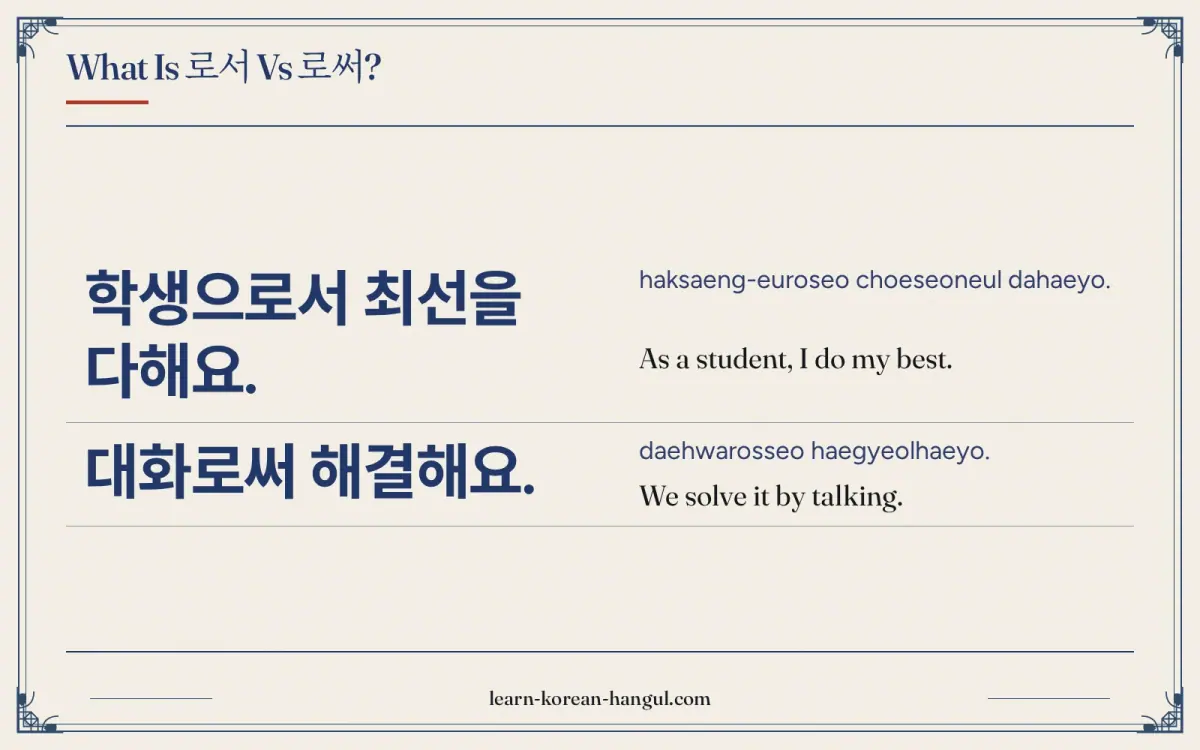
학생으로서 최선을 다해요.
haksaeng-euroseo choeseoneul dahaeyo.
As a student, I do my best.
It is said [학쌩으로서 최서늘 다해요]. The ㄱ of 학 makes the next ㅅ tense. The phrase 최선을 다하다 means "to do one's best". The second sentence says how a problem is solved.
대화로써 해결해요.
daehwarosseo haegyeolhaeyo.
We solve it by talking.
Here 대화 ("conversation") is the tool. The sentence is said [대화로써 해결해요]. Swapping the particles changes the meaning of both sentences. 학생으로써 would suggest that the student is a tool, and 대화로서 would suggest that the conversation holds a role.
Why English Speakers Struggle Here
English speakers struggle because the two particles are one letter apart, and English has no similar pair. Three things make the problem worse.
- The ear is little help. Both endings are short and unstressed, and in fast speech the tense ㅆ in 써 is easy to miss.
- Both translate as "with" or "as" in learner dictionaries. A dictionary entry for 로 lists direction, means, role and cause together. The separate forms 로서 and 로써 are not obvious from it.
- Plain 로 covers both in daily speech. A learner who hears 말로 해요 never learns that a more careful writer would choose 로써.
The result is the habit of picking one at random. A better habit is to run a two-question test, which takes a few seconds and works nearly every time. Plain 로 is a part of the same family of particles, covered in (으)로 vs 에 and in the Korean location particles section.
What Does 로서 Mean?
로서 names the position from which someone acts or is judged. It answers "as what?". The noun is nearly always a person, a group or an official role.
| Noun | With 로서 | Meaning |
|---|---|---|
| 학생 | 학생으로서 | as a student |
| 선생님 | 선생님으로서 | as a teacher |
| 친구 | 친구로서 | as a friend |
| 부모 | 부모로서 | as a parent |
| 국민 | 국민으로서 | as a citizen |
| 한국 사람 | 한국 사람으로서 | as a Korean person |
You can turn the phrase into a modifier with 의: 학생으로서의 책임 (haksaeng-euroseoui chaegim, "a student's responsibility, the responsibility as a student"). It is said [학쌩으로서의 채김].
The important feature of 로서 is the qualification. The speaker says, "In this role, I do or feel or must do this." Examples are 친구로서 말해요 ("I'm telling you as a friend") and 선생님으로서 책임이 있어요 ("As a teacher I have a responsibility"). The role gives a reason or a standard for the action.
What Does 로써 Mean?
로써 names what is used. It answers "by what?" or "with what?". The noun can be a method, a tool or a material, and it can also be a point in time that marks the end or a count.
| Use | Example | Meaning |
|---|---|---|
| Method | 대화로써 해결해요. | We solve it by talking. |
| Method | 노력으로써 성공했어요. | I succeeded through effort. |
| Tool | 말로써 설명하기 어려워요. | It is hard to explain in words. |
| Material | 쌀로써 떡을 만들어요. | We make rice cakes from rice. |
| Point in time | 오늘로써 끝이에요. | As of today, it is over. |
The rice-cake sentence is correct, but in daily talk people say 쌀로 떡을 만들어요 with plain 로. The longer 로써 stresses the material and sounds more written.
오늘로써 끝이에요.
oneullosseo kkeuchieyo.
As of today, it is over.
The sentence is said [오늘로써 끄치에요]. The ㄹ at the end of 오늘 and the ㄹ at the start of 로써 join into a long ㄹ sound, and in 끝이에요 the ㅌ is said as ㅊ and moves on to 이에요. The time use marks a boundary. 오늘로써 does not mean "with today", but "with today as the limit", so the thing ends or counts from this day. It is a formal use that you will see in notices and speeches.
Compared with 로서, the 로써 phrase is almost never about people's roles. When the noun is a person, the question "by what?" does not fit unless you mean a tool.
Which Test Decides?
The test has two questions, asked in order.
- Ask "as what?" Can you put "in the role of" or "as a" before the noun? If yes, use 로서.
- Ask "by what?" Can you put "by means of", "with" or "using" before the noun? If yes, use 로써.
- If neither fits, check whether the noun is a day or a count that marks a limit. Then it is 로써.
The first question is stronger, because roles are narrow. Most nouns for people give 로서, and most nouns for things or actions give 로써.
| Sentence | As what? | By what? | Spelling |
|---|---|---|---|
| 학생___ 열심히 공부해요 | yes | no | 학생으로서 |
| 대화___ 문제를 풀어요 | no | yes | 대화로써 |
| 부모___ 아이를 사랑해요 | yes | no | 부모로서 |
| 노력___ 성공했어요 | no | yes | 노력으로써 |
Because the particle attaches directly to the noun, spacing is simple: no space before 로서 or 로써. The other spacing rules for particles are in Korean spacing rules.
The test for the vowel is separate. After a vowel or ㄹ, the particles are 로서 and 로써. After any other consonant, add 으: 학생으로서, 선생님으로서, 노력으로써. This is the same rule as plain (으)로, which is explained in (으)로 vs 에.
| Noun ending | Rule | Example with 로서 | Example with 로써 |
|---|---|---|---|
| Vowel | 로 | 친구로서 | 대화로써 |
| ㄹ | 로 | 딸로서 (as a daughter) | 말로써 |
| Other consonant | 으로 | 학생으로서 | 노력으로써 |
Sort These Nouns
A quick way to build the habit is to sort nouns into roles and means before you meet them in a sentence. The table lists ten nouns with the particle each one usually takes and a model phrase.
| Noun | Usually | Model phrase | Meaning |
|---|---|---|---|
| 의사 (doctor) | 로서 | 의사로서 말씀드릴게요. | I'll tell you as a doctor. |
| 딸 (daughter) | 로서 | 딸로서 미안해요. | I'm sorry as a daughter. |
| 팀장 (team leader) | 로서 | 팀장으로서 결정했어요. | I decided as team leader. |
| 한국어 학습자 (Korean learner) | 로서 | 학습자로서 질문해요. | I ask as a learner. |
| 행동 (action) | 로써 | 행동으로써 보여 줘요. | I show it through actions. |
| 글 (writing) | 로써 | 글로써 알려요. | I inform by writing. |
| 방법 (method) | 로써 | 이 방법으로써 풀어요. | I solve it by this method. |
| 약 (medicine) | 로써 | 약으로써 치료해요. | I treat it with medicine. |
| 시 (poem) | 로써 | 시로써 표현해요. | I express it through a poem. |
| 돈 (money) | 로써 | 돈으로써 해결해요. | We settle it with money. |
One row can look odd to English eyes. In 팀장으로서 결정했어요, English could say "by the authority of a leader", which sounds like a means. But the Korean question is "in what role?", so the particle is 로서. The English preposition is a poor guide, and the Korean question is a good one. In the model phrase 의사로서 말씀드릴게요, notice that 할게요-type endings are said with a tense sound: [말씀드릴께요]. That spelling rule is in ㄹ게 vs ㄹ께.
When the Sentence Is Not Clear
Related nouns can need different particles, because one names a person and the other a thing. Compare 시인 ("poet") and 시 ("poem").
- 시인으로서 말해요 means "I speak as a poet", which is about the role.
- 시로써 감정을 표현해요 means "I express feelings through poems", which is about the means.
The topic is the same, but the question has changed, so the particle changes too. The test does the work, and the English translation does not.
Another case is plain 로. In many everyday sentences, native speakers say 로 or 으로 and mean either. 선생님으로 일해요 means "I work as a teacher", and 대화로 해결해요 can mean "we solve it by talking". These are accepted in speech. Careful writing, school work and tests prefer the full forms, so learn the pair even if you hear 로 around you. A related set of small particles, with nuance rather than case, is described in Korean auxiliary particles.
Worked Example: 학생으로서 최선을 다해요.
Here is the decision for one sentence, from a blank to a full answer.
- Read the blank. 저는 학생___ 열심히 공부해요 ("I study hard ___ a student").
- Ask "as what?" Yes: the speaker is acting in the role of a student.
- Choose the family. The answer is 로서, not 로써.
- Check the vowel. 학생 ends in the consonant ㅇ, so add 으: 학생으로서.
- Write. 저는 학생으로서 열심히 공부해요.
Compare the opposite case. You want to say "We solve problems by talking." The test gives "by what?", so 로써. 대화 ends in a vowel, so no 으: 대화로써.
The sentence 학생으로서 최선을 다해요 can mean "I do my best because I am a student". The role does not only describe, it explains. This reasoning use is common with 로서: 부모로서 걱정돼요 ("As a parent, I worry").
What Mistakes Do Learners Make Here?
Five mistakes cover most errors. Each follows the pattern "learners often assume X, but actually Y, because Z".
- Using 로써 for a role. Learners often write 학생으로써. Actually a role takes 로서, because the question is "as what?".
- Using 로서 for a means. Learners often write 대화로서 해결해요. Actually a tool takes 로써, because the question is "by what?".
- Forgetting 으. Learners often write 학생로서 or 노력로써. Actually a noun that ends in a consonant needs 으: 학생으로서, 노력으로써.
- Overusing the long form in chat. Learners often write 로써 in every message. Actually plain 로 is the natural form for a means in casual talk.
- Choosing by ear. Learners often trust what they hear. Actually the tense ㅆ is easy to miss in fast speech, so use the test questions instead.
Honest limit of this lesson: it covers the A2 uses. The time use of 로써 is stiff and formal. You will mostly see it in notices and speeches, so do not rush to use it in chat. When you are unsure about any noun, check the Standard Korean Language Dictionary (표준국어대사전).
Practice and Answer Key
Fill each blank with 로서 or 로써 (add 으 when needed). Do all eight before you check the answers.
- 저는 학생___ 열심히 공부해요.
- 말___ 설명하기 어려워요.
- 친구___ 말해요.
- 오늘___ 숙제가 끝났어요.
- 대화___ 문제를 풀어요.
- 선생님___ 책임이 있어요.
- 노력___ 성공했어요.
- 부모___ 아이를 사랑해요.
Practice · 5
Which is correct? "As a teacher, I have a responsibility."
Show answer
선생님으로서 책임이 있어요.
A role takes 로서, and 선생님 ends in a consonant, so the form is 으로서.
Which is correct? "It is hard to explain in words."
Show answer
말로써 설명하기 어려워요.
Words are the tool, so the particle is 로써. 말 ends in ㄹ, so no 으.
Which question gives 로서?
Show answer
As what?
"As what?" names a role or status, so the particle is 로서.
Which is correct? "As of today, it is over."
Show answer
오늘로써 끝이에요.
A day that marks a limit takes 로써. 오늘 ends in ㄹ, so no 으.
Which is correct? "I succeeded through effort."
Show answer
노력으로써 성공했어요.
Effort is the means, so the particle is 로써, and 노력 ends in ㄱ, so the form is 으로써.
Answer Key
- 저는 학생으로서 열심히 공부해요. (jeoneun haksaeng-euroseo yeolsimhi gongbuhaeyo) [저는 학쌩으로서 열씸히 공부해요]. A role takes 로서. 학생 ends in a consonant, so 으로서.
- 말로써 설명하기 어려워요. (mallosseo seolmyeonghagi eoryeowoyo) [말로써 설명하기 어려워요]. Words are the tool, so 로써.
- 친구로서 말해요. (chinguroseo malhaeyo). "As a friend" is a role, so 로서.
- 오늘로써 숙제가 끝났어요. (oneullosseo sukjega kkeunnasseoyo) [오늘로써 숙쩨가 끈나써요]. A point in time that marks a limit takes 로써.
- 대화로써 문제를 풀어요. (daehwarosseo munjereul pureoyo). Talking is the means, so 로써.
- 선생님으로서 책임이 있어요. (seonsaengnimeuroseo chaegimi isseoyo) [선생니므로서 채기미 이써요]. "As a teacher" is a role, so 으로서.
- 노력으로써 성공했어요. (noryeogeurosseo seonggonghaesseoyo) [노려그로써 성공해써요]. Effort is the means, so 으로써.
- 부모로서 아이를 사랑해요. (bumoroseo aireul saranghaeyo). "As a parent" is a role, so 로서.
If you missed an item, ask the two questions again. Say the question out loud: "As what?" or "By what?" The question that gets a natural answer picks the particle.
Where to Go Next
The next spelling lesson is Korean final consonant homophones, which covers words that sound alike at the end. The previous lesson, 왠 vs 웬, uses a similar one-exception rule. This page belongs to the Korean spelling rules section, and spacing is taught separately in Korean spacing rules.
The whole 로서 vs 로써 lesson fits in two questions: "as what?" gives 로서, and "by what?" gives 로써.
Frequently Asked Questions
What Is the Difference between 로서 and 로써?
로서 marks the status, role or qualification of a person or group, like English "as". 로써 marks the means, tool or material used to do something, like "by" or "with". 학생으로서 means "as a student", and 대화로써 means "by means of talking". The spellings differ by only one letter, so use the test questions to choose.
Can I Always Use 로?
Often, but not always. Native speakers use plain 로 or 으로 in place of either one in many everyday sentences, such as 대화로 해결해요. Careful writing, school work and exams still expect 로서 and 로써. If you use 로서 or 로써, use the right one. If you are unsure, 로 is the safer short form for means.
Is 로써 Formal?
로써 is somewhat more formal and more written than plain 로. In speech, 로 does the same job: 말로 해요 sounds more natural than 말로써 해요. Use 로써 when you want to stress the means or when you write an essay, an announcement or a speech.
How Do I Choose in a Sentence?
Ask two questions. "As what?" gives 로서, because the noun names a role. "By what?" or "with what?" gives 로써, because the noun names a tool, a method or a material. For a point in time, as in 오늘로써 끝이에요, the word is 로써.
Do 로서 and 로써 Sound Different?
Yes, but the difference is easy to miss. 로서 is said [로서] with a plain ㅅ, and 로써 is said [로써] with a tense ㅆ. In fast, unstressed speech the two can sound very close, so listening is not a reliable guide. Rely on the test questions, and keep the spelling distinction in writing.