
What you'll learn
- Name the seven final sounds and the letters that merge into each.
- Use the suffix test to find the true final letter of a word.
- Tell apart 낫, 낮, 낯, 낱 and 낟, and similar groups such as 빗, 빚 and 빛.
- Separate the verbs 낫다, 낮다 and 낳다 by sound and meaning.
Prerequisites: you can read Hangul and know that a final consonant is called 받침. Time: about 30 minutes.
Key facts
- Only seven sounds can end a syllable: ㄱ, ㄴ, ㄷ, ㄹ, ㅁ, ㅂ and ㅇ.
- Seven letters end in [ㄷ]: ㄷ, ㅅ, ㅆ, ㅈ, ㅊ, ㅌ and ㅎ.
- 낫, 낮, 낯 and 낱 are all [낟] alone, but their object forms differ.
- Meaning and context decide which spelling is right.
Listen to three words from the [낟] group.
The three clips sound the same, which is the problem this lesson solves. The next section explains what is happening.
What Are Korean Final Consonant Homophones?
Korean final consonant homophones are two or more words whose last syllables end in different letters but share a sound at the end of a word. A homophone is a word that sounds like another word with a different spelling or meaning. English has "to", "too" and "two". Korean has 낫, 낮 and 낯.
The group is large because the writing system keeps more final letters than the language says. The Standard Pronunciation Rules (표준 발음법) of the National Institute of Korean Language (국립국어원) state in Articles 8 to 11 that only seven consonant sounds can be pronounced at the end of a syllable. The seven final sounds lesson shows the full list.
| Final sound | Letters that end in this sound | Example word | Spoken alone |
|---|---|---|---|
| [ㄱ] | ㄱ, ㅋ, ㄲ, ㄳ, ㄺ | 밖, 부엌, 닭 | [박], [부억], [닥] |
| [ㄴ] | ㄴ, ㄵ, ㄶ | 눈, 앉다 | [눈], [안따] |
| [ㄷ] | ㄷ, ㅅ, ㅆ, ㅈ, ㅊ, ㅌ, ㅎ | 낫, 낮, 낯, 낱 | [낟] |
| [ㄹ] | ㄹ, ㄼ, ㄽ, ㄾ, ㅀ | 물, 넓다 | [물], [널따] |
| [ㅁ] | ㅁ, ㄻ | 봄, 삶 | [봄], [삼] |
| [ㅂ] | ㅂ, ㅍ, ㅄ, ㄿ | 입, 잎, 값 | [입], [입], [갑] |
| [ㅇ] | ㅇ | 강 | [강] |
The [ㄷ] row is the biggest, so most homophones fall there. The next section explains why this is hard for English speakers.
Why Is This Hard for English Speakers?
English speakers expect the ending sound of a word to point to its ending letters, at least roughly. In Korean, one final sound can map to five or six letters, and that is the normal state of the writing system.
Two habits make it harder.
- English speakers hear a consonant at the end of a word clearly, and expect every final letter to have its own sound. In Korean, the final consonant is unreleased, which means the tongue closes but does not let the sound out, so the difference between ㅈ, ㅊ, ㅅ and ㅌ disappears.
- English spelling lets context carry meaning, as in "I read it" for present and past. Korean spelling asks the writer to preserve the underlying letter for the sake of grammar and meaning, which is why 낮 and 낫 stay different on paper.
The next section explains why the letters differ even though the sounds do not.
Why Do Different Letters Sound the Same?
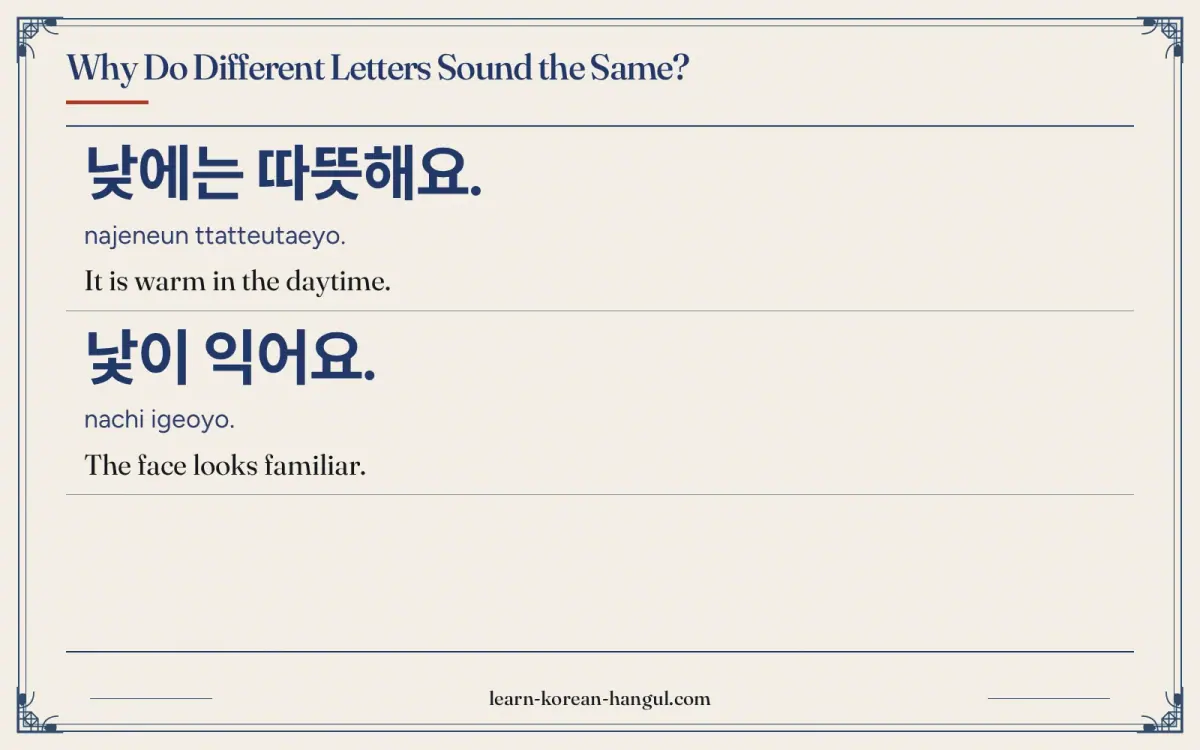
Different letters sound the same at the end of a syllable because Korean pronunciation neutralizes them to one of seven sounds, while spelling keeps the original letter. The spelling principle is that a word is written the way it appears when a vowel follows, so the root stays visible. This is called neutralization: several distinct sounds become one sound in a certain position.
For example, the noun 낮 ("daytime") ends in ㅈ. Alone it is [낟]. With the subject particle 이, the ㅈ moves onto the next syllable and is pronounced again: 낮이 [나지]. The writer therefore sees 낮, and keeps ㅈ in every form, so the reader finds the same word in each context.
낮에는 따뜻해요.
najeneun ttatteutaeyo.
It is warm in the daytime.
낯이 익어요.
nachi igeoyo.
The face looks familiar.
The principle is the reason the spelling is stable. The Korean spelling principles lesson explains the idea in general. The next section turns it into a test you can use.
The Suffix Test
The suffix test adds a vowel-start particle and listens for the consonant that moves to the next block. The particles 을 (object) and 이 (subject) both begin with a vowel, so the final consonant of the noun links onto them and is said as its own sound.
Use 을 for the test, not 이. The particle 이 can blur pairs of letters, because ㄷ before 이 is said [지] and ㅌ before 이 is said [치].
| Word | Meaning | Alone | With 을 | With 이 |
|---|---|---|---|---|
| 낫 | sickle | [낟] | 낫을 [나슬] | 낫이 [나시] |
| 낮 | daytime | [낟] | 낮을 [나즐] | 낮이 [나지] |
| 낯 | face | [낟] | 낯을 [나츨] | 낯이 [나치] |
| 낱 | single item | [낟] | 낱을 [나틀] | 낱이 [나치] |
| 낟 | grain | [낟] | 낟을 [나들] | 낟이 [나지] |
Look at the last two columns. With 을, all five words give different sounds: [슬], [즐], [츨], [틀], [들]. With 이, 낮 and 낟 both give [나지], and 낯 and 낱 both give [나치], because ㄷ before 이 is palatalized, which means it becomes ㅈ, and ㅌ before 이 becomes ㅊ. That is why 을 is the better test word.
The Revised Romanization of Korean writes the spoken sound, so 낫, 낮, 낯 and 낱 all become nat alone, while 낮을 becomes najeul.
An honest limit: the test tells you the final letter of a word whose spoken forms you already know. A word you hear for the first time cannot be tested by ear, because you do not yet know how it behaves with a particle. Look it up in the Standard Korean Language Dictionary (표준국어대사전). The next section lists the most common groups.
Common Homophone Groups
The groups below cover the most common sets of final-consonant homophones. Each row gives the written word, its meaning and its sound alone, so you can compare them across the group.
| Group | Words and meanings | Sound alone | Check with 을 |
|---|---|---|---|
| ㄷ-sound A | 낫 (sickle), 낮 (daytime), 낯 (face), 낱 (single item) | [낟] | 낫을 [나슬], 낮을 [나즐], 낯을 [나츨], 낱을 [나틀] |
| ㄷ-sound B | 빗 (comb), 빚 (debt), 빛 (light) | [빋] | 빗을 [비슬], 빚을 [비즐], 빛을 [비츨] |
| ㄷ-sound C | 옷 (clothes), 옻 (lacquer) | [옫] | 옷을 [오슬], 옻을 [오츨] |
| ㄷ-sound D | 젓 (salted seafood), 젖 (milk, breast) | [젇] | 젓을 [저슬], 젖을 [저즐] |
| ㅂ-sound | 입 (mouth), 잎 (leaf) | [입] | 입을 [이블], 잎을 [이플] |
| ㄱ-sound | 밖 (outside), 박 (gourd) | [박] | 밖을 [바끌], 박을 [바글] |
| verbs, ㄷ-sound | 맞다 (to be correct), 맡다 (to take charge) | [맏따] | 맞아요 [마자요], 맡아요 [마타요] |
| verbs, ㄷ-sound | 낫다 (to be better), 낮다 (to be low) | [낟따] | 나아요 [나아요], 낮아요 [나자요] |
Some groups are very common in daily writing, such as 빛, 빗 and 빚, and some are rare, such as 젓 and 옻. The meaning of the sentence usually leaves no doubt.
빛이 들어와요.
bichi deureowayo.
Light comes in.
빚이 많아요.
biji manayo.
There is a lot of debt.
옷을 입어요.
oseul ibeoyo.
I put on clothes.
The verbs deserve their own section, because their forms can collide even when the vowel follows.
Which Verbs Sound Alike: 낫다, 낮다 and 낳다?
낫다, 낮다 and 낳다 are three different verbs that overlap in sound. 낫다 means "to be better" or "to recover", 낮다 means "to be low", and 낳다 means "to give birth". The first two are both [낟따] alone. 낳다 is [나타].
| Verb | Meaning | Dictionary form said | Polite present | Past polite |
|---|---|---|---|---|
| 낫다 | be better; recover | [낟따] | 나아요 | 나았어요 |
| 낮다 | be low | [낟따] | 낮아요 [나자요] | 낮았어요 |
| 낳다 | give birth | [나타] | 낳아요 [나아요] | 낳았어요 |
All forms come from the standard conjugation. 낫다 is an irregular verb: its ㅅ disappears before a vowel, so 낫 + 아요 becomes 나아요 and not 낫아요. 낮다 and 낳다 are regular.
Two forms collide completely: 나아요 (from 낫다) and 낳아요 (from 낳다) are both said [나아요], and 나았어요 and 낳았어요 are both [나아써요]. Only the sentence tells them apart.
감기가 다 나았어요.
gamgiga da naasseoyo.
My cold is all better.
작년에 아기를 낳았어요.
jangnyeone agireul naasseoyo.
She had a baby last year.
The first sentence uses 나았어요 and the second uses 낳았어요. The ㅎ in 낳 is silent before a vowel, which is the same sound change that makes 않아요 [아나요] in the Korean h deletion section. Before a consonant the ㅎ becomes audible, so 낳다 is [나타] and 낳고 is [나코], and these forms never match 낫다. The next section shows the method on one word.
Worked Example: 낮
To spell the word you hear as [낟] in "In the daytime it is warm", follow five steps.
- Hear the sound. You hear [낟]. That is the [ㄷ] final sound, which several letters share.
- List the candidates. The candidates are 낫, 낮, 낯, 낱 and 낟.
- Check the meaning. The sentence is about warmth at a time of day, so "daytime" is the only reasonable meaning.
- Run the suffix test. The dictionary entry for "daytime" gives 낮, and 낮을 is [나즐]. The ㅈ confirms the spelling.
- Write it. 낮에는 따뜻해요. With 에는 the word is said [나제는].
You'll know it worked when you can say aloud which letter you chose and why a different letter would give a different word. Try the same steps on [빋]: "I owe money" points to 빚, "the sun's rays" points to 빛, and a tool for combing hair points to 빗 (comb).
The next section lists the mistakes learners make.
What Mistakes Do Learners Make with Final Consonants?
Learners make four predictable mistakes, and each one comes from trusting sound alone.
Learners often assume the sound shows the letter. Actually five different words share [낟]. Wrong: writing 낫 for "daytime" because it looks simpler. Right: 낮. Fix: choose the letter from the meaning, then confirm with 을.
Learners often assume ㅅ is the default final letter. Actually ㅅ is only one of seven letters that end in [ㄷ]. Many words that sound like they end in ㅅ are spelled ㅈ, ㅊ, ㅌ or ㅆ. Fix: check each word separately.
Learners often assume 낫다 and 낳다 differ in sound. Actually the polite forms 나아요 and 낳아요 are both [나아요]. Fix: read the whole sentence. Giving birth takes an object (아기를 낳았어요). Recovering takes a subject like 감기 or 병.
Learners often trust a spell checker without checking meaning. Actually a checker sees only the written word. If the word is a real word, such as 낫 for 낮, the checker has no reason to flag it. Fix: after checking, reread the sentence for meaning. The Korean spell checker guide explains the limits of automatic checks.
Korean writers can slip in this area too, particularly when typing fast. The Korean word dictation with batchim practice lets you train your ear and your spelling on words like these.
The next section tests what you have learned.
Practice and Answer Key
Choose the spelling that fits the meaning. Then check each answer with 을 where you can.
- Which word means "daytime"? (낫, 낮, 낯)
- Which word means "debt"? (빗, 빚, 빛)
- Which word means "light"? (빗, 빚, 빛)
- Which word means "comb"? (빗, 빚, 빛)
- Which word means "leaf"? (입, 잎)
- Which word means "milk (from a mother)"? (젓, 젖)
- Which word means "clothes"? (옷, 옻)
- Which verb means "to give birth"? (낫다, 낮다, 낳다)
- Which verb means "to be low"? (낫다, 낮다, 낳다)
- Which word means "outside"? (밖, 박)
Practice · 10
Which word means "daytime"?
Show answer
낮
낮 means daytime. Check: 낮을 is [나즐].
Which word means "debt"?
Show answer
빚
빚 means debt. Check: 빚을 is [비즐].
Which word means "light"?
Show answer
빛
빛 means light. Check: 빛을 is [비츨].
Which word means "comb"?
Show answer
빗
빗 means comb. Check: 빗을 is [비슬].
Which word means "leaf"?
Show answer
잎
잎 means leaf and 입 means mouth. Both are [입] alone; 잎을 is [이플] and 입을 is [이블].
Which word means "milk (from a mother)"?
Show answer
젖
젖 means milk or breast. 젓 is salted seafood, as in 젓갈.
Which word means "clothes"?
Show answer
옷
옷 means clothes. 옻 is lacquer.
Which verb means "to give birth"?
Show answer
낳다
낳다 means to give birth. It is said [나타], unlike the other two [낟따].
Which verb means "to be low"?
Show answer
낮다
낮다 means to be low. Its polite form 낮아요 is said [나자요].
Which word means "outside"?
Show answer
밖
밖 means outside and 박 means gourd. Both are [박] alone; 밖을 is [바끌].
Answer key
- 낮. 낮에는 따뜻해요.
- 빚. 빚이 많아요.
- 빛. 빛이 들어와요.
- 빗. 빗으로 머리를 빗어요.
- 잎. 잎이 떨어져요.
- 젖. 아기가 젖을 먹어요.
- 옷. 옷을 입어요.
- 낳다. 아기를 낳았어요.
- 낮다. 천장이 낮아요.
- 밖. 밖에 비가 와요.
A score of 9 or 10 means the meaning-first method works. If you missed 5 or 10, review the ㅂ and ㄱ rows of the group table, because 입 and 잎 and 밖 and 박 are easy to swap. The next section points to what follows.
Where to Go Next after Korean Final Consonant Homophones
After Korean final consonant homophones, continue to ㄹ게 vs ㄹ께, where the spelling again differs from what you hear, this time in verb endings. The listening side of this skill is trained in the Korean word dictation with batchim lesson, and the pronunciation side is in the Korean liaison section.
For the full set of spelling pairs, go back to Korean spelling rules, and for word spacing see Korean spacing rules. This lesson covers the most common final-consonant groups in everyday writing. It does not list every homophone, and it does not cover double final consonants such as 값 and 닭 beyond the table above. About this page. Last updated 2026-10-09. The Korean text, spoken forms and Revised Romanization were reviewed and signed off by Min-ji Park on 15 October 2026. Romanization is shown only as a learning aid.
Frequently Asked Questions
Why do 낮 and 낫 sound the same? Korean has only seven final sounds, and both ㅈ and ㅅ at the end of a syllable are said as [ㄷ]. Alone, 낮 and 낫 are therefore both [낟]. The difference appears only when a vowel follows. 낮이 is [나지], while 낫이 is [나시]. In writing, the meaning of the sentence decides which letter to use.
How do I know which final consonant to write? Use two checks. First, add a vowel suffix such as 을 and listen, since 낮을 [나즐] reveals ㅈ. Second, check the meaning in the sentence or a dictionary. The suffix test names the final letter of a word you already know, but a new word still needs a dictionary lookup, because several words can share one sound.
Is 낟 still used? The word 낟 is rare on its own today. It survives mainly in compounds such as 낟알, meaning a single grain, which is said [나달]. Learners meet 낫, 낮 and 낯 far more often. Treat 낟 as the plain-looking member of the group that shows how the base letter ㄷ can also sit at the end of a syllable.
What does the suffix test do? The suffix test adds a vowel-start particle such as 을 or 이 to a noun and listens for the consonant that moves to the next block. When the final consonant has a vowel after it, the true letter is pronounced instead of the neutral [ㄷ]. The test names the letter, and the dictionary then confirms the meaning.