What Is 왠 vs 웬?
The pair 왠 vs 웬 is a spelling problem and not a meaning problem. Both are written with the vowel ㅙ or ㅞ, which sound the same to most people, so learners and native speakers both mix them up. The rule that settles it is very short.
| Spelling | Where it appears | Meaning |
|---|---|---|
| 왠 | only in 왠지 | for some reason, somehow |
| 웬 | everywhere else | what kind of, what on earth |
Listen to the two words. They are said alike.
The reason 왠지 stands alone is its origin. It is a shortened form of 왜인지: 왜 ("why") plus 인지, the verb 이다 ("to be") with the ending -ㄴ지 ("whether it is"). When the sounds 왜 and 인 joined, they became 왠. No other common word has the same origin, so no other common word keeps 왠.
Here are two sentences that show both spellings, one after the other.
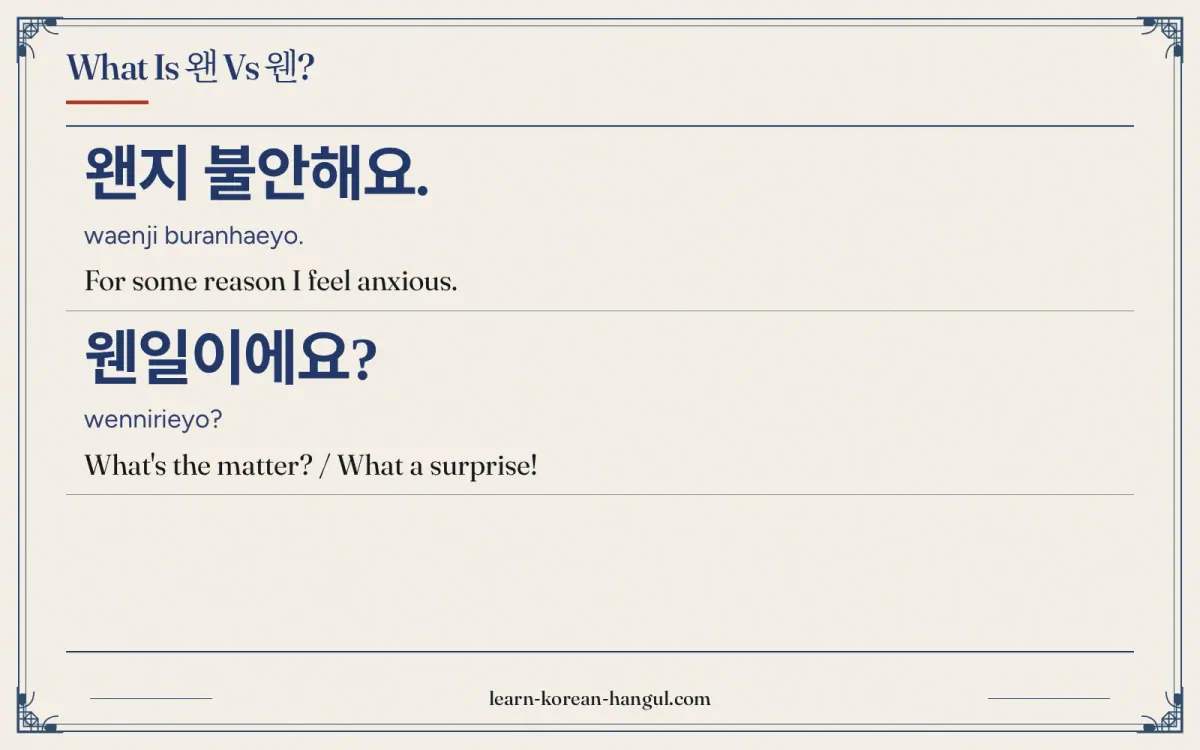
왠지 불안해요.
waenji buranhaeyo.
For some reason I feel anxious.
웬일이에요?
wennirieyo?
What's the matter? / What a surprise!
The first sentence is said [왠지 부란해요]. The second is said [웬니리에요]: in 웬일 a ㄴ sound is inserted before 일, so you hear [웬닐], and then the final ㄹ moves on to 이에요. Revised Romanization shows the inserted ㄴ, which is why it reads wennirieyo.
Why English Speakers Struggle Here
English speakers struggle for three reasons. The first is the ear. Most speakers say ㅙ and ㅞ the same way, so listening tells you nothing. The second is meaning: learners connect 왠 with 왜 ("why") because the shape is similar, and then they write 왠 for every "why-like" idea. The third is that 웬 is not a word you meet early. It is a modifier that sits before a noun, like English "what a" or "what kind of", and English speakers do not expect a special word for it.
The same sound problem exists for Koreans. 왠일 and 왠만하면 are among the most common spelling errors in Korean texts. A learner who makes the mistake is in good company.
The consequence for study is practical. Do not try to listen for the difference. Learn the rule, and use the swap test.
What Is the Single Rule?
The rule is: 왠 only in 왠지; 웬 everywhere else. You do not need to memorise a long list of 웬 words, because the exception is one word.
The rule has a test that works on a new sentence. Replace the word with 왜인지 (waeinji, "why it is").
- Read the sentence with 왜인지 instead of the questionable word.
- If the meaning stays the same, the spelling is 왠지.
- If the sentence breaks, the spelling is 웬.
| Sentence | With 왜인지 | Result |
|---|---|---|
| ___지 슬퍼요 | 왜인지 슬퍼요 ("somehow I feel sad") | works, so 왠지 |
| ___일이에요? | 왜인지 일이에요? | breaks, so 웬일 |
| ___만하면 가세요 | 왜인지만하면 가세요 | breaks, so 웬만하면 |
| ___ 사람이에요? | 왜인지 사람이에요? | breaks, so 웬 사람 |
The test only works for 왠지, and that is the point. Because 왠지 is the only word with 왠, a successful swap means 왠 and a failed swap means 웬. The test does not help with unrelated spellings, so do not use it on 되 and 돼 or on other pairs.
What Does 왠지 Mean?
왠지 means "for some reason" or "somehow". Speakers use it when they have a feeling and cannot say why. It usually stands at the start of the sentence and the sentence ends with a feeling or a guess.
| Sentence | Meaning |
|---|---|
| 왠지 불안해요. | For some reason I feel anxious. |
| 왠지 슬퍼요. | Somehow I feel sad. |
| 왠지 기분이 좋아요. | Somehow I feel good. |
Note that 왠지 is not the question word "why". If you ask a real question, use 왜: 왜 슬퍼요? ("Why are you sad?"). The word 왠지 does not ask anything. It states a feeling with a hidden reason. The feelings vocabulary on the Korean feelings phrases page uses it often. For other short words that open a sentence in daily talk, see the Korean filler words page.
How Does 왜인지 Become 왠지?
The change from 왜인지 to 왠지 is a normal shortening (준말, junmal). Korean often joins two syllables into one when speech is quick. The vowel of 인 slides into the vowel of 왜, and the ㄴ stays at the end, which gives one syllable, 왠. The same thing happens in 이것은 → 이건 ("this, as the topic"). The long form and the short form mean the same, but the spelling of the short form is fixed.
| Long form | Short form | What was joined |
|---|---|---|
| 왜인지 | 왠지 | 왜 + 인 → 왠 |
| 이것은 | 이건 | 것 + 은 → 건 |
| 그것이 | 그게 | 것 + 이 → 게 |
For 왠지 the short form is the only one used in writing, so you rarely see 왜인지 in print. That is why the swap test works in one direction only: you build the long form to check that the short form is 왠.
Another way to look at 웬 is by its word class. 웬 is a determiner (관형사, gwanhyeongsa): a word that stands before a noun and never takes an ending or a particle. 왠지 is an adverb and can open a sentence. The two have different jobs, so their spellings do not need to match.
- 어떤 사람이에요? is a neutral question: "What kind of person is he?"
- 웬 사람이에요? adds surprise: "Who on earth is that?"
If you simply want to ask "what kind of", 어떤 is the safe choice. Use 웬 when you are puzzled or surprised.
Which Words Use 웬?
웬 appears in a small, closed group of words and phrases. All of them use the spelling 웬.
| Word | RR | Meaning | Example |
|---|---|---|---|
| 웬 + noun | wen | what kind of, what on earth | 웬 사람이에요? |
| 웬일 | wennil | what's the matter, what a surprise | 웬일이에요? |
| 웬만하다 | wenmanhada | be fair, be tolerable | 웬만하면 가세요. |
| 웬만큼 | wenmankeum | to a fair degree | 웬만큼 먹었어요. |
| 웬 떡 | wen tteok | what a windfall (idiom) | 웬 떡이야? |
The first row is the pattern to remember: 웬 stands before a noun and expresses surprise or doubt about it. 웬 사람이에요? asks "Who on earth is that?" or "What kind of person is that?" and 웬 비가 이렇게 많이 와요? means "Why is it raining so much?" The speaker is surprised by the rain.
The second sentence is said [웬 비가 이러케 마니 와요]. The word 이렇게 ("like this, so") is said [이러케], because ㅎ and ㄱ combine into an aspirated ㅋ, and 많이 is said [마니], because ㅎ is silent before a vowel. A learner who needs more words for these feelings can look at the Korean feelings phrases page.
웬일 is written as one word. It is a noun that means "what the matter is". The ㄴ sound that is inserted in speech ([웬닐]) is not written, and the spelling stays 웬일.
웬만하다 deserves a note, because the mistake 왠만하면 is very common. The word 웬만하다 means "to be at an acceptable level". 웬만하면 가세요 therefore means "Please go, if you reasonably can", which leaves the choice to the listener. The word is always spelled with 웬.
Practice Sentences
The swap test is easy to understand and harder to use fast. Practice with these sentences. Cover the right column, decide, then check. The pattern is the same for each item.
| Sentence with a blank | What to check | Spelling |
|---|---|---|
| ___지 졸려요. | Does 왜인지 졸려요 work? Yes | 왠 |
| ___ 떡이에요? | Is it a modifier before a noun? Yes | 웬 |
| ___지 걱정돼요. | Does 왜인지 걱정돼요 work? Yes | 왠 |
| ___만큼 먹었어요. | Is it "to a fair degree"? Yes | 웬 |
Two items need a second look. In ___지 걱정돼요, the word 돼요 is also a spelling pair, covered in 되 vs 돼 in this section. In ___만큼 먹었어요, the word 웬만큼 is a different word from 왠지, because the part after the blank starts with 만 and not 지.
Worked Example: 왠지 불안해요.
This is the whole decision for one sentence, in order.
- Hear the sentence. You hear 왠지 불안해요 [왠지 부란해요] spoken aloud. The first syllable could be 왠 or 웬, because most speakers say them the same way.
- Look at what follows. The next syllable is 지, so the word is 왠지 or 웬지. 웬지 is not a word, but 왠지 is.
- Apply the swap. 왜인지 불안해요 means "for some reason I'm anxious". It works.
- Write. 왠지 불안해요.
- Check the ending. 불안하다 is a 하다 adjective, so the polite present is 불안해요 (buranhaeyo). The ㄴ and ㅎ sit side by side without turning into an aspirated sound.
The same steps with 웬일이에요? give a different result. 왜인지 일이에요? does not make sense, so the spelling is 웬일이에요?
The third sentence, 웬만하면 가세요, is said [웬만하면 가세요]. The swap fails again, because 왜인지만하면 is nonsense, so 웬.
What Mistakes Do Learners Make Here?
Five mistakes cover most errors. Each follows the pattern "learners often assume X, but actually Y, because Z".
- Writing 왠일. Learners often match 왠 with 왜. Actually 웬일 is correct, because there is no 왜인지 in it.
- Writing 웬지. Learners often overcorrect and use 웬 everywhere, including 웬지. Actually 왠지 is the one exception.
- Writing 왠만하면. The word is 웬만하다, so 웬만하면 is correct, and 왠만하면 is an error.
- Using 왠지 as "why". Learners often use it in a question. Actually 왜 asks the question and 왠지 states a feeling.
- Trying to hear the difference. Learners often spend time on listening practice. Actually the two sound the same for most speakers, so the rule is the only tool.
Honest limit of this lesson: it covers the common words and the current standard spelling. Rare words and fixed phrases may have their own entries in the Standard Korean Language Dictionary (표준국어대사전), and a dictionary check is the final answer for any word that is not on this page. The idiom 웬 떡 is informal, so keep it for casual talk.
Practice and Answer Key
Fill each blank with 왠 or 웬. Do all eight before you check the answers.
- ___지 슬퍼요.
- ___일이에요?
- ___만하면 가세요.
- ___지 졸려요.
- ___ 사람이에요?
- ___ 비가 이렇게 와요?
- ___지 걱정돼요.
- ___만큼 먹었어요.
Practice · 5
Which is correct? "What's the matter?"
Show answer
웬일이에요?
웬일 is spelled with 웬. There is no 왜인지 in it.
Which is correct? "For some reason I feel sad."
Show answer
왠지 슬퍼요.
왜인지 슬퍼요 works, so the spelling is 왠지.
Which is correct? "Please go, if it is at all possible."
Show answer
웬만하면 가세요.
The word is 웬만하다, so 웬만하면 is correct.
Which is correct? "Who on earth is that?"
Show answer
웬 사람이에요?
웬 stands before a noun and shows surprise. 왜인지 사람이에요 makes no sense, so the spelling is 웬.
Which of these words is spelled with 왠?
Show answer
왠지
왠지 is the only word with 왠, because it comes from 왜인지. The others are all spelled with 웬.
Answer Key
- 왠지 슬퍼요. (waenji seulpeoyo) [왠지 슬퍼요]. The swap 왜인지 슬퍼요 works, so 왠.
- 웬일이에요? (wennirieyo) [웬니리에요]. 웬일 is always 웬.
- 웬만하면 가세요. (wenmanhamyeon gaseyo). The word is 웬만하다.
- 왠지 졸려요. (waenji jollyeoyo) [왠지 졸려요]. The swap works, so 왠.
- 웬 사람이에요? (wen saramieyo) [웬 사라미에요]. 웬 before a noun, so 웬.
- 웬 비가 이렇게 와요? (wen biga ireoke wayo) [웬 비가 이러케 와요]. 웬 before a noun, so 웬.
- 왠지 걱정돼요. (waenji geokjeongdwaeyo) [왠지 걱쩡돼요]. The swap works, so 왠. The ending 돼요 is correct because 해요 fits in its place.
- 웬만큼 먹었어요. (wenmankeum meogeosseoyo) [웬만큼 머거써요]. 웬만큼 means "to a fair degree".
If you missed an item, apply the swap again and say the result aloud. Most errors come from trusting the sound.
Where to Go Next
The next spelling lesson is 로서 vs 로써, which also depends on a short test. The principle behind both lessons is in Korean spelling principles. This page belongs to the Korean spelling rules section, and the spacing rules are in Korean spacing rules.
To keep the rule in one line: write 왠지 with 왠, and write every other word of this kind with 웬.
Frequently Asked Questions
Is It 왠일 or 웬일?
It is 웬일. The spelling 왠일 is a very common mistake. 웬일 means "what is the matter" or "what a surprise", and it is written with 웬 because there is no 왜인지 hidden in it. The only word that has 왠 is 왠지.
What Does 왠지 Mean?
왠지 means "for some reason" or "somehow", and speakers use it when they feel something without knowing why. It is a shortened form of 왜인지. 왠지 불안해요 means "For some reason I feel anxious". You cannot use it for a plain "why" question, for which Korean has 왜.
Is 웬만하면 Correct?
Yes. 웬만하면 is the correct spelling, and 왠만하면 is a mistake. The base word is 웬만하다, "to be fair, reasonable, not too bad". 웬만하면 가세요 means "Please go, if you reasonably can". The same 웬 is in 웬만큼, "to a fair degree".
Do 왠 and 웬 Sound the Same?
For most speakers, yes. The standard pronunciation rules still list ㅙ and ㅞ as different vowels, but most Seoul speakers today pronounce them the same, so you cannot decide by listening. That is why the spelling must be learned as a rule: 왠 only in 왠지, 웬 everywhere else.
How Can I Check Quickly in a Sentence?
Replace the word with 왜인지, "why it is". If the sentence still works, as in 왜인지 불안해요, the correct spelling is 왠지. If it breaks, as in 왜인지 일이에요, the correct spelling is 웬. The swap works because 왠지 is the only word that comes from 왜인지.