What you will learn
- Choose the particle that matches a noun's job: topic, subject, object, destination or place of action.
- Put the words of a Korean sentence in order, with the verb last.
- Write present, past and future polite endings on a short sentence.
- Check your own sentence with three yes/no questions.
Before you start: you should read Hangul and know the polite -요 ending. Time: about 25 minutes. Cover the answer table, write each answer on paper, then compare.
Key Facts
- The set has 15 tasks: 5 fill-in-the-particle, 5 reorder-the-words and 5 translate-into-Korean.
- Korean word order is subject, object, verb, so the verb is the last word of the sentence.
- Each task practises one pattern, and task 15 combines three: the object particle 를, the place particle 에서 and the past ending.
- Every model answer is in the polite 해요 style and ends in 요.
- Three yes/no checks (verb last, particles right, ending right) catch most A1 mistakes.
*Last updated: 2026-10-09. The Korean text, romanization and audio on this page are AI-assisted drafts.
What Is Korean Sentence Writing Practice?
Korean sentence writing practice is writing short, complete sentences from a prompt and then comparing them with a model. At A1 the goal is a correct polite sentence of two to five words, such as 어제 친구를 만났어요 (I met a friend yesterday), not a long or clever one.
The set escalates in three steps. In tasks 1 to 5 you fill one blank with a particle, the small word that tells what job a noun does. In tasks 6 to 10 you arrange scrambled words. In tasks 11 to 15 you translate an English sentence from nothing. The sources for the forms are the Hangul Orthography (한글 맞춤법) for spelling and spacing and the Standard Pronunciation Rules (표준 발음법) for the spoken forms in brackets. The next section explains why English speakers need this ladder.
Why Is This Hard for English Speakers?
English speakers find Korean sentences hard to write because two habits from English fail. English puts the verb in the middle ("I drink coffee") and shows each word's job by its position. Korean puts the verb last and shows each word's job with a particle attached to the noun: 저는 커피를 마셔요.
Three habits cause most errors:
- Verb in the middle. Learners copy the English order and write "저는 마셔요 커피를."
- No particle, or the wrong one. English has no equivalent, so learners drop it or guess.
- Repeating "I". English needs a subject in every sentence. Korean usually leaves out a subject that the situation makes clear.
The set trains each habit on its own before it mixes them. Next, see how the fifteen tasks are arranged.
How Does the Writing Set Work?
The set works in three blocks of five tasks, and each block drills one skill. You write an answer, reveal the model, and mark your answer right or wrong. The table shows the plan.
| Tasks | Skill | What you write | Pattern practised |
|---|---|---|---|
| 1-5 | Fill the particle | One particle in a blank | 는, 이/가, 를, 에, 에서 |
| 6-10 | Reorder | A full sentence from scrambled words | Verb last, time word before the object |
| 11-15 | Translate | A full sentence from English | Copula, past, future, place of action |
Each task uses one pattern, so a wrong answer points to one cause. Task 15 is the exception: it mixes three patterns, so it shows whether you can combine them. Now the tasks themselves.
What Are the Tasks and Prompts?
Write your answer before you open the answer table. Use only polite endings.
Tasks 1-5: Fill the Particle
- 저__ 학생이에요. (은 / 는)
- 친구__ 와요. (가 / 를)
- 커피__ 마셔요. (가 / 를)
- 책이 가방__ 있어요. (에 / 에서)
- 저는 도서관__ 공부해요. (에 / 에서)
Tasks 6-10: Reorder the Words
- 마셔요 / 저는 / 물을
- 가요 / 학교에 / 우리는
- 먹었어요 / 어제 / 밥을 / 저는
- 있어요 / 도서관에 / 친구가
- 갈 거예요 / 내일 / 학교에 / 저는
Tasks 11-15: Translate into Korean
- I am a teacher.
- I met a friend yesterday.
- I will go to school tomorrow.
- I eat rice at home.
- I drank coffee at a café yesterday. (Use three patterns: the place particle 에서, the object particle 를 and the past ending.)
Use these words: 선생님 (teacher), 친구 (friend), 어제 (yesterday), 내일 (tomorrow), 학교 (school), 집 (home), 밥 (rice, a meal), 카페 (café), 커피 (coffee). The model answers follow.
Model Answers
The table gives the model, the Revised Romanization (RR), the spoken form in brackets where it differs from the spelling, and the most common wrong alternative. RR is a learning aid and follows the letters, so it does not show tensing caused by a neighbouring sound.
| # | Model answer | RR and spoken form | Common wrong alternative and why it fails |
|---|---|---|---|
| 1 | 저는 학생이에요. | jeoneun haksaengieyo [저는 학쌩이에요] | 저를 학생이에요. 를 marks an object, but 저 is the topic here. |
| 2 | 친구가 와요. | chinguga wayo | 친구를 와요. 오다 (come) takes no object, so 를 is wrong. |
| 3 | 커피를 마셔요. | keopireul masyeoyo | 커피가 마셔요. This says the coffee is drinking. |
| 4 | 책이 가방에 있어요. | chaegi gabange isseoyo [채기 가방에 이써요] | 책이 가방에서 있어요. 에서 marks where an action happens, and 있다 gives a location. |
| 5 | 저는 도서관에서 공부해요. | jeoneun doseogwaneseo gongbuhaeyo [저는 도서과네서 공부해요] | 저는 도서관에 공부해요. 공부하다 is an action, so the place needs 에서. |
| 6 | 저는 물을 마셔요. | jeoneun mureul masyeoyo [저는 무를 마셔요] | 마셔요 저는 물을. The verb must come last. |
| 7 | 우리는 학교에 가요. | urineun hakgyoe gayo [우리는 학꾜에 가요] | 우리는 가요 학교에. The destination comes before the verb. |
| 8 | 저는 어제 밥을 먹었어요. | jeoneun eoje babeul meogeosseoyo [저는 어제 바블 머거써요] | 저는 밥을 어제 먹었어요 is grammatical, but the time word usually comes before the object. |
| 9 | 친구가 도서관에 있어요. | chinguga doseogwane isseoyo [친구가 도서과네 이써요] | 친구를 도서관에 있어요. 있다 does not take an object. |
| 10 | 저는 내일 학교에 갈 거예요. | jeoneun naeil hakgyoe gal geoyeyo [저는 내일 학꾜에 갈꺼예요] | 저는 내일에 학교에 갈 거예요. Words like 내일 and 어제 take no 에. |
| 11 | 저는 선생님이에요. | jeoneun seonsaengnimieyo [저는 선생니미에요] | 저는 선생님예요. After a final consonant the form is 이에요, not 예요. |
| 12 | 어제 친구를 만났어요. | eoje chingureul mannasseoyo [어제 친구를 만나써요] | 어제 친구가 만났어요. 가 makes the friend the one who met someone. |
| 13 | 내일 학교에 갈 거예요. | naeil hakgyoe gal geoyeyo [내일 학꾜에 갈꺼예요] | 내일 학교에서 갈 거예요. 에서 marks where an action happens, and 가다 needs the destination marker 에. |
| 14 | 저는 집에서 밥을 먹어요. | jeoneun jibeseo babeul meogeoyo [저는 지베서 바블 머거요] | 저는 집에 밥을 먹어요. Eating is an action, so the place takes 에서. |
| 15 | 저는 어제 카페에서 커피를 마셨어요. | jeoneun eoje kapeeseo keopireul masyeosseoyo [저는 어제 카페에서 커피를 마셔써요] | 저는 어제 카페에서 커피를 마셔요. The present ending does not match 어제. |
Task 8 has a second acceptable order: 어제 저는 밥을 먹었어요. Both orders are natural; what matters is that the verb stays last. Hear three of the models:
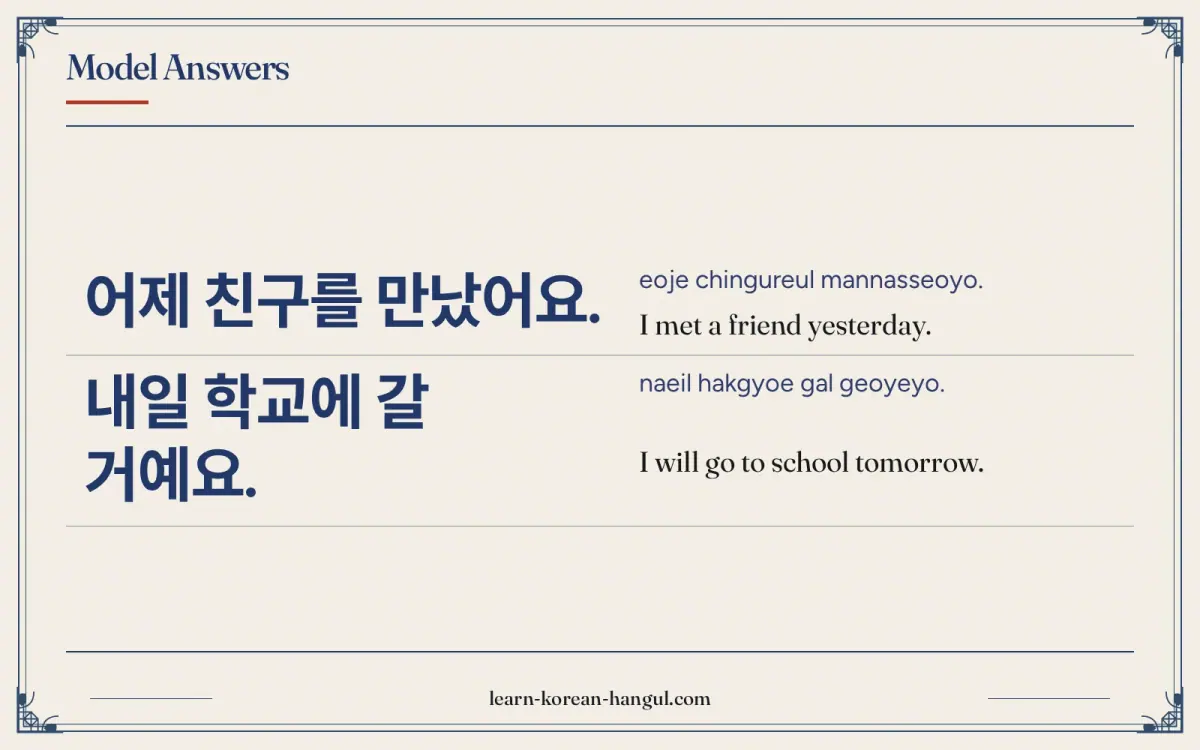
어제 친구를 만났어요.
eoje chingureul mannasseoyo.
I met a friend yesterday.
내일 학교에 갈 거예요.
naeil hakgyoe gal geoyeyo.
I will go to school tomorrow.
저는 어제 카페에서 커피를 마셨어요.
jeoneun eoje kapeeseo keopireul masyeosseoyo.
I drank coffee at a café yesterday.
The spoken form of 갈 거예요 is [갈꺼예요]: the ㄱ of 거 becomes tense after the -(으)ㄹ ending. The checklist turns these answers into a habit.
How Do You Check Your Own Writing?
The self-check checklist has three yes/no questions that you ask of every sentence you write. Answer them in order, because each one catches a different kind of error.
- Is the verb the last word? Find the word that ends in 요. Nothing may follow it.
- Does each noun have the particle for its job? Ask what the noun does. A topic takes 은/는, a subject takes 이/가, an object takes 을/를, a destination takes 에, and the place of an action takes 에서.
- Does the ending match the time and the style? Use -아요/-어요 for now, -았어요/-었어요 for the past, and -(으)ㄹ 거예요 for the future. Keep every sentence in the polite style.
One "no" means you rewrite the sentence. After the three checks, run the shared writing checklist of Korean spelling rules and Korean spacing rules: a particle is written with no space after its noun, and each sentence ends with a period. Next, decide what to do once your answers and the models sit side by side.
What Should You Do after Comparing?
After comparing, mark each task right or wrong, name the type of each error, and rewrite the wrong sentences the next day. The label matters more than the score, because a repeated label shows the one grammar point to study.
- Mark. Give one point for each task that matches a model or the second order allowed in task 8.
- Label. Write P for a particle error, O for word order, E for an ending and S for spelling or spacing.
- Rewrite. Wait a day, cover the model, and write the wrong ones again.
- Read the score. Thirteen or more out of fifteen means you can move on. Fewer means repeat the block where your labels cluster.
If you collect three P labels, read Korean particles. If you collect three O labels, read Korean word order. The worked example below shows the whole process on one sentence.
Worked Example: 저는 학생이에요.
Writing 저는 학생이에요 (I am a student) from the English sentence takes six steps.
- Find the verb. "Am" is the copula 이다, and its polite form is 이에요 or 예요. The verb goes last.
- Find the nouns. "I" is 저, and "student" is 학생.
- Give the topic its particle. The person the sentence is about takes 은/는. 저 ends in a vowel, so the form is 저는.
- Choose the copula form. 학생 ends in the consonant ㅇ, so the form is 이에요: 학생이에요. After a vowel it would be 예요, as in 의사예요.
- Put the verb last. 저는 학생이에요.
- Run the checklist. Verb last, 는 on the topic, polite ending, one period.
The spoken form is [저는 학쌩이에요]: the final ㄱ sound of 학 makes the ㅅ of 생 tense. RR writes jeoneun haksaengieyo.
You will know it worked when you can explain why each piece is there. The next section lists the errors that appear most often.
What Mistakes Do Learners Make Here?
Learners repeat five mistakes in this set. Each one has a cause that you can fix.
- Mistake 1: verb in the middle. Learners often assume Korean keeps the English order. Actually the verb closes the sentence, because Korean shows each word's job with particles instead of position.
- Mistake 2: a space before the particle. Learners often write 저 는. Actually a particle attaches to its noun: 저는.
- Mistake 3: 에 for every place. Learners often assume one word means "at". Actually 에 marks a destination or a location of existing, and 에서 marks where an action takes place.
- Mistake 4: 예요 after a consonant. Learners often write 선생님예요. Actually the form after a consonant is 이에요: 선생님이에요.
- Mistake 5: 에 after a day word. Learners often write 어제에. Actually 어제, 오늘 and 내일 take no 에.
Expert tip: when you are unsure about 에 and 에서, ask whether the verb is an action. If it is, use 에서; if it is 있다, 가다 or 오다, use 에. Now try items that are not in the set.
Practice and Answer Key
Write each answer on paper before you open the key.
- Fill the particle: 동생__ 우유를 마셔요. (이 / 을)
- Reorder: 가요 / 시장에 / 어머니는
- Translate: I study Korean at home.
- Correct the sentence: 저는 어제 학교에서 갔어요.
Answer key
- 동생이 우유를 마셔요. (My younger sibling drinks milk.) 이 marks the subject.
- 어머니는 시장에 가요. (Mother goes to the market.) RR: eomeonineun sijange gayo.
- 저는 집에서 한국어를 공부해요. (I study Korean at home.) The place of the action takes 에서. RR: jeoneun jibeseo hangugeoreul gongbuhaeyo, spoken [저는 지베서 한구거를 공부해요].
- 저는 어제 학교에 갔어요. 가다 needs the destination marker 에, not 에서.
Three or four correct means the patterns are ready for longer texts. The last section shows where to go.
Where to Go Next
After Korean sentence writing practice, continue with Korean diary writing, where the sentences join into a four-line entry in the plain written style. To read model sentences before you write your own, see easy sentences to read. More prompts are in Korean writing prompts. The explanations behind this set are in Korean word order and Korean particles.
This set covers fifteen A1 sentences in the polite style. It does not cover negation, connectors, honorific endings or the plain written style.
Frequently Asked Questions
Where does the verb go? The verb goes last in a Korean sentence. Everything else comes before it, in an order that is flexible as long as each noun keeps its particle. In 저는 어제 밥을 먹었어요, the verb 먹었어요 closes the sentence, and the time word 어제 can come before or after 저는.
Do I always need a subject? No. Korean leaves out a subject that the situation makes clear, and learners who add 저는 to every sentence sound stiff. In 어제 친구를 만났어요, nobody says "I", yet the meaning is clear. Add the subject when it is new or when you contrast it with another person.
How do I check particles? Ask what job each noun does, then match the job to the particle. A topic takes 은/는, a subject takes 이/가, an object takes 을/를, a destination takes 에, and the place of an action takes 에서. Then check that each particle touches its noun with no space.
Can I use 나 instead of 저? Usually not in a polite sentence that ends in 요. 저 is the humble form that goes with polite speech, so 저는 학생이에요 is correct for strangers, teachers and coworkers. 나 belongs to casual speech with friends and to the plain written style, as in diary entries.