
Key facts
- Korean word order is verb-final with a flexible middle. The verb or adjective always closes a basic sentence.
- Particles show roles, so nouns can move without changing who does what.
- The default order is topic, time, place, object, verb.
- This set contains 4 lessons, from A1 to B1.
Listen to a sentence that shows the default order.
The next section defines the topic and lists what the set covers.
What Is Korean Word Order?
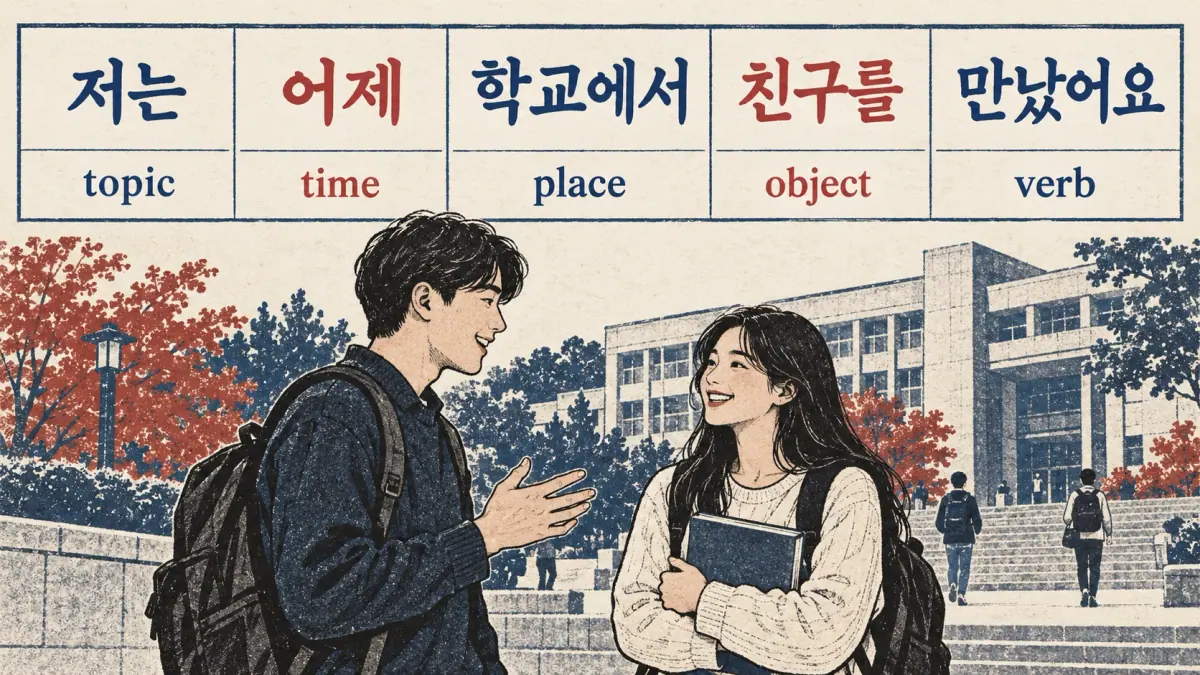
Korean word order is the pattern in which the parts of a sentence appear, and it is verb-final. Verb-final means that the verb or adjective comes last. A particle is a small marker attached to a noun that shows its role, such as 은/는 for the topic, 이/가 for the subject and 을/를 for the object. Because particles carry the roles, the nouns in front of the verb have more freedom than in English.
A slot is a position in the sentence that a type of phrase usually fills. The default slots, from left to right, are topic, time, place, object and verb. In 저는 어제 학교에서 친구를 만났어요, 저는 is the topic, 어제 is the time, 학교에서 is the place, 친구를 is the object and 만났어요 is the verb.
This set covers four questions that follow from that pattern. Where do time and place go? How far can phrases move? Where does a question word stand? Where does an adverb go? The basic verb-last rule itself is taught in the Korean SOV sentence pattern, and the wider area is described in basic Korean grammar. The next section gives a route through the lessons.
Where Should You Start with Korean Word Order?
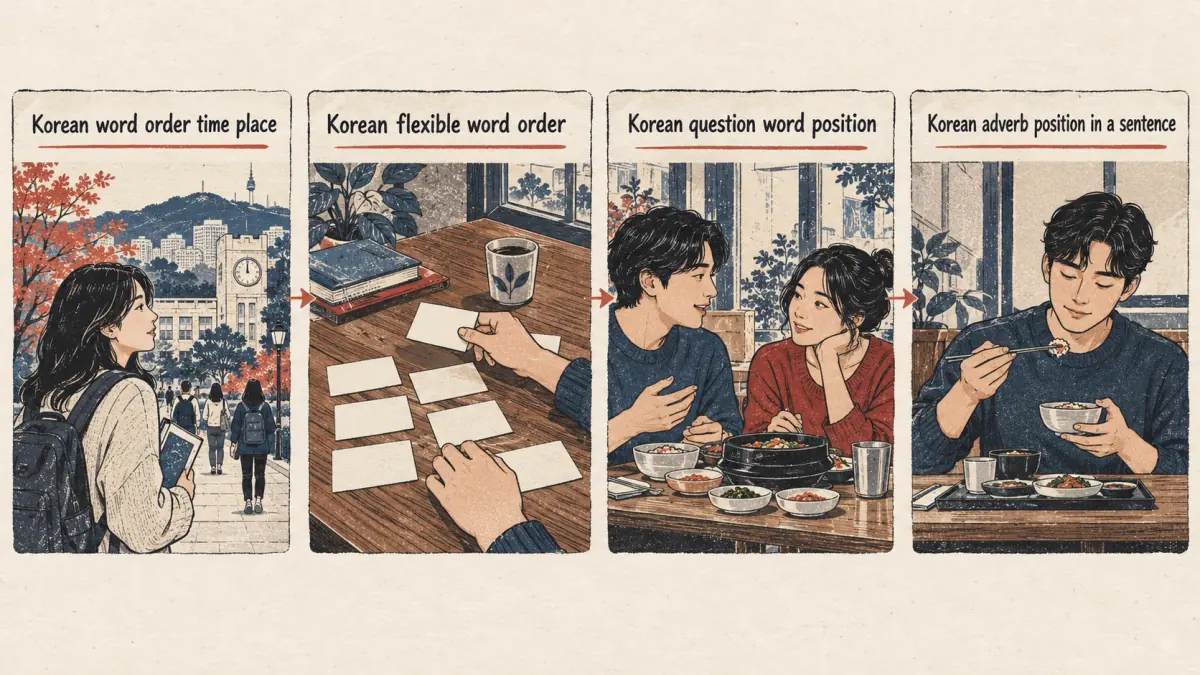
Start with the time, place and object order, then move to flexibility, question words and adverbs. This order goes from the default pattern to its variations and then to two special cases.
- Korean word order time place teaches the default order and the particles 에 and 에서. Read it first.
- Korean flexible word order shows how phrases can move and what the move means.
- Korean question word position shows that a question word stays in the slot of the answer.
- Korean adverb position in a sentence places adverbs next to the words they describe.
Where should a beginner begin? A learner who already builds sentences like 저는 학교에 가요 can start at step one. A learner who has not yet met the verb-last rule should read the SOV lesson first. The next section describes each lesson.
Browse by Topic
Each lesson below has a short description, one example sentence with Revised Romanization (RR, the official Latin spelling, shown only as an aid) and audio.
Korean Word Order Time Place
This lesson teaches the default order of topic, time, place, object and verb. It shows when a time word takes 에, when a place takes 에서, and how several time words line up from large to small. Example: 저는 어제 학교에서 친구를 만났어요. (jeoneun eoje hakgyoeseo chingureul mannasseoyo.) "Yesterday I met a friend at school." Read it in Korean word order time place.
Korean Flexible Word Order
This lesson explains that nouns with particles can change places while the verb stays last. It shows what each move emphasises, and where moving phrases is unnatural. Example: 밥을 동생이 먹어요. (babeul dongsaengi meogeoyo.) "My younger sibling eats the meal", with the object first. See Korean flexible word order.
Korean Question Word Position
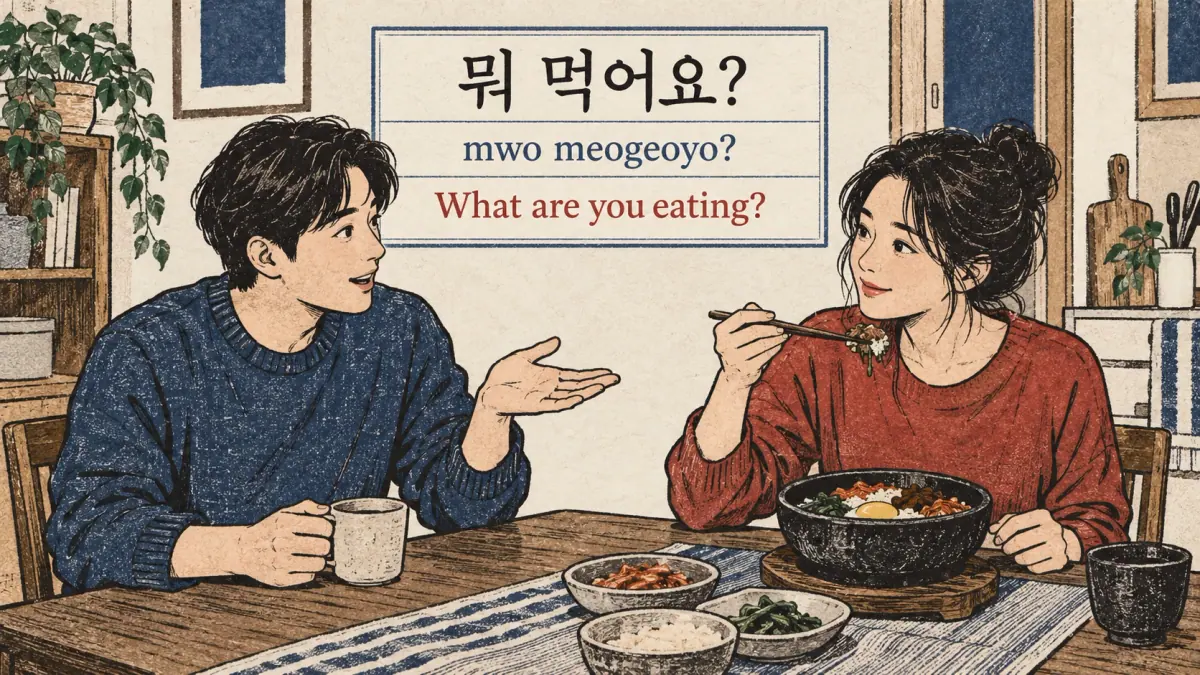
This lesson shows that question words such as 뭐, 누구 and 어디 do not move to the front. They replace the unknown part and stay in its slot. Example: 뭐 먹어요? (mwo meogeoyo?) "What are you eating?" The full lesson is Korean question word position.
Korean Adverb Position in a Sentence
This lesson places adverbs, the words that describe a verb or an adjective, directly before the word they modify. It also separates time adverbs, which stand earlier, from manner adverbs, which stand near the verb. Example: 저는 밥을 천천히 먹어요. (jeoneun babeul cheoncheonhi meogeoyo.) "I eat slowly." Read Korean adverb position in a sentence.
The next section helps you choose a lesson for your own sentence.
Which Lesson Fits Your Sentence?
Match the problem you have to the lesson in the table.
| If your sentence... | Open | Why |
|---|---|---|
| has a time word and a place word | Korean word order time place | time usually comes before place |
| sounds like English word for word | Korean word order time place | English puts place before time |
| puts the object before the subject | Korean flexible word order | explains what the move means |
| asks "what", "who" or "where" | Korean question word position | the question word keeps the answer slot |
| contains 빨리, 천천히, 잘 or 아주 | Korean adverb position in a sentence | adverbs sit before the word they describe |
| has no verb at the end | Korean SOV sentence pattern | the verb must be last |
The next section compares the Korean and English patterns.
How Do Korean and English Word Order Compare?
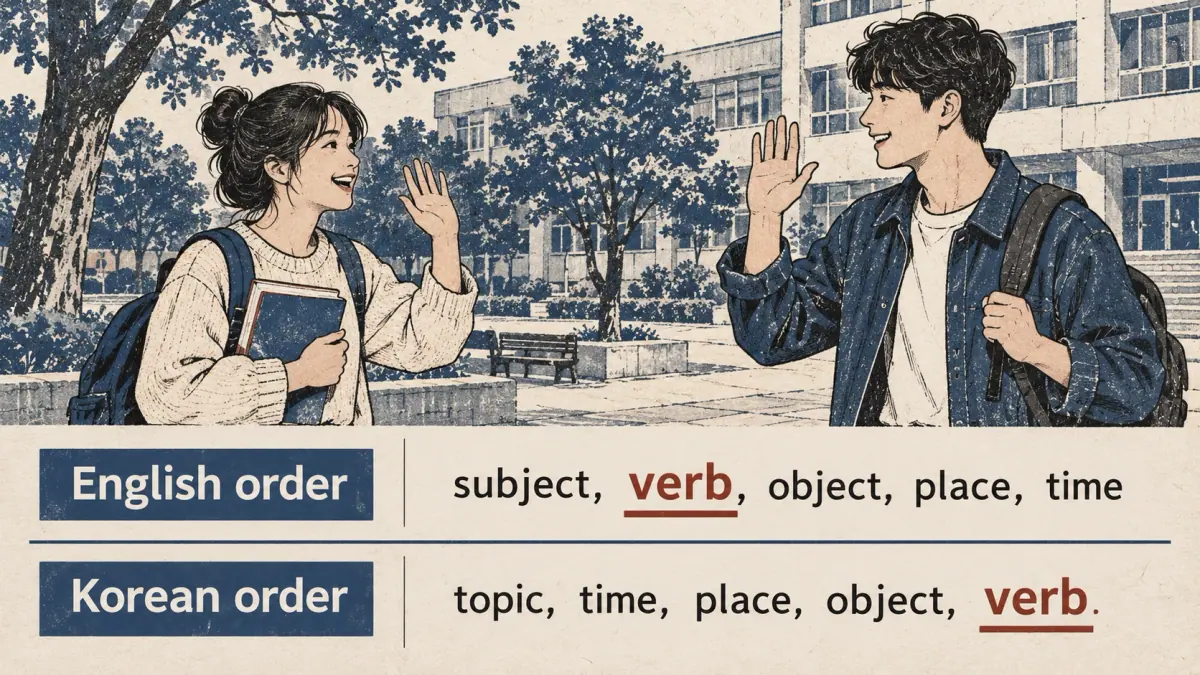
English uses position to show roles, and Korean uses particles. That difference explains why Korean can move nouns while English cannot. The snapshot below uses one idea in both languages.
| Idea | English order | Korean order |
|---|---|---|
| I met a friend at school yesterday | subject, verb, object, place, time | topic, time, place, object, verb |
| The verb | after the subject | at the end |
| A question word | at the front | in the slot of the answer |
| Roles | shown by position | shown by particles |
The most useful single fact is that English tends to put the place before the time ("at school yesterday") and Korean tends to put the time first (어제 학교에서). The next section lists the first mistakes to avoid.
First Mistakes to Avoid
Three mistakes appear in most beginner sentences in this area.
- Copying English order. Saying 저는 학교에서 어제 친구를 만났어요 is grammatical but less common. Put the time before the place.
- Putting the verb in the middle. Saying 저는 읽어요 책을 breaks the verb-last rule. End with the verb.
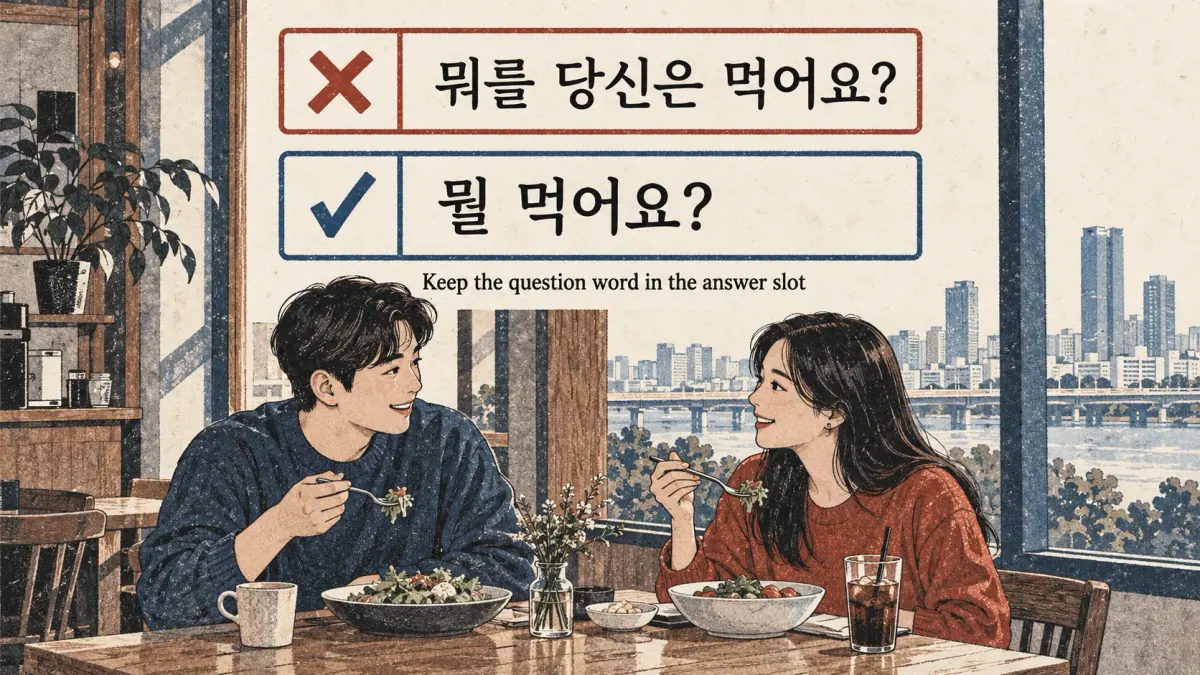
- Moving the question word to the front. Saying 뭐를 당신은 먹어요? copies English. Keep the question word in the answer slot: 뭘 먹어요?
Each lesson in the set explains one of these in detail. The next section shows what the set leaves out.
Scope of This Set
The Korean word order set covers the order of phrases inside a single sentence. The set does not cover sentence patterns for "to be" and "to exist", which are in Korean sentence structure. Nor does it teach the particles one by one; those lessons sit in the particles hub. Sentences with several verbs, relative clauses and embedded questions follow different rules and have their own lessons.
All Korean text, spoken forms and audio on this page were machine-generated and reviewed and signed off by Min-ji Park on 15 October 2026. The next section shows how to practise.
How Do You Practise Korean Word Order?
Practise Korean word order by building sentences from slots and checking them against a key. A simple routine works well across a week.
- Read one lesson and say its model sentences aloud with the audio.
- Write three sentences of your own that follow the same slots.
- Take the grammar quizzes to check the pattern.
- Review the rules with the grammar flashcard decks.
- Print a grammar worksheet and fill it in by hand.
Each lesson ends with a practice set and an answer key, so you can check your work immediately. After finishing the set, continue to the other lessons in basic Korean grammar.
Frequently Asked Questions
Is Korean word order strict? Korean word order is strict about one thing and flexible about the rest. The verb or adjective must come last in a basic sentence. The nouns before it can move, because particles such as 은/는, 이/가 and 을/를 mark their roles. The default order is topic, time, place, object, verb, and moving a phrase usually adds emphasis.
Where do adverbs go in a Korean sentence? An adverb usually stands directly before the verb or adjective it describes. In 저는 밥을 천천히 먹어요, the adverb 천천히 ("slowly") sits right before 먹어요. Time adverbs such as 어제 stand earlier, after the topic. The lesson on adverb position gives the full rules and the exceptions with examples and audio.
Which lesson in Korean word order should I read first? Start with the lesson on time, place and object order. It builds on the verb-last pattern and gives you the default order for almost every sentence. Then read the flexible word order lesson, then question word position, then adverb position. If you have not yet met the verb-last rule, read the Korean SOV sentence pattern first.
What level is Korean word order? The lessons in this set range from A1 to B1 on the CEFR scale. Question word position is A1, because it uses short questions such as 뭐 먹어요. Time and place order and adverb position are A2, and flexible order is B1. A learner who can make simple polite sentences with 은/는, 을/를 and 에 is ready to start.