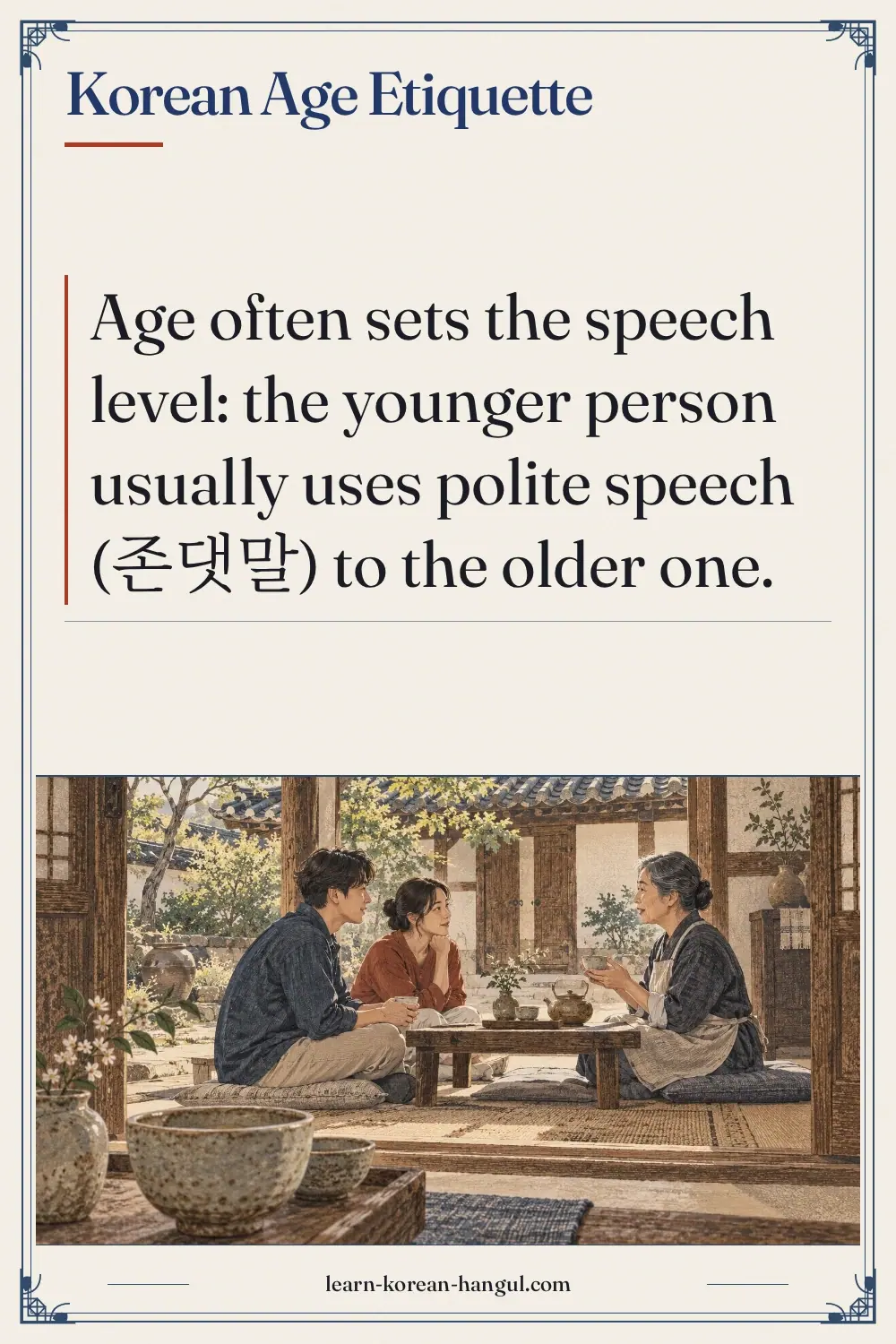
Key facts
- Titles such as 형, 누나, 오빠 and 언니 show the age gap between friends and are chosen by the speaker's gender.
- 몇 년생이세요? ("What year were you born?") is a polite shortcut for finding out someone's age.
Korean Age Etiquette: the Essentials
Age is a social tool in Korean, not just a number. The language has built-in politeness levels, and the most reliable way to pick one is to know who is older. That is why a first conversation with a new friend often includes a question about age that feels very direct to many visitors.
The chain works in three steps.
- Learn the age gap. People ask the age, the birth year or the school year.
- Choose a title. The younger person calls the older one 형, 누나, 오빠 or 언니, or uses a rank such as 선배.
- Choose a speech level. The younger person uses 존댓말 (jondaenmal, honorific speech), and the older person may use 반말 (banmal, casual speech).
These are conventions, not laws, and they vary with the person. A kind older person may say "please speak comfortably" and drop the gap at once. A stricter person in a formal setting may keep it for years. The aim of this page is to give you a map: the usual route, the polite ways to ask and the main exceptions. First, look at how the speech level follows from age.
How Does Age Set the Speech Level?
Age sets the speech level because Korean verbs must show respect to the listener, and age is the first measure of who deserves respect. The rule of thumb is simple: if the other person is older, use polite speech; if you are older, you may use casual speech after you know each other, but many adults still use polite speech with new people.
| Relationship | Younger person says | Older person says | Notes |
|---|---|---|---|
| Strangers, any age | 존댓말 (polite) | 존댓말 (polite) | the safe default for adults |
| Older friend and younger friend | 존댓말, later 반말 if invited | 반말 or 존댓말 | the older person decides when to relax |
| Same age (동갑) | 존댓말 at first | 존댓말 at first | switch only after both agree |
| Boss and employee | 존댓말 | 존댓말 or 반말 | depends on the workplace; 존댓말 is common |
| Child and adult | 존댓말 | 반말 often | adults often use casual speech with young children |
The polite level uses the -아요/-어요 endings (잘 지내요?), and the formal level uses -ㅂ니다 (잘 지냅니다). The casual level drops the 요 (잘 지내?). For the details, see what is banmal in Korean and Korean speech levels.
Here is the same question at three levels, to an older person, a peer and a younger friend.
| Level | Korean | Romanization | Used with |
|---|---|---|---|
| Honorific polite | 식사하셨어요? | siksahasyeosseoyo | an older person you respect |
| Polite | 밥 먹었어요? | bap meogeosseoyo | a stranger or a new colleague |
| Casual | 밥 먹었어? | bap meogeosseo | a close friend or a younger person |
Notice that the level changes the ending, not the meaning. A beginner who uses 요 endings with everyone is polite to everyone and rarely causes offence. The risk is on the other side: using 반말 with an older person because they look young, or because an English-speaking habit says "we are friends".
Once the speech level is settled, the next step is the title. The titles come from family words, which is why they sound affectionate.
Which Titles Show the Age Gap?
Titles in Korean show whether the person is older or younger than you, and they depend on the speaker's gender. The set below applies to friends and people you know a little.
| You are | Calling an older man | Calling an older woman |
|---|---|---|
| A man | 형 (hyeong) | 누나 (nuna) |
| A woman | 오빠 (oppa) | 언니 (eonni) |
A younger friend is called by name, with 야 or 아 after the name in casual speech (민수야), or as 동생 (dongsaeng, "younger sibling or younger friend"). The word 오빠 has a famous second life in pop culture, and the page on what oppa means explains when it is affectionate and when it is only a polite title.
In school and at work, a second set of titles works by experience, not by age: 선배 (seonbae, a senior) and 후배 (hubae, a junior). A seonbae at a university may be the same age as you, but because they entered earlier, you use polite speech and a title. University students also ask 몇 학번이세요? (myeot hakbeoniseyo, "Which entry year are you?") to place each other in the same way.
Expert insight: in Korean, the word 친구 (chingu, "friend") traditionally means a friend of exactly the same age. A person a few years older is not called a chingu to their face, even if you are close. They are your 형 or 누나, and the word for that bond is closer than a friend. A foreigner who calls everyone "friend" may be understood, but the Korean listener will notice.
How Should You Ask about Age Politely?
The polite way to ask about age is to ask for the birth year or to use an honorific question. The blunt 몇 살이야? is only for close friends and children. With a stranger or someone older, use the questions below.
| Level | Question | Romanization | Use with |
|---|---|---|---|
| Casual | 몇 살이야? | myeot sariya? | children, close friends |
| Polite | 몇 살이에요? | myeot sarieyo? | peers you have just met |
| Polite, birth year | 몇 년생이에요? | myeot nyeonsaengieyo? | peers; softer than asking age |
| Honorific, birth year | 몇 년생이세요? | myeot nyeonsaengiseyo? | people slightly older or senior |
| Honorific | 나이가 어떻게 되세요? | naiga eotteoke doeseyo? | strangers |
| Most honorific | 연세가 어떻게 되세요? | yeonsega eotteoke doeseyo? | elders |
The question 몇 년생이세요? is pronounced [면 년생이세요]. It is popular because the answer is a year, such as 98년생이에요, and the speaker can decide the relationship by quick maths. It also avoids a problem with the number itself, which changes with the age system you use (see below). Wh-questions like these usually do not rise sharply at the end.
How do you answer? Say your birth year with 년생 (nyeonsaeng): 저는 95년생이에요 (jeoneun gusibo nyeonsaengieyo). If the other person has the same birth year, you will hear 동갑이네요 (donggabineyo, "We are the same age!"). If you would rather not say, 나이는 비밀이에요 (naineun bimirieyo, "My age is a secret") is a polite smile of a reply. The page on how to say age in Korean lists every form with 살 and 세.
One more detail: people born in January or February can complicate things. Traditionally in the school system, some of them started school with the previous year's group, and they are called 빠른 년생 (ppareun nyeonsaeng, "early-born"). Friends of that group may mix with either year. If the conversation turns to this, simply ask 몇 학번이세요? or 같은 학년이에요? (gateun hangnyeonieyo, "Are we in the same school year?").
How Do You Move from Polite to Casual Speech?
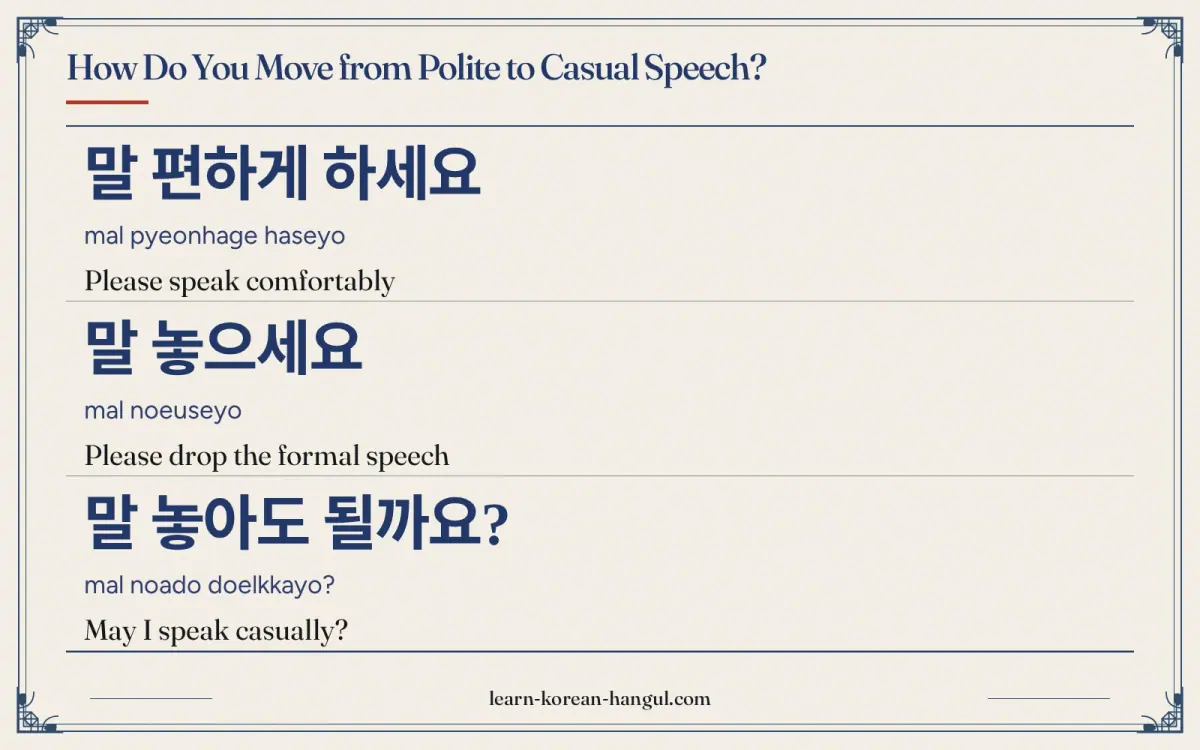
Move from polite to casual only after both people agree. In Korean this is called 말을 놓다 (mareul nota), literally "to put down one's speech", and people usually ask first.
| Who asks | Phrase | Romanization | Meaning |
|---|---|---|---|
| Older person invites | 말 편하게 하세요 | mal pyeonhage haseyo | Please speak comfortably |
| Older person invites | 말 놓으세요 | mal noeuseyo | Please drop the formal speech |
| Same-age friends agree | 우리 말 놓을까요? | uri mal noeulkkayo? [우리 말 노을까요] | Shall we speak casually? |
| Younger person asks | 말 놓아도 될까요? | mal noado doelkkayo? | May I speak casually? |
The older person normally invites the younger one, not the other way around. When two same-age people meet, either can suggest it. After you agree, switch for real. Sliding back and forth between polite and casual within one conversation is common, but a direct "let's speak casually" is the clean signal.
A word of warning for learners: Korean friends may switch to 반말 with you faster than you expect, because foreigners are often treated as a special case. You do not have to copy them. Staying polite is never wrong. A good rule is to use 반말 only when the other person has asked you to, and to use it only with someone of your own age or younger.
What Changed with the 2023 Age Law?
The 2023 law changed official age but not social habits. From 28 June 2023, amendments to the Civil Act (민법) and the Framework Act on Public Administration (행정기본법) made international age (만 나이) the default in South Korean law and administration. A few laws, such as the youth protection rules on buying alcohol and tobacco and the military service rules, still count by birth year (연 나이).
Before the change, three ages were in everyday use.
| System | Korean | How it counts | Example for someone born in 2000 and counted in 2025 |
|---|---|---|---|
| Counting age | 세는나이 | born at 1, add 1 each New Year | 26 |
| Year age | 연 나이 | current year minus birth year | 25 |
| International age | 만 나이 | full years since birth | 24 or 25, by birthday |
In social life, the law has not removed the habit of asking 몇 년생. Birth year does a job that 만 나이 cannot do: it places people in the same school cohort and the same group of friends, so two people with the same birth year can be 동갑 even if their birthdays are months apart. For the legal background and the formulas, see Korean age abolished.
Expert insight: when a Korean friend says "I'm 26 in Korean age", they are using the counting age, and the number depends on the year. Ask for the birth year when you need an exact answer.
What If Rank and Age Conflict?
Rank usually beats age at work, but age still shapes tone. A younger manager (팀장님) expects polite speech from older team members, and an older member typically uses honorific speech to the manager in return. In the same company, a younger person who is more senior is called by title plus 님, such as 팀장님 (timjangnim) or 부장님 (bujangnim). Pure age titles like 형 and 누나 are not used on the office floor, even if people use them after work.
| Situation | What people usually do |
|---|---|
| Younger boss, older employee | employee uses 존댓말 and title + 님; boss uses 존댓말 or the employee's title |
| Older junior colleague | polite speech both ways; the younger person avoids 반말 |
| Colleagues of the same rank, different age | the younger person uses polite speech, often with 선배님 |
| After work, informal drinks | titles may shift to 형, 누나, 오빠, 언니 if people agree |
Drinking rules show age as well. In traditional settings, a younger person pours for an older one with both hands (or the right hand supported by the left), and turns slightly away when drinking in front of an elder. These are customs, not laws, and many people skip them in relaxed groups. Still, offering to pour with two hands is a gesture older people notice and like.
How Do Foreigners Handle Age Questions?
Foreigners are usually forgiven, but a little effort goes a long way. If someone asks your age, answer plainly or give your birth year. If you are asked early in a conversation, that is not an insult. It is a way of finding the right words.
Practical tips:
- Use polite speech by default. 요 endings are enough.
- Answer with your birth year. 99년생이에요 is quick and avoids the age-system confusion.
- Ask back politely. 민수 씨는 몇 년생이세요? ("Minsu, what year were you born?") is natural.
- Do not use 너 ("you") for people. Use the name plus 씨 or a title. Korean avoids "you" for people you respect, and the page on saying you in Korean explains the options.
- Accept a switch with a smile. If they say 말 놓을게요, reply 네, 편하게 하세요.
Age etiquette is not equal in all places. Younger Koreans in tech companies, creative industries and international schools are often more flexible. Some groups decide to use only first names and polite speech for everyone, which removes the gap. Watch what the group does and follow.
Why Does Age Matter so Much in Korean?
Age matters because the language grammar builds respect into every sentence, and the cultural background gives that respect a clear direction. Scholars often link the habit to older Confucian ideas about respect for elders, which shaped family and school life in Korea over centuries. The result is a language where the verb ending must say something about the listener.
English can hide the relationship. "Did you eat?" sounds the same to a grandmother and a classmate. In Korean you must pick 식사하셨어요? or 밥 먹었어? before you start. If you do not know the other person's age, you cannot pick, and that is the practical reason for the question. Seen this way, asking 몇 년생이세요? is not curiosity about your birthday. It is the speaker trying to say the next sentence correctly.
This also explains why the question comes early and why the answer matters more than the person's looks. Appearance is a poor guide: someone who looks forty may be thirty, and an apparently young person may be your senior at work.
What Are the Most Common Age-Etiquette Mistakes?
Most mistakes come from guessing age by appearance or from skipping the title. The list below shows the usual ones and the repair.
- Using 반말 because someone looks young. Wrong: 어디 가? to an adult stranger. Right: 어디 가세요? Stay polite until invited.
- Calling an older person 너. Wrong: 너 몇 살이야? Right: 몇 년생이세요?
- Using 친구 for a much older person. Wrong: calling a person ten years older 제 친구예요 to their face. Right: use 형, 누나, 오빠 or 언니 for the person, and 지인 or the name for a casual mention.
- Using 연세 for yourself. Wrong: 제 연세는 스물다섯이에요. Right: 제 나이는 스물다섯이에요.
- Switching to casual speech alone. Wrong: suddenly saying 고마워 to a new colleague. Right: ask 말 편하게 해도 될까요? first.
- Calling a boss by name plus 씨. Wrong: 민수 씨 to a team leader. Right: 팀장님.
The first two errors are the ones that cause real offence. The others are usually forgiven. After a mistake, a quick 죄송합니다 (joesonghamnida, "I am sorry") and the correct form is enough.
Practice: a First Meeting
Here is a short exchange between two people in their twenties who have just met at a language exchange. Read it aloud and note each choice of level.
| Speaker | Korean | Romanization | Meaning |
|---|---|---|---|
| A | 안녕하세요. 저는 수진이에요. | annyeonghaseyo. jeoneun sujinieyo. | Hello. I'm Sujin. |
| B | 안녕하세요. 저는 태호예요. 몇 년생이세요? | annyeonghaseyo. jeoneun taehoyeyo. myeot nyeonsaengiseyo? | Hello. I'm Taeho. What year were you born? |
| A | 저는 98년생이에요. | jeoneun gusippal nyeonsaengieyo. | I was born in 1998. |
| B | 아, 저도 98년생이에요. 동갑이네요! | a, jeodo gusippal nyeonsaengieyo. donggabineyo! | Oh, I was too. We are the same age! |
| A | 그럼 우리 말 편하게 할까요? | geureom uri mal pyeonhage halkkayo? | Then shall we speak comfortably? |
| B | 좋아요. 편하게 해요. | joayo. pyeonhage haeyo. | Sure. Let's be comfortable. |
Notice that both stay polite until they agree, and that the agreement itself is spoken in polite speech. After this line, they can switch to 반말 together.
What Are the Limits of These Rules?
This page describes common patterns, and individuals differ. Not every Korean person cares about age, and many dislike the pressure of hierarchy. Younger generations question it more openly than older ones, and workplaces are experimenting with first-name cultures and flat titles. Treat the rules as a way to start politely, not as a script.
Also, the exact forms of address vary by region and family. Some families call an older cousin by name plus 형, others never use names. If you are unsure, ask: 어떻게 부르면 될까요? (eotteoke bureumyeon doelkkayo?, "What should I call you?"). Most people appreciate the question.
The Bottom Line
Korean age etiquette follows a simple chain: age gap, title, speech level. Ask for the birth year with 몇 년생이세요?, use polite speech until you are invited to relax, and call older friends 형, 누나, 오빠 or 언니 according to your gender. At work, rank leads and titles with 님 replace names. If you are unsure, stay polite and ask 어떻게 부르면 될까요?
Now see how these habits shape the first moment of a meeting in Korean greeting etiquette, and practise the numbers in how to say age in Korean.
Frequently Asked Questions
Is it rude to ask someone's age?
Usually not. Koreans often ask early because age decides the speech level and titles. To stay polite, ask for the birth year with 몇 년생이세요? or use 나이가 어떻게 되세요? with strangers and 연세가 어떻게 되세요? with elders. You may decline with 나이는 비밀이에요, said with a smile.
What if we are the same age?
Same-age people are called 동갑 (donggap). They normally start with polite speech and move to casual speech only after both agree, for example 우리 말 놓을까요? Once they agree, they use 반말 and often call each other 친구, a word that traditionally means a friend of exactly the same age.
Do foreigners have to follow this?
Foreigners are usually forgiven for mistakes, and some Koreans switch to casual speech with them quickly. Still, polite 요 endings are the safest default, and using them is always appreciated. Use 반말 only when the other person invites you, and only with someone your own age or younger.
How do I say my age?
Say your age with a native number and 살, such as 스물다섯 살이에요, or give your birth year with 년생, such as 99년생이에요. The birth year is easier because it does not depend on which age system the listener uses. The page on how to say age in Korean lists all the forms.
Does age matter less since the 2023 law?
The law made international age (만 나이) the default in law and administration, but it did not change social habits. People still ask for the birth year because it places them in the same school cohort and friend group. Expect the question 몇 년생이세요? to stay common for years.