How to Say Age in Korean
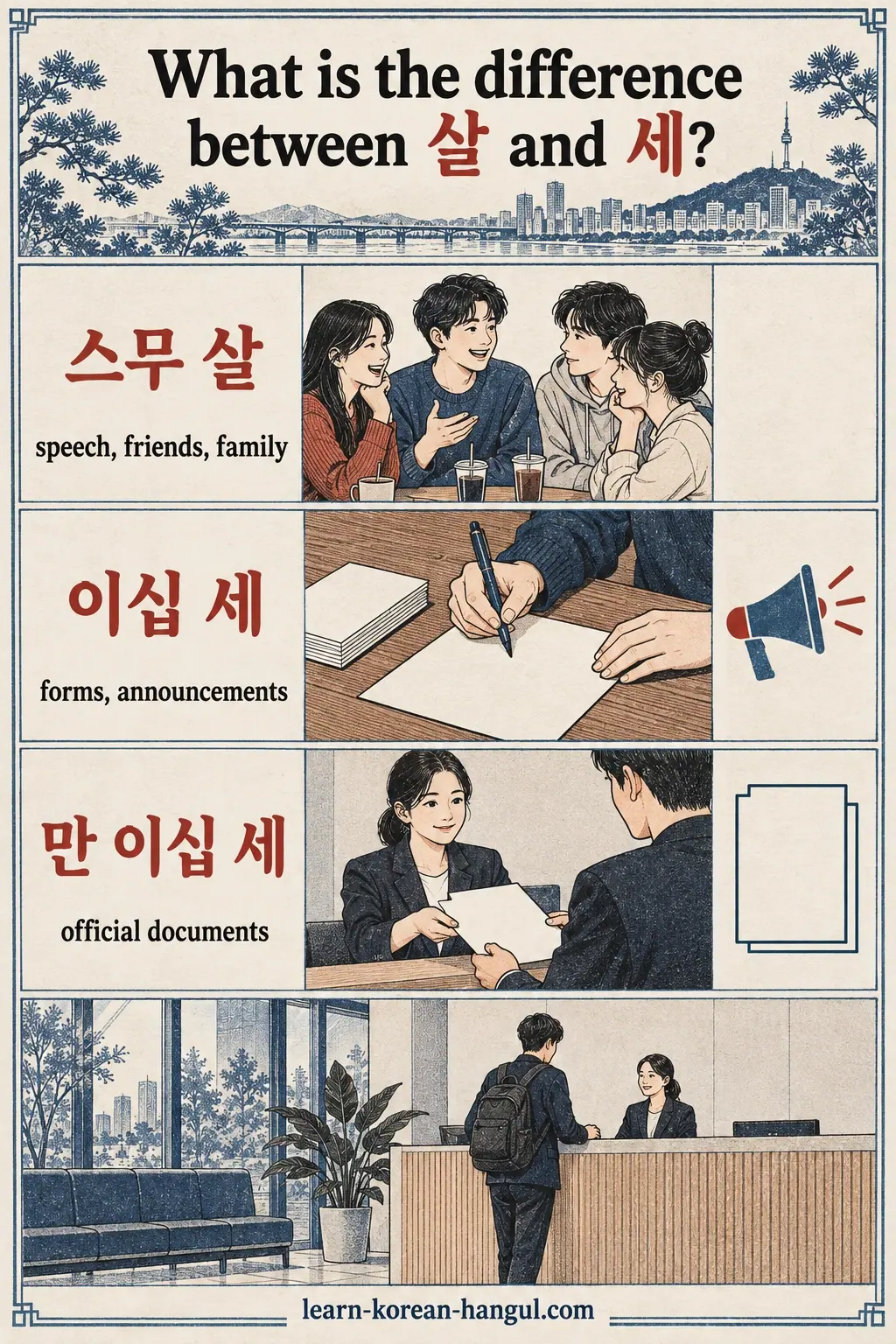
To say your age in Korean, put a native number before 살 and end with 이에요: 저는 스물다섯 살이에요 (I am twenty-five). Korean has three common ways to give an age, and the choice depends on the setting.
| Setting | Pattern | Example | Meaning |
|---|---|---|---|
| Speech, casual or polite | native number + 살 | 스물다섯 살이에요. | I am 25. |
| Forms and formal writing | Sino-Korean number + 세 | 25세 (이십오 세) | age 25 |
| Official or exact age | 만 + number + 세 or 살 | 만 25세, 만 스물다섯 살 | 25 in full years |
The counter 살 and the counter 세 both mean "years old". A counter is a small word that follows a number and shows what is being counted. The difference is the number system: 살 takes native numbers (하나, 둘, 셋), and 세 takes Sino-Korean numbers (일, 이, 삼). The next section lists the native forms you need for 살.
How Do You Form 살 Numbers?
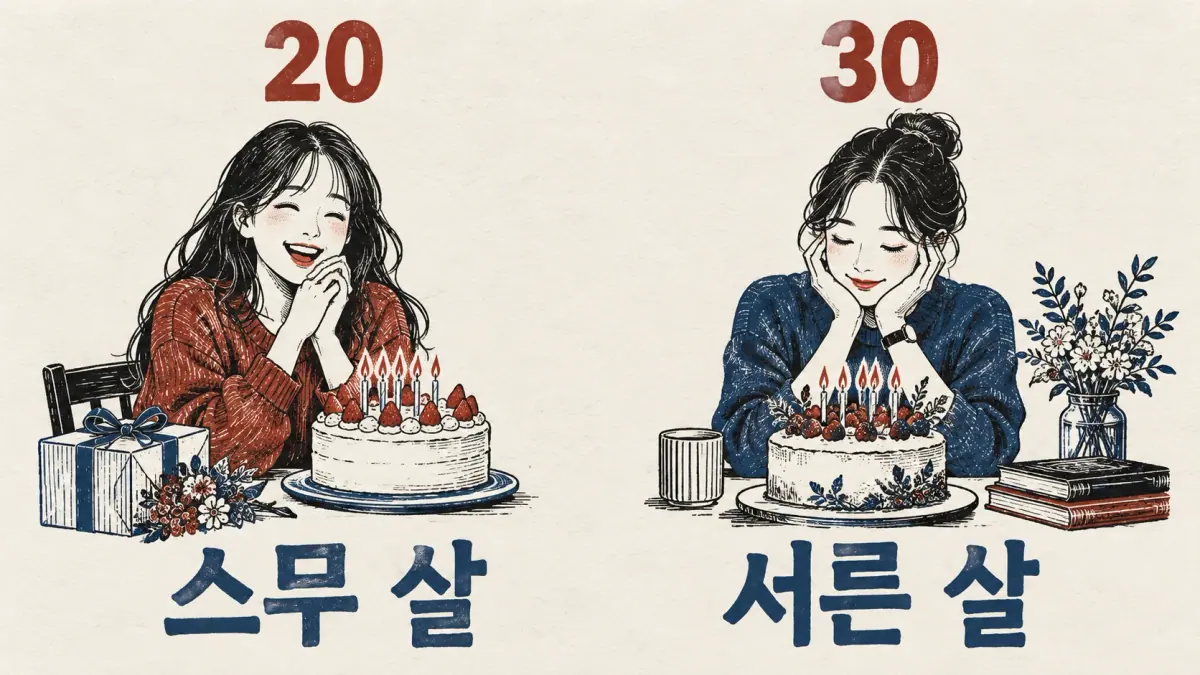
To form an age with 살, say a native number and add 살. The numbers 1 to 4 and 20 shorten before the counter: 한 살, 두 살, 세 살, 네 살 and 스무 살. All other numbers keep their ordinary form.
| Age | With 살 | Age | With 살 |
|---|---|---|---|
| 1 | 한 살 | 11 | 열한 살 |
| 2 | 두 살 | 12 | 열두 살 |
| 3 | 세 살 | 13 | 열세 살 |
| 4 | 네 살 | 14 | 열네 살 |
| 5 | 다섯 살 | 15 | 열다섯 살 |
| 6 | 여섯 살 | 16 | 열여섯 살 |
| 7 | 일곱 살 | 17 | 열일곱 살 |
| 8 | 여덟 살 | 18 | 열여덟 살 |
| 9 | 아홉 살 | 19 | 열아홉 살 |
| 10 | 열 살 | 20 | 스무 살 |
For ages above twenty, the tens have their own names and you add the ones digit.
| Tens | With 살 | Example |
|---|---|---|
| 20 | 스무 살 | 스물한 살 (21), 스물다섯 살 (25) |
| 30 | 서른 살 | 서른두 살 (32), 서른아홉 살 (39) |
| 40 | 마흔 살 | 마흔한 살 (41), 마흔세 살 (43) |
| 50 | 쉰 살 | 쉰다섯 살 (55) |
| 60 | 예순 살 | 예순여덟 살 (68) |
| 70 | 일흔 살 | 일흔한 살 (71) |
Notice the 20 and 30 contrast. Twenty becomes 스무 살 because 스물 loses its ㄹ right before a counter, but 서른 stays the same. For all 99 forms, see the 살 counter and native Korean numbers 1-100.
You now have the forms. Next, the other counter that learners meet on forms.
What Is the Difference between 살 and 세?
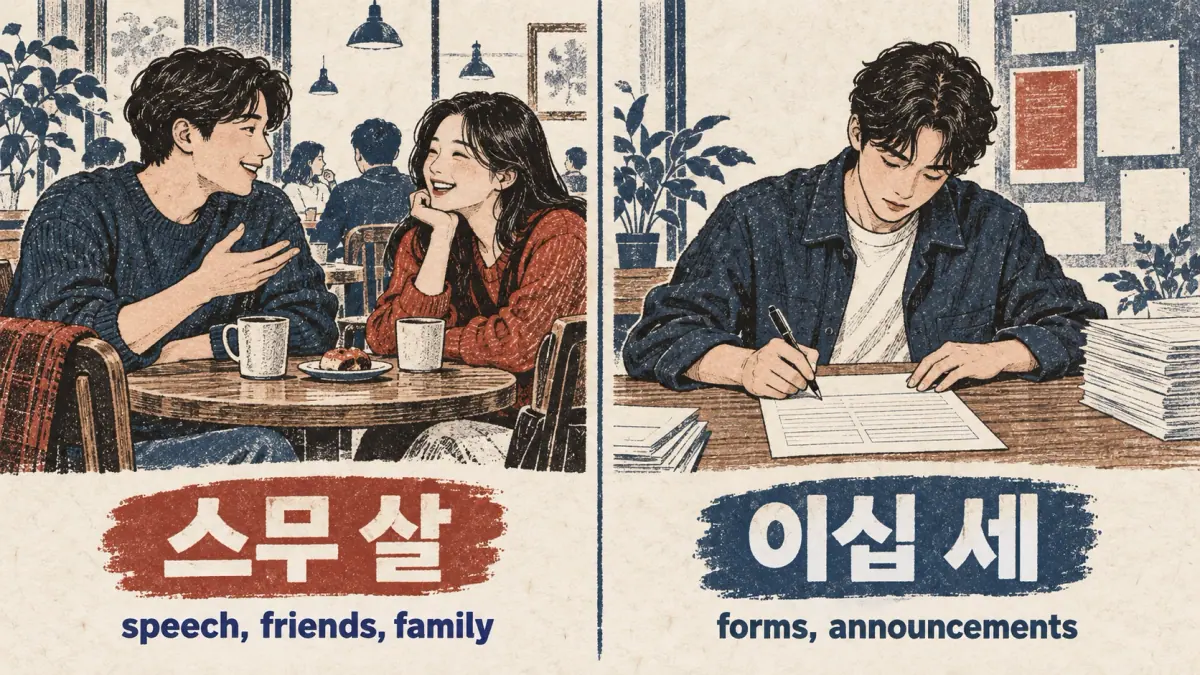
The counters 살 and 세 both mean "years old", but 살 belongs to speech with native numbers, and 세 belongs to forms and formal writing with Sino-Korean numbers. Add 만 before either to say "in full years", as in 만 25세.
| 살 | 세 | 만 + 세 | |
|---|---|---|---|
| Number system | native | Sino-Korean | Sino-Korean |
| Age 20 | 스무 살 | 이십 세 (20세) | 만 이십 세 (만 20세) |
| Age 35 | 서른다섯 살 | 삼십오 세 (35세) | 만 삼십오 세 |
| Where used | speech, friends, family | forms, announcements | official documents |
| Sounds | everyday | formal | exact, legal |
A quick test helps. If you are speaking to a friend, use 살. If you are writing on a visa application, hospital form or registration page, write 세 with digits, as in 35세. If someone asks for your exact age under the current system, use 만 plus 세.
The word 만 here means "full" and refers to international age (만 나이). From 28 June 2023, amendments to the Civil Act (민법) and the Framework Act on Public Administration (행정기본법) made international age the default in South Korean law and administration, so an age on a form normally means 만 나이 even when 만 is not written. A few laws, such as the youth protection rules on buying alcohol and tobacco and the military service rules, still count by birth year, so read the form's wording. For the calculation steps, see calculate Korean age, and for the background, see Korean age abolished.
Now put these pieces into complete sentences.
Sentence Patterns for Stating Your Age
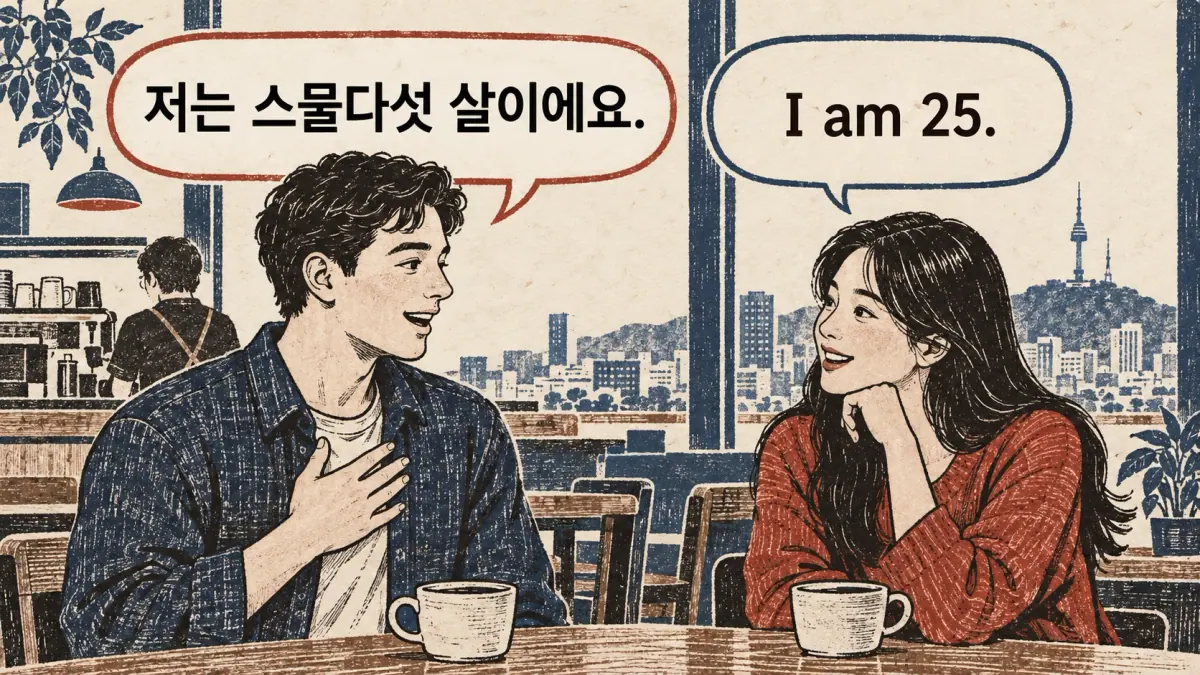
Seven short sentences cover almost every situation where you give an age. Pick the one that fits and swap in your own number.
| Situation | Sentence | Meaning |
|---|---|---|
| Plain statement | 저는 스물다섯 살이에요. | I am 25. |
| Without the subject | 스물다섯 살이에요. | I'm 25. |
| Casual | 나는 스물다섯 살이야. | I'm 25. |
| Formal | 저는 스물다섯 살입니다. | I am 25. |
| This year | 올해 스물다섯 살이에요. | I am 25 this year. |
| International age | 만으로 스물네 살이에요. | I'm 24 in full years. |
| Sino form on a form | 나이: 25세 | Age: 25 |
Three small points deserve notice. First, Korean drops the subject often, so 스물다섯 살이에요 alone is complete. Second, 입니다 is the formal ending, and it suits interviews and speeches. Third, 올해 (this year) fits naturally because an age belongs to a year.
For a twenty-year-old, say 스무 살이에요, and for a thirty-year-old, say 서른 살이에요. You can answer the question 몇 살이에요? with only the age: 서른 살이요.
Stating your age is half the skill. The other half is asking, which is where politeness matters.
How Do You Ask Someone's Age Politely?
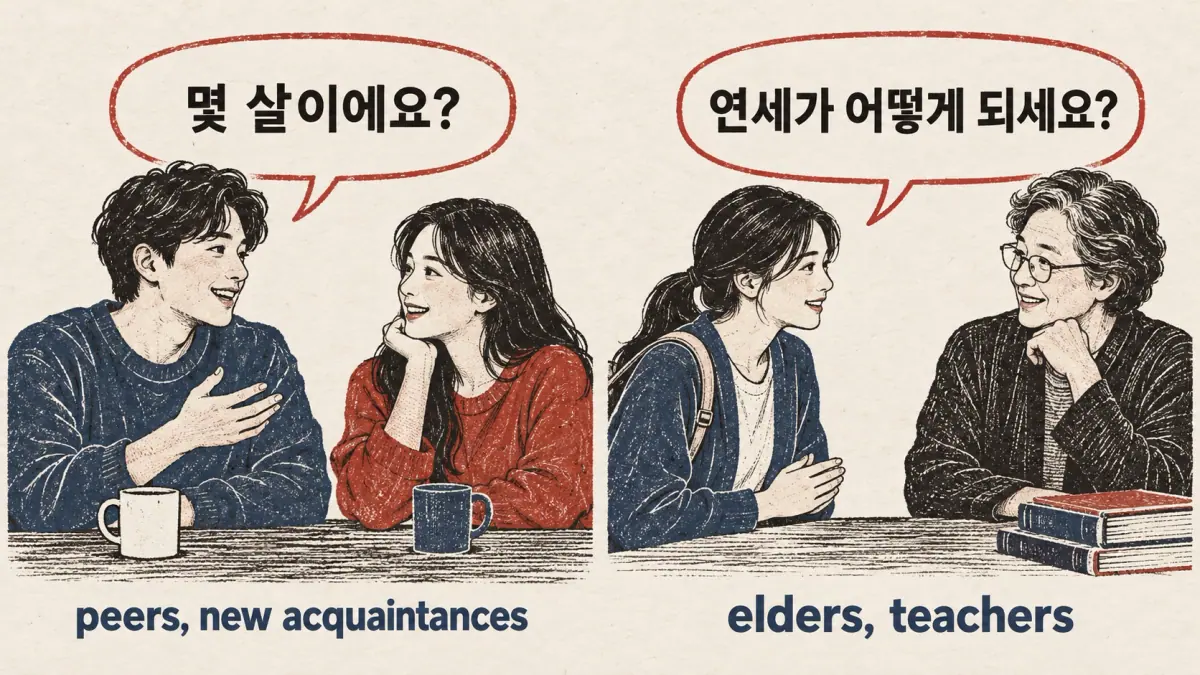
To ask someone's age politely, choose a question that matches your relationship: 몇 살이야? for children and close friends, 몇 살이에요? for peers, 나이가 어떻게 되세요? for strangers and 연세가 어떻게 되세요? for elders. Each step up the ladder adds respect.
| Level | Question | Use with | Note |
|---|---|---|---|
| Casual | 몇 살이야? / 몇 살이니? | children, close friends | informal ending |
| Polite | 몇 살이에요? | peers, new acquaintances | the standard question |
| Formal | 나이가 어떻게 되세요? | strangers, customers | honorific ending 되세요 |
| Honorific | 연세가 어떻게 되세요? | elders, teachers | 연세 replaces 나이 |
The honorific rung replaces the noun itself. 나이 is the ordinary word for age, and 연세 is its respectful counterpart, used only for someone you honour. Never use 연세 about yourself.
A short dialogue shows the polite rung in use.
- 민지: 안녕하세요. 저는 민지예요. 몇 살이에요?
- 준호: 스물다섯 살이에요. 민지 씨는요?
- 민지: 저는 스물세 살이에요.
- 준호: 그럼 제가 두 살 많네요.
(Minji: Hello, I'm Minji. How old are you? Junho: I'm 25. And you, Minji? Minji: I'm 23. Junho: Then I'm two years older.)
With someone older or unknown, move up the ladder.
- 직원: 실례지만, 나이가 어떻게 되세요?
- 손님: 마흔다섯 살이에요.
(Staff: Excuse me, may I ask your age? Customer: I'm forty-five.)
The phrase 실례지만 (excuse me, but) softens the question. When in doubt, go one rung higher than you think you need, because it is safer to be too polite than too casual. The question behind the question is what year someone was born, and Koreans have a shortcut for that.
What Is 몇 년생, and How Do You Answer It?
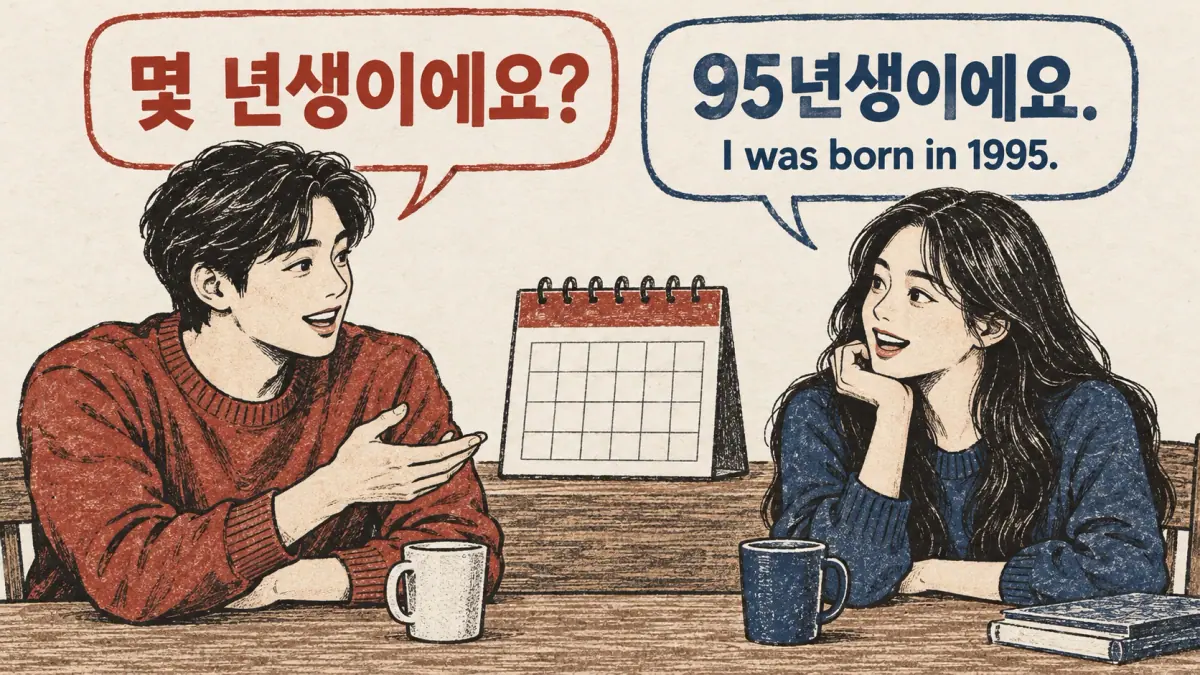
몇 년생 means "born in what year", and it is a common shortcut for finding out how old someone is without saying 살. The question is 몇 년생이에요?, pronounced [면 년생이에요], and the answer is the birth year plus 년생: 구십오 년생이에요 (I was born in 1995).
| Question | Answer | Meaning |
|---|---|---|
| 몇 년생이에요? | 95년생이에요. | I was born in 1995. |
| 몇 년생이세요? | 98년생이에요. | (honorific) I was born in 1998. |
| 몇 년도에 태어나셨어요? | 1990년에 태어났어요. | In what year were you born? / I was born in 1990. |
Two people born in the same year are 동갑 (the same age). If they discover this, they can switch to a friendlier tone: 저랑 동갑이네요! (We're the same age!). In Korean social life, being 동갑 can mean using casual speech with each other, once both agree.
Speakers often shorten the answer to two digits: 95년생 for 1995 and 98년생 for 1998. Two digits are ambiguous across centuries, so give the full year in writing, as in 2005년생. Asking the birth year also beats asking the age for one reason: the answer never changes with today's date.
Learners often ask why anyone would ask this question so early, which brings us to the cultural reason.
Culture Note: Why Age Comes up Early
Koreans ask age early because age decides how two people speak to each other. Korean has formal and casual speech levels, and it has titles for older siblings and friends, such as 형, 누나, 오빠 and 언니. To pick the correct level and the correct title, speakers need to know who is older.
The four older-sibling titles show why the answer matters. Which one you use depends on your own gender and the other person's gender.
| Speaker | Calls an older man | Calls an older woman |
|---|---|---|
| Male speaker | 형 | 누나 |
| Female speaker | 오빠 | 언니 |
Friends of similar age can use these titles for each other once they know who is older, even without a blood relation. Without the age, the speaker cannot pick one.
For a foreigner, the question is normally friendly, not intrusive. You are not required to answer. If you prefer not to, you can say 비밀이에요 (it's a secret) with a smile, or answer with your birth year only. Many Koreans will understand, and some will answer the same question about themselves.
Because age is tied to respect, the way you ask matters more than the question. A polite ladder, as above, avoids most problems. For wider cultural context, see Korean etiquette and introduce yourself in Korean.
Limitation: this page teaches how to say and ask age, not how to judge when it is appropriate. In business and with strangers, the question can be less common, and some people prefer to avoid it. Watch how the other person speaks and follow their lead.
Can You Answer with Just the Number?
Yes. In conversation, Koreans often drop 살 and even 이에요 when the question was 몇 살이에요?, because the context already shows that the answer is an age. The shorter the answer, the more casual it sounds.
| Style | Answer for 25 | Feel |
|---|---|---|
| Full sentence | 저는 스물다섯 살이에요. | polite, complete |
| Short polite | 스물다섯 살이에요. | everyday |
| Number only, polite | 스물다섯이에요. / 스물다섯이요. | quick and common |
| Number only, casual | 스물다섯. | friends only |
A detail trips up many learners. When you drop 살, the number returns to its standalone form, not the short counter form. So 21 is 스물한 살, but without 살 it is 스물하나예요. In the same way, 22 becomes 스물둘, 23 becomes 스물셋 and 20 becomes 스물. The short forms 한, 두, 세, 네 and 스무 appear only directly before a counter.
Use the full sentence with elders, in interviews and in writing. Save the number-only style for friends and peers.
How Do You Say a Baby's or Child's Age?
For a baby under about two years, give the age in months with 개월, using a Sino-Korean number: 육 개월 (six months), 십이 개월 (twelve months). After that, switch to 살: 두 살, 세 살. The first birthday has a special name, 돌, and parents often say 돌이 지났어요 (the first birthday has passed).
| Age | Korean | Meaning |
|---|---|---|
| newborn | 생후 일 개월 | one month after birth |
| baby | 육 개월 | six months old |
| first birthday | 돌 | the first birthday |
| toddler | 두 살 | two years old |
| child | 일곱 살 | seven years old |
To ask a parent about a child, add the polite particle: 아기가 몇 개월이에요? (How many months old is the baby?) and 아이가 몇 살이에요? (How old is the child?). The page on the 달 and 개월 counters covers months in more detail.
How Do You Give an Older Person's Age to Someone Else?
When you tell a third person how old an elder is, add the honorific ending 이세요 to the age, and use 연세 for the word "age": 할아버지는 일흔다섯 살이세요. The honorific marks respect for the person you are talking about, not for the listener.
| Sentence | Meaning |
|---|---|
| 할아버지는 일흔다섯 살이세요. | My grandfather is seventy-five. |
| 어머니는 쉰여덟이세요. | My mother is fifty-eight. |
| 할머니는 연세가 많으세요. | My grandmother is elderly (has many years). |
Do not use the honorific for yourself. A sentence such as 저는 스물다섯 살이세요 is a mistake, because 이세요 raises the subject of the sentence. For your own age, always use 이에요 or 입니다.
Approximate Ages and Decades
To give an approximate age, add 쯤 or 정도 (about) after the age: 서른 살쯤 (about thirty) and 서른 살 정도 (about thirty). To name a decade of life, use 대: 20대 (in the twenties), then 초반, 중반 or 후반 for early, middle and late.
| Pattern | Example | Meaning |
|---|---|---|
| 쯤 | 서른 살쯤 됐어요. | He or she is about thirty. |
| 정도 | 마흔 살 정도예요. | roughly forty |
| 대 + 초반 | 20대 초반 | early twenties |
| 대 + 후반 | 30대 후반 | late thirties |
| 또래 | 저랑 또래예요. | We are about the same age. |
Use these when you do not know an exact age or when exactness would be rude. Guessing someone's age is a common small-talk topic, and the safest way to guess is to name a decade first, then refine it.
Reading Ages Aloud from Digits
When you see an age written as digits with 세, read it with Sino-Korean numbers: 25세 is 이십오 세, and 만 35세 is 만 삼십오 세. This is the reading you hear in news broadcasts, hospital calls and announcements, where precision matters more than warmth.
| Written | Read aloud | Meaning |
|---|---|---|
| 30세 | 삼십 세 | age 30 |
| 40세 | 사십 세 | age 40 |
| 50세 | 오십 세 | age 50 |
| 60세 | 육십 세 | age 60 |
| 70세 | 칠십 세 | age 70 |
| 100세 | 백 세 | age 100 |
| 만 18세 | 만 십팔 세 | 18 in full years |
Speakers rarely say these in casual talk. If a friend asks your age, 서른 살이에요 is natural and 삼십 세예요 sounds like an announcer. Keep the Sino-Korean reading for forms, official calls and written text.
Age Phrase Bank
These ten phrases cover the age-related lines you will use most. Each one pairs a situation with a ready-made sentence.
| Situation | Phrase | Meaning |
|---|---|---|
| Stating your age | 스물다섯 살이에요. | I'm 25. |
| Asking a peer | 몇 살이에요? | How old are you? |
| Asking politely | 나이가 어떻게 되세요? | May I ask your age? |
| Asking the birth year | 몇 년생이에요? | What year were you born? |
| Finding a match | 동갑이에요? | Are we the same age? |
| Comparing | 저보다 한 살 많아요. | He or she is one year older. |
| Declining | 비밀이에요. | It's a secret. |
| Estimating | 서른 살쯤 돼 보여요. | He or she looks about thirty. |
| Written form | 나이: 25세 | Age: 25 |
| Exact age | 만 스물다섯 살이에요. | I'm 25 in full years. |
The phrase bank works as a quick review. Say each line aloud with your own age, then record yourself to check that 스무 살 never turns into 스물 살.
Common Mistakes and Fixes
Most learner errors with age come from the wrong number system, a missing short form or the wrong register. Check yourself against this list.
- Using Sino-Korean numbers with 살. Wrong: 이십오 살. Right: 스물다섯 살.
- Saying 스물 살. Wrong: 스물 살. Right: 스무 살.
- Using the full number form. Wrong: 하나 살, 둘 살, 셋 살. Right: 한 살, 두 살, 세 살.
- Using native numbers with 세 on a form. Wrong: 스물다섯 세. Right: 25세.
- Using 연세 for yourself. Wrong: 제 연세는 스물다섯이에요. Right: 제 나이는 스물다섯 살이에요.
- Asking an elder with 몇 살이야? The casual ending is rude to a stranger. Use 연세가 어떻게 되세요?
If you remember one fix, remember the first: 살 takes native numbers, and 세 takes Sino-Korean numbers. For a similar pairing with other counters, read how Korean counters work.
The Bottom Line
To say age in Korean, use a native number with 살 in speech, and a Sino-Korean number with 세 on forms. Ask 몇 살이에요? among peers, and go up the ladder to 나이가 어떻게 되세요? for strangers and 연세가 어떻게 되세요? for elders. These two nuances matter most: 스무 살 is the only spelling of twenty, and 몇 년생 is the quickest way to learn someone's age. With those in hand, you now know how to say age in Korean at any level of politeness.
For related pages, read about how old are you in Korean for the asking side, and age in Korean for the word lookup, including 나이 and 연세.
Frequently Asked Questions
Is it rude to ask age in Korea?
Usually no. Koreans often ask age early, because it decides the speech level and titles such as 형, 누나, 오빠 and 언니. Still, choose 나이가 어떻게 되세요? with strangers and 연세가 어떻게 되세요? with elders. You may also decline politely. Say 비밀이에요 with a smile, or give your birth year instead.
How do I say I am 20?
Say 스무 살이에요, or 저는 스무 살이에요 in a full sentence. The native number for 20 is 스물, and it shortens to 스무 before the counter 살. On a form or in formal writing, use the Sino-Korean version instead: 20세, read 이십 세. Never say 스물 살 or 이십 살 in conversation.
What is the honorific word for age?
The honorific word for age is 연세 (yeonse). Use it only for someone you respect, such as a grandparent or a teacher: 연세가 어떻게 되세요? The plain word 나이 is neutral, and it is used for yourself, friends and children. Using 연세 about your own age sounds wrong.
How do I say I am 30 in Korean?
Say 서른 살이에요, or 저는 서른 살이에요. The native number for 30 is 서른, and it does not change before the counter 살. In writing, a form would show 30세, read 삼십 세. If you want to say your international age, add 만: 만 서른 살이에요.