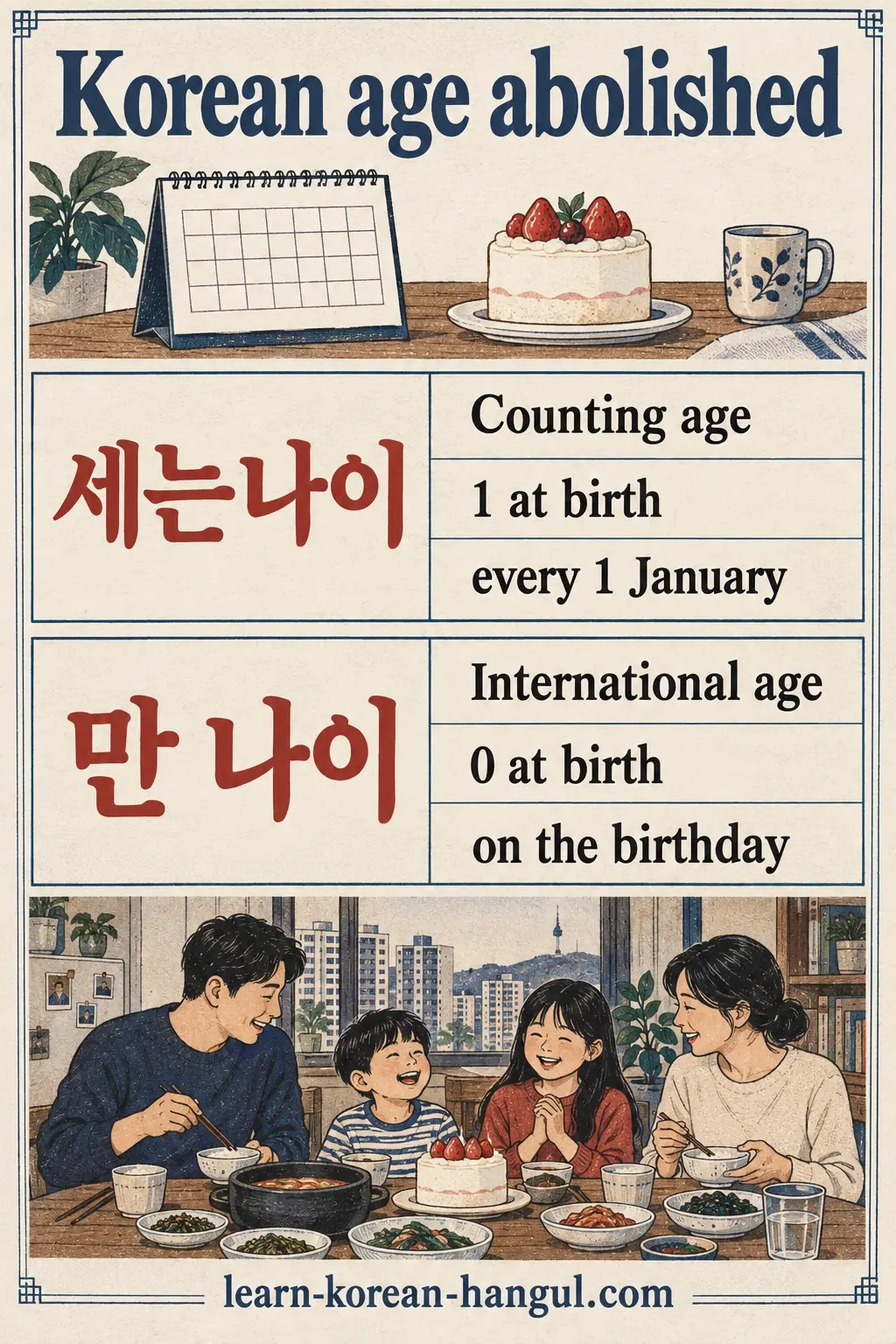
Key facts
- Date in force: 28 June 2023, through amendments to the Civil Act (민법) and the Framework Act on Public Administration (행정기본법).
- New default: when a law or document says 나이 (age), it means 만 나이 unless it states otherwise.
- Old counting age: 1 at birth, plus one every 1 January.
- International age: 0 at birth, plus one on each birthday.
- Still year-based: a few laws, including the rules on alcohol and tobacco sales and on military service, still use 연 나이 (year age).
Korean Age Abolished: the Essentials
The headline "Korean age abolished" refers to one legal change with three practical effects. Before 2023, three ways of counting age existed side by side in South Korea, and the word 나이 (age) could mean any of them. The 2023 amendments fixed one meaning for official use.
- The legal default became international age. The Civil Act now states that age is counted in full years from birth (만 나이), and the Framework Act on Public Administration applies the same rule to government business.
- Counting age lost any official role. No law, form or public notice uses 세는나이. It survives only as a social habit.
- Some year-based rules remained. Where a specific law sets its own rule, that rule still applies. The best-known examples are the sale of alcohol and tobacco and the timing of military service.
The word "abolished" overstates the change in one way. Korean counting age was not banned; people may still say it, and many do. What ended is its ambiguity in official settings. To see why that mattered, you first need to see how the three systems differ.
How Do the Three Korean Age Systems Differ?
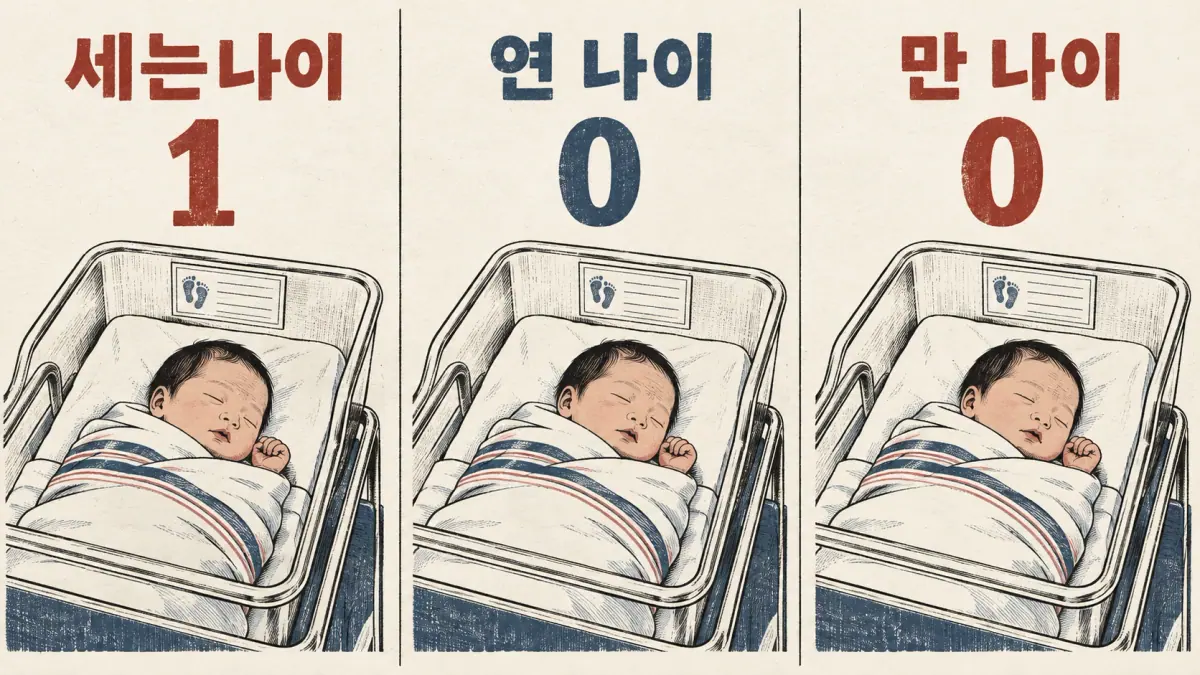
The three Korean age systems differ in two things: the age a baby has at birth, and the day on which a year is added. Counting age starts at 1 and changes on 1 January. Year age starts at 0 and also changes on 1 January. International age starts at 0 and changes on the birthday.
| System | Korean | Age at birth | One year added | Formula | Where used today |
|---|---|---|---|---|---|
| Counting age ("Korean age") | 세는나이, informally 한국 나이 | 1 | every 1 January | current year − birth year + 1 | informal speech only |
| Year age | 연 나이 | 0 | every 1 January | current year − birth year | a few specific laws |
| International age | 만 나이 | 0 | on the birthday | full years since birth | law, contracts, medicine, forms |
Three consequences follow from the table:
- Counting age is always the highest number. It is one year above international age after your birthday in a given year, and two years above it before your birthday.
- Year age is the same for everyone born in the same year. For the whole of 2026, everyone born in 2000 has a year age of 26, whatever their birthday.
- Only international age depends on the exact birth date. Two people born on 1 January and 31 December of the same year have the same counting age and year age, but different international ages for most of the year.
The prefix 만 in 만 나이 means "full, complete". On forms you will see it written before the number, as in 만 25세 (fully 25 years old). The formulas are easier to trust once you apply them to a real birth date.
Worked Example: One Person, Three Ages
Take a person born on 31 December 2000. The table shows their three ages on three dates.
| Date | Counting age (세는나이) | Year age (연 나이) | International age (만 나이) |
|---|---|---|---|
| 30 December 2022 | 23 | 22 | 21 |
| 31 December 2022 | 23 | 22 | 22 |
| 1 January 2023 | 24 | 23 | 22 |
On 1 January 2023, this person was 24 in counting age (2023 − 2000 + 1), 23 in year age (2023 − 2000) and 22 in international age (22 full years since birth). In Korean, those ages are 스물네 살, 스물세 살 and 스물두 살. The same person had three different correct answers to "How old are you?", which is exactly the confusion the law addressed.
A second, more typical example: someone born on 15 May 1995.
| Date | Counting age | Year age | International age |
|---|---|---|---|
| 1 March 2026 | 32 | 31 | 30 |
| 9 October 2026 | 32 | 31 | 31 |
Before the birthday in May, the gap between counting age and international age is two years (32 versus 30). After the birthday, it is one year (32 versus 31). That is why "Korean age is your age plus one" is only half true. In Korean, 31 and 32 are 서른한 살 and 서른두 살.
The extreme case is a baby born on 31 December. In counting age, that baby turned 2 the next day, at one day old. For the full step-by-step method with more dates, see how to calculate Korean age. The next question is why anyone counted this way in the first place.
Why Did Korea Use Counting Age?

Korea used counting age because traditional East Asian reckoning counted the year a person was born in as their first year of life, and everyone moved to the next year of life together at the New Year. China and Japan historically had similar systems. Under this logic, a newborn is "in their first year", so they are 1.
The shared New Year step had a social meaning. People of the same birth year aged together, and a birthday was a personal celebration rather than the moment the age number changed. Traditionally the step was linked to 설날 (Lunar New Year). In modern South Korea, counting age has been calculated from 1 January.
Korean everyday language still carries this history:
- 떡국 한 그릇 먹으면 한 살 더 먹는다. "If you eat a bowl of rice-cake soup, you get a year older." 떡국 is the traditional New Year dish.
- 나이를 먹다, literally "to eat age", is the ordinary way to say "to get older".
The tradition explains the habit. The legal history explains why it took until 2023 to settle the official meaning.
What Did the June 2023 Law Change?
The June 2023 law changed the default meaning of age in South Korean law and administration to international age, and it did so by amending two general laws rather than every individual statute. The timeline below summarises the steps, based on notices from the Ministry of Government Legislation (법제처).
- From the early 1960s: international age in the Civil Act. The Civil Act already calculated legal age in full years from birth; 1962 is the year usually cited. In theory, international age was the legal standard for decades.
- Before 2023: three systems in practice. Daily life used counting age, several specific laws used year age, and documents that simply said 나이 left room for disputes about which age was meant, for example in employment contracts and public notices.
- 2022: political decision. Unifying age counting was a pledge of the incoming government in 2022. The National Assembly passed the amendments in December 2022.
- 28 June 2023: entry into force. The amended Civil Act (민법) and Framework Act on Public Administration (행정기본법) took effect.
The two amendments do different jobs:
- The Civil Act now states that age is calculated in 만 나이, counting the day of birth, and expressed in years. For a child under one year old, age may be expressed in months. This is why Korean parents and doctors say 생후 십 개월 ("ten months after birth").
- The Framework Act on Public Administration applies 만 나이 to administrative matters, such as public services and official notices, unless a specific law says otherwise.
The phrase "unless a specific law says otherwise" is the key to what stayed the same.
What Did Not Change?

Several things did not change: a handful of laws kept year age, birth dates and ID numbers stayed exactly as they were, and social ranking by birth year continued. The list below covers the rules learners and visitors meet most often. Legal details can change, so check current text before relying on any single point.
- Alcohol and tobacco sales (청소년 보호법, Youth Protection Act). The law protects people under 19, but it treats everyone as an adult for this purpose from 1 January of the year in which they turn 19. Shops check the birth year, not the birthday.
- Military service (병역법, Military Service Act). The timing of the conscription examination and service obligations is tied to the year in which a man reaches a given age, so it remains year-based.
- School entry. Children start elementary school in March of the year after they turn six in international age, so a school class is still a group born in the same calendar year.
- Birth dates, ID numbers and documents. Nothing about a person's registered date of birth changed; only the method of reading it into an age.
- The legal age of adulthood. Adulthood under the Civil Act was already 19 in international age and remained so.
Expert insight: the exceptions all share one logic. Each groups people by birth year so that a whole cohort is treated the same on the same date, which is easier to administer than checking each birthday. That same cohort logic drives the social habits in the next section.
Do People Still Use the Old System?

Yes, partly. Counting age is no longer used in any official setting, but it still appears in conversation, especially among older speakers and in casual situations. Many younger speakers now give their international age by default, and some add 만으로 ("in international age") to be clear: 만으로 스물다섯 살이에요.
Why Koreans Ask Your Birth Year
Koreans often avoid the whole question by asking for a birth year: 몇 년생이에요? ("What year were you born?"). The answer, such as 이천 년생이에요 ("I was born in 2000"), is the same in every system. It tells both speakers instantly whether they are 동갑 (the same age), which matters because Korean speech levels and address terms depend on relative age.
If two people discover they were born in the same year, one might say 우리 동갑이네요 ("We're the same age!"), and they may move to casual speech more quickly. If one is older, the younger usually uses address terms such as 형, 언니, 오빠 or 누나 (older brother or sister terms, chosen by the speaker's and listener's gender) and keeps polite speech. The pages on Korean etiquette and age etiquette in Korea cover these customs in detail.
The 빠른 년생 Complication
One group complicates the birth-year shortcut. Under older school-entry rules, children born in January or February often started school with the previous year's cohort. Such people are called 빠른 년생 ("early-born"). Someone who is 빠른 2000년생 may treat people born in 1999 as 동갑, because they were classmates. This custom is fading as those rules no longer apply to new pupils, but adults still mention it.
Birthdays and Milestone Ages
Birthdays themselves are celebrated as before, on the date of birth: 생일 축하해요 ("Happy birthday"). The first birthday, 돌, was always counted from the actual birth date. The traditional 60th-birthday celebration, 환갑, marks the 60th birthday in international age, which was age 61 in counting age; this is a common source of confusion in older texts.
Social habits change more slowly than laws. For a learner, the practical question is what to say when someone asks your age.
How Does This Affect the Korean You Speak?
The change affects which number you give, not the grammar you use. You still say an age with native numbers and the counter 살 in conversation, and with Sino-Korean numbers and the counter 세 in formal writing. What changed is that the expected number is now your international age.
| Situation | Pattern | Example | English |
|---|---|---|---|
| Conversation | native number + 살 | 스물다섯 살이에요 | I'm 25 |
| Forms, news, notices | Sino number + 세 | 이십오 세 | 25 years old |
| Making it explicit | 만 + age | 만 이십오 세 / 만으로 스물다섯 살 | 25 in international age |
| Avoiding the issue | birth year + 년생 | 이천 년생 | born in 2000 |
The question also has three politeness levels. Use 몇 살이에요? with children or people clearly younger than you, 나이가 어떻게 되세요? with adults of similar age, and 연세가 어떻게 되세요? with someone clearly older. 연세 is the honorific word for age.
Expert insight (rule of thumb): if someone gives an age that seems one or two years high, ask 만으로요? ("In international age?"). The question is natural and polite, and it shows you understand the two systems. The number system rules for 살 and 세 are covered in the 살 counter and in Sino vs native Korean numbers; full phrases are in how to say age in Korean. Birth years use Sino numbers, explained in how to say years in Korean.
Visitors and residents from other countries often ask whether any of this applies to them.
Which Age Should You Use in Common Situations?
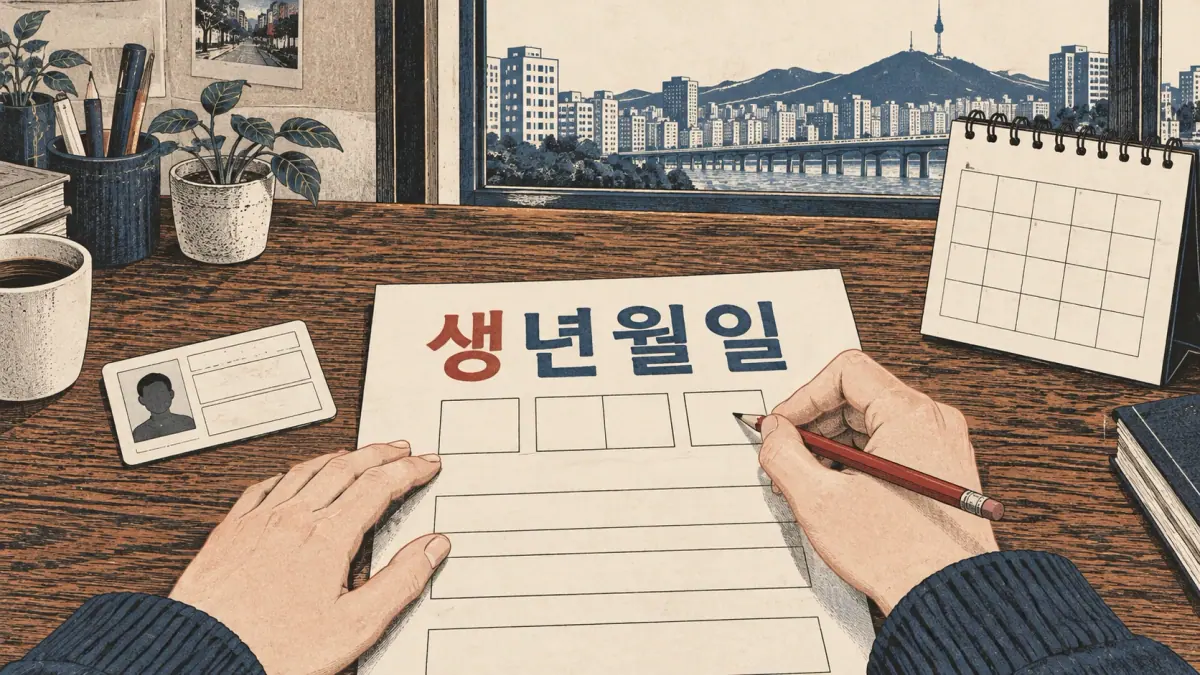
Use international age in every official or written situation, and expect a birth-year question in social ones. The table below covers the situations a learner or visitor meets most often.
| Situation | Age that applies | What you say or see |
|---|---|---|
| Hospital, pharmacy, insurance | International age | 만 나이; a baby's age in months |
| Visa, residence and job forms | International age, from your date of birth | 생년월일 (date of birth) field |
| Buying alcohol or tobacco | Year age | ID check of the birth year |
| Meeting new people | Usually birth year | 몇 년생이에요? |
| School class or university year group | Birth-year cohort, in practice | classmates are 동갑 |
| Older books, dramas and articles before 2023 | Often counting age | an age one or two years higher than today's convention |
| Celebrity profiles | Usually a full date of birth | work out the international age yourself |
The row on older media is the one learners forget. A drama character from 2015 who says she is 스물다섯 살 is probably using counting age, so her international age is 23 or 24. When you read Korean texts written before June 2023, treat any age as possibly counting age unless the text says 만.
Expert insight: forms rarely ask for an age at all. They ask for 생년월일 (date of birth) and let the system compute the age. Writing your date of birth in Korean order, year then month then day, avoids the question entirely. The same principle applies to everyone in Korea, including visitors.
Does the Law Apply to Foreigners in Korea?
Yes, within Korea. The 2023 rules describe how age is calculated in South Korean law and administration, so they apply to anyone dealt with under that system, whatever their nationality. A foreign resident's age on a contract, a hospital form or a government application is their international age, just as for a Korean citizen.
The exceptions apply equally. A visitor buying alcohol in a Korean convenience store is checked under the same year-based youth protection rule as everyone else. Outside South Korea, the Korean rules have no effect: a Korean citizen abroad follows local law. In conversation, nobody expects a foreigner to know their counting age, and giving your international age is always correct. Before relying on these rules, keep their limits in mind.
Common Misconceptions about the Change
Learners and news readers often repeat the same five misunderstandings. Each is corrected below.
- "Everyone became one or two years younger." Legally, most ages were already international ages. The change made that standard explicit and universal in official use; it changed expectations more than numbers.
- "Korean age is now illegal." No law forbids saying counting age. The law sets the meaning of age in official contexts only.
- "All Korean laws now use international age." Some laws, including those on alcohol, tobacco and military service, kept year age.
- "Korean age is always your age plus one." It is plus one after your birthday and plus two before it, within the same calendar year.
- "The drinking age went down." The year-based rule stayed, so the effective buying age did not change.
Practice: Work out Three Ages
Work out the counting age, year age and international age for each case, then check the answers below. Use the formulas from the comparison table.
- Born 20 August 2001. Date: 1 June 2026.
- Born 3 January 1990. Date: 10 January 2026.
- Born 25 December 2025. Date: 2 January 2026.
Answers:
- Counting age 26 (2026 − 2001 + 1), year age 25 (2026 − 2001), international age 24, because the August birthday has not yet come.
- Counting age 37, year age 36, international age 36, because the 3 January birthday has passed.
- Counting age 2, year age 1, international age 0. A baby eight days old would have been "two" in counting age; in international age the baby is 0, or 생후 팔 일 (eight days after birth).
If case 3 surprised you, it shows exactly why the official standard changed. The how to calculate Korean age page works through more birth dates step by step.
Limitations of This Explainer
This page explains the 2023 change for language learners. It is not legal advice, and it does not list every law that keeps a year-based rule. The legal descriptions follow notices from the Ministry of Government Legislation (법제처) and the Ministry of the Interior and Safety (행정안전부) as understood at the time of writing; laws can be amended again. For any decision with legal weight, check the current text on the Korean National Law Information Center (국가법령정보센터) or ask a qualified professional. Social usage also varies by age group and region, so descriptions of speech habits are typical patterns, not rules.
What to Learn Next
Put the systems into practice with how to calculate Korean age, which works through more birth dates step by step. Then learn the phrases in how to say age in Korean, and the number forms in the 살 counter. The Age in Korean section links every page on this topic. With Korean age abolished in official use, the most useful skill is knowing which number people mean in conversation.
Frequently Asked Questions
Is the drinking age in Korea affected by the 2023 change? No. The Youth Protection Act (청소년 보호법) kept its year-based rule, so the effective buying age for alcohol and tobacco did not change. In practice, a person may buy from 1 January of the year in which they turn 19 in international age. Shops check the birth year on an ID card, not the birthday.
Did everyone in Korea become one or two years younger? Not legally. Most legal ages had already been calculated in international age under the Civil Act, usually dated from 1962. What changed is the default: when a law, contract or official notice now says 나이 (age), it means 만 나이 unless it states otherwise. In daily speech, many people now give a number one or two lower than before.
Do Koreans still celebrate birthdays the same way? Yes. Birthdays (생일) are celebrated on the date of birth with seaweed soup (미역국) and cake, as before. The difference is the New Year: 1 January no longer adds a year in any official sense. Milestone birthdays such as the first birthday (돌) were always counted from the actual birth date.
Why do people say Korean age is "plus one"? "Plus one" is a simplification. Korean counting age is one year above international age after your birthday in a given year, and two years above it between 1 January and your birthday. Someone born in May 2000 was 24 in counting age for the whole of 2023, but 22 in international age until May and 23 afterwards.
At what age is someone an adult in South Korea? Under the Civil Act (민법), a person becomes a legal adult at 19 in international age (만 19세). That year-based rule is older than the 2023 change and was not altered by it. Separate laws keep their own rules: buying alcohol and tobacco is tied to the year in which a person turns 19, not to the birthday.