
Key facts
- Korean has roughly 80 million speakers worldwide, a rounded figure used by reference works.
- Overseas Koreans number about 7 million, but heritage is not the same as speaking the language.
How Many People Speak Korean?
About 80 million people speak Korean worldwide, counting first-language speakers in the two Koreas and speakers in overseas communities. Reference sources such as Ethnologue place the total in the high 70 millions to low 80 millions, depending on the edition. Treat 80 million as a good round figure, not an exact count.
The easy way to see where the number comes from is to add it up.
| Group | Rounded figure | How it is counted |
|---|---|---|
| South Korea | about 51 million | resident population, from Statistics Korea (KOSTAT) |
| North Korea | about 26 million | population estimates from the United Nations |
| The two Koreas together | about 77 million | 51 + 26 |
| Overseas speakers | a few million | a portion of the roughly 7 million overseas Koreans |
| Worldwide total | about 80 million | 77 million plus overseas speakers |
The sum shows that the two Koreas account for almost everyone. Overseas communities add a few million more, but not all of them speak Korean well. The next section looks at each part in turn, because "80 million" hides a lot of differences.
The word for the Korean language in South Korea is 한국어 (hangugeo) or 한국말 (hangungmal, [한궁말]). Learners often see 국어 (gugeo, "the national language") in school contexts. All of these point to the same language, and the names for it differ by place, as shown later.
How Are Speakers Split by Country?
Speakers are split mainly between South Korea and North Korea, with overseas communities making up the rest. In South Korea, almost every resident speaks Korean as a first language, with foreign-born residents and long-term visitors as the main exceptions. In North Korea, Korean is the language of the whole country, with fewer English loanwords than in the South.
| Region | Approximate Korean speakers | Notes |
|---|---|---|
| South Korea | about 51 million | nearly all residents; official language |
| North Korea | about 26 million | nearly all residents; official language |
| China | more than a million ethnic Koreans | many in Yanbian and the northeast; many bilingual in Chinese |
| United States | about two million Korean Americans | a smaller number are fluent; many are second generation |
| Japan | several hundred thousand Koreans | many Zainichi Koreans speak Japanese first |
| Central Asia and Russia | hundreds of thousands | many Koryo-saram speak Russian first |
The rows for overseas countries show heritage populations, not fluent speakers, and they are deliberately rounded. For the exact latest numbers of overseas Koreans (재외동포, jaeoedongpo), see the Ministry of Foreign Affairs of the Republic of Korea (mofa.go.kr), which publishes country tables.
Two terms matter here. A first-language speaker (모어 화자, moeo hwaja) learned Korean as a child. A heritage speaker is someone from a Korean family who may understand Korean at home but speaks another language outside it. Both appear in "speaker" counts, and mixing them is the main reason that estimates differ. The next section lists the others.
Why Do Estimates Differ?
Estimates differ because sources define "speaker" differently, count in different years and have little data for some countries. When you see two numbers for Korean speakers, check these five points before deciding which is right.
- First language or total speakers. Some lists count only people whose first language is Korean. Others add second-language speakers. Korean has few second-language speakers compared with its native speakers.
- Heritage or fluency. A census of Korean heritage in another country counts people with Korean ancestry. It does not test their Korean.
- The year. South Korea's population is counted by KOSTAT every year, and a figure of 51 million is rounded from a figure that moves slightly each year. Ethnologue updates yearly, and reprints may lag.
- North Korea. North Korea has few censuses, and international estimates depend on UN projections. The figure of about 26 million is a projection, not a head count in the current year.
- Which varieties count. Standard Korean and regional dialects are normally counted together. Jejueo (Jeju language) is sometimes counted separately, but its speakers are few, and the effect on the total is small.
Expert insight: the gap between sources is usually a few million, not tens of millions. If a page gives a number far outside 75 to 85 million, it is probably mixing heritage and speakers or using an old edition.
Where Are the Largest Overseas Korean Communities?
The largest overseas Korean communities are in the United States, China and Japan, followed by Canada, Central Asia, Russia and Australia. They formed in different periods, and that history explains how much Korean each community speaks today.
| Country | Community name | Short history | Language today |
|---|---|---|---|
| United States | Korean Americans (재미동포) | large migration from the 1960s, with earlier smaller groups | many speak English first; Korean is strong in churches and shops |
| China | Chosunjok (조선족, joseonjok) | settled in the northeast from the 19th century | Korean schools and media in Yanbian, with Chinese widely used |
| Japan | Zainichi Koreans (재일동포) | many arrived during the first half of the 20th century | most speak Japanese first; Korean schools and newer arrivals keep Korean alive |
| Uzbekistan, Kazakhstan, Russia | Koryo-saram (고려인) | moved from the Russian Far East to Central Asia in 1937 | Russian is common; older people may speak the Koryo-mal dialect |
| Canada, Australia | recent migrants and students | growing since the late 20th century | mixed; many first-generation speakers |
Two consequences follow. First, a large heritage population does not mean a large Korean-speaking one. Second, overseas Korean varies from the standard. The Korean of Central Asia, called 고려말 (goryeomal), preserves features of the northern dialects of the 19th century and is spoken by shrinking numbers of older people, while newcomers speak the Seoul standard.
For the learner, the practical message is that you can find Korean speakers in many large cities, especially in Koreatowns, but you will meet the greatest variety of speech in Korea itself.
Is Korean an Official Language outside Korea?
Korean is an official language of South Korea and North Korea, and it has regional official status in the Yanbian Korean Autonomous Prefecture of China. It is not a national official language in any other country, though it is taught in schools and universities in many.
In South Korea, the Framework Act on the Korean Language (국어기본법, gugeogibonbeop) sets rules for using and protecting Korean. The standard language (표준어, pyojuneo) is defined by the National Institute of Korean Language (국립국어원). In North Korea, the standard is called 문화어 (munhwaeo, "cultured language") and is based on the speech of Pyongyang. The differences between the two standards are small in grammar but visible in vocabulary and spelling.
| Place | Name for the language | Romanization | Notes |
|---|---|---|---|
| South Korea | 한국어 / 국어 | hangugeo / gugeo | standard based on Seoul speech |
| North Korea | 조선말 / 조선어 | joseonmal / joseoneo | standard 문화어 based on Pyongyang speech |
| China (Yanbian) | 조선어 / 한국어 | joseoneo / hangugeo | both names appear; regional official language |
| Central Asia | 고려말 | goryeomal | the speech of the Koryo-saram |
The two Koreas use different names because the names of the states differ: 한국 (Hanguk) in the South and 조선 (Joseon) in the North. The speakers understand each other, though the North uses fewer English loanwords and some different vocabulary. A full comparison of the two standards belongs on a separate topic page about North and South Korean language.
How Does Korean Rank Among World Languages?
Korean usually ranks somewhere around 15th to 25th among world languages, depending on the list, the year and whether it counts first-language or total speakers. Lists published by Ethnologue and similar reference works place it well behind the largest languages, such as English, Mandarin Chinese, Hindi and Spanish, and close to languages of a similar size, such as Vietnamese and Turkish.
Instead of one rank, remember three points.
- Size. About 80 million total speakers puts Korean among the world's larger languages, though far below the top few with hundreds of millions.
- Concentration. Almost all Korean speakers live in two countries on one peninsula, unlike English or Spanish, which are spread across continents.
- Reach. The language has a large cultural reach for its size, through music, television, film, games and food, which draws learners from many countries.
Because the rank depends on the list, the safest sentence is "Korean is one of the world's larger languages, with about 80 million speakers." That is accurate for any recent source.
How Many People Are Learning Korean?
No dependable global count of Korean learners exists, so this page gives none. Learners study in schools, universities, language institutes, online courses and apps, and no single organisation counts them all. Be cautious with any single worldwide figure, especially one without a named source and year.
Some partial sources exist.
- The King Sejong Institute (세종학당, sejonghakdang) network runs Korean classes abroad and publishes its own enrolment reports.
- The TOPIK test, run by the National Institute for International Education (NIIED), reports on registered test takers each year. Check the official site, topik.go.kr, for exam facts.
- National education systems in some countries add Korean as a foreign language subject.
None of these counts everyone who studies, so they are lower bounds. If you need a learner figure for a report, cite the specific source, the year and what it counts.
How Do You Say These Numbers in Korean?
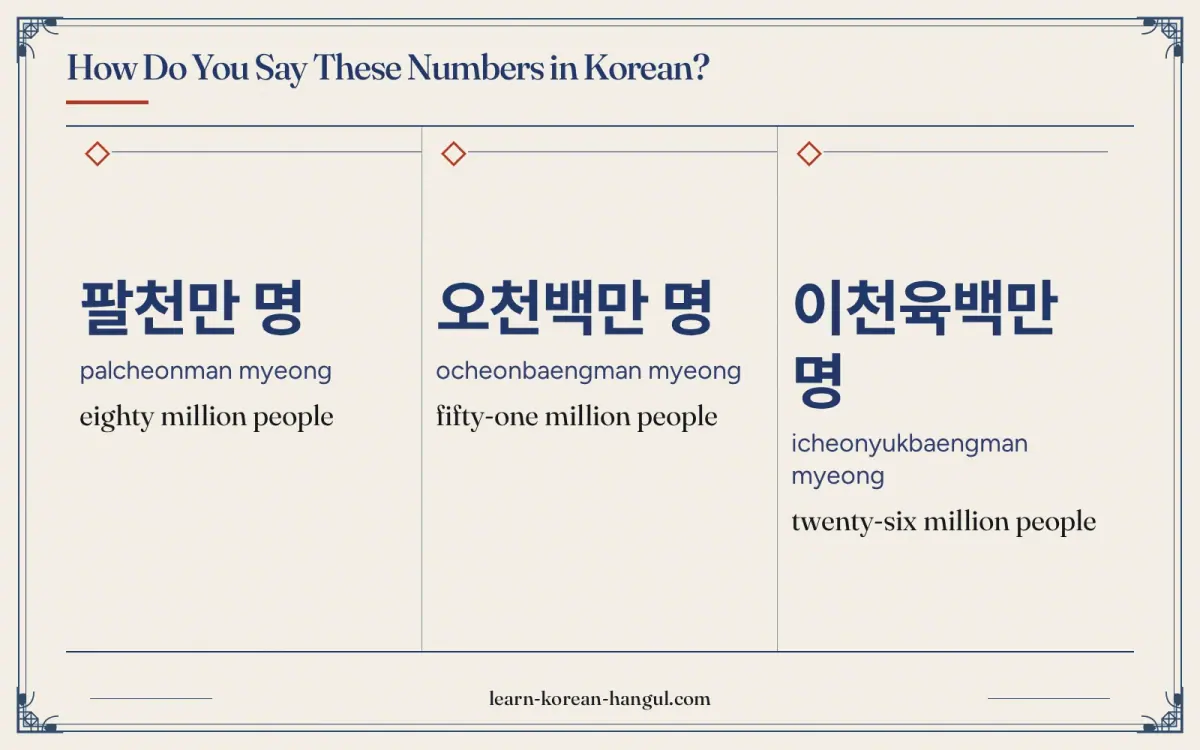
You can say the main figures aloud with the Sino-Korean numbers, grouped in units of 만 (man, ten thousand). Large numbers are the hardest part, because Korean counts in ten-thousands, not thousands. Practise the three figures from this page.
| Figure | Korean | Romanization | Meaning |
|---|---|---|---|
| 80 million | 팔천만 명 | palcheonman myeong | eighty million people |
| 51 million | 오천백만 명 | ocheonbaengman myeong | fifty-one million people |
| 26 million | 이천육백만 명 | icheonyukbaengman myeong | twenty-six million people |
To read 팔천만, think of it as 팔천 (8,000) times 만 (10,000), which gives 80,000,000. The counter for people is 명 (myeong), spaced after the number. A full sentence is 한국어 사용자는 약 팔천만 명이에요 (hangugeo sayongjaneun yak palcheonman myeongieyo), "There are about 80 million Korean speakers". The word 약 (yak) means "about". For other counters, see how to count people in Korean.
Which Korean Words Describe Speakers and Populations?
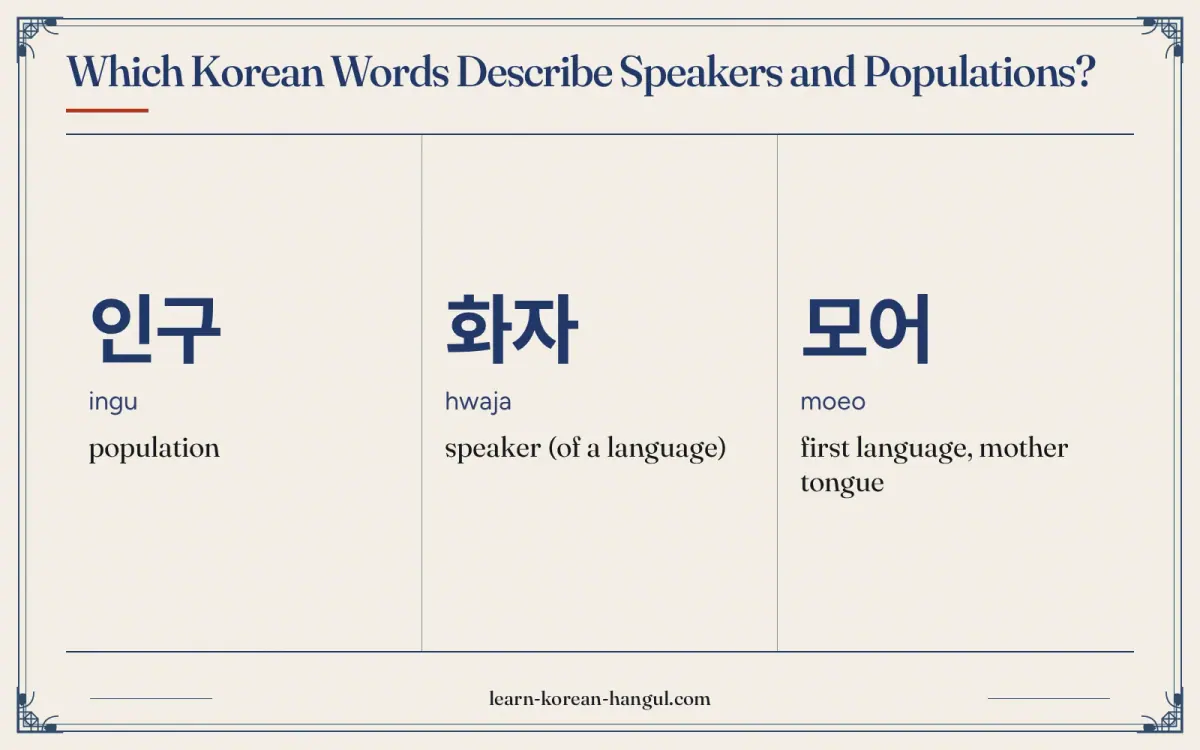
A few Korean words appear in articles about language statistics. Knowing them helps if you read Korean news or Wikipedia pages on this topic.
| Korean | Romanization | Meaning |
|---|---|---|
| 인구 | ingu | population |
| 화자 | hwaja | speaker (of a language) |
| 모어 | moeo | first language, mother tongue |
| 사용자 | sayongja | user |
| 재외동포 | jaeoedongpo | overseas Koreans |
| 한민족 | hanminjok | the Korean people |
In Korean sources, you may see 한국어 화자 (hangugeo hwaja) used for "Korean speakers" and 한국어 사용 인구 (hangugeo sayong ingu) for "the Korean-speaking population". Both fit the same definition problem described earlier, so the same checks apply.
How Should You Test a Claim about Korean Speakers?
Test any speaker claim by asking what is counted, where the number comes from and which year it applies to. Here are three typical claims and how to treat them.
| Claim | Problem | Safer wording |
|---|---|---|
| "Korean is spoken by 51 million people." | counts only South Korea | "About 51 million people live in South Korea, where Korean is the official language." |
| "There are 7 million Korean speakers abroad." | counts heritage, not fluency | "About 7 million people of Korean heritage live abroad; the number who speak Korean is lower." |
| "Korean is the 10th most spoken language." | no list or year named | "Korean ranks around 20th in common lists, depending on what they count." |
The habit is useful beyond this topic. Whenever a statistic about languages looks too neat, ask for the definition, the source and the date. The same questions help with any figure in a language-learning blog.
Who Counts as a Speaker?
A "speaker" can mean very different levels of ability, and each count draws the line in a different place. Four types appear in discussions of Korean.
| Type | Korean term | Typical description | Usually counted? |
|---|---|---|---|
| First-language speaker | 모어 화자 (moeo hwaja) | learned Korean as a child and uses it daily | yes, in every count |
| Heritage speaker | 계승어 화자 (gyeseungeo hwaja) | grew up with Korean at home but uses another language outside | sometimes, depending on the survey |
| Second-language speaker | 제2언어 화자 (jeieoneo hwaja) | learned Korean as a teenager or adult and uses it at work or study | rarely, and with different cutoffs |
| Learner | 학습자 (hakseupja) | is studying Korean and can handle basic exchanges | almost never |
This ladder explains why the headline number is a floor for people who can use Korean in some way, and a ceiling for people who use it as their only language. If a source says "native speakers", it counts only the first row. If it says "speakers", ask which rows it includes. A learner who finishes a beginner course can follow simple conversations, but no census would list that person as a speaker.
The ladder also shows why growth in learners does not change the main count quickly. Even a large rise in learners would add little to a total of tens of millions, because learners are counted in a separate category or not at all.
What Do These Numbers Mean for Learners?
For a learner, the numbers show that Korean is a large, living language that you can use with tens of millions of people. They do not tell you how hard Korean is or how many people you will meet, but they change a few practical choices.
- Standard Korean is the target. With nearly 80 million speakers in two countries that share the same base grammar, the standard language (based on Seoul) is understood everywhere. Learn it first, then explore dialects. The pages on Korean accents and dialects and the Jeju dialect explain the variety.
- Expect a mix of ages and registers. Because speakers live in every kind of setting, from schools and offices to family homes, you will hear polite, casual and regional speech. Start with polite 요 endings.
- You will find speakers abroad, but not always fluent ones. Heritage speakers can be warm and welcoming, and many are glad to practise with learners.
If you are new to the language, learn Korean for beginners is a good place to begin, and the first step is the Hangul alphabet.
What Are the Limits of These Figures?
All figures on this page are rounded, and some are projections. South Korea's number comes from national statistics, North Korea's from international estimates, and overseas figures from government reports of heritage populations. Languages are not counted like cars. The edges are fuzzy, and a person can speak a language a little or very well.
Check the latest editions before you quote a figure. Statistics Korea (kostat.go.kr) for South Korea, the United Nations World Population Prospects (population.un.org) for North Korea, Ethnologue (ethnologue.com) for language totals and the Ministry of Foreign Affairs (mofa.go.kr) for overseas Koreans are the sources named in this page.
The Bottom Line
How many people speak Korean? About 80 million. Most of them, about 77 million together, live in South Korea and North Korea, and a few million more speak it in overseas communities. Because sources define "speaker" differently, treat 80 million as a rounded figure and always check what a number counts.
To go deeper, read about the Korean language family to see where Korean sits among the world's languages, or about Korean language history to see how the standard language developed.
Frequently Asked Questions
Is Korean spoken outside Korea?
Yes. Large Korean communities live in the United States, China, Japan, Canada, Central Asia, Russia and Australia. Korean is widely heard in these places, though many second-generation speakers use the local language first. Yanbian in China keeps Korean schools and media, and Korean churches and shops help keep the language alive abroad.
Which country has the most Korean speakers?
South Korea has the most, with about 51 million residents who speak Korean as a first language. North Korea comes next with about 26 million. No other country comes close, because overseas communities number in the hundreds of thousands to a couple of million, and not all of their members are fluent speakers.
Is Korean an official language elsewhere?
Korean is the official language of South Korea and North Korea. It also has regional official status in the Yanbian Korean Autonomous Prefecture in China, where Korean schools and signs are common. Elsewhere, it is a community and school language, not a national official one, though many universities teach it.
How many people are learning Korean?
No reliable worldwide figure exists, because learners study in schools, institutes, apps and self-study, and no body counts them all. Partial sources include King Sejong Institute enrolment reports and TOPIK registration reports. Check topik.go.kr for exam facts, and cite the source and year if you quote a number.
Why do sources give different numbers?
Sources differ in what they count and when. Some count first-language speakers, some add second-language speakers, and some count people of Korean heritage. North Korea's population is an estimate, and editions are published in different years. Check the definition and the year before comparing two figures.