
Korean language facts start with scale: Korean is the official language of South Korea and North Korea and is spoken by roughly 80 million people worldwide, according to commonly cited estimates. It is written in Hangul, puts the verb at the end of the sentence, and has no proven relative outside the small Koreanic family.
Korean Language Facts: the Essentials

The fact sheet gathers the basics a learner is most often asked about. Each row names the attribute, the value and, where it matters, the source or the debate.
| Attribute | Value |
|---|---|
| Name of the language | 한국어 (hangugeo) or 한국말 in South Korea; 조선말 or 조선어 in North Korea |
| Official status | official language of South Korea and North Korea |
| Speakers | roughly 80 million, mainly in the two Koreas, with large communities in China, Japan, the United States, Russia and Central Asia; estimates vary by source and year |
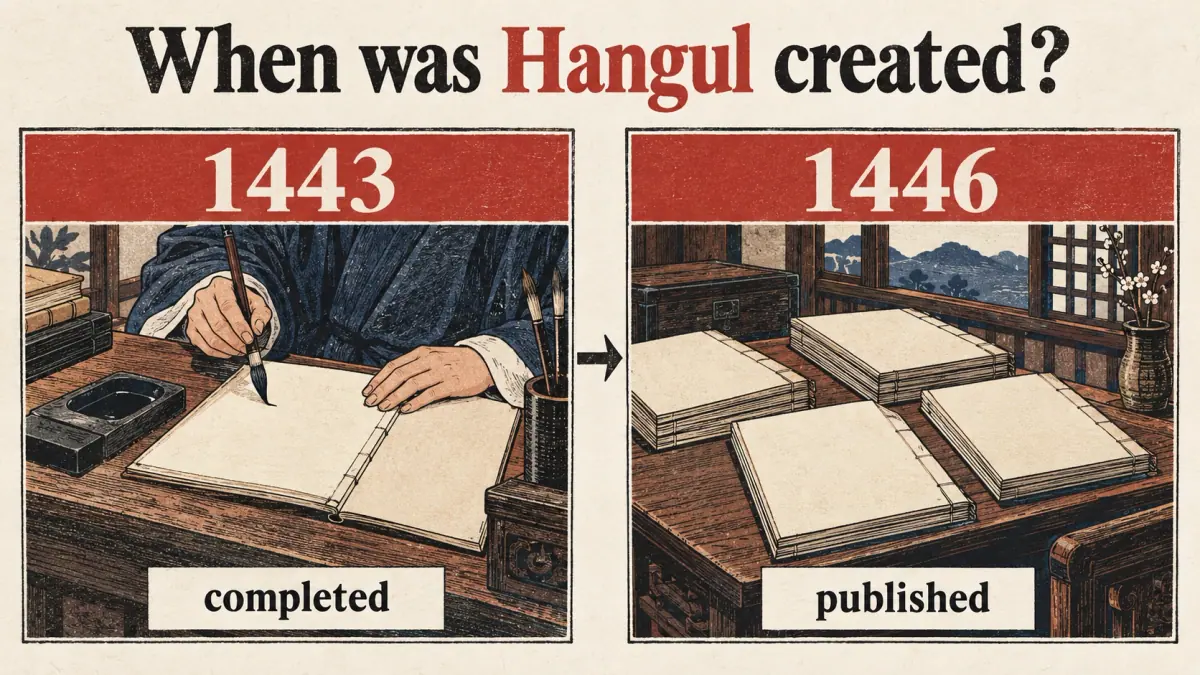
| Writing system | Hangul (한글), created under King Sejong in 1443 and published in 1446; Chinese characters (hanja) appear occasionally |
| Letters | 24 basic letters (14 consonants and 10 vowels), 40 in everyday use |
| Word order | subject, object, verb: 저는 사과를 먹어요 (I an apple eat) |
| Grammar type | endings and particles attach to words to mark their role, tense and politeness |
| Language family | Koreanic; often described as a language isolate |
| Standard forms | 표준어 (pyojuneo), based on Seoul speech, in the South; 문화어 (munhwaeo), based on Pyongyang speech, in the North |
The word-order row is the fact with the biggest effect on learning. In 저는 사과를 먹어요, the verb 먹어요 (eat) comes last, and the particles 는 and 를 mark the topic and the object. English speakers have to wait for the verb, while Japanese speakers find the order familiar.
저는 사과를 먹어요.
jeoneun sagwareul meogeoyo.
I eat an apple.
Some of the rows above are also popular myths in a slightly wrong form. The next section separates them.
Which Common Claims about Korean Are Myths?

Several claims about Korean circulate widely but are wrong or oversimplified. The list gives each claim and the more accurate statement.
- "Hangul is the Korean language." Hangul (한글) is the alphabet; the language is Korean (한국어). You can write Korean words in other scripts, and Hangul can spell foreign words.
- "Korean is a dialect of Chinese." Korean and Chinese belong to different language families with different grammar. Korean borrowed many words from Chinese, the way English borrowed from Latin and French.
- "Korean and Japanese are proven relatives." The grammar is similar, but no relationship has been proven to the satisfaction of most linguists. Similar grammar can also come from long contact.
- "Hangul has 24 letters, full stop." There are 24 basic letters, but everyday writing uses 40 once double consonants and combined vowels are counted. The Korean alphabet letter count page explains each total.
- "Korean is a tonal language." Standard Seoul Korean has no word tones. Some dialects, such as Gyeongsang speech in the southeast, use pitch to tell words apart.
- "North and South Koreans speak different languages." They speak one language with two standards. Vocabulary, spelling rules and loanwords differ, but speakers understand each other.
The pages in this subhub explain each of these facts in depth.
What Pages Are in This Subhub?

This subhub groups the language-fact pages into three sets: speakers, origins and history, and dialects. Pages on the history of Hangul and on regional dialects are linked here as well.




Speakers
How many people speak Korean breaks the roughly 80 million figure down: about 51 million people in South Korea, about 26 million in North Korea and about 7 million people of Korean heritage overseas, not all of whom speak the language. Totals differ mainly because sources count heritage speakers in different ways.
Korean outside the two Koreas is not uniform. In China's Yanbian Korean Autonomous Prefecture, Korean is used alongside Chinese in schools, signs and media, and the local speech is close to the northern dialects. Koreans in Central Asia, known as Koryo-saram, speak a variety called 고려말 (goryeomal, usually written Koryo-mal in English), which grew from northeastern dialects after the 1937 deportation from the Russian Far East. Korean communities in Japan and the United States mostly speak Seoul-based Korean, often as a heritage language beside Japanese or English. These varieties are one reason speaker totals are hard to pin down.
Origins and History
Korean language family explains what "language isolate" means, why most specialists now reject the Altaic theory, and why Jejueo leads many linguists to speak of a small Koreanic family. Korean language history traces the stages from Old Korean through Middle and Early Modern Korean to today's standard based on Seoul speech.
The writing side of that history is already published. The history of Hangul covers the alphabet from its creation in 1443 to Hangul Day, and who invented Hangul covers King Sejong and the scholars around him.
Dialects and North vs South
The Korean dialects section describes the main regional varieties and how they sound. It includes standard Korean, the Gyeongsang dialect with its pitch accent, and the Jeju dialect, which many linguists treat as a separate Koreanic language. North vs South Korean language compares the two standards, 표준어 and 문화어, in sounds, spelling and vocabulary.
Is Hangul the Language or Only Its Alphabet?
Hangul is only the alphabet. The language is Korean, called 한국어 in the South, and Hangul is the script used to write it. Learners often say "learning Hangul" when they mean learning Korean, but reading Hangul takes days while learning the language takes years. The Korean alphabet hub teaches the script.
How Sure Are These Korean Language Facts?

The facts on this page fall into three groups by certainty, and each page in the subhub says which group a claim belongs to.
- Fixed facts: the official status, the subject-object-verb order and the letter counts. These are the same in every reliable source, and the letter counts follow the standard orthography.
- Dated facts: speaker numbers. These are estimates from reference works and censuses, so pages give the source and the year.
- Debated facts: the language family and early history. Here pages say who holds which view and why, instead of picking a side without evidence.
Dates for Hangul follow the Hunminjeongeum record: the letters were completed in the 12th lunar month of 1443 and published with an explanation in 1446. A practical limit of this subhub: it explains what Korean is, not how hard it is to learn. Difficulty questions are answered in is Korean hard to learn.
Frequently Asked Questions
How many people speak Korean?
Roughly 80 million people speak Korean, according to commonly cited estimates. Most live in South Korea and North Korea, and large communities live in China, Japan, the United States, Russia and Central Asia. Totals differ between sources because they count heritage speakers and second-generation emigrants in different ways, so always check the year.
Is Korean related to Japanese?
No relationship has been proven. Korean and Japanese share subject-object-verb order, particles after nouns and many Chinese-origin words, but most linguists treat these as the result of long contact and similar structure, not common ancestry. Korean is usually classed as Koreanic, a small family often described as a language isolate.
When was Hangul created?
Hangul was completed in the 12th lunar month of 1443 under King Sejong of the Joseon dynasty. It was published in 1446 in the text Hunminjeongeum, with an explanation of how the letters work. South Korea celebrates Hangul Day on 9 October, a date based on that 1446 publication.
Do North and South Korea speak the same language?
Yes. North and South Koreans speak one language and understand each other, but each country has its own standard: 표준어, based on Seoul speech, and 문화어, based on Pyongyang speech. They differ in some vocabulary, spelling rules and loanwords, and the North replaced more English loanwords with native Korean words.
Is Korean related to Chinese?
No. Chinese belongs to the Sino-Tibetan family, uses tones and puts the verb before the object, while Korean puts the verb last and uses particles and endings. Korean did borrow a large share of its vocabulary from Chinese, called Sino-Korean, much as English borrowed from Latin and French.
Where to Go Next with Korean Language Facts
Read Korean compared with Japanese, Chinese and English to see how these facts compare with languages you know, or Korean names for one of the most visible parts of Korean language facts in daily life. All four culture sections are on the Korean language and culture hub.