
Key facts
- Korean is often called a language isolate, or the main member of a very small Koreanic family.
- The Altaic hypothesis (Turkic, Mongolic, Tungusic with Korean and Japanese) is rejected by most specialists today.
- A Korean-Japanese link has been proposed for over a century, but regular sound correspondences have not been shown.
What Is the Korean Language Family?
The Korean language family is called Koreanic, and it contains Korean and Jejueo, the language of Jeju Island. Linguists use the name Koreanic for this small group, much as they use Romance for the descendants of Latin. Because the family is so small and no firm link to another family exists, many scholars also call Korean a language isolate.
Both labels are used, and they do not conflict. They answer slightly different questions.
| Question | Answer | Label |
|---|---|---|
| Does Korean have close relatives? | Yes, Jejueo, if it is counted as a separate language | Koreanic family |
| Does Korean have proven relatives outside that group? | No | language isolate (at the family level) |
| Is Korean connected to Altaic or Japonic? | proposed, debated, not proven | hypothesis |
If you count Jejueo as a dialect of Korean, then Korean is a pure isolate. If you count Jejueo as a separate language, then Korean belongs to a two-member family. The classification of Jejueo is discussed later on this page.
In Korean, a language family is a 어족 (eojok), and the study of how languages descend from each other is 언어 계통론 (eoneo gyetongnon). The word 계통 (gyetong) means "lineage" or "line of descent". A language isolate is called a 고립 언어 (gorip eoneo) or 고립어 (goribeo), although 고립어 can also mean an "isolating language" in the Chinese-type sense, which is a different idea. On this page "isolate" always means a language without proven relatives.
Let us clear up the terms first.
What Does "Language Isolate" Mean?
A language isolate is a language with no demonstrated relatives. It is not a "mystery" or an "unrelated" language in a magical sense. It simply has no known sister language that linguists can show to descend from the same ancestor.
Other well-known isolates are Basque in Europe and Burushaski in the Himalayas. A language can be an isolate because its relatives died out without a record, because it split so long ago that the evidence is too faint to recover, or because it never had close relatives.
Here are the main terms in one place.
| Term | Plain-English meaning | Example |
|---|---|---|
| Language family | a group of languages that descend from one ancestor | Romance: French, Spanish, Italian, Romanian |
| Language isolate | a language with no demonstrated relatives | Basque, Burushaski |
| Koreanic | the small family of Korean and Jejueo | Korean, Jejueo |
| Altaic | a proposed family of Turkic, Mongolic and Tungusic, sometimes with Korean and Japanese | disputed |
| Japonic | the family of Japanese and the Ryukyuan languages | Japanese, Okinawan |
| Language contact | languages influencing each other without being related | Korean and Chinese vocabulary |
Notice the last row of the table. Languages that borrow heavily from each other are not necessarily related. This distinction between inheritance and borrowing runs through the whole topic, so the next section explains how linguists tell them apart.
How Do Linguists Decide That Languages Are Related?
Linguists decide that languages are related by finding regular sound correspondences in basic vocabulary and shared grammar that cannot be explained by borrowing or chance. This is called the comparative method. A single similar word is never enough.
A simple example from English and German shows the idea.
| English | German | Pattern |
|---|---|---|
| water | Wasser | t in English, ss in German |
| that | das | th in English, d in German |
| pepper | Pfeffer | p in English, pf in German |
| apple | Apfel | p in English, pf in German |
The pattern is regular: English p regularly matches German pf, English t matches German ss, and so on, across hundreds of words. The same method links Latin, Greek and Sanskrit in the Indo-European family. Three types of evidence matter.
- Sound correspondences. The same sound changes appear across many words in the same way.
- Core vocabulary. Words such as body parts, numbers, pronouns and "water" or "fire" are rarely borrowed, so matches there are strong evidence.
- Grammatical forms. Matching endings and word forms that cannot be borrowed easily, such as irregular verb forms, suggest shared descent.
Three things look like evidence but are weak.
- Typology. Sharing a word order (such as subject-object-verb) or suffix-based grammar does not prove a family tie, because many unrelated languages share these.
- A few look-alike words. With thousands of words in each language, some will match by chance.
- Loanwords. Borrowed words match perfectly but say nothing about shared ancestry. Korean and Japanese both borrowed from Chinese, so many Chinese-based words resemble each other.
This is why the Korean case is difficult. Korean has a strong typological similarity with Japanese and with Turkic, Mongolic and Tungusic languages, but regular correspondences in core vocabulary have not been agreed on. The following sections show the two main proposals.
What Is the Altaic Hypothesis?
The Altaic hypothesis proposes that Turkic, Mongolic and Tungusic languages (and, in some versions, Korean and Japanese) descend from one ancestor. It was developed in the 19th and 20th centuries, and the Finnish linguist G. J. Ramstedt argued in the early 20th century that Korean belonged to the group.
The proposal rests on a list of shared features.
| Feature | Korean example | Also found in |
|---|---|---|
| Subject-object-verb order | 저는 밥을 먹어요 (jeoneun babeul meogeoyo, "I eat rice") | Turkic, Mongolic, Tungusic, Japanese |
| Suffixes added in a chain (agglutination) | 먹-었-겠-습니다 (meok-eot-get-seumnida) | the same languages |
| No grammatical gender | no he/she distinction in verbs | the same languages |
| Modifiers before nouns | 큰 집 (keun jip, "big house") | the same languages |
| Partial vowel harmony | -아 / -어 endings (가-아요 → 가요, 먹-어요) | Turkic and Mongolic have stronger harmony |
Most specialists today reject the Altaic family for three reasons. First, critics such as Gerard Clauson and Gerhard Doerfer argued in the 20th century that many proposed shared words are loanwords between neighbouring languages, not inherited words. Second, the shared features, such as word order and suffix chains, are common worldwide. Third, the proposed sound correspondences have not convinced the wider field. A few researchers still defend a version of Altaic, for example in a 2003 etymological dictionary by Sergei Starostin and colleagues, but the family is not accepted as established.
A newer proposal, the Transeurasian hypothesis put forward by Martine Robbeets in the 2010s, groups Japonic, Koreanic, Tungusic, Mongolic and Turkic. It argues that the languages share an origin in early farming communities of Northeast Asia, and that earlier work failed to separate inherited words from borrowed ones. It remains a minority view that many linguists regard with caution.
So, for a learner, the safest summary is: Altaic is a debated proposal, not an established fact. The next question comes up even more often.
How Has the Debate Developed?
The debate over Korean's relatives is more than a century old, and each stage added a new idea or a new objection. This short timeline shows the main steps, as commonly cited in the linguistic literature.
| Period | Development |
|---|---|
| Early 20th century | The Finnish linguist G. J. Ramstedt proposes that Korean belongs with the Altaic languages (his study of Korean appeared in 1928). |
| 1950s to 1970s | Critics such as Gerard Clauson (1956) and Gerhard Doerfer argue that proposed Altaic matches are loanwords or chance. |
| 1966 | Samuel E. Martin publishes a paper on lexical evidence for a Korean-Japanese link. |
| 2003 | Sergei Starostin and colleagues publish an etymological dictionary defending the Altaic family. |
| 2010s onward | Martine Robbeets develops the Transeurasian hypothesis, which places Japonic and Koreanic in a wider family and uses archaeology and genetics alongside language. |
Dates and attributions here follow common summaries, and the details of each work are more complicated than a table can show. The pattern is clear, though: proposals arrive, critics test the evidence, and the field has so far not reached agreement. That is why careful writers say "unproven" and "debated" instead of "false" or "true".
Is Korean Related to Japanese?
Korean and Japanese are not proven to be related, though they share grammar, a layer of Chinese-based vocabulary and a long history of contact. Linguists have proposed a Korean-Japanese link since the 19th century, and Samuel E. Martin published a well-known 1966 paper arguing for a set of matching words. The field has not accepted it as proven, because regular sound correspondences in core vocabulary have not been agreed on.
The reasons people suspect a link are easy to see.
- Word order and particle systems are very close.
- Both languages have layered honorific systems.
- Both borrowed heavily from Chinese, which produces many similar-sounding words.
The reasons for caution are equally clear.
- Most of the similar vocabulary is Chinese-based, so it shows contact, not ancestry.
- The native (non-Chinese) core words, such as the words for "water", "fire" or "eye", do not match in a regular way.
- The sound systems and verb endings differ in important ways.
| Word | Korean | Japanese | Source |
|---|---|---|---|
| school | 학교 (hakgyo) | 学校 (gakkō) | both borrowed from Chinese |
| water (native) | 물 (mul) | 水 (mizu) | different native words |
| mountain | 산 (san) / 뫼 (moe) | 山/やま (yama) | Korean has the Chinese-based 산 and the older native 뫼, which do not match yama |
Some researchers propose that a Japonic language was once spoken on the Korean Peninsula, before Korean-speaking groups spread south, and that traces remain in old place names. This idea is also debated. For a full comparison with examples, read is Korean related to Japanese and the grammar comparison in Korean vs Japanese grammar difficulty.
Is Korean Related to Chinese?
No. Korean is not related to Chinese, though it has borrowed a large amount of vocabulary from it. Chinese belongs to the Sino-Tibetan family, with tones and a very different grammar. Korean has no tones and a very different sentence structure, and its verbs take endings.
The influence is still very large. Chinese-based words, called Sino-Korean words (한자어, hanja-eo), are commonly cited as making up more than half of the headwords in Korean dictionaries. In everyday speech the share is smaller, because native words are used for many very common ideas. Sino-Korean words are especially common in formal, academic and technical vocabulary.
| Idea | Native Korean word | Sino-Korean word |
|---|---|---|
| mountain | 뫼 (moe, old) | 산 (san) |
| river | 가람 (garam, old) | 강 (gang) |
| number system | 하나, 둘, 셋 | 일, 이, 삼 |
| school | no common native word | 학교 (hakgyo) |
The two number systems are the most visible result of this layering. Korean uses native numbers for ages and hours and Sino-Korean numbers for dates, money and phone numbers. The same mixed layering explains why some Korean words resemble Chinese or Japanese words yet are unrelated by descent.
What Is Jejueo?
Jejueo (제주어, Jejueo) is the traditional language of Jeju Island, and it is the closest known relative of Korean. It differs so much from standard Korean that most Seoul speakers cannot follow it without help. It is also endangered. UNESCO's Atlas of the World's Languages in Danger lists it as critically endangered, with few fluent speakers, most of them elderly.
| Standard Korean | Jejueo | Meaning |
|---|---|---|
| 많이 (mani) | 하영 (hayeong) | a lot |
| 어서 오세요 (eoseo oseyo) | 혼저 옵서예 (honjeo opseoye) | welcome |
| 고맙습니다 (gomapseumnida) | 고맙수다 (gomapsuda) | thank you |
Is Jejueo a language or a dialect? The question is debated. In South Korea it is often called the Jeju dialect (제주 방언, Jeju bang-eon). Many linguists treat it as a separate language because it keeps old sounds and has words and endings that standard Korean lacks, and because speakers of the two varieties cannot easily understand each other. The practical answer is that both labels exist. If Jejueo counts as a separate language, the Koreanic family has two members. If it counts as a dialect, Korean stands alone as an isolate. For learners, the Jeju dialect page gives a gentle introduction to its sounds and words.
Where Did Korean Come From?
Korean developed from a language of the Korean Peninsula that was recorded in Chinese characters from the first centuries CE. Linguists call the earliest stage Old Korean. Most of what we know comes from the Silla kingdom, whose speech became the base for later Korean, and the languages of the other early kingdoms, Goguryeo and Baekje, are poorly recorded. Whether those languages were varieties of the same family or different languages is part of the debate.
For a stage-by-stage account, see Korean language history, and for the writing system, see the history of Hangul. The key point for classification is that the oldest written records are already fairly late and are mixed with Chinese, which limits how far back the comparison can go.
Why Is Korean Grammar Similar to Japanese?
Korean grammar is similar to Japanese for several possible reasons, and several may be true at the same time. The table lists the main explanations and how well supported each one is.
| Explanation | What it says | Support |
|---|---|---|
| Shared typology | many languages with subject-object-verb order and suffixes look alike | strong; common worldwide |
| Contact | long contact across the sea led to borrowing | likely for vocabulary |
| Shared Chinese influence | both borrowed a large layer of Chinese-based words | certain |
| Common ancestry | the languages descend from one ancestor | proposed, not demonstrated |
The first three explanations are well supported and are enough to explain most of what learners notice. The fourth is the open question. For learners, the practical effect is real: Japanese speakers often find Korean particles and word order familiar. The page on Korean vs Japanese grammar difficulty compares them area by area.
What Are the Common Misconceptions?
Several widespread claims about Korean's origins are wrong or too strong. Check this list.
- "Korean is a dialect of Chinese." False. Korean and Chinese are unrelated, and Korean has its own grammar and its own alphabet, Hangul.
- "Korean is Japanese with different letters." False. The grammar is alike in ways, but sounds, vocabulary and verb endings differ.
- "Isolate means mysterious or primitive." False. It is a technical term for a language with no proven relatives.
- "Korean is proven to be Altaic." False. The hypothesis is debated and rejected by most specialists.
- "Jejueo is just Korean slang." False. It is an old variety with its own sounds and words and is endangered.
Expert insight: when you see a confident one-line claim about Korean's origins, ask which evidence it uses. If the answer is "the grammar is similar", it is a typological argument. If the answer is "the words are similar", check whether the words are Chinese loanwords. If the answer is "regular sound correspondences in basic words", it is a serious claim, and it still needs agreement from specialists.
Which Korean Words Name These Ideas?
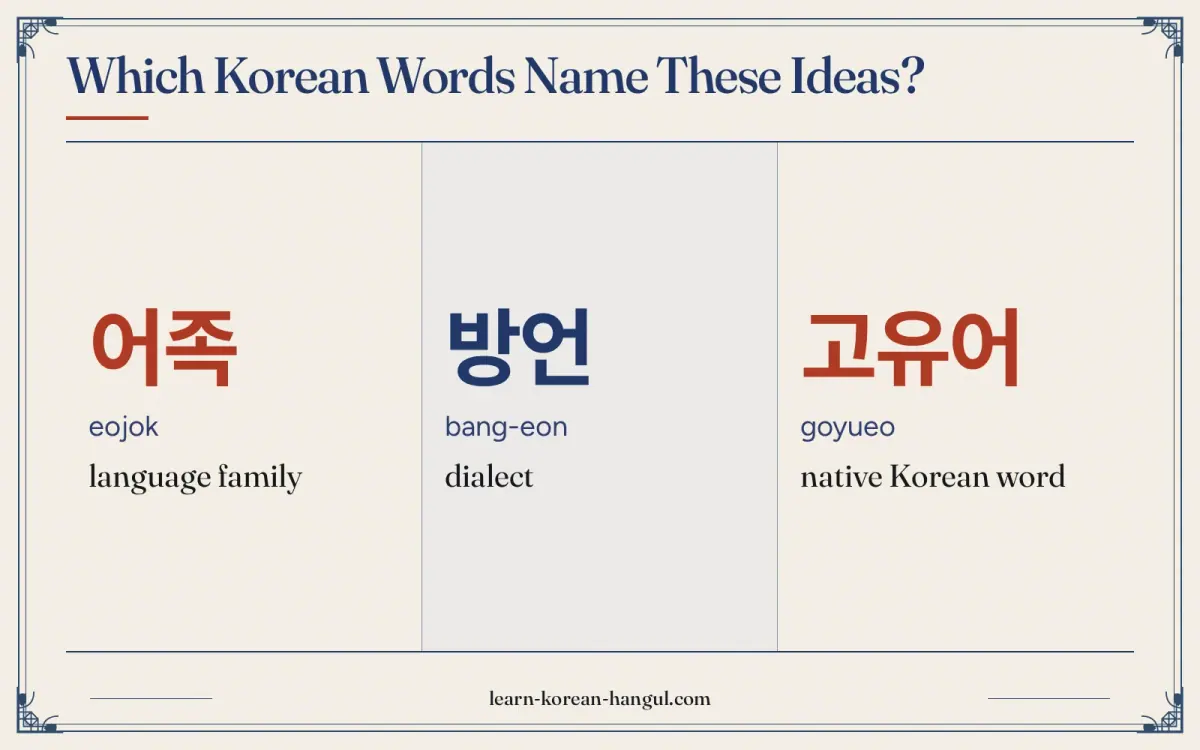
Korean has its own terms for the ideas on this page, and they appear in Korean articles, textbooks and news about the language.
| Korean | Romanization | Meaning |
|---|---|---|
| 어족 | eojok | language family |
| 방언 | bang-eon | dialect |
| 고유어 | goyueo | native Korean word |
| 한자어 | hanja-eo | Sino-Korean word |
| 외래어 | oerae-eo | loanword |
| 제주어 | Jejueo | Jeju language |
The pair 고유어 and 한자어 is the most useful for learners. A 고유어 is a native word such as 물 (water) or 하늘 (sky), and a 한자어 is a word built from Chinese characters, such as 학교 (school) or 전화 (telephone). Dictionaries label words this way, and the labels explain why some Korean words have two forms with the same meaning, one native and one Sino-Korean.
What Does This Mean for Learning Korean?
For learners, family trees matter less than transfer: which parts of your own language help you with Korean. Relatedness is not the same as helpfulness, and Korean is learnable from any background.
| Your background | What helps | What does not |
|---|---|---|
| Japanese | particles, word order, honorific thinking, Chinese-based words | Korean sounds, batchim, verb endings |
| Chinese | Chinese-based words, which follow regular sound patterns | tones, grammar, word endings |
| Turkish or Mongolian | suffix chains, verb-final order, vowel harmony habits | Korean sounds and particles |
| English or Spanish | none from family ties | everything is new, but the system is regular |
If you speak English, nothing in Korean is closer to your language than in any other unrelated language, and a systematic approach works well. Hangul is regular, the grammar follows patterns, and the Chinese-based layer gives you word families to learn in groups. Start with the history of Hangul to see how the writing system was designed, then move on to the beginner pages. A useful habit is to note, for each new word, whether it is native or Chinese-based, because Chinese-based words often come in families such as 학교, 학생 and 학습, which share the syllable 학 (learning).
Quick Check
Test yourself with five questions.
Practice · 5
What is Koreanic?
Show answer
Korean together with Jejueo
Koreanic is the name for the small family of Korean and Jejueo, the language of Jeju Island.
Which statement about the Altaic hypothesis is accurate?
Show answer
It is a debated proposal that most specialists reject
Altaic proposes a Turkic, Mongolic and Tungusic family, sometimes with Korean and Japanese. Most specialists today reject it.
Why do many Korean and Japanese words look alike?
Show answer
Both borrowed many words from Chinese
Both languages borrowed a large Chinese-based vocabulary, which produces look-alike words such as 학교 and 学校.
Which evidence best shows two languages are related?
Show answer
Regular sound correspondences in basic vocabulary
Regular sound correspondences in core words are the key evidence. Word order and loanwords are weak evidence.
Is Korean related to Chinese?
Show answer
No, Korean borrowed many Chinese-based words but is not related
Chinese is Sino-Tibetan. Korean borrowed a large layer of Sino-Korean vocabulary, which is contact between languages, not shared ancestry.
The Bottom Line
The Korean language family is Koreanic, a very small family of Korean and Jejueo, and Korean is often called a language isolate because no outside relatives are proven. The Altaic idea is rejected by most specialists, a Japanese link is possible but unproven, and Chinese influence is large but is borrowing, not ancestry. For learners, this means Korean is its own language with real similarities to its neighbours, and those similarities help most with grammar and Chinese-based words.
To continue, read how Korean developed in Korean language history, or look at is Korean related to Japanese for a closer comparison. For the size of the language today, see how many people speak Korean.
Frequently Asked Questions
Is Korean related to Chinese?
No. Chinese belongs to the Sino-Tibetan family and uses tones, while Korean has no tones and a different sentence structure. Korean borrowed a very large layer of Chinese-based vocabulary, called Sino-Korean words, which is why some words look alike. Borrowing is contact between languages, not shared ancestry.
Is Korean related to Japanese?
It is not proven. Korean and Japanese share word order, particles and many Chinese-based words, and a link has been proposed since the 19th century. Linguists have not agreed on regular sound correspondences in basic native vocabulary, so most treat the languages as unrelated or only possibly related.
What is Jejueo?
Jejueo is the traditional language of Jeju Island. It keeps old sounds and has words and endings that standard Korean lacks, such as 혼저 옵서예 for welcome. UNESCO lists it as critically endangered. Speakers of standard Korean cannot easily understand it, so many linguists treat it as a separate Koreanic language.
Why is Korean grammar similar to Japanese?
Several reasons may combine. Both languages put the verb last and use particles and suffix chains, a pattern common worldwide. They also had long contact and both borrowed heavily from Chinese. Shared ancestry has been proposed but not demonstrated, so similarity in grammar alone does not prove a family link.
Why do some linguists group Korean with Japanese?
They point to shared word order, particles, honorific systems and a few proposed matching words, and some suggest a Japonic language was once spoken on the Korean Peninsula. Others answer that most look-alike vocabulary is borrowed from Chinese and that regular correspondences are missing. The question remains open.
Is Jejueo a dialect or a separate language?
Both labels are used. In South Korea it is often called the Jeju dialect. Many linguists call it a separate language because it differs greatly in sounds, words and endings and is hard for standard Korean speakers to follow. If it counts as separate, the Koreanic family has two members.