
Key facts
- For learners, the grammar similarity is real, and it makes each language easier for speakers of the other.
Is Korean Related to Japanese?
Korean and Japanese are not proven to be related. Linguists have compared them for over a century, and the field has not agreed that they come from one ancestor. They look similar because of at least three different causes, and only one of them is family relation.
| Cause of similarity | What it means | How well supported |
|---|---|---|
| Shared typology | many languages put the verb last and use particles | strong; this is common worldwide |
| Contact and borrowing | the languages influenced each other, mostly through Chinese | strong, especially for vocabulary |
| Common ancestry | both descend from one ancient language | proposed, not demonstrated |
The first two causes explain most of what a learner notices. The third is the open question, discussed in more detail on the page about the Korean language family. There, you will find the idea that Korean forms its own small Koreanic family, while Japanese forms the Japonic family with the Ryukyuan languages.
If you need one sentence for a quiz or a conversation, use this: "Korean and Japanese are very similar in grammar, but linguists have not proven that they are related." The sections below give the evidence behind each half of that sentence, starting with what the languages share.
What Do Korean and Japanese Share?
Korean and Japanese share five main features: word order, particles, modifiers before nouns, honorific systems and verbs built from stems and endings. The easiest way to see them is to put one sentence from each language side by side.
| Meaning | Korean | Japanese |
|---|---|---|
| I | 저 (jeo) | 私 (watashi) |
| topic marker | 는 (neun) | は (wa) |
| school | 학교 (hakgyo) | 学校 (gakkō) |
| direction marker | 에 (e) | に (ni) |
| go (polite) | 가요 (gayo) | 行きます (ikimasu) |
Full sentences:
- Korean: 저는 학교에 가요. (jeoneun hakgyoe gayo)
- Japanese: 私は学校に行きます。 (watashi wa gakkō ni ikimasu)
- Meaning: I go to school.
Read the two lines in parallel and you see the match: pronoun, topic particle, noun, direction particle, verb. The pieces appear in the same order. That is the main reason that speakers of one language often find the other easier than speakers of English do.
Here is the full list of shared features.
- Verb-final order. Both languages end the sentence with the verb. Korean 저는 밥을 먹어요 matches Japanese 私はご飯を食べます.
- Particles after nouns. Korean 은/는, 이/가, 을/를 and 에 match Japanese は, が, を and に closely. Particles mark the role of the word, not word order.
- Modifiers before nouns. A whole clause can come before a noun: Korean 어제 산 책 (eoje san chaek, "the book I bought yesterday") and Japanese 昨日買った本 (kinō katta hon).
- Honorifics. Both express respect in verbs and nouns. Korean 선생님이 오세요 (seonsaengnimi oseyo) and Japanese 先生がいらっしゃいます (sensei ga irasshaimasu) both honour the teacher by changing the verb.
- Agglutination. Both build verbs by adding endings to a stem, one after another, rather than changing the word internally.
Other shared points include dropping the subject when it is clear, having no articles ("a" or "the"), being able to mark a question with a final ending (Korean 갑니까? gamnikka and Japanese 行きますか), and a double number system with a native set and a Chinese-based set. The pages on Korean particles and Korean speech levels explain the Korean side in full, and the grammar comparison in Korean vs Japanese grammar difficulty goes area by area.
The similarity is striking, but it tells us how the languages work, not necessarily where they came from. To judge origin, look at where they differ.
What Is Different?
Korean and Japanese differ in their scripts, sounds, verb endings and politeness systems. The differences are large enough that a Japanese speaker still needs to learn Korean pronunciation and endings from scratch.
| Area | Korean | Japanese |
|---|---|---|
| Script | Hangul alphabet, with spaces between words | kanji plus two kana syllabaries, with no spaces |
| Consonants | three-way contrast (plain, aspirated, tense) such as ㄱ, ㅋ, ㄲ | no aspirated or tense contrast of this kind |
| Vowels | ten simple vowels in the standard (fewer in everyday speech), including ㅓ and ㅡ | five basic vowels |
| Final consonants | many (받침), such as 밥, 한국, 꽃 | only ん and small っ |
| Pitch | no pitch accent in Seoul speech | pitch accent on words |
| Speech levels | several levels: formal, polite, casual | plain and polite, plus keigo |
| Particle forms | change by sound: 이/가, 은/는, 을/를 | fixed: が, は, を |
| Verb endings | many sentence endings carrying politeness and mood | fewer endings; politeness mainly with -ます |
Three differences stand out for learners. First, Korean has final consonants that Japanese lacks, so a word like 한국 (hanguk) ends in a consonant and cannot be pronounced with an extra vowel. Second, the Korean three-way contrast (ㄱ, ㅋ, ㄲ) is hard for Japanese speakers to hear. Third, Korean particles change shape depending on the last sound of the noun: 이 after a consonant and 가 after a vowel, where Japanese uses one fixed が.
Politeness works differently too. Korean marks it in the verb ending of every sentence, so each statement has a level. Japanese also marks politeness in the verb, but it relies more on a shift between plain and polite forms and on a separate vocabulary for respect (keigo). A subtle difference appears when you speak about your own boss to an outsider. In Japanese, you lower your boss's status: 社長は今おりません (shachō wa ima orimasen). In Korean, you usually keep honouring a superior: 사장님은 지금 안 계십니다 (sajangnimeun jigeum an gyesimnida).
Expert insight: these differences do not argue for or against a family tie, because two related languages can drift apart over thousands of years. They do show that the similarity in grammar is not the same as a similarity in sound or script, which is where learners must put their effort.
Are Shared Words Real Cognates?
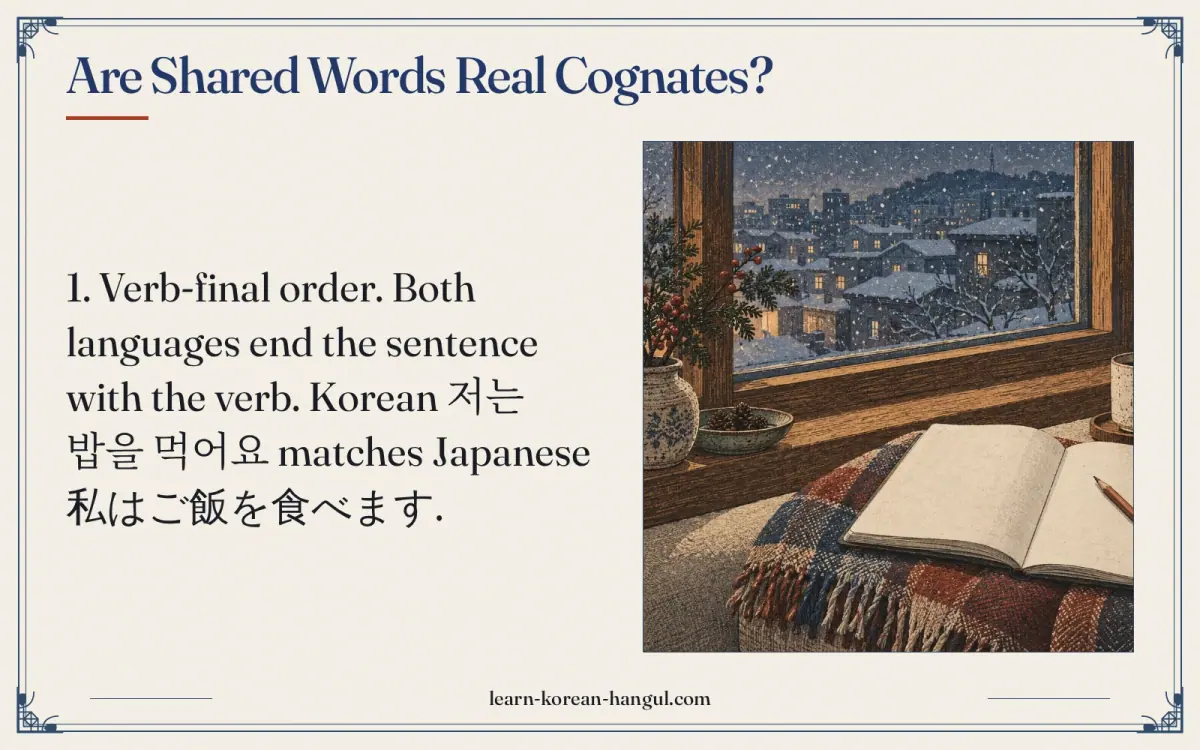
Most look-alike words between Korean and Japanese are Chinese-based borrowings, not cognates. A cognate is a word inherited from a common ancestor. Words that both languages took from Chinese resemble each other because they come from the same source, not because Korean and Japanese share one.
| Meaning | Korean | Japanese | Shared Chinese source |
|---|---|---|---|
| school | 학교 (hakgyo) | 学校 (gakkō) | 學校 |
| university | 대학 (daehak) | 大学 (daigaku) | 大學 |
| telephone | 전화 (jeonhwa) | 電話 (denwa) | 電話 |
| bank | 은행 (eunhaeng) | 銀行 (ginkō) | 銀行 |
| library | 도서관 (doseogwan) | 図書館 (toshokan) | 圖書館 |
| time | 시간 (sigan) | 時間 (jikan) | 時間 |
| student | 학생 (haksaeng) | 学生 (gakusei) | 學生 |
| teacher | 선생 (seonsaeng) | 先生 (sensei) | 先生 |
These pairs follow regular patterns, because both languages borrowed from older Chinese and kept its sounds in a systematic way. Two patterns are easy to remember.
- Korean final -ㄱ often matches Japanese -ku or -ki. 학 (hak) matches 学 (gaku), and 국 (guk) matches 国 (koku).
- Korean final -ㅇ often matches a long vowel in Japanese. 공 (gong) matches 空 (kū), 병 (byeong) matches 病 (byō), and 동 (dong) matches 東 (tō).
The pattern is strong evidence of Chinese borrowing, but it says nothing about a link between the native words of the two languages. Native words, such as the words for "water" or "fire", do not match in the same regular way.
| Meaning | Korean (native) | Japanese (native) |
|---|---|---|
| water | 물 (mul) | 水 (mizu) |
| fire | 불 (bul) | 火 (hi) |
| eye | 눈 (nun) | 目 (me) |
| mountain | 뫼 (moe, old) | 山 (yama) |
A few Chinese-based words have drifted in meaning, and these false friends can trip up learners. Korean 대장부 (daejangbu) means a manly, great man, while Japanese 大丈夫 (daijōbu) means "all right". Korean 애인 (aein) is a sweetheart or partner, while Japanese 愛人 (aijin) usually means a lover outside marriage. When in doubt, look up the word in both languages.
A last group of shared words has a different history. Many modern terms for Western ideas, such as 철학 (cheolhak, philosophy), 경제 (gyeongje, economy), 사회 (sahoe, society), 과학 (gwahak, science) and 문화 (munhwa, culture), were coined or popularized in Japan in the 19th century and then adopted into Korean and Chinese. They match Japanese words (tetsugaku, keizai, shakai, kagaku, bunka) because of this later contact.
What Do the Numbers Show?
Both languages have two number sets, and comparing them is the clearest demonstration of borrowing versus inheritance. The Chinese-based numbers match closely, but the native numbers do not match at all.
| Number | Korean Sino | Japanese Sino | Korean native | Japanese native |
|---|---|---|---|---|
| 1 | 일 (il) | 一 (ichi) | 하나 (hana) | ひとつ (hitotsu) |
| 2 | 이 (i) | 二 (ni) | 둘 (dul) | ふたつ (futatsu) |
| 3 | 삼 (sam) | 三 (san) | 셋 (set) | みっつ (mittsu) |
| 4 | 사 (sa) | 四 (shi) | 넷 (net) | よっつ (yottsu) |
| 5 | 오 (o) | 五 (go) | 다섯 (daseot) | いつつ (itsutsu) |
| 10 | 십 (sip) | 十 (jū) | 열 (yeol) | とお (tō) |
Read down the Sino columns and the pairs 이 and ni, 삼 and san, 오 and go, and 일 and ichi sound alike, because both are adapted from older Chinese. Read down the native columns and nothing lines up: hana, dul and set have no clear link to hitotsu, futatsu and mittsu. If Korean and Japanese had inherited their basic numbers from a shared ancestor, we would expect the native numbers to match in regular ways. Some scholars have proposed such matches, but the field has not accepted them, which is one reason the relationship remains unproven.
The numbers also help learners. If you know Japanese numbers, the Korean Sino numbers are almost free, and you only need to learn the Korean native set from scratch. For how each set is used, see the Korean counters section.
Can You Guess Korean Words from Japanese?
For Chinese-based words, yes, often. Use the sound patterns to guess a Korean word from a Japanese word, then confirm it in a dictionary. The table shows five guesses and the real answers.
| Japanese word | Pattern | Guess | Real Korean word |
|---|---|---|---|
| 新聞 (shinbun, newspaper) | -bun → -mun | 신문 | 신문 (sinmun) |
| 写真 (shashin, photograph) | sha → sa, -shin → -jin | 사진 | 사진 (sajin) |
| 約束 (yakusoku, promise) | -ku → final ㄱ | 약속 | 약속 (yaksok) |
| 学生 (gakusei, student) | gaku → hak | 학생 | 학생 (haksaeng) |
| 国 (koku, country) | -ku → final ㄱ | 국 | 국 (guk) |
Guessing does not work for native words, and it can fail for words that took different paths or meanings, so treat it as a memory aid, not a rule. A good routine is to guess, check, and then write down the pair so you can recognise the pattern next time.
What Does the History of Contact Show?
The history of contact explains why vocabulary overlaps while the core words differ. Korea and Japan have traded, fought and exchanged ideas for roughly two thousand years, and the exchange went in both directions.
- Early centuries. Scholars, monks and craftspeople from the Korean kingdoms, especially Baekje, carried Buddhism, writing and technology to Japan. The Chinese-based reading system and the Chinese texts in Japan arrived partly through this route.
- Late 16th century. Japanese invasions of Korea (1592 to 1598) caused war and displacement.
- 1910 to 1945. During the colonial period, Japanese was used in schools and administration, and many Japanese-made words and loanwords entered Korean. After 1945, South Korea replaced many of them with native or Sino-Korean words.
- Today. Both languages borrow English words (in Korean, 커피 keopi, in Japanese コーヒー kōhī), and they exchange pop culture.
Long contact makes shared structures possible. If two neighbouring languages influence each other for centuries, they may converge in some features without sharing an ancestor. This is a standard idea in linguistics, called an areal feature, and it is one of the explanations for the grammatical overlap.
Which Sentence Pairs Show the Match?
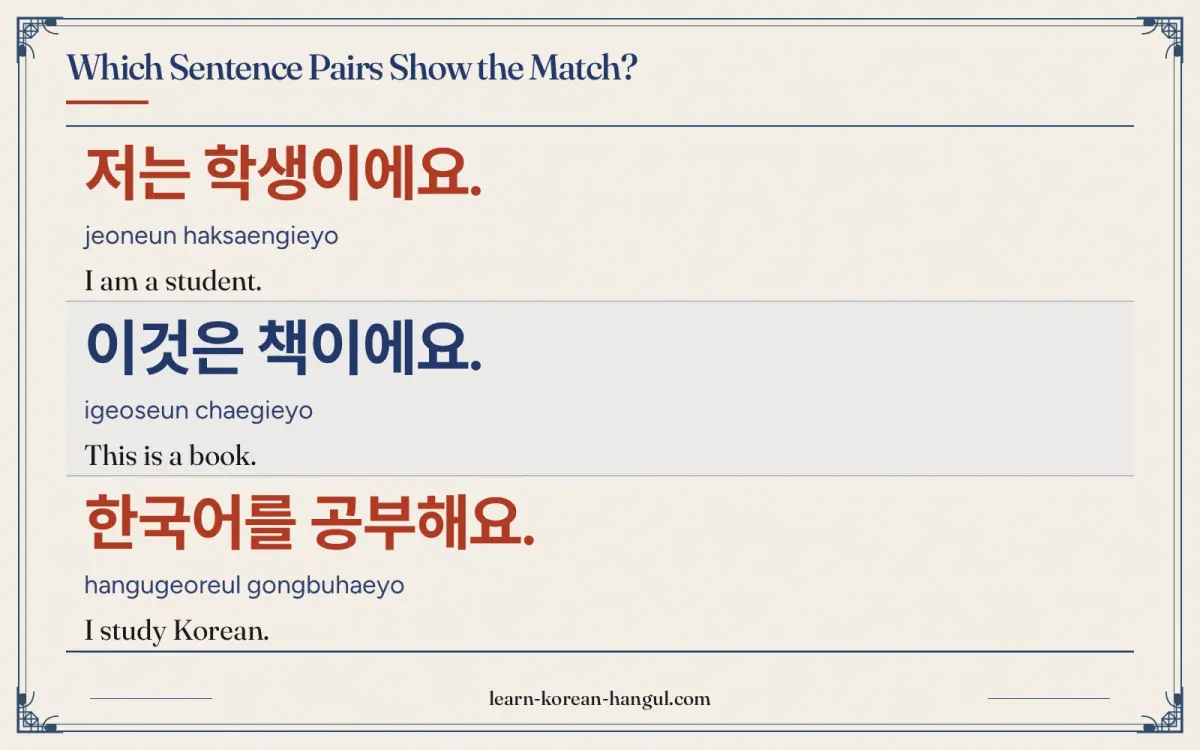
Four everyday sentences show how closely the structures line up. Read each Korean line, then the Japanese line, and notice the same order of parts.
| Meaning | Korean | Romanization | Japanese | Romanization |
|---|---|---|---|---|
| I am a student. | 저는 학생이에요. | jeoneun haksaengieyo | 私は学生です。 | watashi wa gakusei desu |
| This is a book. | 이것은 책이에요. | igeoseun chaegieyo | これは本です。 | kore wa hon desu |
| I study Korean. | 한국어를 공부해요. | hangugeoreul gongbuhaeyo | 韓国語を勉強します。 | kankokugo o benkyō shimasu |
| I read a book at the library. | 도서관에서 책을 읽어요. | doseogwaneseo chaegeul ilgeoyo | 図書館で本を読みます。 | toshokan de hon o yomimasu |
In each pair the topic or object comes first, the particle follows it, and the verb or copula closes the sentence. The Korean copula 이에요 matches the Japanese です, and the Korean particle 에서 (place of an action) matches で. The differences appear in the details. Korean adds a particle that depends on the last sound (를 after 한국어, 을 after 책), and it uses a polite ending 요 where Japanese uses ます or です.
What Does It Mean for Learners?
For learners, the real transfer is large: a Japanese speaker starts Korean with grammar already half-learned, and a Korean speaker starts Japanese the same way. The exact benefits are in the table.
| Area | Transfers | Needs new learning |
|---|---|---|
| Word order | verb-final sentence structure | none |
| Particles | meaning of 는, 가, 를, 에 | forms that change with sound (이/가) |
| Vocabulary | Chinese-based words follow regular sound patterns | native words, different words for new loans |
| Honorifics | the idea of respect in the verb | Korean speech levels and endings |
| Pronunciation | none | final consonants, three-way stops, ㅓ and ㅡ |
| Writing | none | Hangul, which is easy to learn |
If you speak Japanese, start by matching particles and sentence order, and spend your first weeks on pronunciation and endings. If you speak English, the similarity does not transfer, but the regularity of the system still helps. Read is Korean harder than Japanese for a learner's comparison of difficulty, and the grammar comparison linked above for details.
A practical tip for Japanese speakers is to learn Korean words with the Japanese reading in mind. If the Japanese word ends in -ku, expect a final ㄱ. If it has a long vowel such as ō or ū, expect a final ㅇ. Treat these as hints, not rules. The same method works in reverse for Korean speakers who study Japanese.
What Are the Common Myths?
Several widespread claims about Korean and Japanese are misleading. Here are the ones that appear most often, with corrections.
- "Korean and Japanese are the same language with different writing." False. The grammar is alike, but vocabulary, sounds and endings differ widely, and speakers cannot understand each other without study.
- "They are proven to be related." False. The idea is a hypothesis with no agreed proof.
- "They are completely unrelated and similar only by accident." Too strong. A distant relation or an early contact zone is still possible. The honest answer is that the question is open.
- "All similar words are cognates." False. Most are Chinese borrowings, and some are modern words coined in Japan.
- "Korean is a dialect of Japanese or the other way round." False. They are two distinct languages with separate histories.
What Are the Limits of This Comparison?
This page gives a short, simplified comparison. Linguists use more detail than a learner needs, and the Japanese examples here use common spelling and Hepburn romanization. Pronunciation of Chinese-based words differs by region and period. The claim that the question is open reflects the current state of research, which may change with new evidence. If you read a headline that says the link has been "solved", look for the evidence behind it: regular sound correspondences in basic native words, checked by specialists outside the authors' own group.
The Bottom Line
Is Korean related to Japanese? Not proven. The two share verb-final order, particles, modifiers before nouns and honorifics, and a large Chinese-based vocabulary, but their sounds, scripts and endings differ, and no agreed set of native-word matches exists. For learners, the shared grammar is a real advantage, and the next step is to compare it area by area.
Continue with Korean vs Japanese grammar difficulty for a side-by-side comparison, or read the Korean language family page for the background on origins.
Frequently Asked Questions
Are Korean and Japanese mutually intelligible?
No. Speakers of one language cannot follow the other without study. The grammar feels familiar, and shared Chinese-based words such as 학교 and 学校 help in reading, but sounds, native vocabulary and verb endings differ too much. A Japanese speaker can learn Korean grammar quickly, though listening still takes practice.
Why are the grammars so similar?
Three causes combine. Both languages are verb-final with particles and suffix chains, a pattern common worldwide. They had long contact across the sea, and both were shaped by Chinese. A distant common ancestor has been proposed but never demonstrated, so the similarity does not prove a family relation.
Do Korean and Japanese share words?
Yes, mostly Chinese-based words such as 대학 and 大学 or 전화 and 電話. Both languages borrowed them from Chinese, so they follow regular sound patterns. Native words such as 물 and 水 for water do not match, and some modern terms such as 철학 were coined in Japan and adopted into Korean.
Which is closer to Chinese?
Neither is related to Chinese. Both borrowed a large Chinese-based vocabulary, and Sino-Korean and Sino-Japanese words resemble Chinese in origin. Chinese has tones and a different grammar. Japanese uses Chinese characters (kanji) daily, while Korean mostly writes in Hangul, so Japanese looks closer to Chinese on the page.
Is it easier to learn Korean if you know Japanese?
Yes, in grammar. Word order, particles and the idea of honorifics carry over, and Chinese-based words follow regular sound patterns. Pronunciation does not carry over, because Korean has final consonants, a three-way consonant contrast and the vowels ㅓ and ㅡ. Plan extra time for sounds and sentence endings.