This page compares the language side of etiquette: the words, titles and speech levels that carry respect. It is not a tourist guide to customs, and it describes tendencies, not rules that every person follows. Practices vary by region, workplace, age and family, and they are changing. For the Korean side, see the honorifics 씨 and 님 lesson and the speech levels guide.
Korean vs Japanese Etiquette: the Essentials
Korean and Japanese etiquette share a structure and differ in the details. Both societies mark respect in the verb, both pay attention to who is older or higher in rank, and both prefer indirect wording to blunt wording. The details that cause errors are the in-group rule, the use of surname plus title, and the role of age.
Quick verdict by situation
- A business meeting with an outside company: In Japanese you lower your own boss. In Korean you generally keep the honorific for your boss. Do not copy the Japanese habit into Korean.
- Meeting someone older for the first time: Both languages expect polite speech. In Korean, expect a question about age or position, because it settles which speech level to use.
- Addressing a colleague: Japanese uses surname + さん. Korean uses full name + 씨, or surname + a title. Surname + 씨 alone can sound curt.
- At the table: Both use fixed phrases before and after eating. Learn the pair for your language.
- Apologising: Japanese すみません covers many jobs. Korean separates 죄송합니다 (formal, to superiors) from 미안해요 (to equals).
How Do They Compare Overall?
The master table compares the two on eight criteria. Every cell gives a specific value, and each describes the common tendency.
| Criterion | Korean | Japanese |
|---|---|---|
| Bow levels (commonly taught) | About 15°, 30°, 45° and a ceremonial deep bow | About 15° (eshaku), 30° (keirei), 45° (saikeirei) |
| Greeting words | One everyday greeting, 안녕하세요 | Changes by time of day: おはよう, こんにちは, こんばんは |
| Honorific system | Speech levels + subject honorific -(으)시- + humble verbs | Three types of keigo: respectful, humble, polite |
| Speaking of your own boss to outsiders | Generally keep the honorific | Lower your own side (uchi-soto) |
| Title suffix | 님 after a role; 씨 after a full name | さん after a name; 様 and 先生 for high respect |
| Surname + suffix | 김 씨 can sound curt | 田中さん is standard |
| Role of age | Visible: age is often asked early | Seniority (先輩, 後輩) often matters more |
| Thanks and apology | 감사합니다 and 고맙습니다; 죄송합니다 and 미안해요 | ありがとうございます; すみません, 申し訳ありません |
The table shows two systems with the same skeleton. The sections below take the biggest gaps in turn.
How Do Bowing and Greetings Compare?
Both cultures use a bow with levels, and Japanese is more tightly tied to the bow than Korean. A small nod is used among equals, a larger bow for elders and customers, and a deep bow for formal thanks or apology. The angles above (about 15°, 30° and 45°) are commonly taught figures, and real bows vary with the situation.
Korean greetings combine a bow with the phrase 안녕하세요. The handshake is also common in Korean business, often with the left hand supporting the right forearm as a sign of respect. In Japan the bow is the main greeting, and the handshake is less central, though both are used in international business.
The words differ too. Korean uses 안녕하세요 at any time of day. Japanese uses おはようございます in the morning, こんにちは in the day and こんばんは in the evening. Learners moving from Japanese to Korean find the single greeting a relief.
The second phrase shows a Korean feature that Japanese lacks. The word for "goodbye" depends on who is leaving. You say 안녕히 가세요 to the person who goes, and 안녕히 계세요 to the person who stays.
How Do Honorific Language Systems Compare?
Korean builds respect from three tools, and Japanese keigo sorts respect into three types. Neither is easy, and the two overlap only partly. Here is the shape of each.
| Tool | Korean | Japanese |
|---|---|---|
| Choice of ending for the listener | Speech levels: 해요체, 합쇼체, 반말 | Polite です/ます vs plain form |
| Raising the person you talk about | Subject honorific -(으)시- | 尊敬語 (sonkeigo, respectful verbs) |
| Lowering yourself | Humble verbs such as 드리다, 여쭙다, 뵙다 | 謙譲語 (kenjōgo, humble verbs) |
| Special honorific nouns | 성함 (name), 연세 (age), 진지 (meal) | お名前, お年, お食事 |
The same idea in each language shows the pattern. The idea is "please eat" and "I will give it to you".
| Idea | Korean | Japanese |
|---|---|---|
| Please eat (respectful) | 드세요 (deuseyo) | 召し上がってください (meshiagatte kudasai) |
| I will give it to you (humble) | 드릴게요 (deurilgeyo) | 差し上げます (sashiagemasu) |
| I will ask (humble) | 여쭤볼게요 (yeojjwobolgeyo) | 伺います (ukagaimasu) |
| I will see you (humble) | 뵙겠습니다 (boepgetseumnida) | お目にかかります (ome ni kakarimasu) |
The Korean spoken forms are [드세요], [드릴께요], [여쭤볼께요] and [뵙께씀니다]. Korean has fewer special humble verbs than Japanese, and it uses the speech levels and -(으)시- in nearly every sentence. Japanese keigo has more special verb pairs, and it adds a further rule for in-group and out-group.
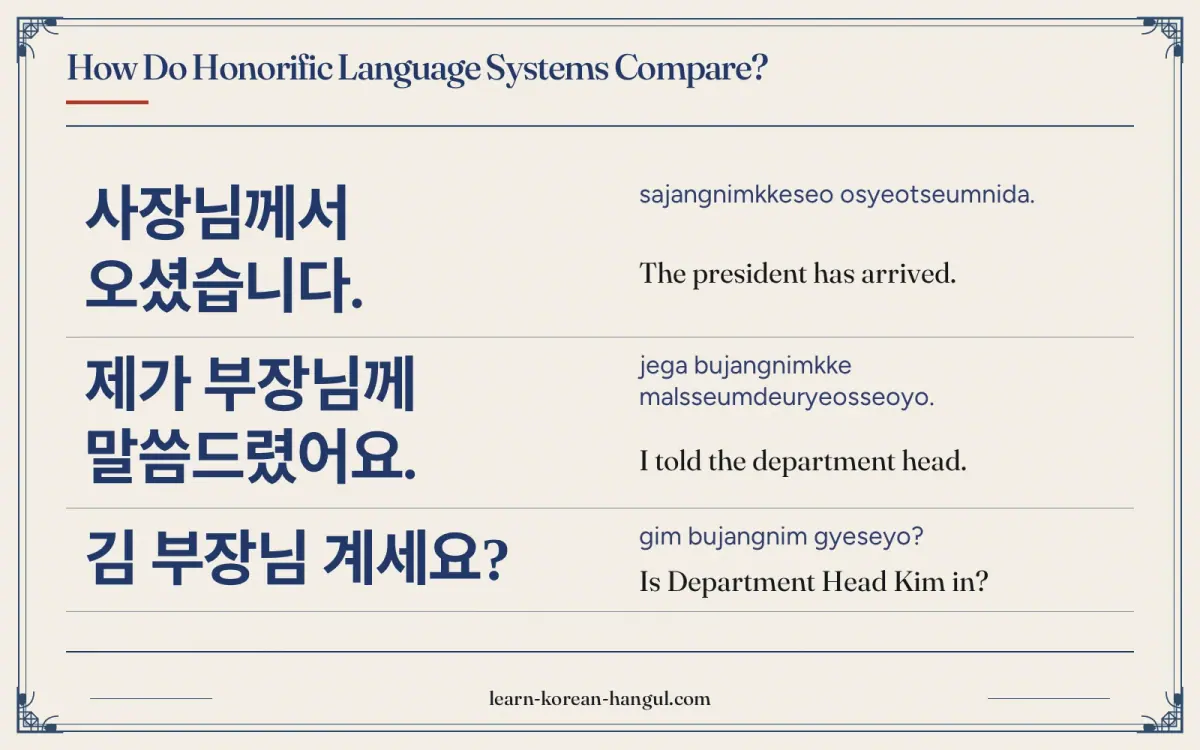
사장님께서 오셨습니다.
sajangnimkkeseo osyeotseumnida.
The president has arrived.
제가 부장님께 말씀드렸어요.
jega bujangnimkke malsseumdeuryeosseoyo.
I told the department head.
The first is said [사장님께서 오셛씀니다]. The ending -(으)시- raises the president, and 께서 is the honorific form of the subject particle. The second is said [제가 부장님께 말씀드려써요]. The phrase 말씀드리다 is a humble verb that lowers the speaker and raises the person being told, here the department head.
What Is the in-Group Rule?
The in-group rule is the one place where Korean and Japanese point in opposite directions. In Japanese, when you talk to someone outside your company about your own boss, you use plain or humble forms for your boss, because your boss belongs to your side (uchi). In Korean workplaces you generally keep the honorific for your boss even in front of outsiders: 저희 부장님께서 오셨습니다 ("Our department head has come").
There is an older Korean rule, called 압존법 (apjonbeop), that lowers a person when you speak about them to someone higher still. It is fading in modern workplaces, and many Koreans now use ordinary honorifics. If you learn Japanese keigo first, do not carry the lowering habit into Korean. Treat this as a tendency, because some traditional families and organisations keep the older rule.
What Does the in-Group Rule Sound Like on the Phone?
A phone call to another company shows the difference in a few lines. A Korean caller asks for a department head, and the person who answers keeps the honorific for their own boss.
김 부장님 계세요?
gim bujangnim gyeseyo?
Is Department Head Kim in?
저희 부장님은 지금 자리에 안 계십니다.
jeohui bujangnimeun jigeum jarie an gyesimnida.
Our department head is not at the desk right now.
The second sentence is said [저히 부장니믄 지금 자리에 안 계심니다]. Two things stand out. The speaker says 저희 ("our", the humble form), which lowers the speaker's own group in the neutral way. But the speaker still uses 부장님 with 님 and the honorific 계시다 (the honorific of "to be") for the boss. A Japanese speaker in the same situation would use the boss's bare name or title without さん, and a plain or humble verb, because the boss is part of the speaker's side. Both choices are polite in their own language, and mixing them up sounds odd to the listener.
The lesson for learners is to follow the language you are speaking. In Korean, the customer is higher than your company, and your boss is still higher than you.
How Do Titles Compare?
Korean attaches 님 to a role and 씨 to a full name, while Japanese attaches さん to a name and adds 様 or 先生 for higher respect. The rules for who may take which suffix differ.
| Use | Korean | Japanese |
|---|---|---|
| Teacher or doctor | 선생님 (seonsaengnim) | 先生 (sensei) |
| Boss with a role | 부장님 (bujangnim) | 部長 (buchō), often without さん |
| Colleague of similar rank | 김민수 씨 | 田中さん |
| Customer | 고객님 (gogaengnim) | お客様 (okyakusama) |
| Superior by name | Avoid 씨: use the title, as in 김 부장님 | Surname + title, as in 田中部長 |
Two rules matter most. First, Korean 씨 is not suitable for superiors. Calling your boss 김 과장 씨 would be wrong; you use the title and 님, as in 김 과장님. Second, Korean 씨 works best with the full name or the given name, as in 민수 씨. Japanese さん attaches comfortably to a surname alone. The name comparison shows how the two languages build names.
Korean also uses family terms for people who are not relatives. A woman may call an older woman 언니 and a man may call an older man 형, as terms of closeness. Japanese has お兄さん and お姉さん, which serve a similar purpose but are used differently.
How Does Age Matter?
Age plays a more visible role in Korean address than in Japanese. In Korea people often ask each other's age, or the year they were born, soon after meeting, because the answer settles which speech level and which family-style term to use. Korea formally moved to the international way of counting age (만 나이) in June 2023 for legal and administrative purposes, but in daily life people still compare birth years, and many people use the birth year to decide who is older.
In Japan, seniority (先輩 senpai and 後輩 kōhai) is often defined by who joined an organisation first, and age comes second. Korean has the same pair, 선배 (seonbae) and 후배 (hubae), so the two systems overlap in school clubs and offices. The difference is that in Korea age can override or sit beside seniority, especially among adults.
The verdict on age: Korean makes age an explicit part of address, and Japanese tends to lean on rank and group membership. For more, read the guide to Korean age etiquette.
How Do Meal, Drink and Gift Phrases Compare?
Both languages have fixed phrases before and after a meal, and both use modest wording for gifts. The words are different, and a learner who knows one set should learn the other as a set.
| Moment | Korean | RR | Japanese |
|---|---|---|---|
| Before eating | 잘 먹겠습니다 | jal meokgetseumnida | いただきます |
| After eating | 잘 먹었습니다 | jal meogeotseumnida | ごちそうさまでした |
| Offering food | 드세요 | deuseyo | どうぞ召し上がれ |
| Toast | 건배 or 짠 | geonbae, jjan | 乾杯 (kanpai) |
| Modest gift phrase | 별거 아니지만... | byeolgeo anijiman | つまらないものですが |
The spoken forms are [잘 먹께씀니다] and [잘 머걷씀니다]. Both Korean phrases are polite and suitable for superiors. A casual version for friends is 잘 먹을게 and 잘 먹었어.
At work, the "thank you for your effort" phrase also differs. Japanese お疲れ様です is used among coworkers of all ranks. Korean 수고하셨습니다 is used widely, but some Koreans feel it is better said by a superior to a junior, and they prefer 고생하셨습니다 or 감사합니다 when speaking up. Opinions vary, so listen to what your colleagues say before you choose.
For apologies, Korean separates 죄송합니다, which suits superiors and customers, from 미안합니다 and 미안해요, which suit equals and juniors. The Japanese すみません is flexible and covers apology, thanks and getting attention, so a Japanese speaker may overuse 죄송합니다 as a general-purpose word. A Korean speaker uses 저기요 to call attention and 감사합니다 to thank.
How Do You Answer Thanks?
Replies to thanks show the same modesty in both languages, with different words. A Korean speaker most often answers 아니에요 ("No, it is nothing") or, more formally, 천만에요 ("not at all"). A Japanese speaker says いえいえ or どういたしまして. In both languages the reply plays down the favour. Using a bare "you're welcome" translation, such as 환영합니다, sounds wrong, because that Korean phrase means "welcome" at an arrival.
| Moment | Korean | RR | Japanese |
|---|---|---|---|
| Polite thanks | 감사합니다 | gamsahamnida | ありがとうございます |
| Friendly thanks | 고마워요 | gomawoyo | ありがとう |
| Reply, modest | 아니에요 | anieyo | いえいえ |
| Reply, formal | 천만에요 | cheonmaneyo | どういたしまして |
The spoken forms are [아니에요] and [천마네요]. A learner who answers every thank-you with a bow and 아니에요 will sound natural in nearly any setting.
How Do Refusals and Requests Compare?
Both languages prefer an indirect refusal to a flat "no". A speaker softens the refusal with a hedge, and the listener is expected to understand that it means no. The Japanese example is ちょっと難しいですね ("that is a little difficult"). The Korean counterpart is the same kind of sentence.
좀 어려울 것 같아요.
jom eoryeoul geot gatayo.
I think that might be a little difficult.
This is said [좀 어려울껃 가타요]. The word 좀 ("a little") and the guess form 것 같아요 ("it seems") soften the sentence, and a Korean listener hears a polite "no". A direct 안 돼요 ("it is not possible") is correct, but in a work setting it can sound blunt to someone you do not know well.
For requests, Korean uses -아/어 주세요 ("please do it for me") and a softer -아/어 주실 수 있어요? ("could you do it for me?"). Japanese uses ください and いただけますか. The gap in directness between the two is small. The gap that matters is in the verbs for the boss and the guest, covered above.
Which Pitfalls Affect Learners?
Learners moving between the two languages fall into predictable traps. This list helps you avoid them.
- Lowering your own boss in Korean. Keep the honorific.
- Using surname + 씨. Add the given name, or use the title with 님.
- Using 씨 for superiors. Use the title with 님.
- Using すみません logic in Korean. Choose between 죄송합니다, 저기요 and 감사합니다.
- Treating one greeting as three. Korean 안녕하세요 works all day.
- Asking age too late, or too early. In Korea a question about age is common and polite among adults, but ask with a smile and be ready to answer.
- Copying a bow depth. Match the person in front of you, and stay a little lower with elders and customers.
Where Does This Comparison Fall Short?
The comparison is a sketch. It has three limits.
- It is about language, not customs. Table manners, gift rules and visiting etiquette are separate topics, and they are not covered here.
- It describes common usage. Real speech varies by region, age and setting.
- It changes over time. Both countries have seen shifts in how strictly honorifics are used, and younger speakers are often more relaxed.
Frequently Asked Questions
Do Koreans Bow Like Japanese?
Both use bows with levels, commonly taught as about 15, 30 and 45 degrees, but the bow is more central to Japanese greetings. In Korea a bow is often combined with 안녕하세요 and a handshake, sometimes with the left hand supporting the right forearm. Match the person in front of you and bow a little lower to elders and customers.
Which Has Stricter Honorifics, Korean or Japanese?
Neither is simply stricter. Korean requires a speech-level choice in almost every sentence, and Japanese keigo has more special verb pairs and the in-group rule. Learners often find Korean harder to start and keigo harder to master. Both take years to feel secure, so use the polite level and listen to the people around you.
Can I Use the Same Politeness in Both Languages?
Mostly not word for word. The idea is shared, but the details differ: Japanese lowers your own boss to outsiders and Korean generally does not, Japanese attaches さん to a surname and Korean prefers 씨 after a full name, and apologies are split differently. Learn each set as a pattern and do not translate Japanese phrases into Korean.
Is Eye Contact Treated the Same?
Not exactly, and individuals vary. In both societies a very direct, long stare toward a superior can feel challenging in formal settings, and a slightly lowered gaze is a sign of respect. Neither forbids eye contact. In friendly or business conversation moderate eye contact is normal. Follow the other person and be flexible.
The Bottom Line
Korean vs Japanese etiquette share a hierarchy and an indirect style, and they differ where learners most often slip: the in-group rule, the use of surname and suffix, and the role of age. In Korean, keep honoring your own superiors, use titles with 님 and full names with 씨, and expect questions about age. In Japanese, lower your own side and use surname + さん. When you are unsure, choose the polite level and watch what the people around you do.