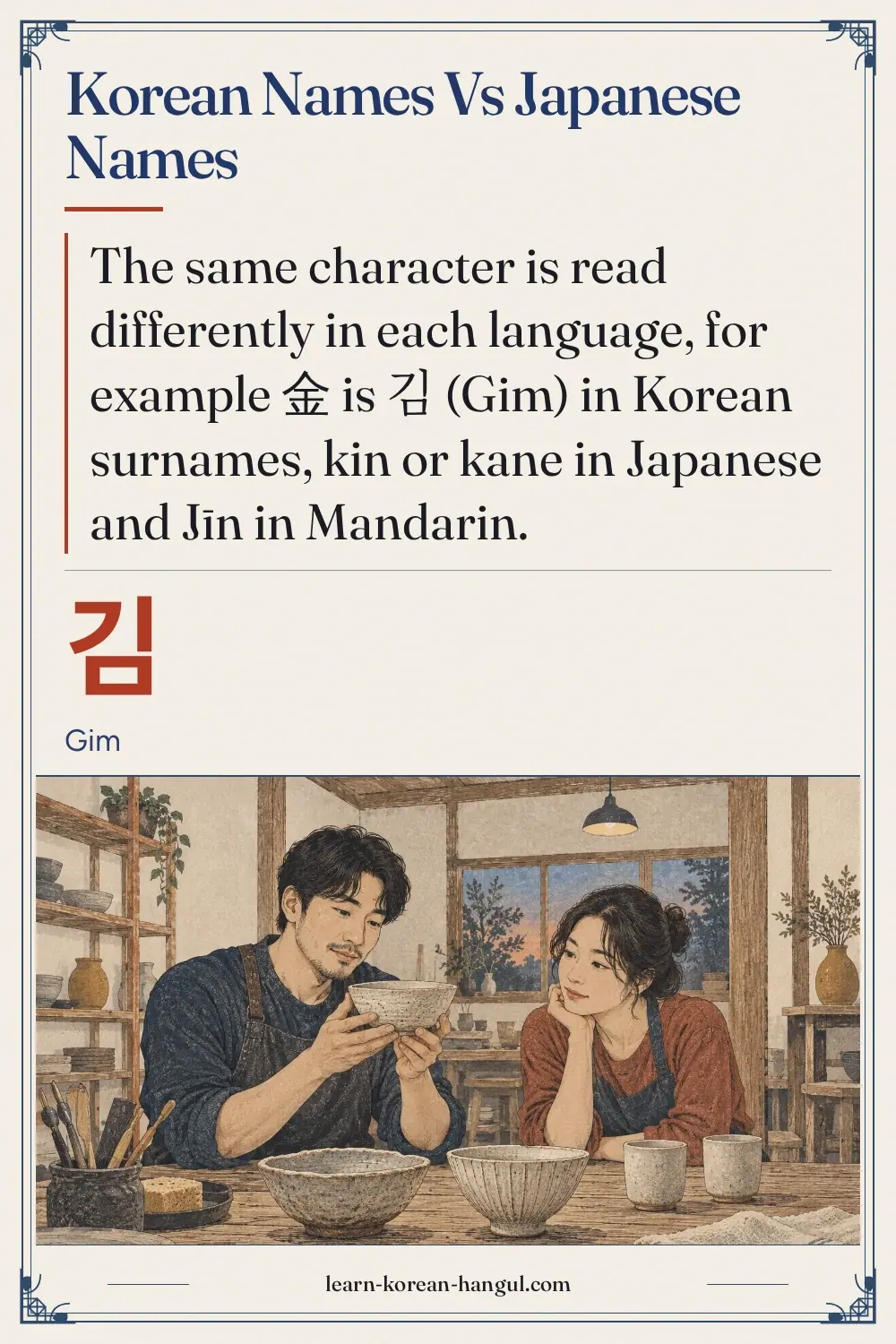
This page compares the structure of Korean and Japanese names, with Chinese names added where the comparison helps. It is a guide to how the systems work, not a way to guess where a person is from. Names travel across borders, people choose their own spellings, and many families do not fit the patterns below. For the Korean side in depth, see Korean last names and Korean name meaning.
Korean Names vs Japanese Names: the Essentials
Korean and Japanese names look alike on paper because both use family-name-first order and both can be written with Chinese characters, but they are built differently. A Korean name is short and its surname is drawn from a small pool. A Japanese name is longer and its surname is drawn from a very large pool.
Quick verdict by use
- If you are filling in a form: Put the surname in the surname box for both. Korean names are surname + given name, so 김민수 is surname 김, given name 민수. Japanese 田中太郎 is surname 田中, given name 太郎.
- If you are reading a name aloud: Korean is easier to read from the characters, because each character usually has one reading. Japanese often needs the reading to be written out.
- If you are writing a name in the other language: Korean writes foreign names by sound in Hangul. Japanese writes foreign names by sound in katakana.
- If you are guessing a person's background from a name: Do not. Ask the person, and use the spelling they give you.
How Do They Compare Overall?
The master table compares Korean, Japanese and Chinese (Mandarin) names on eight criteria. Every cell holds a specific value.
| Criterion | Korean | Japanese | Chinese (Mandarin) |
|---|---|---|---|
| Name order | Surname, then given name | Surname, then given name | Surname, then given name |
| Surname length | Usually 1 syllable (rarely 2) | Usually 2 characters, 2 to 4 syllables | Usually 1 character (rarely 2) |
| Given name length | Usually 2 syllables | 1 to 4 characters, varied | 1 or 2 characters |
| Typical total | 3 syllables | 4 to 6 syllables | 2 or 3 syllables |
| Surname pool | Small; top 3 cover close to half | Very large; the top surnames each cover a small share | Medium; a few very common |
| Reading of characters | Usually one reading per character | Many readings per character | One reading per character (with tone) |
| Writing | Hangul; hanja optional | Kanji plus kana | Hanzi |
| Married couple | Each keeps a surname | Law requires one shared surname | Each usually keeps a surname |
The table shows the main contrasts. Korean surnames are few and short. Japanese surnames are many and longer. Chinese names are short like Korean ones, but the surname pool is larger and the reading comes with tones. The following sections take the main contrasts in turn.
How Do Name Order and Length Differ?
All three systems put the family name first, and they differ in how long each part is. In everyday writing in Asia the order is surname first. In English-language contexts people sometimes reverse it, so Minsu Kim and Kim Minsu can be the same person. On a form, read the field labels, not the position.
| Korean | Japanese | Chinese (Mandarin) | |
|---|---|---|---|
| Example in script | 김민수 | 田中太郎 | 王伟 |
| Surname | 김 | 田中 | 王 |
| Given name | 민수 | 太郎 | 伟 |
| Reading | Gim Minsu | Tanaka Tarō | Wáng Wěi |
| Syllable count | 1 + 2 = 3 | 3 + 2 = 5 | 1 + 1 = 2 |
The examples are typical, not average. Korean names with a two-syllable surname exist, such as 남궁민 (Namgung Min), and so do Korean names with a one-syllable given name. Japanese given names run from one character (such as 涼) to four, and Chinese given names can be one or two characters.
김민수 씨는 한국 사람이에요.
gim minsu ssineun hanguk saramieyo.
Kim Minsu is Korean.
다나카 씨는 일본 사람이에요.
danaka ssineun ilbon saramieyo.
Mr. Tanaka is Japanese.
The first is said [김민수 씨는 한국 사라미에요], and the second [다나카 씨는 일본 사라미에요]. In Korean you add 씨 after a full name. For the Japanese surname, Korean writes the sound in Hangul: 다나카 is Tanaka. A Korean speaker does not read 田中 with Korean readings in modern writing.
How Does Korean Write Japanese and Chinese Names?
Korean writes foreign names by sound in Hangul. For living Japanese people the sound is Japanese, so 田中 is written 다나카, 鈴木 is 스즈키, 山田 is 야마다 and 佐藤 is 사토. For modern Chinese people the sound follows Mandarin, so 王伟 is written 왕웨이. For people from the distant past, Korean often uses the Korean reading of the characters instead, which is why the historical sage known as Confucius is 공자 (Gongja). The rule depends on the period for Chinese names, so check a dictionary of foreign names if the person is a historical figure.
How Do Hanja Readings Differ?
The same Chinese character is read in a different way in each language. A Korean reader says the Sino-Korean sound, which is usually one sound per character. A Japanese reader may have several readings, and a Mandarin reader says the Mandarin sound with a tone.
| Character | Korean | Japanese | Mandarin |
|---|---|---|---|
| 金 | 김 (Gim) as a surname; 금 (geum) for "gold" | kin; Kane- in names such as 金子 Kaneko | Jīn |
| 山 | 산 (san) | yama or san | shān |
| 田 | 전 (jeon) | ta or da | tián |
| 林 | 임 (im) | hayashi or rin | lín |
| 李 | 이 (i) | ri | lǐ |
The first row is the best example. The character 金 is read 김 as a Korean surname (and in a few place names), and it is read 금 when it means "gold". Japanese readers use kin for "gold" and kane in some names, and Mandarin readers use jīn for both.
Another difference is the number of readings. A Korean hanja usually has one standard reading, with a small number of exceptions such as 金. A Japanese kanji used in a name may have a dozen. The name 大翔, for example, can be read Hiroto, Haruto or in other ways, and only the family can say which. For this reason, Japanese forms usually write the reading beside the name, while a Korean name in Hangul has no such ambiguity.
Korean hanja also use traditional forms, and Japanese often uses simplified forms. The character for "study" is 學 in Korea and 学 in Japan, and 国 for "country" in Japan is 國 in Korea. Names that include such characters look different in the two scripts.
Can Korean and Japanese Names Use the Same Kanji?
Yes. Both systems draw on Chinese characters, and many surnames share a character, such as 金, 山, 林, 田 and 李. The characters are the same or close, and the readings differ. A name written entirely in shared characters can be read three ways, depending on which language the reader is using.
How Concentrated Are Surnames?
Korean surnames are far more concentrated than Japanese surnames. In Korea the three most common surnames, Kim, Lee and Park, together cover close to half the population by the 2015 census (rounded figures). In Japan the most common surnames, such as 佐藤 (Satō), 鈴木 (Suzuki), 高橋 (Takahashi) and 田中 (Tanaka), each cover only a small share, around one to two percent by commonly cited estimates. The number of Japanese surnames is commonly cited at well over 100,000, while the number in everyday use in Korea is a few hundred.
| Korean | Japanese | |
|---|---|---|
| Most common surnames | 김, 이, 박 | 佐藤, 鈴木, 高橋, 田中 |
| Share of top surname | About one in five | Around one to two percent (estimate) |
| Count of surnames | A few hundred in everyday use | Commonly cited as over 100,000 |
| Why | Few surnames, borrowed from China | Many surnames, many of them adopted in the 19th century |
The reasons differ. Korean surnames spread from a small set of prestigious Chinese-style surnames and are tied to clans. Japanese surnames are tied to places, such as 田中 ("in the rice field") and 山田 ("mountain field"), and many were adopted when all citizens were required to take a surname in the nineteenth century. The Japanese figures here are commonly cited estimates, so check a current source before you quote them.
What about Chinese Names?
Chinese names are short like Korean ones, with a different pool. A typical Chinese name has a one-character surname and a one- or two-character given name, for a total of two or three syllables. A few surnames have two characters, such as 欧阳 (Ōuyáng). A Chinese name written in pinyin carries tone marks, which are often dropped in English, so Wáng Wěi becomes Wang Wei.
Korean and Chinese names have two clear points of contact. Many Korean surnames come from Chinese ones, and many given names use characters that both languages share. The sounds are related but not the same: 金 is Gim in Korean and Jīn in Mandarin, and 李 is I in Korean and Lǐ in Mandarin. A Korean reader who sees 王伟 as a Chinese name says it as Mandarin, 왕웨이.
Can You Tell a Korean Name from a Japanese One in Latin Letters?
You can sometimes guess, but you should not rely on it. The two systems use different sound patterns, and those patterns show up in romanization. This is a rough guide, not a test.
- Final consonants. Korean surnames often end in a consonant, as in Kim, Park, Jung and Kang. Japanese syllables end in a vowel, or in n, so Japanese surnames such as Tanaka and Suzuki end in a vowel.
- Vowel spellings. Korean romanization often includes eo, eu, ae and oe, as in Seo-yeon and Jeong. Japanese romanization uses plain a, i, u, e and o, with a bar or a double letter for a long vowel (Satō or Satoh).
- Given-name endings. Japanese given names often end in -ko, -mi, -ta, -ya, -ki or -o. Korean given names often end in -jun, -hyun, -seo, -min or -yeon. Many exceptions exist.
How Do You Ask for a Name Politely?
Korean has three common ways to ask, and they differ in politeness. The Japanese counterpart is お名前は? (onamae wa?), with a polite お added.
| Level | Korean | RR | When to use |
|---|---|---|---|
| Casual | 이름이 뭐야? | ireumi mwoya | With children and close friends |
| Polite | 이름이 뭐예요? | ireumi mwoyeyo | With people of your own age |
| Honorific | 성함이 어떻게 되세요? | seonghami eotteoke doeseyo | With elders, customers and in offices |
이름이 뭐예요?
ireumi mwoyeyo?
What is your name?
성함이 어떻게 되세요?
seonghami eotteoke doeseyo?
May I ask your name? (honorific)
The first is said [이르미 뭐예요]. The second is said [성하미 어떠케 되세요]. The word 성함 is the honorific noun for "name". You use it for the other person's name and never for your own. For your own name you say 이름, as in 제 이름은 민수예요 (My name is Minsu). The my name is in Korean page teaches the answers, and the name in Korean page covers the word itself.
How Do Titles Attach to Names?
Titles attach to names in different ways in the two languages. Japanese often addresses a person by the surname alone plus -さん, as in 田中さん. Korean usually adds 씨 to the full name, as in 김민수 씨, or uses a surname with a role such as 김 선생님 or 김 과장님. Calling someone by the surname plus 씨 alone (김 씨) can sound curt, so it is better avoided when you speak to the person directly.
| Korean | Japanese | |
|---|---|---|
| Full name + polite marker | 김민수 씨 | 田中太郎さん |
| Surname + polite marker | 김 씨 (can sound curt) | 田中さん (standard) |
| Surname + title | 김 선생님 | 田中先生 |
| Given name + marker | 민수 씨 (with some closeness) | 太郎さん (with some closeness) |
The details of address belong to etiquette more than to names. For that side, see Korean vs Japanese etiquette and the honorifics 씨 and 님 lesson.
Do Koreans Have Middle Names?
No. A Korean name has a surname and a given name, and the given name is usually two syllables. In English forms the two given-name syllables are sometimes joined by a hyphen (Min-jun) or written as one word (Minjun). The hyphen does not make a middle name. Some Koreans add an English first name, and that is a separate name used in English. The romanization of Korean names page shows the options.
What Changes When a Couple Marries?
Korean and Japanese couples are treated differently by the law. In Korea each partner keeps their own surname. In Japan the Civil Code has required a married couple to use one shared surname, and in practice it is usually the husband's. A change to allow separate surnames has long been debated, so check the current law if you need the details. In China each partner normally keeps their own name. This is one of the clearest differences in how the systems work in daily life.
Practise: Split the Names
Reading Korean names gets quicker when you split them the same way every time. Take the first block as the surname, unless the first two blocks are a known two-syllable surname. Then check your split against the answers.
| Name | Surname | Given name | RR |
|---|---|---|---|
| 이서연 | 이 | 서연 | I Seoyeon |
| 박지호 | 박 | 지호 | Bak Jiho |
| 최하준 | 최 | 하준 | Choe Hajun |
| 정수빈 | 정 | 수빈 | Jeong Subin |
| 남궁민 | 남궁 | 민 | Namgung Min |
The last row is the exception: 남궁 is a two-syllable surname, so the split is 남궁 + 민, not 남 + 궁민. The same step for Japanese names is harder, because you must know where the surname ends in 田中太郎 (田中 + 太郎). In Korean the length gives you a strong first guess, and in Japanese it does not.
Where Does This Comparison Fall Short?
The comparison simplifies. Four limits matter.
- Averages hide variety. A Korean name can have four syllables, and a Japanese name can have only three.
- The numbers are estimates. The surname counts come from census-style sources and commonly cited estimates, and they change.
- Names cross borders. People of Korean heritage in Japan, and people of Japanese heritage in Korea, may carry names that do not match either pattern.
- Romanization is a choice. Two people with the same Hangul or kanji name may spell it differently.
If you need to address someone, learn how they write their name and say it aloud once. That beats any chart.
Frequently Asked Questions
Can Korean and Japanese Names Use the Same Kanji?
Yes. Both draw on Chinese characters, and surnames such as 金, 山, 林, 田 and 李 appear in both. The characters are the same or close, but the readings differ: 金 is 김 in a Korean surname and kin or kane in Japanese. Korean also uses traditional forms, such as 學, where Japanese often uses 学.
How Do I Tell a Korean Name from a Japanese One?
You cannot be sure from a name alone. As a rough guide, Korean surnames often end in a consonant (Kim, Park, Jung), and Korean romanization uses spellings such as eo, eu and ae. Japanese names end in a vowel or n (Tanaka, Suzuki). People choose their own spellings and mixed families break the patterns, so ask the person.
Do Koreans Have Middle Names?
No. A Korean name has a surname and a given name, and the given name is usually two syllables. In English a given name may be written with a hyphen (Min-jun) or as one word (Minjun), but that does not make a middle name. Some Koreans add a separate English name for use in English.
Are Chinese Names Similar to Korean Names?
In structure, yes: both put the family name first, and both have mostly one-syllable surnames and short given names. They differ in the surname pool, which is larger in China, and in sound, since Chinese names carry tones and are written in characters, while Korean names are written in Hangul. Many characters are shared, but their sounds differ.
The Bottom Line
Korean names vs Japanese names comes down to size and reading. Korean names are short, with a one-syllable surname from a small pool and one reading per character. Japanese names are longer, with a surname from a very large pool and several possible readings per character. Chinese names are short, like Korean ones, and add tones. Treat the patterns as a map of how the systems work, and ask people how they spell and say their own names.