
Korean vs Japanese is the most common comparison, and the short version is that the two share grammar order and many Chinese-derived words, while Korean has its own alphabet and sound system. This section compares Korean with Japanese, Mandarin Chinese and English on six criteria and shows what transfers from each language.
Korean vs Japanese: the Essentials

Korean and Japanese look alike in grammar and differ in writing and sound. Both put the verb at the end, mark nouns with particles and change verb endings for politeness. Korean, however, is written in one alphabet, while Japanese mixes two syllabaries with Chinese characters.
One sentence shows how close the grammar is, and how a shared Chinese root sits underneath:
| Language | "I am a student." | Word for "student" |
|---|---|---|
| Korean | 저는 학생이에요. | 학생 (haksaeng) |
| Japanese | 私は学生です。(watashi wa gakusei desu) | 学生 (gakusei) |
| Mandarin | 我是学生。(wǒ shì xuésheng) | 学生 (xuésheng) |
| English | I am a student. | student |
저는 학생이에요.
jeoneun haksaengieyo.
I am a student.
Korean 는 and Japanese は both mark the topic, and the verb or copula comes last in both. The word for "student" comes from the same two Chinese characters in all three Asian languages. Mandarin keeps the characters but uses subject-verb-object order and no topic particle.
The matrix extends this to six criteria. Each cell gives a specific value, not a rating.
| Criterion | Korean | Japanese | Mandarin Chinese | English |
|---|---|---|---|---|
| Writing system | Hangul alphabet, 24 basic letters | hiragana and katakana (46 basic each) plus about 2,000 kanji | Chinese characters; pinyin as a learning aid | Latin alphabet, 26 letters |
| Word order | subject-object-verb | subject-object-verb | subject-verb-object | subject-verb-object |
| Sounds | no tones in Seoul speech; plain, tense and aspirated consonants | pitch accent; mostly open syllables | four tones plus a neutral tone | stress-timed; many consonant clusters |
| Vocabulary sources | native, Sino-Korean, loanwords | native, Sino-Japanese, loanwords | native Chinese | Germanic base with Latin and French |
| Grammar | particles and verb endings | particles and verb endings | word order and aspect particles; no conjugation | prepositions; some inflection |
| Honorifics | speech levels and the honorific -(으)시- | keigo: respectful, humble and polite forms | polite pronoun 您 and polite vocabulary | no grammatical honorifics |
The matrix shows a pattern: Japanese speakers bring the grammar, Chinese speakers bring the vocabulary roots, and English speakers bring neither but need only learn a small alphabet to start reading. The pages below go criterion by criterion.
What Transfers from Japanese, Chinese and English?

Each language you already know gives you a different head start. The table lists what carries over directly, with an example.
| If you know | What transfers | Example |
|---|---|---|
| Japanese | particles with similar jobs | は and 은/는 (topic), が and 이/가 (subject), を and 을/를 (object), に and 에 (place or time) |
| Japanese | Sino-Japanese words with similar sounds | 約束 (yakusoku) and 약속 (yaksok), "promise"; 準備 (junbi) and 준비 (junbi), "preparation" |
| Chinese | Sino-Korean roots | 图书馆 (túshūguǎn) and 도서관 (doseogwan), "library" |
| English | loanwords | 커피 (keopi), "coffee"; 컴퓨터 (keompyuteo), "computer" |
Transfer is a head start, not a shortcut. A Japanese speaker who knows 約束 still has to learn that 약속 takes Korean verbs and endings, as in 약속했어요 (I promised). The pages below show where each language helps and where it stops helping.
What Pages Are in This Subhub?
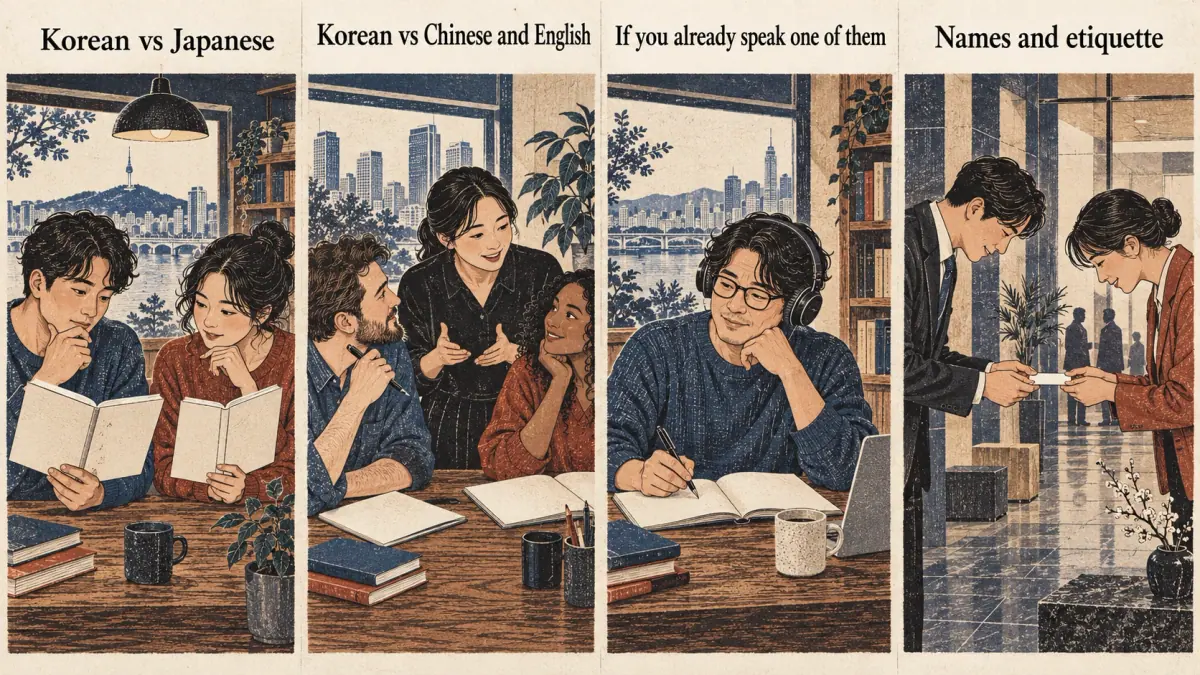
This subhub groups the comparison pages into four sets: Korean and Japanese, Korean and Chinese or English, pages for speakers of Japanese or Mandarin, and names and etiquette. Two difficulty pages from the learner-questions section are linked here as well.







Korean vs Japanese
Korean vs Japanese difficulty compares the two languages skill by skill: Korean is faster to start reading, while Korean pronunciation is harder for most learners. Is Korean related to Japanese explains why the two look alike without a proven common ancestor, from shared word order to pairs like 학교 and 学校, "school". Korean vs Japanese grammar sets particles, verb endings, honorifics and counters side by side.
Korean vs Chinese and English
Is Korean easier than Chinese weighs Korean's alphabet and lack of tones against Mandarin's simpler verb forms. Korean language vs Chinese compares writing, tones, grammar and vocabulary in depth, including how much Korean vocabulary comes from Chinese. Korean language vs English lists the key differences for English speakers, from particles and the missing articles to honorifics.
If You Already Speak One of Them
Two pages are written for learners who already speak an Asian language. Is Korean easy for Japanese speakers shows what transfers, such as particles and pairs like 大学 (daigaku) and 대학 (daehak), "university", and where the traps are. Is Korean easy for Mandarin speakers does the same for Mandarin, where vocabulary transfers strongly and grammar only weakly.
Names and Etiquette
Korean names vs Japanese names compares name order, name length, hanja readings and how concentrated surnames are. Korean vs Japanese etiquette compares bowing, titles such as 씨 and さん, and how honorific language works in each language.
Which Comparison Should You Read?
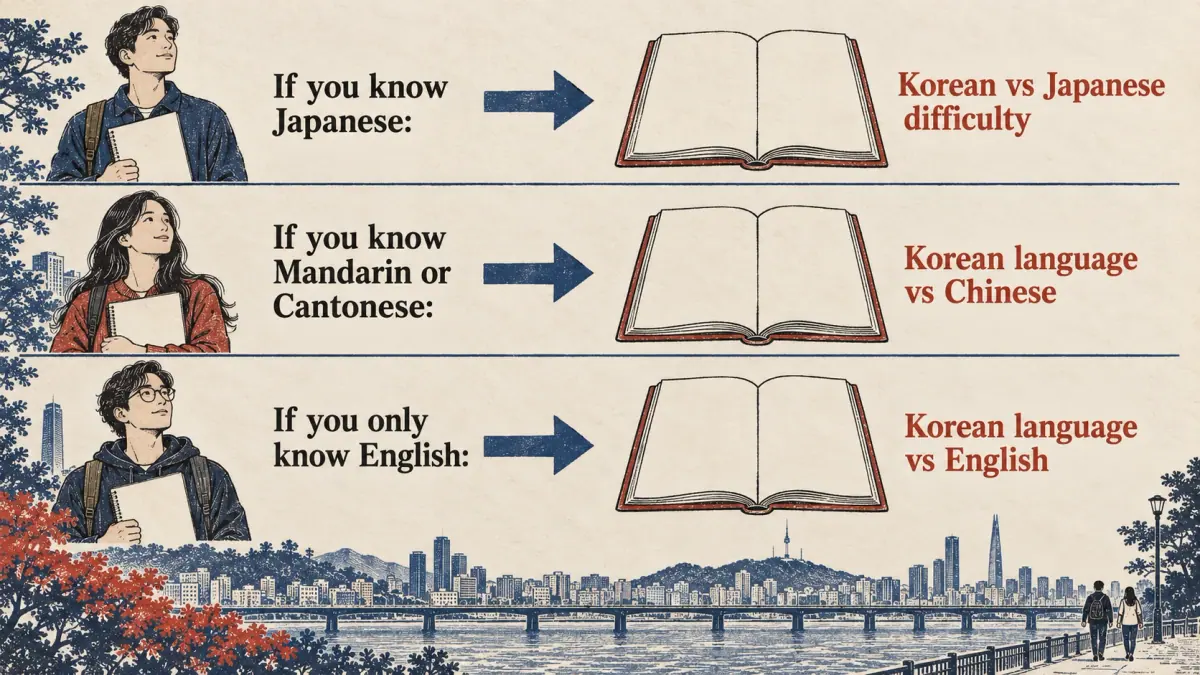
Read the comparison for the language you already know best, because transfer is what changes your learning plan. The decision guide below gives one recommendation per starting point.
- If you know Japanese: start with Korean vs Japanese difficulty, then is Korean easy for Japanese speakers. Expect grammar to feel familiar and pronunciation to be the main work.
- If you know Mandarin or Cantonese: start with Korean language vs Chinese. Expect Sino-Korean words to come quickly and verb endings to take the most practice.
- If you only know English: start with Korean language vs English, then read is Korean hard to learn. Expect a quick start with Hangul and a long middle stage with grammar.
Which Comparison Page Should I Read First?
Read Korean vs Japanese difficulty first if you are choosing between the two languages, because it covers every skill and gives a verdict. If you have already chosen Korean, skip the difficulty pages and read the page for your own first language.
What Does Each Comparison Leave Out?
Every comparison simplifies, so each pair has a hard part that tables hide. Three honest limits apply across this subhub.
- Each pair has a hard part. Japanese speakers still struggle with Korean final consonants and the three-way consonant contrast. Mandarin speakers have no tones to rely on and must learn verb endings. English speakers face both the word order and the honorifics.
- Difficulty depends on the learner. The U.S. Foreign Service Institute (FSI) places Korean in Category IV, its hardest group for native English speakers, at about 88 weeks (2,200 class hours) of full-time training to reach professional working proficiency. The FSI puts Japanese and Mandarin in the same category, so the ranking says little about which of the three is harder.
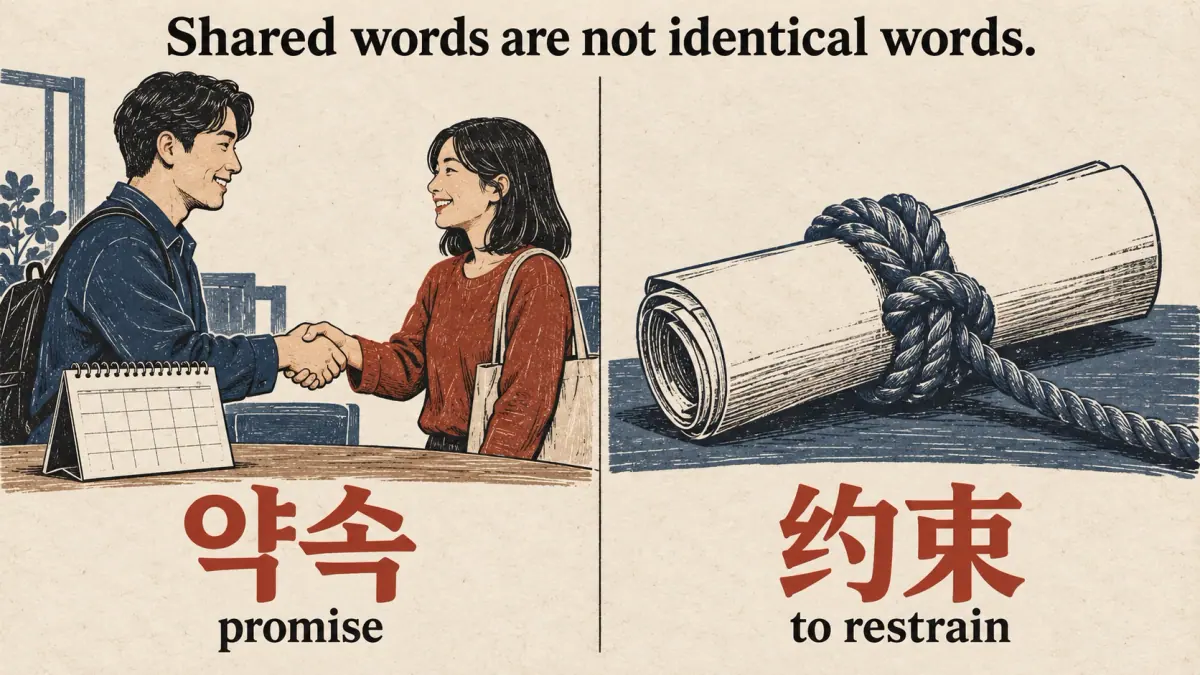
- Shared words are not identical words. A Sino-Korean word can have a different meaning or usage from its Japanese or Chinese cousin, so treat shared roots as hints, not translations. Korean 약속 means "promise", for example, while Mandarin 约束, written with the same characters in simplified form, means "to restrain".
Frequently Asked Questions
Is Korean easier than Japanese?
Neither is easier overall. Korean is faster to start reading, because Hangul takes days while Japanese needs two kana sets and about 2,000 kanji. Korean pronunciation is harder for most learners, and the grammar is about equally demanding. The FSI places both in the same hardest category for English speakers.
Is Korean similar to Chinese?
In vocabulary, partly; in grammar and sound, no. Many Korean words come from Chinese roots, such as 학생 (student) from 学生. But Korean puts the verb last, uses particles and verb endings, and has no tones, while Mandarin uses subject-verb-object order, four tones and no conjugation.
Should I learn Korean or Japanese first?
Learn the one you will use, because motivation matters more than order. If you plan to learn both, either order works: the grammar transfers in both directions. Korean gives a quicker start in reading thanks to Hangul, while Japanese gives a head start with kanji if you later study Sino-Korean words.
Does knowing Japanese help with Korean?
Yes, mainly with grammar and vocabulary. Particles, verb-final order, honorific thinking and many Sino-Korean words feel familiar to Japanese speakers. It does not help with Hangul, with Korean final consonants or with the plain, tense and aspirated consonant contrast, so pronunciation is where Japanese speakers need the most practice.
Is Korean closer to Japanese or to Chinese?
Korean grammar is much closer to Japanese: both are verb-final and use particles and endings. Korean vocabulary has a large Chinese-origin layer, which it shares with Japanese. In sound, Korean is close to neither, because it has no tones like Mandarin and no pitch accent in its Seoul standard.
Where to Go Next after Korean vs Japanese
After this Korean vs Japanese and Chinese overview, read Korean language facts for the background on the language family, or start learning with the Korean alphabet. All culture sections are on the Korean language and culture hub.