
This page is a practical guide for Mandarin speakers learning Korean in English, with notes for Cantonese speakers. It answers what transfers, what does not and in what order to study. For a side-by-side comparison of the two languages themselves, see Korean language vs Chinese. For a view from the English-speaking side, see is Korean easier than Chinese.
Is Korean Easy for Mandarin Speakers?
Korean is moderately easy for Mandarin speakers: easy for words, medium for sounds, and hard for grammar. The verdict by area:
- Vocabulary: high transfer. A large share of Korean words are built from Chinese roots.
- Writing: medium transfer. Hanja help you read, but you must still learn Hangul, and you spell in Hangul, not in characters.
- Sounds: medium transfer. Mandarin's aspirated and unaspirated stops match part of Korean's three-way contrast, and Korean has no tones.
- Grammar: low transfer. The verb comes last, nouns take particles and verbs take endings.
- Politeness: low transfer. Korean builds speech levels into the verb.
No official figure says how long it takes a Mandarin speaker. Treat any hour count you see as an estimate, and use the plan below to set your own pace.
What Transfers from Mandarin?
Vocabulary transfers most, and grammar transfers least. The table rates each area.
| Area | Transfer | Why | Example |
|---|---|---|---|
| Sino-Korean vocabulary | High | Same Chinese roots | 公園 / 공원 |
| Reading hanja | Medium | Traditional forms match, simplified forms need a mapping | 學 / 学 |
| Sounds | Medium | Aspirated vs unaspirated stops match, finals partly | ㅂ / b, ㅍ / p |
| Counters | Medium | Both count with a classifier | 두 개 / 两个 |
| Word order | Low | Korean is verb-last | 밥을 먹어요 / 吃饭 |
| Particles | Low | Mandarin has no case particles | 은/는, 을/를 |
| Verb endings | Low | Mandarin verbs do not change | 먹었어요 / 吃了 |
| Speech levels | Low | Mandarin has no grammatical levels | 해요 / 합니다 |
Here is the word-order gap in one sentence.
| Mandarin | Korean | |
|---|---|---|
| Sentence | 我吃饭。 | 저는 밥을 먹어요. |
| Reading | wǒ chī fàn | jeoneun babeul meogeoyo |
| Word by word | I eat rice | I-topic rice-object eat |
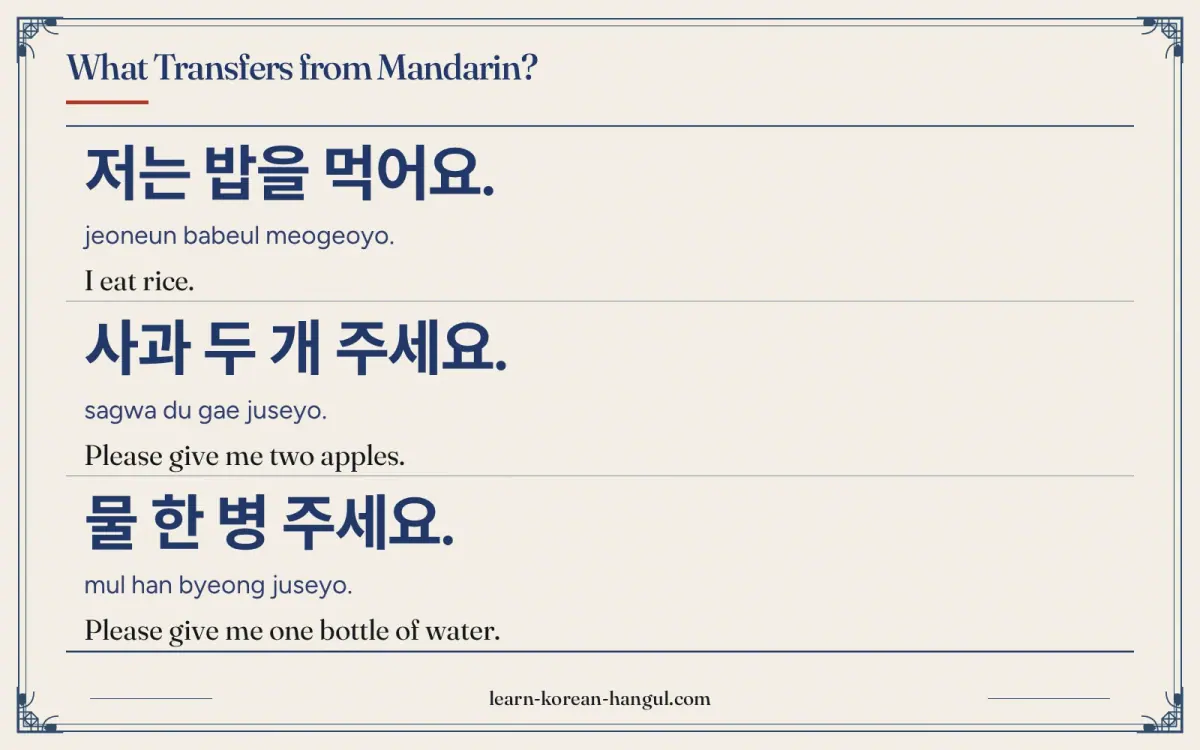
저는 밥을 먹어요.
jeoneun babeul meogeoyo.
I eat rice.
The Korean sentence is said [저는 바블 머거요]. The order flips, and the particles 는 and 을 mark the roles that Mandarin leaves to word order. The Korean particles guide goes through them one at a time.
Which Sino-Korean Words Match Mandarin?
Many common words match in meaning and in sound shape. These seven are everyday examples.
| Meaning | Hanja | Korean | RR | Mandarin |
|---|---|---|---|---|
| park | 公園 | 공원 | gongwon | gōngyuán |
| bank | 銀行 | 은행 | eunhaeng | yínháng |
| exercise | 運動 | 운동 | undong | yùndòng |
| freedom | 自由 | 자유 | jayu | zìyóu |
| experience | 經驗 | 경험 | gyeongheom | jīngyàn |
| traffic | 交通 | 교통 | gyotong | jiāotōng |
| time | 時間 | 시간 | sigan | shíjiān |
The sound shapes follow patterns that Mandarin speakers can use as hints. They are not rules, and each word should be confirmed in a dictionary.
| Mandarin sound | Korean sound | Example |
|---|---|---|
| final -n | usually -n, sometimes -m | 山 shān / 산 san; 三 sān / 삼 sam; 心 xīn / 심 sim |
| final -ng | -ng | 中 zhōng / 중 jung; 生 shēng / 생 saeng |
| initial x- or h- | often ㅎ | 學 xué / 학 hak; 下 xià / 하 ha; 孝 xiào / 효 hyo |
| initial r- | often ㅇ (no initial consonant) | 人 rén / 인 in; 日 rì / 일 il; 熱 rè / 열 yeol |
| no final stop | a final ㄱ, ㄹ or ㅂ | 國 guó / 국 guk; 十 shí / 십 sip |
The last row is the main difference. Korean keeps the old final stops that Mandarin lost, so a Mandarin word that ends in a vowel may end in a consonant in Korean. This is the same point that makes Cantonese speakers feel at home with Korean finals.
Which Words Look Familiar but Differ?
Some words share characters but not meaning. Others have no Korean match at all. Both types catch Mandarin speakers.
| Chinese word | Mandarin meaning | Korean | Korean meaning |
|---|---|---|---|
| 约束 | yuēshù: to restrain | 약속 | a promise, an appointment |
| 新闻 | xīnwén: news | 신문 | a newspaper |
| 汽车 | qìchē: car | 기차 | a train |
| 电脑 | diànnǎo: computer | 컴퓨터 | computer (a loanword from English) |
| 手机 | shǒujī: mobile phone | 휴대폰 | mobile phone (휴대 means "carry") |
Korean often borrowed an English word where Chinese made a new word from characters. Do not try to guess a Korean word by translating the Chinese characters. Check first.
How Do Chinese Measure Words Map to Korean Counters?
Counters transfer as an idea, and a few even share characters. The order is the difference: Chinese says number, measure word, noun, and Korean says noun, number, counter.
| Counter | Hanja | Mandarin | Korean example |
|---|---|---|---|
| 개 (general items) | 個 | 个 (ge) | 사과 두 개 (two apples) |
| 명 (people) | 名 | 名 (míng) | 학생 세 명 (three students) |
| 장 (sheets, tickets) | 張 | 张 (zhāng) | 종이 한 장 (one sheet of paper) |
| 병 (bottles) | 瓶 | 瓶 (píng) | 물 한 병 (one bottle of water) |
| 마리 (animals) | none | 只 (zhī) | 고양이 두 마리 (two cats) |
With these counters Korean uses the native numbers (한, 두, 세), even when the counter itself comes from Chinese, not the Sino-Korean set that matches your own numbers. That is a new thing to learn. The Korean counters guide covers it.
사과 두 개 주세요.
sagwa du gae juseyo.
Please give me two apples.
물 한 병 주세요.
mul han byeong juseyo.
Please give me one bottle of water.
Both are said as written, [사과 두 개 주세요] and [물 한 병 주세요]. The Mandarin pattern 两个苹果 puts the number first, so Korean feels reversed at first.
How Do First-Day Phrases Map from Mandarin?
First-day phrases map by situation, not word for word. The most important trap is "goodbye", because Korean has two forms.
| Mandarin | Korean | RR | Use |
|---|---|---|---|
| 你好 | 안녕하세요 | annyeonghaseyo | Hello, polite |
| 谢谢 | 감사합니다 | gamsahamnida | Thank you, formal polite |
| 对不起 | 죄송합니다 | joesonghamnida | I am sorry, formal |
| 再见 (you leave) | 안녕히 계세요 | annyeonghi gyeseyo | Said to the person who stays |
| 再见 (you stay) | 안녕히 가세요 | annyeonghi gaseyo | Said to the person who leaves |
Spoken, 안녕하세요 is [안녕하세요], 감사합니다 is [감사함니다], 죄송합니다 is [죄송함니다], 안녕히 계세요 is [안녕히 게세요], and 안녕히 가세요 is [안녕히 가세요]. Mandarin 再见 works for both directions, but Korean asks you to pick.
How Do You Say "You"?
You avoid the word "you" in polite Korean. Mandarin speakers use 你 or 您 freely, and the habit carries over badly. The Korean forms are:
- 너 is casual "you", for close friends and younger people only.
- 당신 is a formal-looking "you" that sounds confrontational to strangers, or intimate between married partners.
- A name plus 씨, or a title, is the polite way: 김민수 씨, 선생님, 사장님.
- No pronoun is often best. 밥 먹었어요? ("Did you eat?") needs no word for "you".
Learning this early saves you from sounding rude. The honorifics 씨 and 님 lesson gives the full picture.
What Are the Traps?
The traps are grammar and speech. These six come up most often for Mandarin speakers.
- Verb-final order. Mandarin puts the verb after the subject. Korean puts it at the very end, after the object and any time or place words.
- Particles. Every noun in a full Korean sentence has a role marker. Choosing between 은/는 and 이/가 is the hardest early decision.
- Verb endings. A Mandarin verb stays the same. A Korean verb changes for tense, politeness and mood, and a beginner must learn endings such as -아요/-어요 and -었어요.
- Speech levels. You must choose a level in every sentence. The safe default is the polite 해요 style.
- Spelling in Hangul, not hanja. Do not write Korean in characters. Everyday Korean is written in Hangul, and a text of mostly hanja would look strange.
- Reading romanization like pinyin. Revised Romanization (RR) uses b, d, g for plain stops and p, t, k for aspirated stops, which matches pinyin. But RR also uses eo, eu, ae and ch in ways pinyin does not. Do not read the vowels as pinyin vowels.
The new sounds are the three-way stops and the unrounded vowels. Listen to the three-way contrast first.
Mandarin has b/p, d/t and g/k pairs, so the plain and aspirated sounds are familiar. The tense series is the new one: it is tighter and shorter than the plain stop, with no puff of air.
Can You Use Pinyin to Learn Korean Sounds?
Pinyin is a rough guide, not a notation. This table shows the closest match for the main consonants, and it works best for the first stage.
| Hangul | Nearest pinyin | Note |
|---|---|---|
| ㅂ | b | Plain; between vowels it sounds voiced |
| ㅍ | p | Aspirated |
| ㄷ | d | Plain |
| ㅌ | t | Aspirated |
| ㄱ | g | Plain |
| ㅋ | k | Aspirated |
| ㅈ | j | Plain |
| ㅊ | q | Aspirated |
| ㅃ ㄸ ㄲ ㅉ | none | Tense; no pinyin match |
For vowels, ㅏ is close to a, ㅣ to i and ㅜ to u. The vowels ㅓ and ㅡ have no exact match, so learn them from audio. The vowel ㅓ is unrounded and sits near the Mandarin e in 河 (hé), and ㅡ is unrounded too, and sits near the buzzing vowel in 四. These are rough approximations. Confirm each with a clip, and do not round your lips.
How Should Mandarin Speakers Study?

Mandarin speakers should use vocabulary to move fast and put grammar first in the time they save. This order works well.
- Learn Hangul in a week. It is 24 basic letters, much smaller than a character set. The 7-day Hangul course is a short path.
- Learn the verb-final pattern with ten short sentences. Say each one aloud and change one word at a time.
- Add particles in this order: 은/는, 을/를, 이/가, 에, 에서.
- Use 해요 style for everything at first. It is the safe polite default.
- Collect Sino-Korean words in pairs. Write the hanja, the Hangul and the Mandarin reading side by side, and check each word.
- Train final consonants. Say 학, 밥 and 집 with the sound stopped.
- Add speech levels last. Casual 반말 and formal 합쇼체 come after 해요 feels natural.
A realistic routine is 30 to 45 minutes a day, six days a week, which is three to four and a half hours a week. The pace depends on how often you practise.
저는 학생이에요.
jeoneun haksaengieyo.
I am a student.
한국어를 공부해요.
hangugeoreul gongbuhaeyo.
I study Korean.
The first is said [저는 학쌩이에요], where the ㄱ in 학 makes the following ㅅ tense. The second is said [한구거를 공부해요]. Notice 공부: it is the word 工夫, which means skill or effort in Mandarin but means study in Korean.
Do Hanja Help, and Which Forms Does Korean Use?
Hanja help you recognise vocabulary, but they are not needed for daily reading. Everyday Korean uses Hangul, and hanja show up in names, legal writing and some dictionaries. Korean hanja use the traditional forms, so a reader of simplified characters needs a short mapping.
| Simplified | Traditional (Korean hanja) | Korean |
|---|---|---|
| 学 | 學 | 학 |
| 国 | 國 | 국 |
| 会 | 會 | 회 |
| 体 | 體 | 체 |
| 发 | 發 | 발 |
A reader of traditional characters (Taiwan, Hong Kong) can read Korean hanja directly. A reader of simplified characters can usually guess the traditional form after a short list. You can read about how the scripts relate in Hangul vs hanja.
What Mistakes Do Mandarin Speakers Make in the First Month?
Most first-month mistakes come from carrying Mandarin patterns into Korean. These five are the most common, with the fix for each.
- Putting the verb in the middle. Fix: say the sentence in Korean order, with the verb last, and practise with five short patterns until it feels automatic.
- Leaving out particles in every sentence. Mandarin has none, so the habit sticks. Casual Korean does drop them, but a beginner should include them first and drop them later.
- Using the same verb form for every tense. Fix: learn the three polite forms of one verb, 먹어요, 먹었어요 and 먹을 거예요, and use them in sentences about today, yesterday and tomorrow.
- Guessing words from characters. Fix: check the word in a dictionary, because pairs such as 약속 and 신문 mean something different from the Mandarin word.
- Ignoring the final consonant. Fix: say 밥, 학 and 집 with the sound stopped, and notice that the final consonant often links to the next vowel: 밥을 is said [바블].
Fixing these five habits in the first month does more for your Korean than adding new vocabulary. A short daily review of the three polite forms and the particle table is enough.
What Changes for Cantonese Speakers?
Cantonese speakers have two advantages over Mandarin speakers. Cantonese keeps final -p, -t and -k, so Korean finals are familiar, and Cantonese uses traditional characters, which match Korean hanja. The costs are the same: grammar, particles and endings. A Cantonese speaker who learns the sound correspondences can often guess Sino-Korean sounds more precisely than a Mandarin speaker can. The Mandarin-based hints in this page still apply to meaning, but check sounds against audio.
Is Korean Easier than Japanese for Chinese Speakers?
It depends on your goal, and no study ranks them. Japanese gives an immediate reading advantage, because kanji appear on the page and many words can be read at once. Korean has a smaller writing system, Hangul, and the Sino-Korean words sound close to their Chinese roots. Both languages put the verb last and use particles, so the grammar work is similar. Choose the language you want to use, because motivation outweighs small differences in difficulty.
Check Yourself
Try these four questions. Each has one answer.
Practice · 4
Which Korean word matches the Mandarin 学校 (xuéxiào, school)?
Show answer
학교
학교 (hakgyo) is school. 대학 is university and 학생 is student.
Which sentence has the verb in the normal Korean place?
Show answer
저는 밥을 먹어요
Korean puts the verb last: 저는 밥을 먹어요 (I eat rice). The other two put the verb earlier and are not normal sentences.
Which forms of Chinese characters does Korean hanja use?
Show answer
Traditional forms such as 學
Korean hanja use traditional forms, so 學, 國 and 體, not 学, 国 and 体.
Which pair has the same characters but a different meaning in Korean and Mandarin?
Show answer
약속 and 约束 (promise vs restrain)
Korean 약속 means a promise or an appointment, while Mandarin 约束 (yuēshù) means to restrain. The other two pairs mean the same thing.
Frequently Asked Questions
Do I Need to Learn Hanja?
No. Everyday Korean is written in Hangul, and you can read signs, menus and messages without hanja. Your knowledge of Chinese characters helps you recognise Sino-Korean vocabulary, so use it that way. Korean hanja use the traditional forms, so simplified-character readers need a short mapping, such as 学 to 學.
Is Korean Easier than Japanese for Chinese Speakers?
It depends on your goal, and no study ranks them. Japanese gives an immediate reading advantage because kanji appear on the page. Korean has a small writing system and Sino-Korean words that sound close to their Chinese roots. Both put the verb last and use particles, so grammar work is similar. Choose the language you want to use.
Can I Use Pinyin to Learn Korean?
Pinyin is a rough guide for sounds, not a notation for Korean. Korean plain stops are close to pinyin b, d, g and aspirated stops to p, t, k, but the tense stops have no pinyin match, and the vowels ㅓ and ㅡ need audio. Learn Hangul early and use Revised Romanization only as a temporary aid.
How Long Does It Take Mandarin Speakers to Learn Korean?
No official figure exists for Mandarin speakers, and any hour count is an estimate. The U.S. Foreign Service Institute lists Korean in Category IV for native English speakers, which is a different group. Mandarin speakers usually gain speed on vocabulary and lose it on grammar, so plan for steady daily practice and check your pace against your own goals.
The Bottom Line
Is Korean easy for Mandarin speakers? It is easy for vocabulary, medium for sounds and hard for grammar. Use your Sino-Korean knowledge to learn words fast, check every pair for false friends, and spend the time you save on particles, endings and speech levels. Start with Hangul, because it unlocks everything else.